

The DOI matches its Crossref record; 77 of the 77 references it cites were found in a registry or an index.
People of color in North America report improvements in racial trauma and mental health symptoms following psychedelic experiences
Open accessAbstract
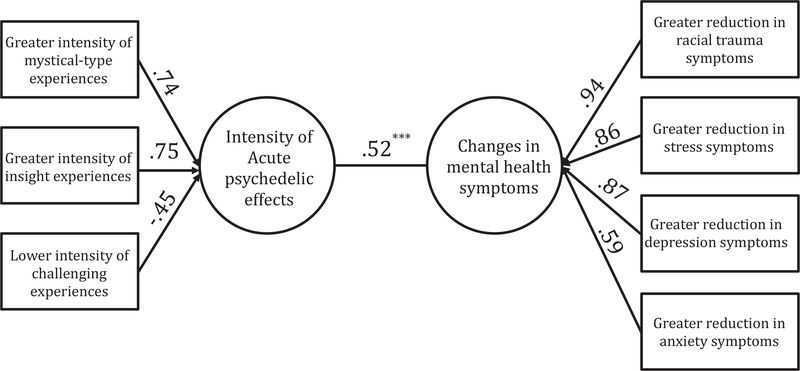
This study examined how psychedelics reduced symptoms of racial trauma among black, indigenous, and people of color (BIPOC) subsequent to an experience of racism. A cross-sectional internet-based survey included questions about experiences with racism, mental health symptoms, and acute and enduring psychedelic effects. Changes in mental health were assessed by retrospective report of symptoms in the 30 days before and 30 days after an experience with psilocybin, Lysergic acid diethylamide (LSD), or 3,4-Methylenedioxymethamphetamine (MDMA). We recruited 313 diverse BIPOC in the US and Canada. Results revealed a significant (p < .001) and moderate (d = −.45) reduction in traumatic stress symptoms from before-to-after the psychedelic experience. Similarly, participants reported decreases in depression (p < .001; d = −.52), anxiety (p < .001; d = −.53), and stress (p < .001; d = −.32). There was also a significant relationship (Rc = 0.52, p < .001) between the dimension of acute psychedelic effects (mystical-type, insight, and challenging experiences) and decreases in a cluster of subsequent psychopathology (traumatic stress, depression, anxiety, and stress), while controlling for the frequency of prior discrimination and the time since the psychedelic experience. BIPOC have been underrepresented in psychedelic studies. Psychedelics may decrease the negative impact of racial trauma. Future studies should examine the efficacy of psychedelic-assisted therapy for individuals with a history of race-based trauma.
Overview
The claims and statistics of this paper haven’t been checked yet.
Run the check — free, no account needed. It reads the open-access text and checks the sources it cites.
Integrity signals
Registry
Cites
Statistics
Figures
Verification
Claims the paper makes
The claims and statistics of this paper haven’t been checked yet.
Run the check — free, no account needed. It reads the open-access text and checks the sources it cites.
Self-check
Percentages, sums and reported differences re-computed from the paper’s own numbers.
The self-check needs the paper’s full text.
Citations
Cites
Tabachnick, B. G., & Fidell, L. S. (1983) · Cited by 79,882
Diagnostic and Statistical Manual of Mental Disorders
(2012) · Springer eBooks · doi:10.1007/springerreference_121117 · Cited by 20,772
Diagnostic and Statistical Manual of Mental Disorders, 5th ed.
Carter, M. J. (2014) · Therapeutic Recreation Journal · Cited by 15,154
(2007) · Cited by 10,092
(1995) · Cited by 6,909
Racial microaggressions in everyday life: Implications for clinical practice.
Sue, D. W., Capodilupo, C. M., Torino, G. C., Bucceri, J. M., Holder, A. M. B., Nadal, K. L., & Esquilin, M. (2007) · American Psychologist · doi:10.1037/0003-066x.62.4.271 · Cited by 5,569
Perceived discrimination and health: A meta-analytic review.
Pascoe, E. A., & Smart Richman, L. (2009) · Psychological Bulletin · doi:10.1037/a0016059 · Cited by 4,427
The Journal of the American Academy of Psychiatry and the Law.
(2021) · PubMed · doi:10.29158/jaapl.210028-20 · Cited by 3,854
Beyond the Turk: Alternative platforms for crowdsourcing behavioral research
Peer, E., Brandimarte, L., Samat, S., & Acquisti, A. (2017) · Journal of Experimental Social Psychology · doi:10.1016/j.jesp.2017.01.006 · Cited by 2,957
Griffiths, R. R., Johnson, M. W., Carducci, M. A., Umbricht, A., Richards, W. A., Richards, B. D., Cosimano, M. P., & Klinedinst, M. A. (2016) · Journal of Psychopharmacology · doi:10.1177/0269881116675513 · Cited by 2,201 · cited 2×
“This scale has been used extensively in prior research and demonstrated excellent internal consistency reliability and predictive validity (Griffiths et al., 2011, 2016).”
BackgroundMethod
Research works printed but not linked: 9
- Cloitre M., 2009, CNS Spectrums, 14, 32
- Davis A. K., Journal of Psychopharmacology
- IBM Corp., 2020, IBM SPSS Statistics for Windows (Version 27.0)
- Pierce C., 1970, The Black seventies, 265
- Terwilliger B. G., 2013, Multicultural versus colorblind ideology: Implications for mental health and counseling.
- Williams M. T., 2006, Adolescence, 41, 1
- Williams M. T., 2014, Behavioral Sciences (Basel, Switzerland), 4, 102
- Williams M. T., 2018, Directions in Psychiatry, 38, 179
- Williams M., 2012, Psychology of culture, 25
Cited by
Sorted by citations
Complex Racial Trauma: Evidence, Theory, Assessment, and Treatment
Cénat, J. M. (2023) · Perspectives on Psychological Science · doi:10.1177/17456916221120428 · Cited by 185
“M. T. Williams et al. (2020) reported essential improvements in the symptoms of racial trauma, traumatic stress, anxiety, and depression for people of color in North America after experiences with psychedelics.”
BackgroundPeill, J. M., Trinci, K. E., Kettner, H., Mertens, L. J., Roseman, L., Timmermann, C., Rosas, F. E., Lyons, T., & Carhart-Harris, R. L. (2022) · Journal of Psychopharmacology · doi:10.1177/02698811211066709 · Cited by 141
The Psychedelic Future of Post-Traumatic Stress Disorder Treatment
Zaretsky, T. G., Jagodnik, K. M., Barsic, R., Antonio, J. H., Bonanno, P. A., MacLeod, C., Pierce, C., Carney, H., Morrison, M. T., Saylor, C. F., et al. (2024) · Current Neuropharmacology · doi:10.2174/1570159x22666231027111147 · Cited by 92
Thrul, J., & Garcia‐Romeu, A. (2021) · Drugs Education Prevention and Policy · doi:10.1080/09687637.2021.1897331 · Cited by 80
Antidepressant effects of a psychedelic experience in a large prospective naturalistic sample
Nygart, V. A., Pommerencke, L. M., Haijen, E. C. H. M., Kettner, H., Kaelen, M., Mortensen, E. L., Nutt, D. J., Carhart-Harris, R. L., & Erritzøe, D. (2022) · Journal of Psychopharmacology · doi:10.1177/02698811221101061 · Cited by 79
The Need for Psychedelic-Assisted Therapy in the Black Community and the Burdens of Its Provision
Smith, D., Faber, S. C., Buchanan, N. T., Foster, D. S., & Green, L. (2022) · Frontiers in Psychiatry · doi:10.3389/fpsyt.2021.774736 · Cited by 55
An Integrated theory of false insights and beliefs under psychedelics
McGovern, H. T., Grimmer, H. J., Doss, M. K., Hutchinson, B. T., Timmermann, C., Lyon, A., Corlett, P. R., & Laukkonen, R. (2024) · Communications Psychology · doi:10.1038/s44271-024-00120-6 · Cited by 79
Intersection of Racism and PTSD: Assessment and Treatment of Racial Stress and Trauma
Williams, M. T., Osman, M., Gran-Ruaz, S., & Lopez, J. (2021) · Current Treatment Options in Psychiatry · doi:10.1007/s40501-021-00250-2 · Cited by 68
Self-citationDavis, A. K., Xin, Y., Sepeda, N. D., Garcia-Romeu, A., & Williams, M. T. (2021) · Chronic Stress · doi:10.1177/24705470211035607 · Cited by 67
Self-citationWilliams, M. T., Osman, M., & Hyon, C. (2023) · Chronic Stress · doi:10.1177/24705470221149511 · Cited by 80
Self-citationKopra, E. I., Ferris, J., WINSTOCK, A. R., Kuypers, K. P. C., Young, A. H., & Rucker, J. (2023) · Journal of Psychopharmacology · doi:10.1177/02698811231158245 · Cited by 67
Psilocybin for Trauma-Related Disorders
Khan, A. J., Bradley, E., O’Donovan, A., & Woolley, J. (2022) · Current Topics in Behavioral Neurosciences · doi:10.1007/7854_2022_366 · Cited by 67
Ethnoracial inclusion in clinical trials of psychedelics: a systematic review
Hughes, M. E., & Garcia‐Romeu, A. (2024) · EClinicalMedicine · doi:10.1016/j.eclinm.2024.102711 · Cited by 49
Jones, G. M., & Nock, M. K. (2022) · Scientific Reports · doi:10.1038/s41598-022-18645-3 · Cited by 48
Counselors’ attitudes toward psychedelics and their use in therapy
Hearn, B., Brubaker, M. D., & Richardson, G. B. (2022) · Journal of Counseling & Development · doi:10.1002/jcad.12429 · Cited by 52
Naturalistic Psychedelic Use: A World Apart from Clinical Care
Glynos, N. G., Fields, C. W., Barron, J., Herberholz, M., Kruger, D. J., & Boehnke, K. F. (2022) · Journal of Psychoactive Drugs · doi:10.1080/02791072.2022.2108356 · Cited by 51
Stauffer, C. S., Brown, M. R., Adams, D., Cassity, M., & Sevelius, J. M. (2022) · Frontiers in Psychiatry · doi:10.3389/fpsyt.2022.932605 · Cited by 45
Healy, C. J., Lee, K. A., & D'Andrea, W. M. (2021) · Chronic Stress · doi:10.1177/24705470211029881 · Cited by 39
Knowledge, Perceptions, and Use of Psychedelics among Individuals with Fibromyalgia
Glynos, N. G., Pierce, J. M., Davis, A. K., McAfee, J., & Boehnke, K. F. (2022) · Journal of Psychoactive Drugs · doi:10.1080/02791072.2021.2022817 · Cited by 42
Self-citationKetamine-Assisted Psychotherapy for PTSD Related to Racial Discrimination
Halstead, M., Reed, S., Krause, R., & Williams, M. T. (2021) · Clinical Case Studies · doi:10.1177/1534650121990894 · Cited by 40
Self-citationJahn, Z. W., Lopez, J., de la Salle, S., Faber, S. C., & Williams, M. T. (2021) · Journal of Psychedelic Studies · doi:10.1556/2054.2021.00166 · Cited by 35
Self-citationManifest your desires: Psychedelics and the self-help industry.
Plesa, P., & Petranker, R. (2022) · The International journal on drug policy · doi:10.1016/j.drugpo.2022.103704 · Cited by 28
Palmer, M., & Maynard, O. (2022) · Harm Reduction Journal · doi:10.1186/s12954-022-00662-0 · Cited by 38
Racial Stress, Racial Trauma, and Evidence-Based Strategies for Coping and Empowerment
Holmes, S. C., Zare, M., Haeny, A. M., & Williams, M. T. (2024) · Annual Review of Clinical Psychology · doi:10.1146/annurev-clinpsy-081122-020235 · Cited by 41
Self-citationChing, T. H. W., Davis, A. K., Xin, Y., & Williams, M. T. (2022) · Journal of Psychoactive Drugs · doi:10.1080/02791072.2022.2025960 · Cited by 38
Self-citationMinorities’ diminished psychedelic returns
Viña, S. M., & Stephens, A. L. (2023) · Drug Science Policy and Law · doi:10.1177/20503245231184638 · Cited by 31
Jones, G. M. (2022) · Journal of Psychopharmacology · doi:10.1177/02698811221127304 · Cited by 30
Nikolaidis, A., Lancelotta, R., Gukasyan, N., Griffiths, R. R., Barrett, F. S., & Davis, A. K. (2022) · Journal of Affective Disorders · doi:10.1016/j.jad.2022.12.042 · Cited by 26
Self-citationInsights on psychedelics: A systematic review of therapeutic effects
Kugel, J., Laukkonen, R., Yaden, D. B., Yücel, M., & Liknaitzky, P. (2025) · Neuroscience & Biobehavioral Reviews · doi:10.1016/j.neubiorev.2025.106117 · Cited by 32
Psychedelics and Racial Justice
Williams, M. T., Cabral, V. G., & Faber, S. C. (2023) · International Journal of Mental Health and Addiction · doi:10.1007/s11469-023-01160-5 · Cited by 25
Self-citationPsychological effects of psychedelics in adolescents
Izmi, N., Carhart-Harris, R. L., & Kettner, H. (2024) · Frontiers in Child and Adolescent Psychiatry · doi:10.3389/frcha.2024.1364617 · Cited by 26
Davis, A. K., Arterberry, B. J., Xin, Y., Agin-Liebes, G., Schwarting, C. M., & Williams, M. T. (2022) · Frontiers in Epidemiology · doi:10.3389/fepid.2022.876706 · Cited by 22
Self-citationPsychedelics and neonihilism: connectedness in a meaningless world
Plesa, P., & Petranker, R. (2023) · Frontiers in Psychology · doi:10.3389/fpsyg.2023.1125780 · Cited by 22
Perceptions of psychedelic-assisted therapy among Black Americans
Carter, S. E., Packard, G. A., Coghlan, C., George, J. R., Brown, A. J., Ching, T. H. W., Julian, J., & Maples‐Keller, J. L. (2023) · Journal of Mood and Anxiety Disorders · doi:10.1016/j.xjmad.2023.100023 · Cited by 22
Perkins, D., Opaleye, E. S., Bouso, J. C., Tófoli, L. F., Sarris, J. J., Schubert, V., Ruffell, S., & Šimonová, H. (2023) · Psychoactives · doi:10.3390/psychoactives2040017 · Cited by 21
Riaz, K., Suneel, S., Malik, M. H. B. A., Kashif, T., Ullah, I., Waris, A., Nicola, M. D., Mazza, M., Sani, G., Martinotti, G., et al. (2023) · Diseases · doi:10.3390/diseases11040159 · Cited by 19
Mayer, C. E., LeBaron, V. T., & Acquaviva, K. (2021) · Journal of Psychoactive Drugs · doi:10.1080/02791072.2021.1916659 · Cited by 18
Low, F., & Earleywine, M. (2023) · Journal of Psychoactive Drugs · doi:10.1080/02791072.2023.2228303 · Cited by 17
Synthetic surprise as the foundation of the psychedelic experience
Filippo, R. D., & Schmitz, D. (2024) · Neuroscience & Biobehavioral Reviews · doi:10.1016/j.neubiorev.2024.105538 · Cited by 17
Psychedelic public health: State of the field and implications for equity
Kuiper, H., Alley, C., Harris, Z., Rauch, C. K., Robbins, M., Rodríguez, P. G., Tomczak, P., Urrutia, J., & Magar, V. (2024) · Social Science & Medicine · doi:10.1016/j.socscimed.2024.117134 · Cited by 16
Psilocybin for the Treatment of Depression: A Promising New Pharmacotherapy Approach
Agin-Liebes, G., & Davis, A. K. (2021) · Current topics in behavioral neurosciences · doi:10.1007/7854_2021_282 · Cited by 20
Self-citationPsychedelic-assisted therapy among sexual and gender minority communities
Hanshaw, B. D., Fusunyan, M. A., Anderson, C. T. M., & Turban, J. L. (2024) · Nature Mental Health · doi:10.1038/s44220-024-00252-y · Cited by 15
Peterson, T. C., & Tollefson, K. (2023) · Energy Efficiency · doi:10.1007/s12053-023-10164-y · Cited by 12
Jones, G. M., Lowe, M. X., Nayak, S. M., Sepeda, N. D., Kettner, H., Carhart-Harris, R. L., Jackson, H., & Garcia‐Romeu, A. (2024) · Journal of Affective Disorders · doi:10.1016/j.jad.2024.10.058 · Cited by 12
Self-citationHaeny, A. M., Lopez, J., Grigas, P. A. C., Crouch, M. C., Davis, A. K., & Williams, M. T. (2023) · Journal of Substance Use and Addiction Treatment · doi:10.1016/j.josat.2023.209035 · Cited by 11
Self-citationRace and ethnicity moderate the associations between lifetime psilocybin use and crime arrests
Jones, G. M., Al‐Suwaidi, M., Castro‐Ramirez, F., McGuire, T. C., Mair, P., & Nock, M. K. (2023) · Frontiers in Psychiatry · doi:10.3389/fpsyt.2023.1169692 · Cited by 10
A Scientific Discussion of Post-Materialism Values and Environmental Behavior
Peterson, T., & Tollefson, K. (2024) · Businesses · doi:10.3390/businesses4030022 · Cited by 9
Yaden, D. B., Graziosi, M., Owen, A. M., Agin-Liebes, G., Aaronson, S. T., Allen, K. E., Barrett, F. S., Bogenschutz, M. P., Carhart-Harris, R. L., Ching, T. H. W., et al. (2025) · Psychedelic Medicine · doi:10.1089/psymed.2024.0019 · Cited by 12
Self-citationPeterson, T. C., & Tollefson, K. (2023) · Businesses · doi:10.3390/businesses3010012 · Cited by 10
Minorities’ diminished psychedelic returns: Cardio-metabolic health
Viña, S. M. (2024) · Drug Science Policy and Law · doi:10.1177/20503245231225756 · Cited by 10
Campbell, M., & Williams, M. T. (2021) · Frontiers in Psychiatry · doi:10.3389/fpsyt.2021.680626 · Cited by 10
Self-citationA Scoping Review of Research in Naturalistic Studies with Psychedelics
de Carvalho, L. L., Encantado, J., Kettner, H., Timmermann, C., Veiga, D., & Teixeira, P. J. (2025) · Journal of Psychoactive Drugs · doi:10.1080/02791072.2025.2520221 · Cited by 10
Caraccio, M., Cheung, K., Mann, S. P., Bruce, L., Jacobs, E., Villiger, D., Sandbrink, J. D., Register, C., Hannikainen, I. R., Høeg, M. L., et al. (2025) · Philosophical Psychology · doi:10.1080/09515089.2025.2532761 · Cited by 8
Feng, R., Ching, T. H. W., Bartlett, A., Torre, J. T. L., & Williams, M. T. (2023) · Journal of Psychoactive Drugs · doi:10.1080/02791072.2023.2253535 · Cited by 8
Self-citationImpact of higher income on environmental interest
Peterson, T. C., & Tollefson, K. (2024) · Energy Sources Part B Economics Planning and Policy · doi:10.1080/15567249.2024.2356098 · Cited by 8
Ensuring psychedelic treatments and research do not leave anyone behind
Simon, M. A. (2023) · Neuropsychopharmacology · doi:10.1038/s41386-023-01710-4 · Cited by 7
A primer for culturally attuned psychedelic clinical trials
Ching, T. H. W., & Kelmendi, B. (2025) · Journal of Psychedelic Studies · doi:10.1556/2054.2025.00394 · Cited by 6
Roméo, B., Kervadec, E., Fauvel, B., Strika-Bruneau, L., Amirouche, A., Verroust, V., Piolino, P., & Benyamina, A. (2025) · Progress in Neuro-Psychopharmacology and Biological Psychiatry · doi:10.1016/j.pnpbp.2025.111300 · Cited by 7
Gaughan, S. J., Wootton, A. R., Krantz, D., Davis, A. K., James, J. E., Rinaldi-Rose, R., Lancelotta, R., & Sevelius, J. M. (2025) · International Journal of Transgender Health · doi:10.1080/26895269.2025.2478112 · Cited by 7
Self-citationRace and Gender Differences in the Moderating Relationship of Psychedelics on Stigma and Distress
Viña, S. M. (2025) · Psychedelic Medicine · doi:10.1089/psymed.2024.0021 · Cited by 6
Laenui, P., & Williams, I. L. (2022) · Contemporary Drug Problems · doi:10.1177/00914509221084129 · Cited by 10
An Occupational Perspective on Psychedelic Therapy: A Scoping Review
Hogan, G. A., Wagner, K. E., Tichenor, E., & Barlott, T. (2024) · Canadian Journal of Occupational Therapy · doi:10.1177/00084174241228678 · Cited by 7
Torre, J. T. L., Gallo, J., Mahammadli, M., Zalewa, D., & Williams, M. T. (2024) · Journal of Psychedelic Studies · doi:10.1556/2054.2024.00348 · Cited by 6
Self-citationClifton, J. M., Belcher, A. M., Greenblatt, A. D., Welsh, C., Cole, T. O., & Davis, A. K. (2022) · Journal of Psychedelic Studies · doi:10.1556/2054.2022.00214 · Cited by 6
Self-citationGlynos, N. G., Reid, M. R., Aday, J. S., Kruger, D. J., Boehnke, K. F., Lake, S., & Lucas, P. (2025) · Journal of Psychoactive Drugs · doi:10.1080/02791072.2025.2491381 · Cited by 5
Argento, E., Goldenberg, S. M., Deering, K., Lavalley, J., Braschel, M. C., Bingham, B., & Shannon, K. (2022) · Drug and Alcohol Dependence Reports · doi:10.1016/j.dadr.2022.100044 · Cited by 6
Korman, B. A. (2023) · Drug Science Policy and Law · doi:10.1177/20503245231191400 · Cited by 5
Antiracist supervision and training: bringing change to mental health care
Williams, M. T., McWilliams, J. A., & Abdulrehman, R. Y. (2023) · The Clinical Supervisor · doi:10.1080/07325223.2023.2249464 · Cited by 6
Self-citationJosiah, N., Shoola, H., Rodney, T. W., Arscott, J., Ndzi, M., Bush, A. D., Wilson, P., Jacques, K. A., Baptiste, D., & Starks, S. A. (2023) · Journal of Advanced Nursing · doi:10.1111/jan.15610 · Cited by 5
Formal Education Levels and Environmental Interest
Peterson, T. C. (2025) · Social Science Quarterly · doi:10.1111/ssqu.70059 · Cited by 4
Yohani, S. C., & Devereux, C. (2025) · International Journal of Environmental Research and Public Health · doi:10.3390/ijerph22091316 · Cited by 4
Foster, C. R., Held, M. L., & Carter, A. (2022) · Journal of Ethnic & Cultural Diversity in Social Work · doi:10.1080/15313204.2022.2155285 · Cited by 5
Jones, J. L. (2023) · Frontiers in Psychiatry · doi:10.3389/fpsyt.2023.1096298 · Cited by 4
Earleywine, M., Falabella, G. S., Oliva, A. B., & Low, F. (2024) · Journal of Psychoactive Drugs · doi:10.1080/02791072.2024.2421892 · Cited by 4
Muslim Women and Psychedelics: a Look at the Past, Present, and Future
Zare, M., & Williams, M. T. (2023) · International Journal of Mental Health and Addiction · doi:10.1007/s11469-023-01108-9 · Cited by 7
Self-citationImpact of Choice Order on Environmental Purchases
Peterson, T. C., & Tollefson, K. (2025) · Climate and Energy · doi:10.1002/gas.22458 · Cited by 3
Rojas, D., Zelman, D. C., Hauson, A. O., & Alexander, I. (2024) · Journal of Psychoactive Drugs · doi:10.1080/02791072.2024.2341811 · Cited by 3
Palmer, M., & Maynard, O. (2022) · Research Square · doi:10.21203/rs.3.rs-1457443/v1 · Cited by 4
Langlitz, N., Greenway, K., Pronovost-Morgan, C., & Gainsley, R. (2026) · Neuroethics · doi:10.1007/s12152-026-09663-3 · Cited by 2
Thomsen, K. N., Howell, K. H., & Bartelli, D. (2024) · Child & Youth Care Forum · doi:10.1007/s10566-024-09800-0 · Cited by 1
Villiger, D. (2025) · Philosophy Compass · doi:10.1111/phc3.70059 · Cited by 1
An examination of generational attitudes on environmental choices in Utah
Peterson, T. (2025) · International Journal of Green Energy · doi:10.1080/15435075.2025.2598538 · Cited by 1
Mehmood, M., Bremler, R., Spriggs, M. J., Kettner, H., Roseman, L., Damgaard, L., Carhart-Harris, R. L., Erritzøe, D., & Zeifman, R. J. (2025) · Psychedelic Medicine · doi:10.1177/28314425251392251 · Cited by 2
Exploring the inclusion of multicultural ecosystem services values in environmental planning
Nascimento, L. A. C., & Fung, P. (2024) · Nature-Based Solutions · doi:10.1016/j.nbsj.2024.100184 · Cited by 1
Faber, N. S., & Chernoloz, O. (2025) · Psychiatry Research · doi:10.1016/j.psychres.2025.116499 · Cited by 1
Laenui, P., & Williams, I. L. (2021) · International and cultural psychology/International and cultural psychology series · doi:10.1007/978-3-030-87763-7_7
Aharon-Almagor, A., & Barrett, F. S. (2022) · Research Square · doi:10.21203/rs.3.rs-1529935/v1
Reid, M. R., Standley, C. J., & Buchanan, N. T. (2023) · Elsevier eBooks · doi:10.1016/b978-0-323-91497-0.00204-6
A Neurocognitive Framework for Psychedelics as Learning OpportunitiesPreprint
Mattek, S. (2024) · PsyArXiv (OSF Preprints) · doi:10.31234/osf.io/jpck8
On The Cinco Sins of Psychedelic Research. An interview with Manoj DossPreprint
Fejer, G., & Doss, M. K. (2024) · doi:10.31234/osf.io/d79kt
A Primer for Culturally Attuned Psychedelic ResearchPreprint
Ching, T. H. W. (2024) · PsyArXiv (OSF Preprints) · doi:10.31234/osf.io/q8npu
Opoku, M. P., Yusuf, R., Nur, S., Gyimah, E. M., Frimpomaa, L., Charalambous, E., Salem, Y. A., Elkayal, M. A., Abosrea, A. A., Babiker, T., et al. (2025) · BMC Public Health · doi:10.1186/s12889-025-24247-1
Color Associations and Mental Health Media Engagement Among Nigerian University Undergraduates
Akintayo, J. B., Adetola, A. S., & Oluwasanya, S.-P. O. (2025) · Howard Journal of Communications · doi:10.1080/10646175.2025.2556197
Xin, Y., Arterberry, B. J., & Davis, A. K. (2025) · Journal of Social Work Practice in the Addictions · doi:10.1080/1533256x.2025.2571512
Self-citationPalmer, M., & Maynard, O. M. (2022) · Figshare · doi:10.6084/m9.figshare.20367236
Xin, Y., Davis, A. K., Yoon, S., & Lee, M. Y. (2026) · Psychedelic Medicine · doi:10.1177/28314425261448756
Self-citationPsychedelic Use and Psychological Healing Among Gender Exploring Clients: Clinicians’ Perspectives
Cassidy, E. K., Riccardi, J., Healy, B., Golakoti, S. S. M., & Farvid, P. (2026) · Women & Therapy · doi:10.1080/02703149.2026.2667141
Psilocybin and Mental Health Outcomes: Scoping Review with ☸️SAIMSARA
SAIMSARA (2026) · SAIMSARA Journal · doi:10.62487/saimsara7a54f680
Impact of gender on residential energy preferences
Peterson, T. C. (2026) · SN Social Sciences · doi:10.1007/s43545-026-01600-8
Dames, S., Williams, K., Campbell, A., Taylor, W., Harder, M., Gagnon, M., Manson, G., & Kryskow, P. (2026) · Journal of Evaluation in Clinical Practice · doi:10.1111/jep.70556
Metadata
- Authors
- Williams, M. T., Davis, A. K., Xin, Y., Sepeda, N. D., Grigas, P. C., Sinnott, S., & Haeny, A. M.
- Affiliations
- University of Connecticut (US)
- Johns Hopkins University (US)
- The Ohio State University (US)
- Department of Psychological Sciences, University of Connecticut, Storrs, CT, USA
- Yale University (US)
- Corresponding author
- Williams, Monnica T.
- Venue
- Drugs: Education, Prevention and Policy
- Publisher
- Informa UK Limited
- Published
- 2020-12-10
- Volume
- 28
- Issue
- 3
- Pages
- 215-226
- ISSN
- 0968-7637 (ISSN-L)
- 1465-3370
- PMC
- PMC8330400
- OpenAlex
- W3112172827
- Cited by
- 101
- References
- 76
- Citations by year
- 2026: 7 · 2025: 19 · 2024: 21 · 2023: 21 · 2022: 23 · 2021: 10
- FWCI
- 5.40
- Type
- journal article
- Language
- en
- Open access
- hybrid
- doi.org
- Licence
- Locations
- Drugs Education Prevention and Policy (publishedVersion, cc-by-nc-nd)
- PubMed (publishedVersion)
- PubMed Central (acceptedVersion, cc-by-nc-nd)
- Funders
- University of Ottawa
- Canada Research Chairs Program
- National Institutes of Health (26, 63)
- Topics
- Social Sciences › Psychology › Clinical Psychology › Psychedelics and Drug Studies
- Social Sciences › Sociology and Political Science › Racial and Ethnic Identity Research
- Social Sciences › Health › Religion, Spirituality, and Psychology
- Keywords
- psychedelics, racial trauma, BIPOC, psilocybin, LSD, MDMA, racism, traumatic stress, depression, anxiety, stress, mystical experience, psychedelic therapy, mental health
About these checks
Registry, retraction, Cites and statistics results are computed, not judged, with one exception: a printed reference that no index lists is read once by a model before it counts as a citation error. Claims are extracted by a model and kept only when their quote appears verbatim in the text; each cited source is then checked, with a model’s help, for whether it says what the claim relies on. Those verdicts can be wrong — read the claim’s quote and the cited source before relying on one.
Statistics and arithmetic are recomputed, not judged.
Confidence bands are shown only for fields calibrated on our annotated test set. None is calibrated yet, so no band is shown.
What counts as a claim ›How we measure confidence ›How we check this ›
Are you an author, or do you see a problem with this page? Request a review
