

The GRoLTS-Checklist: Guidelines for Reporting on Latent Trajectory Studies
Open accessThe DOI matches its Crossref record; 99 of the 100 references it cites were found in a registry or an index, and 1 are not checked yet.
Abstract
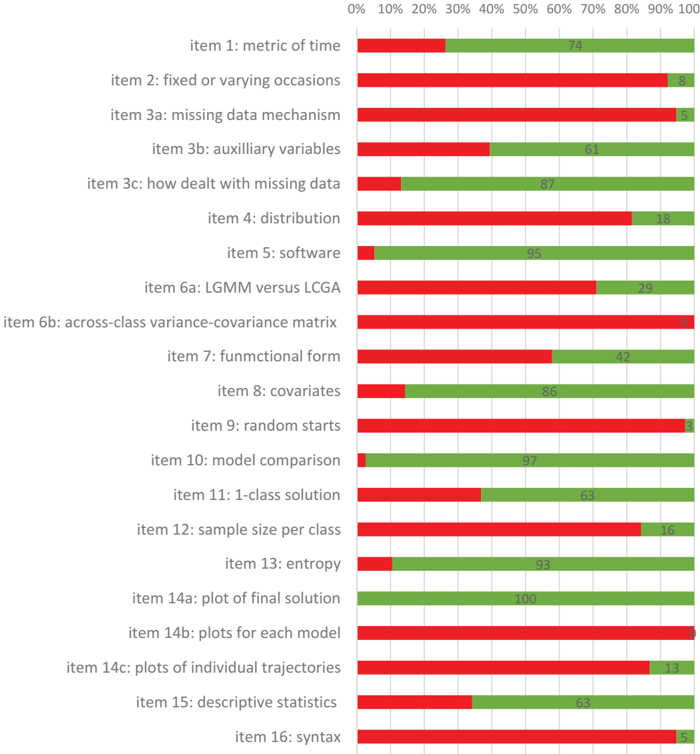
Estimating models within the mixture model framework, like latent growth mixture modeling (LGMM) or latent class growth analysis (LCGA), involves making various decisions throughout the estimation process. This has led to a wide variety in how results of latent trajectory analysis are reported. To overcome this issue, using a 4-round Delphi study, we developed Guidelines for Reporting on Latent Trajectory Studies (GRoLTS). The purpose of GRoLTS is to present criteria that should be included when reporting the results of latent trajectory analysis across research fields. We have gone through a systematic process to identify key components that, according to a panel of experts, are necessary when reporting results for trajectory studies. We applied GRoLTS to 38 papers where LGMM or LCGA was used to study trajectories of posttraumatic stress after a traumatic event.
Overview
The claims and statistics of this paper haven’t been checked yet.
Free: it reads the open-access text and checks the first 5 claims that cite a source we can check. Create a free account to check every claim.
Integrity signals
Registry
Cites
Statistics
Figures


Verification
Claims the paper makes
The claims and statistics of this paper haven’t been checked yet.
Free: it reads the open-access text and checks the first 5 claims that cite a source we can check. Create a free account to check every claim.
Claims other papers make about this one
Each is checked against this paper’s own text: does it say what the citing paper says it does?
The source backs part of the claim, not all of it — or backs it for a different population, condition or comparison.
In the citing paper
“5,782 studies were obtained by searching Pubmed, Embase, PsychInfo and Scopus and through a snowballing strategy in which both the references and the citation of the included papers were screened.Thirty-eight studies were included in the review (0.66%).”
From An open source machine learning framework for efficient and transparent systematic reviews (2021) · cites this paper as [46]
Experimental — accuracy not yet measured
Self-check
Percentages, sums and reported differences re-computed from the paper’s own numbers.
The self-check needs the paper’s full text.
Citations
Cites
Estimating the Dimension of a Model
Schwarz, G. (1978) · The Annals of Statistics · doi:10.1214/aos/1176344136 · Cited by 47,033 · cited 1×
“As was investigated in a large-scale simulation study by Nylund, Asparouhov, and Muthén (2007), the Bayesian information criterion (BIC; Schwarz, 1978) outperformed other model selection tools like the Akaike information criterion (AIC; Akaike, 1973) in the context of LGMMs.”
MethodHierarchical Linear Models: Applications and Data Analysis Methods.
Longford, N. T., Bryk, A. S., & Raudenbush, S. W. (1993) · Contemporary Sociology · doi:10.2307/2075823 · Cited by 18,724 · cited 1×
“As stated by Vermunt (2011), one should be critical with regard to the within-cluster normal distribution assumption.”
Statistical Analysis With Missing Data
Lahiff, M., Little, R. J. A., & Rubin, D. B. (1989) · Journal of the American Statistical Association · doi:10.2307/2289883 · Cited by 17,265
Hierarchical Linear Models: Applications and Data Analysis Methods
Davidian, M. (2003) · Journal of the American Statistical Association · doi:10.1198/jasa.2003.s288 · Cited by 13,723
Missing data: our view of the state of the art
Schafer, J. L., & Graham, J. W. (2002) · Psychological Methods · doi:10.1037/1082-989x.7.2.147 · Cited by 11,638 · cited 2×
“Three types of mechanisms can be distinguished (Schafer & Graham, 2002): (a) missing completely at random (MCAR), which means that all missing data occurred independently of all observed and nonobserved variables; (b) missing at random (MAR), which means that the missing data might depend on…”
Nylund, K. L., Asparouhov, T., & Muthén, B. O. (2007) · Structural Equation Modeling: A Multidisciplinary Journal · doi:10.1080/10705510701575396 · Cited by 11,415 · cited 3×
“” Subsequently, Nylund et al. (2007, p. 538) replied that early simulation studies in the original Lo, Mendell, and Rubin (2001) paper showed that despite this supposed analytic inconsistency, as outlined by Jeffries, the LMR-LRT could still be a useful empirical tool for class numeration.”
McLachlan, G., & Peel, D. (2000) · Wiley Series in Probability and Statistics · doi:10.1002/0471721182 · Cited by 10,991
Applied Longitudinal Data Analysis: Modeling Change and Event Occurrence
Singer, J. D., & Willett, J. B. (2003) · doi:10.1093/acprof:oso/9780195152968.001.0001 · Cited by 10,647
Health Measurement Scales: A Practical Guide to Their Development and Use
Streiner, D. L., Norman, G. R., & Cairney, J. (1989) · Cited by 9,595
Journal of The American Statistical Association
Fienberg, S. E. (2005) · Encyclopedia of Statistical Sciences · doi:10.1002/0471667196.ess1317 · Cited by 6,125
Research works printed but not linked: 4
- Asparouhov, T., & Muthén, B. (2007). Wald test of mean equality for potential latent class predictors in mixture modeling. Retrieved from http://www.statmodel.com/download/MeanTest1.pdf
- Asparouhov, T., & Muthén, B. (2013). Auxiliary variables in mixture modeling: A 3-step approach using M plus. Mplus Web Notes, 15 , version 6.
- Muthén, L. K., & Muthén, B. O. (2013). M plus: Statistical analysis with latent variables. User ' s guide . Los Angeles, CA: Muthén & Muthén.
- Rabe-Hesketh, S., Skrondal, A., & Pickles, A. (2004). GLLAMM manual . U.C. Berkeley Division of Biostatistics Working Paper Series. Working Paper 160. Retrieved from http://biostats.bepress.com/ucbbiostat/ paper160
Cited by
Items 701–800 of 812
Longitudinal Patterns of Distress and Resilience in Japan Self-Defense Forces Peacekeepers
Saito, T., Waki, F., & Nagamine, M. (2026) · Military Medicine · doi:10.1093/milmed/usag035
Trajectories of racial discussion and parental depression in Asian American families
Kim, S. E., Zhang, X. J., Fanta, A., Tsai, W., & Huang, C. Y. (2026) · Ethnicity and Health · doi:10.1080/13557858.2026.2630827
Psychotrauma in civilians:Towards accurate screening for PTSD risk
Karchoud, J. F. (2025) · UvA-DARE (University of Amsterdam)
Sturrock, S. L. (2025) · TSpace (University of Toronto)
The Association between Maternal and Paternal Preconception BMI and Child zBMI Growth Rates
Deveci, A. C. (2022) · TSpace (University of Toronto)
Zambrzycka, J. (2022) · TSpace (University of Toronto)
Heath, L. M. (2024) · TSpace (University of Toronto)
Medication trajectories among persons with multiple sclerosis in a Quebec birth cohort
Sadou, Y., Rousseau, M., Leffondré, K., Larochelle, C., & Mésidor, M. (2026) · Multiple Sclerosis and Related Disorders · doi:10.1016/j.msard.2026.107103
Mao, R., Pan, Q., Yang, Y., Fu, T., Gu, X., Wang, L., Xiang, N., Banghua, L., Lin, Y., & Huang, J. (2026) · Journal of Evidence-Based Medicine · doi:10.1111/jebm.70126
Prieto-Vila, M., Esteller-Collado, G., González‐Blanch, C., Saunders, R., Buckman, J. E. J., Carpallo-González, M., Ruiz‐Rodríguez, P., Moriana, J. A., Vindel, A. C., & Muñoz‐Navarro, R. (2026) · Journal of Psychosomatic Research · doi:10.1016/j.jpsychores.2026.112652
Nishihama, Y., Isobe, T., Ohya, Y., Murata, T., & Nakayama, S. F. (2026) · Environment International · doi:10.1016/j.envint.2026.110219
Zhang, J., Shen, Z., Qi, Y., Yu, X., & Chen, Y. (2026) · Cognitive Development · doi:10.1016/j.cogdev.2026.101699
Dai, S., Li, B., Zhang, Z., Zhang, G., & Xu, P. (2026) · Research Square · doi:10.21203/rs.3.rs-9080605/v1
Trajectories of second language student classroom engagement: Profiles and correlates
Vo, H. N. (2026) · British Journal of Educational Psychology · doi:10.1111/bjep.70081
Alam, M. A., Hasan, S. M. T., Nishan, A. A., Mahfuz, M., Kosek, M. N., Lima, A. Â. M., Maciel, B. L. L., & Ahmed, T. (2026) · PLoS ONE · doi:10.1371/journal.pone.0329596
Engelke, M., Langguth, B., Probst, T., Pryss, R., Schoisswohl, S., Simões, J. P., ten Klooster, P. M., Tödtli, B., Vogel, C., & Schlee, W. (2026) · Internet Interventions · doi:10.1016/j.invent.2026.100943
Kolokotroni, E. A., Poikonen‐Saksela, P., Pat‐Horenczyk, R., Sousa, B., Oliveira-Maia, A. J., Mazzocco, K., Kondylakis, H., & STAMATAKOS, G. S. (2026) · Journal of Personalized Medicine · doi:10.3390/jpm16040209
Ferolino, A. J. P., Mordeno, I. G., & Ducay, J. (2026) · Measurement and Evaluation in Counseling and Development · doi:10.1080/07481756.2026.2649584
“…values of the Akaike Information Criterion (AIC), the Bayesian Information Criterion (BIC), and sample-size adjusted BIC (SSABIC), (c) significant value of the Lo-Mendel-Rubin Likelihood Ratio test (LMR-LRT), and (d) a closer to 1 entropy value (Nylund et al., 2007; Van de Schoot et al., 2017).”
Weiss, N., Axén, I., Hoekstra, T., & Skillgate, E. (2026) · Scientific Reports · doi:10.1038/s41598-026-42074-1
Gaete, J., Martínez, P., Robinson, J., & Núñez, D. (2026) · BMC Psychology · doi:10.1186/s40359-026-04644-w
Maternal Perinatal Distress and Child Behavior: Unpacking Psychobiological Mechanisms
Bruinhof, N. (2026) · Radboud University Press eBooks · doi:10.54195/9789465152554
Rabiei, P., Coll, M., Langevin, P., Dubé, M.-O., Roy, J., & Massé‐Alarie, H. (2026) · Journal of Pain · doi:10.1016/j.jpain.2026.106310
Zhang, L., Li, C., Wang, J., Geng, H., Su, W., Wang, X., Meng, J., Hu, W., Ma, S., Wang, X., et al. (2026) · Stress and Health · doi:10.1002/smi.70181
Penfold, C. M., Almeida‐Meza, P., Redaniel, M. T., Scott, L. J., Moran, P., Raine, R., Bhundia, R., Greenberg, N. L., Wessely, S. C., Croak, B., et al. (2026) · Psychological Medicine · doi:10.1017/s0033291726104280
Distinguishing variability in hoarding symptom course across time
Nutley, S. K., Striley, C. W., Cottler, L. B., Eichenbaum, J., Nosheny, R. L., Weiner, M. W., Mackin, R. S., & Mathews, C. A. (2026) · BMC Psychiatry · doi:10.1186/s12888-026-08192-w
To, X. V., Robinson, B., Mitchell, G. J., McDonald, W., Cumming, P. D., Wood, J., Mammone, T., Evans, T., Ross, J., & Nasrallah, F. A. (2026) · BMJ Open · doi:10.1136/bmjopen-2025-107854
Association of Prepregnancy to Early Adolescence Maternal Smoking With Young Adult Mental Health
Legault, O., Collet, O. A., Martínez, P., Tchouangue-Dinkou, G.-D., Diamant, É., Chen, J., Charest, L., Geoffroy, M., Orri, M., Chadi, N., et al. (2026) · Pediatrics Open Science · doi:10.1542/pedsos.2025-001060
Lopez-Muley, C., Benavides, F. G., Ramada, J. M., Serra, C., Serra, L., & Utzet, M. (2026) · BMC Health Services Research · doi:10.1186/s12913-026-14821-7
“Finally, for each trajectory group, a minimum size of 5% was also preferred as trajectories with small size could give inaccurate estimates [28].”
Hu, Y., Yang, T., Eckel, S. P., Chen, X., Niu, Z., Toledo‐Corral, C. M., Pavlovic, N., LURMANN, F., Grubbs, B. H., Al-Marayati, L. A., et al. (2026) · Environmental Health · doi:10.1186/s12940-026-01314-7
“…traditional mixed-effect models that assume population homogeneity and describe a single mean trajectory with individual variability, LTCM approaches assume a heterogeneous population comprised of unknown subgroups (latent classes), each characterized by a unique mean trajectory profile [31–33].”
Longitudinal Trajectories of Antisynthetase Syndrome-associated Interstitial Lung Disease
Billotte, M., Camara, H., Meyer, A., Moulinet, T., Bolko, L., Didier, K., Dury, S., Bonnotte, B., Devilliers, H., Bonniaud, P., et al. (2026) · Archivos de Bronconeumología · doi:10.1016/j.arbres.2026.05.015
Wang, R., Zhang, A. D., Chen, D., Chen, C., & Wang, R. (2026) · Journal of Inflammation Research · doi:10.21203/rs.3.rs-9743733/v1
Dalene, K. E., Lergenmuller, S., Stigum, H., Meyer, H. E., Nystad, W., Larsen, I. K., Sund, E. R., Krokstad, S., Hopstock, L. A., Ekelund, U., et al. (2026) · BMJ Public Health · doi:10.1136/bmjph-2025-004101
Qiu, T., Tang, M., Rogers, K., Hadlock, S., & Lin, T. (2026) · Journal of Anxiety Disorders · doi:10.1016/j.janxdis.2026.103203
Gupta, T., Deam, M., Headley, E., Seah, T. H. S., Silk, J. S., Griffith, J. M., Vargas, T., Messineo, S., & Horton, L. (2026) · Development and Psychopathology · doi:10.1017/s0954579426101588
Kim, S. H., & Kim, S. J. (2026) · Child Indicators Research · doi:10.1007/s12187-026-10386-3
“Model selection followed established criteria and the GRoLTS checklist (Nagin & Odgers, 2010; van de Schoot et al., 2017): BIC, entropy (≥ 0.80), AvePP (≥ 0.70), OCC (> 5.0), correspondence between assigned and estimated group proportions, and adequate group sizes (≥ 5%).”
InfluentialWeissman, C. R., Cui, B., Benster, L. L., Stapper, N., Miron, J., Daskalakis, Z. J., Appelbaum, L. G., & Kohn, J. N. (2026) · Journal of Affective Disorders · doi:10.1016/j.jad.2026.122167
Wang, R., & Guo, S. (2026) · Research Quarterly for Exercise and Sport · doi:10.1080/02701367.2026.2672706
Li, P., Miao, G., Wang, Q., Wang, L., Ning, N., & Chen, J. (2026) · Frontiers in Medicine · doi:10.3389/fmed.2026.1820392
Ma, Y., Deng, R., Du, L., Bai, L., & Tang, H. (2026) · Scientific Reports · doi:10.1038/s41598-026-59335-8
“The AvePP, odds of correct classification (OCC), posterior probabilities of group membership (P j ), and probabilities of group membership (π j ) were used to evaluate the fitting performance of the final selected lactate trajectories model 18,19 .”
Liang, Y., Ni, Z., Xu, J., Xu, S., Wei, C., Peng, Y., & Xi, J. (2026) · Journal of Affective Disorders · doi:10.1016/j.jad.2026.122177
Enhancing Title and Abstract Priority Screening Through EdRoSi AI PipelinePreprint
Lecot, P., Tonoli-Catez, H., Noseda, A., Buisse, T., Chanut, S., & Chanel, I. (2026) · medRxiv · doi:10.64898/2026.06.26.26356718
Xie, J., & Wang, B. (2026) · Maturitas · doi:10.1016/j.maturitas.2026.109046
Fairweather, S. J., Kwong, A. S. F., Deniz, E., Hammerton, G., Khandaker, G. M., & Jones, H. J. (2026) · medRxiv · doi:10.64898/2026.06.24.26356453
Schmidt, A., Thompson, E. J., Richards, M., Strauss, C., Grey, N., & Gaysina, D. (2026) · Psychological Medicine · doi:10.1017/s0033291726104930
Profiles of Family Engagement in Head Start
Tremaine, E. (2026) · PDXScholar (Portland State University) · doi:10.15760/etd.4249
Zhang, L., Hang, C., Ding, S., & Wu, J. (2026) · BMC Public Health · doi:10.1186/s12889-026-28458-y
“…adolescent physical activity is closely associated with internalizing problem behaviors such as anxiety, stress, and depression [57]; longitudinal studies have also confirmed that sustained physical activity participation is closely related to subsequent reductions in internalizing problems [58].”
Rosen, N. O., Jabbour, K., Marcotte-Beaumier, G., Rossi, M. A., Bergeron, S., Brassard, A., & Péloquin, K. (2026) · The Journal of Sexual Medicine · doi:10.1093/jsxmed/qdag216
Gilfillan, M. (2026) · UpSpace Institutional Repository (University of Pretoria) · doi:10.25403/upresearchdata.33029183
Díaz-Faes, D. A., Maxfield, M., & Widom, C. S. (2026) · Epidemiology and Psychiatric Sciences · doi:10.1017/s204579602610081x
Dynamic gene expression signatures predict psychotherapy response in PTSD
Xu, C., Bader, H. N., Flory, J. D., Bierer, L. M., Chattopadhyay, M., Désarnaud, F., Yang, R., Lehrner, A. L., Makotkine, I., & Yehuda, R. (2026) · Translational Psychiatry · doi:10.1038/s41398-026-04289-8
“…optimal number of latent classes was determined using a combination of fi t indices, including the Bayesian Information Criterion (BIC) for model parsimony, entropy for classi fi cation precision, and the bootstrapped likelihood ratio test (BLRT) to compare k versus k − 1 class solutions [16 – 18].”
Chen, H. C., & Ye, J. (2026) · medRxiv · doi:10.64898/2026.07.22.26358744
Development and validation of Buddhist religiosity scale: an emic and etic approach
Tse, B. (2025) · ResearchOnline at James Cook University (James Cook University) · doi:10.25903/hg6q-4n40
Dasen, L., Kurath, J., Strock, B., Weinreich, K. J., Spaaij, J., Schick, M., Nickerson, A., Bryant, R. A., & Morina, N. (2026) · Journal of Traumatic Stress · doi:10.1002/jts.70110
“Reporting follows the adapted GRoLTS checklist (van de Schoot et al., 2017; Supplementary Table S2).”
Ryan, D., Mirza, Z., Steward, I. P., Badrick, E., Yang, T., Baum, R., Morris, M. A., & Bryant, M. (2026) · Wellcome Open Research · doi:10.12688/wellcomeopenres.27156.1
Fu, Y., Hoekstra, T., Koes, B. W., & Chiarotto, A. (2026) · European Journal of Pain · doi:10.1002/ejp.70346
“We reported this study following the reporting guideline on latent trajectory studies, the Guidelines for Reporting on Latent Trajectory Studies (GRoLTS-Checklist) (van de Schoot et al. 2017), see Appendix S5.”
Ji, Y., Jiang, M., Zhang, X., Wang, Z., Zhao, J., He, Y., & Zeng, D. (2026) · BMC Endocrine Disorders · doi:10.1186/s12902-026-02470-0
Matsuishi, Y., Hoshino, H., Enomoto, Y., Kido, T., Shimojo, N., Ikeda, M., Kotani, M., Mathis, B. J., & Inoue, Y. (2026) · Journal of Clinical Medicine · doi:10.3390/jcm15166134
“Reporting followed the GRoLTS checklist [33].”
Curiosity profiles, creative self-beliefs, and well-being in music-related undergraduate trainingPreprint
Zhang, J., Mehdinezhadnouri, K., Liu, J., Zhang, Q., & Zhu, S. (2026) · Research Square · doi:10.21203/rs.3.rs-9726649/v1
Kamis, C., & Copeland, M. (2026) · Society and Mental Health · doi:10.1177/21568693261469792
Heterogeneous growth mindset trajectories in middle school: Predictors and outcomes
Gale, J., & Yu, J. (2026) · Contemporary Educational Psychology · doi:10.1016/j.cedpsych.2026.102489
Cui, T., Liu, Q., & Zhang, M. (2026) · School Effectiveness and School Improvement · doi:10.1080/09243453.2026.2717637
“GMM is therefore more flexible and better reflects the complexities of real-world developmental data (Muthén, 2004; van de Schoot et al., 2017).”
Nim, C. G., Downie, A., O’Neill, S. F. D., Jensen, R. K., Hogg‐Johnson, S., & Kongsted, A. (2026) · European Journal of Pain · doi:10.1002/ejp.70361
“Although these findings do not validate longitudinal modelling approaches (Kongsted and Nielsen 2017; van de Schoot et al. 2017), they provide specific methodological reassurance that the observed variation is robust to this aspect of study design.”
Maximo, J. O., Richman, J., & Lahti, A. C. (2026) · Neuropsychopharmacology · doi:10.1038/s41386-026-02515-x
Lu, Y., Deng, F., Luo, C., Shang, L., Lei, X., Feng, L., Yu, J., Tang, X., & Zhu, Y. (2026) · Research Square · doi:10.21203/rs.3.rs-10596233/v1
Hoan, E., MacDonald, G., & Johnson, M. D. (2026) · Personality and Social Psychology Bulletin · doi:10.1177/01461672261475727
Vo, H., Ho, H., & Mai, D. (2026) · European Journal of Education · doi:10.1111/ejed.70837
Using Human-LLM Disagreement to Improve Checklist-Based Quality AppraisalPreprint
van der Kuil, T., Coimbra, B. M., van Zuiden, M., Bagheri, A., van de Schoot, R., Dieleman, K., Greijn, B., Houkes, S., Rodenhuis, S., & Grandfield, E. M. (2026) · arXiv (Cornell University) · doi:10.48550/arxiv.2608.20385
“The GRoLTS checklist was introduced to enhance transparency and consistency in reporting latent trajectory studies (Van de Schoot et al., 2017).”
InfluentialFuentes-Vilugrón, G., Correa‐Araneda, F., Arriagada-Hernández, C., Navarrete, F. C., & Jara-Tomckowiack, L. (2026) · Behavioral Sciences · doi:10.3390/bs16091469
Kim, J., & Yang, S. (2026) · Journal of Autism and Developmental Disorders · doi:10.1007/s10803-026-07498-8
Latent profiles of bully/assistants and associations with empathy
Eilts, J., Christner, N., & Wilke, J. (2025) · Pedocs (German Institute for International Educational Research) · doi:10.25656/01:35961
Mandalapu, S. V., Lefebvre, S., & Walker, E. (2026) · medRxiv · doi:10.64898/2026.08.20.26360912
Patterns of institutional trust during COVID-19
Harding, A. B., Atshan, S., Parks, V., Ghosh‐Dastidar, B., Waldron-Moore, P. N., & Ayer, L. A. (2026) · Journal of Emergency Management · doi:10.5055/jem.0973
Mapping 20-Year Global Functioning Trajectories in Schizophrenia Spectrum Disorders
Abella, M., Hansen, H. G., Hjorthøj, C. R., Albert, N., Madsen, T., Nordentoft, M., & Starzer, M. S. K. (2026) · Schizophrenia Bulletin · doi:10.1093/schbul/sbag117
Fredriksen, K. H., Lunansky, G., Huisman, M. A., Beekman, A. T. F., Rhebergen, D., Collard, R. M., & Kok, A. A. L. (2026) · Journal of Affective Disorders · doi:10.1016/j.jad.2026.122489
Barrass, L., Farooq, B., Riglin, L., Weavers, B., Soares, A. G., Jones, H. J., Penton‐Voak, I. S., Tovo‐Rodrigues, L., Santos, I. S., Lee, N. R., et al. (2026) · medRxiv · doi:10.64898/2026.09.07.26362409
Håkansson, M., Svensson, Å., Halldén, J., & Makenzius, M. (2026) · Research Square · doi:10.21203/rs.3.rs-10840252/v1
Zhang, Y., Zhu, Q., Wang, C., Cai, X., Lin, S., Ding, B., Zhu, X., & Lin, Y. (2026) · Diabetes Metabolic Syndrome and Obesity · doi:10.2147/dmso.s638418
“19,21 Finally, 24 weeks is insufficient to evaluate long-term eGFR slope or hard kidney and cardiovascular outcomes.”
Goulart, G. D. S. (2022) · RIUnB Institutional Repository (University of Brasília) · doi:10.26512/2022.08.t.44494
Haines, E. G., Thomas, E. F., Wibisono, S., Louis, W. R., Acevedo, J. D., & Wenzel, M. (2026) · Political Psychology · doi:10.1111/pops.70195
“Given that even the five-class solution was extracting small profiles, we concluded that the six-class solution was likely overfitting the data (Ram & Grimm, 2009; Van De Schoot et al., 2017).”
du Sert, O. P., Ghanem, J., McGrory, V., Anselmo, K., Anderson, K. K., Iyer, S. N., Joober, R., Shah, J. L., MALLA, A. K., & Lepage, M. (2026) · Early Intervention in Psychiatry · doi:10.1111/eip.70258
“Models will be reported in accordance with the guidelines for reporting on latent trajectory studies checklist to ensure transparency, reproducibility, and methodological rigour (Van De Schoot et al. 2017).”
Zheng, S., & Wang, Y. (2026) · BMC Geriatrics · doi:10.1186/s12877-026-08360-3
Najji, R., Jonas, J. B., Bullimore, M., Resnikoff, S., Bron, A. M., Giraud, C., Fernández-Maloigne, C., Bourne, R., & Leveziel, N. (2026) · BMJ Open Ophthalmology · doi:10.1136/bmjophth-2026-002940
Dorsolateral Prefrontal rTMS Symptom Cluster Response Trajectories for Depression
Kaster, T. S., Chen, X., Downar, J. H., Vila‐Rodriguez, F., Baribeau, D. A., Thorpe, K. E., Daskalakis, Z. J., Yan, C., & Blumberger, D. M. (2026) · JAMA Network Open · doi:10.1001/jamanetworkopen.2026.36032
Li, T., Wang, J., Yang, L., Xu, H., Li, F., & Yang, J. (2026) · Nurse Education Today · doi:10.1016/j.nedt.2026.107438
Yiwen, W., & Zhu, D. (2026) · European Journal of Pain · doi:10.1002/ejp.70389
Kontturi, M. (2026) · UEF eRepo (University of Eastern Finland)
Pendergrast, C. (2023) · Adelaide Research & Scholarship (AR&S) (University of Adelaide)
Multimorbidity in osteoarthritis
Swain, S. (2021) · Nottingham ePrints (University of Nottingham)
Caycho-Caja, A., Peña-Tomas, B. G., Montes-Iturrizaga, I., Sallo, Z. B., & Ordóñez-Huamán, C. (2026) · CES Psicología · doi:10.21615/cesp.8036
Powers, J. N., Zhang, D., Puma, J. E., & Farewell, C. V. (2026) · Safety and Health at Work · doi:10.1016/j.shaw.2026.09.011
Li, S., Han, Y., Ding, F., Qiu, Z., Ma, X., Huang, H., Zhang, B., & Wang, H. (2026) · Frontiers in Neurology · doi:10.3389/fneur.2026.1967355
A review of the scope of BMI latent class trajectory analysis in children and adolescents
Yu, D., Yang, X., Gu, Y., & Li, L. (2026) · Discover Pediatrics · doi:10.1007/s44571-026-00007-3
Robustness of multivariate longitudinal finite mixture models to covariance misspecification
van der Nest, G., Candel, M. J. J. M., van Breukelen, G., & Passos, V. L. (2026) · Journal of Statistical Computation and Simulation · doi:10.1080/00949655.2026.2724035
Mason, K. J., Jordan, K. P., Thomas, M. J., Bailey, J., Mughal, F., Protheroe, J., Jowett, S. M., Jöud, A., Snell, K. I. E., & Dunn, K. M. (2026) · medRxiv · doi:10.64898/2026.10.15.26365290
Yan, H., Shen, X., Weng, H., Li, W., & Yang, S. (2026) · Frontiers in Medicine · doi:10.3389/fmed.2026.1885240
Metadata
- Authors
- van de Schoot, R., Sijbrandij, M., Winter, S. D., Depaoli, S., & Vermunt, J. K.
- Affiliations
- Utrecht University, The Netherlands, and North-West University, South Africa
- Amsterdam Public Health (NL)
- Utrecht University (NL)
- University of California, Merced (US)
- Tilburg University (NL)
- Venue
- Structural Equation Modeling: A Multidisciplinary Journal
- Publisher
- Informa UK Limited
- Published
- 2016-11-11
- Volume
- 24
- Issue
- 3
- Pages
- 451-467
- ISSN
- 1070-5511 (ISSN-L)
- 1532-8007
- OpenAlex
- W2555629321
- Cited by
- 721
- References
- 99
- Citations by year
- 2026: 111 · 2025: 105 · 2024: 84 · 2023: 93 · 2022: 107 · 2021: 97 · 2020: 63 · 2019: 42 · 2018: 15 · 2017: 4
- FWCI
- 22.25
- Type
- journal article
- Language
- en
- Open access
- hybrid
- doi.org
- Licence
- Locations
- Structural Equation Modeling A Multidisciplinary Journal (publishedVersion, cc-by)
- Research portal (Tilburg University) (publishedVersion, other-oa)
- VU Research Portal (publishedVersion, other-oa)
- Data Archiving and Networked Services (DANS) (submittedVersion, other-oa)
- Utrecht University Repository (Utrecht University) (submittedVersion, other-oa)
- Funders
- Nederlandse Organisatie voor Wetenschappelijk Onderzoek (NWO-VIDI-452-14-006, NWO-VICI-453-10-002,)
- Topics
- Social Sciences › Decision Sciences › Management Science and Operations Research › Psychometric Methodologies and Testing
- Social Sciences › Decision Sciences › Statistics, Probability and Uncertainty › Meta-analysis and systematic reviews
- Physical Sciences › Mathematics › Statistics and Probability › Statistical Methods and Bayesian Inference
- Keywords
- reporting guidelines, growth mixture modeling, latent class growth analysis, mixture models, reporting quality, post-traumatic stress, Delphi method, expert consensus
About these checks
Registry, retraction, Cites and statistics results are computed, not judged, with one exception: a printed reference that no index lists is read once by a model before it counts as a citation error. Claims are extracted by a model and kept only when their quote appears verbatim in the text; each cited source is then checked, with a model’s help, for whether it says what the claim relies on. Those verdicts can be wrong — read the claim’s quote and the cited source before relying on one.
Statistics and arithmetic are recomputed, not judged.
Confidence bands are shown only for fields calibrated on our annotated test set. None is calibrated yet, so no band is shown.
What counts as a claim ›How we measure confidence ›How we check this ›
Are you an author, or do you see a problem with this page? Request a review
Data sources
Bibliographic data: Semantic Scholar, OpenAlex, Crossref.
Contains information from the Semantic Scholar Academic Graph Datasets, made available under the ODC Attribution License (ODC-BY 1.0).
Semantic Scholar’s data is described in: Kinney, R., et al. (2023). The Semantic Scholar Open Data Platform. arXiv:2301.10140.
