

Prehospital Providers' Perceptions on Providing Patient and Family Centered Care
The DOI matches its Crossref record; 3 of the 3 references it cites were found in a registry or an index.
Abstract
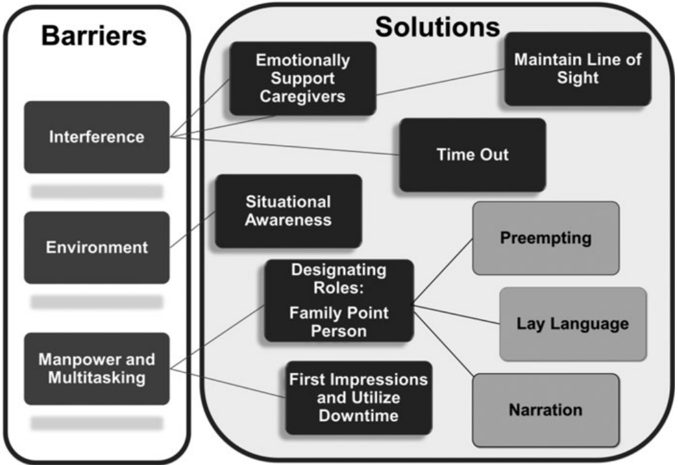
BACKGROUND: A gap exists in understanding a provider's approach to delivering care that is mutually beneficial to patients, families, and other providers in the prehospital setting. The purpose of this study was to identify attitudes, beliefs, and perceived barriers to providing patient and family centered care (PFCC) in the prehospital setting and to describe potential solutions for improving PFCC during critical pediatric events. METHODS: We conducted a qualitative, cross-sectional study of a purposive sample of Emergency Medical Technicians (EMTs) and paramedics from an urban, municipal, fire-based EMS system, who participated in the Pediatric Simulation Training for Emergency Prehospital Providers (PediSTEPPS) course. Two coders reviewed transcriptions of audio recordings from participants' first simulation scenario debriefings and performed constant comparison analysis to identify unifying themes. Themes were verified through member checking with two focus groups of prehospital providers. RESULTS: A total of 122 EMTs and paramedics participated in 16 audiotaped debriefing sessions and two focus groups. Four overarching themes emerged regarding the experience of PFCC by prehospital providers: (1) Perceived barriers included the prehospital environment, limited manpower, multi-tasking medical care, and concern for interference with patient care; (2) Providing emotional support comprised of empathetically comforting caregivers, maintaining a calm demeanor, and empowering families to feel involved; (3) Effective communication strategies consisted of designating a family point person, narration of actions, preempting the next steps, speaking in lay terms, summarizing during downtime, and conveying a positive first impression; (4) Tactics to overcome PFCC barriers were maintaining a line of sight, removing and returning a caregiver to and from the scene, and providing situational awareness. CONCLUSIONS: Based on debriefings from simulated scenarios, some prehospital providers identified the provision of emotional support and effective communication as important components to the delivery of PFCC. Other providers revealed several perceived barriers to providing PFCC, though potential solutions to overcome many of these barriers were also identified. These findings can be utilized to integrate effective communication and emotional support techniques into EMS protocols and provider training to overcome perceived barriers to PFCC in the prehospital setting.
Overview
The claims and statistics of this paper haven’t been checked yet.
Free: it reads the open-access text and checks the first 5 claims that cite a source we can check. Create a free account to check every claim.
Integrity signals
Registry
Cites
Statistics
Figures


Verification
Claims the paper makes
The claims and statistics of this paper haven’t been checked yet.
Free: it reads the open-access text and checks the first 5 claims that cite a source we can check. Create a free account to check every claim.
Claims other papers make about this one
Each is checked against this paper’s own text: does it say what the citing paper says it does?
The source backs part of the claim, not all of it — or backs it for a different population, condition or comparison.
In the citing paper
“Providers represent an important mechanism for implementing PFCC research [4, 78, 79]”
From Translating evidence to patient care through caregivers: a systematic review of caregiver-mediated interventions (2018) · cites this paper as [79]
Experimental — accuracy not yet measured
Self-check
Percentages, sums and reported differences re-computed from the paper’s own numbers.
The self-check needs the paper’s full text.
Citations
Cites
Using thematic analysis in psychology
Braun, V., & Clarke, V. (2006) · Qualitative Research in Psychology · doi:10.1191/1478088706qp063oa · Cited by 194,414
Sampling for qualitative research
Marshall, M. N. (1996) · Family Practice · doi:10.1093/fampra/13.6.522 · Cited by 4,293
Method slurring: the grounded theory/phenomenology example
Baker, C., Wuest, J., & Stern, P. N. (1992) · Journal of Advanced Nursing · doi:10.1111/j.1365-2648.1992.tb01859.x · Cited by 701
Research works printed but not linked: 21
- Dudley N, Ackerman A, Brown KM, Snow SK (eds). Patient-and family- centered care of children in the emergency department. Pedi- atrics. 2015;135(1):e255-72.
- American Academy of Pediatrics Committee on Pediatric Emergency Medicine, American College of Emergency Physicians Pediatric Emergency Medicine Committee, and Emergency Nurses Association Pediatric Committee, 2015, Pediatrics, 135, e255, 10.1542/peds.2014-3424 · DOI · Paper page
- O'Malley PJ, Brown K, Krug SE; Committee on Pediatric Emer- gency Medicine. Patient and family-centered care of children in the emergency department. Pediatrics. 2008;122(2):511-522. · DOI · Paper page
- Jones B, Parker-Raley J, Maxon T, Brown C. Understanding health care professionals' views of family presence during pedi- atric resuscitation. Am J Crit Care. 2011;20(3):199-208. · DOI
- Woodward GE, Fleegler EW. Should parents accompany pedi- atric interfacility ground ambulance transports? Results of a national survey of pediatric transport team managers. Ped Emerg Care. 2001;17(1):22-27.
- Institute of Medicine. Emergency Medical Services at the Crossroads. Washington, DC: National Academies Press, 2006.
- 10.1097/00006565-200102000-00006 · doi:10.1097/00006565-200102000-00006
- Macnab AJ, Richards J, Green G. Family-oriented care dur- ing pediatric inter-hospital transport. Patient Educ Counsel. 1999;36(3):247-57. · doi:10.1016/s0738-3991(98)00090-1
- Browne LR, Shah MI, Studnek JR, et al. 2015 Pediatric research priorities in prehospital care. prehospital emergency care. 2016. (Epub ahead of print). PMID: 26808233. · doi:10.3109/10903127.2015.1102997
- Doughty C, Pearson N, Mondragon J, Arnold J, Ngo T, Shah M. Simulation-based pediatric resuscitation curriculum for pre- hospital providers. MedEdPORTAL Publications, 2014. (do: org/10.15766/mep_2374-8265.9949). · doi:10.15766/mep_2374-8265.9949
- Shah MI, Carey JM, Rapp SE, et al. Impact of high- fidelity pediatric simulation on paramedic seizure manage- ment. Prehosp Emerg Care. 2016. (Epub ahead of print). (doi: 10.3109/10903127.2016.1139217). · doi:10.3109/10903127.2016.1139217
- Hutson P, Rowan M. Qualitative studies; their role in medical research. Can Fam Physician. 1998;44:2453-8.
- Byrne M. Ground theory as a qualitative research methodology. AORN J. 2001;73(6):1155-6. · DOI
- Ezzy D. Qualitative Analysis: Practice and Innovation. London: Routledge, 2002. pp 86-89.
- Henderson DP, Knapp JF. Report of the national consensus con- ference on family presence during pediatric cardiopulmonary resuscitation. Pediatr Emerg Care. 2005;21(11);787-91. · DOI · Paper page
- Boie ET, Moore GP, Brummett C, Nelson DR. Do parents want to be present during invasive procedures performed on their children in the emergency department? A survey of 400 parents. Ann Emerg Med. 1999;34(1):70-74. · DOI · Paper page
- Manguren J, Scott SH, Guzzetta CE, et al. Effects of family pres- ence during resuscitations and invasive procedures in a pedi- atric emergency department. J Emerg Nurs. 2006;32:223-5.
- Goldberger ZD, Nallamothu BK, Nichol G, Chan PS, Curtis JR, Cooke CR. Policies allowing family presence during resuscita- tion and patterns of care during in-hospital cardiac arrest. Circ Cardiovasc Qual Outcome. 2015;8(3):226-34. · DOI · Paper page
- Clark AP, Calvin AO, Meyers TA, Eichhorn DJ, Guzzetta CE. Family presence during cardiopulmonary resuscitation and invasive procedures. A research based intervention. Crit Care Nurs Clin North Am. 2001;13:569-75. · DOI
- Koziel JR, Meckler G, Brown L, et al. (2015) Barriers to pediatric disaster triage: a qualitative investigation. Prehosp Emerg Care. 2015;19(2):279-86. · DOI
- Foster MJ, Whitehead L, Maybee P, Cullens V. The parents', hospitalized child's, and health care providers' perceptions and experiences of family centered care within a pediatric criti- cal care setting: a metasynthesis of qualitative research. J Fam Nurs. 2013;19(4):431-68. · DOI · Paper page
Cited by
Fiest, K. M., McIntosh, C. J., Demiantschuk, D., Leigh, J. P., & Stelfox, H. T. (2018) · BMC Medicine · doi:10.1186/s12916-018-1097-4 · Cited by 88
Metadata
- Authors
- Ayub, E. M., Sampayo, E. M., Shah, M. I., & Doughty, C. B.
- Venue
- Prehospital Emergency Care
- Publisher
- Informa UK Limited
- Published
- 2016-11-18
- Volume
- 21
- Issue
- 2
- Pages
- 233-241
- ISSN
- 1090-3127
- 1545-0066
- Cited by
- 33
- References
- 3
- Language
- en
About these checks
Registry, retraction, Cites and statistics results are computed, not judged, with one exception: a printed reference that no index lists is read once by a model before it counts as a citation error. Claims are extracted by a model and kept only when their quote appears verbatim in the text; each cited source is then checked, with a model’s help, for whether it says what the claim relies on. Those verdicts can be wrong — read the claim’s quote and the cited source before relying on one.
Statistics and arithmetic are recomputed, not judged.
Confidence bands are shown only for fields calibrated on our annotated test set. None is calibrated yet, so no band is shown.
What counts as a claim ›How we measure confidence ›How we check this ›
Are you an author, or do you see a problem with this page? Request a review
Data sources
Bibliographic data: Semantic Scholar, OpenAlex, Crossref.
Contains information from the Semantic Scholar Academic Graph Datasets, made available under the ODC Attribution License (ODC-BY 1.0).
Semantic Scholar’s data is described in: Kinney, R., et al. (2023). The Semantic Scholar Open Data Platform. arXiv:2301.10140.
