

How does GenAI affect trust in teacher-student relationships? Insights from students’ assessment experiences
Open accessThe DOI matches its Crossref record; 32 of the 32 references it cites were found in a registry or an index; 12 of the 40 sources its claims cite were checked for support.
Abstract
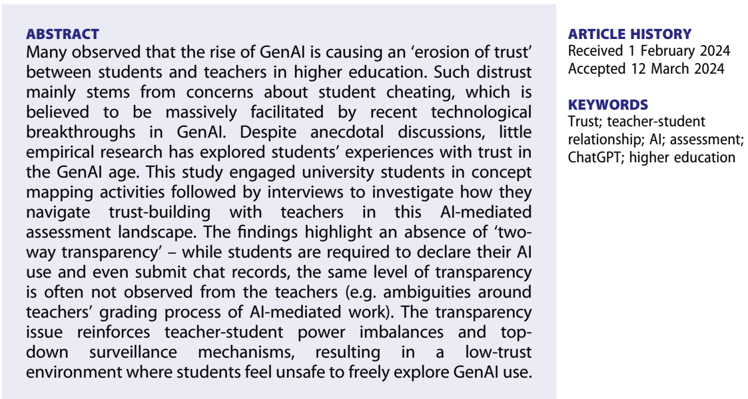
Many observed that the rise of GenAI is causing an 'erosion of trust' between students and teachers in higher education.Such distrust mainly stems from concerns about student cheating, which is believed to be massively facilitated by recent technological breakthroughs in GenAI.Despite anecdotal discussions, little empirical research has explored students' experiences with trust in the GenAI age.This study engaged university students in concept mapping activities followed by interviews to investigate how they navigate trust-building with teachers in this AI-mediated assessment landscape.The findings highlight an absence of 'twoway transparency' -while students are required to declare their AI use and even submit chat records, the same level of transparency is often not observed from the teachers (e.g.ambiguities around teachers' grading process of AI-mediated work).The transparency issue reinforces teacher-student power imbalances and topdown surveillance mechanisms, resulting in a low-trust environment where students feel unsafe to freely explore GenAI use.
Overview
CoChat Summary
TL;DR
This qualitative study of 11 university students finds that GenAI-mediated assessment is marked by low trust, driven by one-way transparency and fear of AI-cheating accusations. Students adopt self-defensive strategies and expect teachers to demonstrate AI literacy and transparent grading of AI-assisted work.
Key findings
- Four themes emerged: navigating the use of AI, navigating the acknowledgement of AI, navigating interpersonal relationship building, and navigating expectations of teachers. Students feared false AI-cheating accusations; some refused GenAI entirely, including turning off Grammarly, and three students used open-source AI detection services before submission.
- A lack of “two-way transparency” was central: students had to declare AI use or submit chat records, while teachers rarely explained how AI-mediated work would be graded, and the Turnitin “AI score” was only available to teachers. This reinforced power imbalances and top-down surveillance, producing a low-trust environment.
- AI declarations were entangled with trust: students worried that acknowledging AI use would penalise their marks or signal poor ability, and the way teachers communicated policies—punitive versus supportive—shaped their willingness to disclose.
- Students held heightened expectations for teacher competence: they wanted teachers to demonstrate AI literacy, distinguish AI writing from human writing, redesign assessments, and model ethical AI use. Personal connection mattered, but large classes made some students feel “anonymised.”
Methods
- Qualitative design with 11 university students recruited via an online forum at one Asian teacher-education university; participants needed prior experience using GenAI in assignments. Most were in education-related programmes.
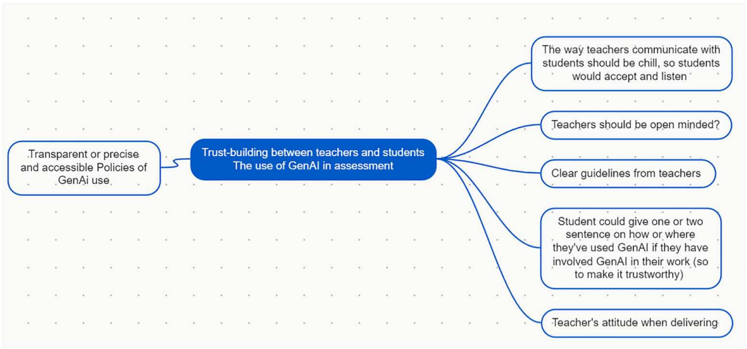
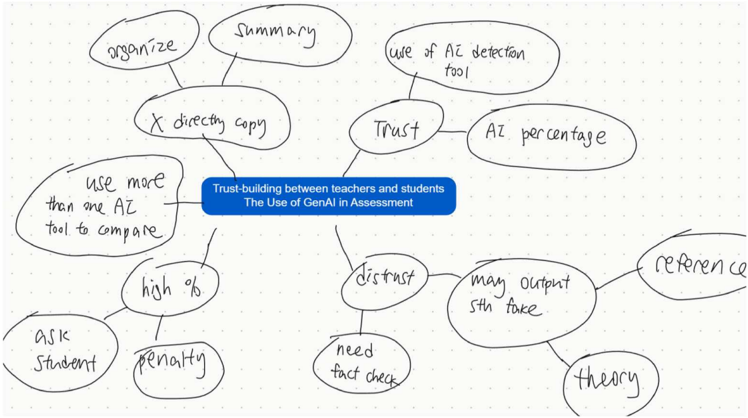
- Three-pronged data collection: a Zoom background interview; a 15-minute concept map on “Trust-building between Teachers and Students: The Use of GenAI in Assessment”; and follow-up interviews clarifying the maps, with total sessions lasting 30 minutes to one hour.
- Analysis treated each student as a separate case, integrating concept map open coding with interview data, then conducting cross-case thematic analysis. The author conducted all interviews and analysis; a trained research assistant independently coded one-third of the dataset (three cases) and reviewed all coding, with discrepancies resolved by consensus.
Limitations
- Stated: the sample mainly included students from educational backgrounds, limiting transferability; trust is broad and multidimensional, and the study only addresses teacher-student trust, not peer trust or trust in technology. The paper also states findings are not generalisable.
- Evident: the sample is small (11), self-selected, and from a single university, with no teacher perspectives; data rely on self-report interviews and concept maps, which may capture surface-level or socially desirable accounts.
Model-written summary. Check it against the paper before relying on it.
Integrity signals
Registry
Cites
Statistics
Figures


Verification
Claims the paper makes
12 Valid · 4 Not valid · 21 Not checked · 52 Own results and interpretations
Every source the paper cites for this claim was checked and supports it.
In the paper
“technological breakthroughs in GenAI have massively reduced the cost and effort required for students to engage in cheating behaviour (Lodge, Thompson, and Corrin 2023).”
§ How does GenAI affect trust in teacher-student relationships? Insights from students' assessment experiences > Introduction
What the sources say
- Supportedcites Lodge, Thompson, and Corrin 2023 matched to “Mapping out a research agenda for generative artificial intelligence in tertiary education” (2023) source
The Assessment integrity section says that the wide availability of generative AI has significantly lowered the barriers to cheating in terms of effort and risk. This supports the claim's broad characterization of reduced cost and effort; the source does not specify a monetary cost. (LLM, conf=0.90)
plainstates a cause- Asserted: passes — The authors put it forward as true.
- Checkable: passes — It can be checked against evidence.
- Load-bearing: passes — The paper’s conclusions depend on it.
- Based: passes — The paper gives a reason why it holds.
- Supported
Every source the paper cites for this claim was checked and supports it.
In the paper
“Empirical research on trust between teachers and students is particularly scarce in higher education (Felten, Forsyth, and Sutherland 2023).”
§ How does GenAI affect trust in teacher-student relationships? Insights from students' assessment experiences > Trust between students and teachers in higher education
What the sources say
- Supportedcites Felten, Forsyth, and Sutherland 2023 matched to “Building Trust in the Classroom: A Conceptual Model for Teachers, Scholars, and Academic Developers in Higher Education” (2023) source
In “Trust in the higher education classroom,” the paper explicitly says empirical work on trust between teachers and students in higher education classrooms remains sparse. This directly supports the citing sentence. (LLM, conf=0.95)
plain- Asserted: passes — The authors put it forward as true.
- Checkable: passes — It can be checked against evidence.
- Load-bearing: unclear — It is unclear whether the paper’s conclusions depend on it.
- Based: passes — The paper gives a reason why it holds.
- Supported
Every source the paper cites for this claim was checked and supports it.
In the paper
“Trusting relationships between teachers and students are crucial in developing effective teaching, learning and assessment (Felten, Forsyth, and Sutherland 2023).”
§ How does GenAI affect trust in teacher-student relationships? Insights from students' assessment experiences > Introduction
What the sources say
- Supportedcites Felten, Forsyth, and Sutherland 2023 matched to “Building Trust in the Classroom: A Conceptual Model for Teachers, Scholars, and Academic Developers in Higher Education” (2023) source
In “Trust in the higher education classroom” (page not provided), the paper calls trust a key element of meaningful student–teacher interactions and links constructive interactions to student learning. It also describes trust as foundational to effective feedback, supporting the claim’s assessment component. (LLM, conf=0.88)
plainstates a cause- Asserted: passes — The authors put it forward as true.
- Checkable: passes — It can be checked against evidence.
- Load-bearing: passes — The paper’s conclusions depend on it.
- Based: passes — The paper gives a reason why it holds.
- Supported
The cited sources support only part of this claim — read each source’s verdict below.
In the paper
“In a recent survey study conducted by Chan and Lee (2023), they found that university students are more optimistic and enthusiastic about embracing GenAI in various aspects of life compared to their university teachers.”
§ How does GenAI affect trust in teacher-student relationships? Insights from students' assessment experiences > Discussion
What the sources say
- Partly supportedcites Chan and Lee 2023 matched to “The AI generation gap: Are Gen Z students more interested in adopting generative AI such as ChatGPT in teaching and learning than their Gen X and millennial generation teachers?” (2023) sourceExperimental — accuracy not yet measured
The Quantitative results section reports that students were more positive than teachers about several uses of GenAI, and GenAI perceptions across the generations describes students’ optimism. But the study examines GenAI chiefly in higher education; it does not establish that students are more enthusiastic about adopting it in various aspects of life. (LLM, conf=0.88)
plainstates an association- Asserted: passes — The authors put it forward as true.
- Checkable: passes — It can be checked against evidence.
- Load-bearing: unclear — It is unclear whether the paper’s conclusions depend on it.
- Based: passes — The paper gives a reason why it holds.
- Partly supported
The cited sources support only part of this claim — read each source’s verdict below.
In the paper
“While previous discussions of competence trust in education focused mainly on teachers' subject knowledge (e.g.Macfarlane 2009; Zhou 2023), this study provides an expanded view of the 'competence' students expect from their teachers in an AI-mediated assessment landscape.”
§ How does GenAI affect trust in teacher-student relationships? Insights from students' assessment experiences > Discussion
What the sources say
- Not checked — no full text of the sourcecites Macfarlane 2009 matched to “A Leap of Faith: The Role of Trust in Higher Education Teaching” (2009) doi:10.18999/njhe.9.221
- Partly supportedcites Zhou 2023 matched to “Towards a New Definition of Trust for Teaching in Higher Education” (2023) sourceExperimental — accuracy not yet measured
In “How Scholars Understand Trust” (page unavailable), Zhou identifies domain knowledge or skills as part of teacher competence, supporting that portion of the citation. But the same passage says competence in trust is a function of teaching effectiveness, including lesson clarity, delivery and student engagement. Zhou therefore does not support portraying earlier competence discussions as focused mainly on subject knowledge. (LLM, conf=0.86)
plain- Asserted: passes — The authors put it forward as true.
- Checkable: passes — It can be checked against evidence.
- Load-bearing: passes — The paper’s conclusions depend on it.
- Based: passes — The paper gives a reason why it holds.
31 more claims
Create a free account to see all 89 claims and to verify the 2 references still open.
- Probably not a substantial claim. 40
- It may state two separate claims as one. 22
Claims other papers make about this one
Each is checked against this paper’s own text: does it say what the citing paper says it does?
In the citing paper
“The concept of 'two-way transparency' (Luo 2024b) highlights that while students must declare their AI use, institutions must be transparent about how such declarations will be assessed and the consequences of non-compliance.”
From Addressing student non-compliance in AI use declarations: implications for academic integrity and assessment in higher education (2025) · cites this paper as Luo 2024b
In the citing paper
“This study's findings that fear of academic repercussions (Luo 2024b) and institutional inconsistencies (Simkin and McLeod 2010; Stone 2023) complicate students' decision-making processes, challenge TPB's focus on individual attitudes, and highlight broader institutional and technological factors.”
From Addressing student non-compliance in AI use declarations: implications for academic integrity and assessment in higher education (2025) · cites this paper as Luo 2024b
Citations
Cites
ChatGPT: Bullshit spewer or the end of traditional assessments in higher education?
(2023) · Journal of Applied Learning & Teaching · doi:10.37074/jalt.2023.6.1.9 · Cited by 1,806 · cited 1×
“A handful of discussion papers have voiced concerns about how GenAI may reinforce a relationship of distrust between university teachers and students (e.g. Kramm and McKenna 2023; Rudolph 2023), but very limited empirical studies can be found on this topic.”
A comprehensive AI policy education framework for university teaching and learning
Chan, C. K. Y. (2023) · International Journal of Educational Technology in Higher Education · doi:10.1186/s41239-023-00408-3 · Cited by 1,577
Five Faces of Trust: An Empirical Confirmation in Urban Elementary Schools
Hoy, W. K., & Tschannen-Moran, M. (1999) · Journal of School Leadership · doi:10.1177/105268469900900301 · Cited by 641
Chan, C. K. Y., & Lee, K. K. W. (2023) · Smart Learning Environments · doi:10.1186/s40561-023-00269-3 · Cited by 634
Feedback in Higher and Professional Education: Understanding it and doing it well
(2012) · Routledge eBooks · doi:10.4324/9780203074336 · Cited by 452
Pupil wellbeing – Teacher wellbeing: Two sides of the same coin?
Roffey, S. (2012) · Educational and Child Psychology · doi:10.53841/bpsecp.2012.29.4.8 · Cited by 380 · cited 1×
“Teachers also benefit from a trusting relationship with students – teachers who have low trust in their students are found prone to burnout (Roffey 2012).”
Luo (Jess), J. (2024) · Assessment & Evaluation in Higher Education · doi:10.1080/02602938.2024.2309963 · Cited by 366 · cited 2×
“Under the current discourse, teachers could be ‘subjectified less as educators but more as gatekeepers to avoid academic mis-conduct’ (Luo 2024, 10).”
Framing Experience: Concept Maps, Mind Maps, and Data Collection in Qualitative Research
Wheeldon, J., & Faubert, J. (2009) · International Journal of Qualitative Methods · doi:10.1177/160940690900800307 · Cited by 347 · cited 3×
“Concept mapping has also been widely adopted in social sciences research and is regarded useful in ‘gathering more unsolicited reflection [and] providing a visual snapshot of experience’ (Wheeldon and Faubert 2009, 79).”
Learning to work with the black box: Pedagogy for a world with artificial intelligence
Bearman, M., & Ajjawi, R. (2023) · British Journal of Educational Technology · doi:10.1111/bjet.13337 · Cited by 346 · cited 1×
“Following advice from previous research, assessment can include tasks that allow students to exercise and develop their evaluative judgement, particularly judgement of AI-generated outputs (Bearman and Ajjawi 2023; Luo and Chan 2023).”
Trust and Betrayal in the Workplace: Building Effective Relationships in Your Organization
Reina, D. S., & Reina, M. L. (1999) · Cited by 222
Research works printed but not linked: 1
- Legard, R., J. Keegan, and K. Ward. 2003. In-depth interviews. In Qualitative research practice: A guide for social research students and researchers, eds. J. Ritchie, and J. Lewis, 138-69. Thousand Oaks, CA: Sage.
Cited by
Gonsalves, C. (2025) · Assessment & Evaluation in Higher Education · doi:10.1080/02602938.2024.2415654 · Cited by 212
Li, B., Tan, Y. L., Wang, C., & Lowell, V. L. (2025) · Computers and Education Artificial Intelligence · doi:10.1016/j.caeai.2025.100445 · Cited by 301
Jia, W., Pan, L., & Neary, S. (2025) · Behavioral Sciences · doi:10.3390/bs15101348 · Cited by 45
“Conversely, if teachers fail to establish trust through effective caring and guidance during students’ GenAI use, negative emotional experiences (J. Luo, 2024), such as doubts about one’s capabilities, feelings of helplessness when faced with GenAI-generated content (Varol, 2025), and concerns…”
The impact of AI on education and careers: What do students think?
Thomson, S. R., Pickard-Jones, B., Baines, S., & Otermans, P. C. J. (2024) · Frontiers in Artificial Intelligence · doi:10.3389/frai.2024.1457299 · Cited by 80
Song, Z., Qin, J., Jin, F., Cheung, W. M., & Lin, C. (2025) · Teaching and Teacher Education · doi:10.1016/j.tate.2025.105157 · Cited by 70
Learning by teaching with ChatGPT : The effect of teachable ChatGPT agent on programming education
Chen, A., Wei, Y., Le, H., & Zhang, Y. (2025) · British Journal of Educational Technology · doi:10.1111/bjet.70001 · Cited by 87
Ananin, D. P., Владимирович, К. Р., & Remorenko, I. M. (2025) · Высшее образование в России · doi:10.31992/0869-3617-2025-34-2-31-50 · Cited by 59
Alotaibi, S. M. (2025) · Interactive Learning Environments · doi:10.1080/10494820.2025.2492785 · Cited by 50
“This includes factors such as the perceived accuracy of information provided by these tools, the privacy protections in place, and the transparency of the algorithms behind them (Amoozadeh et al., 2024; Luo (Jess), 2024).”
Wen, Y., Zhao, X., Li, X., & Zang, Y. (2025) · Sustainability · doi:10.3390/su17031127 · Cited by 39
Understanding AI guilt: the development, pilot-testing, and validation of an instrument for students
Chan, C. K. Y. (2025) · Education and Information Technologies · doi:10.1007/s10639-025-13629-y · Cited by 29
“However, the rapid adoption of generative AI tools has raised ethical, psychological, and pedagogical challenges, particularly in the realm of academic integrity and student well-being (Chan, 2024; Chiu, 2023; Luo, 2024 ).”
ChatGPT’s impact on student learning outcomes: a meta-analysis of 35 experimental studies
Wu, X., Zhu, P., Zhang, J., Yin, M., & Wang, Y. (2026) · Humanities and Social Sciences Communications · doi:10.1057/s41599-026-07019-z · Cited by 65
“Conversely, Humanities students are less likely to see ChatGPT as technical support and more likely to view it as a potential threat, fearing that it may oversimplify or misunder-stand the complex aspects of human culture, ethics, and behaviour (Luo, 2025).”
Luo, J. (., & Dawson, P. (2026) · Studies in Higher Education · doi:10.1080/03075079.2025.2552825 · Cited by 17
Self-citationEngineering Educators' Perspectives on the Impact of Generative AI in Higher Education
Dewan, U., Hingle, A., McDonald, N., & Johri, A. (2025) · 2025 IEEE Global Engineering Education Conference (EDUCON) · doi:10.1109/educon62633.2025.11016518 · Cited by 16
Examining Student and Teacher Perspectives on Undisclosed Use of Generative AI in Academic Work
Adnin, R., Pandkar, A., Yao, B., Wang, D., & Das, M. (2025) · Proceedings of the 2025 CHI Conference on Human Factors in Computing Systems · doi:10.1145/3706598.3713393 · Cited by 16
Student self-reflection as a tool for managing GenAI use in large class assessment
Combrinck, C., & Loubser, N. (2025) · Discover Education · doi:10.1007/s44217-025-00461-2 · Cited by 49
Yang, J., Qiu, H., & Yu, W. (2024) · Journal of Asian Public Policy · doi:10.1080/17516234.2024.2429046 · Cited by 18
Mesny, A., Roberge‐Maltais, I., & Galy, A. (2025) · The International Journal of Management Education · doi:10.1016/j.ijme.2025.101307 · Cited by 27
Liu, H., Fang, X., Cui, Q., & Chiu, T. K. F. (2026) · Review of Education · doi:10.1002/rev3.70141 · Cited by 14
Exploring the Impact of Using Chatbots on Teacher-student Relationships in Today's Higher Education
Zou, Z. (2024) · Journal of Education Humanities and Social Sciences · doi:10.54097/0pev3z68 · Cited by 11
“Luo's findings suggest that chatbots do add new complexities to the teacher-student relationship in universities in the context of the increasing massification and participation of higher education [14].”
InfluentialLuo, J. J., Keung, C. P. C., & Tang, H. H. (2025) · Assessment & Evaluation in Higher Education · doi:10.1080/02602938.2024.2444890 · Cited by 14
“Some have argued in favour of using AI detection to prevent cheating, whereas others are concerned that this may reinforce a surveillance culture and undermine trust-building between teachers and students (Luo 2024a).”
Self-citationEthical Considerations in the Application of Artificial Intelligence in Education
Ding, N. (2025) · International Journal of Education and Humanities · doi:10.54097/78e6gr15 · Cited by 12
Zhang, Y. (2025) · European Journal of Education · doi:10.1111/ejed.70142 · Cited by 10
Teachers’ perceptions of value-sensitive AI in education: A case study of AI tutor
Shen, Y., Le, H., Wang, Z., & Wang, Q. (2025) · Teaching and Teacher Education · doi:10.1016/j.tate.2025.105253 · Cited by 16
Sharif, H., Atif, A., & Nagra, A. A. (2025) · Sustainability · doi:10.3390/su17219793 · Cited by 17
Balancing ethics and support: Peer tutors’ experiences with AI tools in student writing
Eleftheriou, M., Ahmer, M., & Fredrick, D. R. (2025) · Contemporary Educational Technology · doi:10.30935/cedtech/16554 · Cited by 11
Doyle, L., Nash, R. A., Jakcsiova, V., & Turner, E. (2025) · Technology Knowledge and Learning · doi:10.1007/s10758-025-09903-0 · Cited by 12
“We propose that the relational aspects of teachers’ use of AI feedback are an important and immediate priority for future research, matching the growing interest in relational aspects of students ’ use of AI (see Luo, 2024 ).”
Bannister, P. (2025) · Higher Education Research & Development · doi:10.1080/07294360.2025.2586653 · Cited by 6
Instructional affect and learner motivation in generative AI-restrictive and permissive classrooms
Sumilong, M. J. (2025) · Frontiers in Education · doi:10.3389/feduc.2025.1626802 · Cited by 11
Beyond detection: GenAI in EAL writing education
Sun, Y. (2025) · ELT Journal · doi:10.1093/elt/ccaf054 · Cited by 5
Sun, Y. (2026) · Applied Linguistics Review · doi:10.1515/applirev-2025-0247 · Cited by 9
“In addition, ethical concerns have been raised regarding the lack of trans-parency in AI processes, the potential compromise of academic integrity, and the harm of trust between students and teachers (Luo 2025; O ’ Regan and Ferri 2025).”
Jalilzadeh, K., Çelık, F., & Duran, V. (2025) · European Journal of Education · doi:10.1111/ejed.70293 · Cited by 5
Eaton, S. E., Figueroa, B. A. M., McDermott, B., Kumar, R., Brennan, R. W., & Wiens, J. (2025) · Assessment & Evaluation in Higher Education · doi:10.1080/02602938.2025.2587246 · Cited by 12
Opportunities and Challenges of AI Adoption in Higher Education, a Post COVID-19 Analysis
Dube, K., Gwatidzo, S., & Maleho, L. M. (2025) · International Conference on Business Analytics for Technology and Security (ICBATS) · doi:10.1109/icbats66542.2025.11258206 · Cited by 3
Xing, W., & Teng, M. F. (2026) · European Journal of Education · doi:10.1111/ejed.70439 · Cited by 7
Dou, D., Huang, C., Li, J., & Shi, J. (2026) · Applied Research in Quality of Life · doi:10.1007/s11482-026-10583-w · Cited by 5
“Exposure to machine-generated content has been linked to students’ increased feelings of disconnection and reduced trust in educators (Alessandro et al., 2025; Luo, 2025).”
Silalahi, A. D. K. (2024) · SSRN Electronic Journal · doi:10.2139/ssrn.5037486 · Cited by 3
Ming, N., Sharma, S., & Noh, J. (2025) · IEEE International Conference on Semantic Computing (ICSC) · doi:10.1109/icsc64641.2025.00020 · Cited by 2
“The application of GenAI models in the field of education shows significant potential, particularly in the automated generation of questions for pedagogical purposes.”
Teacher-Student Dynamics in AI-Driven Language Education in the Post-Truth Era
Al-kadi, A. (2025) · Journal of language and Education · doi:10.17323/jle.2025.24343 · Cited by 6
“Apart from curriculum narrowing, automated input, which is emotionally sterile, lacks the nuance of human critique (Kooli, 2023; Luo, 2024).”
Something Old, Something New: WebQuests and GenAI in Teacher Education
Tiernan, P., Donlon, E., Hamash, M., & Lovatt, J. (2026) · AI in Education · doi:10.3390/aieduc2010007 · Cited by 4
“These should emphasise transparency and accountability (Halaweh, 2023) so that teachers are equipped to navigate the opportunities and challenges AI presents (Luo, 2025).”
Bareither, C., & Griessl, L. (2026) · AI & Society · doi:10.1007/s00146-026-02988-w · Cited by 10
“Not only can students now easily produce academic texts with a few simple prompts (Fyfe 2023; Luo 2024; Kim et al. 2025), senior researchers are also starting to apply GenAI in their epistemic practices (Morris 2023; Clark et al. 2025; Jeon et al. 2025).”
InfluentialYang, B. (2026) · Studies in Higher Education · doi:10.1080/03075079.2026.2648696 · Cited by 4
Leba, S. M. R., Nggaruaka, T., & Butarbutar, R. (2025) · EthAIca · doi:10.56294/ai2025419 · Cited by 9
Silvennoinen, M., Aksovaara, S., & Alanko-Turunen, M. (2025) · Bled eConference · doi:10.18690/um.fov.4.2025.29 · Cited by 3
Hündür, T., ÇELİKOĞLU, M., & Taş, E. (2025) · ODÜ Sosyal Bilimler Araştırmaları Dergisi (ODÜSOBİAD) · doi:10.48146/odusobiad.1734027 · Cited by 1
AI detectors, student anxiety, and authorial alienation: a qualitative study of affective control
Ardana, S. G., & Christiana, M. (2026) · Teaching in Higher Education · doi:10.1080/13562517.2026.2643825 · Cited by 3
“The interface supports a ‘one-way transparency’ (Luo 2024b) in which the student is put on show, but the means remain concealed.”
Xing, W., & Teng, M. F. (2026) · System · doi:10.1016/j.system.2026.104030 · Cited by 6
Gow, S., & Illingworth, S. (2026) · Artificial Intelligence in Education · doi:10.1108/aiie-06-2025-0151 · Cited by 3
Kalim, U., Irfan, S., Jamil, B., & Kanwar, A. S. (2026) · Discover Education · doi:10.1007/s44217-026-01370-8 · Cited by 3
Nyagoga, L. M., Malik, L., Lukoko, H. O., & Liu, M. (2026) · Artificial Intelligence in Education · doi:10.1108/aiie-02-2025-0029 · Cited by 2
Cournoyea, M., & Seeley, S. (2026) · Assessment & Evaluation in Higher Education · doi:10.1080/02602938.2026.2656286 · Cited by 2
Xia, W., & Wei, W. (2026) · Innovations in Education and Teaching International · doi:10.1080/14703297.2026.2655907 · Cited by 2
Espinoza, M. M. G., Vélez, W. A. Z., Solano, S. P. C., Asencio, E. I. C., & Cobeña, E. I. D. (2026) · Education Sciences · doi:10.3390/educsci16071055 · Cited by 2
Wu, Q., & Li, J. (2024) · International Conference on Intelligent Computing and Human-Computer Interaction (ICHCI) · doi:10.1109/ichci63580.2024.10808120 · Cited by 7
Mak, M. H. C., & Walasek, L. (2025) · Computers and Education: Artificial Intelligence · doi:10.1016/j.caeai.2025.100507 · Cited by 10
BUILDING TRUST IN UNIVERSITY-LEVEL ENGLISH LANGUAGE EDUCATION IN INDONESIA: A MIXED METHODS STUDY
Suryanto, S. (2024) · Indonesian Journal of Learning and Instruction · doi:10.25134/ijli.v7i1.9543 · Cited by 2
“Establishing trust between students and teachers in English language teaching significantly enhances educational processes and outcomes by creating a supportive, safe classroom environment that boosts student engagement, communication, and academic integrity (Jess, 2024; Kolleck et al., 2021).”
BackgroundLepage, A., & Roy, N. (2024) · Mesure et évaluation en éducation · doi:10.7202/1117467ar · Cited by 4
Surveillance and Guidance: An Academic Integrity Crossway for Humans Using Generative AI
Dumouchel, G., & Peters, M. (2025) · Springer eBooks · doi:10.1007/978-3-031-92534-4_7 · Cited by 1
Leveraging cyber-social research techniques to develop an AI-based communication activity
Lanigan, M. L. (2025) · Communication Teacher · doi:10.1080/17404622.2025.2543430
Characterizing User Needs for GenAI Incorporation in Educational Games
Goldshtein, M., Ahmed, I., Yu, F., Verma, V., McNamara, D. S., & Arner, T. (2026) · Education Sciences · doi:10.3390/educsci16020300 · Cited by 1
Generative Artificial Intelligence and Teacher Development
Kostka, I. (2026) · Wiley eBooks · doi:10.1002/9781405198431.wbeal20861
Participatory, not Punitive: Student-Driven AI Policy Recommendations in a Design Classroom
Seki, K., Vijay, M., & Kotturi, Y. (2026) · CHI Conference on Human Factors in Computing Systems · doi:10.1145/3772318.3790691 · Cited by 3
Lee, J., & Esposito, A. G. (2026) · Educational Psychology · doi:10.1080/01443410.2026.2651729
Paxton, A., Kang, P., & Yim, A. (2026) · Teaching & Learning Inquiry The ISSOTL Journal · doi:10.20343/teachlearninqu.14.19
“In open-ended interviews with university students, Luo (2024) found a host of anxieties related to trust in the classroom and in assessment practices, with students expressing fear of false accusations of unauthorized GenAI use, compounded by a culture of anonymity in large university classrooms…”
Lê, N. H., & Doan, D. M. (2026) · Journal of Hospitality Leisure Sport & Tourism Education · doi:10.1016/j.jhlste.2026.100609 · Cited by 1
Fathi, T. E., Lamri, D., & Ibrahmi, E. M. A. (2026) · Springer eBooks · doi:10.1007/978-3-032-18030-8_10
Students’ Use of Generative AI Tools in Multiple Choice Exams
Serban, N., Ketenci, T., & Sokol, J. (2026) · INFORMS Transactions on Education · doi:10.1287/ited.2025.0166 · Cited by 2
Grichko, V., Driver, J., Mulder, S., & Hall, S. M. (2026) · Review of Education · doi:10.1002/rev3.70167 · Cited by 2
Text features associated with students’ generative AI use: Norwegian teachers’ perspectives
Jeffery, J. V., Skar, G. B. U., Kvistad, A. H., & Graham, S. (2026) · Frontiers in Education · doi:10.3389/feduc.2026.1792351
Wang, J., Tandon, U., Alghafes, R. A., Rai, J. S., & Dernóczy-Polyák, A. (2026) · Journal of Enterprise Information Management · doi:10.1108/jeim-10-2025-1052 · Cited by 2
Dargusch, J., Willis, J., Harris, L. R., Kettle, M., Arnold, J., Gallagher, J. E., Chi, D. N., & Rogers, N. (2026) · Review of Education · doi:10.1002/rev3.70195
GenAI-enabled versus human assessment of written assignments
Lin, S., Ngai, G., Lee, P., Ip, A. K. Y., & Kwan, K. (2026) · Innovations in Education and Teaching International · doi:10.1080/14703297.2026.2699254 · Cited by 1
The future of professional capital in the age of AI: policy and practice in teacher education
Yıldız, S., & Karagöl, İ. (2026) · Journal of Professional Capital and Community · doi:10.1108/jpcc-02-2026-0061
Zhang, T., Qiu, X., Uştuk, Ö., & Phakiti, A. (2026) · Teachers and Teaching · doi:10.1080/13540602.2026.2703817
Artificial intelligence as a pedagogical companion for STEM research learning in higher education
Valentine Joseph Owan, P. D. (2026) · Discover Education · doi:10.1007/s44217-026-01906-y · Cited by 2
“Students may therefore adopt foreign frameworks that are misaligned with their cultural and social realities, leading to the marginalization of local perspectives and indigenous scholarship [70, 79].”
From Disruption to Design: Educator-Led Generative AI Learning Interventions in Marketing Education
Quamina, L. T., Ghandour, R., Hardley, F., & Baig, A. (2026) · Marketing Education Review · doi:10.1080/10528008.2026.2703575 · Cited by 2
Zhang, B., Xia, W., Guo, X., & Wei, W. (2026) · The Curriculum Journal · doi:10.1002/curj.70076
ANALISIS HAMBATAN KOMUNIKASI DALAM PEMBELAJARAN BERBASIS ARTIFICIAL INTELLIGENCE
Urfiah, Fatimah, J. M., & Mau, M. (2026) · Journal Publicuho · doi:10.35817/publicuho.v9i2.1240
A theoretical model for the ethical use of generative AI tools in higher education assessments
Baig, M. I., & Yadegaridehkordi, E. (2026) · International Journal of Ethics and Systems · doi:10.1108/ijoes-09-2025-0538 · Cited by 1
Why the real test of Canada’s AI strategy is in university classrooms
Woodworth, J. (2026) · The Conversation · doi:10.64628/aam.vuk6kp95v
Chang, D., Lin, M. P.-C., Huang, J.-Y., & Ryoo, J. (2026) · Frontiers in Education · doi:10.3389/feduc.2026.1826174 · Cited by 5
Li, H. (2026) · Higher Education Research & Development · doi:10.1080/07294360.2026.2716795
Rajaram, K. (2026) · Organizational Behavior Teaching Review · doi:10.1177/10525629261483734 · Cited by 1
Adaptive and Personalized Assessment Pathways Enabled by GenAI
Kayyali, M. (2026) · Advances in computational intelligence and robotics book series · doi:10.4018/979-8-3373-9089-5.ch006
Sun, Y. (2026) · International Conference on Data-driven Optimization of Complex Systems (DOCS) · doi:10.1109/docs70981.2026.11698591
Vincoli, M., Scholz, N., & Nagashima, T. (2026) · Lecture notes in computer science · doi:10.1007/978-3-032-37979-5_42
Miranović, T., & Mehta, P. (2026) · Oxford University Press eBooks · doi:10.1093/9780198945215.003.0243
Metadata
- Authors
- Luo (Jess), J.
- Affiliations
- the Education University of Hong Kong
- ORCID
- Luo (Jess), Jiahui
- Venue
- Teaching in Higher Education
- Publisher
- Informa UK Limited
- Published
- 2024-04-20
- Volume
- 30
- Issue
- 4
- Pages
- 991-1006
- ISSN
- 1356-2517 (ISSN-L)
- 1470-1294
- OpenAlex
- W4394974898
- Semantic Scholar
- c6978dc8f6e7b6de9cadc606a084cc13bf1ce889
- Cited by
- 132
- References
- 31
- Citations by year
- 2026: 71 · 2025: 52 · 2024: 9
- FWCI
- 53.42
- Type
- journal article
- Language
- en
- Open access
- hybrid
- doi.org
- Licence
- Locations
- Teaching in Higher Education (publishedVersion, cc-by-nc-nd)
- Funders
- Startup Research Grant
- Topics
- Social Sciences › Education › Artificial Intelligence in Education
- Social Sciences › Education › Academic integrity and plagiarism
- Social Sciences › Education › Digital Education and Society
- Keywords
- generative AI, teacher-student trust, academic integrity, cheating, transparency, power imbalance, surveillance, student experience, grading, concept mapping
About these checks
Registry, retraction, Cites and statistics results are computed, not judged, with one exception: a printed reference that no index lists is read once by a model before it counts as a citation error. Claims are extracted by a model and kept only when their quote appears verbatim in the text; each cited source is then checked, with a model’s help, for whether it says what the claim relies on. Those verdicts can be wrong — read the claim’s quote and the cited source before relying on one.
The claim verdicts this report counts are experimental: their accuracy is not yet measured.
A language model drew the claims from the paper on 2026-10-05, under version 3 of the claim definition (model deepseek-v4.1-flash, prompt extract-v3).
A second model labelled each claim on 2026-10-05 (model jev-1.13-20260917, definition revision gold-guideline-v0.2).
Cited sources are checked with a language model’s help (gpt-6-sol).
Statistics and arithmetic are recomputed, not judged.
Confidence bands are shown only for fields calibrated on our annotated test set. None is calibrated yet, so no band is shown.
What counts as a claim ›How we measure confidence ›How we check this ›
Are you an author, or do you see a problem with this page? Request a review
Data sources
Bibliographic data: Semantic Scholar, OpenAlex, Crossref.
Contains information from the Semantic Scholar Academic Graph Datasets, made available under the ODC Attribution License (ODC-BY 1.0).
Semantic Scholar’s data is described in: Kinney, R., et al. (2023). The Semantic Scholar Open Data Platform. arXiv:2301.10140.
