

CSP-inspired adaptive chemistry reduction for combustion simulations without tabulation
Open accessThe DOI matches its Crossref record; 49 of the 49 references it cites were found in a registry or an index; none of the 32 sources its claims cite is checked for support yet.
Abstract
Modern combustion systems increasingly operate under challenging conditions, including Moderate and Intense Low Oxygen Dilution (MILD) combustion, high Flue Gas Recirculation (FGR), and hydrogen-rich fuels, driven by stringent emission reduction requirements. Traditional chemistry reduction methods, such as the Flamelet Generated Manifold (FGM), rely on restrictive assumptions about flame structure and fail under these emerging operating conditions where classical flame fronts become ill-defined or entirely absent. This work presents a novel Computational Singular Perturbation (CSP)-inspired chemistry reduction framework that addresses these limitations. The methodology employs analysis of chemical timescales to identify dominant species followed by a realtime homogeneous correction method designed to compute the complete chemical species profile from the reduced species basis and local flow conditions. This strategic adaptive retention of chemical information creates an intermediate level of detail based on first principles, eliminating concerns about user fine-tuning and the definitions and tabulation of basis flamelets, while achieving significant computational savings. To further enhance efficiency, machine learning acceleration through deep neural networks is explored as an alternative implementation pathway. Validation of the framework through one-dimensional freely propagating flames demonstrates exceptional accuracy, with flame temperature prediction error of 0.08% and flame speed prediction error of 0.24% using only a third of the participating species. Two-dimensional axisymmetric combustor simulations show significant improvements in flame position and structure prediction compared to detailed chemistry simulations with the Eddy Dissipation Concept (EDC). These results are highly encouraging and warrant first-party implementations of the proposed algorithm with further investigation into more complex industrial reactive flows.
Overview
CoChat Summary
TL;DR
The paper presents a CSP-inspired adaptive chemistry reduction framework that identifies fast/steady-state and slow/major species from chemical timescale analysis and uses a homogeneous correction step to reconstruct the full species profile without tabulated flamelets. In 1D flames it predicts temperature and flame speed within 0.08% and 0.24% using 19 of 53 GRI-Mech 3.0 species, and in a 2D axisymmetric combustor it improves flame anchoring/position relative to EDC, though solver integration limits speedup.
Key findings
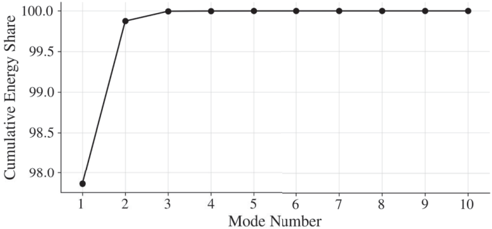
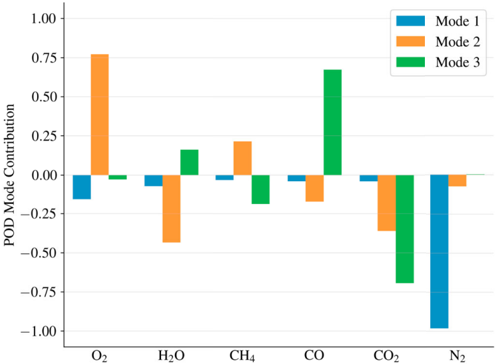
- POD analysis of a 0D methane-air+FGR reactor with GRI-Mech 3.0 (53 species, 323 elementary reactions) found that three dominant modes capture more than 99% of the total kinetic energy, mainly involving CH4, O2, CO2, H2O, CO, and N2.
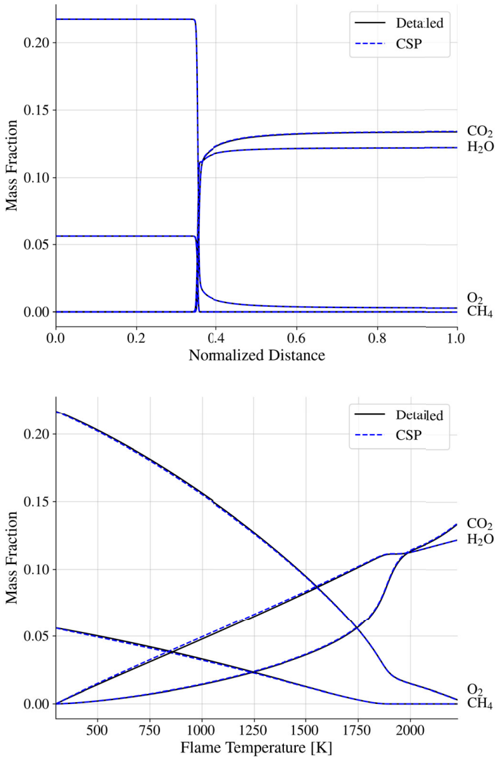
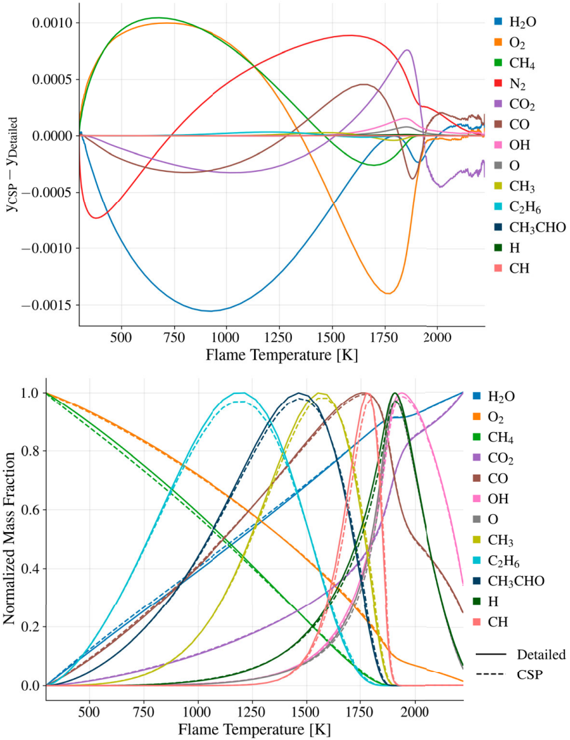
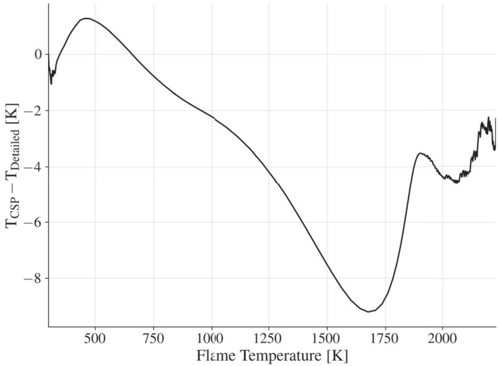
- CSP ranking selected 34 fast steady-state species and 19 major transported species, i.e. about one third of the species and ignoring 64% of participating species; 1D freely propagating flame results gave a final adiabatic flame temperature of 2223.4 K, a 0.08% underprediction, and a flame speed of 37.55 cm/s, a 0.24% overprediction versus detailed chemistry.
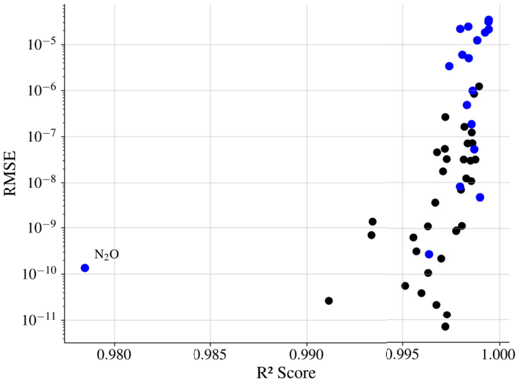
- The MLP source-term model was trained on more than 1000 flame simulations and approximately 275,000 feature-label vector pairs, with under 500,000 trainable parameters; overall R² was 0.997 ± 0.003 for T < 500 K, 0.995 ± 0.006 for 500 K < T < 1000 K, and 0.970 ± 0.046 for T > 1000 K, with worst R² 0.773 for H2CN above 1000 K.
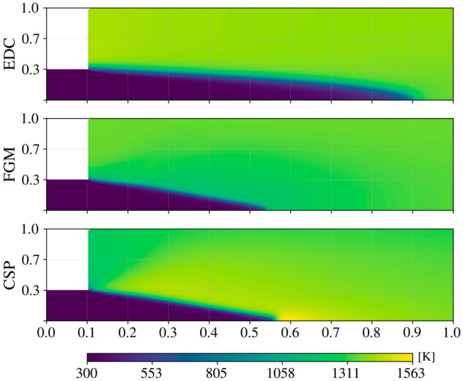
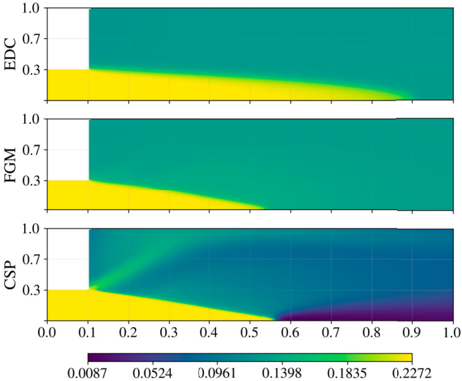
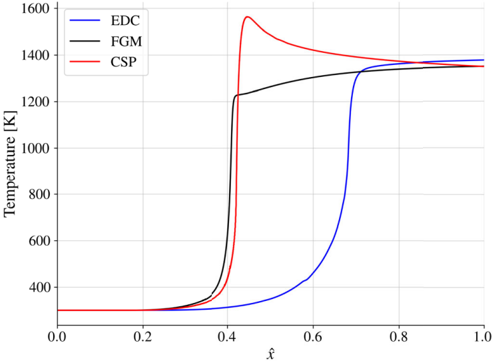
- In the 2D axisymmetric combustor, the CSP-modified EDC improved flame anchoring and positioning compared with standard EDC and more closely resembled FGM predictions; exhaust temperature was well predicted, but deviations appeared in the corner recirculation zone and local temperature peaks downstream of the primary reaction zone.
Methods
- CSP reduction: POD on a 0D reactor, CSP pointers and an integrated importance index P_i from a reference 1D flame to classify fast versus slow species; 19 major species are transported while 34 steady-state species are solved via a homogeneous correction algebraic step and Newton-step iteration, with Jacobian evaluation from Cantera finite-difference or sparse analytical methods and a biconjugate gradient stabilized solver.
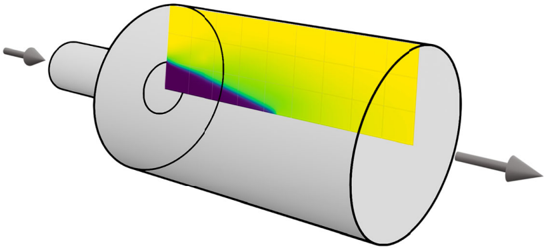
- Validation: 1D freely propagating premixed methane-air+FGR flame using modified CHEMKIN PREMIX versus Cantera detailed chemistry; 2D axisymmetric combustor in modified Ansys Fluent EDC via UDFs, compared with EDC and FGM, at low inlet velocity 0.1 m/s, Re < 6000, k-ω SST turbulence model, and local grid refinement.
- MLP: deep feedforward reverse-pyramid multilayer perceptron with normalized species mass fractions and temperature as inputs and source terms for all 53 species as outputs; training data from systematic parameter sweeps over the flammability range with FGR; split 68% training, 17% validation, 15% test; Adam optimizer, Huber loss, and early stopping.
Limitations
- Stated: MLP accuracy decreases above 1000 K because data normalization and sampling prioritize the high-gradient flame front, leaving the post-flame equilibrium zone sparser; this drop is largely confined to minor species, and data augmentation may remedy it. To avoid compounding inference errors, the evaluation used numerical on-the-fly source terms rather than ML inference.
- Stated: the 2D implementation through the Ansys Fluent EDC UDF imposes a fixed solver structure; the theoretical speedup from reducing transported species by about 64% is constrained by the surrounding solver architecture, and the internal iteration loop might interfere with the CSP algorithm, so an alternative implementation with greater solver control may be warranted.
- Stated/evident: the 2D comparison is limited by the cost of detailed chemistry in high-resolution 3D geometries, so it compares against EDC and FGM rather than detailed chemistry; local non-uniformity, hotspots, and corner recirculation deviations suggest chemistry-transport interaction may need further adjustment. Evident: validation is limited to a 1D flame and a simplified 2D axisymmetric combustor, and the authors call for first-party implementations and further investigation in more complex industrial reactive flows.
Model-written summary. Check it against the paper before relying on it.
Integrity signals
Registry
Cites
Statistics
Figures


Verification
Claims the paper makes
0 Valid · 3 Not valid · 17 Not checked · 87 Own results and interpretations
A result the paper reports from its own data — it cites no other source for it, so there is none to check. The quote shows it is in the paper.
In the paper
“Twodimensional axisymmetric combustor simulations show significant improvements in flame position and structure prediction compared to detailed chemistry simulations with the Eddy Dissipation Concept (EDC).”
§ CSP-inspired adaptive chemistry reduction for combustion simulations without tabulation > Abstract
plainstates a cause- Asserted: passes — The authors put it forward as true.
- Checkable: passes — It can be checked against evidence.
- Load-bearing: passes — The paper’s conclusions depend on it.
- Based: passes — The paper gives a reason why it holds.
A result the paper reports from its own data — it cites no other source for it, so there is none to check. The quote shows it is in the paper.
In the paper
“These hotspots mark regions where the CSP-based results exhibit larger deviations from the FGM reference, indicating that the interaction between chemistry and transport processes may require further adjustments.”
§ CSP-inspired adaptive chemistry reduction for combustion simulations without tabulation > 4.3. Two-dimensional combustor simulation results
hedgedstates an association- Asserted: passes — The authors put it forward as true.
- Checkable: passes — It can be checked against evidence.
- Load-bearing: unclear — It is unclear whether the paper’s conclusions depend on it.
- Based: passes — The paper gives a reason why it holds.
- Rests on an assumption not shown here.
A result the paper states — it cites no source for it, so there is none to check. The quote shows it is in the paper.
In the paper
“This agreement becomes particularly impressive when considering the dramatic reduction in computational complexity achieved by ignoring 64% of the participating chemical species.”
§ CSP-inspired adaptive chemistry reduction for combustion simulations without tabulation > 4.2. One-dimensional flame simulation results
plain- Asserted: passes — The authors put it forward as true.
- Checkable: passes — It can be checked against evidence.
- Load-bearing: passes — The paper’s conclusions depend on it.
- Based: passes — The paper gives a reason why it holds.
A result the paper reports from its own data — it cites no other source for it, so there is none to check. The quote shows it is in the paper.
In the paper
“However, this performance drop is largely confined to minor species, and the subset of 19 retained major species exhibit high prediction accuracy across all temperature ranges.”
§ CSP-inspired adaptive chemistry reduction for combustion simulations without tabulation > 4.1. Chemical source term evaluation using machine learning
plain- Asserted: passes — The authors put it forward as true.
- Checkable: passes — It can be checked against evidence.
- Load-bearing: unclear — It is unclear whether the paper’s conclusions depend on it.
- Based: passes — The paper gives a reason why it holds.
A result the paper reports from its own data — it cites no other source for it, so there is none to check. The quote shows it is in the paper.
In the paper
“The inference accuracy and precision of the trained model are remarkably high across all participating chemical species, particularly in the critical regions with moderate temperatures and the onset of combustion.”
§ CSP-inspired adaptive chemistry reduction for combustion simulations without tabulation > 4.1. Chemical source term evaluation using machine learning
plain- Asserted: passes — The authors put it forward as true.
- Checkable: passes — It can be checked against evidence.
- Load-bearing: unclear — It is unclear whether the paper’s conclusions depend on it.
- Based: passes — The paper gives a reason why it holds.
50 more claims
Create a free account to see all 107 claims and every source verdict.
- It may state two separate claims as one. 31
- Probably not a substantial claim. 25
Self-check
Percentages, sums and reported differences re-computed from the paper’s own numbers.
Each contradiction between two passages listed here was confirmed by an independent check.
Rated major: it would touch a result — a value a result rests on, reported and recomputed p-values on opposite sides of the significance level, two passages that conflict with no sign which is right, or a cited work retracted before this paper was published.
In the paper
§ CSP-inspired adaptive chemistry reduction for combustion simulations without tabulation > 3.1. One-dimensional freely propagating flame simulation
“Conversely, a detailed chemistry onedimensional flow was calculated using Cantera which models flames that are stabilised in an axisymmetric stagnation flow [34].This calculation acts as a benchmark to evaluate the proposed chemistry reduction scheme.”
§ CSP-inspired adaptive chemistry reduction for combustion simulations without tabulation > Additional information
“Results of identical freely propagating flame using Cantera is taken as ground truth for the calculation of R 2 and RMSE values.”
Rated minor: it would not touch a result — a value no result rests on, a p-value that stays on the same side of the significance level, or a conflict that is clerical, resolved elsewhere in the paper, or outside its own findings.
In the paper
§ CSP-inspired adaptive chemistry reduction for combustion simulations without tabulation > 1. Introduction
“using the established Cantera software package as a benchmark for detailed chemistry solutions [34].”
§ CSP-inspired adaptive chemistry reduction for combustion simulations without tabulation > References
“34. A. Ghasemi Khourinia, M. Derksen, and J. Kok, Greencode project dataset for chemistry reduc- tion with CSP, preprint (2025).”
Rated minor: it would not touch a result — a value no result rests on, a p-value that stays on the same side of the significance level, or a conflict that is clerical, resolved elsewhere in the paper, or outside its own findings.
In the paper
§ CSP-inspired adaptive chemistry reduction for combustion simulations without tabulation > 1. Introduction
“This three-dimensional application showcases the method's capability to handle complex geometries and realistic flow conditions under FGR while maintaining computational efficiency.”
§ CSP-inspired adaptive chemistry reduction for combustion simulations without tabulation > 3.2. Two-dimensional axisymmetric combustor simulation
“The second test case extends the validation to a more realistic and challenging configuration: a simplified axisymmetric combustor that captures essential features of practical combustion systems while remaining computationally tractable for detailed comparison studies.”
Citations
Cites
Chemkin-II: A Fortran chemical kinetics package for the analysis of gas-phase chemical kinetics
Kee, R. J., Rupley, F. M., & Miller, J. H. (1989) · OSTI OAI (U.S. Department of Energy Office of Scientific and Technical Information) · doi:10.2172/5681118 · Cited by 4,039
Goodwin, D. G., Moffat, H. K., Schoegl, I. M., Speth, R. L., & Weber, B. W. (2015) · Figshare · doi:10.5281/zenodo.48735 · Cited by 2,858
Simplifying chemical kinetics: Intrinsic low-dimensional manifolds in composition space
Maas, U., & Pope, S. B. (1992) · Combustion and Flame · doi:10.1016/0010-2180(92)90034-m · Cited by 1,539
Cavaliere, A., & de Joannon, M. (2004) · Progress in Energy and Combustion Science · doi:10.1016/j.pecs.2004.02.003 · Cited by 1,206
Computationally efficient implementation of combustion chemistry using in situ adaptive tabulation
Pope, S. B. (1997) · Combustion Theory and Modelling · doi:10.1080/713665229 · Cited by 1,124
Magnussen, B. F. (1981) · AIAA Aerospace Sciences Meeting · doi:10.2514/6.1981-42 · Cited by 959
Turbulence, Coherent Structures, Dynamical Systems and Symmetry
Holmes, P., Lumley, J. L., Berkooz, G., & Rowley, C. W. (2012) · Cambridge University Press eBooks · doi:10.1017/cbo9780511919701 · Cited by 924
Gicquel, O., Darabiha, N., & Thévenin, D. (2000) · Proceedings of the Combustion Institute · doi:10.1016/s0082-0784(00)80594-9 · Cited by 701
Modeling of complex premixed burner systems by using flamelet-generated manifolds
van Oijen, J. A., Lammers, F. A., & de Goey, L. P. H. (2001) · Combustion and Flame · doi:10.1016/s0010-2180(01)00316-9 · Cited by 437
Using CSP to Understand Complex Chemical Kinetics
Lam, S. H. (1993) · Combustion Science and Technology · doi:10.1080/00102209308924120 · Cited by 364
Modelling non-adiabatic partially premixed flames using flame-prolongation of ILDM
Fiorina, B., Baron, R., Gicquel, O., Thévenin, D., Carpentier, S. M., & Darabiha, N. (2003) · Combustion Theory and Modelling · doi:10.1088/1364-7830/7/3/301 · Cited by 298
The extension of the ILDM concept to reaction–diffusion manifolds
Bykov, V., & Maas, U. (2007) · Combustion Theory and Modelling · doi:10.1080/13647830701242531 · Cited by 251
An algorithm for the construction of global reduced mechanisms with CSP data
Massias, A., Diamantis, D. J., Mastorakos, E., & Goussis, D. A. (1999) · Combustion and Flame · doi:10.1016/s0010-2180(98)00132-1 · Cited by 242
Modelling of premixed counterflow flames using the flamelet-generated manifold method
van Oijen, J. A., & de Goey, L. P. H. (2002) · Combustion Theory and Modelling · doi:10.1088/1364-7830/6/3/305 · Cited by 216
Flamelet-generated manifolds : development and application to premixed laminar flames
van Oijen, J. A. (2002) · TU/e Research Portal · doi:10.6100/ir557848 · Cited by 163
Asymptotic Solution of Stiff PDEs with the CSP Method: The Reaction Diffusion Equation
Hadjinicolaou, Μ., & Goussis, D. A. (1998) · SIAM Journal on Scientific Computing · doi:10.1137/s1064827596303995 · Cited by 129
Capabilities and limitations of multi-regime flamelet combustion models
Knudsen, E., & Pitsch, H. G. (2011) · Combustion and Flame · doi:10.1016/j.combustflame.2011.05.025 · Cited by 126
Review on MILD Combustion of Gaseous Fuel: Its Definition, Ignition, Evolution, and Emissions
Mi, J., Li, P., Wang, F., Cheong, K.-P., & Wang, G. (2021) · Energy & Fuels · doi:10.1021/acs.energyfuels.1c00511 · Cited by 98
Turbulent Combustion Modelling and Experiments: Recent Trends and Developments
Giusti, A., & Mastorakos, E. (2019) · Flow Turbulence and Combustion · doi:10.1007/s10494-019-00072-6 · Cited by 96
Ding, T., Readshaw, T., Rigopoulos, S., & Jones, W. P. (2021) · Combustion and Flame · doi:10.1016/j.combustflame.2021.111493 · Cited by 87
On slow manifolds of chemically reactive systems
Singh, S., Powers, J. M., & Paolucci, S. (2002) · The Journal of Chemical Physics · doi:10.1063/1.1485959 · Cited by 84
Ampah, J. D., Jin, C., Afrane, S., Yusuf, A. A., Liu, H., & Yao, M. (2024) · Green Chemistry · doi:10.1039/d4gc00864b · Cited by 76
Turbulent combustion modeling for internal combustion engine CFD: A review
Posch, S., Gößnitzer, C., Lang, M., Novella, R., Steiner, H., & Wimmer, A. (2024) · Progress in Energy and Combustion Science · doi:10.1016/j.pecs.2024.101200 · Cited by 74
Evaluation of Chemical Kinetic Mechanisms for Methane Combustion: A Review from a CFD Perspective
Zettervall, N., Fureby, C., & Nilsson, E. J. K. (2021) · Fuels · doi:10.3390/fuels2020013 · Cited by 67
Bösenhofer, M., Wartha, E.-M., Jordan, C., & Harasek, M. (2018) · Energies · doi:10.3390/en11071902 · Cited by 62
Using adaptive proper orthogonal decomposition to solve the reaction–diffusion equation
Singer, M. A., & Green, W. H. (2008) · Applied Numerical Mathematics · doi:10.1016/j.apnum.2008.02.004 · Cited by 57
Nonlinear dimensionality reduction for parametric problems: A kernel proper orthogonal decomposition
Díez, P., Muixí, A., Zlotnik, S., & García‐González, A. (2021) · International Journal for Numerical Methods in Engineering · doi:10.1002/nme.6831 · Cited by 48
HPC-enabling technologies for high-fidelity combustion simulations
Mira, D., Pérez-Sánchez, E. J., Borrell, R., & Houzeaux, G. (2022) · Proceedings of the Combustion Institute · doi:10.1016/j.proci.2022.07.222 · Cited by 48
Gövert, S., Mira, D., Kok, J. B. W., Vázquez, M., & Houzeaux, G. (2017) · Flow Turbulence and Combustion · doi:10.1007/s10494-017-9848-4 · Cited by 46
Self-citationLiang, Y., Pope, S. B., & PEPIOTDESJARDINS, P. (2015) · Combustion and Flame · doi:10.1016/j.combustflame.2015.05.012 · Cited by 42
An Efficient Machine-Learning Approach for PDF Tabulation in Turbulent Combustion Closure
Ranade, R., Li, G., Li, S., & Echekki, T. (2019) · Combustion Science and Technology · doi:10.1080/00102202.2019.1686702 · Cited by 42
Challenges and perspectives of combustion chemistry research
Yuan, W., Li, Y., & Qi, F. (2017) · Science China Chemistry · doi:10.1007/s11426-017-9066-9 · Cited by 26
Cui, S., Zhou, X., Zhang, Z., Liu, F., & Kou, C. (2024) · Process Safety and Environmental Protection · doi:10.1016/j.psep.2024.07.059 · Cited by 21
Kinetic Models of Methane-Hydrogen Mixture Combustion: Brief Review and Validation
Semenikhin, A. S., Matveev, S. S., Викторович, Ч. И., Matveev, S. G., Idrisov, D. V., Gurakov, N. I., Radin, D. V., Novichkova, S. S., Fokin, N. I., Симин, Н. О., et al. (2022) · Thermal Engineering · doi:10.1134/s004060152210007x · Cited by 20
Newale, A. S., Pope, S. B., & PEPIOTDESJARDINS, P. (2020) · Proceedings of the Combustion Institute · doi:10.1016/j.proci.2020.06.343 · Cited by 19
Tingas, E.-A., Diamantis, D. J., & Goussis, D. A. (2018) · Combustion Theory and Modelling · doi:10.1080/13647830.2018.1470333 · Cited by 16
On the influence of steam on combustion
Derksen, M. A. F. (2005) · University of Twente Research Information · Cited by 14
Self-citationAnand, M. S., Medic, G., Paliath, U., Suder, K. L., Malik, M. R., & Laskowski, G. M. (2021) · AIAA SciTech Forum · doi:10.2514/6.2021-0956 · Cited by 14
Strategies to Reduce NOx Emissions from Flue Gas: Trends and Prospects
Gooneh-Farahani, S., & Anbia, M. (2025) · Water Air & Soil Pollution · doi:10.1007/s11270-025-08373-5 · Cited by 14
He, D., Yu, Y., Ma, H., Liang, H., & Wang, C. (2022) · Applied Sciences · doi:10.3390/app12189162 · Cited by 12
A Comprehensive Review of Flamelet Methods: Future Directions and Emerging Challenges
Nejaamtheen, M. N., & Choi, J. (2024) · Energies · doi:10.3390/en18010045 · Cited by 12
A review on computational studies on hydrogen combustion for gas turbine applications
Shankar, A., Parammasivam, K. M., & Narayanan, S. S. (2024) · Aircraft Engineering and Aerospace Technology · doi:10.1108/aeat-12-2023-0312 · Cited by 10
Yu, G., & Li, B. (2024) · Journal of Energy Resources Technology · doi:10.1115/1.4064526 · Cited by 6
Cordier, M., Bénard, P., Lybaert, P., Paepe, W. D., & Bricteux, L. (2021) · Flow Turbulence and Combustion · doi:10.1007/s10494-021-00282-x · Cited by 4
Tabulated Chemistry Models for Numerical Simulation of Combustion Flow Field
Muto, M. (2025) · Fluids · doi:10.3390/fluids10040083 · Cited by 3
Fratalocchi, V. (2017) · doi:10.3990/1.9789036544498 · Cited by 2
Greencode Project Dataset for Chemistry Reduction with CSP
Khourinia, A. G., Derksen, M., & Kok, J. (2025) · University of Twente Research Information · doi:10.4121/5423254e-bc6e-4006-ad76-a2c4ee13f6bc · Cited by 1
Self-citationGoodwin, D. G., Moffat, H. K., Schoegl, I., Speth, R. L., & Weber, B. W. (2024) · Zenodo · doi:10.5281/zenodo.14455267
Greencode Project Dataset for Chemistry Reduction with CSP
Khourinia, A. G., Derksen, M., & Kok, J. (2025) · 4TU.ResearchData · doi:10.4121/5423254e-bc6e-4006-ad76-a2c4ee13f6bc.v1
Self-citation
Research works printed but not linked: 3
- Global Energy Review 2025 IEA Paris preprint (2025). Available at https://www.iea.org/reports/global-energy-review-2025 Licence: CC BY 4.0.
- K. Calvin, D. Dasgupta, G. Krinner, A. Mukherji, P.W. Thorne, C. Trisos, J. Romero, P. Aldunce, K. Barrett, G. Blanco, and W.W. Cheung, IPCC, 2023: Climate Change 2023: Syn- thesis Report. Contribution of Working Groups I, II and III to the Sixth Assessment Report of the Intergovernmental Panel on Climate Change [Core Writing Team, H. Lee and J. Romero (eds.)]. IPCC, Geneva, Switzerland., Tech. Rep., Intergovernmental Panel on Climate Change (IPCC), 2023, Available at https://www.ipcc.ch/report/ar6/syr/.
- G.P. Smith, D.M. Golden, M. Frenklach, N.W. Moriarty, B. Eiteneer, M. Goldenberg, C.T. Bow- man, R.K. Hanson, S. Song, W.C. Gardiner Jr., V.V. Lissianski, and Z. Qin, GRI-Mech 3.0, preprint (1999). Available at http://www.me.berkeley.edu/gri_mech/.
Cited by
Hierarchical Attention Modeling Method for Complex Combustion System Simulation in Scramjets
Deng, J., Chen, E., Tian, Y., Liang, S., Yang, M., Deng, X., Zhang, H., & Chen, C. (2026) · AIAA Journal · doi:10.2514/1.j067258
Metadata
- Authors
- Ghasemi, A., Derksen, M., & Kok, J. B. W.
- Affiliations
- University of Twente
- Mateq Process B.V.
- University of Twente (NL)
- Venue
- Combustion Theory and Modelling
- Publisher
- Informa UK Limited
- Published
- 2026-04-03
- Volume
- 30
- Issue
- 3
- Pages
- 331-358
- ISSN
- 1364-7830 (ISSN-L)
- 1741-3559
- OpenAlex
- W7148786046
- Cited by
- 1
- References
- 47
- Citations by year
- 2026: 1
- FWCI
- 1.59
- Type
- journal article
- Language
- en
- Open access
- hybrid
- doi.org
- Licence
- cc-by
- creativecommons.org/licenses/by/4.0/ (vor)
- doi.org/10.1080/policies-text-data-mining (tdm)
- Locations
- Combustion Theory and Modelling (publishedVersion, cc-by)
- University of Twente Research Information (publishedVersion, cc-by)
- Funders
- Top Sector Energy, TKI Nieuw Gas (TKITOETKI 2021-H2-09)
- Topics
- Physical Sciences › Engineering › Computational Mechanics › Combustion and flame dynamics
- Physical Sciences › Chemical Engineering › Fluid Flow and Transfer Processes › Advanced Combustion Engine Technologies
- Physical Sciences › Physics and Astronomy › Statistical and Nonlinear Physics › Model Reduction and Neural Networks
- Keywords
- computational singular perturbation, MILD combustion, flue gas recirculation, hydrogen-rich fuels, flamelet generated manifold, eddy dissipation concept, flame speed, flame temperature, deep neural network acceleration
About these checks
Registry, retraction, Cites and statistics results are computed, not judged, with one exception: a printed reference that no index lists is read once by a model before it counts as a citation error. Claims are extracted by a model and kept only when their quote appears verbatim in the text; each cited source is then checked, with a model’s help, for whether it says what the claim relies on. Those verdicts can be wrong — read the claim’s quote and the cited source before relying on one.
A language model drew the claims from the paper on 2026-11-19, under version 3 of the claim definition (model deepseek-v4.1-flash, prompt extract-v3).
A second model labelled each claim on 2026-11-19 (model jev-1.13-20260917, definition revision gold-guideline-v0.2).
Statistics and arithmetic are recomputed, not judged.
Confidence bands are shown only for fields calibrated on our annotated test set. None is calibrated yet, so no band is shown.
What counts as a claim ›How we measure confidence ›How we check this ›
Are you an author, or do you see a problem with this page? Request a review
Data sources
Bibliographic data: Semantic Scholar, OpenAlex, Crossref.
Contains information from the Semantic Scholar Academic Graph Datasets, made available under the ODC Attribution License (ODC-BY 1.0).
Semantic Scholar’s data is described in: Kinney, R., et al. (2023). The Semantic Scholar Open Data Platform. arXiv:2301.10140.
