

From sameness to difference: Swedish Somalis’ post-migration perceptions of the circumcision of girls and boys
Open accessThe DOI matches its Crossref record; 52 of the 52 references it cites were found in a registry or an index.
Abstract
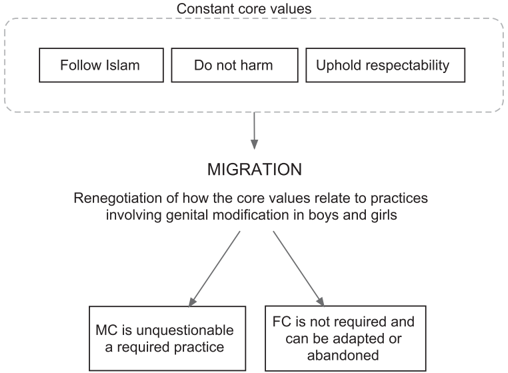
In every society where non-therapeutic female circumcision (FC) occurs, so too does non-therapeutic male circumcision (MC). In the past few decades, the norm in Euro-American societies has been to distinguish between the practices: FC is banned, while MC is condoned or encouraged. We explored Somalis' post-migration perceptions of FC and MC, while considering that they once lived in a society where both practices were widely accepted and now live in a society where there is a legal ban on FC alongside acceptance of MC. Eighteen individual interviews and seven focus group discussions were conducted with Somali men and women in three Swedish cities. There seemed to be a continuity of values across male and female forms of genital cutting concerning being a good Muslim, not inflicting harm and upholding respectability. Following migration, however, a renegotiation of how these values relate to MC and FC resulted in a conceptual split between the two: MC was perceived as an unquestionably required practice, but FC was viewed as a practice that can be adapted or abandoned. In a new cultural context after migration, perceptions of ideal male and female genitals, and what kinds of inscriptions on the body are desired, seem to have changed.
Overview
The claims and statistics of this paper haven’t been checked yet.
Free: it reads the open-access text and checks the first 5 claims that cite a source we can check. Create a free account to check every claim.
Integrity signals
Registry
Cites
Statistics
Figures
Verification
Claims the paper makes
The claims and statistics of this paper haven’t been checked yet.
Free: it reads the open-access text and checks the first 5 claims that cite a source we can check. Create a free account to check every claim.
Self-check
Percentages, sums and reported differences re-computed from the paper’s own numbers.
The self-check needs the paper’s full text.
Citations
Cites
Using thematic analysis in psychology
Braun, V., & Clarke, V. (2006) · Qualitative Research in Psychology · doi:10.1191/1478088706qp063oa · Cited by 194,414 · cited 1×
“Our analysis followed the framework of thematic analysis described by Braun and Clarke (2006).”
MethodLincoln, Y. S., Guba, E. G., & Pilotta, J. J. (1985) · International Journal of Intercultural Relations · doi:10.1016/0147-1767(85)90062-8 · Cited by 45,787
Shilling, C. (2003) · SAGE Publications Ltd eBooks · doi:10.4135/9781446215470 · Cited by 2,391
(2013) · Reproductive Health Matters · doi:10.1016/s0968-8080(13)42747-7 · Cited by 410
The Female Circumcision Controversy: An Anthropological Perspective
Gruenbaum, E. (2001) · doi:10.9783/9780812292510 · Cited by 335
Effects of female genital cutting on physical health outcomes: a systematic review and meta-analysis
Berg, R. C., Underland, V., Odgaard-Jensen, J., Fretheim, A., & Vist, G. E. (2014) · BMJ Open · doi:10.1136/bmjopen-2014-006316 · Cited by 289
Cold, C. J., & Taylor, J. R. (1999) · BJU International · doi:10.1046/j.1464-410x.1999.0830s1034.x · Cited by 263
Beyond Indigenous Authenticity: Reflections on the Insider/Outsider Debate in Immigration Research
Kusow, A. M. (2003) · Symbolic Interaction · doi:10.1525/si.2003.26.4.591 · Cited by 225 · cited 1×
“Yet, the interviewer’s being an ‘outsider’ may also have encouraged openness and urged informants to explain the ‘insider’ view, which is not expected to be otherwise grasped by an ‘outsider’ (Kusow 2003).”
BackgroundSchildkrout, E. (2004) · Annual Review of Anthropology · doi:10.1146/annurev.anthro.33.070203.143947 · Cited by 216 · cited 1×
“The body has been described as a surface on which society inscribes itself: ‘First, the body, as a canvas, is not only the site where culture is inscribed but also a place where the individual is defined and inserted into the cultural landscape’ (Schildkrout 2004, 338).”
BackgroundHadley, G. (2007) · Journal of Anatomy · doi:10.1111/j.1469-7580.2007.771_2.x · Cited by 187
Research works printed but not linked: 16
- Cavallera, V., M. Reggi, S. Abdi, Z. Jinnah, J. Kivelenge, A. Warsame, A. Yusuf, and P. Ventevogel 2016. Culture, Context and Mental Health of Somali refugees: A Primer for Staff Working in Mental Health and Psychosocial Support Programmes . Geneva: United Nations High Commissioner for Refugees.
- Earp, B. D. 2017. ' Does Female Genital Mutilation Have Health Benefits? The Problem with Medicalizing Morality. ' Quillette Magazine , August 15.
- Earp, B. D, and R. Darby. 2017. ' Circumcision, Sexual Experience, and Harm. ' University of Pennsylvania Journal of International Law 37 (2): 1 -57.
- Johansen, R. E. B. 2006. ' Experiences and Perceptions of Pain, Sexuality and Childbirth. A Study of Female Genital Cutting among Somalis in Norwegian Exile, and Their Health Care Providers. ' PhD diss., University of Oslo.
- Johnsdotter, S. 2018. ' Girls and Boys as Victims: Asymmetries and Dynamics in European Public Discourses on Genital Modifications in Children. ' In FGM/C: From Medicine to Critical Anthropology , edited by M. Fusaschi and G. Cavatorta, 31 -47. Torino: Meti Edizioni.
- Ministry of Health and Social Affairs. 2000. Omsk € arelse av pojkar [Circumcision of boys]. Stockholm: Ministry of Health and Social Affairs.
- Open Society Foundations. 2014. Somalis in Malm € o . New York: Open Society Foundations.
- Socialstyrelsens f € orfattningssamling. 2001. Omsk € arelse av pojkar [Circumcision of boys]. Stockholm: Swedish National Board of Health and Welfare.
- Statistics Sweden. 2016. Utl € andska medborgare efter medborgarskapsland, k € on och år [Foreign citizens in Sweden by country of citizenship, age and sex]. Stockholm: Statistics Sweden.
- Statistics Sweden. 2017. Utrikes f € odda efter f € odelseland, k € on och ålder [Foreign-born by county of birth, gender and age]. Stockholm: Statistics Sweden.
- Svensk f € orfattningssamling. 1982 . Lag (1982:316) med f € orbud mot k € onsstympning av kvinnor [Act prohibiting female genital mutilation of women]. Stockholm: Government Offices.
- Svensk f € orfattningssamling. 2001 . Lag (2001:499) om omsk € arelse av pojkar [Act regulating cirucmcision of boys]. Stockholm: Government Offices.
- UNICEF. 2013. Female Genital Mutilation/cutting. A Statistical Overview and Exploration of the Dynamics of Change . New York: UNICEF.
- WHO. 2007. New Data on Male Circumcision and HIV Prevention: Policy and Programme Implications . Montreux: WHO.
- WHO. 2008. Eliminating Female Genital Mutilation: An Interagency Statement . Geneva: WHO.
- WHO. 2016. A Framework for Voluntary Medical Male Circumcision: Effective HIV Prevention and a Gateway to Improved Adolescent Boy ' s and Men ' s Health in Eastern and Southern Africa by 2021 . Geneva: WHO.
Cited by
Sharif Mohamed, F., Wild, V., Earp, B. D., Johnson-Agbakwu, C., & Abdulcadir, J. (2020) · The Journal of Sexual Medicine · doi:10.1016/j.jsxm.2019.12.004 · Cited by 63
Genital Modifications in Prepubescent Minors: When May Clinicians Ethically Proceed?
The Brussels Collaboration on Bodily Integrity (2024) · The American Journal of Bioethics · doi:10.1080/15265161.2024.2353823 · Cited by 40
“…literacy) (Catania et al. 2007; Merli 2010; Vissandjée et al. 2014; Johnsdotter and Essén 2016; Berg et al. 2017; Vissandjée, Short, and Bates 2017; Wahlberg, Essén, and Johnsdotter 2019; Koukoui 2019; Johnsdotter 2020; Hanberger, Essén, and Wahlberg 2021; Ziyada and Johansen 2021; Abdulcadir…”
Male or female genital cutting: why ‘health benefits’ are morally irrelevant
Earp, B. D. (2021) · Journal of Medical Ethics · doi:10.1136/medethics-2020-106782 · Cited by 39
Gruenbaum, E., Earp, B. D., & Shweder, R. A. (2023) · International Journal of Impotence Research · doi:10.1038/s41443-022-00581-5 · Cited by 31
Earp, B. D. (2020) · Archives of Sexual Behavior · doi:10.1007/s10508-020-01633-x · Cited by 28
Non-therapeutic penile circumcision of minors: current controversies in UK law and medical ethics
Lempert, A., Chegwidden, J., Steinfeld, R., & Earp, B. D. (2022) · Clinical Ethics · doi:10.1177/14777509221104703 · Cited by 20
Pricking in the African Diaspora: Current Evidence and Recurrent Debates
Wahlberg, A., Påfs, J., & Jordal, M. (2019) · Current Sexual Health Reports · doi:10.1007/s11930-019-00198-8 · Cited by 19
Self-citationEarp, B. D. (2020) · Ethics Medicine and Public Health · doi:10.1016/j.jemep.2020.100533 · Cited by 19
Lunde, I. B., Hauge, M.-I., Johansen, R. E. B., & Sagbakken, M. (2020) · Ethnicities · doi:10.1177/1468796819896089 · Cited by 14
Palm, C., Elmerstig, E., Holmström, C., & Essén, B. (2023) · Frontiers in Sociology · doi:10.3389/fsoc.2023.1188097 · Cited by 13
“As has been described in previous research, negative attitudes toward FGC were also informed by dominant condemnatory discourse in the Swedish migration context, which emphasizes FGC as a violent and harmful practice (Gele et al., 2015; Wahlberg et al., 2019; Ziyada et al., 2020).”
BackgroundResultSelf-citationAgboli, A., Richard, F., Baum, M. B., Brackelaire, J.-L., d’Aguanno, A., Diallo, K., Mikolajczak, M., Ricadat, É., & Aujoulat, I. (2022) · PLoS ONE · doi:10.1371/journal.pone.0270088 · Cited by 8
“Attitudes change after migration regarding FGM have been reported in other European countries [5, 15, 16].”
BackgroundMacNamara, N., Mackle, D., Pierson, C., & Bloomer, F. (2020) · Women s Studies International Forum · doi:10.1016/j.wsif.2020.102391 · Cited by 8
Elmi, A. H., Omar, A. A., Dirie, N. I., Abdi, A. O., & Garba, B. (2025) · International Medical Case Reports Journal · doi:10.2147/imcrj.s522255 · Cited by 6
Earp, B. D., Abdulcadir, J., & Shahvisi, A. (2024) · Culture Health & Sexuality · doi:10.1080/13691058.2024.2388438 · Cited by 5
“…of ritual male genital cutting of children, but not vice versa, suggesting that the former may be structurally dependent on the latter. thus, as Wahlberg, Essén, and Johnsdotter (2019) explain, in Somalia, as in virtually all societies ‘where girls are circumcised, boys are also ritually…”
Negotiating Female Genital Cutting as a Difficult Characteristic in Kurdish National Identity
Lunde, I. B., Sagbakken, M., & Johansen, R. E. B. (2019) · Nordic Journal of Migration Research · doi:10.2478/njmr-2019-0011 · Cited by 4
Attitudes towards comparison of male and female genital cutting in a Swedish Somali population
Hanberger, A., Essén, B., & Wahlberg, A. (2021) · Acta Obstetricia et Gynecologica Scandinavica · doi:10.1111/aogs.14114 · Cited by 3
Self-citationTibajev, A., Vartanova, I., Strimling, P., & Essén, B. (2025) · Reproductive Health · doi:10.1186/s12978-025-02161-4 · Cited by 3
“…their studies of attitudes toward female genital cutting among the Somali population in Sweden, Johnsdotter and Essén [64], and Wahlberg and Essén [65] show rapid changes linked to the new material, religious, and social conditions in Sweden, prompting a reconsideration of cultural practices and…”
Self-citationStrid, S. (2020) · Sociologisk Forskning · doi:10.37062/sf.57.19969 · Cited by 3
Medically Unnecessary Female Genital Alteration: Implications for Health Care Workers
Joseph, R. A., & Mullen, L. M. (2020) · Journal of Pediatric Surgical Nursing · doi:10.1097/jps.0000000000000283 · Cited by 2
Francisca, I. O. (2020) · International Journal of Sociology and Anthropology · doi:10.5897/ijsa2019.0839 · Cited by 2
“…(Johnsdotter and Essen, 2017; Johnsdotter and Mestre, 2017; Jordal et al., 2019; Packer et al., 2015; Prazak and Coffman, 2006; Shell-Duncan, 2008; Wahlberg et al., 2019; Zurynski et al., 2017) because of social and cultural pressure on parents to maintain the practice, despite laws of host…”
BackgroundA qualitative study on female genital cutting among Kurdish-Norwegians
Lunde, I. B. (2020) · NORA - Norwegian Open Research Archives · Cited by 1
Motherwork and Space: Social and Political Participation of Mothers in Sweden’s racialised Suburbs
Twum, J. (2020) · Lund University Publications Student Papers (Lund University) · Cited by 1
Perspectives on Boys' Circumcision
Sardi, L. M., & Allan, J. A. (2019) · Oxford University Press eBooks · doi:10.1093/obo/9780199791231-0225
Elmi, A. H., Ibrahim, F. H., & Abdi, A. O. (2025) · Urology Case Reports · doi:10.1016/j.eucr.2025.103297
“Studies from multiple East African communities show that traditional circumcision is frequently carried out with non-sterile tools and by practitioners without formal medical training, which significantly increases the risk of serious complications in young children 2,4,6 .”
KVINNLIG KÖNSSTYMPNING En litteraturstudie
Ahmed, A., & Guled, N. (2020) · Gothenburg University Publications Electronic Archive (Gothenburg University)
Salad, F. (2024) · DiVA (Digitala Vetenskapliga Arkivet)
Olsson, L., & Ulvenstam, L. (2019) · DiVA (Digitala Vetenskapliga Arkivet)
Bahador, A., Shekarbeygi, A., & Vadiea, S. (2025) · Social Problems of Iran · doi:10.61882/jspi.16.3.59
Metadata
- Authors
- Wahlberg, A., Essén, B., & Johnsdotter, S.
- Affiliations
- Uppsala University (SE)
- Malmö University (SE)
- Corresponding author
- Wahlberg, Anna
- Venue
- Culture, Health & Sexuality
- Publisher
- Informa UK Limited
- Published
- 2018-11-09
- Volume
- 21
- Issue
- 6
- Pages
- 619-635
- ISSN
- 1369-1058 (ISSN-L)
- 1464-5351
- OpenAlex
- W2788867483
- Semantic Scholar
- 1ed3c2da56cec29886a4613117c01c94d9ac5188
- Cited by
- 24
- References
- 52
- Citations by year
- 2025: 4 · 2024: 3 · 2023: 1 · 2022: 3 · 2021: 2 · 2020: 9 · 2019: 2
- FWCI
- 3.09
- Type
- journal article
- Language
- en
- Open access
- hybrid
- doi.org
- Licence
- Locations
- Culture Health & Sexuality (publishedVersion, cc-by)
- PubMed (publishedVersion)
- KTH Publication Database DiVA (KTH Royal Institute of Technology) (submittedVersion, other-oa)
- Malmö University Publications (Malmö University) (submittedVersion)
- Funders
- Gillbergska stiftelsen
- County Administrative Board Uppsala (801–2478-15)
- Stiftelsen Sven Jerrings Fond
- Vetenskapsrådet (2015–03546)
- Topics
- Health Sciences › Medicine › Public Health, Environmental and Occupational Health › Female Genital Mutilation/Cutting Issues
- Health Sciences › Medicine › Surgery › Genital Health and Disease
- Social Sciences › Sociology and Political Science › Gender, Health, and Social Inequality
- Keywords
- female genital mutilation, male circumcision, Somali immigrants, cultural continuity and change, Muslim identity, bodily integrity, respectability, body inscription, gender norms, Sweden
- MeSH terms
- Adult, Circumcision, Male, Culture, Female, Humans, Interviews as Topic, Islam, Male, Somalia, Sweden, Focus Groups, Circumcision, Female
About these checks
Registry, retraction, Cites and statistics results are computed, not judged, with one exception: a printed reference that no index lists is read once by a model before it counts as a citation error. Claims are extracted by a model and kept only when their quote appears verbatim in the text; each cited source is then checked, with a model’s help, for whether it says what the claim relies on. Those verdicts can be wrong — read the claim’s quote and the cited source before relying on one.
Statistics and arithmetic are recomputed, not judged.
Confidence bands are shown only for fields calibrated on our annotated test set. None is calibrated yet, so no band is shown.
What counts as a claim ›How we measure confidence ›How we check this ›
Are you an author, or do you see a problem with this page? Request a review
Data sources
Bibliographic data: Semantic Scholar, OpenAlex, Crossref.
Contains information from the Semantic Scholar Academic Graph Datasets, made available under the ODC Attribution License (ODC-BY 1.0).
Semantic Scholar’s data is described in: Kinney, R., et al. (2023). The Semantic Scholar Open Data Platform. arXiv:2301.10140.
