

In-Degree and PageRank: Why Do They Follow Similar Power Laws?
Open accessThe DOI matches its Crossref record; 27 of the 31 references it cites were found in a registry or an index; none of the 34 sources its claims cite is checked for support yet.
Abstract
PageRank is a popularity measure designed by Google to rank Web pages. Experiments confirm that PageRank values obey a power law with the same exponent as In-Degree values. This paper presents a novel mathematical model that explains this phenomenon. The relation between PageRank and In-Degree is modeled through a stochastic equation, which is inspired by the original definition of PageRank, and is analogous to the well-known distributional identity for the busy period in the _M_/_G_/1 queue. Further, we employ the theory of regular variation and Tauberian theorems to prove analytically that the tail distributions of PageRank and In-Degree differ only by a multiplicative constant, for which we derive a closed-form expression. Our analytical results are in good agreement with experimental data.
Overview
CoChat Summary
TL;DR
This paper gives a stochastic model and Tauberian analysis showing that PageRank and In-Degree have the same power-law exponent. It also derives a closed-form multiplicative constant for the asymptotic difference between their tail distributions and checks it against Web data.
Key findings
- The paper proves that the tail distributions of PageRank and In-Degree “differ only by a multiplicative constant,” while sharing the same power-law exponent.
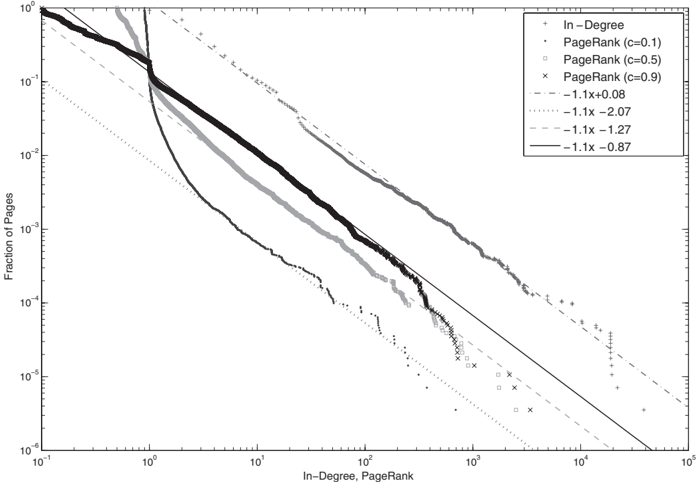
- In the Web-data experiment on the Stanford Web graph with 281,903 nodes and ~2.3 million edges, the authors fit a slope of -1.1, corresponding to a power-law exponent α = 1.1 for both In-Degree and PageRank.
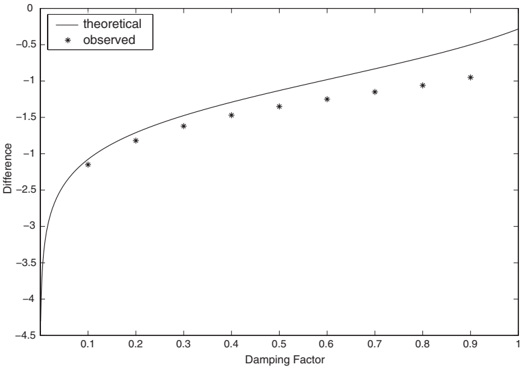
- For the same dataset, the average Out-Degree (and hence average In-Degree) was 8.2; using this value, the theoretical and observed multiplicative differences were reported as “quite close,” and for typical damping factors c between 0.8 and 0.9 the difference was 0.41, yielding a factor y(c) only 2.57 times the observed one.
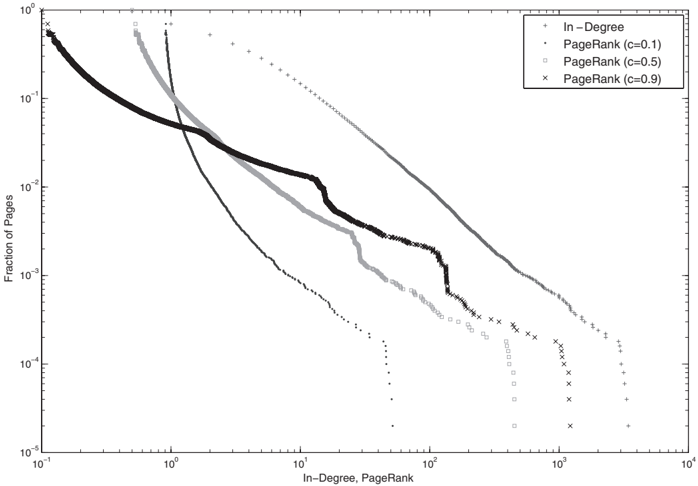
- In the Growing Network simulations, the paper reports a network of 50,000 nodes with Out-Degree d = 8 and q = 0.2; the resulting plots also showed parallel log-log lines for In-Degree and PageRank, though the Web data matched the model better.
Methods
- The paper introduces a stochastic recursive equation for PageRank, based on the PageRank definition, with simplifying assumptions including constant Out-Degree and independence among certain PageRank variables.
- It models In-Degree as a regularly varying random variable via a Poisson-arrival construction on a regularly varying random interval, and then uses Laplace-Stieltjes transforms plus Tauberian theorems to analyze tail asymptotics.
- The analysis is supplemented by numerical experiments on the Stanford Web data and on a simulated Growing Network model, with power-law exponents estimated via a maximum-likelihood method.
Limitations
- The paper explicitly says the model makes “several rather severe simplifying assumptions,” especially constant Out-Degree and independence among PageRank values of pages sharing a common neighbor.
- It also states that the model “does not capture PageRank behavior to the full extent,” as shown by the discrepancy between predicted and observed multiplicative constants; this is the paper’s own stated limitation.
- Evident from the text: the theoretical model focuses on tail asymptotics and does not model some real Web-graph dependencies, such as clustering and personalization/topic sensitivity, which the authors say they would consider in further research.
Model-written summary. Check it against the paper before relying on it.
Integrity signals
Registry
Cites
Statistics
Figures
Verification
Claims the paper makes
0 Valid · 3 Not valid · 26 Not checked · 32 Own results and interpretations
None of the sources cited for this claim could be matched to a paper, so there is nothing to check it against.
In the paper
“Our analytical results are in good agreement with experimental data.”
- Also stated in: § 1. Introduction · plain
“Our own experiments based on Web data from [Kamvar 06] are also in agreement with [Pandurangan et al. 02]”
What the sources say
- Not matchedcites Kamvar 06
This doesn’t read as a citation we can look up.
- Not matchedcites Pandurangan et al. 02
This doesn’t read as a citation we can look up.
plainstates an association- Asserted: passes — The authors put it forward as true.
- Checkable: passes — It can be checked against evidence.
- Load-bearing: passes — The paper’s conclusions depend on it.
- Based: passes — The paper gives a reason why it holds.
- Also stated in: § 1. Introduction · plain
A result the paper states — it cites no source for it, so there is none to check. The quote shows it is in the paper.
In the paper
“Indeed, experiments show that the shape of the PageRank distribution depends on the damping factor”
plainstates a cause- Asserted: passes — The authors put it forward as true.
- Checkable: passes — It can be checked against evidence.
- Load-bearing: passes — The paper’s conclusions depend on it.
- Based: passes — The paper gives a reason why it holds.
In the paper
“The calculations based on the maximum likelihood method (5.1) yield a slope -1 . 1”
What the sources say
- Not matchedcites [Newman 05]
This doesn’t read as a citation we can look up.
plain- Asserted: passes — The authors put it forward as true.
- Checkable: passes — It can be checked against evidence.
- Load-bearing: passes — The paper’s conclusions depend on it.
- Based: passes — The paper gives a reason why it holds.
- Not matched
A result the paper reports from its own data — it cites no other source for it, so there is none to check. The quote shows it is in the paper.
In the paper
“Clearly, these empirical values of In-Degree and PageRank lead to parallel lines for all values of the damping factor, provided that the PageRank values are reasonably large.”
boostedstates a cause- Asserted: passes — The authors put it forward as true.
- Checkable: passes — It can be checked against evidence.
- Load-bearing: passes — The paper’s conclusions depend on it.
- Based: passes — The paper gives a reason why it holds.
A result the paper states — it cites no source for it, so there is none to check. The quote shows it is in the paper.
In the paper
“for which we derive a closed-form expression”
- Also stated in: § 1. Introduction · plain
“our analysis allows us to derive explicitly the multiplicative constant that quantifies the difference between PageRank and In-Degree tail behavior.”
plain- Asserted: passes — The authors put it forward as true.
- Checkable: passes — It can be checked against evidence.
- Load-bearing: passes — The paper’s conclusions depend on it.
- Based: passes — The paper gives a reason why it holds.
- Rests on 2 assumptions not shown here.
- Also stated in: § 1. Introduction · plain
27 more claims
Create a free account to see all 61 claims and every source verdict.
- It may state two separate claims as one. 8
- Probably not a substantial claim. 23
Citations
Cites
Emergence of Scaling in Random Networks
Barabási, A.-L., & Albert, R. (1999) · Science · doi:10.1126/science.286.5439.509 · Cited by 36,135
An introduction to probability theory and its applications
(1958) · Journal of the Franklin Institute · doi:10.1016/0016-0032(58)90688-4 · Cited by 29,269
The anatomy of a large-scale hypertextual Web search engine
Brin, S., & Page, L. (1998) · Computer Networks and ISDN Systems · doi:10.1016/s0169-7552(98)00110-x · Cited by 16,004
Newman (2005) · doi:10.1080/00107510500052444 · Cited by 5,749
An Introduction to Probability Theory and its Applications.
Kingman, J. F. C., & Feller, W. (1972) · Journal of the Royal Statistical Society. Series A (General) · doi:10.2307/2344620 · Cited by 4,938
Bingham, N. H., Goldie, C. M., & Teugels, J. L. (1987) · Cambridge University Press eBooks · doi:10.1017/cbo9780511721434 · Cited by 2,382
Topic-sensitive pagerank: A context-sensitive ranking algorithm for web search
Haveliwala, T. H. (2003) · IEEE Transactions on Knowledge and Data Engineering · doi:10.1109/tkde.2003.1208999 · Cited by 1,052
Langville, A., & Meyer, C. (2004) · Internet Mathematics · doi:10.1080/15427951.2004.10129091 · Cited by 894
The degree sequence of a scale‐free random graph process
Bollobás, B., Riordan, O., Spencer, J., & Tusnády, G. (2001) · Random Structures & Algorithms · doi:10.1002/rsa.1009 · Cited by 804
Problems with fitting to the power-law distribution
Goldstein, M. L., Morris, S. A., & Yen, G. G. (2004) · The European Physical Journal B · doi:10.1140/epjb/e2004-00316-5 · Cited by 495
Cited by
Fast incremental and personalized PageRank
Bahmani, B., Chowdhury, A., & Goel, A. (2010) · Proceedings of the VLDB Endowment · doi:10.14778/1929861.1929864 · Cited by 327
“…observe that not only do the global PageRank scores and in-degrees follow the same power-laws (as previously proved under mild assumptions in the literature [33]), but also the personalized PageRanks follow power-laws with average exponent roughly equal to the exponent for PageR-ank and in-degree.”
BackgroundResultInfluentialRanking and clustering of nodes in networks with smart teleportation
Lambiotte, R., & Rosvall, M. (2012) · Physical Review E · doi:10.1103/physreve.85.056107 · Cited by 111
Asymptotic analysis for personalized Web search
Volkovich, Y., & Litvak, N. (2010) · Advances in Applied Probability · doi:10.1239/aap/1275055243 · Cited by 69
Self-citationInformation ranking and power laws on trees
Jelenković, P. R., & Olvera‐Cravioto, M. (2010) · Advances in Applied Probability · doi:10.1239/aap/1293113151 · Cited by 59
Neighborhood randomization for link privacy in social network analysis
Fard, A. M., & Wang, K. (2013) · World Wide Web · doi:10.1007/s11280-013-0240-6 · Cited by 53
Local weak convergence for PageRank
Garavaglia, A., van der Hofstad, R., & Litvak, N. (2020) · The Annals of Applied Probability · doi:10.1214/19-aap1494 · Cited by 62
“It has been observed [46, 50] that in real-world networks with power-law (in)degree distributions, PageRank follows a power-law with the same exponent.”
BackgroundSelf-citationGeneralized PageRank on directed configuration networks
Chen, N., Litvak, N., & Olvera‐Cravioto, M. (2016) · Random Structures and Algorithms · doi:10.1002/rsa.20700 · Cited by 52
Self-citationDetermining Factors Behind the PageRank Log-Log Plot
Volkovich, Y., Litvak, N., & Donato, D. (2007) · Lecture Notes in Computer Science · doi:10.1007/978-3-540-77004-6_9 · Cited by 31
Self-citationLau, A. K. W., Kajikawa, Y., & Sharif, N. (2019) · Production Planning & Control · doi:10.1080/09537287.2019.1700569 · Cited by 38
On Local Estimations of PageRank: A Mean Field Approach
Fortunato, S., Boguñá, M., Flammini, A., & Menczer, F. (2007) · Internet Mathematics · doi:10.1080/15427951.2007.10129294 · Cited by 29
Circulation of a digital community currency
Mattsson, C. E. S., Criscione, T., & Takes, F. W. (2023) · Scientific Reports · doi:10.1038/s41598-023-33184-1 · Cited by 21
PageRank in Scale-Free Random Graphs
Chen, N., Litvak, N., & Olvera‐Cravioto, M. (2014) · Lecture notes in computer science · doi:10.1007/978-3-319-13123-8_10 · Cited by 32
Self-citationGoogle matrix and Ulam networks of intermittency maps
Ermann, L., & Shepelyansky, D. L. (2010) · Physical Review E · doi:10.1103/physreve.81.036221 · Cited by 18
Distribution of centrality measures on undirected random networks via the cavity method
Bartolucci, S., Caccioli, F., Caravelli, F., & Vivo, P. (2024) · Proceedings of the National Academy of Sciences of the United States of America · doi:10.1073/pnas.2403682121 · Cited by 16
Kumar, R., Tomkins, A., Vassilvitskii, S., & Vee, E. (2015) · ACM International Conference on Web Search and Data Mining (WSDM) · doi:10.1145/2684822.2685310 · Cited by 32
PageRank on inhomogeneous random digraphs
Lee, J., & Olvera‐Cravioto, M. (2019) · Stochastic Processes and their Applications · doi:10.1016/j.spa.2019.07.002 · Cited by 30
Quantum centrality testing on directed graphs via PT -symmetric quantum walks
Izaac, J., Wang, J. B., Abbott, P. C., & S., X. (2017) · Physical Review A · doi:10.1103/physreva.96.032305 · Cited by 20
Charikhi, M. (2024) · Physica A Statistical Mechanics and its Applications · doi:10.1016/j.physa.2024.129552 · Cited by 21
A New BAT and PageRank Algorithm for Propagation Probability in Social Networks
Yeh, W., Zhu, W., Huang, C., Hsu, T.-Y., Liu, Z., & Tan, S.-Y. (2022) · Applied Sciences · doi:10.3390/app12146858 · Cited by 20
“A higher PageRank value means that a web page is more popular [22, 24, 58, 59] 2.”
BackgroundProbabilistic Relation between In-Degree and PageRank
Litvak, N., Scheinhardt, W., & Volkovich, Y. (2008) · Lecture notes in computer science · doi:10.1007/978-3-540-78808-9_7 · Cited by 13
Self-citationTowards Google matrix of brain
Shepelyansky, D. L., & Zhirov, O. V. (2010) · Physics Letters A · doi:10.1016/j.physleta.2010.06.007 · Cited by 14
Centrality Measures in Complex Networks: A SurveyPreprint
Saxena, A., & Iyengar, S. R. S. (2020) · arXiv (Cornell University) · doi:10.48550/arxiv.2011.07190 · Cited by 230
Information ranking and power laws on trees
Jelenković, P. R., & Olvera‐Cravioto, M. (2010) · Advances in Applied Probability · doi:10.1017/s0001867800004523 · Cited by 53
PageRank’s behavior under degree correlations
Olvera‐Cravioto, M. (2021) · The Annals of Applied Probability · doi:10.1214/20-aap1623 · Cited by 22
“The aim of this work, as well as of much of the earlier work on the distribution of the ranks produced by PageRank [15, 29, 32, 33, 42, 43], is to provide some mathematical interpretation to what PageRank is actually ranking highly, and how this is related to the underlying graph where it is being…”
BackgroundDistribution and Dependence of Extremes in Network Sampling ProcessesPreprint
Avrachenkov, K. E., Markovich, N. M., & Sreedharan, J. K. (2014) · arXiv (Cornell University) · Cited by 12
PageRank in Undirected Random Graphs
Avrachenkov, K. E., Kadavankandy, A., Prokhorenkova, L. O., & Raigorodskii, A. M. (2015) · Lecture notes in computer science · doi:10.1007/978-3-319-26784-5_12 · Cited by 21
“According to several studies [18, 20, 29, 37], PageRank and in-degree are strongly correlated in directed networks such as the Web graph.”
BackgroundGleich, D. F., Komjáthy, J., & Litvak, N. (2015) · Lecture notes in computer science · doi:10.1007/978-3-319-26784-5 · Cited by 12
Self-citationRankings in directed configuration models with heavy tailed in-degrees
Cai, X. S., Caputo, P., Perarnau, G., & Quattropani, M. (2023) · The Annals of Applied Probability · doi:10.1214/23-aap1955 · Cited by 14
“A series of papers [38, 50, 51] proposed an idealized stochastic model proving that the power-law distributions of the in-degree and of the PageRank score of a uniformly random vertex I only differ by a multiplicative factor.”
BackgroundRanking algorithms on directed configuration networksPreprint
Chen, N., Litvak, N., & Olvera‐Cravioto, M. (2014) · arXiv (Cornell University) · doi:10.48550/arxiv.1409.7443 · Cited by 13
Self-citationExactSim: benchmarking single-source SimRank algorithms with high-precision ground truths
Wang, H., Wei, Z., Liu, Y., Yuan, Y., Du, X., & Wen, J.-R. (2021) · The VLDB Journal · doi:10.1007/s00778-021-00672-7 · Cited by 9
Ramani, A. S., Eikmeier, N., & Gleich, D. F. (2019) · SIAM Review · doi:10.1137/17m1127132 · Cited by 12
Distribution and Dependence of Extremes in Network Sampling Processes
Avrachenkov, K. E., Markovich, N. M., & Sreedharan, J. K. (2014) · International Conference on Signal-Image Technology and Internet-Based Systems (SITIS) · doi:10.1109/sitis.2014.91 · Cited by 7
Extreme Value Statistics for Evolving Random Networks
Markovich, N. M., & Vaičiulis, M. (2023) · Mathematics · doi:10.3390/math11092171 · Cited by 13
PageRank's behavior under degree-degree correlationsPreprint
Olvera‐Cravioto, M. (2019) · arXiv (Cornell University) · doi:10.48550/arxiv.1909.09744 · Cited by 6
“The aim of this work, as well as of much of the earlier work on the distribution of the ranks produced by PageRank [32, 43, 42, 28, 15, 31], is to provide some mathematical interpretation to what PageRank is actually ranking highly, and how this is related to the underlying graph where it is being computed.”
BackgroundTracking Virality and Susceptibility in Social Media
Hoang, T.-A., & Lim, E. (2016) · ACM International Conference on Information and Knowledge Management (CIKM) · doi:10.1145/2983323.2983800 · Cited by 10
“On average, there is less than 5% of walks need to be re-sampled.”
BackgroundA Structural Result for Personalized PageRank and its Algorithmic Consequences
Vial, D., & Subramanian, V. (2019) · ACM SIGMETRICS International Conference on Measurement and Modeling of Computer Systems (SIGMETRICS) · doi:10.1145/3309697.3331481 · Cited by 4
Sequence‐based centrality measures in maritime transportation networks
Li, J., Wang, X., & Zhang, T. (2020) · IET Intelligent Transport Systems · doi:10.1049/iet-its.2020.0301 · Cited by 5
Distribution and dependence of extremes in network sampling processes
Avrachenkov, K. E., Markovich, N. M., & Sreedharan, J. K. (2015) · Computational Social Networks · doi:10.1186/s40649-015-0018-3 · Cited by 4
Extremal properties of evolving networks: local dependence and heavy tails
Markovich, N. M. (2023) · Annals of Operations Research · doi:10.1007/s10479-023-05175-y · Cited by 8
“This is supported by empirical studies where the in-degree and PR of the Web are shown to follow a power law with the same exponent (Litvak et al., 2007; Pandurangan et al., 2002; Volkovich & Litvak, 2010).”
Ranking Algorithms on Directed Configuration Networks
Chen, N. (2015) · University of Twente Research Information · doi:10.7916/d8j38rx8 · Cited by 5
Attributed Network Embedding in Streaming Style
Wu, A., Yuan, Y., Li, C., Ma, Y., & Zhang, H. (2024) · IEEE International Conference on Data Engineering (ICDE) · doi:10.1109/icde60146.2024.00243 · Cited by 3
Yamashita, T., & Kaneko, K. (2025) · Lecture notes in computer science · doi:10.1007/978-3-031-91398-3_11 · Cited by 2
Extremes Control of Complex Systems With Applications to Social Networks
Markovich, N. M. (2015) · IFAC-PapersOnLine · doi:10.1016/j.ifacol.2015.06.264 · Cited by 2
“A survey of other estimators can be found in Markovich [2007] among others.”
BackgroundA Structural Result for Personalized PageRank and its Algorithmic Consequences
Vial, D., & Subramanian, V. (2019) · Proceedings of the ACM on Measurement and Analysis of Computing Systems · doi:10.1145/3341617.3326140 · Cited by 4
“On the other hand, [21] was preceded by [20], where the power law hypothesis was established for global PageRank; further back, the hypothesis was studied under more restrictive assumptions in [38, 48, 49].”
BackgroundInfluentialConnectivity of random graphs after centrality-based vertex removal
van der Hofstad, R., & Pandey, M. (2024) · Journal of Applied Probability · doi:10.1017/jpr.2023.106 · Cited by 1
“PageRank has been intensely studied on various random graph models [5, 15, 16, 19, 31, 32, 34], with the main focus being to prove or disprove that PageRank has the same power-law exponent as the in-degree distribution.”
BackgroundQuickcent: a fast and frugal heuristic for harmonic centrality estimation on scale-free networks
Plana, F., Abeliuk, A., & Pérez, J. E. P. (2024) · Computing · doi:10.1007/s00607-024-01303-z · Cited by 2
“It was already mentioned in the text that while indegree and PageRank centrality of a digraph obey a power-law with the same exponent [39], we have no knowledge of results describing the distribution of harmonic centrality on digraphs.”
BackgroundModeling and Containment of Search Worms Targeting Web Applications
Hua, J., & Sakurai, K. (2010) · Lecture notes in computer science · doi:10.1007/978-3-642-14215-4_11 · Cited by 1
“Pandurangan et al. [15] and Litvak et al. [ 16 ] claimed that the distribution of PageRank values follows the power law and the exponent is about 1.1 for cumulative plots.”
BackgroundInfluentialThe PageRank Vector of a Scale-Free Web Network Growing by Preferential Attachment
Markovich, N. M., & Krieger, U. R. (2021) · Lecture notes in computer science · doi:10.1007/978-3-030-92507-9_3 · Cited by 1
Web Graph Parameters and the Pagerank Distribution.
Volkovich, Y., Litvak, N., & Donato, D. (2007) · Mining and Learning with Graphs
Self-citationExtremes Control of Complex Systems With Applications to Social NetworkPreprint
Markovich, N. M. (2015) · arXiv (Cornell University) · doi:10.48550/arxiv.1502.04985
“A survey of other estimators can be found in Markovich [2007] among others.”
BackgroundUsing PageRank Algorithm in Analyzing Dictionary Graphs and PageRank in Dynamic Graphs
Salarinezhad, A. (2015) · Brock University Digital Repository (Brock University)
Stochastic models for web ranking
Volkovich, Y., Donato, D., & Litvak, N. (2007) · ACM SIGMETRICS Performance Evaluation Review · doi:10.1145/1328690.1328713
Self-citationStatistical analysis of infectious disease data on networks
Li, X. (2015) · D-Scholarship@Pitt (University of Pittsburgh)
User Behavior Mining in Microblogging
Hoang, T. A. (2016) · Singapore Management University Institutional Knowledge (InK) (Singapore Management University)
Identifying and interpreting context on the Web : an application-driven approach
Kelleher, D. (2008) · Trinity's Access to Research Output (TARA) (Trinity College Dublin)
How to attribute credit if you must
Meiklejohn, L. S. (2021) · Open University of Cape Town (University of Cape Town) · Cited by 1
Tail asymptotics and precise large deviations for some Poisson cluster processes
Baeriswyl, F., Chavez‐Demoulin, V., & Wintenberger, O. (2024) · Advances in Applied Probability · doi:10.1017/apr.2024.32 · Cited by 1
“The equivalence between the regularly varying property of κ A and that of L A is easy to prove and is to be found, for example, in [34].”
Weighted maxima and sums of non-stationary random-length sequences in heavy-tailed models
Markovich, N. M. (2025) · Journal of Applied Probability · doi:10.1017/jpr.2024.118
LocAPS: Adaptive Positive Sampling for Network Embedding
Wu, A., Yu, Y., Li, C., Ma, Y., & Wang, Y. (2026) · IEEE Transactions on Knowledge and Data Engineering · doi:10.1109/tkde.2026.3677006
“…has two key properties that align with our goal: (1) its entries sum to 1 (following definition III.1), and (2) its distribution is highly skewed, following a power law ([21], [22]), meaning that most probability mass is concentrated on a small set of nodes closely related to a source node (see Fig.”
Sampling and inference in complex networks
Sreedharan, J. K. (2016) · doi:10.70675/97730d97z4ff8z4e04za4f0z6e247654ab20
“It is known that under some strict conditions, for a directed graph, PageRank and Indegree have same tail exponents [Litvak et al. 2007].”
Sankofa: Online Query-Adaptive Dynamic Graph Summaries
Bainson, A. B., Mortensen, K. O., Zaporojets, K., Mottin, D., & Karras, P. (2026) · Proceedings of the VLDB Endowment · doi:10.14778/3828612.3828641 · Cited by 1
“As the distribution exponent 𝛼 equals the damping factor 𝛽 [34], we replace 1 − 𝛼 in Equation (4) by the teleportation probability 𝜖 = 1 − 𝛽 , hence the required length 𝐿 is:”
Metadata
- Authors
- Litvak, N., Scheinhardt, W. R. W., & Volkovich, Y.
- Venue
- Internet Mathematics
- Publisher
- Internet Mathematics
- Published
- 2007-01
- Volume
- 4
- Issue
- 2-3
- Pages
- 175-198
- ISSN
- 1542-7951 (ISSN-L)
- 1944-9488
- OpenAlex
- W1959086707
- Cited by
- 62
- References
- 31
- Citations by year
- 2026: 2 · 2025: 2 · 2024: 6 · 2023: 4 · 2022: 1 · 2021: 4 · 2020: 3 · 2019: 6 · 2017: 1 · 2016: 4 · 2015: 9 · 2014: 4 · 2013: 1 · 2012: 1
- FWCI
- 3.44
- Type
- journal article
- Language
- en
- Open access
- bronze
- doi.org
- Locations
- Internet Mathematics (publishedVersion)
- Project Euclid (Cornell University) (submittedVersion)
- University of Twente Research Information (submittedVersion, other-oa)
- Funders
- Nederlandse Organisatie voor Wetenschappelijk Onderzoek
- Topics
- Physical Sciences › Physics and Astronomy › Statistical and Nonlinear Physics › Complex Network Analysis Techniques
- Physical Sciences › Computer Science › Information Systems › Web visibility and informetrics
- Physical Sciences › Computer Science › Information Systems › Information Retrieval and Search Behavior
- Keywords
- PageRank, in-degree distribution, power law, tail distribution, stochastic modeling, regular variation, Tauberian theorems, web page popularity, scale-free networks
About these checks
Registry, retraction, Cites and statistics results are computed, not judged, with one exception: a printed reference that no index lists is read once by a model before it counts as a citation error. Claims are extracted by a model and kept only when their quote appears verbatim in the text; each cited source is then checked, with a model’s help, for whether it says what the claim relies on. Those verdicts can be wrong — read the claim’s quote and the cited source before relying on one.
A language model drew the claims from the paper on 2026-10-10, under version 3 of the claim definition (model deepseek-v4.1-flash, prompt extract-v3).
A second model labelled each claim on 2026-10-10 (model jev-1.13-20260917, definition revision gold-guideline-v0.2).
Statistics and arithmetic are recomputed, not judged.
Confidence bands are shown only for fields calibrated on our annotated test set. None is calibrated yet, so no band is shown.
What counts as a claim ›How we measure confidence ›How we check this ›
Are you an author, or do you see a problem with this page? Request a review
Data sources
Bibliographic data: Semantic Scholar, OpenAlex, Crossref.
Contains information from the Semantic Scholar Academic Graph Datasets, made available under the ODC Attribution License (ODC-BY 1.0).
Semantic Scholar’s data is described in: Kinney, R., et al. (2023). The Semantic Scholar Open Data Platform. arXiv:2301.10140.
