

The DOI matches its Crossref record; 47 of the 47 references it cites were found in a registry or an index; none of the 61 sources its claims cite is checked for support yet.
Towards integrated flood management along the lower Rhine and Mississippi Rivers and the international legacy of the 2005 New Orleans Hurricanes Katrina–Rita flood disaster
Open accessAbstract
Large lowland rivers and deltas with high concentrations of human activities are vulnerable to different forms of global environmental change and depend upon effective flood management. This study utilizes the approaches and experiences of the lower Mississippi (Louisiana) and lower Rhine Rivers (the Netherlands) to examine the development of integrated flood management (IFM). The development of an ‘integrated’ approach to flood management informed by climate change science and oriented to environmental restoration is strongly present in Europe, and the Netherlands in particular. The epic 2005 New Orleans flood disaster associated with Hurricanes Katrina–Rita represented a paradigm change in flood management with international implications, and in particular the management of embanked floodplains. In contrast to the ‘incremental’ evolutionary model of flood management in the Netherlands, the US and lower Mississippi are characterized by large ‘pendulum’ style changes in flood management, alternating from federal- to local-scale dominance with the environmental change being a lower priority. An important distinction between the lower Rhine and Mississippi is the governmental structure of management, and particularly the role of local-scale entities. US flood management is more top-down than Dutch flood management, with Dutch water boards having more input into water management than US levee boards. The Dutch approach, by comparison, provides elasticity to develop a true ‘integrated’ approach to flood management adaptable to global environmental change and suited for environmental management and restoration. The 2005 New Orleans and Gulf Coast flood disaster initiated a new era of US flood management characterized by the return of a robust federal presence, and stimulated an international exchange of ideas regarding IFM that embraces climate change science and environmental restoration.
Overview
AI snapshot
Written from the paper’s full text.
TL;DR
This paper compares the evolution and governance of flood management along the lower Rhine and lower Mississippi, arguing that the Rhine follows an incremental path toward integrated flood management while the Mississippi follows a pendulum model of federal–local shifts. It also assesses the international legacy of the 2005 Hurricanes Katrina–Rita flood disaster, including the EU Floods Directive, US levee safety reforms, and the International Levee Handbook.
Key findings
- The lower Rhine is represented by an “incremental” model: after the 1953 flood caused 1831 deaths in the Netherlands, the Delta Works was built, and after 1993 and 1995 floods the “Room for the River” plan became a benchmark of integrated flood management, including moving dikes, lowering groynes, creating side channels, and flood bypasses. The lower Mississippi is represented by a “pendulum” model: the 1927 flood led to the 1928 Mississippi River and Tributaries Project, including repair/construction of 3200 km of dikes, channel cutoffs, dams, and floodwater routing, with later oscillations between federal and local control.
- Governance differs sharply: Dutch water boards are democratic, hydrologic-boundary institutions that cross provincial borders, are autonomous under national law, and must include stakeholder seats (7–9) alongside resident seats (18–30); Louisiana levee boards are appointed by the governor, confined largely to state/county borders, lack mandated stakeholder representation, and vary in expertise.
- The 2005 Katrina–Rita disaster stimulated international exchange: the EU Floods Directive (2007/60/EC) required flood risk assessment and mapping; the US National Levee Safety Act (2007) and 2009 NLSC Report recommended a national levee safety program, standardized inspections, a shift from 100-yr to 200-yr safety, risk-based design, and federal funding; the 2013 International Levee Handbook synthesized best practices from the US, France, UK, Netherlands, and Germany.
- US dike oversight is fragmented: of over 160,000 km of dikes, only 4,500 km were constructed and are managed by the USACE; 3,500 km were locally constructed and are USACE-managed; 15,000 km were USACE-constructed but locally managed; and about 77,000 km have had no federal oversight, with half of America’s dikes built and managed by local or state interests. Louisiana coastal erosion averages 75 sq.km annually, and the Mississippi delta fishery is valued at nearly three billion US dollars annually, producing a third of all US seafood.
Methods
- Comparative review and synthesis of literature, policy documents, and institutional frameworks for the lower Mississippi and lower Rhine, focusing mainly on dike/levee systems.
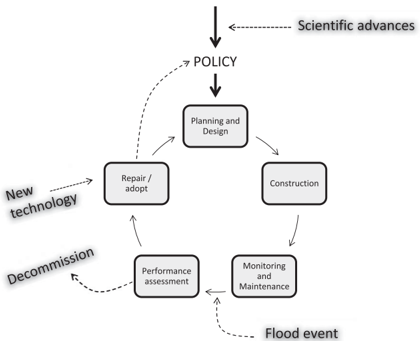
- Uses conceptual models: the “cycle of dike management” (policy; planning and design; construction, monitoring, maintenance, performance assessment; post-flood operations) and “incremental” versus “pendulum” models of flood management evolution.
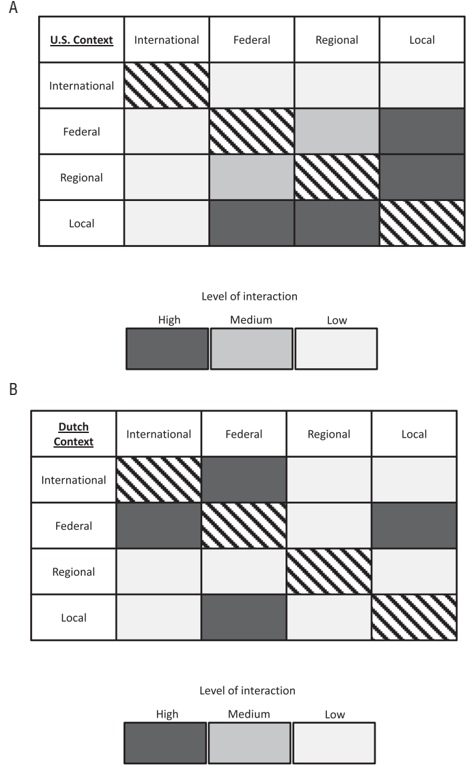
- Compares physical and human indices (Table 1), governance scales (Tables 3–4), and Louisiana levee boards versus Dutch water boards (Table 5); no new primary hydrologic data are presented.
Limitations
- Stated: the International Levee Handbook explicitly mentions the need for “environmentally friendly” dike systems but does not provide explicit guidance for restoring riparian ecosystems. The paper also states that the US federal government does not know very much about its flood control dikes and that a precise number of US dikes cannot be obtained.
- Stated: the degree to which Hurricane Harvey will represent a new “hinge point” in US flood management “will require additional time to realize.”
- Evident: this is a qualitative comparative review without new empirical data or formal hypothesis testing, and it focuses mainly on dikes/levees rather than the full range of flood management options.
Model-written summary. Check it against the paper before relying on it.
Integrity signals
Registry
Cites
Statistics
Figures


Verification
Claims the paper makes
33 No basis given · 27 Sources not found · 22 Own interpretation · 9 Not checked yet · 4 No full text of the sources · 1 Own result
The paper states this without a source or data behind it here, so there is nothing to check it against. The quote shows it is in the paper.
In the paper
“This is indeed a key reason why high rates of coastal erosion in Louisiana, which average 75 sq.km annually, is of a major concern to coastal urban communities.”
§ Towards integrated flood management along the lower Rhine and Mississippi Rivers and the international legacy of the 2005 New Orleans Hurricanes Katrina-Rita flood disaster > 3.1. Physical and human setting
plain- Asserted: passes — The authors put it forward as true.
- Checkable: passes — It can be checked against evidence.
- Load-bearing: unclear — It is unclear whether the paper’s conclusions depend on it.
- Based: passes — The paper gives a reason why it holds.
The paper states this without a source or data behind it here, so there is nothing to check it against. The quote shows it is in the paper.
In the paper
“Thus, international exchanges and agreements between federal agencies involved in flood management have increased”
§ Towards integrated flood management along the lower Rhine and Mississippi Rivers and the international legacy of the 2005 New Orleans Hurricanes Katrina-Rita flood disaster > 6. Conclusions and the way forward
plaindirect- Asserted: passes — The authors put it forward as true.
- Checkable: passes — It can be checked against evidence.
- Load-bearing: passes — The paper’s conclusions depend on it.
- Based: passes — The paper gives a reason why it holds.
A result the paper reports from its own data — it cites no other source for it, so there is none to check. The quote shows it is in the paper.
In the paper
“Although the Rhine delta is much smaller than the Mississippi, it supports a population of about five million greater than the Mississippi delta (Table 1).”
§ Towards integrated flood management along the lower Rhine and Mississippi Rivers and the international legacy of the 2005 New Orleans Hurricanes Katrina-Rita flood disaster > 3.1. Physical and human setting
plain- Asserted: passes — The authors put it forward as true.
- Checkable: passes — It can be checked against evidence.
- Load-bearing: unclear — It is unclear whether the paper’s conclusions depend on it.
- Based: passes — The paper gives a reason why it holds.
The paper states this without a source or data behind it here, so there is nothing to check it against. The quote shows it is in the paper.
In the paper
“The Mississippi delta, therefore, retains a much higher proportion of natural land cover than the Rhine delta.”
§ Towards integrated flood management along the lower Rhine and Mississippi Rivers and the international legacy of the 2005 New Orleans Hurricanes Katrina-Rita flood disaster > 3.1. Physical and human setting
plain- Asserted: passes — The authors put it forward as true.
- Checkable: passes — It can be checked against evidence.
- Load-bearing: unclear — It is unclear whether the paper’s conclusions depend on it.
- Based: passes — The paper gives a reason why it holds.
The paper states this without a source or data behind it here, so there is nothing to check it against. The quote shows it is in the paper.
In the paper
“Indices related to population, port size, and the proportion of natural land cover, for example, are indicative of the Rhine being much more intensively impacted by human activities than the Mississippi River delta.”
§ Towards integrated flood management along the lower Rhine and Mississippi Rivers and the international legacy of the 2005 New Orleans Hurricanes Katrina-Rita flood disaster > 3.1. Physical and human setting
hedgedcorrelational- Asserted: passes — The authors put it forward as true.
- Checkable: passes — It can be checked against evidence.
- Load-bearing: unclear — It is unclear whether the paper’s conclusions depend on it.
- Based: passes — The paper gives a reason why it holds.
In the paper
“Additionally, the CPRA coordinates the plan across different stakeholders, including at the scales of levee boards and individual municipalities (CPRA, 2017).”
§ Towards integrated flood management along the lower Rhine and Mississippi Rivers and the international legacy of the 2005 New Orleans Hurricanes Katrina-Rita flood disaster > 4.3. Regional scale governance
What the sources say
- Not matchedcites CPRA 2017
Couldn’t be matched to a paper in Crossref, so it can’t be checked.
plaindirect- Asserted: passes — The authors put it forward as true.
- Checkable: passes — It can be checked against evidence.
- Load-bearing: unclear — It is unclear whether the paper’s conclusions depend on it.
- Based: passes — The paper gives a reason why it holds.
- Not matched
A claim is checked only against the cited paper’s full text, never its abstract, and none is available for its sources.
In the paper
“Louisiana, by contrast, has ample coastal wetlands that help to buffer coastal populations from storm surge events, with the current status of the wetlands being related to the geomorphic framework of channel belts and flood basins driven by the delta cycle (Gosselink 1984, Day et al. 2007).”
§ Towards integrated flood management along the lower Rhine and Mississippi Rivers and the international legacy of the 2005 New Orleans Hurricanes Katrina-Rita flood disaster > 3.1. Physical and human setting
What the sources say
plaindirect- Asserted: passes — The authors put it forward as true.
- Checkable: passes — It can be checked against evidence.
- Load-bearing: passes — The paper’s conclusions depend on it.
- Based: passes — The paper gives a reason why it holds.
In the paper
“A recent development concerning state-level management of the Mississippi River delta is the Louisiana Coastal Protection and Restoration Authority (CPRA), formed as a direct outcome of the 2005 Hurricanes Katrina-Rita devastation of the Louisiana coastal zone (CPRA 2017).”
§ Towards integrated flood management along the lower Rhine and Mississippi Rivers and the international legacy of the 2005 New Orleans Hurricanes Katrina-Rita flood disaster > 4.3. Regional scale governance
What the sources say
- Not matchedcites CPRA 2017
Couldn’t be matched to a paper in Crossref, so it can’t be checked.
plaindirect- Asserted: passes — The authors put it forward as true.
- Checkable: passes — It can be checked against evidence.
- Load-bearing: unclear — It is unclear whether the paper’s conclusions depend on it.
- Based: passes — The paper gives a reason why it holds.
- Not matched
In the paper
“And of course, the silver lining in the 2005 New Orleans flood disaster is that it stimulated a robust exchange of ideas between the US and the Netherlands (e.g.US Congress 2005).”
§ Towards integrated flood management along the lower Rhine and Mississippi Rivers and the international legacy of the 2005 New Orleans Hurricanes Katrina-Rita flood disaster > 5. Diffusion of ideas: the international legacy of the 2005 New Orleans flood disaster
What the sources say
- Not matchedcites US Congress 2005
Couldn’t be matched to a paper in Crossref, so it can’t be checked.
plaindirect- Asserted: passes — The authors put it forward as true.
- Checkable: passes — It can be checked against evidence.
- Load-bearing: passes — The paper’s conclusions depend on it.
- Based: passes — The paper gives a reason why it holds.
- Not matched
None of the sources cited for this claim have been checked yet.
In the paper
“Although watershed management that is climate resilient is becoming a standard management goal, the actual development of effective national approaches to flood management occurs along different trajectories depending upon varying national priorities and, especially, specific flood disasters (e.g.Santato et al. 2013, Serra-Llobet et al. 2013, Pescaroli and Nones, 2016).”
§ Towards integrated flood management along the lower Rhine and Mississippi Rivers and the international legacy of the 2005 New Orleans Hurricanes Katrina-Rita flood disaster > 1. Introduction
What the sources say
- Not matchedcites Santato et al. 2013
Couldn’t be matched to a paper in Crossref, so it can’t be checked.
- Not matchedcites Serra-Llobet et al. 2013
Couldn’t be matched to a paper in Crossref, so it can’t be checked.
- Not checked yetcites Pescaroli and Nones, 2016 source
Checked before — its earlier verdict is held back until a new check runs.
plaindirect- Asserted: passes — The authors put it forward as true.
- Checkable: passes — It can be checked against evidence.
- Load-bearing: passes — The paper’s conclusions depend on it.
- Based: passes — The paper gives a reason why it holds.
- Not matched
- Probably not a substantial claim. 29
- It may state two separate claims as one. 22
The paper states this without a source or data behind it here, so there is nothing to check it against. The quote shows it is in the paper.
In the paper
“The Mississippi delta supports a vital regional fishery valued at nearly three billion US dollars (annually), which produces a third of all US seafood.”
§ Towards integrated flood management along the lower Rhine and Mississippi Rivers and the international legacy of the 2005 New Orleans Hurricanes Katrina-Rita flood disaster > 3.1. Physical and human setting
plain- Asserted: passes — The authors put it forward as true.
- Checkable: passes — It can be checked against evidence.
- Load-bearing: fails — The paper’s conclusions may not depend on it.
- Based: passes — The paper gives a reason why it holds.
Probably not a substantial claim. The paper’s conclusions may not depend on it. It may state two separate claims as one.
A conclusion the paper draws from its own results — it cites no other source for it, so there is none to check. The quote shows it is in the paper.
In the paper
“In contrast, Louisiana levee boards do not require that stakeholder interests be represented, or a specific governmental mechanism by which their voice is brought to the federal level.”
§ Towards integrated flood management along the lower Rhine and Mississippi Rivers and the international legacy of the 2005 New Orleans Hurricanes Katrina-Rita flood disaster > 6. Conclusions and the way forward
plain- Asserted: passes — The authors put it forward as true.
- Checkable: passes — It can be checked against evidence.
- Load-bearing: passes — The paper’s conclusions depend on it.
- Based: passes — The paper gives a reason why it holds.
It may state two separate claims as one.
The paper states this without a source or data behind it here, so there is nothing to check it against. The quote shows it is in the paper.
In the paper
“Room for the River is the benchmark standard of 'integrated flood management' for lowland rivers.”
§ Towards integrated flood management along the lower Rhine and Mississippi Rivers and the international legacy of the 2005 New Orleans Hurricanes Katrina-Rita flood disaster > 4. Comparison of governance of flood management in the Netherlands and Louisiana
plain- Asserted: passes — The authors put it forward as true.
- Checkable: passes — It can be checked against evidence.
- Load-bearing: fails — The paper’s conclusions may not depend on it.
- Based: fails — The paper may give no reason why it holds.
Probably not a substantial claim. The paper’s conclusions may not depend on it. The paper may give no reason why it holds.
- Rests on an assumption: Room for the River is the benchmark standard of integrated flood management for lowland rivers.
The paper states this without a source or data behind it here, so there is nothing to check it against. The quote shows it is in the paper.
In the paper
“Research thus far, however, has not compared the framework of flood management governance and the legacy of the 2005 flood disaster.”
§ Towards integrated flood management along the lower Rhine and Mississippi Rivers and the international legacy of the 2005 New Orleans Hurricanes Katrina-Rita flood disaster > 1. Introduction
plain- Asserted: passes — The authors put it forward as true.
- Checkable: passes — It can be checked against evidence.
- Load-bearing: passes — The paper’s conclusions depend on it.
- Based: fails — The paper may give no reason why it holds.
Probably not a substantial claim. The paper may give no reason why it holds.
The paper states this without a source or data behind it here, so there is nothing to check it against. The quote shows it is in the paper.
In the paper
“But states and provinces are not usually involved in the direct design and construction of flood control infrastructure.”
§ Towards integrated flood management along the lower Rhine and Mississippi Rivers and the international legacy of the 2005 New Orleans Hurricanes Katrina-Rita flood disaster > 4.3. Regional scale governance
plain- Asserted: passes — The authors put it forward as true.
- Checkable: passes — It can be checked against evidence.
- Load-bearing: fails — The paper’s conclusions may not depend on it.
- Based: passes — The paper gives a reason why it holds.
Probably not a substantial claim. The paper’s conclusions may not depend on it.
The paper states this without a source or data behind it here, so there is nothing to check it against. The quote shows it is in the paper.
In the paper
“Because the Dutch Rhine is the lowermost reaches of a large watershed that drains eight nations, international cooperation with upstream nations is essential.”
§ Towards integrated flood management along the lower Rhine and Mississippi Rivers and the international legacy of the 2005 New Orleans Hurricanes Katrina-Rita flood disaster > 4.1. International-scale governance
plaindirect- Asserted: passes — The authors put it forward as true.
- Checkable: passes — It can be checked against evidence.
- Load-bearing: passes — The paper’s conclusions depend on it.
- Based: passes — The paper gives a reason why it holds.
It may state two separate claims as one.
The paper states this without a source or data behind it here, so there is nothing to check it against. The quote shows it is in the paper.
In the paper
“While the cycle of dike management is rather general across many national flood management strategies, the specific roles and responsibilities for the associated tasks are often assigned to different scales of governmental institutions and private entities.”
§ Towards integrated flood management along the lower Rhine and Mississippi Rivers and the international legacy of the 2005 New Orleans Hurricanes Katrina-Rita flood disaster > 2. Flood management and the cycle of dike management
plain- Asserted: passes — The authors put it forward as true.
- Checkable: passes — It can be checked against evidence.
- Load-bearing: fails — The paper’s conclusions may not depend on it.
- Based: fails — The paper may give no reason why it holds.
Probably not a substantial claim. The paper’s conclusions may not depend on it. The paper may give no reason why it holds.
A conclusion the paper draws from its own results — it cites no other source for it, so there is none to check. The quote shows it is in the paper.
In the paper
“By comparison with flood management in the Netherlands, however, US states have more influence over local scales of management along the lower Mississippi.”
§ Towards integrated flood management along the lower Rhine and Mississippi Rivers and the international legacy of the 2005 New Orleans Hurricanes Katrina-Rita flood disaster > 4.3. Regional scale governance
plaincorrelational- Asserted: passes — The authors put it forward as true.
- Checkable: passes — It can be checked against evidence.
- Load-bearing: fails — The paper’s conclusions may not depend on it.
- Based: fails — The paper may give no reason why it holds.
Probably not a substantial claim. The paper’s conclusions may not depend on it. The paper may give no reason why it holds.
A conclusion the paper draws from its own results — it cites no other source for it, so there is none to check. The quote shows it is in the paper.
In the paper
“The devastating 2005 New Orleans and coastal flood disaster by Hurricanes Katrina-Rita triggered a paradigm change in flood management within the US with international linkages that recognize global climate change.”
§ Towards integrated flood management along the lower Rhine and Mississippi Rivers and the international legacy of the 2005 New Orleans Hurricanes Katrina-Rita flood disaster > 6. Conclusions and the way forward
plaindirect- Asserted: passes — The authors put it forward as true.
- Checkable: passes — It can be checked against evidence.
- Load-bearing: passes — The paper’s conclusions depend on it.
- Based: unclear — It is unclear why the paper says it holds.
It may state two separate claims as one.
- Rests on an assumption: Flood management evolves in response to extreme flood disasters.
The paper states this without a source or data behind it here, so there is nothing to check it against. The quote shows it is in the paper.
In the paper
“The Room for the River plan is considered a model of 'integrated flood management'.”
§ Towards integrated flood management along the lower Rhine and Mississippi Rivers and the international legacy of the 2005 New Orleans Hurricanes Katrina-Rita flood disaster > 3.2. Models of flood management evolution
plain- Asserted: passes — The authors put it forward as true.
- Checkable: passes — It can be checked against evidence.
- Load-bearing: passes — The paper’s conclusions depend on it.
- Based: passes — The paper gives a reason why it holds.
Probably not a substantial claim.
None of the sources cited for this claim have been checked yet.
In the paper
“At the onset of the cycle is flood management policy, which develops in response to national priorities (e.g.environmental, agricultural, urban development, cultural resources), the influence of societal values and the perception of flood risk to different stakeholders (DEFRA 2005, NRC 1999, Sayers et al. 2015).”
§ Towards integrated flood management along the lower Rhine and Mississippi Rivers and the international legacy of the 2005 New Orleans Hurricanes Katrina-Rita flood disaster > 2. Flood management and the cycle of dike management
What the sources say
- Not matchedcites DEFRA 2005
Couldn’t be matched to a paper in Crossref, so it can’t be checked.
- Not matchedcites NRC 1999
Couldn’t be matched to a paper in Crossref, so it can’t be checked.
- Not checked — no full text of the sourcecites Sayers et al. 2015 source
plaindirect- Asserted: passes — The authors put it forward as true.
- Checkable: passes — It can be checked against evidence.
- Load-bearing: fails — The paper’s conclusions may not depend on it.
- Based: passes — The paper gives a reason why it holds.
Probably not a substantial claim. The paper’s conclusions may not depend on it.
- Not matched
In the paper
“EO 13690 was challenged by some stakeholders, and the Louisiana levee boards were especially opposed to its implementation, maintaining that the new standards would adversely impact the Louisiana economy.”
§ Towards integrated flood management along the lower Rhine and Mississippi Rivers and the international legacy of the 2005 New Orleans Hurricanes Katrina-Rita flood disaster > 5.4. Towards a US model of IFM
What the sources say
- Not matchedcites Association of Louisiana Levee Boards 2015
Couldn’t be matched to a paper in Crossref, so it can’t be checked.
plain- Asserted: passes — The authors put it forward as true.
- Checkable: passes — It can be checked against evidence.
- Load-bearing: unclear — It is unclear whether the paper’s conclusions depend on it.
- Based: passes — The paper gives a reason why it holds.
It may state two separate claims as one.
- Not matched
A conclusion the paper draws from its own results — it cites no other source for it, so there is none to check. The quote shows it is in the paper.
In the paper
“Louisiana levee boards are top-down institutions, as members are appointed at the state level (and thus are not independent of state-level politics).”
§ Towards integrated flood management along the lower Rhine and Mississippi Rivers and the international legacy of the 2005 New Orleans Hurricanes Katrina-Rita flood disaster > 6. Conclusions and the way forward
plaindirect- Asserted: passes — The authors put it forward as true.
- Checkable: passes — It can be checked against evidence.
- Load-bearing: passes — The paper’s conclusions depend on it.
- Based: unclear — It is unclear why the paper says it holds.
It may state two separate claims as one.
The paper states this without a source or data behind it here, so there is nothing to check it against. The quote shows it is in the paper.
In the paper
“An additional example that represents an international exchange of ideas from the EU and US is the recently completed International Levee Handbook.”
§ Towards integrated flood management along the lower Rhine and Mississippi Rivers and the international legacy of the 2005 New Orleans Hurricanes Katrina-Rita flood disaster > 6. Conclusions and the way forward
plaincorrelational- Asserted: passes — The authors put it forward as true.
- Checkable: passes — It can be checked against evidence.
- Load-bearing: fails — The paper’s conclusions may not depend on it.
- Based: passes — The paper gives a reason why it holds.
Probably not a substantial claim. The paper’s conclusions may not depend on it.
A conclusion the paper draws from its own results — it cites no other source for it, so there is none to check. The quote shows it is in the paper.
In the paper
“Dutch water boards, by contrast, are bottom-up democratic institutions and members are accountable to their constituencies.”
§ Towards integrated flood management along the lower Rhine and Mississippi Rivers and the international legacy of the 2005 New Orleans Hurricanes Katrina-Rita flood disaster > 6. Conclusions and the way forward
plain- Asserted: passes — The authors put it forward as true.
- Checkable: passes — It can be checked against evidence.
- Load-bearing: passes — The paper’s conclusions depend on it.
- Based: fails — The paper may give no reason why it holds.
Probably not a substantial claim. The paper may give no reason why it holds. It may state two separate claims as one.
The paper states this without a source or data behind it here, so there is nothing to check it against. The quote shows it is in the paper.
In the paper
“A key feature of Dutch water boards is that they are federally mandated to include specific numbers of stakeholders, including environmental, municipal, agricultural, and industry.”
§ Towards integrated flood management along the lower Rhine and Mississippi Rivers and the international legacy of the 2005 New Orleans Hurricanes Katrina-Rita flood disaster > 6. Conclusions and the way forward
plaindirect- Asserted: passes — The authors put it forward as true.
- Checkable: passes — It can be checked against evidence.
- Load-bearing: passes — The paper’s conclusions depend on it.
- Based: fails — The paper may give no reason why it holds.
Probably not a substantial claim. The paper may give no reason why it holds.
A conclusion the paper draws from its own results — it cites no other source for it, so there is none to check. The quote shows it is in the paper.
In the paper
“In the wake of Hurricanes Katrina-Rita flooding of New Orleans and the US Gulf Coast, however, international perspectives have become more integrated into US flood management.”
§ Towards integrated flood management along the lower Rhine and Mississippi Rivers and the international legacy of the 2005 New Orleans Hurricanes Katrina-Rita flood disaster > 4.1. International-scale governance
plaindirect- Asserted: passes — The authors put it forward as true.
- Checkable: passes — It can be checked against evidence.
- Load-bearing: passes — The paper’s conclusions depend on it.
- Based: fails — The paper may give no reason why it holds.
Probably not a substantial claim. The paper may give no reason why it holds.
A conclusion the paper draws from its own results — it cites no other source for it, so there is none to check. The quote shows it is in the paper.
In the paper
“Nevertheless, that the International Levee Handbook explicitly includes engineering in relation to IPCC projected changes in discharge variability caused by climate change as well as sealevel rise, should be viewed as especially important to the US.”
§ Towards integrated flood management along the lower Rhine and Mississippi Rivers and the international legacy of the 2005 New Orleans Hurricanes Katrina-Rita flood disaster > 5.3. European and US exchange: The International Levee Handbook of 2013
plain- Asserted: passes — The authors put it forward as true.
- Checkable: passes — It can be checked against evidence.
- Load-bearing: fails — The paper’s conclusions may not depend on it.
- Based: fails — The paper may give no reason why it holds.
Probably not a substantial claim. The paper’s conclusions may not depend on it. The paper may give no reason why it holds. It may state two separate claims as one.
The paper states this without a source or data behind it here, so there is nothing to check it against. The quote shows it is in the paper.
In the paper
“The effort is a major compilation and extensive synthesis of best practices in the design, construction, and management of dikes.”
§ Towards integrated flood management along the lower Rhine and Mississippi Rivers and the international legacy of the 2005 New Orleans Hurricanes Katrina-Rita flood disaster > 6. Conclusions and the way forward
plain- Asserted: passes — The authors put it forward as true.
- Checkable: passes — It can be checked against evidence.
- Load-bearing: fails — The paper’s conclusions may not depend on it.
- Based: passes — The paper gives a reason why it holds.
Probably not a substantial claim. The paper’s conclusions may not depend on it.
In the paper
“A limitation of the effort, however, is that while it explicitly mentions the need to design 'environmentally friendly' dike systems it does not provide explicit guidance for the restoration of riparian ecosystems.”
§ Towards integrated flood management along the lower Rhine and Mississippi Rivers and the international legacy of the 2005 New Orleans Hurricanes Katrina-Rita flood disaster > 5.3. European and US exchange: The International Levee Handbook of 2013
What the sources say
- Not matchedcites CIRIA 2013
Couldn’t be matched to a paper in Crossref, so it can’t be checked.
plain- Asserted: passes — The authors put it forward as true.
- Checkable: passes — It can be checked against evidence.
- Load-bearing: fails — The paper’s conclusions may not depend on it.
- Based: passes — The paper gives a reason why it holds.
Probably not a substantial claim. The paper’s conclusions may not depend on it.
- Not matched
In the paper
“Drawing upon up-to-date scientific approaches and thoroughly documented experiences with flooding, the International Levee Handbook provides a comprehensive and detailed overview of 'best practices' in the design of dike systems for flood management.”
§ Towards integrated flood management along the lower Rhine and Mississippi Rivers and the international legacy of the 2005 New Orleans Hurricanes Katrina-Rita flood disaster > 5.3. European and US exchange: The International Levee Handbook of 2013
What the sources say
- Not matchedcites CIRIA 2013
Couldn’t be matched to a paper in Crossref, so it can’t be checked.
plain- Asserted: passes — The authors put it forward as true.
- Checkable: passes — It can be checked against evidence.
- Load-bearing: fails — The paper’s conclusions may not depend on it.
- Based: passes — The paper gives a reason why it holds.
Probably not a substantial claim. The paper’s conclusions may not depend on it.
- Not matched
The paper states this without a source or data behind it here, so there is nothing to check it against. The quote shows it is in the paper.
In the paper
“In accord with the 'pendulum' model of flood management in the US, the new White House administration rescinded EO 13690 with its own Executive Order on 15 August 2017.”
§ Towards integrated flood management along the lower Rhine and Mississippi Rivers and the international legacy of the 2005 New Orleans Hurricanes Katrina-Rita flood disaster > 5.4. Towards a US model of IFM
plaindirect- Asserted: passes — The authors put it forward as true.
- Checkable: passes — It can be checked against evidence.
- Load-bearing: fails — The paper’s conclusions may not depend on it.
- Based: fails — The paper may give no reason why it holds.
Probably not a substantial claim. The paper’s conclusions may not depend on it. The paper may give no reason why it holds.
In the paper
“The Dutch response to the catastrophic event was the extensive 'Delta Works' project, a comprehensive flood management plan that included dike fortification, flood basin storage, and massive storm surge barriers (Deltawerken 2016).”
§ Towards integrated flood management along the lower Rhine and Mississippi Rivers and the international legacy of the 2005 New Orleans Hurricanes Katrina-Rita flood disaster > 3.2. Models of flood management evolution
What the sources say
- Not matchedcites Deltawerken 2016
Couldn’t be matched to a paper in Crossref, so it can’t be checked.
plaindirect- Asserted: passes — The authors put it forward as true.
- Checkable: passes — It can be checked against evidence.
- Load-bearing: unclear — It is unclear whether the paper’s conclusions depend on it.
- Based: passes — The paper gives a reason why it holds.
It may state two separate claims as one.
- Not matched
The paper states this without a source or data behind it here, so there is nothing to check it against. The quote shows it is in the paper.
In the paper
“The ICPR formed in 1815 and is the oldest international organization involved in watershed management.”
§ Towards integrated flood management along the lower Rhine and Mississippi Rivers and the international legacy of the 2005 New Orleans Hurricanes Katrina-Rita flood disaster > 4.1. International-scale governance
plain- Asserted: passes — The authors put it forward as true.
- Checkable: passes — It can be checked against evidence.
- Load-bearing: fails — The paper’s conclusions may not depend on it.
- Based: fails — The paper may give no reason why it holds.
Probably not a substantial claim. The paper’s conclusions may not depend on it. The paper may give no reason why it holds. It may state two separate claims as one.
None of the sources cited for this claim could be matched to a paper in Crossref, so there is nothing to check it against.
In the paper
“The management of a dike system can be conceptualized along a 'cycle' of activities (Figure 1) consisting of four sequential phases, including (i) policy, (ii) planning and design, (iii) construction, monitoring and maintenance, performance assessment, and (iv) post-flood operations (e.g.Morris et al. 2007, Pescaroli andNones 2016).”
§ Towards integrated flood management along the lower Rhine and Mississippi Rivers and the international legacy of the 2005 New Orleans Hurricanes Katrina-Rita flood disaster > 2. Flood management and the cycle of dike management
What the sources say
- Not matchedcites Morris et al. 2007
Couldn’t be matched to a paper in Crossref, so it can’t be checked.
- Not matchedcites Pescaroli andNones 2016
Couldn’t be matched to a paper in Crossref, so it can’t be checked.
plain- Asserted: passes — The authors put it forward as true.
- Checkable: passes — It can be checked against evidence.
- Load-bearing: fails — The paper’s conclusions may not depend on it.
- Based: passes — The paper gives a reason why it holds.
Probably not a substantial claim. The paper’s conclusions may not depend on it.
- Not matched
None of the sources cited for this claim have been checked yet.
In the paper
“The Great Mississippi Flood of 1927 is the largest flood disaster in US history and its impact on society and science has been thoroughly studied (e.g.McPhee 1989, Berry 1997).”
§ Towards integrated flood management along the lower Rhine and Mississippi Rivers and the international legacy of the 2005 New Orleans Hurricanes Katrina-Rita flood disaster > 3.2. Models of flood management evolution
What the sources say
- Not checked — no full text of the sourcecites McPhee 1989
- Not matchedcites Berry 1997
Couldn’t be matched to a paper in Crossref, so it can’t be checked.
plain- Asserted: passes — The authors put it forward as true.
- Checkable: passes — It can be checked against evidence.
- Load-bearing: fails — The paper’s conclusions may not depend on it.
- Based: passes — The paper gives a reason why it holds.
Probably not a substantial claim. The paper’s conclusions may not depend on it.
In the paper
“A key facet of the Floods Directive is its implications regarding the development of an integrated governmental framework for managing flooding, as the Directive requires that local stakeholders have an active role in planning (Santato et al. 2013).”
§ Towards integrated flood management along the lower Rhine and Mississippi Rivers and the international legacy of the 2005 New Orleans Hurricanes Katrina-Rita flood disaster > 5.1. The 2007 IPCC report and the 2007 EU floods directive
What the sources say
- Not matchedcites Santato et al. 2013
Couldn’t be matched to a paper in Crossref, so it can’t be checked.
plaindirect- Asserted: passes — The authors put it forward as true.
- Checkable: passes — It can be checked against evidence.
- Load-bearing: unclear — It is unclear whether the paper’s conclusions depend on it.
- Based: passes — The paper gives a reason why it holds.
It may state two separate claims as one.
- Not matched
In the paper
“The 2007 EU Floods Directive, as an example, required that the safety status of flood control infrastructure be inventoried and repaired to specific standards by 2015.”
§ Towards integrated flood management along the lower Rhine and Mississippi Rivers and the international legacy of the 2005 New Orleans Hurricanes Katrina-Rita flood disaster > 6. Conclusions and the way forward
What the sources say
- Not matchedcites 2007 EU Floods Directive
Couldn’t be matched to a paper in Crossref, so it can’t be checked.
plain- Asserted: passes — The authors put it forward as true.
- Checkable: passes — It can be checked against evidence.
- Load-bearing: fails — The paper’s conclusions may not depend on it.
- Based: passes — The paper gives a reason why it holds.
Probably not a substantial claim. The paper’s conclusions may not depend on it.
- Not matched
A conclusion the paper draws from its own results — it cites no other source for it, so there is none to check. The quote shows it is in the paper.
In the paper
“A major distinction between flood management in the US and the Netherlands is the role of local-scale institutions, and this is especially present along the lower Mississippi.”
§ Towards integrated flood management along the lower Rhine and Mississippi Rivers and the international legacy of the 2005 New Orleans Hurricanes Katrina-Rita flood disaster > 6. Conclusions and the way forward
plaincorrelational- Asserted: passes — The authors put it forward as true.
- Checkable: passes — It can be checked against evidence.
- Load-bearing: passes — The paper’s conclusions depend on it.
- Based: passes — The paper gives a reason why it holds.
It may state two separate claims as one.
The paper states this without a source or data behind it here, so there is nothing to check it against. The quote shows it is in the paper.
In the paper
“As 99% of the Mississippi drainage is within the US it is not surprising that historically there have been minimal international perspectives integrated into US styles of flood management.”
§ Towards integrated flood management along the lower Rhine and Mississippi Rivers and the international legacy of the 2005 New Orleans Hurricanes Katrina-Rita flood disaster > 4.1. International-scale governance
plaindirect- Asserted: passes — The authors put it forward as true.
- Checkable: passes — It can be checked against evidence.
- Load-bearing: passes — The paper’s conclusions depend on it.
- Based: passes — The paper gives a reason why it holds.
It may state two separate claims as one.
A conclusion the paper draws from its own results — it cites no other source for it, so there is none to check. The quote shows it is in the paper.
In the paper
“Models of flood management evolution that pertain to the lower Rhine and lower Mississippi are 'incremental' and 'pendulum', respectively.”
§ Towards integrated flood management along the lower Rhine and Mississippi Rivers and the international legacy of the 2005 New Orleans Hurricanes Katrina-Rita flood disaster > 3.2. Models of flood management evolution
plaincorrelational- Asserted: passes — The authors put it forward as true.
- Checkable: passes — It can be checked against evidence.
- Load-bearing: passes — The paper’s conclusions depend on it.
- Based: passes — The paper gives a reason why it holds.
It may state two separate claims as one.
The paper states this without a source or data behind it here, so there is nothing to check it against. The quote shows it is in the paper.
In the paper
“The main federal organization in the Netherlands concerning flood management along the Rhine River is the Rijkswaterstaat, which is responsible for the design and construction of major flood control infrastructure.”
§ Towards integrated flood management along the lower Rhine and Mississippi Rivers and the international legacy of the 2005 New Orleans Hurricanes Katrina-Rita flood disaster > 4.2. National-scale governance
plain- Asserted: passes — The authors put it forward as true.
- Checkable: passes — It can be checked against evidence.
- Load-bearing: fails — The paper’s conclusions may not depend on it.
- Based: passes — The paper gives a reason why it holds.
Probably not a substantial claim. The paper’s conclusions may not depend on it. It may state two separate claims as one.
In the paper
“The event resulted in numerous dike breaches, and in the Netherlands was responsible for 1831 deaths in (mainly) rural coastal flood basins (Van de Ven 2007).”
§ Towards integrated flood management along the lower Rhine and Mississippi Rivers and the international legacy of the 2005 New Orleans Hurricanes Katrina-Rita flood disaster > 3.2. Models of flood management evolution
What the sources say
- Not matchedcites Van de Ven 2007
Couldn’t be matched to a paper in Crossref, so it can’t be checked.
plaindirect- Asserted: passes — The authors put it forward as true.
- Checkable: passes — It can be checked against evidence.
- Load-bearing: unclear — It is unclear whether the paper’s conclusions depend on it.
- Based: passes — The paper gives a reason why it holds.
It may state two separate claims as one.
- Not matched
In the paper
“In essence, the 2009 NLSC Report strongly advocates for stronger federal control over flood control (levee) projects.”
§ Towards integrated flood management along the lower Rhine and Mississippi Rivers and the international legacy of the 2005 New Orleans Hurricanes Katrina-Rita flood disaster > 5.2. The US National Levee Safety Committee, Act of 2007 and 2009 report
What the sources say
- Not matchedcites NCLS 2009
Couldn’t be matched to a paper in Crossref, so it can’t be checked.
boosted- Asserted: passes — The authors put it forward as true.
- Checkable: passes — It can be checked against evidence.
- Load-bearing: fails — The paper’s conclusions may not depend on it.
- Based: passes — The paper gives a reason why it holds.
Probably not a substantial claim. The paper’s conclusions may not depend on it.
- Not matched
The paper states this without a source or data behind it here, so there is nothing to check it against. The quote shows it is in the paper.
In the paper
“And, there is a clear procedure for how stakeholder interests are forwarded to federal levels (e.g.Rijkswaterstaat) so that they have input on larger planning and management initiatives.”
§ Towards integrated flood management along the lower Rhine and Mississippi Rivers and the international legacy of the 2005 New Orleans Hurricanes Katrina-Rita flood disaster > 6. Conclusions and the way forward
boosteddirect- Asserted: passes — The authors put it forward as true.
- Checkable: passes — It can be checked against evidence.
- Load-bearing: passes — The paper’s conclusions depend on it.
- Based: fails — The paper may give no reason why it holds.
Probably not a substantial claim. The paper may give no reason why it holds.
A conclusion the paper draws from its own results — it cites no other source for it, so there is none to check. The quote shows it is in the paper.
In the paper
“This ensures that each water board has demographic representation that is thematically proportional.”
§ Towards integrated flood management along the lower Rhine and Mississippi Rivers and the international legacy of the 2005 New Orleans Hurricanes Katrina-Rita flood disaster > 6. Conclusions and the way forward
plaindirect- Asserted: passes — The authors put it forward as true.
- Checkable: passes — It can be checked against evidence.
- Load-bearing: fails — The paper’s conclusions may not depend on it.
- Based: passes — The paper gives a reason why it holds.
Probably not a substantial claim. The paper’s conclusions may not depend on it.
In the paper
“The most recent Water Plan extends from 2016 to 2021 (Delta Commission 2016) and represents a tremendous evolution since the original 1953 Delta Plan.”
§ Towards integrated flood management along the lower Rhine and Mississippi Rivers and the international legacy of the 2005 New Orleans Hurricanes Katrina-Rita flood disaster > 4.2. National-scale governance
What the sources say
- Not matchedcites Delta Commission 2016
Couldn’t be matched to a paper in Crossref, so it can’t be checked.
boosted- Asserted: passes — The authors put it forward as true.
- Checkable: passes — It can be checked against evidence.
- Load-bearing: fails — The paper’s conclusions may not depend on it.
- Based: passes — The paper gives a reason why it holds.
Probably not a substantial claim. The paper’s conclusions may not depend on it. It may state two separate claims as one.
- Not matched
The paper states this without a source or data behind it here, so there is nothing to check it against. The quote shows it is in the paper.
In the paper
“Important physical changes in IFM include measures such as the movement of dikes away from the channel, lowering groynes, and the creation of side channels within the embanked floodplain to store flood waters to reduce downstream flood risk (Table 2).”
§ Towards integrated flood management along the lower Rhine and Mississippi Rivers and the international legacy of the 2005 New Orleans Hurricanes Katrina-Rita flood disaster > 3.2. Models of flood management evolution
plaindirect- Asserted: passes — The authors put it forward as true.
- Checkable: passes — It can be checked against evidence.
- Load-bearing: unclear — It is unclear whether the paper’s conclusions depend on it.
- Based: passes — The paper gives a reason why it holds.
It may state two separate claims as one.
A conclusion the paper draws from its own results — it cites no other source for it, so there is none to check. The quote shows it is in the paper.
In the paper
“In addition to differences in scale, three key differences between the Mississippi and Rhine Rivers include (i) policy and management history, (ii) degree of natural and humanized landscapes, and (iii) the governmental framework in which management is implemented.”
§ Towards integrated flood management along the lower Rhine and Mississippi Rivers and the international legacy of the 2005 New Orleans Hurricanes Katrina-Rita flood disaster > 1. Introduction
plain- Asserted: passes — The authors put it forward as true.
- Checkable: passes — It can be checked against evidence.
- Load-bearing: passes — The paper’s conclusions depend on it.
- Based: fails — The paper may give no reason why it holds.
Probably not a substantial claim. The paper may give no reason why it holds. It may state two separate claims as one.
- Rests on an assumption: The lower Mississippi and lower Rhine are broadly representative of flood management conditions along large lowland rivers in the US and Europe.
The paper states this without a source or data behind it here, so there is nothing to check it against. The quote shows it is in the paper.
In the paper
“The key role of the ICPR is to promote sustainable development of the Rhine basin, and this especially includes protection and restoration of its ecosystems, floodplains, water quality, and reduced flood risk.”
§ Towards integrated flood management along the lower Rhine and Mississippi Rivers and the international legacy of the 2005 New Orleans Hurricanes Katrina-Rita flood disaster > 4.1. International-scale governance
plaindirect- Asserted: passes — The authors put it forward as true.
- Checkable: passes — It can be checked against evidence.
- Load-bearing: fails — The paper’s conclusions may not depend on it.
- Based: passes — The paper gives a reason why it holds.
Probably not a substantial claim. The paper’s conclusions may not depend on it.
In the paper
“The Floods Directive required all EU member states to assess and map flood risk for all of its inland and coastal waterways, and to actively take measures to reduce flood risk (i.e.construct, repair and replace dikes, etc.).”
§ Towards integrated flood management along the lower Rhine and Mississippi Rivers and the international legacy of the 2005 New Orleans Hurricanes Katrina-Rita flood disaster > 5.1. The 2007 IPCC report and the 2007 EU floods directive
What the sources say
- Not matchedcites 60/EC
Couldn’t be matched to a paper in Crossref, so it can’t be checked.
plaindirect- Asserted: passes — The authors put it forward as true.
- Checkable: passes — It can be checked against evidence.
- Load-bearing: unclear — It is unclear whether the paper’s conclusions depend on it.
- Based: passes — The paper gives a reason why it holds.
It may state two separate claims as one.
- Not matched
A conclusion the paper draws from its own results — it cites no other source for it, so there is none to check. The quote shows it is in the paper.
In the paper
“Flood management in the US and the Netherlands is characterized by strong federal governmental institutions and rather weak regional-scale governmental organizations.”
§ Towards integrated flood management along the lower Rhine and Mississippi Rivers and the international legacy of the 2005 New Orleans Hurricanes Katrina-Rita flood disaster > 6. Conclusions and the way forward
plain- Asserted: passes — The authors put it forward as true.
- Checkable: passes — It can be checked against evidence.
- Load-bearing: passes — The paper’s conclusions depend on it.
- Based: unclear — It is unclear why the paper says it holds.
It may state two separate claims as one.
The paper states this without a source or data behind it here, so there is nothing to check it against. The quote shows it is in the paper.
In the paper
“The Rijkswaterstaat implements the National Water Plan, which is formally approved by Parliament.”
§ Towards integrated flood management along the lower Rhine and Mississippi Rivers and the international legacy of the 2005 New Orleans Hurricanes Katrina-Rita flood disaster > 4.2. National-scale governance
plain- Asserted: passes — The authors put it forward as true.
- Checkable: passes — It can be checked against evidence.
- Load-bearing: fails — The paper’s conclusions may not depend on it.
- Based: passes — The paper gives a reason why it holds.
Probably not a substantial claim. The paper’s conclusions may not depend on it. It may state two separate claims as one.
The paper relies on this without support.
The lower Mississippi and lower Rhine are broadly representative of flood management conditions along large lowland rivers in the US and Europe.
“The lower Mississippi and lower Rhine are broadly representatives of flood management conditions along large lowland rivers in the US and Europe.”
The paper relies on this without support.
Twelve years after the Hurricanes Katrina-Rita flood disaster is a sufficient period to consider how the event changed US and Mississippi River flood management and its broader international implications.
“Twelve years beyond the Hurricanes Katrina-Rita flood disaster along the US Gulf Coast is a sufficient period, however, to consider how the event changed US and Mississippi River flood management, as well as the broader internationalimplications of the 2005 flood disaster.”
The paper relies on this without support.
The lower Rhine and Mississippi Rivers are prime examples of European and US lowland fluvial systems, respectively.
“As the lower Rhine and Mississippi Rivers are prime examples of European and US lowland fluvial systems, respectively, a comparison of the governmental framework for flood management (Tables 3 and 4) elucidates important differences in flood management vision and organization.”
The paper relies on this without support.
Room for the River is the benchmark standard of integrated flood management for lowland rivers.
“Room for the River is the benchmark standard of 'integrated flood management' for lowland rivers.”
The paper relies on this without support.
Federal agencies found it inefficient and complex to deal with multiple local stakeholders.
“This role was a formal requirement mandated by the federal government for Louisiana to receive federal funding for coastal restoration, because federal agencies found it inefficient and complex to deal with multiple local stakeholders.”
The paper relies on this without support.
After reorganization following the 2005 Hurricanes Katrina-Rita flood, the Louisiana CPRA helps coordinate between federal and local scales.
“Following their reorganization after the 2005 Hurricanes Katrina-Rita flood, the Louisiana CPRA helps to coordinate between federal and local-scales”
The paper relies on this without support.
Levee boards are required to include scientific expertise from associated universities.
“levee boards are required to include scientific expertise from associated universities.”
The paper relies on this without support.
There is a lack of consistency in membership within the state of Louisiana and between different states along the lower Mississippi.
“The lack of consistency in membership within the state of Louisiana and between different states along the lower Mississippi”
The paper relies on this without support.
Flood management evolves in response to extreme flood disasters.
“Flood management evolves in response to extreme flood disasters.”
The paper relies on this without support.
The Dutch Room for the River approach to flood management represents a mature entity.
“The Dutch Room for the River approach to flood management represents a mature entity”
The paper relies on this without support.
The Dutch Room for the River approach is the penultimate outcome of an incrementally adaptive system that has evolved over hundreds of years.
“the penultimate outcome of an incrementally adaptive system that has evolved over hundreds of years”
The paper relies on this without support.
The Dutch Room for the River approach includes the hard engineering approach of the Delta Works program.
“including the hard engineering approach of the Delta Works program”
The paper relies on this without support.
Flood management along the lower Mississippi continues to make major pendulum style adjustments.
“Flood management along the lower Mississippi, in contrast, continues to make major pendulum style adjustments”
The paper relies on this without support.
Recent developments along the lower Mississippi favour stronger federal control.
“with recent developments favouring stronger federal control”
The paper relies on this without support.
Along the coastal Mississippi delta, plans to restore wetlands by sediment diversions are being guided by contemporary climate change science through the Louisiana CPRA.
“Along the coastal Mississippi delta, plans to restore wetlands by sediment diversions are being guided by contemporary climate change science through the Louisiana CPRA.”
The paper relies on this without support.
Aging flood management infrastructure requires an increasing amount of maintenance.
“aging flood management infrastructure requires an increasing amount of maintenance”
Self-check
Percentages, sums and reported differences re-computed from the paper’s own numbers.
Each contradiction between two passages listed here was confirmed by an independent check.
Rated major: it would touch a result — a value a result rests on, reported and recomputed p-values on opposite sides of the significance level, two passages that conflict with no sign which is right, or a cited work retracted before this paper was published.
In the paper
“Thus, the vast majority of America's dikes, some ∼77,000 km, have had no federal oversight, either in construction or management.”
§ Towards integrated flood management along the lower Rhine and Mississippi Rivers and the international legacy of the 2005 New Orleans Hurricanes Katrina-Rita flood disaster > 5.2. The US National Levee Safety Committee, Act of 2007 and 2009 report
Reported 160000 · recomputed 100000
Rated minor: it would not touch a result — a value no result rests on, a p-value that stays on the same side of the significance level, or a conflict that is clerical, resolved elsewhere in the paper, or outside its own findings.
In the paper
“Indeed, in 1977, 25 years prior to the 2009 NCLS Report, the USACE issued guidelines”
§ Towards integrated flood management along the lower Rhine and Mississippi Rivers and the international legacy of the 2005 New Orleans Hurricanes Katrina-Rita flood disaster > 5.2. The US National Levee Safety Committee, Act of 2007 and 2009 report
Reported 25 · recomputed 32
Rated minor: it would not touch a result — a value no result rests on, a p-value that stays on the same side of the significance level, or a conflict that is clerical, resolved elsewhere in the paper, or outside its own findings.
In the paper
§ Towards integrated flood management along the lower Rhine and Mississippi Rivers and the international legacy of the 2005 New Orleans Hurricanes Katrina-Rita flood disaster > 6. Conclusions and the way forward
“Implement federal flood control standards, including Executive Order 13690 (2015): Federal Flood Risk”
§ Towards integrated flood management along the lower Rhine and Mississippi Rivers and the international legacy of the 2005 New Orleans Hurricanes Katrina-Rita flood disaster > 5.4. Towards a US model of IFM
“the new White House administration rescinded EO 13690 with its own Executive Order on 15 August 2017.”
Rated minor: it would not touch a result — a value no result rests on, a p-value that stays on the same side of the significance level, or a conflict that is clerical, resolved elsewhere in the paper, or outside its own findings.
In the paper
§ Towards integrated flood management along the lower Rhine and Mississippi Rivers and the international legacy of the 2005 New Orleans Hurricanes Katrina-Rita flood disaster > 5.1. The 2007 IPCC report and the 2007 EU floods directive
“And five months after New Orleans flooded, the European Union enacted new legislation.”
§ Towards integrated flood management along the lower Rhine and Mississippi Rivers and the international legacy of the 2005 New Orleans Hurricanes Katrina-Rita flood disaster > 5.1. The 2007 IPCC report and the 2007 EU floods directive
“The EU formally proposed sweeping legislation regarding flood protection months after New Orleans flooded, in early 2006 (Mens et al. 2011, Serra-Llobet 2014).The legislation was finalized and put into force as the EU Floods Directive in 2007 (60/EC).”
Citations
Cites
Mackay, A. W. (2008) · Journal of Environmental Quality · doi:10.2134/jeq2008.0015br · Cited by 5,592
Coastal systems and low-lying areas
Nicholls, R. J., Wong, P. P. Y., Burkett, V. R., Codignotto, J. O., Hay, J. E., McLean, R., Ragoonaden, S., & Woodroffe, C. D. (2007) · Cited by 1,328
Federal Emergency Management Agency (FEMA)
Samuels, R. J. (2005) · Sage eBooks · doi:10.4135/9781412952446.n202 · Cited by 1,174
Determinants of Risk: Exposure and Vulnerability
Cardona, O.-D., van Aalst, M. K., Birkmann, J., Fordham, M., McGregor, G., Perez, R., Pulwarty, R. S., Schipper, E. L. F., Sinh, B. T., Décamps, H., et al. (2012) · Managing the Risks of Extreme Events and Disasters to Advance Climate Change Adaptation · doi:10.1017/cbo9781139177245.005 · Cited by 1,007
Restoration of the Mississippi Delta: Lessons from hurricanes Katrina and Rita
Day, J. W., Boesch, D. F., Clairain, E. J., Kemp, G. P., Laska, S. B., Mitsch, W. J., Orth, K., Mashriqui, H., Reed, D. J., Shabman, L., et al. (2007) · Science · doi:10.1126/science.1137030 · Cited by 846
Causes for the decline of suspended‐sediment discharge in the Mississippi River system, 1940–2007
Meade, R. H., & Moody, J. A. (2009) · Hydrological Processes · doi:10.1002/hyp.7477 · Cited by 479
Rising Tide: The Great Mississippi Flood of 1927 and How It Changed America
Watkins, T., & Barry, J. (1998) · The Arkansas Historical Quarterly · doi:10.2307/40027956 · Cited by 470
Flood risk of natural and embanked landscapes on the Ganges–Brahmaputra tidal delta plain
Auerbach, L. W., Goodbred, S. L., Mondal, D. R., Wilson, C. A., Ahmed, K. R., Roy, K., Steckler, M. S., Small, C., Gilligan, J. M., & Ackerly, B. A. (2014) · Nature Climate Change · doi:10.1038/nclimate2472 · Cited by 366
Suspended sediment dynamics in a large drainage basin: the River Rhine
Asselman, N. E. M. (1999) · Hydrological Processes · doi:10.1002/(sici)1099-1085(199907)13:10 · Cited by 291
Rising Tide: The Great Mississippi Flood of 1927 and How It Changed America.
Salmond, J. A., & Barry, J. (1998) · Journal of American History · doi:10.2307/2568184 · Cited by 207
van de Ven, G. P. (1993) · Cited by 175
The ecology of delta marshes of coastal Louisiana : a community profile
Gosselink, J. G., & National Coastal Ecosystems Team (U.S.) (1984) · doi:10.5962/bhl.title.4037 · Cited by 163
Governance of flood risk management in a time of climate change: the cases of Jakarta and Rotterdam
Ward, P. J., Pauw, P., van Buuren, A., & Marfai, M. A. (2012) · Environmental Politics · doi:10.1080/09644016.2012.683155 · Cited by 156
Twilley, R. R., Bentley, S. J., Chen, Q., Edmonds, D. A., Hagen, S. C., Lam, N. S.-N., Willson, C. S., Xu, K., Braud, D., Hampton Peele, R., et al. (2016) · Sustainability Science · doi:10.1007/s11625-016-0374-4 · Cited by 150
Hudson, P. F., Middelkoop, H., & Stouthamer, E. (2008) · Geomorphology · doi:10.1016/j.geomorph.2008.07.001 · Cited by 147
Self-citationHu, K., Chen, Q., & Wang, H. (2014) · Coastal Engineering · doi:10.1016/j.coastaleng.2014.09.008 · Cited by 146
Battling to Save the World’s River Deltas
Vörösmarty, C. J., Syvitski, J., Day, J., de Sherbinin, A., Giosan, L., & Paola, C. (2009) · Bulletin of the Atomic Scientists · doi:10.2968/065002005 · Cited by 142
Snider, N. P., Green, M., Richards, C. P., Owens, A., Reed, D. J., Chamberlain, J., Groves, D. G., Rhinehart, W. K., & Belhadjali, K. (2013) · Journal of Coastal Research · doi:10.2112/si_67_1.1 · Cited by 129
The New Orleans hurricane protection system : what went wrong and why
Andersen, C. F., & Buhrman, J. (2007) · American Society of Civil Engineers eBooks · Cited by 110
Flood magnification on the River Rhine
Pinter, N., van der Ploeg, R. R., Schweigert, P., & Hoefer, G. (2005) · Hydrological Processes · doi:10.1002/hyp.5908 · Cited by 104
The meaning of system robustness for flood risk management
Mens, M. J. P., Klijn, F., de Bruijn, K. M., & van Beek, E. (2011) · Environmental Science & Policy · doi:10.1016/j.envsci.2011.08.003 · Cited by 89
Strategic flood management: ten ‘golden rules’ to guide a sound approach
Sayers, P., Galloway, G., Penning-Rowsell, E., Yuanyuan, L., Fuxin, S., Yiwei, C., Kang, W., Le Quesne, T., Wang, L., & Guan, Y. (2015) · International Journal of River Basin Management · doi:10.1080/15715124.2014.902378 · Cited by 85
Man-Made Lowlands: History of Water Management and Land Reclamation in the Netherlands
Mulder, K. F., & van de Ven, G. P. (1996) · Technology and Culture · doi:10.1353/tech.1996.0139 · Cited by 82
Flood hazards: the context of fluvial geomorphology
Benito, G., & Hudson, P. F. (2010) · Cambridge University Press eBooks · doi:10.1017/cbo9780511807527.010 · Cited by 59
Self-citationFlood safety in the Netherlands: The Dutch response to Hurricane Katrina
Wesselink, A. (2007) · Technology in Society · doi:10.1016/j.techsoc.2007.01.010 · Cited by 59
Twice a river, Rhine and Meuse in the Netherlands
Middelkoop, H., & Boo, M.-S. (1999) · Research Repository (Delft University of Technology) · Cited by 56
Jonkman, S. N., Kok, M., van Ledden, M., & Vrijling, J. K. (2009) · Journal of Flood Risk Management · doi:10.1111/j.1753-318x.2009.01036.x · Cited by 55
The Rhine delta—a record of sediment trapping over time scales from millennia to decades
Middelkoop, H., Erkens, G., & van der Perk, M. (2010) · Journal of Soils and Sediments · doi:10.1007/s11368-010-0237-z · Cited by 50
System Building from Below: Institutional Change in Dutch Water Control Systems
Kaijser, A. (2002) · Technology and Culture · doi:10.1353/tech.2002.0120 · Cited by 48
Divine Providence: The 2011 Flood in the Mississippi River and Tributaries Project
Camillo, C. A. (2003) · Lincoln (University of Nebraska) · Cited by 47
Dam, P. J. E. M. V. (2002) · Technology and Culture · doi:10.1353/tech.2002.0144 · Cited by 40
van den Brink, M. A., Meijerink, S. V., Termeer, C. J. A. M., & Gupta, J. (2013) · Regional Environmental Change · doi:10.1007/s10113-012-0401-7 · Cited by 39
Development of the New Orleans Flood Protection System prior to Hurricane Katrina
Rogers, J. D. (2008) · Journal of Geotechnical and Geoenvironmental Engineering · doi:10.1061/(asce)1090-0241(2008)134:5(602 · Cited by 36
Levees and the National Flood Insurance Program: Improving Policies and Practices
Nance, E., & Galloway, G. (2013) · Cited by 36
The Tous dam disaster of 1982 and the origins of integrated flood risk management in Spain
Serra‐Llobet, A., Tàbara, J. D., & Saurí, D. (2012) · Natural Hazards · doi:10.1007/s11069-012-0458-0 · Cited by 34
Mostert, E. (2016) · Water History · doi:10.1007/s12685-016-0154-1 · Cited by 23
Environmental History of the Rhine–Meuse Delta
Nienhuis, P. H. (2008) · doi:10.1007/978-1-4020-8213-9 · Cited by 22
Obama, B. (2015) · United States. Office of the Federal Register · Cited by 17
Cascading Events, Technology and the Floods Directive: future challenges
Pescaroli, G., & Nones, M. (2016) · E3S Web of Conferences · doi:10.1051/e3sconf/20160707003 · Cited by 15
A Dutch Perspective on Coastal Louisiana Flood Risk Reduction and Landscape Stabilization
Dijkman, J. (2007) · doi:10.21236/ada473780 · Cited by 14
de Bruin, D. (2006) · Irrigation and Drainage · doi:10.1002/ird.240 · Cited by 10
Capacity building for flood management systems: a conceptual model and case studies
Katsuhama, Y., & Grigg, N. S. (2010) · Water International · doi:10.1080/02508060.2010.533348 · Cited by 8
A Dutch geoscience perspective on the Katrina disaster
Törnqvist, T. E. (2007) · Netherlands Journal of Geosciences – Geologie en Mijnbouw · doi:10.1017/s0016774600077878 · Cited by 7
Flood preparedness in The Netherlands: A US perspective
Kolen, B., Hommes, S., & Huijskes, E. (2012) · Research Repository (Delft University of Technology) · Cited by 4
Flood Risk and Global Change: Future Prospects
Serra‐Llobet, A. (2014) · AGU Fall Meeting Abstracts · Cited by 1
(2001) · Research Repository (Delft University of Technology)
(1989) · Medical Entomology and Zoology
Research works printed but not linked: 15
- Association of State Floodplain Managers (ASFPM), 2008, Floodplain Management 2050: A Report of the 2007 Assembly of the Gilbert F
- Association of State Floodplain Managers (ASFPM), 2015, ASFPM News & Views, 28
- Butzer K.W, 1976, Early hydraulic civilisation in Egypt: a study in cultural ecology
- CIRIA, 2013, The international levee handbook (C731)
- DEFRA, 2005, Making space for water: taking forward a new government strategy for flood and coastal erosion risk management forward in England
- DeHaan H., 2012, Mississippi River and tributaries system 2011 post-flood report
- Delta Commission, 2016, National water plan 2016-2021
- Department of Environment, Land, Water and Planning (DELWP), 2015, Levee management guidelines
- Havekes H., 2010, Water governance: The Dutch regional water authority model
- Havakes H., 2015, Water governance: The Dutch water authority model
- 10.1111/j.1753-318x.2009.01036 · DOI
- Mississippi River Commission (MRC), 2007, The Mississippi River and tributaries project: controlling the project flood
- 10.1061/asce1090-02412008134:5602 · DOI
- TAW, 1995, Under pressure 1995: The condition of the Dutch river dikes during the flood period of January–February 1995
- Van Heezik A., 2008, Battle over the rivers: Two hundred years of river policy in the Netherlands
Cited by
Sorted by citations
Pathways for Hydrological Resilience: Strategies for Adaptation in a Changing Climate
Granata, F., & Nunno, F. D. (2025) · Earth Systems and Environment · doi:10.1007/s41748-024-00567-x · Cited by 103
Quick, I., König, F., Baulig, Y., Schriever, S., & Vollmer, S. (2019) · International Journal of River Basin Management · doi:10.1080/15715124.2019.1672699 · Cited by 17
Wang, Y., Ni, J., Wan, J., Xu, J., Zheng, C., & Borthwick, A. G. L. (2024) · Communications Earth & Environment · doi:10.1038/s43247-023-01189-3 · Cited by 13
Evaluating ecosystem-based natural disaster management
Ha, K. (2019) · Human and Ecological Risk Assessment An International Journal · doi:10.1080/10807039.2019.1619069 · Cited by 6
Birch, T., Nelson, M., & Ehrenfeucht, R. (2024) · Climate and Development · doi:10.1080/17565529.2024.2312815
Metadata
- Authors
- Hudson, P. F.
- Affiliations
- Leiden University (NL)
- Corresponding author
- Hudson, Paul F.
- ORCID
- Hudson, Paul F.
- Venue
- International Journal of River Basin Management
- Publisher
- Informa UK Limited
- Published
- 2017-12-14
- Volume
- 16
- Issue
- 3
- Pages
- 273-285
- ISSN
- 1571-5124 (ISSN-L)
- 1814-2060
- OpenAlex
- W2774931468
- Cited by
- 6
- References
- 47
- Citations by year
- 2025: 1 · 2024: 2 · 2023: 1 · 2019: 2
- FWCI
- 0.27
- Type
- journal article
- Language
- en
- Open access
- hybrid
- doi.org
- Licence
- Locations
- International Journal of River Basin Management (publishedVersion, cc-by-nc-nd)
- Leiden Repository (Leiden University) (submittedVersion)
- Data Archiving and Networked Services (DANS) (submittedVersion, other-oa)
- Funders
- Universiteit Utrecht
- Rijkswaterstaat
- U.S. Army Corps of Engineers
- Topics
- Physical Sciences › Environmental Science › Global and Planetary Change › Flood Risk Assessment and Management
- Physical Sciences › Environmental Science › Water Science and Technology › Integrated Water Resources Management
- Physical Sciences › Earth and Planetary Sciences › Earth-Surface Processes › Hydrology and Sediment Transport Processes
- Keywords
- integrated flood management, Lower Mississippi River, Hurricane Katrina, Hurricane Rita, floodplain, levees, climate change adaptation, environmental restoration, water boards, global change
About these checks
Registry, retraction, Cites and statistics results are computed, not judged, with one exception: a printed reference that no index lists is read once by a model before it counts as a citation error. Claims are extracted by a model and kept only when their quote appears verbatim in the text; each cited source is then checked, with a model’s help, for whether it says what the claim relies on. Those verdicts can be wrong — read the claim’s quote and the cited source before relying on one.
A language model drew the claims from the paper on 2026-11-11, under version 3 of the claim definition (model deepseek-v4.1-flash, prompt extract-v3).
A second model labelled each claim on 2026-11-11 (model jev-1.13-20260917, definition revision gold-guideline-v0.2).
Statistics and arithmetic are recomputed, not judged.
Confidence bands are shown only for fields calibrated on our annotated test set. None is calibrated yet, so no band is shown.
What counts as a claim ›How we measure confidence ›How we check this ›
Are you an author, or do you see a problem with this page? Request a review
