

The Brunnsviken Brief Quality of Life Scale (BBQ): Development and Psychometric Evaluation
Open accessThe DOI matches its Crossref record; 38 of the 40 references it cites were found in a registry or an index.
Abstract
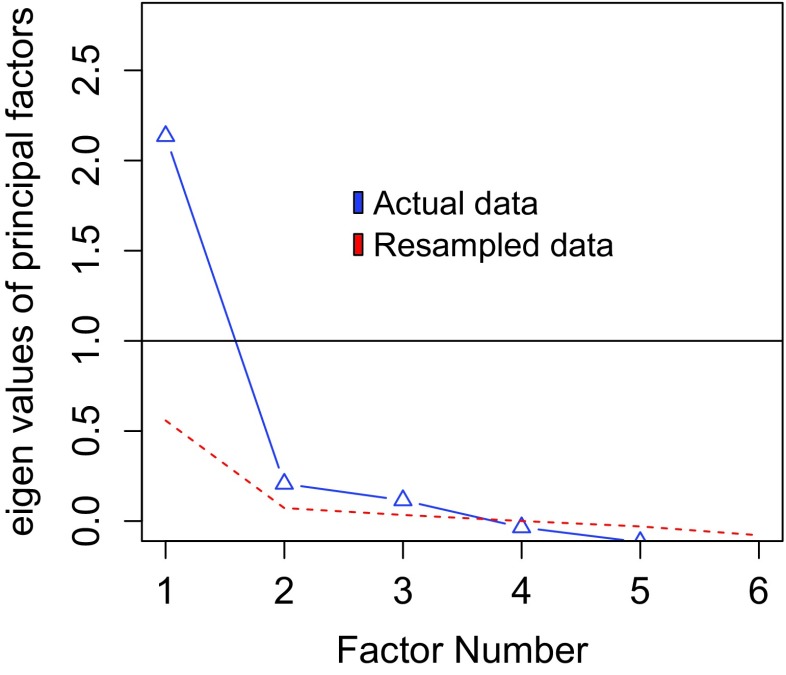
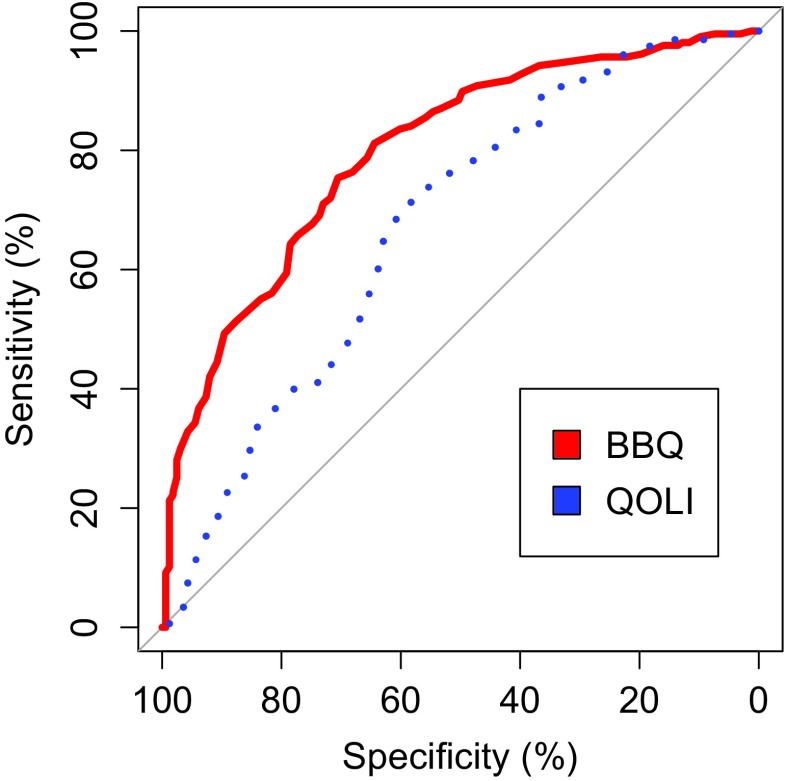
Measurements of subjective quality of life (QoL) are an important complement to symptom ratings in clinical research and practice. Despite there being several established QoL self-rating scales, we identified a need for a freely accessible, easy-to-use inventory, validated for use with both clinical and non-clinical samples, based on the overall life satisfaction conceptualization of QoL. The Brunnsviken Brief Quality of life scale (BBQ) was designed to meet these requirements. Items were selected by performing a factor analysis on a large data-set of QoL ratings collected previously. Six life areas (Leisure time, View on life, Creativity, Learning, Friends and Friendship, and View of self) were identified as important for overall QoL and were included in the BBQ. A psychometric evaluation was performed using two independent samples: healthy undergraduate students (n = 163), and a sample seeking treatment for social anxiety disorder (n = 568). Results suggested a unifactorial structure, with good concurrent and convergent validity, high internal and test-retest reliability, and accurate classification ability. We conclude that the BBQ is a valid and reliable measure of subjective QoL for use in clinical and research settings. The BBQ is presently available in 31 languages and can be freely downloaded from www.bbqscale.com .
Overview
The claims and statistics of this paper haven’t been checked yet.
Free: it reads the open-access text and checks the first 5 claims that cite a source we can check. Create a free account to check every claim.
Integrity signals
Registry
Cites
Statistics
Figures
Verification
Claims the paper makes
The claims and statistics of this paper haven’t been checked yet.
Free: it reads the open-access text and checks the first 5 claims that cite a source we can check. Create a free account to check every claim.
Claims other papers make about this one
Each is checked against this paper’s own text: does it say what the citing paper says it does?
The cited source doesn’t support the claim as written.
In the citing paper
“BBQ has satisfactory internal consistency reliability (α = 0.68) and test-retest reliability (r = 0.89; Lindner et al., 2016).”
From Learning how to recover from stress: Results from an internet-based randomized controlled pilot trial (2023) · cites this paper as Lindner et al., 2016
Checked by a reasoning model — may be wrong.
Experimental — accuracy not yet measuredThe source backs part of the claim, not all of it — or backs it for a different population, condition or comparison.
In the citing paper
“BBQ demonstrates strong test–retest reliability (r = 0.82) and validity, though its internal consistency is moderate (Cronbach's α = 0.76).”
From Internet‐Based Acceptance and Commitment Therapy With Interoceptive Exposure for Panic Disorder: A Randomized Controlled Trial and Working Alliance Analysis. (2026) · cites this paper as Lindner et al. 2016
Experimental — accuracy not yet measuredThe cited source says what the claim attributes to it.
In the citing paper
“It has shown good psychometric properties and a cut-off value has been proposed to differentiate between clinical and non-clinical populations (Lindner et al., 2016).”
From Effectiveness of and processes related to internet-delivered acceptance and commitment therapy for adolescents with anxiety disorders: a randomized controlled trial (2023) · cites this paper as Lindner et al., 2016
The cited source says what the claim attributes to it.
In the citing paper
“BBQ has shown satisfactory reliability both in terms of inter-item correlation and Cronbach’s alpha, as well as regarding test-retest reliability in the short term. An intra-class correlation coefficient of 0.82, indicate high test-retest reliability”
From Evaluation of a Novel Psychological Intervention Tailored for Patients With Early Cognitive Impairment (PIPCI): Study Protocol of a Randomized Controlled Trial (2020) · cites this paper as Lindner et al., 2016
The cited source says what the claim attributes to it.
In the citing paper
“Quality of life was assessed with the validated scale Brunnsviken Brief Quality of Life Scale (BBQ; Lindner et al., 2016).”
From Targeting excessive avoidance behavior to reduce anxiety related to asthma: A feasibility study of an exposure-based treatment delivered online (2021) · cites this paper as Lindner et al., 2016
Self-check
Percentages, sums and reported differences re-computed from the paper’s own numbers.
The self-check needs the paper’s full text.
Citations
Cites
Diagnostic and Statistical Manual of Mental Disorders
American Psychiatric Association (2013) · doi:10.1176/appi.books.9780890425596 · Cited by 116,369
STATISTICAL METHODS FOR ASSESSING AGREEMENT BETWEEN TWO METHODS OF CLINICAL MEASUREMENT
Martin Bland, J., & Altman, D. (1986) · The Lancet · doi:10.1016/s0140-6736(86)90837-8 · Cited by 47,965
The PHQ-9: Validity of a brief depression severity measure
Kroenke, K., Spitzer, R. L., & Williams, J. B. W. (2001) · Journal of General Internal Medicine · doi:10.1046/j.1525-1497.2001.016009606.x · Cited by 44,910
The satisfaction with life scale
Diener, E., Emmons, R. A., Larsen, R. J., & Griffin, S. (1985) · Journal of Personality Assessment · doi:10.1207/s15327752jpa4901_13 · Cited by 31,768
EuroQol: a new facility for the measurement of health-related quality of life
(1990) · Health Policy · doi:10.1016/0168-8510(90)90421-9 · Cited by 15,736
Diagnostic and Statistical Manual of Mental Disorders, 5th ed.
Carter, M. J. (2014) · Therapeutic Recreation Journal · Cited by 15,166
pROC: an open-source package for R and S+ to analyze and compare ROC curves
Robin, X., Turck, N., Hainard, A., Tiberti, N., Lisacek, F., Sanchez, J.-C., & Müller, M. (2011) · BMC Bioinformatics · doi:10.1186/1471-2105-12-77 · Cited by 13,697 · cited 1×
“Further, receiver operating characteristics (ROC) were calculated using the pROC R package (Robin et al., 2011) in order to assess the classification accuracy along different discrimination thresholds.”
MethodCostello, A. B., & Osborne, J. (2005) · University of Massachusetts Amherst · doi:10.7275/jyj1-4868 · Cited by 10,297 · cited 1×
“All six item loadings were above .50, suggesting a solid factor (Costello & Osborne, 2005).”
BackgroundGuillemin, F., Bombardier, C., & Beaton, D. (1993) · Journal of Clinical Epidemiology · doi:10.1016/0895-4356(93)90142-n · Cited by 6,060
(1999) · Cited by 5,934
Cited by
Items 201–213 of 213
Farnsworth von Cederwald, A., Lilja, J. L., Hentati Isacsson, N., & Kaldo, V. (2024) · Figshare · doi:10.6084/m9.figshare.24472616
Westerberg, B., Jacobson, K., Hallerbäck, M. U., Bejerot, S., & Holländare, F. (2026) · Journal of Medical Internet Research · doi:10.2196/76527
“The Brunnsviken Brief Quality of Life Scale (BBQ) [35], consisting of 12 items (responses ranging from 0=do not agree to 4=totally agree), was used to assess QOL.”
Impact of diagnostic genetic testing for familial dementia: experiences of patients and relatives
van der Schaar, J., Visser, L. N. C., Asscher, E. C. A., Pijnenburg, Y. A. L., de Geus, C. M., van der Flier, W. M., Bredenoord, A. L., van den Hoven, M., Smets, E. M. A., & van der Lee, S. J. (2026) · Alzheimer s Research & Therapy · doi:10.1186/s13195-026-02000-z · Cited by 1
“Quality of life was assessed via the Brunnsviken Brief Quality of Life Scale (BBQ) [27] and a VAS.”
Kodancha, P., Baboo, S., & Rajeev, A. (2026) · Journal of Psychosocial Rehabilitation and Mental Health · doi:10.1007/s40737-026-00528-9
Howell, J., Hua, J., & Lab, M. (2024) · OSF Preprints (OSF Preprints)
Banbury, S. A., Hutchison, P., & Chandler, C. (2026) · PEC Global · doi:10.1016/j.pecglo.2026.100005
Sense of Coherence and the Relation to Autistic Traits in Autistic Adults
Westerberg, B., Bejerot, S., Langius‐Eklöf, A., & Holländare, F. (2026) · Autism · doi:10.1177/13623613261469916
“Subjective QOL was measured using the Swedish version of the 12-item Brunnsviken Brief Quality of Life Scale (BBQ; Lindner et al., 2016).”
Prediction Models for Treatment Response in Stress-Related Disorders (Preprint)Preprint
Föyen, L. F., Sennerstam, V., Kontio, E., Flygare, O., Boman, M., & Lindsäter, E. (2026) · doi:10.2196/preprints.109431
von Cederwald, A. F., Carlsson, V., Salomonsson, S., & Kaldo, V. (2026) · Research Square · doi:10.21203/rs.3.rs-10514842/v1
Lindegaard, T., Berg, M., Käll, A., Lockman, J., Schönberg, E., Björklund, M., Frederick, R. J., & Andersson, G. (2026) · Psychodynamic Psychiatry · doi:10.1521/pdps.2026.54.3.511
Self-citationBrehmer, J., Berg, M., Astudillo, G., Lindegaard, T., Find, A. E., Carlbring, P., Ludvigsson, M., & Andersson, G. (2026) · Journal of Affective Disorders · doi:10.1016/j.jad.2026.122494
“There were also no significant between-group differences in quality of life, as measured with BBQ.”
InfluentialSelf-citationInternet-based CBT for young adults with low self-esteem: a randomized, controlled study
Berg, M., Lindegaard, T., Kåll, J., Granath, V., Fält, K., Karlsson, M., & Andersson, G. (2026) · Journal of Behavior Therapy and Experimental Psychiatry · doi:10.1016/j.jbtep.2026.102140
Self-citationStrid, N., Tuominen, J., Bernstein, R., Kirberg, M., Valli, K., Windt, J., Bekinschtein, T., Noreika, V., Revonsuo, A., & Sikka, P. (2026) · Neuroscience of Consciousness · doi:10.1093/nc/niag075
Metadata
- Authors
- Lindner, P., Frykheden, O., Forsström, D., Andersson, E., Ljótsson, B., Hedman, E., Andersson, G., & Carlbring, P.
- Affiliations
- Stockholm University (SE)
- Karolinska Institutet (SE)
- Linköping University (SE)
- Corresponding author
- Lindner, Philip
- Venue
- Cognitive Behaviour Therapy
- Publisher
- Informa UK Limited
- Published
- 2016-02-17
- Volume
- 45
- Issue
- 3
- Pages
- 182-195
- ISSN
- 1650-6073 (ISSN-L)
- 1651-2316
- PMC
- PMC4867878
- OpenAlex
- W2283608639
- Cited by
- 212
- References
- 39
- Citations by year
- 2026: 15 · 2025: 27 · 2024: 36 · 2023: 34 · 2022: 25 · 2021: 25 · 2020: 20 · 2019: 12 · 2018: 9 · 2017: 6 · 2016: 3
- FWCI
- 15.70
- Type
- journal article
- Language
- en
- Open access
- hybrid
- doi.org
- Licence
- Locations
- Cognitive Behaviour Therapy (publishedVersion, cc-by-nc-nd)
- PubMed Central (publishedVersion, cc-by-nc-nd)
- PubMed (publishedVersion)
- Topics
- Social Sciences › Psychology › Social Psychology › Psychological Well-being and Life Satisfaction
- Social Sciences › Decision Sciences › Management Science and Operations Research › Psychometric Methodologies and Testing
- Social Sciences › Psychology › Clinical Psychology › Health and Well-being Studies
- Keywords
- subjective quality of life, life satisfaction, self-report scale development, psychometric validation, social anxiety disorder, life domains, leisure, friendship, self-concept, scale reliability, scale validity
- MeSH terms
- Adult, Female, Humans, Male, Psychiatric Status Rating Scales, Psychometrics, Quality of Life, Surveys and Questionnaires, Reproducibility of Results, Young Adult
About these checks
Registry, retraction, Cites and statistics results are computed, not judged, with one exception: a printed reference that no index lists is read once by a model before it counts as a citation error. Claims are extracted by a model and kept only when their quote appears verbatim in the text; each cited source is then checked, with a model’s help, for whether it says what the claim relies on. Those verdicts can be wrong — read the claim’s quote and the cited source before relying on one.
Statistics and arithmetic are recomputed, not judged.
Confidence bands are shown only for fields calibrated on our annotated test set. None is calibrated yet, so no band is shown.
What counts as a claim ›How we measure confidence ›How we check this ›
Are you an author, or do you see a problem with this page? Request a review
Data sources
Bibliographic data: Semantic Scholar, OpenAlex, Crossref.
Contains information from the Semantic Scholar Academic Graph Datasets, made available under the ODC Attribution License (ODC-BY 1.0).
Semantic Scholar’s data is described in: Kinney, R., et al. (2023). The Semantic Scholar Open Data Platform. arXiv:2301.10140.
