

Tailored internet-based cognitive behavioral therapy for individuals with chronic pain and comorbid psychological distress: a randomized controlled trial
Open accessThe DOI matches its Crossref record; 81 of the 81 references it cites were found in a registry or an index.
Abstract
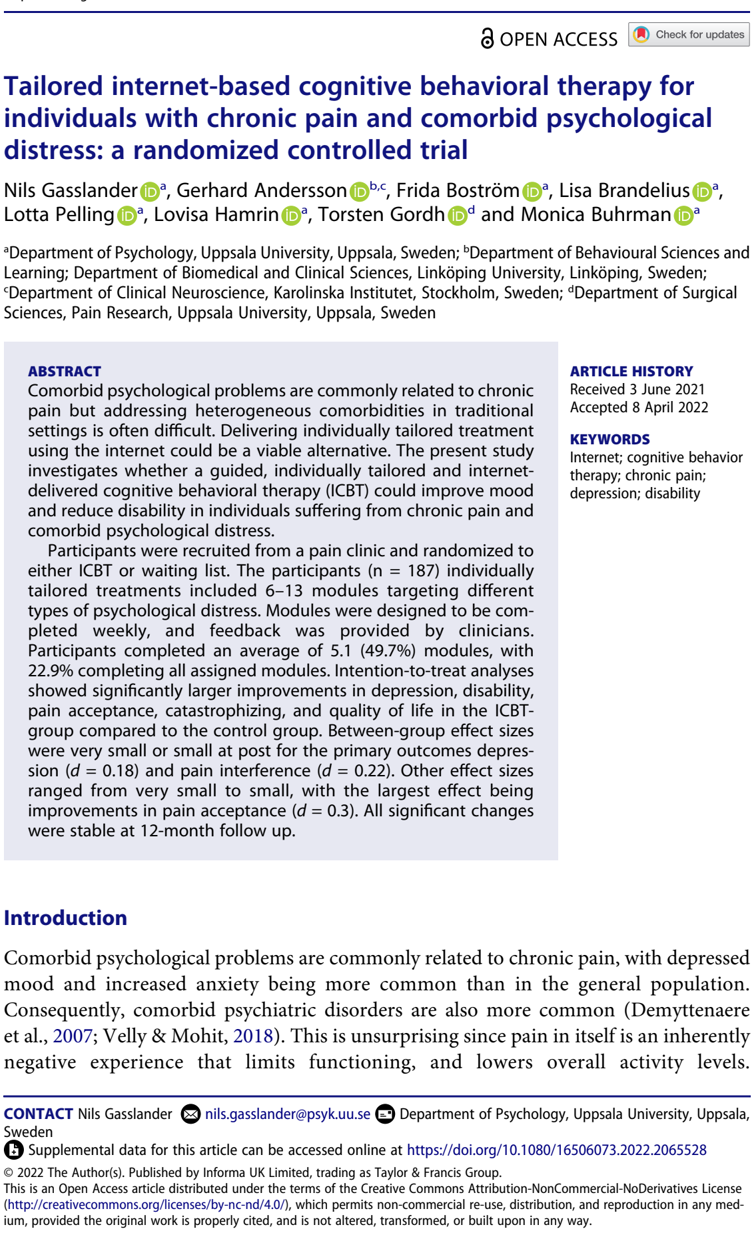
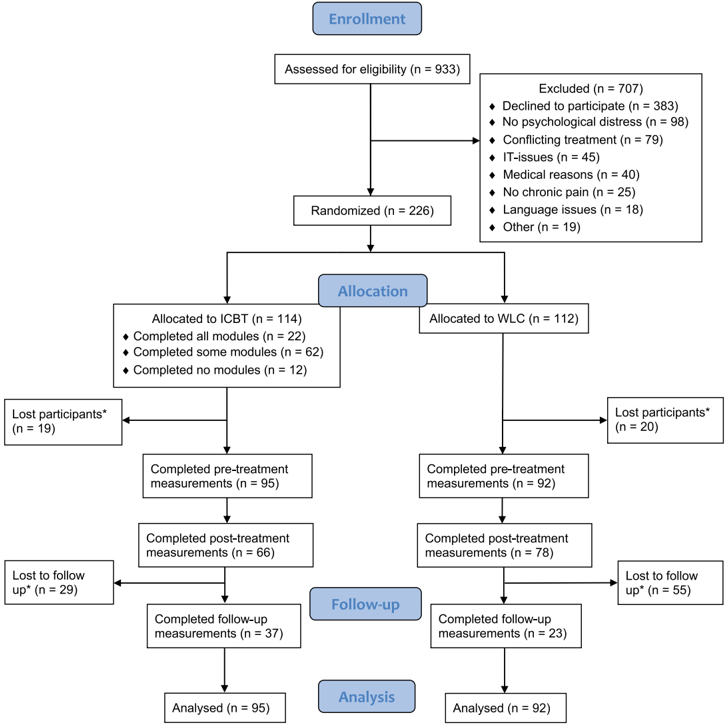
Comorbid psychological problems are commonly related to chronic pain but addressing heterogeneous comorbidities in traditional settings is often difficult. Delivering individually tailored treatment using the internet could be a viable alternative. The present study investigates whether a guided, individually tailored and internet-delivered cognitive behavioral therapy (ICBT) could improve mood and reduce disability in individuals suffering from chronic pain and comorbid psychological distress.Participants were recruited from a pain clinic and randomized to either ICBT or waiting list. The participants (n = 187) individually tailored treatments included 6–13 modules targeting different types of psychological distress. Modules were designed to be completed weekly, and feedback was provided by clinicians. Participants completed an average of 5.1 (49.7%) modules, with 22.9% completing all assigned modules. Intention-to-treat analyses showed significantly larger improvements in depression, disability, pain acceptance, catastrophizing, and quality of life in the ICBT-group compared to the control group. Between-group effect sizes were very small or small at post for the primary outcomes depression (d = 0.18) and pain interference (d = 0.22). Other effect sizes ranged from very small to small, with the largest effect being improvements in pain acceptance (d = 0.3). All significant changes were stable at 12-month follow up.
Overview
The claims and statistics of this paper haven’t been checked yet.
Free: it reads the open-access text and checks the first 5 claims that cite a source we can check. Create a free account to check every claim.
Integrity signals
Registry
Cites
Statistics
Figures



Verification
Claims the paper makes
The claims and statistics of this paper haven’t been checked yet.
Free: it reads the open-access text and checks the first 5 claims that cite a source we can check. Create a free account to check every claim.
Claims other papers make about this one
Each is checked against this paper’s own text: does it say what the citing paper says it does?
The source backs part of the claim, not all of it — or backs it for a different population, condition or comparison.
In the citing paper
“No differences were found between these groups at post-treatment in the three studies (Ólason et al., 2018; Schlicker et al., 2020; Gasslander et al., 2022) exploring this outcome.”
From A systematic review of cognitive behavioral therapy-based interventions for comorbid chronic pain and clinically relevant psychological distress (2023) · cites this paper as Gasslander et al., 2022
Experimental — accuracy not yet measuredThe source backs part of the claim, not all of it — or backs it for a different population, condition or comparison.
In the citing paper
“Two out of two studies (100%) indicated significant differences in increased pain acceptance at post-treatment (Buhrman et al., 2015; Gasslander et al., 2022) with very small (d = 0.12) and small effect size (d = 0.30), but not at follow-up in one out of one study (0%) that explored this outcome, in favor of CBT compared to TAU.”
From A systematic review of cognitive behavioral therapy-based interventions for comorbid chronic pain and clinically relevant psychological distress (2023) · cites this paper as Gasslander et al., 2022
Experimental — accuracy not yet measuredThe source backs part of the claim, not all of it — or backs it for a different population, condition or comparison.
In the citing paper
“Two out of three studies (67%) found significant differences in the reduction of pain interference at post-treatment with small to very small (d ranging from 0.22 to 0.12; Buhrman et al., 2015; Gasslander et al., 2022)”
From A systematic review of cognitive behavioral therapy-based interventions for comorbid chronic pain and clinically relevant psychological distress (2023) · cites this paper as Gasslander et al., 2022
Experimental — accuracy not yet measuredThe source backs part of the claim, not all of it — or backs it for a different population, condition or comparison.
In the citing paper
“No significant differences (0%) between these groups were found at post-treatment in two studies (Buhrman et al., 2015; Gasslander et al., 2022) and at follow-up in one study (Buhrman et al., 2015) exploring the fear of anxiety symptoms.”
From A systematic review of cognitive behavioral therapy-based interventions for comorbid chronic pain and clinically relevant psychological distress (2023) · cites this paper as Gasslander et al., 2022
Experimental — accuracy not yet measuredThe source backs part of the claim, not all of it — or backs it for a different population, condition or comparison.
In the citing paper
“One out of two studies (50%) indicated significant differences in coping strategy of ignoring and catastrophizing at post-treatment (Gasslander et al., 2022) with small effect sizes (d = 0.38 and d = 0.34)”
From A systematic review of cognitive behavioral therapy-based interventions for comorbid chronic pain and clinically relevant psychological distress (2023) · cites this paper as Gasslander et al., 2022
Experimental — accuracy not yet measured
2 more claims about this paper
Create a free account to see every claim other papers make about this one.
Self-check
Percentages, sums and reported differences re-computed from the paper’s own numbers.
The self-check needs the paper’s full text.
Citations
Cites
Statistical Power Analysis for the Behavioral Sciences
Muller, K. (1989) · Technometrics · doi:10.1080/00401706.1989.10488618 · Cited by 99,167
The Hospital Anxiety and Depression Scale
Zigmond, A. S., & Snaith, R. P. (1983) · Acta Psychiatrica Scandinavica · doi:10.1111/j.1600-0447.1983.tb09716.x · Cited by 47,139 · cited 1×
“In contrast to similar scales, HADS include no items referring to physical symptoms, reasoning that such reactions may be attributed to the medical disease or treatment itself (Zigmond & Snaith, 1983).”
A Brief Measure for Assessing Generalized Anxiety Disorder: The GAD-7
Spitzer, R. L., Kroenke, K., Williams, J. B. W., & Löwe, B. (2006) · Archives of Internal Medicine · doi:10.1001/archinte.166.10.1092 · Cited by 31,765 · cited 1×
“Scores above 10 are considered to be in the clinical range (Spitzer et al., 2006).”
BackgroundJournal of Clinical Psychiatry
(2018) · Journal of Clinical Psychiatry · doi:10.5505/kpd · Cited by 13,651
Validation of the Insomnia Severity Index as an outcome measure for insomnia research
Bastien, C. (2001) · Sleep Medicine · doi:10.1016/s1389-9457(00)00065-4 · Cited by 8,067 · cited 1×
“A 5-point Likert scale is used to rate each item yielding a total score from 0 to 28, with higher scores indicating more severe insomnia (Bastien et al., 2001).”
MethodSurvey of chronic pain in Europe: Prevalence, impact on daily life, and treatment
Breivik, H., Collett, B., Ventafridda, V., Cohen, R., & Gallacher, D. (2006) · European Journal of Pain · doi:10.1016/j.ejpain.2005.06.009 · Cited by 5,486 · cited 1×
“Although non-drug treatments are common, only a minority of patients in Europe report having received psychotherapy, and access to multidisciplinary treatments varies (Breivik et al., 2006, 2013).”
BackgroundArchives of Physical Medicine and Rehabilitation
(1976) · Journal of Sound and Vibration · doi:10.1016/0022-460x(76)90695-7 · Cited by 5,476
Blevins, C. A., Weathers, F. W., Davis, M. T., Witte, T. K., & Domino, J. L. (2015) · Journal of Traumatic Stress · doi:10.1002/jts.22059 · Cited by 5,233 · cited 1×
“Test-retest reliability has been reported as .82 at 1 week and internal consistency has been shown to be high at α = .94 (Blevins et al., 2015).”
BackgroundMorin, C. M., Belleville, G., Bélanger, L., & Ivers, H. (2011) · Sleep · doi:10.1093/sleep/34.5.601 · Cited by 4,620 · cited 1×
“Internal consistency has been reported as very good, α = .90–.91 (Morin et al., 2011) and in the present trial the internal consistency was good, α = .81.”
BackgroundLöwe, B., Decker, O., Müller, S., Brähler, E., Schellberg, D., Herzog, W., & Herzberg, P. Y. (2008) · Medical Care · doi:10.1097/mlr.0b013e318160d093 · Cited by 4,527 · cited 2×
“Internal consistency is good across different samples, α = .89 (Löwe et al., 2008).”
Background
Research works printed but not linked: 1
- Sheehan, D. V. (2014). Mini Internationell Neuropsykiatrisk Intervju: Swedish translation version 7.0.0 enligt DSM-5. University of South Florida, Institute for Research in Psychiatry. https:// psykiatristod.se/download/18.298d3d1f16d8b550c941601a/1570616697125/M.I.N.I.7.0_AU1. 0_swe-SE.pdf
Cited by
McCracken, L. M. (2023) · European Journal of Pain · doi:10.1002/ejp.2091 · Cited by 105
“In the trial of tailored internet- based CBT, compared to a waiting list, participants in the tailored CBT achieved small effect sizes for depression and pain interference, but no effect on disability (Gasslander et al., 2022).”
InfluentialSanabria-Mazo, J. P., Colomer-Carbonell, A., Fernández-Vázquez, Ó., Noboa-Rocamora, G., Cardona-Ros, G., McCracken, L. M., Montes-Pérez, A., Castaño-Asins, J. R., Edo, S., Borràs, X., et al. (2023) · Frontiers in Psychology · doi:10.3389/fpsyg.2023.1200685 · Cited by 56
Tao, T. J., Lim, T. K., Yeung, E. T. F., Liu, H., Shris, P. B., Lawrence, K., Lee, T. M. C., & Hou, W. K. (2023) · npj Digital Medicine · doi:10.1038/s41746-023-00809-8 · Cited by 67
Sanabria-Mazo, J. P., Colomer-Carbonell, A., Borràs, X., Castaño-Asins, J. R., McCracken, L. M., Montero-Marin, J., Pérez-Aranda, A., Edo, S., Sanz, A., Feliu-Soler, A., et al. (2023) · The Journal of Pain · doi:10.1016/j.jpain.2023.04.008 · Cited by 40
Rosser, B. A., Fisher, E., Janjua, S., Eccleston, C., Keogh, E., & Duggan, G. B. (2023) · Cochrane Database of Systematic Reviews · doi:10.1002/14651858.cd013863.pub2 · Cited by 45
Gasslander, N., Alfonsson, S., Jackalin, A., Tengberg, C., Håkansson, J., Huotari, L., & Buhrman, M. (2021) · BMC Psychology · doi:10.1186/s40359-021-00663-x · Cited by 20
“Design, procedure and participants Data for this study was retrieved from a previously conducted iCBT study for individuals with chronic pain [12].”
BackgroundMethodInfluentialSelf-citationThe latest developments with internet-based psychological treatments for depression
Andersson, G. (2024) · Expert Review of Neurotherapeutics · doi:10.1080/14737175.2024.2309237 · Cited by 20
“Overall, treating depression in association with somatic disorders is a field that deserves more attention as comorbidity with for example chronic pain is substantial and treatment programs for somatic conditions often include treatment ingredients based on depression protocols [14].”
BackgroundSelf-citationScholten, S., & Glombiewski, J. A. (2024) · Current Opinion in Psychology · doi:10.1016/j.copsyc.2024.101958 · Cited by 17
Jehl, N. M., Hess, C. W., Choate, E., Nguyen, H. T., Yang, Y., & Simons, L. E. (2024) · Journal of Pediatric Psychology · doi:10.1093/jpepsy/jsae056 · Cited by 11
Oirschot, G. V., Pomphrey, A., Dunne, C., Murphy, K., Blood, K., & Doherty, C. (2024) · JMIR Rehabilitation and Assistive Technologies · doi:10.2196/48154 · Cited by 11
Considerations for idiographic chronic pain treatment
Lavefjord, A., & Sundström, F. (2024) · Current Opinion in Psychology · doi:10.1016/j.copsyc.2024.101946 · Cited by 9
“Similarly, although at a more complex, and arguably somewhat more idiographic, level, Gasslander et al. [25], tailored digital treatment content to patients with chronic pain based on the occurrence of comorbid psychological problems such as anxiety, depression, or trauma.”
Maltoni, J., Neufeld, C. B., Aminoff, V., & Andersson, G. (2025) · Internet Interventions · doi:10.1016/j.invent.2025.100854 · Cited by 10
Self-citationXiang, X., Turner, S., Ruiz-Sierra, S., Zheng, C., Ash, S., Kodkany, N., Dimoji, A., Gosdzinski, C., & Kubicek, G. (2024) · Clinical Gerontologist · doi:10.1080/07317115.2024.2395890 · Cited by 9
“With the emergence of more adaptive iCBT programs that can toggle modules based on specific user needs, personalization is becoming more feasible (Gasslander et al., 2022; Silfvernagel et al., 2018; Van Beugen et al., 2016).”
Sanduvete-Chaves, S., Chacón-Moscoso, S., & Cano-García, F. J. (2024) · Journal of Psychosomatic Research · doi:10.1016/j.jpsychores.2024.111888 · Cited by 4
Persson, M., Daka, B., Varkey, E., Lilja, J. L., Nissling, L., Cronstedt, O., Perschbacher, A.-K., Bratt, A. S., & Weineland, S. (2024) · Cognitive Behaviour Therapy · doi:10.1080/16506073.2024.2408384 · Cited by 7
“The proportion of patients who completed all modules in the I AM program was higher than the completion rates reported in studies on ICBT for mental health in primary care (Gervind, 2024) and for chronic pain and comorbid psychological distress in specialist care (Gasslander, 2022).”
Li, M., Liu, F., Han, X., Li, J., & Fan, Y. (2024) · Psycho-Oncology · doi:10.1002/pon.70014 · Cited by 5
RetractedO'Donnell, M. L., Arjmand, H., Lumley, M. A., Seal, K. H., Mani, R., Sterling, M. M., Reed, D. E., Sbisa, A. M., Bair, M. J., Bown, S., et al. (2025) · Pain · doi:10.1097/j.pain.0000000000003880 · Cited by 7
Bendelin, N., Gerdle, B. U. C., & Andersson, G. (2023) · Scandinavian Journal of Pain · doi:10.1515/sjpain-2022-0139 · Cited by 4
“ICBT has been found helpful in treating comorbidities alongside face-to-face treatment [64].”
Self-citationLara, L. V. G., Granizo, V. C., & Izurieta, A. P. R. (2025) · Revista de la Facultad de Ciencias Médicas de Córdoba · doi:10.31053/1853.0605.v82.n4.48710 · Cited by 1
“Adicionalmente, los resultados positivos en pacientes con comorbilidades psicológicas (9,14) y uso prolongado de opioides (2) señalan el potencial de la TCC para abordar casos complejos que representan desafíos significativos en la práctica clínica actual.”
InfluentialPreferences, tailoring, and self-tailoring in internet-delivered treatments: lessons learned
Andersson, G., & Carlbring, P. (2026) · Expert Review of Neurotherapeutics · doi:10.1080/14737175.2026.2652294 · Cited by 1
“The third example of a tailored treatment was a Swedish study on chronic pain with comorbid psychological distress [27].”
Self-citationQiu, R., Feng, H., Li, X., & Zhou, H. (2026) · Journal of Medical Internet Research · doi:10.2196/90458 · Cited by 1
“Most trials reported a mean or median participant age of 60 years or older, particularly those conducted in primary care, postdischarge, or geriatric settings, whereas several internet-delivered psychological intervention trials focused on younger or midlife samples [46-49].”
InfluentialSanabria‐Mazo, J. P., Rodríguez‐Freire, C., Royuela-Colomer, E., Ponce‐López, P., Alonso‐Coello, P., Barrios, V., Navarrete, J., Pérez‐Aranda, A., McCracken, L. M., & Luciano, J. V. (2026) · European Journal of Pain · doi:10.1002/ejp.70342 · Cited by 1
“…Pérez-Aranda et al. 2019; Pérez-Fernández et al. 2022; Robles et al. 2024; Taub et al. 2024; Torrijos-Zarcero et al. 2021; Turner et al. 2016; Zgierska et al. 2016), and CCBT ( k = 6) (Bostrøm et al. 2023; Buhrman et al. 2015; Gasslander et al. 2022; Pincus et al. 2015; Solberg Nes et al. 2024).”
Bendelin, N. (2023) · Linköping University medical dissertations · doi:10.3384/9789180750288 · Cited by 1
Li, C. J., & Hou, W. K. (2026) · Springer eBooks · doi:10.1007/978-3-032-08980-9_22
Eather, C.-E., Sullivan, C. M., Sterling, M. M., Armfield, N. R., Liimatainen, J., Chandra, S. S., & Elphinston, R. A. (2026) · Pain · doi:10.1097/j.pain.0000000000003959
Gasslander, N., Sundström, F., Andersson, G., & Buhrman, M. (2026) · Internet Interventions · doi:10.1016/j.invent.2026.100958
Self-citationJin, Q., Wen, Y., Wu, L., Wang, Z., & Zhang, Y. (2026) · Frontiers in Medicine · doi:10.3389/fmed.2026.1788247 · Cited by 1
“Over the past 60 years, parallel advancements in the scientific understanding of pain and the development of cognitive and behavioral therapies have led to the widespread application of CBT in addressing chronic pain issues (9–11).”
Semonella, M., Luca, A. D., Rodighiero, C., Andersson, G., Buhrman, M., Donisi, V., Usubini, A. G., Landi, G., Manna, C., Pasini, I., et al. (2026) · Frontiers in Psychology · doi:10.3389/fpsyg.2026.1813251 · Cited by 1
Self-citationNwokedike, A. C., Gbadamosi, F. O., Onyebuchi, C. W., Okolo, E. E., Vincent, E., Anjorin, L. O., Onwumere, C. M., Ezewudo, I., Bello, O. M., Onyebuchi, S., et al. (2026) · medtigo Journal of Medicine · doi:10.63096/medtigo3062442
Metadata
- Authors
- Gasslander, N., Andersson, G., Boström, F., Brandelius, L., Pelling, L., Hamrin, L., Gordh, T., & Buhrman, M.
- Affiliations
- Uppsala University (SE)
- Linköping University (SE)
- Corresponding author
- Gasslander, Nils
- ORCID
- Venue
- Cognitive Behaviour Therapy
- Publisher
- Informa UK Limited
- Published
- 2022-05-09
- Volume
- 51
- Issue
- 5
- Pages
- 408-434
- ISSN
- 1650-6073 (ISSN-L)
- 1651-2316
- OpenAlex
- W4229439703
- Semantic Scholar
- 01d588358fcbde45246c0b03f51a2a1deb8d5281
- Cited by
- 29
- References
- 79
- Citations by year
- 2026: 9 · 2025: 3 · 2024: 9 · 2023: 7
- FWCI
- 4.20
- Type
- journal article
- Language
- en
- Open access
- hybrid
- doi.org
- Licence
- Locations
- Cognitive Behaviour Therapy (publishedVersion, cc-by-nc-nd)
- PubMed (publishedVersion)
- KTH Publication Database DiVA (KTH Royal Institute of Technology) (submittedVersion, other-oa)
- Uppsala University Publications (Uppsala University) (submittedVersion, other-oa)
- Funders
- AFA Insurance
- Topics
- Social Sciences › Psychology › Applied Psychology › Digital Mental Health Interventions
- Health Sciences › Health Professions › Physical Therapy, Sports Therapy and Rehabilitation › Musculoskeletal pain and rehabilitation
- Social Sciences › Psychology › Clinical Psychology › Mindfulness and Compassion Interventions
- Keywords
- internet-based cognitive behavioral therapy, chronic pain, psychological distress, depression, pain catastrophizing, pain acceptance, disability, quality of life, pain interference, comorbidities
- MeSH terms
- Psychological Distress, Humans, Quality of Life, Cognitive Behavioral Therapy, Treatment Outcome, Internet, Chronic Pain
About these checks
Registry, retraction, Cites and statistics results are computed, not judged, with one exception: a printed reference that no index lists is read once by a model before it counts as a citation error. Claims are extracted by a model and kept only when their quote appears verbatim in the text; each cited source is then checked, with a model’s help, for whether it says what the claim relies on. Those verdicts can be wrong — read the claim’s quote and the cited source before relying on one.
Statistics and arithmetic are recomputed, not judged.
Confidence bands are shown only for fields calibrated on our annotated test set. None is calibrated yet, so no band is shown.
What counts as a claim ›How we measure confidence ›How we check this ›
Are you an author, or do you see a problem with this page? Request a review
Data sources
Bibliographic data: Semantic Scholar, OpenAlex, Crossref.
Contains information from the Semantic Scholar Academic Graph Datasets, made available under the ODC Attribution License (ODC-BY 1.0).
Semantic Scholar’s data is described in: Kinney, R., et al. (2023). The Semantic Scholar Open Data Platform. arXiv:2301.10140.
