

Forces of Terror: Armed Banditry and Insecurity in North-west Nigeria
Open accessThe DOI matches its Crossref record; 19 of the 19 references it cites were found in a registry or an index; 3 of the 74 sources its claims cite were checked for support.
Abstract
Nigeria has confronted several security conundrums in recent years, including armed banditry, which poses a severe threat to the north-west and the entire nation. North-west Nigeria has been hit by an unprecedented wave of kidnappings, maiming, killings, population displacements, cattle rustling, and disruption of socio-economic activities due to the rise of armed bandits in the region. These events have created a climate of uncertainty that has become a cause for concern for the government and the citizenry. Relying on secondary sources of data, this article examines the causes, manifestations, and dimensions of armed banditry in north-west Nigeria, and its security implications. It provides a survey of both the visible and less-visible actors in the conflict. The article argues that armed banditry in the north-west and other parts of Nigeria transcends pastoralist insurgency, as evident in the dominant narratives, considering the multiplicity of complexly connected causal factors, actors, manifestations, and dimensions that are present in the threats posed by this development. The article also shows the negative impacts of armed banditry on human and national security in the region.
Overview
CoChat Summary
TL;DR
The article examines the causes, manifestations, dimensions, actors, and security implications of armed banditry in north-west Nigeria, arguing that it is not merely pastoralist insurgency but a multidimensional crisis with complexly connected drivers and enablers. It documents severe human, economic, educational, and national-security impacts across the region.
Key findings
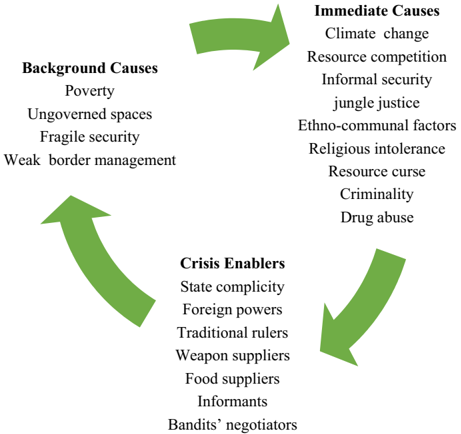
- Armed banditry is driven by background causes (poverty, ungoverned spaces, fragile security, weak border management), immediate triggers (climate-induced migration and resource competition, informal security and jungle justice, ethno-communal and religious factors, resource curse, criminality, drug abuse), and crisis enablers (state complicity, foreign powers, traditional rulers, weapon suppliers, food suppliers, informants, and bandits’ negotiators).
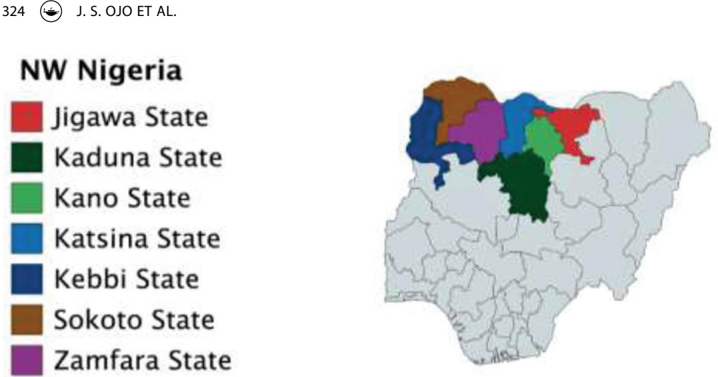
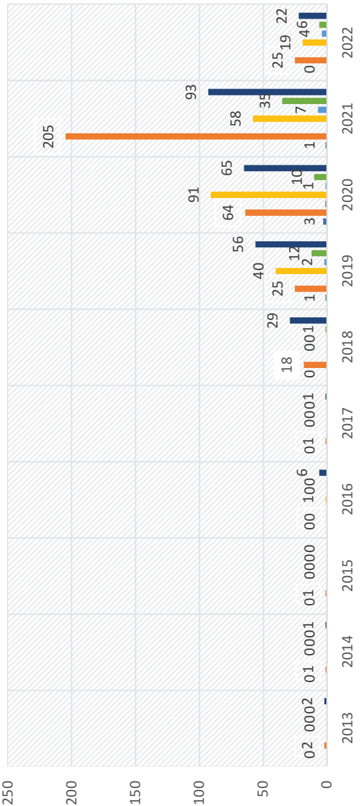
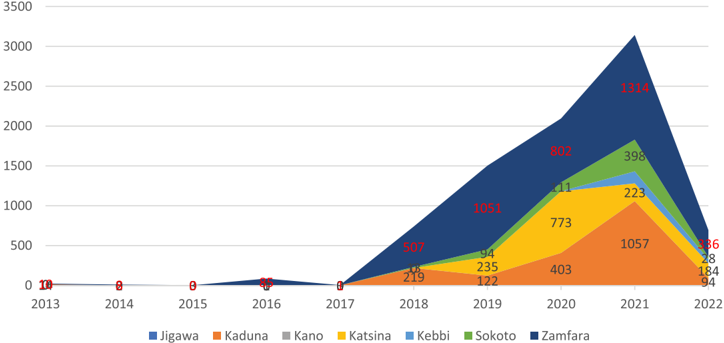
- Between January 2013 and March 2022, armed bandits killed 8,300 people in north-west Nigeria: 7 in Jigawa, 1,917 in Kaduna, 1,416 in Katsina, 202 in Kebbi, 644 in Sokoto, and 4,114 in Zamfara. Out of 909 recorded bandit attacks, Kaduna experienced 342, Katsina 208, Zamfara 275, Sokoto 54, Kebbi 14, Jigawa 5, and Kano 1.
- Displacement and humanitarian impacts include 210,354 people displaced from 171 communities in the north-west, with Zamfara accounting for 144,996, Sokoto 35,941, and Katsina 29,417; NEMA reported 105,463 displaced in Sokoto alone. The crisis is estimated to have displaced over 210,000 people in north-west Nigeria as of March 2020 and generated 35,000 refugees who crossed into places like Maradi in Niger Republic.
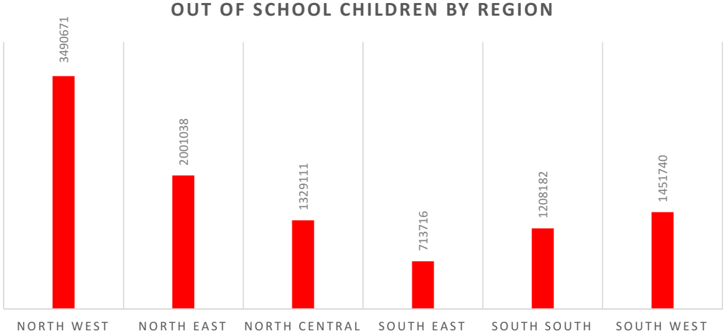
- Economic and educational impacts include insecurity costing Nigeria 8% of its GDP ($132.59 billion) in 2021, 26.95% of GDP affected by disruption of agricultural-related activities, more than 5,884 farmlands covering more than 58,330 hectares abandoned in Katsina, 519 students and staff abducted in seven school attacks in Katsina, Kaduna, and Zamfara between 2019 and 2021, and 3.49 million out-of-school children in the north-west.
Methods
- The article relies on secondary sources of data and adopts a qualitative-dominated analysis.
- It examines the causes, manifestations, dimensions, visible and less-visible actors, and security implications of armed banditry in north-west Nigeria.
- It draws on datasets and reports including the NST dataset, UNDP Multidimensional Poverty Index/OPHI data, Institute of Economics and Peace, Nigeria’s National Bureau of Statistics, Manufacturers’ Association of Nigeria, UNHCR, and NEMA.
Limitations
- The paper does not include an explicit limitations section. It states that bandit attack fatalities are largely underreported by government, media, and security agencies, and that records of school attacks and victims are not exhaustive.
- Evident from the text: the study depends on secondary sources and qualitative-dominated analysis, so its findings are shaped by the reliability, completeness, and availability of existing reports and datasets.
Model-written summary. Check it against the paper before relying on it.
Integrity signals
Registry
Cites
Statistics
Figures








Verification
Claims the paper makes
2 Valid · 5 Not valid · 71 Not checked · 64 Own results and interpretations
The cited sources support only part of this claim — read each source’s verdict below.
In the paper
“In most cases, armed bandits often live in ungoverned or under-governed spaces, where government presence is mostly limited or absent.”
§ Forces of Terror: Armed Banditry and Insecurity in North-west Nigeria > Armed banditry: a conceptual clarification
What the sources say
- Partly supportedcites [23] 23. Ojo, John Sunday, "Governing 'Ungoverned Spaces' in the Foliage of Conspiracy: Toward (re) ordering Terrorism, from Boko Haram Insurgency, Fulani Militancy to Banditry in Northern Nigeria," African Security 13, no. 1 (2020): 77-110. sourceExperimental — accuracy not yet measured
The Introduction links some bandits’ operations to ungoverned spaces and identifies unguarded forests where they operate. It also describes such spaces as having limited or absent government presence. The paper does not establish that bandits live there in most cases; its specific statement is about some operations in northern Nigeria. (LLM, conf=0.85)
plainstates an association- Asserted: passes — The authors put it forward as true.
- Checkable: passes — It can be checked against evidence.
- Load-bearing: unclear — It is unclear whether the paper’s conclusions depend on it.
- Based: passes — The paper gives a reason why it holds.
- Partly supported
The cited sources support only part of this claim — read each source’s verdict below.
In the paper
“It takes several hours for the state to respond due to massive forests such as Kunduma, Falgore, Subudu, Kamara, Kiyanbana and Kamuk forests shielding the armed bandits from state security interventions.”
§ Forces of Terror: Armed Banditry and Insecurity in North-west Nigeria > Introduction
What the sources say
- Partly supportedcites [8] 8. Ejiofor, Promise Frank, "Beyond Ungoverned Spaces: Connecting the Dots between Relative Deprivation, Banditry, and Violence in Nigeria," African Security (2022): 1-31. 10. Ibid., 10. sourceExperimental — accuracy not yet measured
“The criminal activities of bandits” says bandits attack from forests, and “State responses to banditry” describes their forest hideouts. Neither passage says forests cause the state to take several hours to respond or identifies the listed forests as shielding bandits from intervention. Page numbers are unavailable in our copy. (LLM, conf=0.79)
plainstates a cause- Asserted: passes — The authors put it forward as true.
- Checkable: passes — It can be checked against evidence.
- Load-bearing: unclear — It is unclear whether the paper’s conclusions depend on it.
- Based: passes — The paper gives a reason why it holds.
- Partly supported
A result the paper reports from its own data — it cites no other source for it, so there is none to check. The quote shows it is in the paper.
In the paper
“Kano and Jigawa state experienced minimal incidences of armed banditry.”
§ Forces of Terror: Armed Banditry and Insecurity in North-west Nigeria > Origin of armed banditry in North West Nigeria
plain- Asserted: passes — The authors put it forward as true.
- Checkable: passes — It can be checked against evidence.
- Load-bearing: unclear — It is unclear whether the paper’s conclusions depend on it.
- Based: passes — The paper gives a reason why it holds.
A result the paper reports from its own data — it cites no other source for it, so there is none to check. The quote shows it is in the paper.
In the paper
“The data reveals that Kaduna experienced most of the attacks by armed bandits, followed by Katsina, Zamfara, and Sokoto states.”
§ Forces of Terror: Armed Banditry and Insecurity in North-west Nigeria > Origin of armed banditry in North West Nigeria
plain- Asserted: passes — The authors put it forward as true.
- Checkable: passes — It can be checked against evidence.
- Load-bearing: unclear — It is unclear whether the paper’s conclusions depend on it.
- Based: passes — The paper gives a reason why it holds.
A result the paper reports from its own data — it cites no other source for it, so there is none to check. The quote shows it is in the paper.
In the paper
“The effects of armed banditry also extend to education, with a series of attacks recorded against schools, students, and teachers.”
§ Forces of Terror: Armed Banditry and Insecurity in North-west Nigeria > Economic and educational impacts
plainstates a cause- Asserted: passes — The authors put it forward as true.
- Checkable: passes — It can be checked against evidence.
- Load-bearing: passes — The paper’s conclusions depend on it.
- Based: passes — The paper gives a reason why it holds.
71 more claims
Create a free account to see all 142 claims and to verify the 3 references still open.
- It may state two separate claims as one. 48
- Probably not a substantial claim. 24
- The quote only partly states this claim. 1
Self-check
Percentages, sums and reported differences re-computed from the paper’s own numbers.
Each contradiction between two passages listed here was confirmed by an independent check.
Rated minor: it would not touch a result — a value no result rests on, a p-value that stays on the same side of the significance level, or a conflict that is clerical, resolved elsewhere in the paper, or outside its own findings.
In the paper
§ Forces of Terror: Armed Banditry and Insecurity in North-west Nigeria > Origin of armed banditry in North West Nigeria
“Katsina 208, Kebbi 14, Sokoto 54, Zamfara 275.”
§ Forces of Terror: Armed Banditry and Insecurity in North-west Nigeria > Origin of armed banditry in North West Nigeria
“The data reveals that Kaduna experienced most of the attacks by armed bandits, followed by Katsina, Zamfara, and Sokoto states.”
Rated minor: it would not touch a result — a value no result rests on, a p-value that stays on the same side of the significance level, or a conflict that is clerical, resolved elsewhere in the paper, or outside its own findings.
In the paper
§ Forces of Terror: Armed Banditry and Insecurity in North-west Nigeria > References
“Nigeria: Population at Risk, March 1, 2022. Accessed February 20, 2022.”
§ Forces of Terror: Armed Banditry and Insecurity in North-west Nigeria > References
“March 1, 2022. Accessed February 20, 2022.”
Rated minor: it would not touch a result — a value no result rests on, a p-value that stays on the same side of the significance level, or a conflict that is clerical, resolved elsewhere in the paper, or outside its own findings.
In the paper
§ Forces of Terror: Armed Banditry and Insecurity in North-west Nigeria > Ethno-communal and religious dimension
“more than half of Nigerians (48.2%) identified themselves with ethnic origins and 21% with religious affinities.”
§ Forces of Terror: Armed Banditry and Insecurity in North-west Nigeria > Ethno-communal and religious dimension
“more than half of Nigerians (48.2%)”
Citations
Cites
The publisher hasn’t deposited this paper’s reference list.
Research works printed but not linked: 9
- [22]22. Uche, J. C. and Iwuamadi, C. K., "Nigeria: Rural Banditry and Community Resilience in the Nimbo Community," Conflict Studies Quarterly, no. 24 (2018): 71-82. 20. Ibid., 1. 21. Ibid., 8. 22. Ibid., 1.
- [24]24. Shalangwa, M. W. "The Nature and Consequences of Armed Banditry in Border Communities of Adamawa State, Nigeria," Unpublished Thesis (2013). 25. Ibid., 19.
- [25]25. Slatta, Richard W., ed., Bandidos: The Varieties of Latin American Banditry (New York: Greenwood Press, 1987).
- [36]36. Leonardo A. Villalón, ed., Oxford Handbook of African Sahel (Oxford: Oxford University Press, 2021).
- [45]45. Oxford Poverty and Human Development Initiative (OPHI), 2017
- [49]49. Okechukwu Ibeanu, Israel Kelue Okoye, Ikenna Alumona and Ernest Toochi Aniche (Singapore: Palgrave Macmillan, 2022), 267-89. 47. Ibid.
- [57]57. Osaghae, Eghosa E., and Rotimi. Suberu, A History of Identities, Violence and Stability in Nigeria, Vol. 6. (Oxford: Center for Research on Inequality, Human Security and Ethnicity, University of Oxford, 2005).
- [66]66. Oriola, Temitope B., Freedom C. Onuoha, and Samuel Oyewole. "Boko Haram in the Lake Chad Basin: Dimensions, activities and trajectories," In Boko Haram's Terrorist Campaign in Nigeria, 1-12. Routledge, 2021;
- [93]93. Thisdaylive, "Report Links Rising Insecurity, Terrorism to Frustration, Economic Marginalization of Youths," April 25, 2022. 100. The Guardian, "Nigerians pay more for Insecurity as Economic Impact Hits N50tr," March 23, 2021. 101. Ibid., 86. 102. Olapeju, Rosenje Musharafa, and Adeniyi, Oluwatobi Peter, "The Impact of Banditry on Nigeria's Security in the Fourth Republic: An Evaluation of Nigeria's North-West," Zamfara Journal of Politics and Development 2, no. 1 (2021): 26. 103. Premium Time, "Banditry: Residents of North-west States Reluctantly Embrace Stringent Measures as Governors Unite," September 12, 2021. 104. International Crisis Group, "Stopping Nigeria's Spiraling Farmer-Herders violence, African Report," July 28, 2018. 105. NST. 106. CBC, Nigerian State Governor says more than 300 Kidnapped Schoolboys have been Turned over to Security, December 17, 2020. 107. Dakuku Peterside, School Kidnappings and its Implications for Posterity, Premium Times, June 21, 2021. 108. Premium Times, "ANALYSIS: Kidnappings and School Closures: What the Nigerian Govt must do," December, 2021. 109. Blueprint, Banditry, others drawing North's education backward, March 5, 2021. 110. Premium Times, "SPECIAL REPORT: Kano, Akwa Ibom, Eight other States Housed most of Nigeria's out-of-school Children," September 8, 2021. 111. International Crisis Group, "Violence in Nigeria's North West: Rolling Back the Mayhem," May 18, 2020. 112. The Punch, Bandits killed 11,000 men, orphaned 44,000 in Zamfara -Marafa, May 6, 2019; PM News, 2019. "Zamfara under pressure from bandits for more than 10 years - SSG," April 25, 2019. 113. Vanguard, Horror in Sokoto, Niger, "Kaduna: "Bandits kill farmers, seize survivors' Harvest, turn Abducted Women into Sex Slaves," February 27, 2022. 114. PM News, "Zamfara under Pressure from Bandits for more than 10 years -SSG," April 25, 2019. 115. Samuel Oyewole, "Struck and Killed in Nigerian Air Force's Campaigns: Assessment of Airstrike Locations, Targets and Impacts in Internal Security Operations," African Security Review 30, no. 1 (2021): 24-47. 116. Vanguard, "How South West Gave Legal Teeth to Amotekun," March 7, 2020. 117. The Guardian, "Southeast Governors unleash Ebube Agu to Tackle Rising Unrest," April 12, 2021. 118. Punch, "NAF Denies Paying N20m to avoid Shooting down Buhari's Plane," October 17, 2021. 119. Samuel Oyewole, Civil-military Relations: Conflict and Cooperation between Military Bases and Host Communities in Nigeria, African Security, 13(4) (2020): 353-379
Cited by
Mohammed, Y., Reynolds, H. W., Waziri, H. S., Attahiru, A., Mikailu, F., Adewole, A. O., Wisdom, M., Uba, B. V., Kamateeka, M., Waziri, N. E., et al. (2024) · Vaccine X · doi:10.1016/j.jvacx.2024.100563 · Cited by 76
“…states particularly Sokoto, Kebbi and Zamfara axis, armed banditry typifies by mass kidnapping, robbery along major highways, cattle rustling, and disruption of socio-economic activities by ethnic militias has resulted in internal displacement of thousands of people and missed communities [132].”
BackgroundAina, F., Ojo, J. S., & Oyewole, S. (2023) · African Security Review · doi:10.1080/10246029.2023.2246432 · Cited by 41
Self-citationCooper, L., Erbeto, T. B., Danzomo, A. A., Abdullahi, H., Boateng, K., Adamu, U. S., Shuaib, F. M. B., Ndoutabé, M., Gray, E. J., Bandyopadhyay, A. S., et al. (2024) · The Lancet Infectious Diseases · doi:10.1016/s1473-3099(23)00688-6 · Cited by 27
Sustaining the blue bounty: Fish food and nutrition security in Nigeria's evolving blue economy
Saba, A. O., Eyo, V. O., Elegbede, I. O., Fakoya, K. A., Ojewole, A. E., Dawodu, F. O., Rashidat, A. A., & Amal, M. N. A. (2024) · AIMS Agriculture and Food · doi:10.3934/agrfood.2024029 · Cited by 23
“Among the major contributions to the food deficit in Nigeria are pastoral conflicts and terrorist attacks, especially in the northern areas [21].”
Ethno-religious Conflicts and the Challenges of National Security in Nigeria’s Fourth Republic
Adenuga, G. A., Olajubu, A., Oyewole, S., & Omotola, J. S. (2023) · South African Review of Sociology · doi:10.1080/21528586.2023.2233462 · Cited by 16
“A recent study by Ojo, Oyewole, and Aina (2023) shows that Kaduna has the most alarming record of ethno-religious con fl icts, making it the leading hotspot of armed banditry in Nigeria.”
Self-citationBandits’ Struggle for Survival and its Humanitarian Impacts in Zamfara State, Nigeria
Saminu, I., binYaacob, C. M. A., & Shukri, S. (2023) · Cogent Social Sciences · doi:10.1080/23311886.2023.2241714 · Cited by 22
“These Page 5 of 21 circumstances created and radicalized a dispersed community of poor, destitute, and disgruntled pastoralists (Ojo et al., 2023).”
BackgroundInfluentialEducational Insecurity in Northwest Nigeria
Kanu, I. A., Paul, P. M., Bazza, M. B., Kamai, P. H., Bakwaph, P. K., & Onukwuba, M. (2024) · International Journal of Religion · doi:10.61707/9zmetc45 · Cited by 29
“In their study, Ojo, Oyewole and Aina, (2023) reveal that ethno-communal and religious forces are significant triggers of kidnapping and armed banditry in north-west Nigeria, because most Nigerians, rather than state-centric nationality, identify primarily based on communal, ethnic and religious…”
BackgroundConflict exposure and expected victimization in Nigeria
Tuki, D. (2024) · Behavioral Sciences of Terrorism and Political Aggression · doi:10.1080/19434472.2024.2421839 · Cited by 14
Aina, F. (2023) · Peace Review · doi:10.1080/10402659.2023.2208539 · Cited by 13
Self-citationOnyia, F. O., Ikem, P. A., Okoye, K. E., & Ugbor‐Kalu, U. J. (2024) · African Security Review · doi:10.1080/10246029.2024.2405723 · Cited by 14
Market warfare strategy and rural armed banditry in Zamfara State, Nigeria
Idris, A., Lenshie, N. E., Umaru, M., Onuh, P. A., & Ganiyu, A. D. (2024) · African Security Review · doi:10.1080/10246029.2024.2398473 · Cited by 11
Farley, E., Karinja, M. N., Lawal, A. M., Olaleye, M., Muhammad, S., Umar, M., Gaya, F. K., Mbaeri, S. C., Sherlock, M., Kabila, D. W., et al. (2023) · PLoS neglected tropical diseases · doi:10.1371/journal.pntd.0011508 · Cited by 6
Idris, A., Lenshie, N. E., Miapyen, B. S., & Maikomo, J. M. (2025) · Global Change Peace & Security · doi:10.1080/14781158.2025.2490943 · Cited by 6
“Nigeria, in particular, grapples with pervasive rural banditry, a phenomenon significantly influenced by economic, sociocultural, and political factors (Okoli and Ugwu 2019; Akanle and Omo-bowale 2015; Hassan-Wuyo 2022b; Ojo, Sunday, and Oyewole 2023).”
Accumulation by/for terrorism: the political economy of terrorism financing in Nigeria
Ejiofor, P. F. (2024) · Small Wars and Insurgencies · doi:10.1080/09592318.2024.2425181 · Cited by 5
(2024) · doi:10.1007/s44282-024-00112-1 · Cited by 5
“Due to the adverse impact of armed bandit attacks on Nige-ria’s quest for economic development, the phenomenon is now the country’s ‘most urgent national security concern’ [57].”
Is There a Religious Dimension to Concern about Farmer–Herder Conflicts in Nigeria?
Tuki, D. (2025) · International Studies Quarterly · doi:10.1093/isq/sqaf061 · Cited by 11
Armed Banditry and Food Security in Northwest Nigeria
Oyewole, S., & Monday, T. U. (2024) · Springer eBooks · doi:10.1007/978-3-031-45445-5_7 · Cited by 9
Self-citationOkolie, A.-M., Mbaegbu, C. C., Nwoke, I. S., & Owonikoko, S. B. (2023) · Security Journal · doi:10.1057/s41284-023-00398-x · Cited by 6
“They act as hidden forces behind the attacks with differing aims and objectives, recruitment tactics and operational simulations (Ojo et al. 2023).”
Police Corruption and Its Security Challenges in Africa: Kenya As a Country Case Study
Hope, K. R. (2023) · Advances in African economic, social and political development · doi:10.1007/978-3-031-32229-7_5 · Cited by 4
Demystifying the Season of Putsch in Africa's Sahel: Gaining Insight into Niger's Dynamics
Afriyie, F. A. (2024) · Strategic Review for Southern Africa · doi:10.35293/srsa.v46i1.5005 · Cited by 5
Lenshie, N. E. (2026) · Small Wars and Insurgencies · doi:10.1080/09592318.2026.2639775 · Cited by 8
Tade, O., & Akanji, O. O. (2025) · Small Wars and Insurgencies · doi:10.1080/09592318.2025.2603248 · Cited by 3
“This has serious implications for food security in the country (see also the findings of Ojo, Oyewole, and Aina on the effects of banditry in northwest Nigeria) 45 .”
Ayuk, A. A., Enyia, J. O., JOSEPH, E., Njong, C. A., ODINKA, G. E., Oko Peter, E. R. E. H., Okongo John, N. S. O. R., Honey, O. I., Riman, H. B., & Tiku, O. T. (2024) · GeoJournal of Tourism and Geosites · doi:10.30892/gtg.53222-1234 · Cited by 9
Ozioko, N., & Kamalakannan, S. (2024) · International Journal of Community Medicine and Public Health · doi:10.18203/2394-6040.ijcmph20242571 · Cited by 6
Impact of conflict shocks on land rental market dynamics: Panel evidence from Nigeria
Olanrewaju, O., Bamiwuye, T., & Omotayo, A. O. (2025) · Land Use Policy · doi:10.1016/j.landusepol.2025.107748 · Cited by 5
Managing the proliferation of small arms and light weapons for Nigeria’s national security
Amali, S. E., & Buthelezi, M. W. (2025) · Discover Global Society · doi:10.1007/s44282-025-00166-9 · Cited by 16
Angalapu, D., Tony, E. A., & Uben, A. M. (2024) · Environment and Security · doi:10.1177/27538796241288705 · Cited by 6
“From the fringes of forests, armed groups carry out brutal attacks; after that, they keep their kidnapped victims, rustled cows and guns in the forest (Ojo et al., 2023).”
Spatial and temporal modeling of conflict related fatality and public health implications in Nigeria
Egbon, O. A., Belachew, A. M., Bogoni, M. A., Gayawan, E., & Louzada, F. (2025) · Scientific Reports · doi:10.1038/s41598-025-98422-0 · Cited by 3
“That is, for any administrative state with label k ( k = 1 , 2 , ..., 37) , all w it geographical locations that lie within the administrative region receive a label k .”
A case of social banditry or common banditry? Situating the Nigerian banditry problem
Akanji, O. O. (2025) · Small Wars and Insurgencies · doi:10.1080/09592318.2025.2572600 · Cited by 4
One Means, Multiple Ends: A Strategic Framework of Understanding Kidnapping in Nigeria
Oyewole, S., & Omotola, J. S. (2024) · Advances in African economic, social and political development · doi:10.1007/978-3-031-47168-1_2 · Cited by 3
Self-citationAderinto, A. A., Aremu, A. O., Oluwole, D. A., Oyamakin, S. O., Oladejo, O. A., Umar., T. I., Yusuf, H. E., Audu, A., & Muhammed, F. (2025) · Deviant Behavior · doi:10.1080/01639625.2025.2471566 · Cited by 2
“Ojewale (2023); Ojo, Oyewole, and Aina (2023) also stressed that perpetrators are usually driven or motivated into banditry as a result of poverty and the presence of many ungoverned spaces as well as weak security management.”
The effects of cattle rustling on children’s educational outcomes in Sub-Saharan Africa
Mwaura, H. K., Wakhu, S., & Kanyingi, B. W. (2025) · Global Change Peace & Security · doi:10.1080/14781158.2025.2542737 · Cited by 2
“This was highlighted in research conducted by Abdullahi, Muhammed, and Victor (2020) and Ojo, Oyewole, and Aina (2023) in the Kaduna state of Nigeria, which showed that overall, there were fewer students in areas known for rustling as compared to the areas considered safer in the state.”
Aderinto, A. A., Aremu, O. A., Oluwole, D. A., Oyamakin, S. O., Oladejo, O. A., Umar., T. I., Yusuf, H. E., Audu, A., & Muhammed, F. (2025) · International Journal of Offender Therapy and Comparative Criminology · doi:10.1177/0306624x251346166 · Cited by 2
Terrorism and Banditry: Implications for Nigeria's Sovereignty and Territorial Integrity
Ameh, E. U. (2023) · European Journal of Conflict Management · doi:10.47672/ejcm.1541 · Cited by 4
“Additionally, the tourism sector has also been affected as the country's reputation as an unsafe destination has discouraged foreign tourists from visiting, leading to significant revenue loss (Ojo et al., 2023).”
BackgroundInfluentialGbati, M. N. (2024) · Heliyon · doi:10.1016/j.heliyon.2024.e33559 · Cited by 7
“Past research also support the study [43 – 46].”
ResultWhy the Nigeria police struggles to tackle banditry in Nigeria
Madueke, O. (2025) · The Round Table · doi:10.1080/00358533.2025.2518321 · Cited by 8
“…of ungoverned forest spaces within the region (Manu, 2023; Ojo, 2020; Okoli & Abubakar, 2021; Onwuzuruigbo, 2019, 2021), while others, including Ojo et al. (2023), Osasona (2023), Akinyetun (2021), and Ejiofor (2022) identify relative deprivation and poor socioeconomic conditions, including…”
(2024) · doi:10.1080/17467586.2024.2356511 · Cited by 2
“Large literature has been generated on farmer-herder conflict, banditry, and terrorism in northwest with very limited systematic efforts to understand their connections (Kyari & Alimba, 2015; Ojo et al., 2023).”
Okunola, R. A., & Ayodele, A. (2026) · Small Wars and Insurgencies · doi:10.1080/09592318.2026.2661937 · Cited by 4
Lenshie, N. E. (2026) · Global Change Peace & Security · doi:10.1080/14781158.2026.2686681 · Cited by 1
Onyishi, A. E. (2025) · Studies in Ethnicity and Nationalism · doi:10.1111/sena.70003 · Cited by 1
State regulation, artisanal gold mining, and the banditry challenge in northwest Nigeria
Lenshie, N. E., Zahemen, J. A., & Ezeibe, C. C. (2026) · Development in Practice · doi:10.1080/09614524.2026.2697238 · Cited by 1
(2025) · doi:10.1186/s41072-025-00215-1 · Cited by 1
“This has prompted various forums and stakeholders to intensify efforts aimed at addressing maritime piracy and related activities perpetrated by non-state armed groups, which currently impact over 8.7 million Nigerians in need of urgent humanitarian assistance (Ojo et al. 2023).”
InfluentialKidnapping in Nigeria: Ethnic, Religious and Regional Dimensions
Fasakin, A. (2026) · Ethnopolitics · doi:10.1080/17449057.2025.2612441 · Cited by 2
Banditry and Human Security: Implications on Mental Health
Tinuola, F. R., & Ekpe, H. A. (2025) · Springer eBooks · doi:10.1007/978-3-031-74786-1_9 · Cited by 1
(2026) · doi:10.1038/s41598-025-34702-z · Cited by 1
“Furthermore, recurring insecurity (banditry and kidnapping) and illness outbreaks (cholera, Lassa fever, and meningitis) heighten the state’s risk profile 19 .”
Ilesanmi, O. D., Femi, A. F., Rasak, B., Mkperedem, A. A., Akinola, O. F., Oyeyipo, E. J., Olorunmola, J. J., & Oluwaseyi, W. A. (2023) · Cogent Arts and Humanities · doi:10.1080/23311983.2023.2286064 · Cited by 1
“The Fulani herdsmen crisis remains a major issue in Nigeria, especially in North Central and Southwest regions (John et al., 2023).”
BackgroundIwara, M., & Ayandele, O. (2024) · Springer eBooks · doi:10.1007/978-3-031-45445-5_9 · Cited by 1
Examining Counter-Terrorism Strategies in Nigeria
Aremu, A. O. (2024) · Springer eBooks · doi:10.1007/978-3-031-67943-8_8 · Cited by 1
(2025) · doi:10.69739/jahss.v2i3.979
“Socio-Economic Factors: The identification of poverty and unemployment as key drivers of violence supports the human security paradigm proposed by Ojo et al. (2023), which highlights how a lack of basic services and economic opportunities contributes to insecurity.”
InfluentialAngalapu, D., & Aniche, E. T. (2026) · Africa Spectrum · doi:10.1177/00020397261475027
Space Politics, Policy, and Strategy in Nigeria
Oyewole, S. (2024) · Southern space studies · doi:10.1007/978-3-031-49646-2_3
Self-citationLoison, S. A., Liverpool‐Tasie, L. S. O., Belton, B., et al. (2025) · doi:10.12688/verixiv.2359.1
Unemployment: A Driving Force toward Kidnapping in Sokoto and Zamfara States, Nigeria
Bala, U., Lumi, M., & Launi, S. (2025) · AKSU Journal of Administration and Corporate Governance · doi:10.61090/aksujacog.2025.020
Olusegun, O., Nyongessien, I., Garba, S., Adewole, A., & Adetuyi, A. M. (2025) · Modern Supply Chain Research and Applications · doi:10.1108/mscra-02-2025-0013 · Cited by 4
Abah, J. (2025) · Journal of Peacebuilding & Development · doi:10.1177/15423166251372325
“A growing body of research highlights critical shortages in basic services such as healthcare, food supply, and water, sanitation, and hygiene (WASH) infrastructure (Ojo et al., 2023).”
Keeping Food and People Safe: Evidence from Nigerian Wholesale MarketsPreprint
Thériault, V., Liverpool‐Tasie, L. S. O., Reardon, T., Bashir, A. Y., Olutunmogun, V. A., Abatan, I., Tasie, O., & Wineman, A. (2025) · doi:10.12688/verixiv.2322.1
Organised crime, violent conflicts and the movement towards a dual policing system in Nigeria
Babalola, D., & Seiyefa, E. (2025) · The Round Table · doi:10.1080/00358533.2025.2522843 · Cited by 4
“It is difficult to pinpoint the precise number of armed bandits in the region, but experts have estimated that there are over 30,000 individuals affiliated with various groups, with group sizes varying from a few people to over 1,000 members (Ojo et al., 2023, p. 321).”
InfluentialOsah, G., Eti, C. E., & Azubuike, N. C. (2025) · IGI Global eBooks · doi:10.4018/979-8-3373-3616-9.ch008 · Cited by 1
Ibrahim, A. A., Mbaya, J. H., Lasisi, N. O., & Ejiwole, O. J. (2025) · Science World Journal · doi:10.4314/swj.v20i1.21
“There are suggestions that there are collaborative networks among these groups in terms of reinforcement and sharing of logistics to advance their criminal activities (Ojo et al., 2023) see also in (Nwangwu & Okoli, 2023).”
Displaced and Forgotten: Unveiling Northwest Nigeria’s Armed Banditry Induced Humanitarian Crisis
Aina, F., & Ojo, J. S. (2024) · Springer eBooks · doi:10.1007/978-3-031-45445-5_4 · Cited by 4
Self-citationPills, substances and brigandage: Exploring the drug factor in Nigeria’s banditry crisis
Okoli, A. C., & Aina, F. (2024) · African Security Review · doi:10.1080/10246029.2024.2327332 · Cited by 1
Self-citationBabangida, B. K., Haruna, A. M., & Mohammed, A. B. (2025) · Safer Communities · doi:10.1108/sc-08-2024-0052 · Cited by 2
Ajayi, O. M., & Oyekunle, T. B. (2026) · Frontiers in Sustainable Food Systems · doi:10.3389/fsufs.2026.1800476
Bamaiyi, Y. S., & Aliero, H. S. (2025) · African Journal of Humanities and Contemporary Education Research · doi:10.62154/ajhcer.2025.019.01011 · Cited by 2
“There are various types of armed banditry classified by Global Centre for Responsibility to Protect, Nigeria: Population at Risk, (2022) as cited in (Ojo et al. 2023).”
Militia, Boko Haram, banditry, and infrastructure bursts: Impacts on Nigerian energy systems
Inuwa, H., Leonard, A., & Hirmer, S. A. (2026) · Energy Policy · doi:10.1016/j.enpol.2026.115417 · Cited by 1
(2026) · doi:10.1080/15027570.2026.2696093
“These gangs take refuge in forests such as Sububu and Dansadau in Zamfara and are involved in the smuggling of weapons from Niger (Ojo, Oyewole, and Aina 2023).”
Armed banditry and food security in northwest Nigeria: the Zamfara state experience
Monday, T. U., Umaru, M., Nwamadi, B. C., & Adeleke, A. A. (2025) · African Security Review · doi:10.1080/10246029.2025.2549820 · Cited by 1
“Amidst this, the northwest has the highest intensity of poverty in Nigeria (45%), with five of the seven poorest states of the federation located in the region (Ojo et al., 2023).”
Assessing the impact of violent conflict on attitudes toward military rule in Nigeria
Tuki, D. (2026) · Defence and Peace Economics · doi:10.1080/10242694.2026.2656381
Chinese Digital Technologies and the Construction of Surveillance States in Africa
Nhliziyo, M. (2025) · Studies in digital politics and governance · doi:10.1007/978-3-032-04269-9_4
Rethinking postcolonial justice: Issakaba and the role of vigilante power in Nigerian cinema
Mark, T. G. (2026) · Journal of Contemporary African Studies · doi:10.1080/02589001.2026.2668487
“…to broader failures of governance and security: Egbegi, Ajah, and Ogbonnaya (2018) identify leadership and institutional weaknesses as central to Nigeria’s insecurity, while Ojo, Oyewole, and Aina (2023) trace internal conflict to corruption, ineffective leadership, and fragile military structures.”
Akanji, O. O. (2026) · Small Wars and Insurgencies · doi:10.1080/09592318.2026.2629442 · Cited by 1
How do economic and geospatial factors shape conflict? A Bayesian spatial risk approach to Nigeria
Roldán, J. J. V., Galiano, A., & Álvarez, J. M. M. (2026) · Political Science Research and Methods · doi:10.1017/psrm.2026.10107 · Cited by 1
Aina, F., & Adeleke, A. (2025) · Springer eBooks · doi:10.1007/978-3-031-82892-8_6
Self-citationThe Impact of Banditry on the Socioeconomic Development of North Central Nigeria
Mustapha, M. (2026) · British Journal of Contemporary Research · doi:10.67693/bjcr-j8nlf4l3
Chukwuemeka, N. A., Ifeagwazi, C. M., Chidebe, R. C. W., Ozor, O. T., Aliche, C. J., Mgbeanuli, C. C., Erojikwe, I., & Chukwuorji, J. C. (2024) · Journal of Interpersonal Violence · doi:10.1177/08862605241262239 · Cited by 2
“As the Nigerian military continues to play a significant role in fostering peace in the regions of ethnic violence, banditry, and terrorist attacks (Ojo et al., 2023; Oyewole et al., 2022), the country may continue to have a veteran population with somewhat levels of PTSD symptoms.”
Unmasking Armed Banditry in Nigeria
Ojo, J. S., Aina, F., & Oyewole, S. (2024) · Springer eBooks · doi:10.1007/978-3-031-45445-5_1 · Cited by 2
Self-citation
Metadata
- Authors
- Ojo, J. S., Oyewole, S., & Aina, F.
- Affiliations
- George Mason University (US)
- Federal University Oye Ekiti (NG)
- King's College London (GB)
- Corresponding author
- Ojo, John Sunday
- Venue
- Democracy and Security
- Publisher
- Informa UK Limited
- Published
- 2023-01-17
- Volume
- 19
- Issue
- 4
- Pages
- 319-346
- ISSN
- 1555-5860 (ISSN-L)
- 1741-9166
- OpenAlex
- W4317039619
- Semantic Scholar
- 5e6a3791cd33f215e8236733b7a66ad7c3c8e00e
- Cited by
- 91
- References
- 0
- Citations by year
- 2026: 18 · 2025: 33 · 2024: 29 · 2023: 11
- FWCI
- 39.07
- Type
- journal article
- Language
- en
- Open access
- hybrid
- doi.org
- Licence
- Locations
- Democracy and Security (publishedVersion, cc-by-nc-nd)
- Leiden Repository (Leiden University) (submittedVersion)
- Topics
- Social Sciences › Sociology and Political Science › Diverse Research Studies Overview
- Social Sciences › Sociology and Political Science › Terrorism, Counterterrorism, and Political Violence
- Social Sciences › Sociology and Political Science › Political Conflict and Governance
- Keywords
- armed banditry, insecurity, North-West Nigeria, cattle rustling, kidnapping, population displacement, human security, national security, security actors
About these checks
Registry, retraction, Cites and statistics results are computed, not judged, with one exception: a printed reference that no index lists is read once by a model before it counts as a citation error. Claims are extracted by a model and kept only when their quote appears verbatim in the text; each cited source is then checked, with a model’s help, for whether it says what the claim relies on. Those verdicts can be wrong — read the claim’s quote and the cited source before relying on one.
The claim verdicts this report counts are experimental: their accuracy is not yet measured.
A language model drew the claims from the paper on 2026-10-10, under version 3 of the claim definition (model deepseek-v4.1-flash, prompt extract-v3).
A second model labelled each claim on 2026-10-10 (model jev-1.13-20260917, definition revision gold-guideline-v0.2).
Cited sources are checked with a language model’s help (gpt-6-sol).
Statistics and arithmetic are recomputed, not judged.
Confidence bands are shown only for fields calibrated on our annotated test set. None is calibrated yet, so no band is shown.
What counts as a claim ›How we measure confidence ›How we check this ›
Are you an author, or do you see a problem with this page? Request a review
Data sources
Bibliographic data: Semantic Scholar, OpenAlex, Crossref.
Contains information from the Semantic Scholar Academic Graph Datasets, made available under the ODC Attribution License (ODC-BY 1.0).
Semantic Scholar’s data is described in: Kinney, R., et al. (2023). The Semantic Scholar Open Data Platform. arXiv:2301.10140.
