

The DOI matches its Crossref record; 206 of the 211 references it cites were found in a registry or an index, and 5 are not checked yet.
Music therapy for stress reduction: a systematic review and meta-analysis
Open accessAbstract
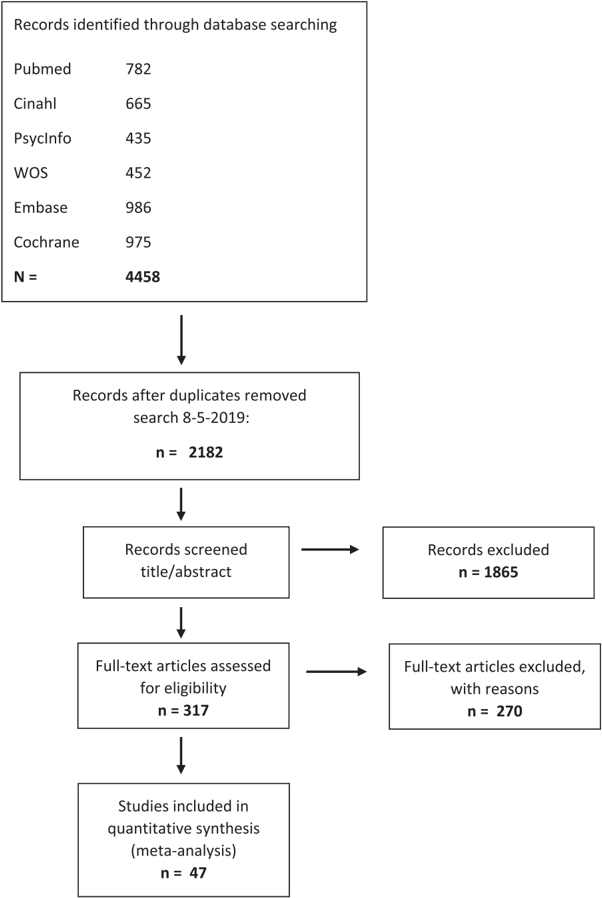
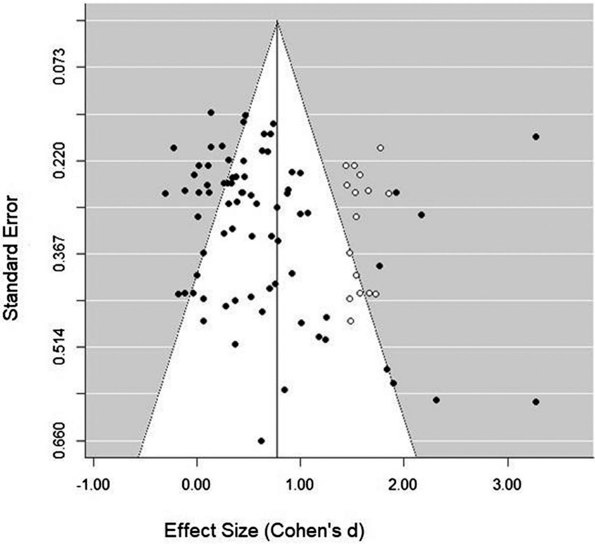
Music therapy is increasingly being used as an intervention for stress reduction in both medical and mental healthcare settings. Music therapy is characterized by personally tailored music interventions initiated by a trained and qualified music therapist, which distinguishes music therapy from other music interventions, such as ‘music medicine’, which concerns mainly music listening interventions offered by healthcare professionals. To summarize the growing body of empirical research on music therapy, a multilevel meta-analysis, containing 47 studies, 76 effect sizes and 2.747 participants, was performed to assess the strength of the effects of music therapy on both physiological and psychological stress-related outcomes, and to test potential moderators of the intervention effects. Results showed that music therapy showed an overall medium-to-large effect on stress-related outcomes (d = .723, [.51–.94]). Larger effects were found for clinical controlled trials (CCT) compared to randomized controlled trials (RCT), waiting list controls instead of care as usual (CAU) or other stress-reducing interventions, and for studies conducted in Non-Western countries compared to Western countries. Implications for both music therapy and future research are discussed.
Overview
The claims and statistics of this paper haven’t been checked yet.
Run the check — free, no account needed. It reads the open-access text and checks the sources it cites.
Integrity signals
Registry
Cites
Statistics
Figures
Verification
Claims the paper makes
The claims and statistics of this paper haven’t been checked yet.
Run the check — free, no account needed. It reads the open-access text and checks the sources it cites.
Claims other papers make about this one
Each is checked against this paper’s own text: does it say what the citing paper says it does?
The check wasn’t confident either way, so it gives no verdict — never disputed.
In the citing paper
“CBT-I has demonstrated efficacy in traumaexposed populations, reducing pre-sleep arousal and improving sleep continuity by integrating conventional behavioral sleep strategies with trauma-informed adaptations in multiple RCTs [115,116], especially when combined with trauma-focused interventions, such as trauma-focused cognitive behavioral therapy (TF-CBT) and eye movement desensitization and repro”
From Pre-Sleep Anxiety: Mechanisms and Therapeutic Approaches in Clinical Practice. (2026) · cites this paper as [115]
Experimental — accuracy not yet measured
Self-check
Percentages, sums and reported differences re-computed from the paper’s own numbers.
The self-check needs the paper’s full text.
Citations
Cites
Items 201–211 of 211
The past, present and future of musical therapy
Altschuler, I. (1954) · Music Therapy · Cited by 17
Page, M. J., Boutron, I., Nejstgaard, C. H., Altman, D. G., & Hróbjartsson, A. (2018) · Journal of Clinical Epidemiology · doi:10.1016/j.jclinepi.2018.01.004 · Cited by 14
A description of the use of music therapy in consultation-liaison psychiatry.
Rafieyan, R., & Ries, R. (2007) · PubMed · Cited by 13
Haack, B., & Silverman, M. J. (2016) · The Arts in Psychotherapy · doi:10.1016/j.aip.2016.09.005 · Cited by 13
Myint, K., Rajarajeswaran, J., Hoe, S.-Z., Kanthimathi, & Lam, S.-K. (2017) · Biomedical Research-tokyo · Cited by 13
Expectancy effects threaten the inferential validity of synchrony-prosociality researchPreprint
Atwood, S., Schachner, A., & Mehr, S. A. (2020) · doi:10.31234/osf.io/zjy8u · Cited by 12
A pilot study on the effect of music-heart beat feedback system on human heart activity
Nomura, S., Yoshimura, K., & Kurosawa, Y. (2013) · Journal of Medical Informatics & Technologies · Cited by 11
Pitts, S. E., & Silverman, M. J. (2015) · Journal of Creativity in Mental Health · doi:10.1080/15401383.2014.984097 · Cited by 7
Mohammadi, A. Z., Shahabi, T., & Panah, F. M. (2011) · Canadian journal of music therapy · Cited by 2
Sexually transmissable infections.
Casey, G. (2017) · PubMed · Cited by 2
Why include music therapy in a neuro-rehabilitation team?
Magee, W. L., & Dance, P. (2019) · Advances in Clinical Neuroscience & Rehabilitation · doi:10.34944/dspace/6265 · Cited by 2
Research works printed but not linked: 11
- Aldwin, C. M. (2007). Stress, coping, and development, second edition: An integrative perspective. Guilford Press.
- American Music Therapy Association. (2018). Definition and quotes about music therapy. What is music therapy? https://www.musictherapy.org/about/quotes/
- American Psychological Association. (2017). Stress in America: Coping with Change. https://www.apa.org/news/press/releases/stress/2016/coping-with-change.pdf
- 10.1186/s13063-016-1752-z · DOI
- Casey, G. (2017). Stress and disease. Kai Tiaki Nursing New Zealand, 23, 20–24.
- Câmara, Y. M. R., Campo, M. R. M., & Câmara, Y. R. (2013). Music therapy as a therapeutic resource for mental health. Braz J Mental Health, 94–117.
- Gabrielsson, A., & Lindström, E. (2010). The role of structure in the musical expression of emotions. In P. N. Juslin, & J. A. Sloboda (Eds.), Series in affective science. Handbook of music and emotion: Theory, research, applications (pp. 367–400). Oxford University Press. · DOI
- McNair, D. M., Lorr, M., & Droppleman, L. (1981). Profile of mood states questionnaire. EDITS.
- Schumacher, K., & Calvet, C. (2008). Synchronization. Music therapy with children on the autistic spectrum. Vandenhoeck & Ruprecht.
- 10.1007/s00520-014-2478-7 · DOI
- 10.1002/cncr.11842 · DOI
Cited by
Sorted by citations
From Therapeutic Factors to Mechanisms of Change in the Creative Arts Therapies: A Scoping Review
de Witte, M., Orkibi, H., Zarate, R., Karkou, V., Sajnani, N., Malhotra, B., Ho, R. T. H., Kaimal, G., Baker, F. A., & Koch, S. C. (2021) · Frontiers in Psychology · doi:10.3389/fpsyg.2021.678397 · Cited by 366
Effects of music therapy on anxiety: A meta-analysis of randomized controlled trials
Lu, G., Jia, R., Liang, D., Yu, J., Wu, Z., & Chen, C. (2021) · Psychiatry Research · doi:10.1016/j.psychres.2021.114137 · Cited by 125
Agres, K., Schaefer, R., Volk, A., van Hooren, S., Holzapfel, A., Bella, S. D., Müller, M., de Witte, M., Herremans, D., Ramírez, R., et al. (2021) · Music & Science · doi:10.1177/2059204321997709 · Cited by 113
Moysis, L., Iliadis, L. A., Sotiroudis, S. P., Boursianis, A. D., Papadopoulou, M. S., Kokkinidis, K.-I. D., VOLOS, C. K., Sarigiannidis, P. G., Nikolaidis, S., & Goudos, S. K. (2023) · IEEE Access · doi:10.1109/access.2023.3244620 · Cited by 71
Barnett, K. S., & Vasiu, F. (2024) · Frontiers in Behavioral Neuroscience · doi:10.3389/fnbeh.2024.1422361 · Cited by 73
Metadata
- Authors
- de Witte, M., Pinho, A. D. S., Stams, G.-J., Moonen, X., Bos, A. E. R., & van Hooren, S.
- Affiliations
- University of Amsterdam
- University of Amsterdam (NL)
- Zuyd University of Applied Sciences (NL)
- The Open University (GB)
- KenVaK, Research Centre for the Arts Therapies
- Venue
- Health Psychology Review
- Publisher
- Informa UK Limited
- Published
- 2020-11-27
- Volume
- 16
- Issue
- 1
- Pages
- 134-159
- ISSN
- 1743-7199 (ISSN-L)
- 1743-7202
- OpenAlex
- W3105716709
- Cited by
- 444
- References
- 204
- Citations by year
- 2026: 117 · 2025: 131 · 2024: 81 · 2023: 59 · 2022: 35 · 2021: 20 · 2020: 1
- FWCI
- 4.64
- Type
- journal article
- Language
- en
- Open access
- hybrid
- doi.org
- Licence
- Locations
- Health Psychology Review (publishedVersion, cc-by-nc-nd)
- PubMed (publishedVersion)
- UvA-DARE (University of Amsterdam) (submittedVersion, cc-by-nc-nd)
- DSpace (Open University in the Netherlands) (submittedVersion, cc-by-nc-nd)
- DSpace (Open University in the Netherlands) (submittedVersion, other-oa)
- Data Archiving and Networked Services (DANS) (submittedVersion, other-oa)
- Funders
- Nederlandse Organisatie voor Wetenschappelijk Onderzoek (grant number 023.007.068)
- Topics
- Social Sciences › Psychology › Social Psychology › Music Therapy and Health
- Social Sciences › Psychology › Clinical Psychology › Art Therapy and Mental Health
- Life Sciences › Neuroscience › Cognitive Neuroscience › Neuroscience and Music Perception
- Keywords
- music therapy, stress reduction, physiological stress, psychological stress, intervention moderators, music medicine, music listening intervention, healthcare settings
- MeSH terms
- Anxiety, Humans, Music, Music Therapy, Stress, Psychological
About these checks
Registry, retraction, Cites and statistics results are computed, not judged, with one exception: a printed reference that no index lists is read once by a model before it counts as a citation error. Claims are extracted by a model and kept only when their quote appears verbatim in the text; each cited source is then checked, with a model’s help, for whether it says what the claim relies on. Those verdicts can be wrong — read the claim’s quote and the cited source before relying on one.
Statistics and arithmetic are recomputed, not judged.
Confidence bands are shown only for fields calibrated on our annotated test set. None is calibrated yet, so no band is shown.
What counts as a claim ›How we measure confidence ›How we check this ›
Are you an author, or do you see a problem with this page? Request a review
