

Resilience and sport: transforming life horizons
Open accessThe DOI matches its Crossref record; 26 of the 26 references it cites were found in a registry or an index; none of the 57 sources its claims cite is checked for support yet.
Abstract
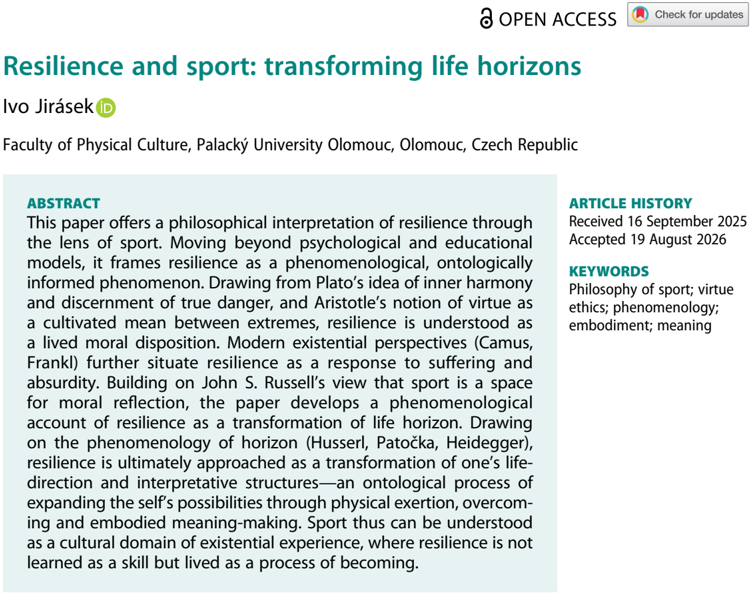
This paper offers a philosophical interpretation of resilience through the lens of sport. Moving beyond psychological and educational models, it frames resilience as a phenomenological, ontologically informed phenomenon. Drawing from Plato’s idea of inner harmony and discernment of true danger, and Aristotle’s notion of virtue as a cultivated mean between extremes, resilience is understood as a lived moral disposition. Modern existential perspectives (Camus, Frankl) further situate resilience as a response to suffering and absurdity. Building on John S. Russell’s view that sport is a space for moral reflection, the paper develops a phenomenological account of resilience as a transformation of life horizon. Drawing on the phenomenology of horizon (Husserl, Patočka, Heidegger), resilience is ultimately approached as a transformation of one’s life-direction and interpretative structures—an ontological process of expanding the self’s possibilities through physical exertion, overcoming and embodied meaning-making. Sport thus can be understood as a cultural domain of existential experience, where resilience is not learned as a skill but lived as a process of becoming.
Overview
CoChat Summary
TL;DR
This paper offers a phenomenological, ontologically informed interpretation of resilience in sport, moving beyond psychological and virtue-ethical accounts to frame resilience as a transformation of the life horizon. It argues that sport is a privileged experiential field in which resilience is lived as an embodied process of becoming rather than learned as a skill.
Key findings
- Resilience is interpreted not as a fixed trait, adaptation, or merely a moral virtue, but as a transformation of the horizon of meaning through which one understands oneself and the world; sport discloses this through failure, uncertainty, physical limitation, and renewal.
- The paper builds on John S. Russell’s claim that “[r]esilience is a virtue that is expressed in the ability to adapt positively to significant adversity” (Russell 2015, 164) and that “sport is designed fundamentally to test resilience” (Russell 2015, 166), while shifting the focus from virtue ethics to phenomenology.
- Philosophical antecedents are traced through Plato’s inner harmony and courage as preserving correct belief about true danger, Aristotle’s virtue as a cultivated mean (courage between cowardice and recklessness, guided by phronēsis), and modern existential responses to suffering and absurdity in Camus and Frankl.
- Phenomenological horizon (Husserl, Patočka, Heidegger) is used to argue that resilience emerges as an expansion or reconfiguration of lived meaning; illustrative hypothetical examples include a bereaved recreational runner and a youth football team losing its captain. No quantitative results are reported.
Methods
- Conceptual/philosophical paper with no empirical sample, data collection, or statistical analysis.
- Main analysis is a phenomenological interpretation of resilience, developed through engagement with Plato, Aristotle, Camus, Frankl, Russell, and phenomenology of horizon (Husserl, Patočka, Heidegger), applied to sporting experience.
- The argument uses illustrative hypothetical examples—a recreational runner coping with grief and a youth football team after losing its captain—to illuminate abstract claims.
Limitations
- The paper states no limitations section.
- Evident from the text: there is no empirical data, sample, or quantitative testing; the examples are hypothetical and illustrative, so the claims are conceptual rather than empirically validated.
- Evident from the text: the account is deliberately philosophical and phenomenological, not a psychological or educational model, and does not aim to provide measurable interventions or practical training prescriptions.
Model-written summary. Check it against the paper before relying on it.
Integrity signals
Registry
Cites
Statistics
Figures

Verification
Claims the paper makes
0 Valid · 1 Not valid · 41 Not checked · 63 Own results and interpretations
In the paper
“The uncertainty of outcome, the inevitability of setbacks, and the continuous possibility of failure are not accidental aspects of sport but conditions that make sport meaningful as a human practice.”
§ Resilience and sport: transforming life horizons > Resilience in the philosophy of sport: John S. Russell
What the sources say
- Not checked yetcites Russell 2015 matched to “Resilience: Warren P. Fraleigh Distinguished Scholar Lecture” (2015) source
plainstates a cause- Asserted: passes — The authors put it forward as true.
- Checkable: passes — It can be checked against evidence.
- Load-bearing: passes — The paper’s conclusions depend on it.
- Based: passes — The paper gives a reason why it holds.
In the paper
“In this way, resilience in sport takes on the features of a process of self-cultivation, in which the athlete finds value not only in success, but also in the struggle with failure and in the acceptance of the fragility of human performance.”
§ Resilience and sport: transforming life horizons > Resilience in the philosophy of sport: John S. Russell
What the sources say
- Not checked yetcites Russell 2015 matched to “Resilience: Warren P. Fraleigh Distinguished Scholar Lecture” (2015) source
plain- Asserted: passes — The authors put it forward as true.
- Checkable: passes — It can be checked against evidence.
- Load-bearing: passes — The paper’s conclusions depend on it.
- Based: passes — The paper gives a reason why it holds.
None of the sources cited for this claim have been checked yet.
In the paper
“A survivor of the Nazi concentration camps, Frankl argued that the primary human motivation is not the pursuit of pleasure (Freud) nor the will to power (Adler), but the will to meaning.”
§ Resilience and sport: transforming life horizons > Modern reflections
What the sources say
- Not checked yetcites Frankl 1994
- Not checked yetcites Frankl 2006
plain- Asserted: passes — The authors put it forward as true.
- Checkable: passes — It can be checked against evidence.
- Load-bearing: passes — The paper’s conclusions depend on it.
- Based: passes — The paper gives a reason why it holds.
In the paper
“This internal order-a concord among the parts of the soul, and between soul and body-is achieved through the proper balance of mousikē (music and the arts) and gymnastics, which together contribute to the formation of inner order and a capacity to remain composed in the face of difficulty without a loss of integrity.”
§ Resilience and sport: transforming life horizons > Plato: the harmonious soul as a prefiguration of resilience
What the sources say
- Not matchedcites Plato 2005
An author–year citation the paper’s reference list doesn’t settle. We don’t search these by name.
plainstates a cause- Asserted: passes — The authors put it forward as true.
- Checkable: passes — It can be checked against evidence.
- Load-bearing: passes — The paper’s conclusions depend on it.
- Based: passes — The paper gives a reason why it holds.
- Not matched
None of the sources cited for this claim have been checked yet.
In the paper
“Rather, Frankl emphasises the human capacity to find meaning even in extreme conditions of suffering and loss, including situations that may appear meaningless or unbearable.”
§ Resilience and sport: transforming life horizons > Modern reflections
What the sources say
- Not checked yetcites Frankl 1994
- Not checked yetcites Frankl 2006
hedged- Asserted: passes — The authors put it forward as true.
- Checkable: passes — It can be checked against evidence.
- Load-bearing: passes — The paper’s conclusions depend on it.
- Based: passes — The paper gives a reason why it holds.
8 more claims
Create a free account to see all 105 claims and to verify the 34 references still open.
- Probably not a substantial claim. 89
- It may state two separate claims as one. 18
Citations
Cites
Ordinary magic: Resilience processes in development.
Masten, A. S. (2001) · American Psychologist · doi:10.1037/0003-066x.56.3.227 · Cited by 8,497
Child Development in the Context of Disaster, War, and Terrorism: Pathways of Risk and Resilience
Masten, A. S., & Narayan, A. J. (2012) · Annual Review of Psychology · doi:10.1146/annurev-psych-120710-100356 · Cited by 1,024
Annual Research Review: What is resilience within the social ecology of human development?
Ungar, M., Ghazinour, M., & Richter, J. (2013) · Journal of Child Psychology and Psychiatry · doi:10.1111/jcpp.12025 · Cited by 842
Developmental systems and psychopathology
SAMEROFF, A. J. (2000) · Development and Psychopathology · doi:10.1017/s0954579400003035 · Cited by 670
Comfort Zone: Model or metaphor?
Brown, M. (2008) · Journal of Outdoor and Environmental Education · doi:10.1007/bf03401019 · Cited by 165
Morgan, W. J. (2006) · Routledge eBooks · doi:10.4324/9780203003732 · Cited by 132
The Origins of the Horizon in Husserl’s Phenomenology
Geniusas, S. (2012) · Contributions to Phenomenology · doi:10.1007/978-94-007-4644-2 · Cited by 92
Does Pushing Comfort Zones Produce Peak Learning Experiences?
Leberman, S., & Martin, A. J. (2002) · Journal of Outdoor and Environmental Education · doi:10.1007/bf03400765 · Cited by 74
Theology, Ethics and Transcendence in Sports
(2011) · Routledge eBooks · doi:10.4324/9780203840757 · Cited by 64
Resilience: Warren P. Fraleigh Distinguished Scholar Lecture
Russell, J. S. (2015) · Journal of the Philosophy of Sport · doi:10.1080/00948705.2015.1009838 · Cited by 55
Comfort zone orientation: Individual differences in the motivation to move beyond one's comfort zone
Kiknadze, N. C., & Leary, M. R. (2021) · Personality and Individual Differences · doi:10.1016/j.paid.2021.111024 · Cited by 37
On the Manifold Senses of Horizonedness. The Theories of E. Husserl and A. Gurwitsch
Walton, R. J. (2003) · Husserl Studies · doi:10.1023/a:1022224629243 · Cited by 35
Towards a dynamic interactive model of resilience (DIMoR) for education and learning contexts
ahmed Shafi, A., Templeton, S., Middleton, T., Millican, R., Vare, P., Pritchard, R., & Hatley, J. (2020) · Emotional and Behavioural Difficulties · doi:10.1080/13632752.2020.1771923 · Cited by 28
Holism and Horizon: Husserl and McDowell on Non-conceptual Content
Barber, M. D. (2008) · Husserl Studies · doi:10.1007/s10743-008-9035-5 · Cited by 22
Striving, entropy, and meaning
Russell, J. S. (2020) · Journal of the Philosophy of Sport · doi:10.1080/00948705.2020.1789987 · Cited by 19
Transformative experience as a change of horizon
Jirásek, I. (2019) · Routledge eBooks · doi:10.4324/9780429298806-9 · Cited by 15
Self-citationHorizons of Expectation. Ricoeur, Derrida, Patočka
Evink, E., & Romanian Society for Phenomenology (2013) · Studia Phaenomenologica · doi:10.7761/sp.13.297 · Cited by 7
Unsafe safety: the essence of challenge and experiential education as implicit religion
Jirásek, I. (2022) · Journal of Adventure Education and Outdoor Learning · doi:10.1080/14729679.2020.1863824 · Cited by 7
Self-citationHellige, H. D. (2019) · Handbook on Resilience of Socio-Technical Systems · doi:10.4337/9781786439376.00008 · Cited by 7
Saulius Geniusas: The Origins of the Horizon in Husserl’s Phenomenology
Rabanaque, L. R. (2013) · Husserl Studies · doi:10.1007/s10743-013-9145-6 · Cited by 5
‘The hand of God’: hierophany and transcendence through sport
Jirásek, I. (2024) · Journal of the Philosophy of Sport · doi:10.1080/00948705.2024.2309345 · Cited by 4
Self-citationZalewska, S. L. (2022) · Forum Pedagogiczne · doi:10.21697/fp.2021.2.23 · Cited by 3
(1995)
(1994)
(1994)
(2006)
Research works printed but not linked: 11
- ARISTOTLE. 2009. Etika níkomachova. Translated by Antonín Kříž. Praha:
- CAMUS, A. 2006. Mýtus o Sisyfovi. Translated by Dagmar Steinová. Praha: Garamond
- CIRLIG, S. 2022. The snowflake generation: The implications of overdeveloped ego on social reality. Revista Universitara de Sociologie 18(3): 362-68.
- COUBERTIN, P. 2000. The philosophic foundation of modern Olympism. In Pierre de Coubertin 1863-1937 Olympism: Selected writings, edited by N. Müller. International Olympic Committee: Lausanne: pp. 580-83.
- GADAMER, H.-G. 1987. The relevance of the beautiful and other essays. Translated by Nicholas Walker. Cambridge: Cambridge University Press.
- HEIDEGGER, M. 1996. Bytí a čas. Translated by Ivan Chvatík, Pavel Kouba, Miroslav Petříček and Jiří Němec. Praha: OIKÚMENÉ.
- HUIZINGA, J. 1955. Homo Ludens: A study of the play-element in culture. Boston: The Beacon Press
- HUSSERL, E. 1968. Karteziánské meditace. Praha: Svoboda.
- MARCUSE, H. 1991. Jednorozměrný člověk: Studie o ideologii rozvinuté industriální společnosti. Translated byMiroslav Rýdl. Praha: Naše vojsko.
- Patočka, J. 1995. Tělo, společenství, jazyk, svět. Praha: ISE, edice OIKÚMENÉ.
- SIMONOVIĆ, L. 2004. Philosophy of Olympism. Belgrade: Lj. Simonović.
Cited by
Still being checked.
Metadata
- Authors
- Jirásek, I.
- Affiliations
- Palacký University Olomouc (CZ)
- Corresponding author
- Jirásek, Ivo
- ORCID
- Jirásek, Ivo
- Venue
- Sport, Ethics and Philosophy
- Publisher
- Informa UK Limited
- Published
- 2026-08-30
- Pages
- 1-13
- ISSN
- 1751-133X (ISSN-L)
- 1751-1321
- OpenAlex
- W7204733011
- Semantic Scholar
- b4e627be8c85293d5886cc065784939b529d8ae6
- Cited by
- 0
- References
- 25
- FWCI
- 0.00
- Type
- journal article
- Language
- en
- Open access
- hybrid
- doi.org
- Licence
- cc-by
- creativecommons.org/licenses/by/4.0/ (vor)
- doi.org/10.1080/policies-text-data-mining (tdm)
- Locations
- Sport Ethics and Philosophy (publishedVersion, cc-by)
- Funders
- The EU
- Topics
- Social Sciences › Arts and Humanities › Philosophy › Phenomenology and Existential Philosophy
- Social Sciences › Arts and Humanities › Philosophy › Philosophical Ethics and Theory
- Social Sciences › Sociology and Political Science › Sociology, History and Politics of Sport
- Keywords
- resilience, sport, moral dispositions, existentialism, suffering, absurdity, phenomenology of sport, overcoming, personal transformation, Plato, Aristotle, Jean-Paul Sartre, Albert Camus, Frankl
About these checks
Registry, retraction, Cites and statistics results are computed, not judged, with one exception: a printed reference that no index lists is read once by a model before it counts as a citation error. Claims are extracted by a model and kept only when their quote appears verbatim in the text; each cited source is then checked, with a model’s help, for whether it says what the claim relies on. Those verdicts can be wrong — read the claim’s quote and the cited source before relying on one.
A language model drew the claims from the paper on 2026-11-17, under version 3 of the claim definition (model deepseek-v4.1-flash, prompt extract-v3).
A second model labelled each claim on 2026-11-17 (model jev-1.13-20260917, definition revision gold-guideline-v0.2).
Statistics and arithmetic are recomputed, not judged.
Confidence bands are shown only for fields calibrated on our annotated test set. None is calibrated yet, so no band is shown.
What counts as a claim ›How we measure confidence ›How we check this ›
Are you an author, or do you see a problem with this page? Request a review
Data sources
Bibliographic data: Semantic Scholar, OpenAlex, Crossref.
Contains information from the Semantic Scholar Academic Graph Datasets, made available under the ODC Attribution License (ODC-BY 1.0).
Semantic Scholar’s data is described in: Kinney, R., et al. (2023). The Semantic Scholar Open Data Platform. arXiv:2301.10140.
