

More than meets the eye: Fibre and Paper Analysis of the Chinese Manuscripts from the Silk Roads
Open accessThe DOI matches its Crossref record; 23 of the 23 references it cites were found in a registry or an index; none of the 21 sources its claims cite is checked for support yet.
Abstract
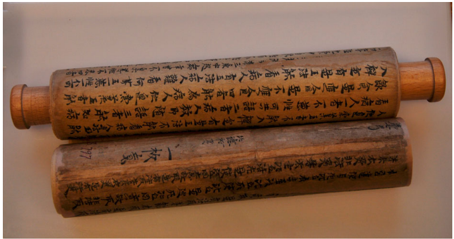
This study contributes to the history of paper in Central Asia during the first millennium C.E. and aims to create a typology of paper based on a systematic study of Chinese manuscript collections found along the Silk Roads. The further aspect of this study aims to improve our knowledge of archaeometric research considered with the revision and test of scientific methodology which can then be used for historical and philological scholarship. By using fibre analysis and the technological study of paper combined with codicological and textual information, research has aimed to explore the possibilities for dating these materials, and fingerprinting their places of origin. The fact that many of Chinese manuscripts being studied (which are the oldest preserved and dated artefacts from Central Asia) are fixed in time by dates mentioned in colophons makes them valuable and reliable references for building a typology of paper and for comparative study of any yet to be discovered papers from that region. A sample of studied manuscripts comprises a total of 182 Chinese manuscripts selected from the Dunhuang Collection in the British Library in London, the Bibliothèque Nationale de France in Paris (BnF), the Institute of Oriental Manuscripts in St. Petersburg, and the Turfan collection in the Berlin Brandenburg Academy of Sciences (BBAW) and the Berlin State Library (StaBi).
Overview
CoChat Summary
TL;DR
This study builds a preliminary typology of paper used in Chinese manuscripts from Silk Road collections by combining fibre microscopy with codicological and textual evidence. It finds that rag paper, especially ramie with hemp, dominated the first-millennium sample, while bark/phloem paper became more prominent later, and that papermaking sieve prints help distinguish paper types but cannot alone date or locate production.
Key findings
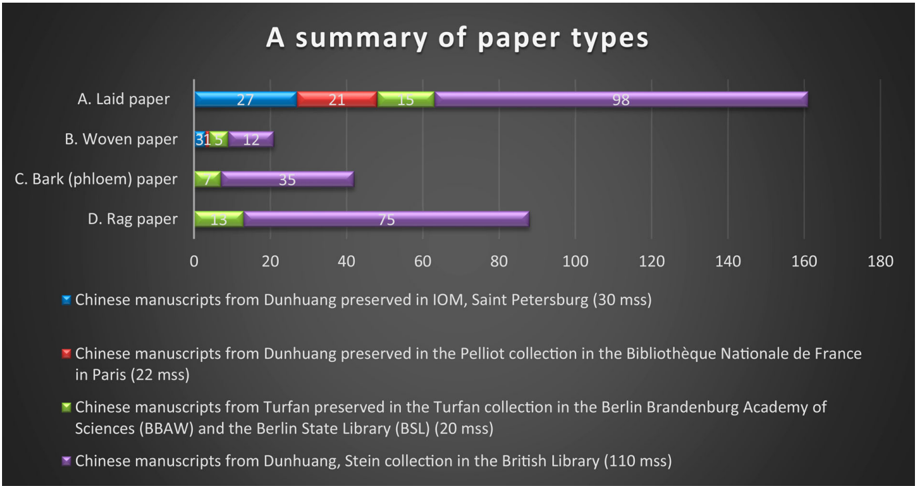
- Among 130 manuscripts tested for fibre composition, 88 were rag paper and 42 were bark/phloem paper; rag paper included 4 pure hemp samples, 84 mostly ramie sometimes with hemp, 8 with added paper mulberry/mulberry, and 15 with singular other fibres such as flax, jute, silk, or cotton.
- Of 110 Dunhuang manuscripts, 75 were rag paper and 35 were *Broussonetia* sp. paper; of 20 Turfan samples, 13 were rag paper and 7 contained paper mulberry fibres.
- Woven-type paper was a minority: 21/110 British Library Dunhuang manuscripts, 5/20 Turfan, 1/22 Pelliot, and 5/30 Institute of Oriental Manuscripts samples; it did not appear in dated papers before 692 CE.
- The oldest dated manuscript, S.797, is dated to 406 CE; the most recent, S.4760, to 981 CE. All oldest fifth-century samples were ramie and hemp rags on laid patchy paper with irregular laid lines, suggesting reed or grass sieves rather than bamboo.
Methods
- The study examined 182 Chinese manuscripts from the Dunhuang Collection in the British Library, the Bibliothèque Nationale de France, the Institute of Oriental Manuscripts in St. Petersburg, and the Turfan collection in BBAW/StaBi; 130 were tested for fibre composition.
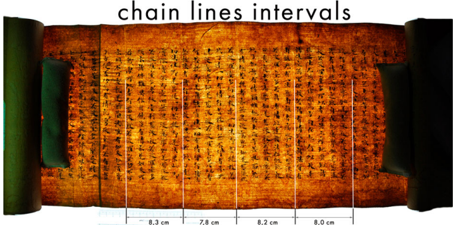
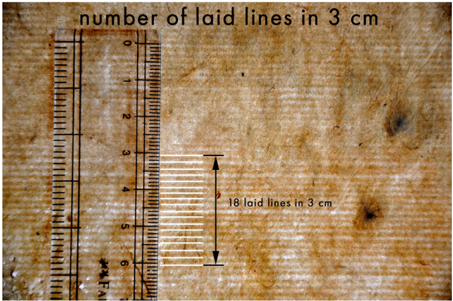
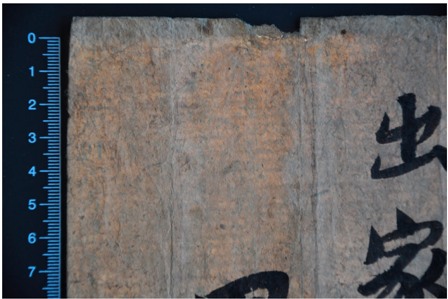
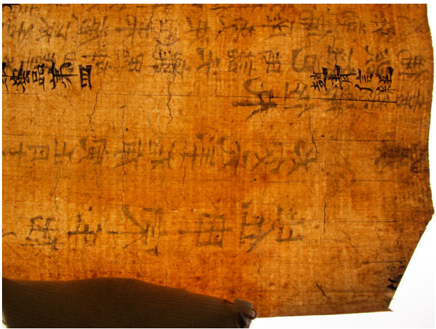
- Codicological features were measured by eye on a light box: paper translucency, yellow dye, leaf layers, sieve print type, laid lines per 3 cm, chain-line intervals, fibre distribution, and thickness.
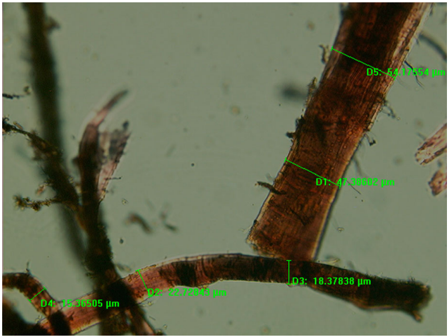
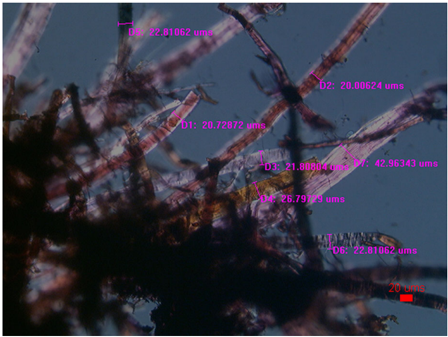
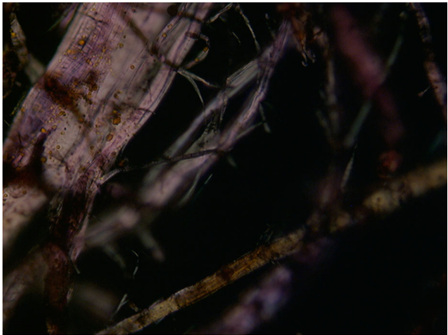
- Fibre identification used an Olympus BX51 transmitted-reflected light microscope with polarized light and Herzberg stain, measuring fibre morphology, width, and length; results were organized into a typology based on raw material and papermaking sieve print.
Limitations
- The paper states that paper analysis lacks chronological references for materials used in particular regions, that more reference materials are needed, and that chain lines alone cannot identify origin or date.
- It also states that there were not enough reference materials to assign location and time to particular added fibres, that more fifth-century manuscripts should be examined to verify preliminary results, and that dye analyses were not undertaken.
- Evident from the text: only 130 of 182 manuscripts were tested for fibre composition, many manuscripts are undated, and the Turfan collection consists largely of fragments without much additional information.
Model-written summary. Check it against the paper before relying on it.
Integrity signals
Registry
Cites
Statistics
Figures

Verification
Claims the paper makes
0 Valid · 5 Not valid · 18 Not checked · 120 Own results and interpretations
A result the paper reports from its own data — it cites no other source for it, so there is none to check. The quote shows it is in the paper.
In the paper
“There were 75 samples out of 110 Dunhuang manuscripts written in Chinese identi fi ed as rag paper and 13 samples out of 20 from the Turfan collection.”
plainn = 13- Asserted: passes — The authors put it forward as true.
- Checkable: passes — It can be checked against evidence.
- Load-bearing: unclear — It is unclear whether the paper’s conclusions depend on it.
- Based: passes — The paper gives a reason why it holds.
A result the paper reports from its own data — it cites no other source for it, so there is none to check. The quote shows it is in the paper.
In the paper
“The oldest example of paper mulberry was found in a yellowdyed paper of the manuscript S.2660 dated to 504 CE with text of the commentary on the Ś rim ā l ā -devisimhan ā da s ū tra .”
plainSingle case- Asserted: passes — The authors put it forward as true.
- Checkable: passes — It can be checked against evidence.
- Load-bearing: unclear — It is unclear whether the paper’s conclusions depend on it.
- Based: passes — The paper gives a reason why it holds.
A result the paper reports from its own data — it cites no other source for it, so there is none to check. The quote shows it is in the paper.
In the paper
“Other additions of fi bres, such as fl ax, jute, silk, wool, or cotton, were found in 15 samples.”
plainn = 15- Asserted: passes — The authors put it forward as true.
- Checkable: passes — It can be checked against evidence.
- Load-bearing: unclear — It is unclear whether the paper’s conclusions depend on it.
- Based: passes — The paper gives a reason why it holds.
In the paper
“The date when the text was copied has been preserved in the colophons of 47 manuscripts among my selection (Giles 1957).”
What the sources say
- Not matchedcites Giles 1957
An author–year citation the paper’s reference list doesn’t settle. We don’t search these by name.
plain- Asserted: passes — The authors put it forward as true.
- Checkable: passes — It can be checked against evidence.
- Load-bearing: unclear — It is unclear whether the paper’s conclusions depend on it.
- Based: passes — The paper gives a reason why it holds.
- Not matched
A result the paper reports from its own data — it cites no other source for it, so there is none to check. The quote shows it is in the paper.
In the paper
“However, the majority of manuscripts (88) were composed on rag paper.”
plain- Asserted: passes — The authors put it forward as true.
- Checkable: passes — It can be checked against evidence.
- Load-bearing: unclear — It is unclear whether the paper’s conclusions depend on it.
- Based: passes — The paper gives a reason why it holds.
58 more claims
Create a free account to see all 143 claims and every source verdict.
- Probably not a substantial claim. 44
- It may state two separate claims as one. 54
Claims other papers make about this one
Each is checked against this paper’s own text: does it say what the citing paper says it does?
The cited source says what the claim attributes to it.
In the citing paper
“These findings compare to those from papers studied at the British Library, which are composed mainly of either ramie or paper mulberry possibly combined with another bast fibre (Helman-Wazny 2016).”
From One of the First to Emerge from the Library Cave: The Seattle Art Museum Sutra Fragment (2024) · cites this paper as Helman-Wazny 2016
Self-check
Percentages, sums and reported differences re-computed from the paper’s own numbers.
Each contradiction between two passages listed here was confirmed by an independent check.
Rated minor: it would not touch a result — a value no result rests on, a p-value that stays on the same side of the significance level, or a conflict that is clerical, resolved elsewhere in the paper, or outside its own findings.
In the paper
“Out of the 30 Chinese manuscripts selected from the collection of Institute of Oriental Manuscripts 25 represent laid type of paper. Two manuscripts contain paper characterized by 25 to 30 laid lines in 3 cm. Twelve manuscripts represent laid paper characterized by 18 -24 laid lines in 3 cm; seven were on laid paper characterized by 16 -17 laid lines in 3 cm; and fi ve were on paper with 11 -15 laid lines in 3 cm.”
Reported 25 · recomputed 26
Rated minor: it would not touch a result — a value no result rests on, a p-value that stays on the same side of the significance level, or a conflict that is clerical, resolved elsewhere in the paper, or outside its own findings.
In the paper
§ Conclusions: Typology of manuscripts and early history of paper · p. 14
“This type of paper characterized by the above-described combination of features does not appear in later dated manuscripts.”
§ Laid type of paper · p. 11
“This type of paper characterized by the abovedescribed combination of features does not appear in later dated manuscripts, with the exception of two booklets dated by colophon to 905 and 906 CE.”
Citations
Cites
Papermaking: The History and Technique of An Ancient Craft
McMurtrie, D. C., & Hunter., D. (1943) · The American Historical Review · doi:10.2307/1840938 · Cited by 466
Paper before print: the history and impact of paper in the Islamic world
(2002) · Choice Reviews Online · doi:10.5860/choice.39-4542 · Cited by 204
The Invention of Printing in China and Its Spread Westward
Laufer, B., & Carter, T. F. (1927) · Journal of the American Oriental Society · doi:10.2307/593242 · Cited by 72
THE IDENTIFICATION OF ORIENTAL PAPER-MAKING FIBRES
Collings, T., & Milner, D. (1978) · The Paper Conservator · doi:10.1080/03094227.1978.9638509 · Cited by 48
Science and Civilisation in China
Myers, R. H., Bray, F., & Tsuen-Hsuin, T. (1987) · The American Historical Review · doi:10.2307/1862904 · Cited by 47
The Archaeology of Tibetan Books
Helman-Ważny, A. (2014) · BRILL eBooks · doi:10.1163/9789004275058 · Cited by 39
Self-citation(2011) · Cited by 39
History of Textile Technology of Ancient China
Weiji, C. (1992) · Medical Entomology and Zoology · Cited by 31
The Invention of Printing in China and Its Spread Westward
Peake, C. H., Carter, T. F., & Goodrich, L. C. (1955) · Journal of the American Oriental Society · doi:10.2307/595172 · Cited by 28
Research works printed but not linked: 5
- Helman-Wa ż ny, Agnieszka. 2014. Archaeology of Tibetan Books . Leiden: Brill. Hunter, Dard. 1932. Old Papermaking in China and Japan . Ohio: Mountain House Press.
- Laufer Berthold, 1931, Paper and Printing in Ancient China
- Pan, Jixing. 1979. Draft on History of Chinese Paper-making Technology . Beijing: Cultural Relics Publishing House.
- Pan, Jixing. 1981. On the Origin of Papermaking in the Light of Newest Archeological Discoveries. IPH Information 15 (2): 38 -39.
- Whit fi eld, Susan. 2007. ' The Dunhuang Manuscripts: From Cave to Computer. ' W.L. Idema (ed.). Books in Numbers. Seventy-Fifth Anniversary of the Harvard-Yenching Library . Cambridge, Massachusetts, 113 -140.
Cited by
Han, B., Yang, Y., Wang, B., Jiang, H., & Sablier, M. (2022) · Cellulose · doi:10.1007/s10570-022-04924-9 · Cited by 23
“Ancient papers are of high cultural value as carriers for the information that can be decoded from their contents for historical and paleographical studies (Helman-Ważny, 2016; Sakamoto and Okada, 2013).”
BackgroundYao, N., Zhan, X., Ma, Q., et al. (2021) · Heritage Science · doi:10.1186/s40494-021-00596-z · Cited by 8
Stanley, T. (2017) · Journal of the American Institute for Conservation · doi:10.1080/01971360.2017.1392105 · Cited by 7
Identifying sources of fibre in Chinese handmade papers by phytoliths: A methodological exploration
Li, T. (2018) · STAR Science & Technology of Archaeological Research · doi:10.1080/20548923.2018.1475454 · Cited by 7
“Some (e.g., Gong, Bo, and Gong 2014; Helman-Ważny 2016; Li et al. 2017; Shi and Li 2013) pay close attention to fibre identification and see it as crucial to understanding the manufacture of Chinese handmade © 2018 The Author(s).”
BackgroundWan, Q., (李晓林), X. L., Liu, W., (李洋), Y. L., Han, B., & Li, T. (2024) · Studies in Conservation · doi:10.1080/00393630.2024.2309423 · Cited by 6
Notes on the early history of paper in Central Asia based on material evidence
Helman-Ważny, A. (2020) · Z Badań nad Książką i Księgozbiorami Historycznymi · doi:10.33077/uw.25448730.zbkh.2020.628 · Cited by 6
Self-citationPattern Analysis Software Tools (PAST) for Written Artefacts
Mohammed, H., Helman-Ważny, A., Colini, C., et al. (2022) · Lecture notes in computer science · doi:10.1007/978-3-031-06555-2_15 · Cited by 4
Self-citationGe, M., Gu, Z., Tian, F., et al. (2024) · Heritage Science · doi:10.1186/s40494-024-01390-3 · Cited by 4
“Patterns of chain and laid lines in the paper structure allow us to distinguish handmade woven paper from handmade laid paper characterized by particular numbers of laid lines [10].”
BackgroundA Tale of Papermaking along the Silk Road
Helman-Ważny, A. (2021) · De Gruyter eBooks · doi:10.1515/9783110753301-022 · Cited by 3
“17 Helman-Ważny 2016, 134–135.”
MethodResultInfluentialSelf-citationHelman-Ważny, A., & Ramble, C. (2023) · De Gruyter eBooks · doi:10.1515/9783110776478 · Cited by 3
Self-citationArnaud-Nguyêñ, E. (2020) · Z Badań nad Książką i Księgozbiorami Historycznymi · doi:10.33077/uw.25448730.zbkh.2020.630 · Cited by 2
History of Paper and Traditional Papermaking Techniques
Петровна, Б. А. (2025) · Springer eBooks · doi:10.1007/978-3-031-91080-7_3 · Cited by 1
Old Uyghur Buddhist Scrolls: A Case Study Based on the Säkiz Yükmäk Yaruk Scrolls
Raschmann, S.-C. (2024) · Acta Orientalia · doi:10.1556/062.2024.00415 · Cited by 2
Von Autodafé bis Rasur Aspekte der Zerstörung von Geschriebenem und das Beispiel China
Giele, E. (2019) · De Gruyter eBooks · doi:10.1515/9783110629040-007 · Cited by 1
Guan, Y., Gao, H., Shen, H., et al. (2021) · BioResources · doi:10.15376/biores.16.2.3851-3870 · Cited by 1
One of the First to Emerge from the Library Cave: The Seattle Art Museum Sutra Fragment
Ping, F. (2024) · Silk Roads Archaeology and Heritage · doi:10.5334/srah.7
Overview of paper and papermaking in Xinjiang, China
Cai, M. (2020) · Z Badań nad Książką i Księgozbiorami Historycznymi · doi:10.33077/uw.25448730.zbkh.2020.631
Paper in Dongba Manuscripts from the Weltmuseum in Vienna
Helman-Ważny, A., & Cai, M. (2023) · De Gruyter eBooks · doi:10.1515/9783110776478-014
Self-citationKeles, E., & Çelik, Ö. (2026) · Microbial Cell · doi:10.15698/mic2026.03.871 · Cited by 1
“Paper mulberry has long been utilized in Chinese papermaking traditions,andmicroscopicanalyseshaveidentifieditsfibersin10th-centuryChineseragpapers[66].”
Han, U. B. (2018) · theses.fr (ABES) · doi:10.70675/58568ac1zb4ecz4c1cz9deez32a017b6a4d4 · Cited by 1
Saved from Desert Sands: Re-discovering Objects on the Silk Roads
Granger, K., & Galambos, I. (2025) · doi:10.1163/9789004706880
Metadata
- Authors
- Helman-Ważny, A.
- Affiliations
- Universität Hamburg (DE)
- Corresponding author
- Helman-Ważny, Agnieszka
- Venue
- STAR: Science & Technology of Archaeological Research
- Publisher
- Informa UK Limited
- Published
- 2016-08-05
- Volume
- 2
- Issue
- 2
- Pages
- 127-140
- ISSN
- 2054-8923 (ISSN-L)
- OpenAlex
- W2492839191
- Cited by
- 21
- References
- 21
- Citations by year
- 2026: 1 · 2025: 1 · 2024: 5 · 2023: 2 · 2022: 2 · 2021: 3 · 2020: 3 · 2019: 1 · 2018: 2 · 2017: 1
- FWCI
- 6.70
- Type
- journal article
- Language
- en
- Open access
- gold
- doi.org
- Locations
- STAR Science & Technology of Archaeological Research (publishedVersion, cc-by)
- DOAJ (DOAJ: Directory of Open Access Journals) (submittedVersion, cc-by-sa)
- Funders
- Deutsche Forschungsgemeinschaft (Fr 702/9-1)
- Topics
- Social Sciences › Arts and Humanities › Archeology (arts and humanities) › Cultural Heritage Materials Analysis
- Social Sciences › Arts and Humanities › History › Eurasian Exchange Networks
- Social Sciences › Arts and Humanities › History › Libraries, Manuscripts, and Books
- Keywords
- Chinese manuscripts, Silk Road, fiber analysis, paper provenance, Dunhuang manuscripts, Turfan manuscripts, colophons, first millennium AD, paper technology
About these checks
Registry, retraction, Cites and statistics results are computed, not judged, with one exception: a printed reference that no index lists is read once by a model before it counts as a citation error. Claims are extracted by a model and kept only when their quote appears verbatim in the text; each cited source is then checked, with a model’s help, for whether it says what the claim relies on. Those verdicts can be wrong — read the claim’s quote and the cited source before relying on one.
A language model drew the claims from the paper on 2026-10-04, under version 3 of the claim definition (model deepseek-v4.1-flash, prompt extract-v3).
A second model labelled each claim on 2026-10-04 (model jev-1.13-20260917, definition revision gold-guideline-v0.2).
Statistics and arithmetic are recomputed, not judged.
Confidence bands are shown only for fields calibrated on our annotated test set. None is calibrated yet, so no band is shown.
What counts as a claim ›How we measure confidence ›How we check this ›
Are you an author, or do you see a problem with this page? Request a review
Data sources
Bibliographic data: Semantic Scholar, OpenAlex, Crossref.
Contains information from the Semantic Scholar Academic Graph Datasets, made available under the ODC Attribution License (ODC-BY 1.0).
Semantic Scholar’s data is described in: Kinney, R., et al. (2023). The Semantic Scholar Open Data Platform. arXiv:2301.10140.
