

Archaeological and Geological Evidence at Monte Verde II, Chile, Supports a Human Occupation at ∼14,500 Years Ago
Open accessThe DOI matches its Crossref record; 14 of the 14 references it cites were found in a registry or an index; none of the 71 sources its claims cite is checked for support yet.
Abstract
In recent articles, Surovell et al. (Citation2026a. “A Mid-Holocene Age for Monte Verde Challenges the Timeline of Human Colonization of South America.” Science 391 (6791): 1283–1288; Surovell, Todd A., César Méndez, Juan-Luis García, Christopher Lüthgens, Jay M. Thompson, and Claudio Latorre. 2026b. “Reply to Waters et al.: Stratigraphy, Chronology, and Redeposition at Monte Verde.” Science 391 (6791): 1283–1288) and Méndez et al. (Citation2026. “Misconceptions of the Stratigraphic and Landforms Relations at Monte Verde: A Reply to Dillehay et al.” Science 391: 1283–1288) challenge the age and cultural integrity of the Monte Verde II site in south-central Chile, which is dated to approximately 14.5 ka. We demonstrate that their claims are unsupported. They contain erroneous information and methodological and interpretive flaws. We uphold the original interpretation of MV-II as a late Pleistocene human occupation.
Overview
CoChat Summary
TL;DR
This rebuttal argues that archaeological and geological evidence from Monte Verde II (MV-II), Chile, supports a well-preserved late Pleistocene human occupation at approximately 14.5 ka, rejecting Surovell et al.’s middle Holocene redeposition/tephra-based challenge. It contends that the Lepué Tephra is absent beneath the occupation layer, the proposed peat correlation and SU2 unit are invalid, and the cultural assemblage shows primary deposition.
Key findings
- MV-II is dated to ∼14.5 ka; radiocarbon dates on marine-algae and terrestrial-plant quids, burned seaweed, hearth charcoal, wooden artifacts, and associated fauna range ∼14.3–14.5 ka, including a new burned *Porphyra* sp. assay of 12,251 ± 44 14C yr BP, calibrated to ∼14,380 cal yr BP (95.4%: 14,520–14,230 cal yr BP).
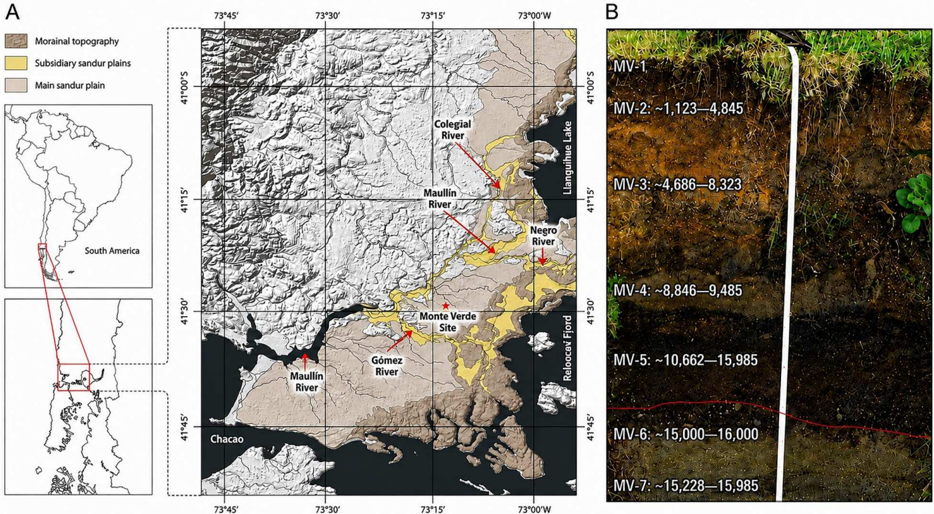
- No ∼11 ka Lepué Tephra occurs beneath the MV-II occupation layer; more than 100 stratigraphic profiles over 50 years found no tephra above or below the archaeological layer, and deposits identified as Lepué are misidentified weathered sandy facies or other tephra. T4 peat dates of 7940–8050 and 9540–9680 14C yr BP are not correlative with the MV-5 peat.
- Surovell et al.’s SU2 unit is artificial and internally inconsistent: Stratum 6 dates 4.2–4.4 and 4.6–4.8 ka, Stratum 7 7.2–7.3 ka, Stratum 8 4.9–5.3 ka, Stratum 9 13.1–13.2 ka, and the layer underlying MV-II 11.9–16.7 to 15.3–20.9 ka; it does not support a Lepué Tephra beneath MV-II.
- The redeposition hypothesis is unsupported by the intact MV-1 to MV-5 sequence, patterned artifacts, hearths, footprints, fragile quids, and seven gomphotheres mostly represented by ribs concentrated in a roughly 3 × 4 m area, with no abrasion, rounding, or water-polish; charcoal peaks at ∼14.2–14.5 ka suggest local human fire.
Methods
- Reanalysis and revision of non-site areas sampled by Surovell et al., geochemical studies of several strata, radiocarbon dating and additional geochemical analysis of samples from the same strata, and pollen analysis of cores taken for a prior radiocarbon study by Ervin Taylor.
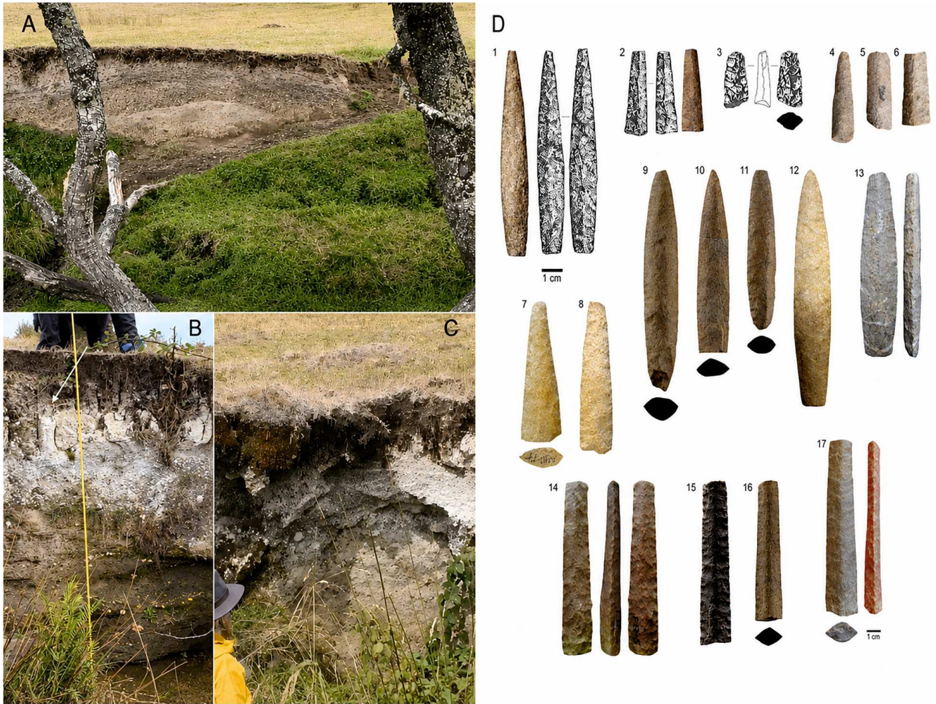
- Synthesis of more than 50 years of interdisciplinary fieldwork at Chinchihuapi Creek, including stratigraphic survey, controlled excavation, auger sampling, more than 70 test pits, trenches, and block units in the proposed T4 terrace, and more than 1.5 km of cutbank exposures; morpho-technological and 3D geometric morphometric analysis of projectile points (Supplementary Material Content 15).
- Comparative chronostratigraphic and taphonomic assessment of the MV-II assemblage and regional paleoenvironmental records, including the Lago Condorito charcoal record dated 14.6–15.0 ka.
Limitations
- The paper states that Surovell et al. did not excavate at MV-II, never observed the site stratigraphy first-hand, used a superficial survey 50–4000 m from the site, employed biased sampling, and did not directly reassess the cultural deposits.
- The paper states that its supporting data and interpretations are provided in Supplementary Material and Zenodo/Figshare, described as open access and non-peer reviewed; the main article is a rebuttal rather than a primary excavation report.
- Text makes evident: the argument depends heavily on prior published work and supplementary analyses, and no new excavation at MV-II is reported here.
Model-written summary. Check it against the paper before relying on it.
Integrity signals
Registry
Cites
Statistics
Figures

Verification
Claims the paper makes
0 Valid · 3 Not valid · 54 Not checked · 74 Own results and interpretations
None of the sources cited for this claim have been checked yet.
In the paper
“which is dated to approximately cal 14.5 ka”
- Also stated in: § Abstract · plain
“all dated to ∼14.5 ka”
- Also stated in: § Abstract · boosted
“has been securely dated to ∼14.5 ka”
§ Archaeological and Geological Evidence at Monte Verde II, Chile, Supports a Human Occupation at ~14,500 Years Ago > Abstract
What the sources say
- Not matchedcites Dillehay 1989
An author–year citation the paper’s reference list doesn’t settle. We don’t search these by name.
- Not checked yetcites Dillehay et al. 2015 matched to “New Archaeological Evidence for an Early Human Presence at Monte Verde, Chile” (2015) source
- Not matchedcites Pino and Dillehay 2023
An author–year citation the paper’s reference list doesn’t settle. We don’t search these by name.
boosted- Asserted: passes — The authors put it forward as true.
- Checkable: passes — It can be checked against evidence.
- Load-bearing: passes — The paper’s conclusions depend on it.
- Based: passes — The paper gives a reason why it holds.
- Also stated in: § Abstract · plain
In the paper
“Moreover, wood-bearing layers in the upper T4 do not exist (see SM, Content 4-5).”
§ Archaeological and Geological Evidence at Monte Verde II, Chile, Supports a Human Occupation at ~14,500 Years Ago > Abstract
What the sources say
- Not matchedcites SM, Content 4-5
This doesn’t read as a citation we can look up.
plain- Asserted: passes — The authors put it forward as true.
- Checkable: passes — It can be checked against evidence.
- Load-bearing: passes — The paper’s conclusions depend on it.
- Based: passes — The paper gives a reason why it holds.
- Not matched
In the paper
“Long-term field observations spanning approximately five decades by the Monte Verde research team, as well as the brief observations by Surovell et al. (2026a), similarly report no evidence of comparable secondary deposits.”
§ Archaeological and Geological Evidence at Monte Verde II, Chile, Supports a Human Occupation at ~14,500 Years Ago > Abstract
What the sources say
- Not matchedcites Surovell et al. (2026a)
More than one paper fits this citation.
plain- Asserted: passes — The authors put it forward as true.
- Checkable: passes — It can be checked against evidence.
- Load-bearing: passes — The paper’s conclusions depend on it.
- Based: passes — The paper gives a reason why it holds.
- Not matched
None of the sources cited for this claim have been checked yet.
In the paper
“Systematic archaeological and geological investigations -including stratigraphic survey, controlled excavation, and auger sampling -conducted along the narrow upstream portion of the Chinchihuapi Creek drainage in the late 1970s and 1980s identified only two archaeological localities (see SM, Contents 4-5).”
- Also stated in: § Abstract · plain
“These consist of a ceramic occupation (X-12) and a multicomponent early Holocene and late Pleistocene site (CH-1; Dillehay 1997;Dillehay et al. 2019).”
§ Archaeological and Geological Evidence at Monte Verde II, Chile, Supports a Human Occupation at ~14,500 Years Ago > Abstract
What the sources say
- Not matchedcites Dillehay 1997
An author–year citation the paper’s reference list doesn’t settle. We don’t search these by name.
- Not checked yetcites Dillehay et al. 2019 matched to “New excavations at the late Pleistocene site of Chinchihuapi I, Chile” (2019) source
plain- Asserted: passes — The authors put it forward as true.
- Checkable: passes — It can be checked against evidence.
- Load-bearing: passes — The paper’s conclusions depend on it.
- Based: passes — The paper gives a reason why it holds.
- Also stated in: § Abstract · plain
A result the paper reports from its own data — it cites no other source for it, so there is none to check. The quote shows it is in the paper.
In the paper
“In particular, the integrity of cultural materials and associated depositional contexts demonstrates an absence of hydraulic reworking or downstream displacement and of an overlying anaerobic peat layer preserving wood and uncarbonized organic matter.”
§ Archaeological and Geological Evidence at Monte Verde II, Chile, Supports a Human Occupation at ~14,500 Years Ago > Abstract
boosted- Asserted: passes — The authors put it forward as true.
- Checkable: passes — It can be checked against evidence.
- Load-bearing: passes — The paper’s conclusions depend on it.
- Based: passes — The paper gives a reason why it holds.
66 more claims
Create a free account to see all 131 claims and to verify the 10 references still open.
- It may state two separate claims as one. 46
- Probably not a substantial claim. 18
- The quote only partly states this claim. 1
Self-check
Percentages, sums and reported differences re-computed from the paper’s own numbers.
Each contradiction between two passages listed here was confirmed by an independent check.
Rated minor: it would not touch a result — a value no result rests on, a p-value that stays on the same side of the significance level, or a conflict that is clerical, resolved elsewhere in the paper, or outside its own findings.
In the paper
§ Archaeological and Geological Evidence at Monte Verde II, Chile, Supports a Human Occupation at ~14,500 Years Ago > Notes on Contributors
“(C) also to the west, is an exposed outcrop that corresponds to the SCH-4 Formation covered by a whitishgray layer, which in turn is overlaid by the MV-4 gravel and a sandy facies and organic soil.Section 5 is exposed in C.”
§ Archaeological and Geological Evidence at Monte Verde II, Chile, Supports a Human Occupation at ~14,500 Years Ago > Notes on Contributors
“stratum MV-4 is not present.Thus, in Section 5, only the SCH-4 is observed and covered by an organic soil.”
Citations
Cites
Whitlock, C., & Larsen, C. (2002) · Developments in Paleoenvironmental Research · doi:10.1007/0-306-47668-1_5 · Cited by 736
Monte Verde: Seaweed, Food, Medicine, and the Peopling of South America
Dillehay, T. D., Ramírez, C., Pino, M., Collins, M. B., Rossen, J., & Pino-Navarro, J. D. (2008) · Science · doi:10.1126/science.1156533 · Cited by 695
Self-citationNew Archaeological Evidence for an Early Human Presence at Monte Verde, Chile
Dillehay, T. D., Ocampo, C., Saavedra, J., Sawakuchi, A. O., Vega, R. M., Pino, M., Collins, M. B., Scott Cummings, L., Arregui, I., Villagran, X. S., et al. (2015) · PLoS ONE · doi:10.1371/journal.pone.0141923 · Cited by 307
Self-citationMoreno, P. I., Videla, J., Valero-Garcés, B., Alloway, B. V., & Heusser, L. E. (2018) · Quaternary Science Reviews · doi:10.1016/j.quascirev.2018.08.013 · Cited by 69
(1989) · doi:10.1126/science.245.4925.1436.a · Cited by 66
Self-citationMonte Verde II: an assessment of new radiocarbon dates and their sedimentological context
Mario Pino, Q., & Dillehay, T. D. (2023) · Antiquity · doi:10.15184/aqy.2023.32 · Cited by 35
Self-citationSurovell, T. A., Allaun, S. A., Crass, B. A., Gingerich, J. A. M., Graf, K. E., Holmes, C. E., Kelly, R. L., Kornfeld, M., Krasinski, K. E., Larson, M. L., et al. (2022) · PLOS ONE · doi:10.1371/journal.pone.0264092 · Cited by 28
New excavations at the late Pleistocene site of Chinchihuapi I, Chile
Dillehay, T. D., Ocampo, C., Saavedra, J., Pino, M., Scott-Cummings, L., Kovácik, P., Silva, C., & Alvar, R. (2019) · Quaternary Research · doi:10.1017/qua.2018.145 · Cited by 23
Self-citationA mid-Holocene age for Monte Verde challenges the timeline of human colonization of South America
Surovell, T. A., Méndez, C., García, J.-L., Lüthgens, C., Thompson, J. M., & Latorre, C. (2026) · Science · doi:10.1126/science.adw9217 · Cited by 17
Vargas, D., Le Verger, K., Wiesenberg, G. L. B., von Büren, C., Carrillo-Briceño, J. D., Jaimes, A., & Sánchez-Villagra, M. R. (2025) · Archaeological and Anthropological Sciences · doi:10.1007/s12520-025-02296-2 · Cited by 6
Research works printed but not linked: 9
- Casamiquela, Rodolfo, and T. D. Dillehay. 1989. "Vertebrate and Invertebrate Faunal Analysis." In Monte Verde: A Late Pleistocene Settlement in Chile. Vol. 1, The Palaeoenvironment and Site Context, edited by T. D. Dillehay, 205-210. Washington, DC: Smithsonian Institution Press.
- Dillehay, Tom D. 1997. Monte Verde: A Late Pleistocene Settlement in Chile. Vol. 2, The Archaeological Context. Washington, DC: Smithsonian Institution Press.
- Dillehay, Tom D., and Mario Pino. 1989. "Chronology and Stratigraphy." In Monte Verde: A Late Pleistocene Settlement in Chile. Vol. 1, The Palaeoenvironment and Site Context, edited by T. D. Dillehay, 133-146.
- Dillehay, Tom D., and Mario Pino. 1997. "Site Setting and Stratigraphy." In Monte Verde: A Late Pleistocene Settlement in Chile. Vol. 2, The Archaeological Context and Interpretation, edited by T. D. Dillehay, 25-39. Washington, DC: Smithsonian Institution Press.
- Dillehay, Tom D., Mario Pino, M. E. Davis, S. Valastro, A. Varela, and R. Casamiquela. 1982. "Monte Verde: Radiocarbon Dates from an Early-Man Site in South- Central Chile." Journal of Field Archaeology 9:547-550.
- Guillemin, M.-L., M. Valero, S. Mauger, S. Faugeron, C. Destombe, J. Utge, P. Verdu, et al. 2023. "Sequencing of Seaweeds Ancient DNA from Monte Verde, One of the Oldest Archeological Sites in South America." Paper pre- sented at the 8th European Phycological Congress, Brest, France.
- Méndez, César, T. A. Surovell, Juan-Luis García, C. Lüthgens, J. Thompson, and Claudio Latorre. 2026. "Misconceptions of the Stratigraphic and Landforms Relations at Monte Verde: A Reply to Dillehay et al." Science 391:1283-1288.
- Ramíréz, C. 1989. "Botanical Remains." In Monte Verde: A Late Pleistocene Settlement in Chile. Vol. 1, the Palaeoenvironment and Site Context, edited by T. D. Dillehay, 25-40. Washington, DC: Smithsonian Institution Press.
- Surovell, Todd A., César Méndez, Juan-Luis García, Christopher Lüthgens, Jay M. Thompson, and Claudio Latorre. 2026b. "Reply to Waters et al.: Stratigraphy, Chronology, and Redeposition at Monte Verde." Science 391 (6791): 1283-1288. · DOI · Paper page
Cited by
Carrillo-Briceño, J. D., Chichkoyan, K. V., Jaimes, A., Becerra‐Valdivia, L., Wilson, O. E., Verger, K. L., Mothé, D., Vargas, D., Reyes-Cespedes, A. E., Hilbert, L. M., et al. (2026) · Quaternary Science Reviews · doi:10.1016/j.quascirev.2026.110154 · Cited by 3
Monte Verde, Genetic Evidence, and the Peopling of the Americas
Meltzer, D. J., Moreno-Mayar, J. V., Pinotti, T., Heintzman, P. D., Pedersen, M. W., & Willerslev, E. (2026) · PaleoAmerica · doi:10.1080/20555563.2026.2727824 · Cited by 2
Pérez-Balarezo, A. (2026) · PaleoAmerica · doi:10.1080/20555563.2026.2727825
Self-citationResponse to Archaeogenetics, Epistemology, and the Peopling of the Americas
Meltzer, D. J., Moreno-Mayar, J. V., Pinotti, T., Heintzman, P. D., Pedersen, M. W., & Willerslev, E. (2026) · PaleoAmerica · doi:10.1080/20555563.2026.2755699
Davis, L. G., & Madsen, D. B. (2026) · Science Advances · doi:10.1126/sciadv.aek3138
Self-citation
Metadata
- Authors
- Dillehay, T. D., Pino, M., Lara, L. E., Abarzúa, A. M., Pérez-Balarezo, A., Davis, L. G., Sawakuchi, A. P., Erlandson, J., Madsen, D. G., Grayson, D. K., Guzman, J., Adovasio, J. M., Roos, C. I., Saavedra, J., Rossen, J., Martel-Cea, A., Millafilo, D., Cerda, J., Mink, P., Sierpe, R., & Holliday, V. T.
- Affiliations
- Vanderbilt University (US)
- Instituto de Ciencias de la Tierra, Universidad Austral de Chile
- Universidad Austral de Chile (CL)
- Pontificia Universidad Católica del Perú (PE)
- Oregon State University (US)
- Universidade de São Paulo (BR)
- University of Oregon (US)
- University of Nevada, Las Vegas (US)
- University of Washington (US)
- Indaga
- Historical Society of Western Pennsylvania (US)
- Southern Methodist University (US)
- Subdirreción de CONADI
- Chronicle Heritage, Inc.
- University of Kentucky (US)
- Pomona College (US)
- University of Arizona (US)
- Corresponding author
- Dillehay, Tom D.
- ORCID
- Venue
- PaleoAmerica
- Publisher
- Informa UK Limited
- Published
- 2026-06-01
- Volume
- 12
- Issue
- 2
- Pages
- 132-143
- ISSN
- 2055-5563 (ISSN-L)
- 2055-5571
- OpenAlex
- W7203773170
- Semantic Scholar
- e30700b81860711955cf58d241645679ca9ab628
- Cited by
- 5
- References
- 13
- Citations by year
- 2026: 5
- FWCI
- 36.08
- Type
- journal article
- Language
- en
- Open access
- hybrid
- doi.org
- Licence
- cc-by-nc-nd
- creativecommons.org/licenses/by-nc-nd/4.0/ (vor)
- doi.org/10.1080/policies-text-data-mining (tdm)
- Locations
- PaleoAmerica (publishedVersion, cc-by-nc-nd)
- Funders
- National Science Foundation (BS-1-1985)
- Topics
- Social Sciences › Anthropology › Pleistocene-Era Hominins and Archaeology
- Social Sciences › Archeology › Archaeology and ancient environmental studies
- Physical Sciences › Earth and Planetary Sciences › Atmospheric Science › Geology and Paleoclimatology Research
- Keywords
- Late Pleistocene, stratigraphy, site chronology, redeposition, geological evidence
About these checks
Registry, retraction, Cites and statistics results are computed, not judged, with one exception: a printed reference that no index lists is read once by a model before it counts as a citation error. Claims are extracted by a model and kept only when their quote appears verbatim in the text; each cited source is then checked, with a model’s help, for whether it says what the claim relies on. Those verdicts can be wrong — read the claim’s quote and the cited source before relying on one.
A language model drew the claims from the paper on 2026-11-23, under version 3 of the claim definition (model deepseek-v4.1-flash, prompt extract-v3).
A second model labelled each claim on 2026-11-23 (model jev-1.13-20260917, definition revision gold-guideline-v0.2).
Statistics and arithmetic are recomputed, not judged.
Confidence bands are shown only for fields calibrated on our annotated test set. None is calibrated yet, so no band is shown.
What counts as a claim ›How we measure confidence ›How we check this ›
Are you an author, or do you see a problem with this page? Request a review
How to cite
Cite CoChat for the checks on this page, and the paper for its own findings.
- This page
- CoChat. (2026). Citation check: Archaeological and Geological Evidence at Monte Verde II, Chile, Supports a Human Occupation at ∼14,500 Years Ago. https://app.cochat.ai/papers/10.1080/20555563.2026.2699017
- The paper
- Dillehay, T. D., Pino, M., Lara, L. E., Abarzúa, A. M., Pérez-Balarezo, A., Davis, L. G., Sawakuchi, A. P., Erlandson, J., Madsen, D. G., Grayson, D. K., Guzman, J., Adovasio, J. M., Roos, C. I., Saavedra, J., Rossen, J., Martel-Cea, A., Millafilo, D., Cerda, J., Mink, P., . . . Holliday, V. T. (2026). Archaeological and Geological Evidence at Monte Verde II, Chile, Supports a Human Occupation at ∼14,500 Years Ago. PaleoAmerica. https://doi.org/10.1080/20555563.2026.2699017
Data sources
Bibliographic data: Semantic Scholar, OpenAlex, Crossref.
Contains information from the Semantic Scholar Academic Graph Datasets, made available under the ODC Attribution License (ODC-BY 1.0).
Semantic Scholar’s data is described in: Kinney, R., et al. (2023). The Semantic Scholar Open Data Platform. arXiv:2301.10140.
