Cited by 10

The DOI matches its Crossref record.

LINC00998 functions as a novel tumor suppressor in acute myeloid leukemia via regulating the ZFP36 ring finger protein/mammalian target of rapamycin complex 2 axis

Fang, Ximin, Pan, Xiazhen, Mai, Huirong, Yuan, Xiuli, Liu, Sixi, Wen, Feiqiu·2021·Bioengineered

Overview

The claims and statistics of this paper haven’t been checked yet.

Run the check — free, no account needed. It reads the open-access text and checks the sources it cites.

A few free checks a day · papers already verified open instantly · results are public

Integrity signals

Registry

Crossref · 10.1080/21655979.2021.1996506

Cites

Statistics

Figures

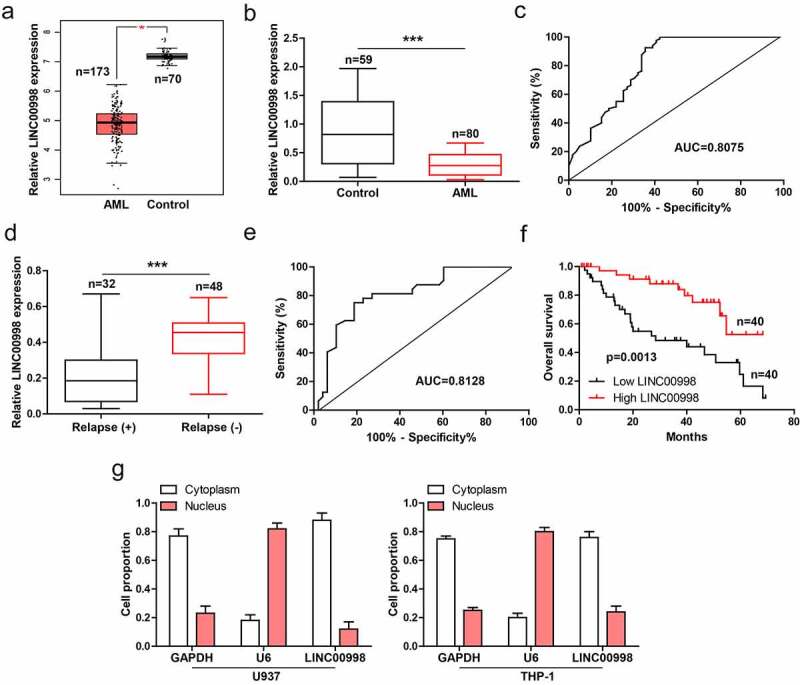
Figure 1. LINC00998 is lowly expressed in human AML. (a) GEPIA database showing the expression of LINC00998 in AML. (b, c) qRT-PCR analysis of LINC00998 in PBMCs from 80 AML patients and 59 healthy controls, followed by ROC curve analysis. (d, e) qRT-PCR analysis of LINC00998 in PBMCs from AML patients with or without relapse, followed by ROC curve analysis. (f) The survival curve of AML patients with low or high LINC00998 level based on median LINC00998 expression (Hazard Ratio = 3.161, 95% confidence interval = 1.565 ~ 6.386). (g) qRT-PCR analysis of LINC00998 level in nuclear and cytoplasmic fragments of U937 and THP-1 cells. ***P < 0.001
Figure 1. LINC00998 is lowly expressed in human AML. (a) GEPIA database showing the expression of LINC00998 in AML. (b, c) qRT-PCR analysis of LINC00998 in PBMCs from 80 AML patients and 59 healthy controls, followed by ROC curve analysis. (d, e) qRT-PCR analysis of LINC00998 in PBMCs from AML patients with or without relapse, followed by ROC curve analysis. (f) The survival curve of AML patients with low or high LINC00998 level based on median LINC00998 expression (Hazard Ratio = 3.161, 95% confidence interval = 1.565 ~ 6.386). (g) qRT-PCR analysis of LINC00998 level in nuclear and cytoplasmic fragments of U937 and THP-1 cells. ***P < 0.001CC BY · PubMed Central
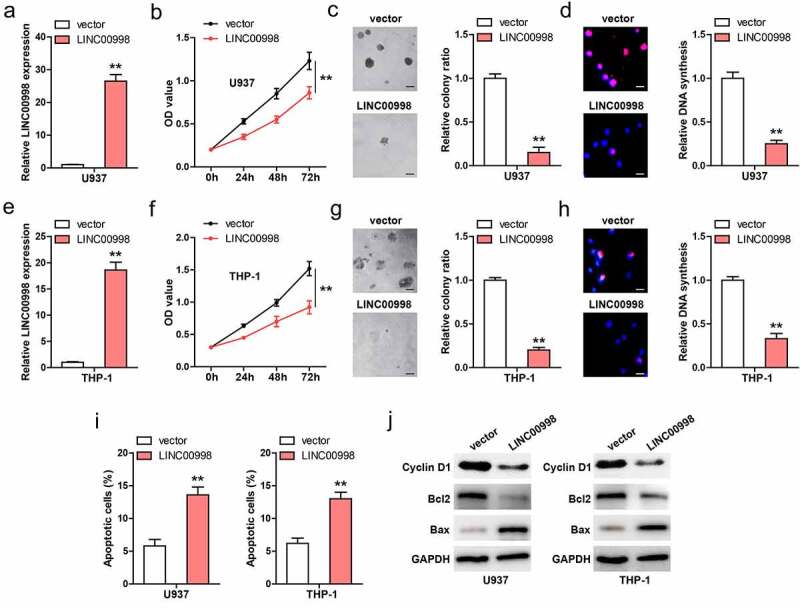
Figure 2. LINC00998 inhibits AML cell malignant behaviors. (a) qRT-PCR verifying the overexpression of LINC00998 in U937 cells. (b–d) CCK-8, colony formation and EdU assays testing cell viability, colony and DNA synthesis rate of U937 cells after LINC00998 overexpression. (e–h) The effect of LINC00998 overexpression on cell viability, colony and DNA synthesis rate. (i) Flow cytometry analyzing cell apoptosis after LINC00998 overexpression. (j) The indicated protein levels in LINC00998-overexpressing AML cell lines. Scale bar = 50 μm, **P < 0.01
Figure 2. LINC00998 inhibits AML cell malignant behaviors. (a) qRT-PCR verifying the overexpression of LINC00998 in U937 cells. (b–d) CCK-8, colony formation and EdU assays testing cell viability, colony and DNA synthesis rate of U937 cells after LINC00998 overexpression. (e–h) The effect of LINC00998 overexpression on cell viability, colony and DNA synthesis rate. (i) Flow cytometry analyzing cell apoptosis after LINC00998 overexpression. (j) The indicated protein levels in LINC00998-overexpressing AML cell lines. Scale bar = 50 μm, **P < 0.01CC BY · PubMed Central
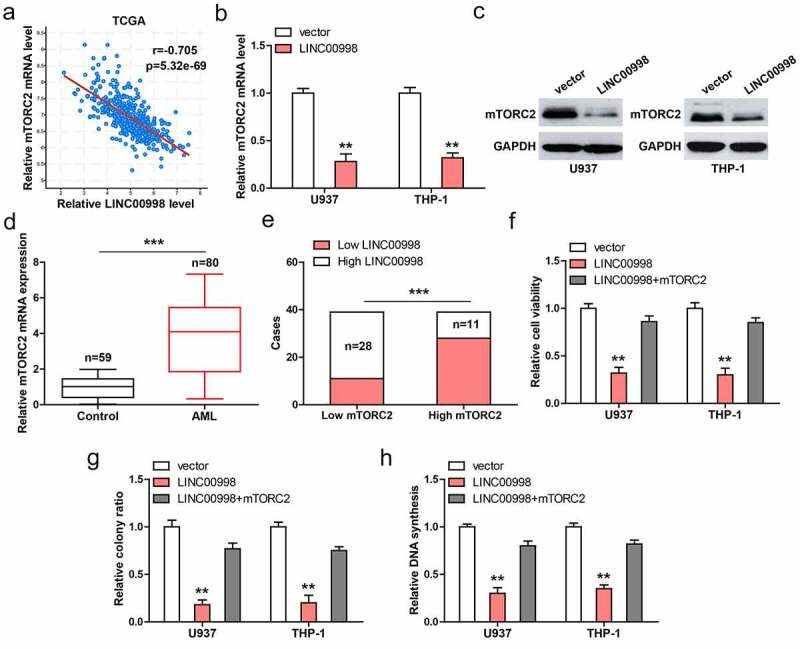
Figure 3. LINC00998 inhibits mTORC2 level. (a) The correlation between LINC00998 and mTORC2 mRNA in TCGA AML database. (b, c). The mRNA and protein levels of mTORC2 after LINC00998 overexpression. (d) qRT-PCR analysis of mTORC2 mRNA levels in PBMCs from 80 AML patients and 59 healthy controls. (e) The correlation between LINC00998 and mTORC2 mRNA in AML. F-H. Cell viability, colony and DNA synthesis in LINC00998-overexpressed U937 and THP-1 cells with mTORC2 overexpression. **P < 0.01, ***P < 0.001
Figure 3. LINC00998 inhibits mTORC2 level. (a) The correlation between LINC00998 and mTORC2 mRNA in TCGA AML database. (b, c). The mRNA and protein levels of mTORC2 after LINC00998 overexpression. (d) qRT-PCR analysis of mTORC2 mRNA levels in PBMCs from 80 AML patients and 59 healthy controls. (e) The correlation between LINC00998 and mTORC2 mRNA in AML. F-H. Cell viability, colony and DNA synthesis in LINC00998-overexpressed U937 and THP-1 cells with mTORC2 overexpression. **P < 0.01, ***P < 0.001CC BY · PubMed Central
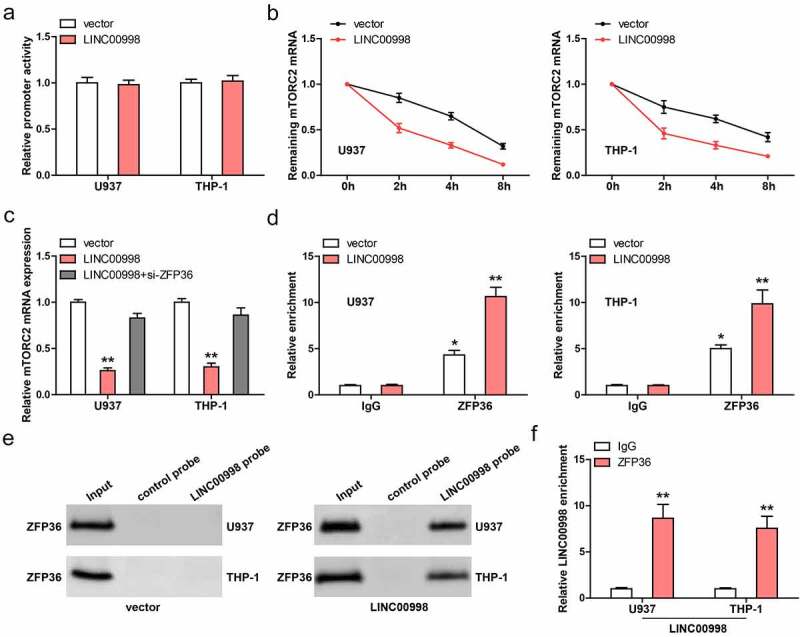
Figure 4. LINC00998 enhances ZFP36-mediated mTORC2 mRNA decay. (a) The promoter activity of mTORC2 affected by LINC00998. (b) qRT-PCR analysis of mTORC2 mRNA level at the indicated time in LINC00998-overexpressed AML cells treated with Actinomycin D. (c) qRT-PCR testing the effect of ZFP36 silencing on mTORC2 expression in LINC00998-overexpressed AML cells. (d) The enrichment of mTORC2 3`-UTR by ZFP36 antibody. (e) RNA pull-down assay using LINC00998 probe, followed by western blot analysis of ZFP36 level. (f) The enrichment of LINC00998 by ZFP36 antibody. *P < 0.05, **P < 0.01
Figure 4. LINC00998 enhances ZFP36-mediated mTORC2 mRNA decay. (a) The promoter activity of mTORC2 affected by LINC00998. (b) qRT-PCR analysis of mTORC2 mRNA level at the indicated time in LINC00998-overexpressed AML cells treated with Actinomycin D. (c) qRT-PCR testing the effect of ZFP36 silencing on mTORC2 expression in LINC00998-overexpressed AML cells. (d) The enrichment of mTORC2 3`-UTR by ZFP36 antibody. (e) RNA pull-down assay using LINC00998 probe, followed by western blot analysis of ZFP36 level. (f) The enrichment of LINC00998 by ZFP36 antibody. *P < 0.05, **P < 0.01CC BY · PubMed Central
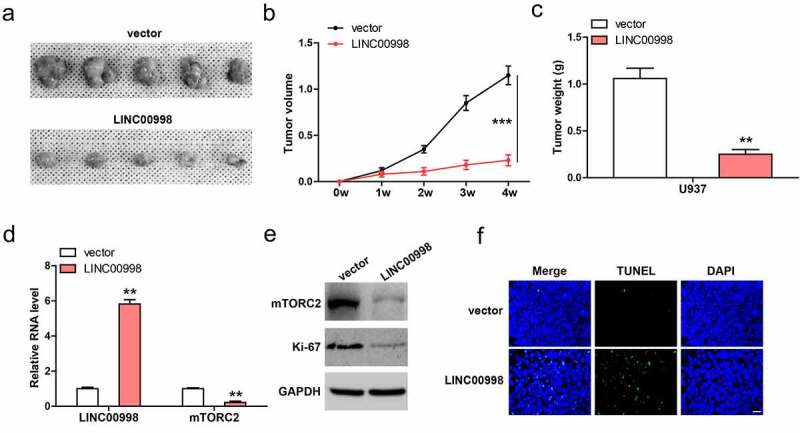
Figure 5. LINC00998 inhibits tumor growth in vivo. (a–c). Tumor volume, weight and image in control and LINC00998-overexpressing groups. (d) qRT-PCR analysis of LINC00998 and mTORC2 levels in the indicated two groups. (e) Western blot analyzing mTORC2 and Ki-67 levels in the indicated two groups. (f) TUNEL staining testing cell apoptosis in the indicated two groups. Staining of nucleus with DAPI. Scale bar = 50 μm, **P < 0.01, ***P < 0.001
Figure 5. LINC00998 inhibits tumor growth in vivo. (a–c). Tumor volume, weight and image in control and LINC00998-overexpressing groups. (d) qRT-PCR analysis of LINC00998 and mTORC2 levels in the indicated two groups. (e) Western blot analyzing mTORC2 and Ki-67 levels in the indicated two groups. (f) TUNEL staining testing cell apoptosis in the indicated two groups. Staining of nucleus with DAPI. Scale bar = 50 μm, **P < 0.01, ***P < 0.001CC BY · PubMed Central

Verification

Claims the paper makes

The claims and statistics of this paper haven’t been checked yet.

Run the check — free, no account needed. It reads the open-access text and checks the sources it cites.

A few free checks a day · papers already verified open instantly · results are public

Claims other papers make about this one

Each is checked against this paper’s own text: does it say what the citing paper says it does?

Self-check

Percentages, sums and reported differences re-computed from the paper’s own numbers.

The self-check needs the paper’s full text.

Citations

Cites

No references could be resolved yet.

Research works printed but not linked: 30

  1. 10.1056/NEJMra1406184 · DOI
  2. Ben KM, Ingegnere T, Quesnel B, et al. Acute myeloid leukemia: is it T time? Cancers (Basel). 2021;13(10):2385.
  3. 10.1007/s11864-019-0694-6 · DOI
  4. 10.1007/PL00000913 · DOI
  5. 10.1002/path.2638 · DOI
  6. 10.1016/j.ejphar.2020.172976 · DOI
  7. Ren X. Genome-wide analysis reveals the emerging roles of long non-coding RNAs in cancer. Oncol Lett. 2020;19(1):588–594.
  8. 10.1016/j.ncrna.2017.06.003 · DOI
  9. 10.1038/s41388-018-0382-1 · DOI
  10. 10.1080/21655979.2021.1930336 · DOI
  11. 10.1038/s41388-018-0162-y · DOI
  12. 10.1182/blood-2016-03-643544 · DOI · Paper page
  13. 10.1080/21655979.2021.1882133 · DOI
  14. 10.1080/21655979.2021.1918522 · DOI
  15. Chi Y, Wang D, Wang J, et al. Long Non-Coding RNA in the Pathogenesis of Cancers. Cells-Basel. 2019;8(9):1015.
  16. 10.1016/j.apsb.2020.10.001 · DOI
  17. 10.1038/s41467-020-15547-8 · DOI
  18. 10.1053/j.gastro.2018.02.018 · DOI
  19. 10.1016/j.isci.2020.100835 · DOI
  20. 10.1093/bib/bbv031 · DOI
  21. 10.1016/j.canlet.2019.04.016 · DOI
  22. 10.1126/science.1192002 · DOI · Paper page
  23. 10.1038/s41388-020-01512-8 · DOI
  24. 10.1016/j.cellsig.2011.09.015 · DOI
  25. 10.1038/onc.2016.363 · DOI
  26. 10.1016/j.blre.2017.11.006 · DOI
  27. 10.1038/s41419-020-03247-6 · DOI
  28. 10.1186/s12943-018-0879-9 · DOI
  29. 10.1016/j.ccell.2019.10.011 · DOI
  30. 10.1080/21655979.2021.1971508 · DOI

Cited by

Sorted by citations

See all 10

Metadata

Authors
Fang, X., Pan, X., Mai, H., Yuan, X., Liu, S., & Wen, F.
Affiliations
  • The First Affiliated Hospital of Jinan University
  • The University of Hong Kong-Shenzhen Hospital
  • Shenzhen Children’s Hospital
Venue
Bioengineered
Published
2021-12-02
Volume
12
Issue
2
Pages
10363-10372
ISSN
  • 2165-5979
  • 2165-5987
Cited by
10
References
0
Language
en
Funders
Shenzhen Science and Technology Project, Guangdong Province, China (JCYJ20160429180540076)

About these checks

Registry, retraction, Cites and statistics results are computed, not judged, with one exception: a printed reference that no index lists is read once by a model before it counts as a citation error. Claims are extracted by a model and kept only when their quote appears verbatim in the text; each cited source is then checked, with a model’s help, for whether it says what the claim relies on. Those verdicts can be wrong — read the claim’s quote and the cited source before relying on one.

Statistics and arithmetic are recomputed, not judged.

Confidence bands are shown only for fields calibrated on our annotated test set. None is calibrated yet, so no band is shown.

What counts as a claim ›How we measure confidence ›How we check this ›

Are you an author, or do you see a problem with this page? Request a review

How to cite

Cite CoChat for the checks on this page, and the paper for its own findings.

This page
CoChat. (2026). Citation check: LINC00998 functions as a novel tumor suppressor in acute myeloid leukemia via regulating the ZFP36 ring finger protein/mammalian target of rapamycin complex 2 axis. https://app.cochat.ai/papers/10.1080/21655979.2021.1996506
The paper
Fang, X., Pan, X., Mai, H., Yuan, X., Liu, S., & Wen, F. (2021). LINC00998 functions as a novel tumor suppressor in acute myeloid leukemia via regulating the ZFP36 ring finger protein/mammalian target of rapamycin complex 2 axis. Bioengineered. https://doi.org/10.1080/21655979.2021.1996506