

Bone marrow mesenchymal stem cells-derived exosomal microRNA-124-3p attenuates hypoxic-ischemic brain damage through depressing tumor necrosis factor receptor associated factor 6 in newborn rats
The DOI matches its Crossref record; 48 of the 48 references it cites were found in a registry or an index.
Abstract
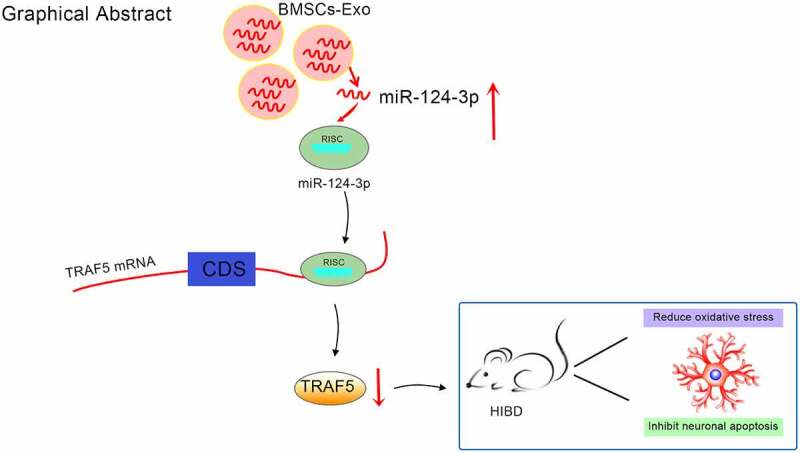
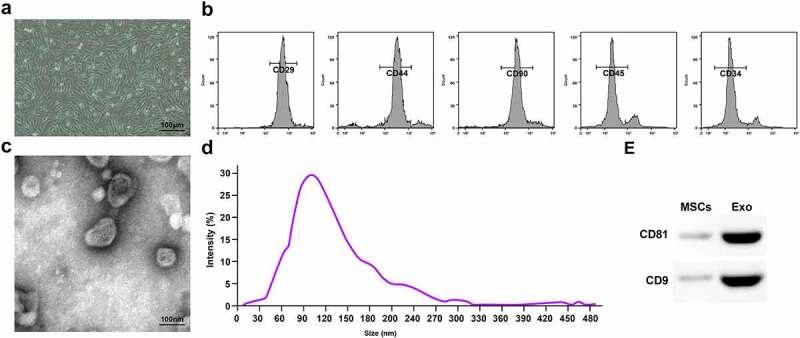
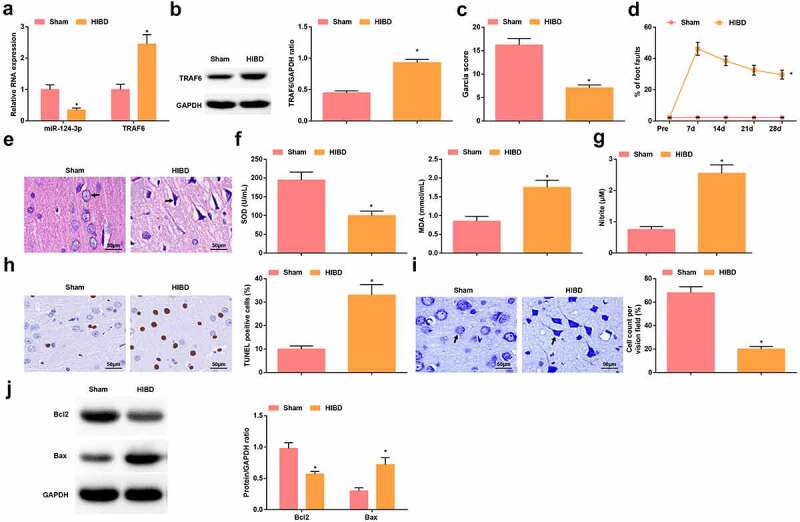
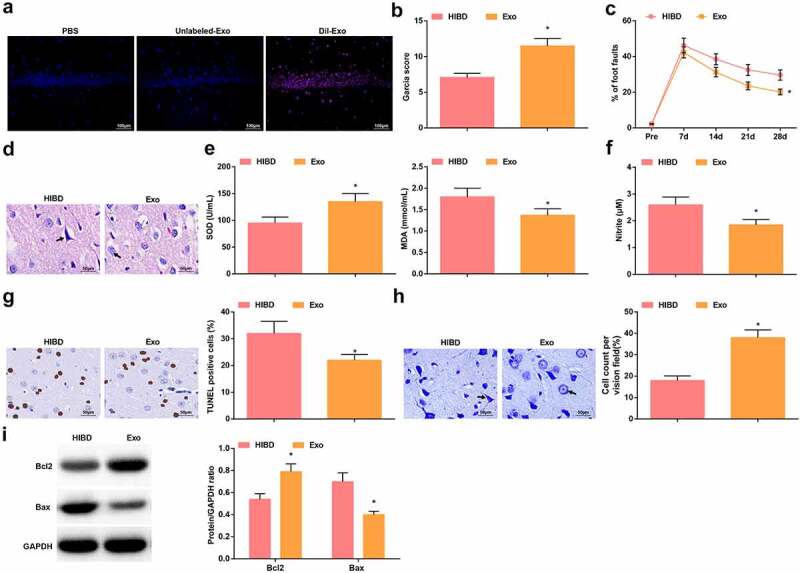
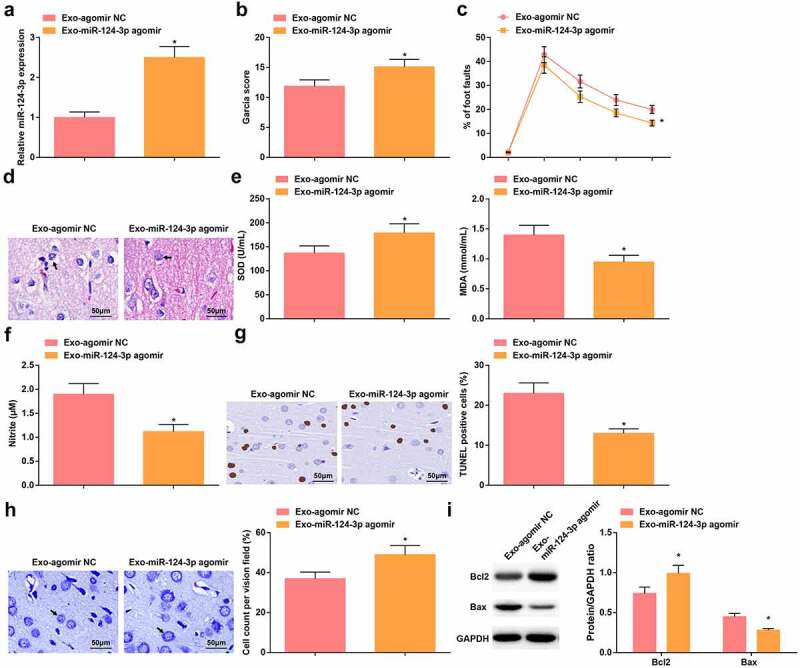
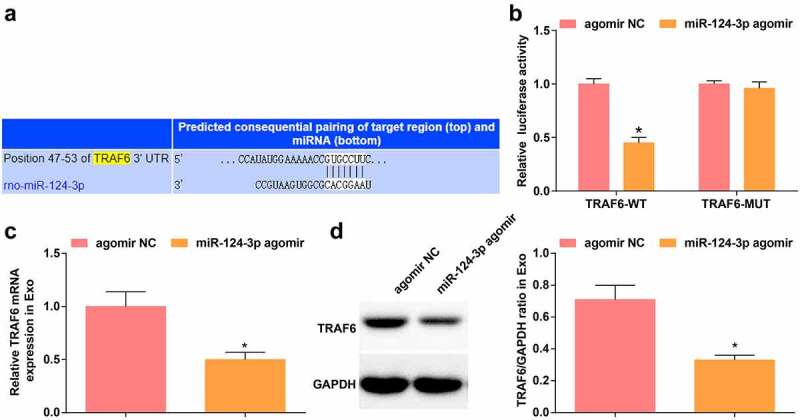
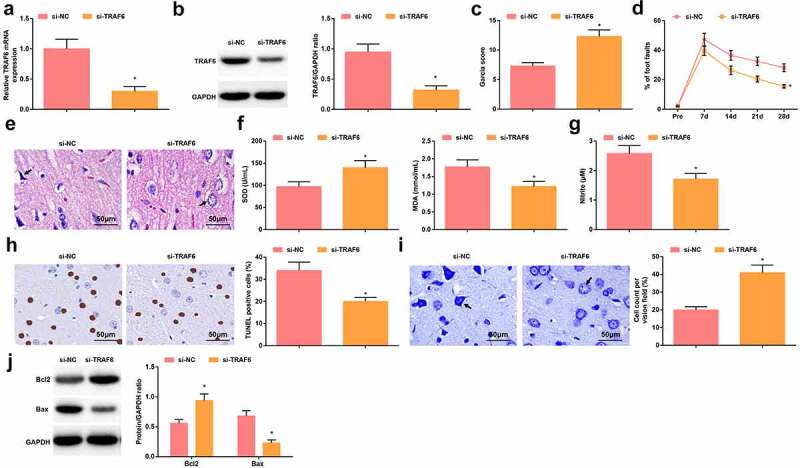
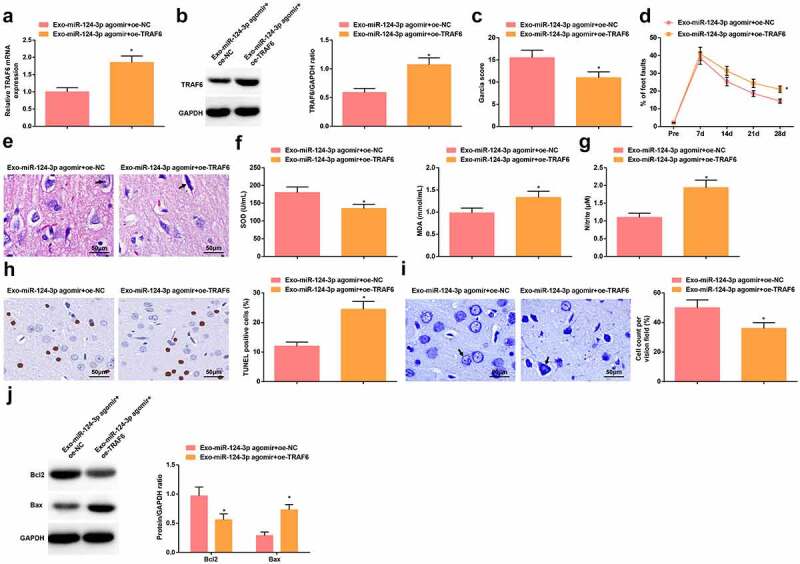
Mesenchymal stem cells (MSCs)-derived exosomes (Exo) are beneficial in the use of brain damages. Restrictively, the mechanism of Exo expressing miR-124-3p in hypoxic-ischemic brain damage (HIBD) is not completely comprehended. Thereupon, this work was put forward to reveal the action of bone marrow MSCs-derived Exo (BMSCs-Exo) expressing miR-124-3p in the illness. BMSCs were isolated and transfected with miR-124-3p agomir. Then, BMSCs-Exo were extracted and identified. The newborn HIBD rats were injected with miR-124-3p-modified BMSCs-Exo or tumor necrosis factor receptor associated factor 6 (TRAF6)-related vectors. Next, neurological functions, neuron pathological and structural damages, oxidative stress and neuronal apoptosis were observed. miR-124-3p and TRAF6 expression was tested, along with their targeting relationship. miR-124-3p was down-regulated, and TRAF6 was up-regulated in newborn HIBD rats. miR-124-3p targeted TRAF6. BMSCs-Exo improved neurological functions, alleviated neuron pathological and structural damages, suppressed oxidative stress and reduced neuronal apoptosis in newborn HIBD rats, whereas BMSCs-Exo-mediated effects were enhanced by restoring miR-124-3p. Silencing TRAF6 attenuated HIBD in newborn rats, but overexpression of TRAF6 reversed the protective role of miR-124-3p-overexpressing BMSCs-Exo. This work makes it comprehensive that up-regulated exosomal miR-124-3p ameliorates HIBD in newborn rats by targeting TRAF6, which replenishes the potential agents for curing HIBD.
Overview
The claims and statistics of this paper haven’t been checked yet.
Free: it reads the open-access text and checks the first 5 claims that cite a source we can check. Create a free account to check every claim.
Integrity signals
Registry
Cites
Statistics
Figures
Verification
Claims the paper makes
The claims and statistics of this paper haven’t been checked yet.
Free: it reads the open-access text and checks the first 5 claims that cite a source we can check. Create a free account to check every claim.
Claims other papers make about this one
Each is checked against this paper’s own text: does it say what the citing paper says it does?
The source backs part of the claim, not all of it — or backs it for a different population, condition or comparison.
In the citing paper
“Recently, accumulating evidence has showed that EVs, endogenous lipid membrane vesicles 30–150 nm in diameter that can transport therapeutic drugs (including proteins, lipids, and nucleic acids) and possess biocompatibility, metabolic stability, BBB penetrability, and target specificity, are potential avenues for treating neurological diseases [11–14].”
From Engineered Extracellular Vesicles Loaded with MiR-100-5p Antagonist Selectively Target the Lesioned Region to Promote Recovery from Brain Damage (2025) · cites this paper as [11]
Experimental — accuracy not yet measured
Self-check
Percentages, sums and reported differences re-computed from the paper’s own numbers.
The self-check needs the paper’s full text.
Citations
Cites
Exosome Mediated Delivery of miR-124 Promotes Neurogenesis after Ischemia
Yang, J., Zhang, X., Chen, X., Wang, L., & Yang, G. (2017) · Molecular Therapy - Nucleic Acids · doi:10.1016/j.omtn.2017.04.010 · Cited by 547
Qi, X., Zhang, J., Yuan, H., Xu, Z., Li, Q., Niu, X., Hu, B., Wang, Y., & Li, X. (2016) · International Journal of Biological Sciences · doi:10.7150/ijbs.14809 · Cited by 535
Self-citationHuang, S., Ge, X., Yu, J., Han, Z., Yin, Z., Li, Y., Chen, F., Wang, H., Zhang, J., & Lei, P. (2018) · The FASEB Journal · doi:10.1096/fj.201700673r · Cited by 388
Liu, X., Zhang, M., Liu, H., Zhu, R., He, H., Zhou, Y., Zhang, Y., Li, C., Liang, D., Zeng, Q., et al. (2021) · Experimental Neurology · doi:10.1016/j.expneurol.2021.113700 · Cited by 343
Self-citationOphelders, D. R. M. G., Wolfs, T. G. A. M., Jellema, R. K., Zwanenburg, A., Andriessen, P., Delhaas, T., Ludwig, A.-K., Radtke, S., Peters, V., Janssen, L., et al. (2016) · Stem Cells Translational Medicine · doi:10.5966/sctm.2015-0197 · Cited by 278
Gangadaran, P., Rajendran, R. L., Lee, H. W., Kalimuthu, S., Hong, C. M., Jeong, S. Y., Lee, S.-W., Lee, J., & Ahn, B.-C. (2017) · Journal of Controlled Release · doi:10.1016/j.jconrel.2017.08.022 · Cited by 210
Li, R., Zhao, K., Ruan, Q., Meng, C., & Yin, F. (2020) · Arthritis Research & Therapy · doi:10.1186/s13075-020-2146-x · Cited by 155
Thomi, G., Joerger-Messerli, M., Haesler, V., Muri, L., Surbek, D., & Schoeberlein, A. (2019) · Cells · doi:10.3390/cells8080855 · Cited by 131
MicroRNA-132 attenuates cerebral injury by protecting blood-brain-barrier in MCAO mice
Zuo, X., Lu, J., Manaenko, A., Qi, X., Tang, J., Mei, Q., Xia, Y., & Hu, Q. (2019) · Experimental Neurology · doi:10.1016/j.expneurol.2019.03.017 · Cited by 113
Zhou, X., Chu, X., Yuan, H., Qiu, J., Zhao, C., Xin, D., Li, T., Ma, W., Wang, H., Wang, Z., et al. (2019) · Biomedicine & Pharmacotherapy · doi:10.1016/j.biopha.2019.108818 · Cited by 111
Zhao, Y., Gan, Y., Xu, G., Yin, G., & Liu, D. (2020) · Neurochemical Research · doi:10.1007/s11064-020-02998-0 · Cited by 107
Wang, Y., Chen, G., Yu, X., Li, Y., Zhang, L., He, Z., Zhang, N., Yang, X., Zhao, Y., Li, N., et al. (2016) · Inflammation · doi:10.1007/s10753-016-0384-5 · Cited by 99
Fang, S., Li, Y., & Chen, P. (2018) · Drug Design, Development and Therapy · doi:10.2147/dddt.s178698 · Cited by 98
Zhao, J., Zhang, X., Dong, L., Wen, Y., Zheng, X., Zhang, C., Chen, R., Zhang, Y., Li, Y., He, T., et al. (2015) · British Journal of Pharmacology · doi:10.1111/bph.13270 · Cited by 94
Roles of TRAF6 in Central Nervous System
Dou, Y., Tian, X., Zhang, J., Wang, Z., & Chen, G. (2018) · Current Neuropharmacology · doi:10.2174/1570159x16666180412094655 · Cited by 87
Hu, Q., Manaenko, A., Bian, H., Guo, Z., Huang, J.-L., Guo, Z.-N., Yang, P., Tang, J., & Zhang, J. H. (2017) · Stroke · doi:10.1161/strokeaha.116.015753 · Cited by 85
The Ubiquitin E3 Ligase TRAF6 Exacerbates Ischemic Stroke by Ubiquitinating and Activating Rac1
Li, T., Qin, J., Xia, Y., Ji, Y., Guo, F., Cheng, W., Wu, X., Gong, F., Hong, Y., Zhu, X., et al. (2017) · Journal of Neuroscience · doi:10.1523/jneurosci.1751-17.2017 · Cited by 83
Xiao, B., Zhu, Y., Huang, J., Wang, T., Wang, F., & Sun, S. (2019) · Biology Open · doi:10.1242/bio.039958 · Cited by 83
LI, T., ZHANG, C., DING, Y., ZHAI, W., LIU, K., BU, F., TU, T., SUN, L., ZHU, W., ZHOU, F., et al. (2015) · Oncology Reports · doi:10.3892/or.2015.4109 · Cited by 73
Wang, S., Duan, L., Xia, B., Liu, Z., Wang, Y., & Wang, G. (2017) · Biomedicine & Pharmacotherapy · doi:10.1016/j.biopha.2017.06.051 · Cited by 69
New insights into the pathogenesis of perinatal hypoxic‐ischemic brain injury
Vasiljevic, B., Maglajlić, S., Gojnic, M. G., Stankovic, S. D., Ignjatović, S., & Lutovac, D. P. (2011) · Pediatrics International · doi:10.1111/j.1442-200x.2010.03290.x · Cited by 62
Qian, D., Wei, G., Xu, C., He, Z., Hua, J., Li, J., Hu, Q., Lin, S., Gong, J., Meng, H., et al. (2017) · Scientific Reports · doi:10.1038/s41598-017-00629-3 · Cited by 60
(2019) · Cellular Physiology and Biochemistry · doi:10.33594/000000090 · Cited by 56
Liang, Y., Liu, Q., Xu, G., Zhang, J., Chen, Y., Hua, F., Deng, C., & Hu, Y.-H. (2019) · Journal of Bioenergetics and Biomembranes · doi:10.1007/s10863-019-09812-9 · Cited by 53
miR-124-3p is a chronic regulator of gene expression after brain injury
Vuokila, N., Łukasiuk, K., Bot, A. M., van Vliet, E. A., Aronica, E., Pitkänen, A., & Puhakka, N. (2018) · Cellular and Molecular Life Sciences · doi:10.1007/s00018-018-2911-z · Cited by 52
Safakheil, M., & Safakheil, H. (2020) · Journal of Molecular Neuroscience · doi:10.1007/s12031-020-01483-1 · Cited by 52
Jiang, X., Lew, K. S., Chen, Q., Richards, M., & Wang, P. (2019) · Current Pharmaceutical Design · doi:10.2174/1381612825666190119130441 · Cited by 50
Treatment and new progress of neonatal hypoxic-ischemic brain damage.
Yang, L., Zhao, H., & Cui, H. (2020) · PubMed · doi:10.14670/hh-18-214 · Cited by 43
Li, H., He, H., Song, J., Du, Y.-F., Guan, M., & Wu, C. (2019) · Cellular Signalling · doi:10.1016/j.cellsig.2019.109436 · Cited by 42
miR-21 protects neonatal rats from hypoxic-ischemic brain damage by targeting CCL3
Liu, J., Zhang, S., Huang, Y., & Sun, L. (2020) · APOPTOSIS · doi:10.1007/s10495-020-01596-3 · Cited by 37
Self-citationHua, F., Li, H.-F., He, M.-H., Yan, J., Yang, M., Zhang, F., Wang, R., Wang, Q.-Y., & Zhang, J.-P. (2019) · Brain Research Bulletin · doi:10.1016/j.brainresbull.2019.06.004 · Cited by 36
Fard, N., Saffari, A., Emami, G., Hofer, S., Kauczor, H., & Mehrabi, A. (2014) · Journal of Surgical Research · doi:10.1016/j.jss.2014.02.034 · Cited by 35
Xue, Q., Yang, L., Wang, H., & Han, S. (2021) · BioMed Research International · doi:10.1155/2021/8884438 · Cited by 35
Potential Therapeutic Applications and Developments of Exosomes in Parkinson’s Disease
Luo, S., Du, L., & Cui, Y. (2020) · Molecular Pharmaceutics · doi:10.1021/acs.molpharmaceut.0c00195 · Cited by 34
Chen, F., Hu, Y., Xie, Y., Zhao, Z., Ma, L., Li, Z., & Tan, W. (2020) · Mediators of Inflammation · doi:10.1155/2020/8869511 · Cited by 33
Statistical Analysis of Quantitative RT-PCR Results
Khan-Malek, R. C., & Wang, Y. (2010) · Methods in molecular biology · doi:10.1007/978-1-60761-849-2_13 · Cited by 30
Gender difference in the effect of progesterone on neonatal hypoxic/ischemic brain injury in mouse
Dong, S., Zhang, Q., Kong, D., Zhou, C., Zhou, J., Han, J., Zhou, Y., Jin, G., Hua, X., Wang, J., et al. (2018) · Experimental Neurology · doi:10.1016/j.expneurol.2018.05.013 · Cited by 30
Self-citationXiong, L., Zhou, H.-L., Zhao, Q., Xue, L., Al‐Hawwas, M., He, J., Wu, M., Zou, Y., Yang, M., Dai, J., et al. (2020) · Cellular and Molecular Neurobiology · doi:10.1007/s10571-019-00769-2 · Cited by 30
Xu, S., Jiang, X.-L., Liu, Q., Xu, J., Huang, J., Gan, S., Lu, W., Zhuo, F., Yang, M., & Sun, S. (2019) · Genes & Diseases · doi:10.1016/j.gendis.2019.01.002 · Cited by 24
miR‑183‑5p attenuates cerebral ischemia injury by negatively regulating PTEN
Li, Z., Zhou, X., Li, S., Liu, J., Yang, J., Fan, X., & Zhou, S. (2020) · Molecular Medicine Reports · doi:10.3892/mmr.2020.11493 · Cited by 24
Self-citationStatistical Analysis of Quantitative RT-PCR Results
Khan-Malek, R. C., & Wang, Y. (2017) · Methods in molecular biology · doi:10.1007/978-1-4939-7172-5_15 · Cited by 24
Expression and regulation of miR-449a and AREG in cerebral ischemic injury
Yu, Y., Zhang, X., Han, Z., Zhao, W., & Zhang, L. (2019) · Metabolic Brain Disease · doi:10.1007/s11011-019-0393-9 · Cited by 23
Huang, R., Zhang, J., Ren, C., Zhang, X., Gu, L., Dong, Y., Zhang, J., & Zhang, J. (2019) · Neuroreport · doi:10.1097/wnr.0000000000001194 · Cited by 21
miR-137 alleviates focal cerebral ischemic injury in rats by regulating JAK1/STAT1 signaling pathway
Zhang, M., Ge, D., Su, Z. Z., & Qi, B. (2020) · Human & Experimental Toxicology · doi:10.1177/0960327119897103 · Cited by 20
Jiang, Y. P., Bai, X., Zhao, Q., Al‐Hawwas, M., Jin, Y., Zou, Y., Hu, Y. H., Liu, L., Liu, L., Zhang, Y., et al. (2020) · BMC Neuroscience · doi:10.1186/s12868-020-00565-5 · Cited by 19
Self-citationLung injury induced by paraquat, hyperoxia and cobalt chloride: Effects of ambroxol
Nemery, B., Vanlommel, S., Verbeken, E. K., Lauweryns, J. M., & Demedts, M. (1992) · Pulmonary Pharmacology · doi:10.1016/0952-0600(92)90018-c · Cited by 13
Chen, W.-B., Zhang, L.-X., Zhao, Y.-K., Li, J., & Jiao, Y. (2020) · Brain Research Bulletin · doi:10.1016/j.brainresbull.2020.08.006 · Cited by 7
MiR-124-3p alleviates the dezocine tolerance against pain by regulating TRAF6 in a rat model
Huo, Y., Zhang, K., Zhang, T., Han, Y., & Hu, Z. (2020) · Neuroreport · doi:10.1097/wnr.0000000000001559 · Cited by 6
Research works printed but not linked: 1
- Zhu L, Zhou, XY, Li, SS, et al. miR1835p attenuates cerebral ischemia injury by negatively regulating PTEN. Mol Med Rep. 2020; 22(5): 3944– 3954. 32901892 PMC7533437
Cited by
Cheng, Y., Gai, C., Zhao, Y., Li, T., Song, Y., Luo, Q., Xin, D., Jiang, Z., Chen, W., Liu, D., et al. (2025) · Neuroscience Bulletin · doi:10.1007/s12264-025-01376-6 · Cited by 5
“…lipid membrane vesicles 30–150 nm in diameter that can transport therapeutic drugs (including proteins, lipids, and nucleic acids) and possess biocompatibility, metabolic stability, BBB penetrability, and target specificity, are potential avenues for treating neurological diseases [11–14].”
Metadata
- Authors
- Min, W., Wu, Y., Fang, Y., Hong, B., Dai, D., Zhou, Y., Liu, J., & Li, Q.
- Affiliations
- Changhai Stroke Center, Changhai Hospital, Second Military Medical University, Shanghai China
- Venue
- Bioengineered
- Publisher
- Informa UK Limited
- Published
- 2022-01-22
- Volume
- 13
- Issue
- 2
- Pages
- 3195-3207
- ISSN
- 2165-5979
- 2165-5987
- PMC
- PMC8973938
- Cited by
- 26
- References
- 48
- Language
- en
About these checks
Registry, retraction, Cites and statistics results are computed, not judged, with one exception: a printed reference that no index lists is read once by a model before it counts as a citation error. Claims are extracted by a model and kept only when their quote appears verbatim in the text; each cited source is then checked, with a model’s help, for whether it says what the claim relies on. Those verdicts can be wrong — read the claim’s quote and the cited source before relying on one.
Statistics and arithmetic are recomputed, not judged.
Confidence bands are shown only for fields calibrated on our annotated test set. None is calibrated yet, so no band is shown.
What counts as a claim ›How we measure confidence ›How we check this ›
Are you an author, or do you see a problem with this page? Request a review
Data sources
Bibliographic data: Semantic Scholar, OpenAlex, Crossref.
Contains information from the Semantic Scholar Academic Graph Datasets, made available under the ODC Attribution License (ODC-BY 1.0).
Semantic Scholar’s data is described in: Kinney, R., et al. (2023). The Semantic Scholar Open Data Platform. arXiv:2301.10140.
