

The DOI matches its Crossref record.
ZAP-70 Protein Promotes Tyrosine Phosphorylation of T Cell Receptor Signaling Motifs (ITAMs) in Immature CD4+8+ Thymocytes with Limiting p56lck
Abstract
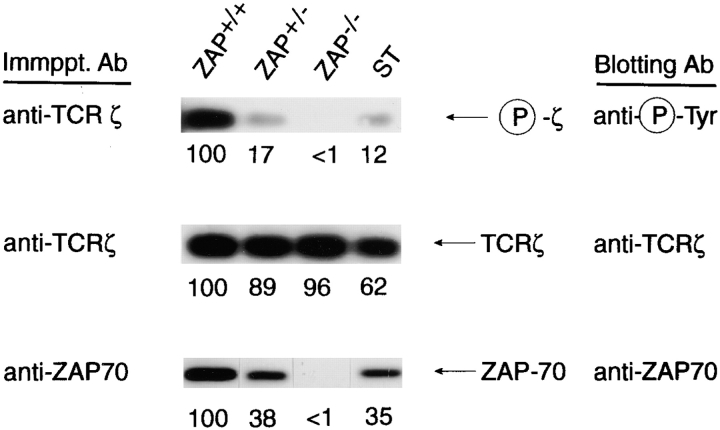
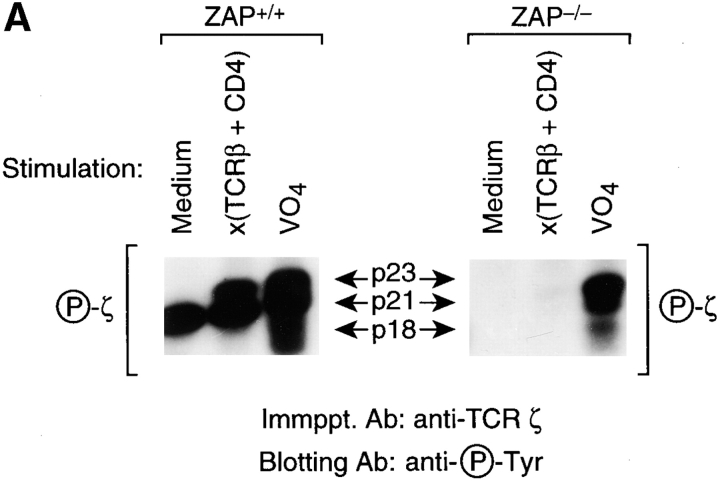
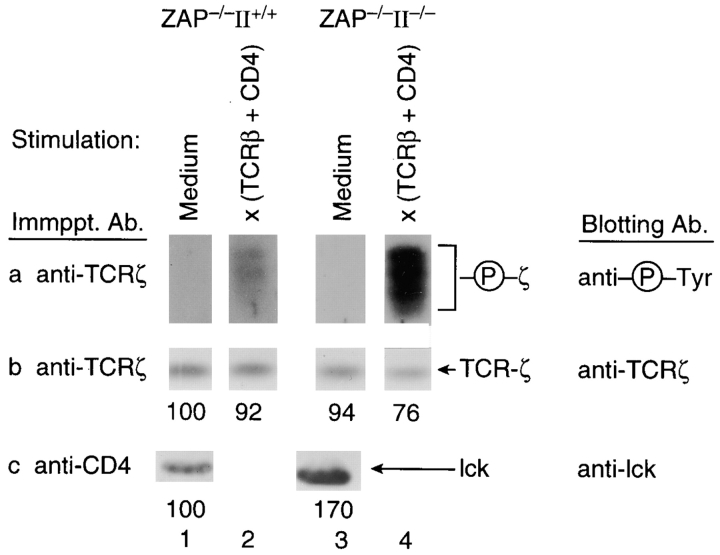
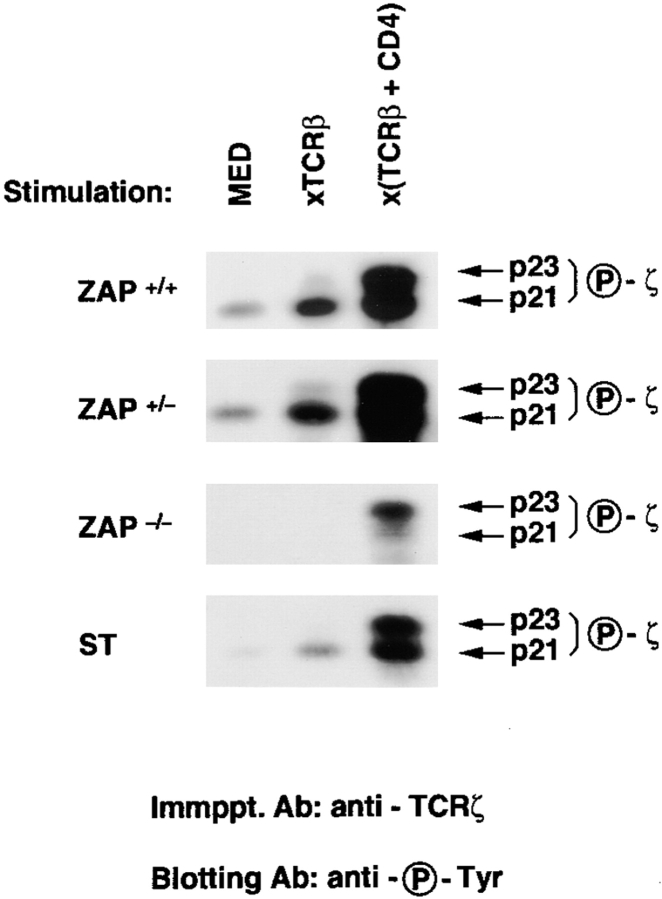
As a result of interaction with epithelial cells in the thymic cortex, immature CD4+8+ (double positive, DP) thymocytes express relatively few T cell receptors (TCRs) and contain diminished numbers of coreceptor-associated p56lck (lck) PTK molecules. As a result, TCR signal transduction in DP thymocytes is significantly impaired, despite its importance for repertoire selection. We report here that, in DP thymocytes, tyrosine phosphorylation of TCR signaling motifs (ITAMs) by lck, an early event in TCR signal transduction, is dependent upon ZAP-70 protein independent of ZAP-70's kinase activity. Furthermore, the dependence on ZAP-70 protein for ITAM phosphorylation diminishes as available lck increases. Importantly, ZAP-70's role in ITAM phosphorylation in DP thymocytes is not limited to protecting phosphorylated ITAMs from dephosphorylation. Rather, this study indicates that ZAP-70 protein augments ITAM phosphorylation in DP thymocytes and so compensates in part for the relative deficiency of coreceptor-associated lck.
Overview
The claims and statistics of this paper haven’t been checked yet.
Run the check — free, no account needed. It reads the open-access text and checks the sources it cites.
Integrity signals
Registry
Cites
Statistics
Figures
Verification
Claims the paper makes
The claims and statistics of this paper haven’t been checked yet.
Run the check — free, no account needed. It reads the open-access text and checks the sources it cites.
Claims other papers make about this one
Each is checked against this paper’s own text: does it say what the citing paper says it does?
In the citing paper
“ZAP-70 has been reported to promote the phosphorylation of CD3ζ and the association of CD3ζ with Lck, as ZAP-70 deficiency impairs the TCR-induced CD3ζ phosphorylation[8], [9], [10].”
From RhoH Regulates Subcellular Localization of ZAP-70 and Lck in T Cell Receptor Signaling (2010) · cites this paper as [8]
Self-check
Percentages, sums and reported differences re-computed from the paper’s own numbers.
The self-check needs the paper’s full text.
Citations
Cites
No references could be resolved yet.
Research works printed but not linked: 15
- Van Ewijk, 1980, Distribution of H-2 microenvironments in the mouse thymus. Immunoelectron microscopic identification of I-A and H-2K bearing cells, J Histochem Cytochem, 28, 1089, 10.1177/28.10.6999083 · DOI
- Wiest, 1993, Regulation of T cell receptor expression in immature CD4+CD8+ thymocytes by p56lcktyrosine kinase: basis for differential signaling by CD4 and CD8 in immature thymocytes expressing both coreceptor molecules, J Exp Med, 178, 1701, 10.1084/jem.178.5.1701 · DOI
- Wiest, 1996, TCR activation of ZAP70 is impaired in CD4+CD8+ thymocytes as a consequence of intrathymic interactions that diminish available p56lck, Immunity, 4, 495, 10.1016/S1074-7613(00)80415-X · DOI
- Qian, 1996, Dominant-negative ζ-associated protein 70 inhibits T cell antigen receptor signaling, J Exp Med, 183, 611, 10.1084/jem.183.2.611 · DOI
- Negishi, 1995, Essential role for ZAP-70 in both positive and negative selection of thymocytes, Nature, 376, 435, 10.1038/376435a0 · DOI
- Wiest, 1997, A spontaneously arising mutation in the DLAARN motif of murine ZAP-70 abrogates kinase activity and arrests thymocyte development, Immunity, 6, 663, 10.1016/S1074-7613(00)80442-2 · DOI
- Wange, 1996, Complex complexes: signaling at the TCR, Immunity, 5, 197, 10.1016/S1074-7613(00)80315-5 · DOI
- Nakayama, 1990, Inhibition of T cell receptor expression and function in immature CD4+CD8+cells by CD4, Science, 249, 1558, 10.1126/science.2120773 · DOI
- Nakayama, 1989, Intrathymic signalling in immature CD4+CD8+thymocytes results in tyrosine phosphorylation of the T-cell receptor zeta chain, Nature, 341, 651, 10.1038/341651a0 · DOI
- van Oers, 1994, ZAP-70 is constitutively associated with tyrosine-phosphorylated TCR zeta in murine thymocytes and lymph node T cells, Immunity, 1, 675, 10.1016/1074-7613(94)90038-8 · DOI
- van Oers, 1996, Lck regulates the tyrosine phosphorylation of the T cell receptor subunits and ZAP-70 in murine thymocytes, J Exp Med, 183, 1053, 10.1084/jem.183.3.1053 · DOI
- Iwashima, 1994, Sequential interactions of the TCR with two distinct cytoplasmic tyrosine kinases, Science, 263, 1136, 10.1126/science.7509083 · DOI
- Secrist, 1993, Stimulatory effects of the protein tyrosine phosphatase inhibitor, pervanadate, on T-cell activation events, J Biol Chem, 268, 5886, 10.1016/S0021-9258(18)53403-7 · DOI
- Duplay, 1994, p56lckinteracts via its src homology 2 domain with the ZAP-70 kinase, J Exp Med, 179, 1163, 10.1084/jem.179.4.1163 · DOI
- Straus, 1996, SH2 domain function is essential for the role of the Lck tyrosine kinase in T cell receptor signal transduction, J Biol Chem, 271, 9976, 10.1074/jbc.271.17.9976 · DOI
Cited by
ZAP-70: an essential kinase in T-cell signaling
Wang, H., Kadlecek, T. A., Au-Yeung, B. B., Goodfellow, H. E. S., Hsu, L. Y., Freedman, T. S., & Weiss, A. (2010) · Cold Spring Harbor Perspectives in Biology · doi:10.1101/cshperspect.a002279 · Cited by 395
RhoH Regulates Subcellular Localization of ZAP-70 and Lck in T Cell Receptor Signaling
Chae, H.-D., Siefring, J. E., Hildeman, D. A., Gu, Y., & Williams, D. A. (2010) · PLoS ONE · doi:10.1371/journal.pone.0013970 · Cited by 35
Xing, Y., Wang, X., Igarashi, H., Kawamoto, H., & Sakaguchi, N. (2008) · Molecular Immunology · doi:10.1016/j.molimm.2007.10.028 · Cited by 15
Metadata
- Authors
- Ashe, J. M., Wiest, D. L., Abe, R., & Singer, A.
- Affiliations
- From the *Experimental Immunology Branch, National Cancer Institute, Bethesda, Maryland 20892; ‡Fox Chase Cancer Center, Philadelphia, Pennsylvania 19111; and the §Division of Immunobiology, Research Institute for Biological Sciences, Science University of Tokyo, Chiba 278, Japan
- Venue
- The Journal of Experimental Medicine
- Publisher
- Rockefeller University Press
- Published
- 1999-04-05
- Volume
- 189
- Issue
- 7
- Pages
- 1163-1168
- ISSN
- 0022-1007
- 1540-9538
- PMC
- PMC2193013
- Cited by
- 26
- References
- 0
- Language
- en
About these checks
Registry, retraction, Cites and statistics results are computed, not judged, with one exception: a printed reference that no index lists is read once by a model before it counts as a citation error. Claims are extracted by a model and kept only when their quote appears verbatim in the text; each cited source is then checked, with a model’s help, for whether it says what the claim relies on. Those verdicts can be wrong — read the claim’s quote and the cited source before relying on one.
Statistics and arithmetic are recomputed, not judged.
Confidence bands are shown only for fields calibrated on our annotated test set. None is calibrated yet, so no band is shown.
What counts as a claim ›How we measure confidence ›How we check this ›
Are you an author, or do you see a problem with this page? Request a review
