

The DOI matches its Crossref record; 30 of the 30 references it cites were found in a registry or an index.
Splenectomy inactivates the cholinergic antiinflammatory pathway during lethal endotoxemia and polymicrobial sepsis
Open accessAbstract
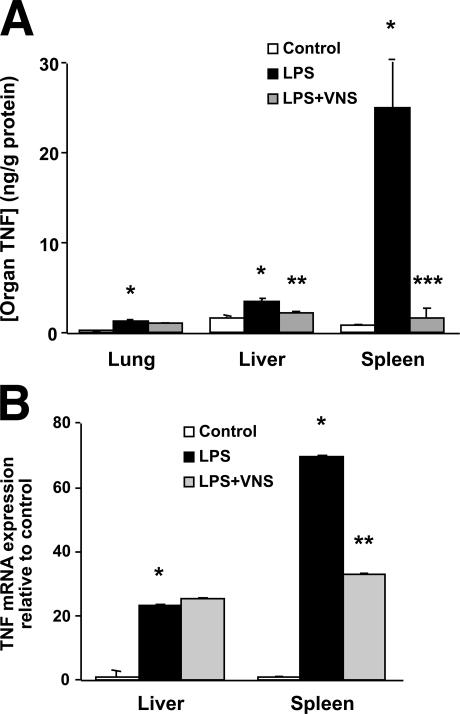
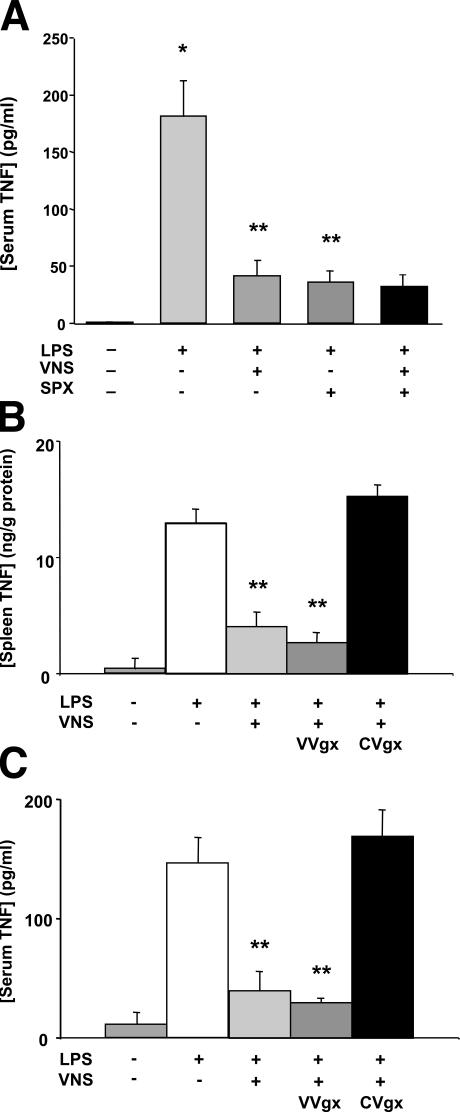
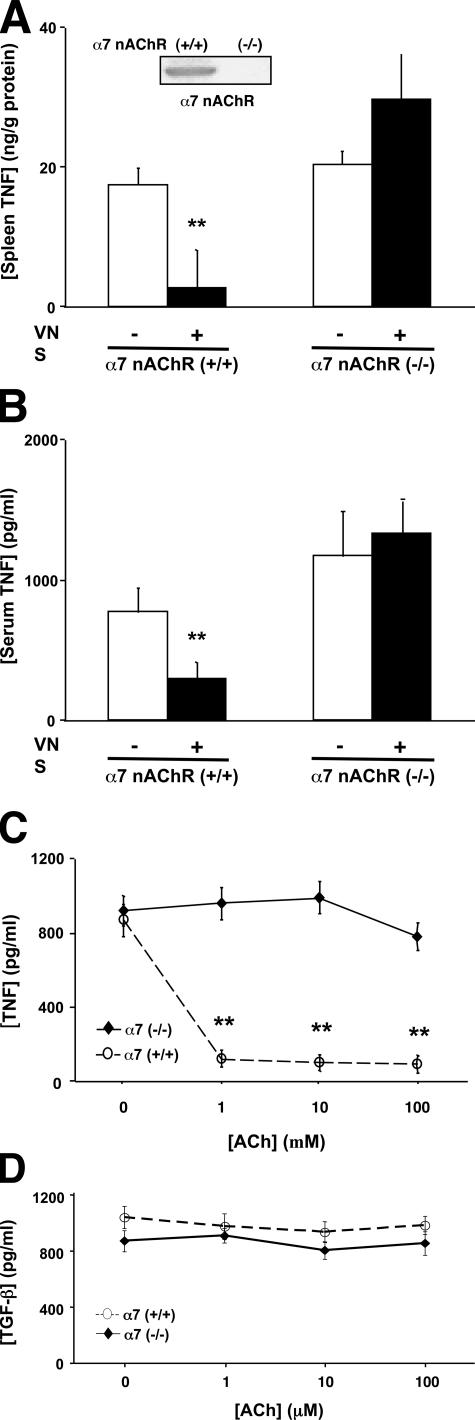
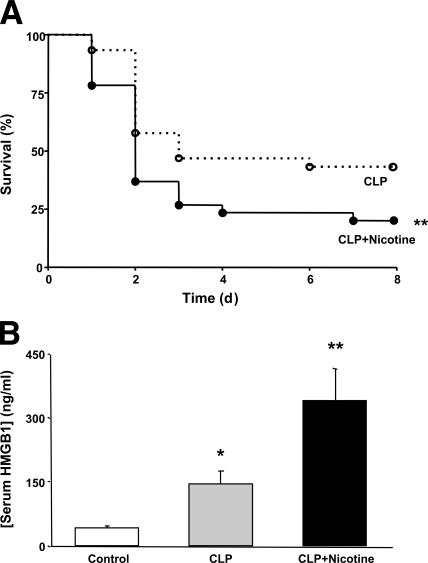
The innate immune system protects against infection and tissue injury through the specialized organs of the reticuloendothelial system, including the lungs, liver, and spleen. The central nervous system regulates innate immune responses via the vagus nerve, a mechanism termed the cholinergic antiinflammatory pathway. Vagus nerve stimulation inhibits proinflammatory cytokine production by signaling through the α7 nicotinic acetylcholine receptor subunit. Previously, the functional relationship between the cholinergic antiinflammatory pathway and the reticuloendothelial system was unknown. Here we show that vagus nerve stimulation fails to inhibit tumor necrosis factor (TNF) production in splenectomized animals during lethal endotoxemia. Selective lesioning of the common celiac nerve abolishes TNF suppression by vagus nerve stimulation, suggesting that the cholinergic pathway is functionally hard wired to the spleen via this branch of the vagus nerve. Administration of nicotine, an α7 agonist that mimics vagus nerve stimulation, increases proinflammatory cytokine production and lethality from polymicrobial sepsis in splenectomized mice, indicating that the spleen is critical to the protective response of the cholinergic pathway. These results reveal a specific, physiological connection between the nervous and innate immune systems that may be exploited through either electrical vagus nerve stimulation or administration of α7 agonists to inhibit proinflammatory cytokine production during infection and tissue injury.
Overview
The claims and statistics of this paper haven’t been checked yet.
Run the check — free, no account needed. It reads the open-access text and checks the sources it cites.
Integrity signals
Registry
Cites
Statistics
Figures
Verification
Claims the paper makes
The claims and statistics of this paper haven’t been checked yet.
Run the check — free, no account needed. It reads the open-access text and checks the sources it cites.
Claims other papers make about this one
Each is checked against this paper’s own text: does it say what the citing paper says it does?
In the citing paper
“Splenectomy significantly reduces TNF levels in liver and blood, and vagus nerve stimulation fails to reduce levels further (28).”
From Physiology and immunology of the cholinergic antiinflammatory pathway (2007) · cites this paper as [28]
In the citing paper
“Recent studies of the physiology, functional anatomy, and cellular molecular mechanisms of the cholinergic antiinflammatory pathway indicate that the principal components for cytokine suppression by the vagus nerve converge in the spleen (28).”
From Physiology and immunology of the cholinergic antiinflammatory pathway (2007) · cites this paper as [28]
In the citing paper
“The spleen is the major source of both hepatic and systemic TNF during endotoxemia; it releases newly synthesized TNF into the splenic vein, which drains into the liver, and from there, TNF crosses into the systemic circulation (28).”
From Physiology and immunology of the cholinergic antiinflammatory pathway (2007) · cites this paper as [28]
In the citing paper
“Vagus nerve stimulation in WT mice inhibits TNF synthesis in spleen, liver, and blood but not in α7 nAChR subunit-knockout animals (28).”
From Physiology and immunology of the cholinergic antiinflammatory pathway (2007) · cites this paper as [28]
In the citing paper
“The functional anatomic mechanism of vagus nerve-derived signals to spleen traverses the common celiac branch of the vagus nerve because common celiac branch vagotomy abrogates the TNF-suppressing effects of vagus nerve stimulation in spleen and serum.”
From Physiology and immunology of the cholinergic antiinflammatory pathway (2007) · cites this paper as [28]
In the citing paper
“As the vagus nerve does not signal directly to either the paw or the subcutaneous tissues, it is likely that the reduction in inflammation observed following vagus nerve stimulation in these models is attributable to the downregulation of cytokine production by the reticuloendothelial system and redirection of leukocyte trafficking away from the periphery (28).”
From Physiology and immunology of the cholinergic antiinflammatory pathway (2007) · cites this paper as [28]
In the citing paper
“And now it appears that a major source of systemic TNF during lethal challenges is the spleen, the source of Galen's black bile (28).”
From Physiology and immunology of the cholinergic antiinflammatory pathway (2007) · cites this paper as [28]
Self-check
Percentages, sums and reported differences re-computed from the paper’s own numbers.
The self-check needs the paper’s full text.
Citations
Cites
Textbook of Medical Physiology
Guyton, A. C., & Hall, J. E. (1966) · Annals of Internal Medicine · doi:10.7326/0003-4819-64-6-1363_2 · Cited by 9,760
Angus, D. C., Linde-Zwirble, W. T., Lidicker, J., Clermont, G., Carcillo, J., & Pinsky, M. R. (2001) · Critical Care Medicine · doi:10.1097/00003246-200107000-00002 · Cited by 8,503 · cited 1×
“20052362 1623 Severe sepsis is the leading cause of death in intensive care units and accounts for 9% of deaths in the United States annually (1).”
BackgroundVagus nerve stimulation attenuates the systemic inflammatory response to endotoxin
Borovikova, L. V., Ivanova, S., Zhang, M., Yang, H., Botchkina, G. I., Watkins, L. R., Wang, H., Abumrad, N., Eaton, J. W., & Tracey, K. J. (2000) · Nature · doi:10.1038/35013070 · Cited by 4,211
Self-citationTracey, K. J. (2002) · Nature · doi:10.1038/nature01321 · Cited by 3,728
Self-citationNicotinic acetylcholine receptor α7 subunit is an essential regulator of inflammation
Wang, H., Yu, M., Ochani, M., Amella, C. A., Tanovic, M., Susarla, S., Li, J. H., Wang, H., Yang, H., Ulloa, L., et al. (2003) · Nature · doi:10.1038/nature01339 · Cited by 3,228
Self-citationPoints of control in inflammation
Nathan, C. (2002) · Nature · doi:10.1038/nature01320 · Cited by 2,738
Stroke-Associated Pneumonia: Major Advances and Obstacles
Hannawi, Y., Hannawi, B., Rao, C. P. V., Suárez, J. I., & Bershad, E. M. (2013) · Cerebrovascular Diseases · doi:10.1159/000350199 · Cited by 1,664
Cholinergic agonists inhibit HMGB1 release and improve survival in experimental sepsis
Wang, H., Liao, H., Ochani, M., Justiniani, M., Lin, X., Yang, L., Al-Abed, Y., Wang, H., Metz, C., Miller, E. J., et al. (2004) · Nature Medicine · doi:10.1038/nm1124 · Cited by 1,170 · cited 9×
“Previously, the survival benefi ts of nicotine were found to correlate with reduced serum levels of HMGB1, a necessary and suffi cient mediator of lethal systemic infl ammation (11).”
BackgroundMethodInfluentialSelf-citationNeuroendocrine Regulation of Immunity
Webster, J. I., Tonelli, L., & Sternberg, E. M. (2002) · Annual Review of Immunology · doi:10.1146/annurev.immunol.20.082401.104914 · Cited by 957 · cited 1×
“Vagus nerve modulation of the spleen may represent the functionally, hard-wired counterpart to humoral antiinfl ammatory responses, such as the hypothalamic–pituitary– adrenal axis (26).”
BackgroundDeactivation of macrophages by transforming growth factor-β
Tsunawaki, S., Sporn, M. B., Ding, A. H., & Nathan, C. (1988) · Nature · doi:10.1038/334260a0 · Cited by 862
Research works printed but not linked: 1
- 1998, Am. J. Physiol., 275, R63
Cited by
Sorted by citations
Chen, Y., Wang, L., Kang, Q., Zhang, X., Yu, G., Wan, X., Wang, J., & Zhu, K. (2017) · Cellular Physiology and Biochemistry · doi:10.1159/000477308 · Cited by 10,730
Acetylcholine-Synthesizing T Cells Relay Neural Signals in a Vagus Nerve Circuit
Rosas-Ballina, M., Olofsson, P. S., Ochani, M., Valdés-Ferrer, S. I., Levine, Y. A., Reardon, C., Tusche, M. W., Pavlov, V. A., Andersson, U., Chavan, S., et al. (2011) · Science · doi:10.1126/science.1209985 · Cited by 1,551
Self-citationPhysiology and immunology of the cholinergic antiinflammatory pathway
Tracey, K. J. (2007) · Journal of Clinical Investigation · doi:10.1172/jci30555 · Cited by 1,563
“Vagus nerve stimulation in WT mice inhibits TNF synthesis in spleen, liver, and blood but not in α 7 nAChR subunit–knockout animals (28).”
InfluentialSelf-citationHarmful molecular mechanisms in sepsis
Rittirsch, D., Flierl, M. A., & Ward, P. A. (2008) · Nature reviews. Immunology · doi:10.1038/nri2402 · Cited by 1,230
“Recent studies have shown that the branch of the vagus nerve that innervates the spleen is crucial for the suppression of cytokine synthesis in sepsi”
ResultTracey, K. J. (2009) · Nature Reviews Immunology · doi:10.1038/nri2566 · Cited by 1,154
“Direct electrical stimulation of the cholinergic anti-inflammatory pathway with electrodes that generate action potentials in the vagus nerve significantly inhibits cytokine production by innate immune cells in the spleen, liver, gastrointestinal tract, heart and other tissues that are innervated by the vagus nerv”
BackgroundSelf-citation
Metadata
- Authors
- Huston, J. M., Ochani, M., Rosas-Ballina, M., Liao, H., Ochani, K., Pavlov, V. A., Gallowitsch-Puerta, M., Ashok, M., Czura, C. J., Foxwell, B., Tracey, K. J., & Ulloa, L.
- Affiliations
- 1Laboratory of Biomedical Science
- Imperial College London (GB)
- Northwell Health (US)
- Venue
- The Journal of Experimental Medicine
- Publisher
- Rockefeller University Press
- Published
- 2006-06-19
- Volume
- 203
- Issue
- 7
- Pages
- 1623-1628
- ISSN
- 0022-1007 (ISSN-L)
- 1540-9538
- PMC
- PMC2118357
- OpenAlex
- W2154170498
- Cited by
- 683
- References
- 30
- Citations by year
- 2026: 25 · 2025: 22 · 2024: 37 · 2023: 32 · 2022: 50 · 2021: 51 · 2020: 37 · 2019: 44 · 2018: 33 · 2017: 40 · 2016: 29 · 2015: 31 · 2014: 36 · 2013: 25 · 2012: 39
- FWCI
- 18.41
- Type
- journal article
- Language
- en
- Open access
- bronze
- doi.org
- Locations
- The Journal of Experimental Medicine (publishedVersion)
- Europe PMC (PubMed Central) (publishedVersion, cc-by-nc-sa)
- PubMed Central (publishedVersion, cc-by-nc-sa)
- PubMed (publishedVersion)
- Funders
- Defense Advanced Research Projects Agency
- Advanced Research Projects Agency
- National Institute of General Medical Sciences (R01GM057226)
- National Center for Research Resources (M01RR018535)
- Topics
- Life Sciences › Neuroscience › Neurology › Vagus Nerve Stimulation Research
- Life Sciences › Biochemistry, Genetics and Molecular Biology › Cancer Research › Cancer, Stress, Anesthesia, and Immune Response
- Health Sciences › Medicine › Cardiology and Cardiovascular Medicine › Heart Rate Variability and Autonomic Control
- Keywords
- splenectomy, cholinergic anti-inflammatory pathway, vagus nerve stimulation, alpha7 nicotinic acetylcholine receptor, endotoxemia, polymicrobial sepsis, TNF-α, reticuloendothelial system, spleen, nicotine, inflammatory cytokines, neuroimmune regulation
- MeSH terms
- Acetylcholine, Animals, Female, Male, Mice, Inbred BALB C, Mice, Inbred C57BL, Rats, Inbred Lew, Splenectomy, Signal Transduction, Mice, Knockout, Sepsis, Endotoxemia, Mice, Rats
About these checks
Registry, retraction, Cites and statistics results are computed, not judged, with one exception: a printed reference that no index lists is read once by a model before it counts as a citation error. Claims are extracted by a model and kept only when their quote appears verbatim in the text; each cited source is then checked, with a model’s help, for whether it says what the claim relies on. Those verdicts can be wrong — read the claim’s quote and the cited source before relying on one.
Statistics and arithmetic are recomputed, not judged.
Confidence bands are shown only for fields calibrated on our annotated test set. None is calibrated yet, so no band is shown.
What counts as a claim ›How we measure confidence ›How we check this ›
Are you an author, or do you see a problem with this page? Request a review
