

Ab initio prediction of ferrimagnetism, exchange interactions and Curie temperatures in Mn2TiZ Heusler compounds
Open accessThe DOI matches its Crossref record; 42 of the 43 references it cites were found in a registry or an index; 2 of the 13 sources its claims cite were checked for support.
Abstract
The Heusler compounds Mn(2)TiZ (Z = Al, Ga, In, Si, Ge, Sn, P, As, Sb) are of great interest due to their potential ferrimagnetic properties and high spin polarization. Here, we present calculations of the structural and magnetic properties of these materials. Their magnetic moment follows the Slater-Pauling rule m = N(V) - 24. None of them is actually a perfect half-metallic ferrimagnet, but some exhibit more than 90% spin polarization and Curie temperatures well above room temperature. The exchange interactions are complex; direct and indirect exchange contributions are identified. The Curie temperature scales with the total magnetic moment, and it has a positive pressure dependence. The role of the Z element is investigated: it influences the properties of the compounds mainly via its valence electron number and its atomic radius, which determines the lattice parameter. Based on these results, Mn(2)TiSi, Mn(2)TiGe, and Mn(2)TiSn are proposed as candidates for spintronic applications.
Overview
CoChat Summary
## TL;DR
First-principles calculations on hypothetical Mn\(_2\)TiZ Heusler compounds find ferrimagnetism across the series, with magnetic moments broadly following the Slater-Pauling rule \(m = N_V - 24\). Several members—especially Mn\(_2\)TiSi, Mn\(_2\)TiGe, and Mn\(_2\)TiSn—combine high spin polarization with Curie temperatures above room temperature, making them proposed spintronic candidates.
## Key findings
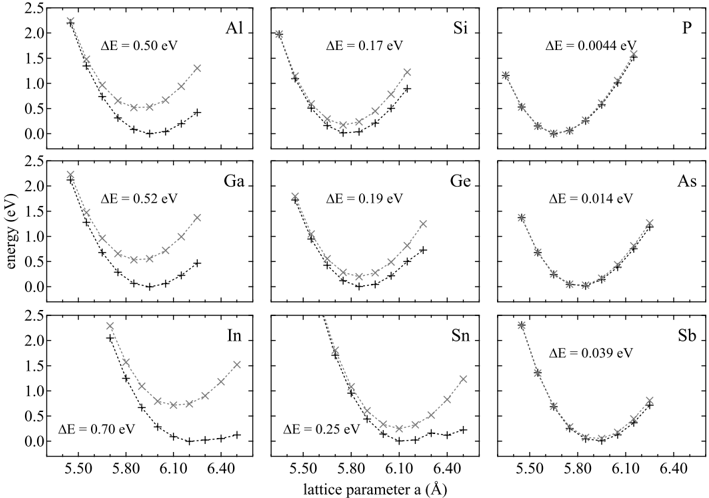
- The ferrimagnetic state is lower in energy than the nonmagnetic state for all compounds studied, and ferromagnetic initial states were unstable and converged to ferrimagnetism.
- Calculated total moments roughly follow \(m = N_V - 24\); examples from Elk are 2.98 \(\mu_B\)/f.u. for Mn\(_2\)TiAl, 1.97 \(\mu_B\)/f.u. for Mn\(_2\)TiGe, and 0.97 \(\mu_B\)/f.u. for Mn\(_2\)TiSb.
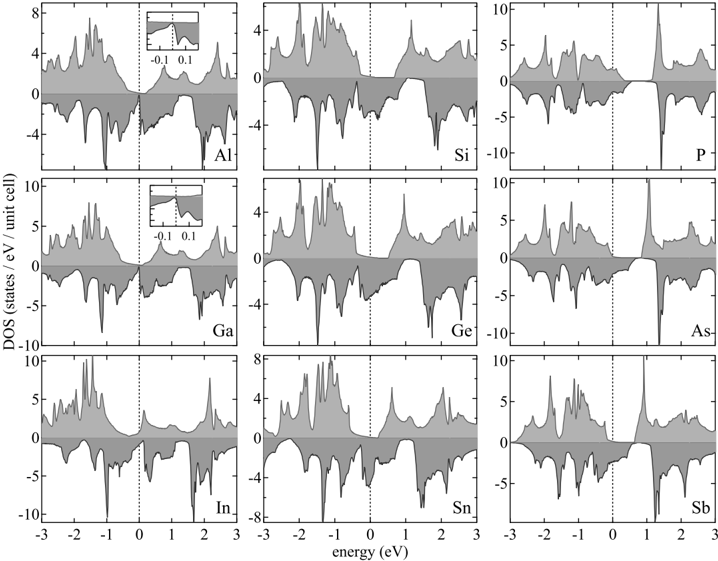
- Spin polarization is very high for several compounds: Elk gives 94% for Mn\(_2\)TiSi and Mn\(_2\)TiGe, 97% for Mn\(_2\)TiSn, and 84–88% for Mn\(_2\)TiAs/Sb; Mn\(_2\)TiAl, Ga, and In have lower polarization (21%, 45%, and 7% in Elk).
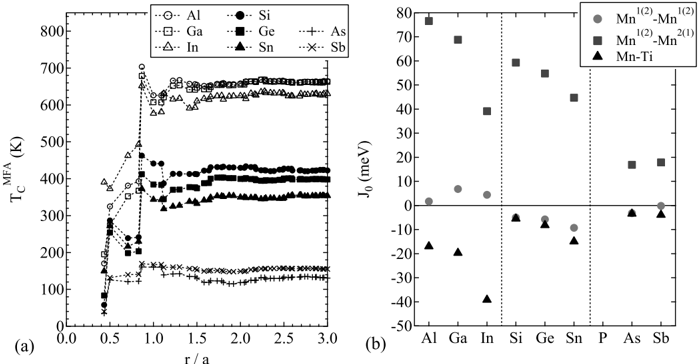
- Mean-field Curie temperatures are 665 K (Al), 663 K (Ga), 630 K (In), 424 K (Si), 398 K (Ge), 354 K (Sn), 132 K (As), and 156 K (Sb); the paper states that the 21- and 22-valence-electron compounds are ferromagnetic/ferrimagnetic above room temperature.
## Methods
- Density functional theory calculations were performed with two full-potential codes: Elk (FLAPW) and Munich SPR-KKR (full-potential KKR), using the PBE generalized-gradient approximation.
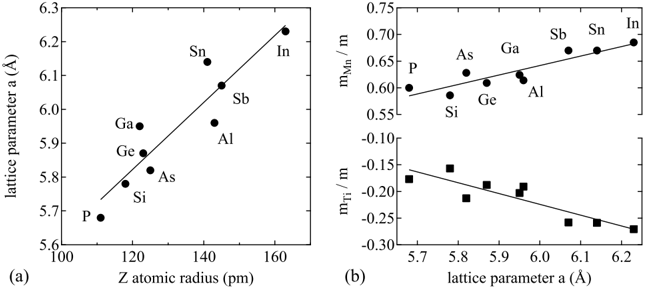
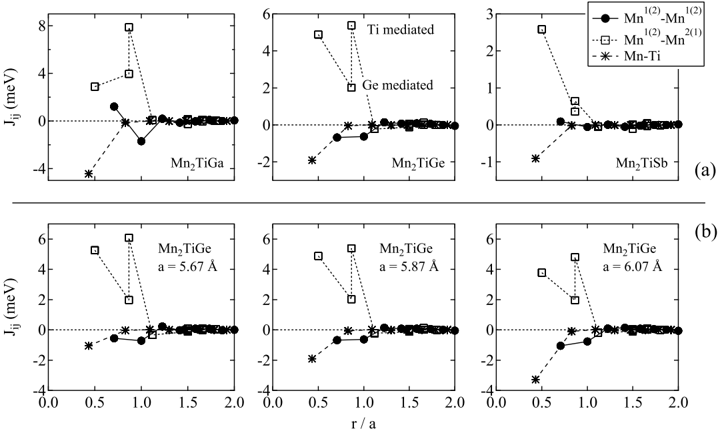
- Lattice parameters were obtained by total-energy minimization with Elk; magnetic moments and densities of states were then evaluated at equilibrium lattice constants, and exchange couplings \(J_{ij}\) were computed in SPRKKR using the Liechtenstein real-space approach.
- Curie temperatures were estimated in the mean-field approximation from the exchange coupling matrix; the text says the multi-sublattice Heusler case required solving coupled equations, with summation out to \(R_{\max}=3.0a\).
## Limitations
- The paper states that Mn\(_2\)TiP and Mn\(_2\)TiAs could not be converged into ferrimagnetic states at the equilibrium lattice parameters in SPRKKR; Mn\(_2\)TiAs required an artificially increased lattice constant, and Mn\(_2\)TiP could not be fixed within a reasonable range.
- The authors note that mean-field Curie temperatures are not fully accurate: for Mn-based ferrimagnetic compounds (Mn\(_2\)VAl and Mn\(_2\)VGa, used as benchmarks) the MFA values are about 25% lower than experiment.
- Evident from the text: the study is entirely theoretical and the compounds are hypothetical; it reports no experimental synthesis or measurement of Mn\(_2\)TiZ compounds.
Model-written summary. Check it against the paper before relying on it.
Integrity signals
Registry
Cites
Statistics
Figures
Verification
Claims the paper makes
2 Valid · 0 Not valid · 6 Not checked · 70 Own results and interpretations
The sources with a verdict support this claim; the rest weren’t checked yet, have no full text we could read, or their verdicts aren’t rated yet.
In the paper
“However, it is expected that parts of this series will exist in the L2 1 structure, seeing that Mn 2 VAl and Mn 2 VGa, as well as parts of the Co 2 Ti Z series have been prepared [26, 27, 28].”
What the sources say
- Not checked — no full text of the sourcecites [26] [26] Kumar K R, Kumar N H, Markandeyulu G, Chelvane J A, Neu V and Babu P D 2008 J. Magn. Magn. Mater. 320 2737 - source
- Supportedcites [27] [27] Barth J et al. 2010 Phys. Rev. B 81 064404 - source
The citation [28] is attached to the evidential clause of the sentence, i.e. to 'parts of the Co2TiZ series have been prepared', which is the analogue the citing authors use to argue that parts of Mn2TiZ should adopt the L21 structure; the Mn2TiZ expectation itself is their own inference, not this paper's statement. Our copy confirms exactly that: Experimental Details (p. ~, Sec. III) states the arc-melted and annealed Co2TiZ (Z = Si, Ge, Sn) ingots 'resulted in samples exhibiting the L21 structure', and the Structure and composition section (Sec. II B) plus the Summary (Sec. V) report the XRD evidence for the cubic L21 (Fm3̄m) main phase, with a possible B32-type disorder flagged only for Co2TiGe. So the source is the work that prepared part of the Co2TiZ series in L21, which is what the citation is offered for. (LLM, conf=0.85)
- Not checked — no full text of the sourcecites [28] [28] Graf T, Barth J, Balke B, Populoh S, Weidenkaff A and Felser C 2010 Scripta Materialia 63 925 - source
hedged- Asserted: passes — The authors put it forward as true.
- Checkable: passes — It can be checked against evidence.
- Load-bearing: passes — The paper’s conclusions depend on it.
- Based: passes — The paper gives a reason why it holds.
The cited sources support only part of this claim — read each source’s verdict below.
In the paper
“In these cases a total magnetic moment of only 1 µ B / f . u . is expected.”
What the sources say
- Partly supportedcites [24] [24] Galanakis I, Dederichs P H and Papanikolaou N 2002 Phys. Rev. B 66 174429 - sourceExperimental — accuracy not yet measured
Our copy does establish the 'rule of 24' the claim leans on: Section III/IV (pp. 3 and 6) and the Conclusions (p. 9) state M_t = Z_t - 24 for full-Heusler alloys, and Section IV A (p. 6) even discusses a 1 µB integer moment for a Ti compound. However, Mn2TiP, Mn2TiAs and Mn2TiSb are nowhere in the paper — the studied families are Co2MnZ, Co2YAl/Fe2YAl, Ru2MnZ, Rh2MnZ, Ni2MnAl, Co2FeSi, Co2MnSb/As and Mn2VAl/Ge (searches: 'Mn2TiP Mn2TiAs Mn2TiSb', 'Mn2Ti compounds titanium', '25 valence electrons 1 µB'). So the 1 µB/f.u. expectation for those three specific compounds is the citing authors' own extrapolation, not a statement of this source; notably, for the Ti compounds this paper did study (Co2TiAl, Co2TiSn, p. 6) it reports failure to follow the SP curve rather than an integer 1 µB moment. (LLM, conf=0.72)
plain- Asserted: passes — The authors put it forward as true.
- Checkable: passes — It can be checked against evidence.
- Load-bearing: passes — The paper’s conclusions depend on it.
- Based: passes — The paper gives a reason why it holds.
- Partly supported
A result the paper reports from its own data — it cites no other source for it, so there is none to check. The quote shows it is in the paper.
In the paper
“We find that the ferrimagnetic state has always lower energy than the non-magnetic state; the difference in total energy reduces with increasing number of valence electrons, but it increases within the groups with the atomic number.”
plainstates a cause- Asserted: passes — The authors put it forward as true.
- Checkable: passes — It can be checked against evidence.
- Load-bearing: unclear — It is unclear whether the paper’s conclusions depend on it.
- Based: passes — The paper gives a reason why it holds.
A result the paper reports from its own data — it cites no other source for it, so there is none to check. The quote shows it is in the paper.
In the paper
“We find that the ferrimagnetic state has always lower energy than the non-magnetic state; the difference in total energy reduces with increasing number of valence electrons, but it increases within the groups with the atomic number.”
plain- Asserted: passes — The authors put it forward as true.
- Checkable: passes — It can be checked against evidence.
- Load-bearing: passes — The paper’s conclusions depend on it.
- Based: passes — The paper gives a reason why it holds.
A result the paper states — it cites no source for it, so there is none to check. The quote shows it is in the paper.
In the paper
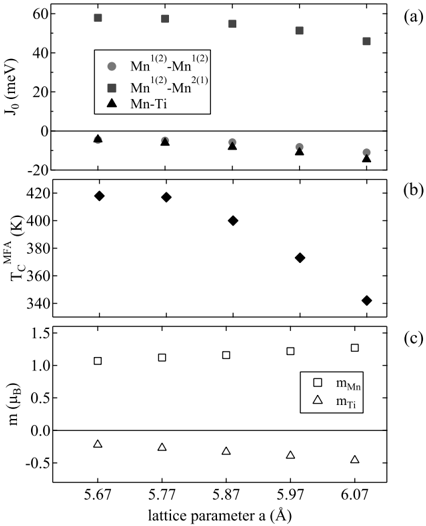
“The Curie temperature scales with the total magnetic moment, and it has a positive pressure dependence.”
- Also stated in: § 3.3. Exchange interactions and Curie temperatures · plain
“Put in terms of a pressure dependence, we observe d T C / d p > 0, i.e., the Curie temperature increases with increasing pressure.”
- Also stated in: § 4. Conclusion · plain
“It was found that the pressure dependence of T C is positive, in agreement with ferromagentic full Heusler compounds.”
plainstates a cause- Asserted: passes — The authors put it forward as true.
- Checkable: passes — It can be checked against evidence.
- Load-bearing: unclear — It is unclear whether the paper’s conclusions depend on it.
- Based: passes — The paper gives a reason why it holds.
- Also stated in: § 3.3. Exchange interactions and Curie temperatures · plain
31 more claims
Create a free account to see all 78 claims and to verify the 5 references still open.
- The quote only partly states this claim. 2
- It may state two separate claims as one. 38
- Probably not a substantial claim. 4
Citations
Cites
Generalized Gradient Approximation Made Simple
Perdew, J. P., Burke, K., & Ernzerhof, M. (1996) · Physical Review Letters · doi:10.1103/physrevlett.77.3865 · Cited by 215,824
Slater-Pauling behavior and origin of the half-metallicity of the full-Heusler alloys
Galanakis, I., Dederichs, P. H., & Papanikolaou, N. (2002) · Physical Review B · doi:10.1103/physrevb.66.174429 · Cited by 2,089
Liechtenstein, A. I., Katsnelson, M. I., Antropov, V. P., & Gubanov, V. A. (1987) · Journal of Magnetism and Magnetic Materials · doi:10.1016/0304-8853(87)90721-9 · Cited by 1,873
Theory of Magnetic Exchange Interactions:Exchange in Insulators and Semiconductors
Anderson, P. W. (1963) · Solid State Physics · doi:10.1016/s0081-1947(08)60260-x · Cited by 860 · cited 1×
“ferrimagnetic and the non-magnetic states are represented with + and ×, respectively. with a unit matrix I and the vector Eν = heνi. The largest eigenvalue of the Θ matrix gives the Curie temperature [16, 33]. In order to separate the two Mn lattices, the calculations were run in F¯43m space group, in which the Mn ato…”
MethodPickett, W. E., & Moodera, J. S. (2001) · Physics Today · doi:10.1063/1.1381101 · Cited by 653
Magnetic and chemical order in Heusler alloys containing cobalt and manganese
Webster, P. J. (1971) · Journal of Physics and Chemistry of Solids · doi:10.1016/s0022-3697(71)80180-4 · Cited by 640
Picozzi, S., Continenza, A., & Freeman, A. J. (2002) · Physical Review B · doi:10.1103/physrevb.66.094421 · Cited by 595
Half-Metallic Antiferromagnets
van Leuken, H., & de Groot, R. A. (1995) · Physical Review Letters · doi:10.1103/physrevlett.74.1171 · Cited by 432
Mn2CoZ(Z=Al,Ga,In,Si,Ge,Sn,Sb)compounds: Structural, electronic, and magnetic properties
Liu, G. D., Dai, X. F., Liu, H. Y., Chen, J. L., Li, Y. X., Xiao, G., & Wu, G. H. (2008) · Physical Review B · doi:10.1103/physrevb.77.014424 · Cited by 379
Kübler, J., Fecher, G. H., & Felser, C. (2007) · Physical Review B · doi:10.1103/physrevb.76.024414 · Cited by 312
Wurmehl, S., Kandpal, H. C., Fecher, G. H., & Felser, C. (2006) · Journal of Physics: Condensed Matter · doi:10.1088/0953-8984/18/27/001 · Cited by 268
Half-metallic ferrimagnetism inMn2VAl
Weht, R., & Pickett, W. E. (1999) · Physical Review B · doi:10.1103/physrevb.60.13006 · Cited by 237
Spin-density-functional-based search for half-metallic antiferromagnets
Pickett, W. E. (1998) · Physical Review B · doi:10.1103/physrevb.57.10613 · Cited by 236
Role of conduction electrons in mediating exchange interactions in Mn-based Heusler alloys
Şaşıoğlu, E., Sandratskii, L. M., & Bruno, P. (2008) · Physical Review B · doi:10.1103/physrevb.77.064417 · Cited by 219
Electronic structure and magnetic exchange coupling in ferromagnetic full Heusler alloys
Kurtulus, Y., Dronskowski, R., Samolyuk, G. D., & Antropov, V. P. (2005) · Physical Review B · doi:10.1103/physrevb.71.014425 · Cited by 183
Fully Relativistic Band Structure Calculations for Magnetic Solids - Formalism and Application
Ebert, H. (2007) · Lecture Notes in Physics · doi:10.1007/3-540-46437-9_6 · Cited by 171
Search for half-metallic ferrimagnetism in V-based Heusler alloys Mn2VZ (Z = Al, Ga, In, Si, Ge, Sn)
Özdogan, K., Galanakis, I., Şaşioglu, E., & Aktaş, B. (2006) · Journal of Physics: Condensed Matter · doi:10.1088/0953-8984/18/10/013 · Cited by 169
Kanomata, T., Shirakawa, K., & Kaneko, T. (1987) · Journal of Magnetism and Magnetic Materials · doi:10.1016/0304-8853(87)90312-x · Cited by 162
Doping ofMn2VAlandMn2VSiHeusler alloys as a route to half-metallic antiferromagnetism
Galanakis, I., Özdoğan, K., Şaşıoğlu, E., & Aktaş, B. (2007) · Physical Review B · doi:10.1103/physrevb.75.092407 · Cited by 155
Luo, H., Zhang, H. W., Zhu, Z., Ma, L., Xu, S., Wu, G., Zhu, X., Jiang, C., & Xu, H. B. (2008) · Journal of Applied Physics · doi:10.1063/1.2903057 · Cited by 149
Exchange interactions and Curie temperatures inNi2−xMnSballoys: First-principles study
Rusz, J., Bergqvist, L., Kudrnovský, J., & Turek, I. (2006) · Physical Review B · doi:10.1103/physrevb.73.214412 · Cited by 139
(2010) · doi:10.1103/physrevb.81.064404 · Cited by 133
Pressure dependence of the Curie temperature in Ni 2 MnSn Heusler alloy: A first-principles study
Şaşıoğlu, E., Sandratskii, L., & Bruno, P. (2005) · Physical Review B · doi:10.1103/physrevb.71.214412 · Cited by 123
Luo, H., Zhu, Z., Liu, G., Xu, S., Wu, G., Liu, H., Qü, J., & Li, Y. (2007) · Journal of Magnetism and Magnetic Materials · doi:10.1016/j.jmmm.2007.06.021 · Cited by 119
Şaşioglu, E., Sandratskii, L. M., & Bruno, P. (2005) · Journal of Physics: Condensed Matter · doi:10.1088/0953-8984/17/6/017 · Cited by 116
Half-Metallic Diluted Antiferromagnetic Semiconductors
Akai, H., & Ogura, M. (2006) · Physical Review Letters · doi:10.1103/physrevlett.97.026401 · Cited by 113
Luo, H., Zhu, Z., Ma, L., Xu, S., Zhu, X., Jiang, C., Xu, H., & Wu, G. (2008) · Journal of Physics D: Applied Physics · doi:10.1088/0022-3727/41/5/055010 · Cited by 100
Xing, N., Li, H., Dong, J., Long, R., & Zhang, C. (2007) · Computational Materials Science · doi:10.1016/j.commatsci.2007.09.007 · Cited by 93
Bandstructures and Hyperfine Fields of Heusler Alloys
Ishida, S., Asano, S., & Ishida, J. (1984) · Journal of the Physical Society of Japan · doi:10.1143/jpsj.53.2718 · Cited by 86
Transport and magnetic properties of Mn2VAl: Search for half-metallicity
Jiang, C., Venkatesan, M., & Coey, J. M. D. (2001) · Solid State Communications · doi:10.1016/s0038-1098(01)00151-x · Cited by 85
Exchange energies, Curie temperatures and magnons in Heusler compounds
Thöne, J., Chadov, S., Fecher, G. H., Felser, C., & Kübler, J. (2009) · Journal of Physics D Applied Physics · doi:10.1088/0022-3727/42/8/084013 · Cited by 61
Luo, H.-Z., Liu, G.-D., Feng, Z.-Y., Li, Y.-X., Ma, L., Wu, G.-H., Zhu, X., Jiang, C.-B., & Xu, H. (2009) · Journal of Magnetism and Magnetic Materials · doi:10.1016/j.jmmm.2009.08.002 · Cited by 60
Structural, magnetic and transport properties of half-metallic ferrimagnet Mn2VGa
Ramesh Kumar, K., Harish Kumar, N., Markandeyulu, G., Arout Chelvane, J., Neu, V., & Babu, P. D. (2008) · Journal of Magnetism and Magnetic Materials · doi:10.1016/j.jmmm.2008.06.003 · Cited by 55
Transport properties of the ferromagnetic Heusler alloyCo2TiSn
Majumdar, S., Chattopadhyay, M. K., Sharma, V. K., Sokhey, K. J. S., Roy, S. B., & Chaddah, P. (2005) · Physical Review B · doi:10.1103/physrevb.72.012417 · Cited by 52
Half-metallic ferrimagnetism in Mn2CuGe
Wei, X., Hu, X.-R., Mao, G.-Y., Chu, S.-B., Lei, T., Hu, L., & Deng, J.-B. (2010) · Journal of Magnetism and Magnetic Materials · doi:10.1016/j.jmmm.2010.05.063 · Cited by 51
Neutron Diffraction Study of Heusler Type Alloy Mn0.47V0.28Al0.25
Itoh, H., Nakamichi, T., Yamaguchi, Y., & Kazama, N. (1983) · Transactions of the Japan Institute of Metals · doi:10.2320/matertrans1960.24.265 · Cited by 50
Nonzero macroscopic magnetization in half-metallic antiferromagnets at finite temperatures
Şaşıoğlu, E. (2009) · Physical Review B · doi:10.1103/physrevb.79.100406 · Cited by 46
Magnetic Properties of a Ternary Alloy Mn0.5V0.5-yAly
Yoshida, Y., Kawakami, M., & Nakamichi, T. (1981) · Journal of the Physical Society of Japan · doi:10.1143/jpsj.50.2203 · Cited by 38
Graf, T., Barth, J., Balke, B., Populoh, S., Weidenkaff, A., & Felser, C. (2010) · Scripta Materialia · doi:10.1016/j.scriptamat.2010.07.001 · Cited by 27
Defects in CrAs and related compounds as a route to half-metallic ferrimagnetism
Galanakis, I., Özdoğan, K., Şaşıoğlu, E., & Aktaş, B. (2006) · Physical Review B · doi:10.1103/physrevb.74.140408 · Cited by 22
Half-metallic ferrimagnetism in zincblende Mn-doped transition metal chalcogenides
Nakamura, K., Ito, T., & Freeman, A. J. (2005) · Physical Review B · doi:10.1103/physrevb.72.064449 · Cited by 17
Fujii, S., Okada, M., Ishida, S., & Asano, S. (2008) · Journal of the Physical Society of Japan · doi:10.1143/jpsj.77.074702 · Cited by 17
Cited by
Magnetism in cubic manganese-rich Heusler compounds
Wollmann, L., Chadov, S., Kübler, J., & Felser, C. (2014) · Physical Review B · doi:10.1103/physrevb.90.214420 · Cited by 155
Magnetism in tetragonal manganese-rich Heusler compounds
Wollmann, L., Chadov, S., Kübler, J., & Felser, C. (2015) · Physical Review B · doi:10.1103/physrevb.92.064417 · Cited by 105
Exchange interactions and Curie temperatures of Mn 2 CoZ compounds
Meinert, M., Schmalhorst, J., & Reiss, G. (2011) · Journal of Physics Condensed Matter · doi:10.1088/0953-8984/23/11/116005 · Cited by 118
Self-citationAbada, A., Amara, K., Hiadsi, S., & Amrani, B. (2015) · Journal of Magnetism and Magnetic Materials · doi:10.1016/j.jmmm.2015.04.023 · Cited by 97
Half-metallicity in new Heusler alloys Mn 2 ScZ (Z = Si, Ge, Sn)
Ram, M., Saxena, A., Aly, A. E., & Shankar, A. (2020) · RSC Advances · doi:10.1039/c9ra09303f · Cited by 95
Metadata
- Authors
- Meinert, M., Schmalhorst, J.-M., & Reiss, G.
- Affiliations
- Bielefeld University (DE)
- Venue
- Journal of Physics: Condensed Matter
- Publisher
- IOP Publishing
- Published
- 2010-12-21
- Volume
- 23
- Issue
- 3
- Pages
- 036001
- ISSN
- 0953-8984 (ISSN-L)
- 1361-648X
- OpenAlex
- W1982418083
- Semantic Scholar
- ee30c007eee244a1a83b356d8179e3aa232b799d
- Cited by
- 63
- References
- 43
- Citations by year
- 2025: 4 · 2024: 1 · 2023: 2 · 2022: 2 · 2021: 4 · 2020: 5 · 2019: 4 · 2018: 3 · 2017: 5 · 2016: 5 · 2015: 7 · 2014: 7 · 2013: 3 · 2012: 6
- FWCI
- 1.94
- Type
- journal article
- Language
- en
- Open access
- green
- arxiv.org
- Locations
- Journal of Physics Condensed Matter (publishedVersion)
- PubMed (publishedVersion)
- arXiv (Cornell University) (submittedVersion)
- PUB – Publications at Bielefeld University (Bielefeld University) (submittedVersion)
- Publikationen an der Universität Bielefeld (Universität Bielefeld) (submittedVersion)
- arXiv (Cornell University)
- Topics
- Physical Sciences › Materials Science › Electronic, Optical and Magnetic Materials › Heusler alloys: electronic and magnetic properties
- Physical Sciences › Materials Science › Electronic, Optical and Magnetic Materials › Magnetic Properties of Alloys
- Physical Sciences › Materials Science › Materials Chemistry › Shape Memory Alloy Transformations
- Keywords
- ferrimagnetism, half-metallicity, spin polarization, Curie temperature, exchange interaction, Slater-Pauling rule, pressure dependence, lattice parameters, spintronics
About these checks
Registry, retraction, Cites and statistics results are computed, not judged, with one exception: a printed reference that no index lists is read once by a model before it counts as a citation error. Claims are extracted by a model and kept only when their quote appears verbatim in the text; each cited source is then checked, with a model’s help, for whether it says what the claim relies on. Those verdicts can be wrong — read the claim’s quote and the cited source before relying on one.
The claim verdicts this report counts are experimental: their accuracy is not yet measured.
A language model drew the claims from the paper on 2026-10-10, under version 3 of the claim definition (model deepseek-v4.1-flash, prompt extract-v3).
A second model labelled each claim on 2026-10-10 (model jev-1.13-20260917, definition revision gold-guideline-v0.2).
Cited sources are checked with a language model’s help (qwen3.8-omni-flash).
Statistics and arithmetic are recomputed, not judged.
Confidence bands are shown only for fields calibrated on our annotated test set. None is calibrated yet, so no band is shown.
What counts as a claim ›How we measure confidence ›How we check this ›
Are you an author, or do you see a problem with this page? Request a review
Data sources
Bibliographic data: Semantic Scholar, OpenAlex, Crossref.
Contains information from the Semantic Scholar Academic Graph Datasets, made available under the ODC Attribution License (ODC-BY 1.0).
Semantic Scholar’s data is described in: Kinney, R., et al. (2023). The Semantic Scholar Open Data Platform. arXiv:2301.10140.
