

Position-dependent and cooperative quantum Parrondo walks
Open accessThe DOI matches its Crossref record; 31 of the 31 references it cites were found in a registry or an index.
Abstract
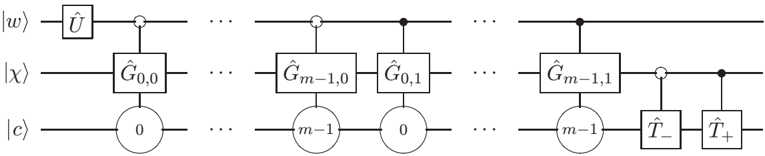
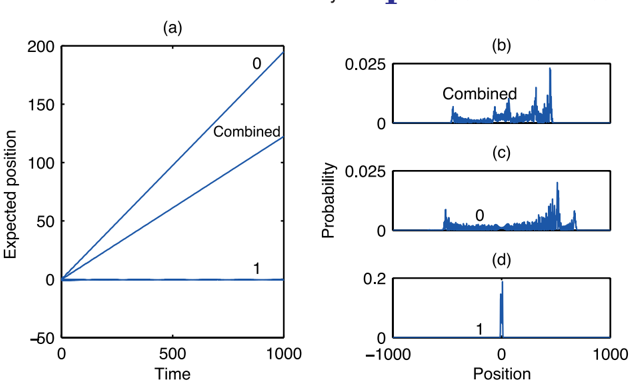
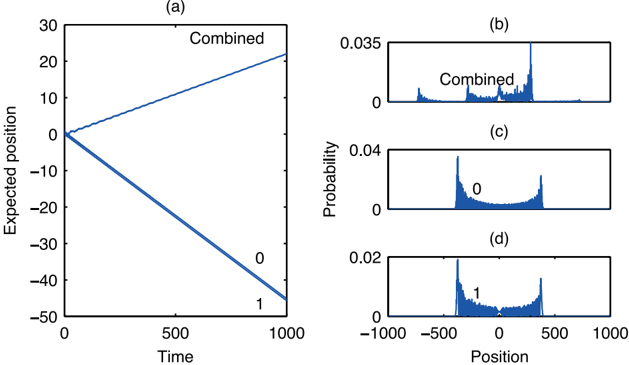
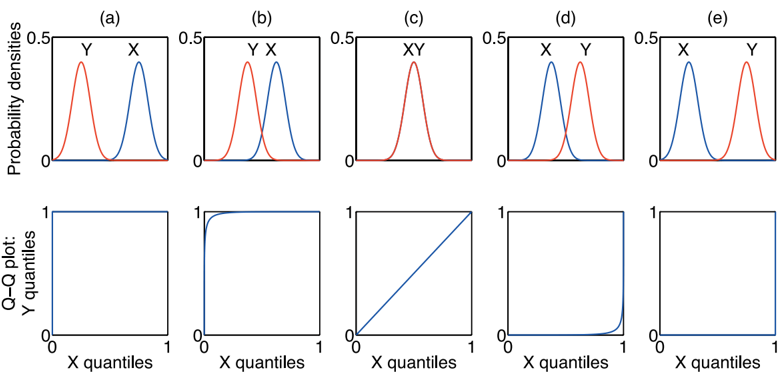
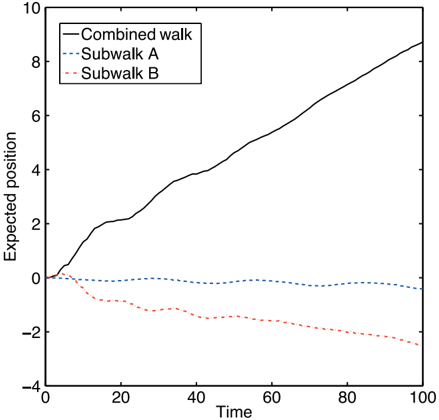
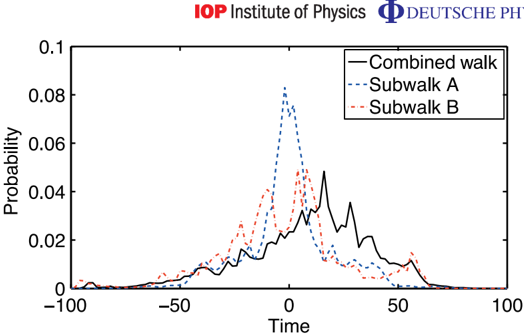
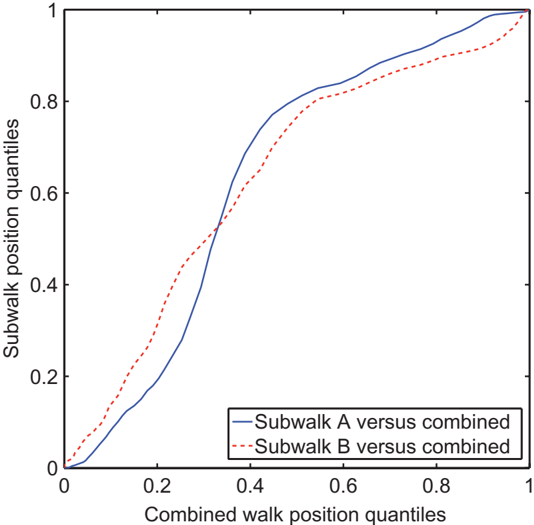
This work is a study on quantum computational formulations of Parrondo walks, that is, positively trending random walks formed as combinations of negatively trending random walks. We reanalyse the position-dependent walk proposed by Košík et al (2007 J. Mod. Opt. 54 2275), correcting the parameter choices in that paper to achieve the Parrondo effect. We also devise a quantum analogue of the cooperative Parrondo walk of Toral (2002 Fluct. Noise Lett. 2 L305), in which it is the interaction between multiple participants, rather than position-dependence, that allows the Parrondo effect to occur. We give a general formulation of a quantum analogue of the classical walk of Toral (2002 Fluct. Noise Lett. 2 L305), and demonstrate the Parrondo effect numerically. Lastly, we highlight a qualitative difference in asymptotic behaviour between quantum Parrondo walks and their classical counterparts. In particular, we draw attention to an intuitive but unreliable assumption, based on classical random walks, which may pose extra challenges for applications of the Parrondo effect in the quantum setting seeking to separate or classify data or particles.
Overview
The claims and statistics of this paper haven’t been checked yet.
Free: it reads the open-access text and checks the first 5 claims that cite a source we can check. Create a free account to check every claim.
Integrity signals
Registry
Cites
Statistics
Figures


Verification
Claims the paper makes
The claims and statistics of this paper haven’t been checked yet.
Free: it reads the open-access text and checks the first 5 claims that cite a source we can check. Create a free account to check every claim.
Claims other papers make about this one
Each is checked against this paper’s own text: does it say what the citing paper says it does?
The cited source says what the claim attributes to it.
In the citing paper
“The 2D graphs that can be realized with this technique allow the study of new quantum walk phenomena, such as wave communication [20], cooperative quantum games [21] and the creation of topological phases in 2D [22].”
From Two-photon quantum walks in an elliptical direct-write waveguide array (2011) · cites this paper as [21]
Self-check
Percentages, sums and reported differences re-computed from the paper’s own numbers.
The self-check needs the paper’s full text.
Citations
Cites
Quantum Computation and Quantum Information
Nielsen, M. A., Chuang, I., & Grover, L. K. (2002) · American Journal of Physics · doi:10.1119/1.1463744 · Cited by 21,895
An introduction to ROC analysis
Fawcett, T. (2006) · Pattern Recognition Letters · doi:10.1016/j.patrec.2005.10.010 · Cited by 21,879
Quantum random walks: An introductory overview
Kempe, J. (2003) · Contemporary Physics · doi:10.1080/00107151031000110776 · Cited by 1,413
Quantum computation and decision trees
Farhi, E., & Gutmann, S. (1998) · Physical Review A · doi:10.1103/physreva.58.915 · Cited by 1,215
Quantum random-walk search algorithm
Shenvi, N., Kempe, J., & Whaley, K. B. (2003) · Physical Review A · doi:10.1103/physreva.67.052307 · Cited by 1,150
Quantum random walks - an introductory overview
Kempe, J., & Einstein, A. (2003) · Cited by 1,035
Rubinstein, R. Y., & Kroese, D. P. (2004) · Information Science and Statistics · doi:10.1007/978-1-4757-4321-0 · Cited by 597
Ambainis, A., Bach, E., Nayak, A., Vishwanath, A., & Watrous, J. (2001) · Proceedings of the thirty-third annual ACM symposium on Theory of computing · doi:10.1145/380752.380757 · Cited by 562
From Quantum Cellular Automata To Quantum Lattice Gases
Meyer, D., Qca, F., David, Q., & Meyer, A. (1996) · CERN Document Server (European Organization for Nuclear Research) · Cited by 488
An Example of the Difference Between Quantum and Classical Random Walks
Childs, A. M., Farhi, E., & Gutmann, S. (2002) · Quantum Information Processing · doi:10.1023/a:1019609420309 · Cited by 481
AA, Evans, M., Hastings, N., & Peacock, B. (1994) · Journal of the American Statistical Association · doi:10.2307/2290968 · Cited by 426
Losing strategies can win by Parrondo's paradox
Harmer, G. P., & Abbott, D. (1999) · Nature · doi:10.1038/47220 · Cited by 348
New Paradoxical Games Based on Brownian Ratchets
Parrondo, J. M. R., Harmer, G. P., & Abbott, D. (2000) · Physical Review Letters · doi:10.1103/physrevlett.85.5226 · Cited by 261
Quantum walks in optical lattices
Dür, W., Raussendorf, R., Kendon, V. M., & Briegel, H.-J. (2002) · Physical Review A · doi:10.1103/physreva.66.052319 · Cited by 259
Quantum Simulations of Classical Random Walks and Undirected Graph Connectivity
Watrous, J. (2001) · Journal of Computer and System Sciences · doi:10.1006/jcss.2000.1732 · Cited by 216
Abbott, D., & Harmer, G. P. (1999) · Statistical Science · doi:10.1214/ss/1009212247 · Cited by 206
(2007) · Wiley Series in Probability and Statistics · doi:10.1002/9780470285312.ch18 · Cited by 190
A REVIEW OF PARRONDO'S PARADOX
Harmer, G. P., & Abbott, D. (2002) · Fluctuation and Noise Letters · doi:10.1142/s0219477502000701 · Cited by 149
Classical rules in quantum games
van Enk, S. J., & Pike, R. (2002) · Physical Review A · doi:10.1103/physreva.66.024306 · Cited by 124
Brownian ratchets and Parrondo’s games
Harmer, G. P., Abbott, D., Taylor, P., & Parrondo, J. M. R. (2001) · Chaos An Interdisciplinary Journal of Nonlinear Science · doi:10.1063/1.1395623 · Cited by 116
Flitney, A. P., Ng, J., & Abbott, D. (2002) · Physica A: Statistical Mechanics and its Applications · doi:10.1016/s0378-4371(02)01084-1 · Cited by 106
Parrondo Games as Lattice Gas Automata
Meyer, D., & Blumer, H. (2002) · Journal of Statistical Physics · doi:10.1023/a:1014566822448 · Cited by 89
CAPITAL REDISTRIBUTION BRINGS WEALTH BY PARRONDO'S PARADOX
Toral, R. (2002) · Fluctuation and Noise Letters · doi:10.1142/s0219477502000907 · Cited by 68
Quantum models of Parrondo's games
Flitney, A. P., & Abbott, D. (2003) · Physica A Statistical Mechanics and its Applications · doi:10.1016/s0378-4371(02)01909-x · Cited by 61
Three routes to the exact asymptotics for the one-dimensional quantum walk
Carteret, H. A., Ismail, M. E. H., & Richmond, B. (2003) · Journal of Physics A: Mathematical and General · doi:10.1088/0305-4470/36/33/305 · Cited by 52
Winning combinations of history-dependent games
Kay, R., & Johnson, N. F. (2003) · Physical review. E, Statistical physics, plasmas, fluids, and related interdisciplinary topics · doi:10.1103/physreve.67.056128 · Cited by 49
Exploiting randomness in quantum information processing
Lee, C. F., & Johnson, N. F. (2002) · Physics Letters A · doi:10.1016/s0375-9601(02)01088-5 · Cited by 39
Minimal Brownian Ratchet: An Exactly Solvable Model
Lee, Y., Allison, A., Abbott, D., & Stanley, E. (2003) · Physical Review Letters · doi:10.1103/physrevlett.91.220601 · Cited by 31
Quantum Parrondo's game with random strategies
Košík, J., Miszczak, J. A., & Bužek, V. (2007) · Journal of Modern Optics · doi:10.1080/09500340701408722 · Cited by 27
QUANTUM PARRONDO GAMES: BIASED AND UNBIASED
Meyer, D., & Blumer, H. (2002) · Fluctuation and Noise Letters · doi:10.1142/s021947750200083x · Cited by 25
Klarreich, E. (2001) · The Sciences · doi:10.1002/j.2326-1951.2001.tb03546.x · Cited by 12
Research works printed but not linked: 1
- Ambianis A, Bach E, Nayak A, Vishwanath A and Watrous J 2001 Proc. 33rd ACM Symp. on Theory of Computing p 37
Cited by
Two-photon quantum walks in an elliptical direct-write waveguide array
Owens, J. O., Broome, M. A., Biggerstaff, D. N., Goggin, M. E., Fedrizzi, A., Linjordet, T., Ams, M., Marshall, G. D., Twamley, J., Withford, M. J., et al. (2011) · New Journal of Physics · doi:10.1088/1367-2630/13/7/075003 · Cited by 135
Self-citationParrondo’s paradox from classical to quantum: A review
Lai, J. W., & Cheong, K. H. (2020) · Nonlinear Dynamics · doi:10.1007/s11071-020-05496-8 · Cited by 78
“With this formalism, the authors were able to show that the combination of two “losing” subwalks gives a “winning” subwalk—Parrondo’s effect [69].”
BackgroundMethodInfluentialParrondoʼs game using a discrete-time quantum walk
Chandrashekar, C. M., & Banerjee, S. (2011) · Physics Letters A · doi:10.1016/j.physleta.2011.02.071 · Cited by 42
Parrondo effect in quantum coin-toss simulations
Lai, J. W., & Cheong, K. H. (2020) · Physical review. E · doi:10.1103/physreve.101.052212 · Cited by 40
Cooperative quantum Parrondo’s games
Pawela, Ł., & Sładkowski, J. (2013) · Physica D Nonlinear Phenomena · doi:10.1016/j.physd.2013.04.010 · Cited by 32
Metadata
- Authors
- Bulger, D., Freckleton, J., & Twamley, J.
- Affiliations
- Macquarie University (AU)
- Venue
- New Journal of Physics
- Publisher
- IOP Publishing
- Published
- 2008-09-12
- Volume
- 10
- Issue
- 9
- Pages
- 093014
- ISSN
- 1367-2630 (ISSN-L)
- OpenAlex
- W2083008652
- Semantic Scholar
- 95751b7393e23a981df2efc100c8b9c8aca61acb
- Cited by
- 20
- References
- 31
- Citations by year
- 2026: 1 · 2025: 1 · 2024: 1 · 2023: 1 · 2022: 1 · 2021: 1 · 2020: 3 · 2017: 2 · 2016: 3 · 2015: 1 · 2014: 2 · 2013: 1
- FWCI
- 1.06
- Type
- journal article
- Language
- en
- Open access
- gold
- doi.org
- Licence
- cc-by
- Locations
- New Journal of Physics (publishedVersion, cc-by)
- Topics
- Physical Sciences › Computer Science › Artificial Intelligence › Quantum Computing Algorithms and Architecture
- Physical Sciences › Physics and Astronomy › Atomic and Molecular Physics, and Optics › Quantum Mechanics and Applications
- Physical Sciences › Physics and Astronomy › Atomic and Molecular Physics, and Optics › Quantum Information and Cryptography
- Keywords
- quantum walks, asymptotic behavior, quantum computing
About these checks
Registry, retraction, Cites and statistics results are computed, not judged, with one exception: a printed reference that no index lists is read once by a model before it counts as a citation error. Claims are extracted by a model and kept only when their quote appears verbatim in the text; each cited source is then checked, with a model’s help, for whether it says what the claim relies on. Those verdicts can be wrong — read the claim’s quote and the cited source before relying on one.
Statistics and arithmetic are recomputed, not judged.
Confidence bands are shown only for fields calibrated on our annotated test set. None is calibrated yet, so no band is shown.
What counts as a claim ›How we measure confidence ›How we check this ›
Are you an author, or do you see a problem with this page? Request a review
Data sources
Bibliographic data: Semantic Scholar, OpenAlex, Crossref.
Contains information from the Semantic Scholar Academic Graph Datasets, made available under the ODC Attribution License (ODC-BY 1.0).
Semantic Scholar’s data is described in: Kinney, R., et al. (2023). The Semantic Scholar Open Data Platform. arXiv:2301.10140.
