

Complete-graph tensor network states: a new fermionic wave function ansatz for molecules
Open accessThe DOI matches its Crossref record; 54 of the 54 references it cites were found in a registry or an index.
Abstract
Kovyrshin and Markus Reiher - Replica exchange molecular dynamics optimization of tensor network states for quantum many-body systems Wenyuan
Overview
The claims and statistics of this paper haven’t been checked yet.
Free: it reads the open-access text and checks the first 5 claims that cite a source we can check. Create a free account to check every claim.
Integrity signals
Registry
Cites
Statistics
Figures
Verification
Claims the paper makes
The claims and statistics of this paper haven’t been checked yet.
Free: it reads the open-access text and checks the first 5 claims that cite a source we can check. Create a free account to check every claim.
Claims other papers make about this one
Each is checked against this paper’s own text: does it say what the citing paper says it does?
In the citing paper
“Some processes in biochemistry such as conformational transition in hemoglobin occur on a time scale that is many times the current limit of MD calculations 149 .”
From Quantum Chemistry in the Age of Quantum Computing (2019) · cites this paper as [149]
Self-check
Percentages, sums and reported differences re-computed from the paper’s own numbers.
The self-check needs the paper’s full text.
Citations
Cites
Dunning, T. H. (1989) · The Journal of Chemical Physics · doi:10.1063/1.456153 · Cited by 31,648
Electron affinities of the first-row atoms revisited. Systematic basis sets and wave functions
Kendall, R. A., Dunning, T. H., & Harrison, R. J. (1992) · The Journal of Chemical Physics · doi:10.1063/1.462569 · Cited by 15,496
Density matrix formulation for quantum renormalization groups
White, S. R. (1992) · Physical Review Letters · doi:10.1103/physrevlett.69.2863 · Cited by 7,702 · cited 1×
“Over the last two decades, we have witnessed the rise of the density matrix renormalization group (DMRG) algorithm [1]–[3], which had a tremendous impact on the fields of condensed matter physics [4] and quantum chemistry [5, 6].”
BackgroundThe density-matrix renormalization group
Schollwöck, U. (2005) · Reviews of Modern Physics · doi:10.1103/revmodphys.77.259 · Cited by 3,323
Density-matrix algorithms for quantum renormalization groups
White, S. R. (1993) · Physical Review B · doi:10.1103/physrevb.48.10345 · Cited by 3,244 · cited 1×
“Over the last two decades, we have witnessed the rise of the density matrix renormalization group (DMRG) algorithm [1]–[3], which had a tremendous impact on the fields of condensed matter physics [4] and quantum chemistry [5, 6].”
BackgroundColloquium : Area laws for the entanglement entropy
Eisert, J., Cramer, M., & Plenio, M. B. (2010) · Reviews of Modern Physics · doi:10.1103/revmodphys.82.277 · Cited by 2,873
Molecular Electronic‐Structure Theory
Helgaker, T., Jørgensen, P., & Olsen, J. (2000) · doi:10.1002/9781119019572 · Cited by 2,594
Efficient Classical Simulation of Slightly Entangled Quantum Computations
Vidal, G. (2003) · Physical Review Letters · doi:10.1103/physrevlett.91.147902 · Cited by 2,368 · cited 1×
“Nevertheless, because of the nature of the interactions we may hope that there exists an efficient parametrization of a class of variational wave functions such that the low-energy sector of the electronic Hamiltonian is described with sufficient accuracy [12, 16–19].”
MethodUnderstanding Molecular Simulation
(2002) · doi:10.1016/b978-0-12-267351-1.x5000-7 · Cited by 2,042
Verstraete, F., Murg, V., & Cirac, J. I. (2008) · Advances in Physics · doi:10.1080/14789940801912366 · Cited by 1,762 · cited 2×
“The basic idea of tensor network states is to approximate ground-state wave functions of strongly correlated systems by spanning only the relevant part of the Hilbert space of the system of interest [12].”
BackgroundSelf-citationValence bond ground states in isotropic quantum antiferromagnets
Affleck, I., Kennedy, T., Lieb, E. H., & Tasaki, H. (1988) · Communications in Mathematical Physics · doi:10.1007/bf01218021 · Cited by 1,477 · cited 2×
“The work of Affleck, Kennedy, Lieb and Tasaki [11] on finitely correlated states provided the foundations of a new family of states, the tensor network states.”
BackgroundFinitely correlated states on quantum spin chains
Fannes, M., Nachtergaele, B., & Werner, R. F. (1992) · Communications in Mathematical Physics · doi:10.1007/bf02099178 · Cited by 1,422 · cited 8×
“Hence, an MPS state might be difficult to optimize for a general molecule of arbitrary structure.”
BackgroundInfluentialReiher, M., Salomon, O., & Artur Hess, B. (2001) · Theoretical Chemistry Accounts: Theory, Computation, and Modeling (Theoretica Chimica Acta) · doi:10.1007/s00214-001-0300-3 · Cited by 1,335
Self-citationExact solution of a 1D asymmetric exclusion model using a matrix formulation
Derrida, B., Evans, M. R., Hakim, V, & Pasquier, V (1993) · Journal of Physics A: Mathematical and General · doi:10.1088/0305-4470/26/7/011 · Cited by 1,289 · cited 1×
“where the rank-3 tensors Ai are written as m × m matrices Ai [ni ] for a specific local state ni [9], [32]–[34].”
BackgroundTwo-State Reactivity as a New Concept in Organometallic Chemistry
Schröder, D., Shaik, S., & Schwarz, H. (2000) · Accounts of Chemical Research · doi:10.1021/ar990028j · Cited by 1,213
Vidal, G. (2007) · Physical Review Letters · doi:10.1103/physrevlett.99.220405 · Cited by 1,122 · cited 1×
“Tensor network states can be designed in a way to directly map the entanglement of the underlying system [28, 29].”
BackgroundMatrix Product Density Operators: Simulation of Finite-Temperature and Dissipative Systems
Verstraete, F., García-Ripoll, J. J., & Cirac, J. I. (2004) · Physical Review Letters · doi:10.1103/physrevlett.93.207204 · Cited by 1,098 · cited 1×
“The MPS constructed by the DMRG algorithm are the simplest example of tensor network states for one-dimensional systems [25, 27, 31].”
MethodSelf-citationThermodynamic limit of density matrix renormalization.
Östlund, S., & Rommer, S. (1995) · Physical Review Letters · doi:10.1103/physrevlett.75.3537 · Cited by 1,077 · cited 1×
“In 1995, Rommer and Östlund showed that the DMRG wave function [7, 8] can be described by a Matrix Product State (MPS) [9, 10] which is – qualitatively speaking – a onedimensional chain of rank-3 tensors.”
BackgroundThe ALPS project release 1.3: Open-source software for strongly correlated systems
Albuquerque, A. F., Alet, F., Corboz, P., Dayal, P., Feiguin, A., Fuchs, S., Gamper, L., Gull, E., Gürtler, S., Honecker, A., et al. (2007) · Journal of Magnetism and Magnetic Materials · doi:10.1016/j.jmmm.2006.10.304 · Cited by 726
Self-citationSalomon, O., Reiher, M., & Hess, B. A. (2002) · The Journal of Chemical Physics · doi:10.1063/1.1493179 · Cited by 597
Self-citationCriticality, the Area Law, and the Computational Power of Projected Entangled Pair States
Verstraete, F., Wolf, M. M., Perez-Garcia, D., & Cirac, J. I. (2006) · Physical Review Letters · doi:10.1103/physrevlett.96.220601 · Cited by 580 · cited 1×
“The MPS constructed by the DMRG algorithm are the simplest example of tensor network states for one-dimensional systems [24, 26, 30].”
MethodSelf-citationClassical simulation of quantum many-body systems with a tree tensor network
Shi, Y.-Y., Duan, L.-M., & Vidal, G. (2006) · Physical Review A · doi:10.1103/physreva.74.022320 · Cited by 577 · cited 1×
“(kχp) where k is the number of orbitals, χ the bond dimension and p is the rank of the tensor. Tensor network states can be designed in a way to directly map the entanglement of the underlying system [28,29]. The MPS constructed by the DMRG algorithm are the simplest example of tensor network states for one-dimensiona…”
BackgroundMatrix product state representations
Perez-Garcia, D., Verstraete, F., Wolf, M. M., & Cirac, J. I. (2007) · Quantum Information and Computation · doi:10.26421/qic7.5-6-1 · Cited by 568 · cited 1×
“The MPS constructed by the DMRG algorithm are the simplest example of tensor network states for one-dimensional systems [24, 26, 30].”
MethodSelf-citationSimple Variational Wave Functions for Two-Dimensional Heisenberg Spin-½ Antiferromagnets
Huse, D. A., & Elser, V. (1988) · Physical Review Letters · doi:10.1103/physrevlett.60.2531 · Cited by 565 · cited 1×
“A similar parametrization of a simple variational wave function was also chosen by Huse and Elser [40] to describe ground states of frustrated quantum spin systems.”
MethodPoli, R., & Harvey, J. N. (2003) · Chemical Society Reviews · doi:10.1039/b200675h · Cited by 472
From density-matrix renormalization group to matrix product states
McCulloch, I. P. (2007) · Journal of Statistical Mechanics: Theory and Experiment · doi:10.1088/1742-5468/2007/10/p10014 · Cited by 460 · cited 2×
“The DMRG algorithm optimizes the tensors by keeping the eigenvectors of the reduced density matrix corresponding to the dominant eigenvalues (see also McCulloch [34] and Verstraete et al. [12] who discussed the additional flexibility when using both wave function and Hamiltonian in MPS representation).”
MethodReiher, M. (2002) · Inorganic Chemistry · doi:10.1021/ic025891l · Cited by 440
Self-citationRommer, S., & Östlund, S. (1997) · Physical Review B · doi:10.1103/physrevb.55.2164 · Cited by 431 · cited 1×
“In 1995, Rommer and Östlund showed that the DMRG wave function [7, 8] can be described by a Matrix Product State (MPS) [9, 10] which is – qualitatively speaking – a onedimensional chain of rank-3 tensors.”
BackgroundRelativistic Quantum Chemistry: The Fundamental Theory of Molecular Science
Reiher, M., & Wolf, A. (2009) · Wiley eBooks · doi:10.1002/9783527627486 · Cited by 296
Self-citationReal-space quantum renormalization groups
White, S. R., & Noack, R. M. (1992) · Physical Review Letters · doi:10.1103/physrevlett.68.3487 · Cited by 289
Free Energy of Spin-Crossover Complexes Calculated with Density Functional Methods
Paulsen, H., Duelund, L., Winkler, H., Toftlund, H., & Trautwein, A. X. (2001) · Inorganic Chemistry · doi:10.1021/ic000954q · Cited by 278 · cited 1×
“The accurate calculation of different spin states is of great importance to chemistry; in particular, for chemical reactions in which a spin-crossing event occurs [45]–[53].”
BackgroundFeedback-optimized parallel tempering Monte Carlo
Katzgraber, H. G., Trebst, S., Huse, D. A., & Troyer, M. (2006) · Journal of Statistical Mechanics: Theory and Experiment · doi:10.1088/1742-5468/2006/03/p03018 · Cited by 251 · cited 1×
“It might be desirable to dynamically optimize the temperatures for some specific applications [44], but for the purposes of this work, we restrict ourselves to a static choice of the temperatures.”
BackgroundSelf-citationDFT Computation of Relative Spin-State Energetics of Transition Metal Compounds
Harvey, J. N. (2004) · Structure and Bonding · doi:10.1007/b97939 · Cited by 249
Solving gapped Hamiltonians locally
Hastings, M. B. (2006) · Physical Review B · doi:10.1103/physrevb.73.085115 · Cited by 239 · cited 1×
“Nevertheless, because of the nature of the interactions we may hope that there exists an efficient parametrization of a class of variational wave functions such that the low-energy sector of the electronic Hamiltonian is described with sufficient accuracy [12], [17]–[20].”
BackgroundKlumper, A., Schadschneider, A., & Zittartz, J. (1991) · Journal of Physics A: Mathematical and General · doi:10.1088/0305-4470/24/16/012 · Cited by 230 · cited 1×
“where the rank-3 tensors Ai are written as m × m matrices Ai [ni ] for a specific local state ni [9], [32]–[34].”
BackgroundGroundstate properties of a generalized VBS-model
Kl�mper, A., Schadschneider, A., & Zittartz, J. (1992) · Zeitschrift f�r Physik B Condensed Matter · doi:10.1007/bf01309281 · Cited by 218
β-Peptides as Inhibitors of Small-Intestinal Cholesterol and Fat Absorption
Werder, M., Hauser, H., Abele, S., & Seebàch, D. (1999) · Helvetica Chimica Acta · doi:10.1002/(sici)1522-2675(19991006)82:10<1784::aid-hlca1784>3.0.co;2-m · Cited by 209
Hachmann, J., Cardoen, W., & Chan, G. K.-L. (2006) · The Journal of Chemical Physics · doi:10.1063/1.2345196 · Cited by 200 · cited 1×
“rephrased the quantum chemical DMRG algorithm consistently in terms of matrix product states [5, 35].”
MethodMarti, K. H., Ondík, I. M., Moritz, G., & Reiher, M. (2008) · The Journal of Chemical Physics · doi:10.1063/1.2805383 · Cited by 184 · cited 2×
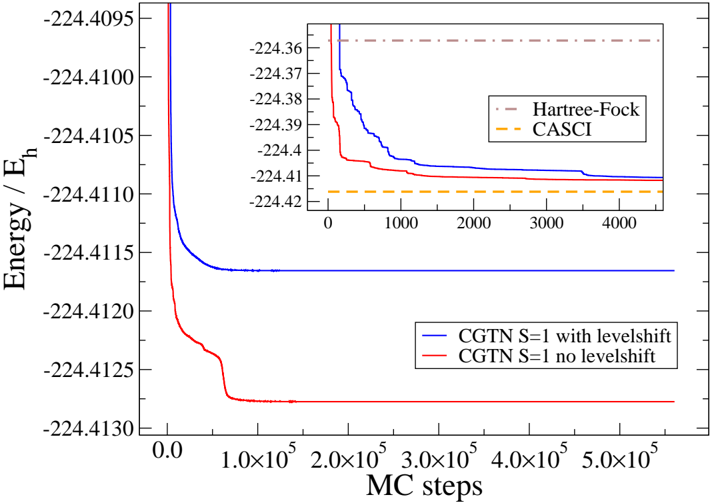
“vector basis must be constructed. Another solution, which we need to employ in our second example below, is the application of a level-shift operator as used, for instance, for the DMRG algorithm in [52]. The concept of the level-shift operator can be easily implemented in the current optimization scheme. The idea is…”
MethodSelf-citationGround State Fidelity from Tensor Network Representations
Zhou, H.-Q., Orús, R., & Vidal, G. (2008) · Physical Review Letters · doi:10.1103/physrevlett.100.080601 · Cited by 176 · cited 1×
“The high-dimensional coefficient tensor is broken down into low-rank tensors, which are arranged on an arbitrary network [12], [22]–[28].”
BackgroundVariational Quantum Monte Carlo Simulations with Tensor-Network States
Sandvik, A. W., & Vidal, G. (2007) · Physical Review Letters · doi:10.1103/physrevlett.99.220602 · Cited by 169 · cited 2×
“tional Optimization We apply a variational Monte Carlo scheme to optimize the CGTN state. In the context of tensor-network states, this was demonstrated by Schuch et al. [36] and by Sandvik and Vidal [40] for local Hamiltonians. We augment the optimization with a parallel tempering scheme. The energy of the system is…”
MethodTensor Product Variational Formulation for Quantum SystemsPreprint
Nishio, Y., Maeshima, N., Gendiar, A., & Nishino, T. (2004) · arXiv (Cornell University) · doi:10.48550/arxiv.cond-mat/0401115 · Cited by 160
Two-Dimensional Tensor Product Variational Formulation
Nishino, T., Hieida, Y., Okunishi, K., Maeshima, N., Akutsu, Y., & Gendiar, A. (2001) · Progress of Theoretical Physics · doi:10.1143/ptp.105.409 · Cited by 151
Moritz, G., Hess, B. A., & Reiher, M. (2005) · The Journal of Chemical Physics · doi:10.1063/1.1824891 · Cited by 145 · cited 1×
“Note that an artificial one-dimensional ordering of the molecular orbitals for the construction of the total basis states, which can create convergence problems to local energy minima as in the quantum chemical DMRG algorithm [13,14], is explicitly circumvented.”
BackgroundSelf-citationSchuch, N., Wolf, M. M., Verstraete, F., & Cirac, J. I. (2008) · Physical Review Letters · doi:10.1103/physrevlett.100.040501 · Cited by 130 · cited 3×
“Our extension is twofold: (i) SBS, EPS and CPS have only been applied to local spin Hamiltonians so far, while we aim at the full electronic Hamiltonian as given in (1) and (ii) we include all pair correlations of the one-electron basis states and do not impose any restriction on these pairs.”
BackgroundSelf-citationQC-DMRG study of the ionic-neutral curve crossing of LiF
LEGEZA, O., RODER, J., & HESS, B. A. (2003) · Molecular Physics · doi:10.1080/0026897031000155625 · Cited by 113
Mezzacapo, F., Schuch, N., Boninsegni, M., & Cirac, J. I. (2009) · New Journal of Physics · doi:10.1088/1367-2630/11/8/083026 · Cited by 103 · cited 1×
“These include string-bond states (SBS) [37] and subsequently entangled-plaquette states (EPS) [38] and correlator product states (CPS) [39].”
BackgroundAn Introduction to the Density Matrix Renormalization Group Ansatz in Quantum Chemistry
Chan, G. K.-L., Dorando, J. J., Ghosh, D., Hachmann, J., Neuscamman, E., Wang, H., & Yanai, T. (2008) · Progress in Theoretical Chemistry and Physics · doi:10.1007/978-1-4020-8707-3_4 · Cited by 80
On the definition of local spin in relativistic and nonrelativistic quantum chemistry
Reiher, M. (2006) · Faraday Discussions · doi:10.1039/b605229k · Cited by 73
Self-citationDensity-matrix renormalization-group study of excitons in dendrimers
Martín-Delgado, M. A., Rodriguez-Laguna, J., & Sierra, G. (2002) · Physical Review B · doi:10.1103/physrevb.65.155116 · Cited by 59
Καλέμος, Α., Dunning, T. H., Mavridis, A., & Harrison, J. (2004) · Canadian Journal of Chemistry · doi:10.1139/v04-045 · Cited by 52
Moritz, G., & Reiher, M. (2006) · The Journal of Chemical Physics · doi:10.1063/1.2139998 · Cited by 51 · cited 1×
“Note that an artificial one-dimensional ordering of the molecular orbitals for the construction of the total basis states, which can create convergence problems to local energy minima as in the quantum chemical DMRG algorithm [13,14], is explicitly circumvented.”
BackgroundSelf-citationThe transition-state region of the O(3P)+O2(3Σg−) potential energy surface
Schinke, R., & Fleurat‐Lessard, P. (2004) · The Journal of Chemical Physics · doi:10.1063/1.1784776 · Cited by 46
Abundance of translation invariant pure states on quantum spin chains
Fannes, M., Nachtergaele, B., & Werner, R. F. (1992) · Letters in Mathematical Physics · doi:10.1007/bf00406552 · Cited by 46 · cited 8×
“Hence, an MPS state might be difficult to optimize for a general molecule of arbitrary structure.”
BackgroundInfluential
Research works printed but not linked: 6
- Marti K H and Reiher M. The density matrix renormalization group algorithm in quantum chemistry. Z. Phys. Chem., pages DOI:10.1524, in press., 2009.
- Cirac J I and Verstraete F. Renormalization and tensor product states in spin chains and lattices, 2009. arXiv.org:0910.1130.
- Eisert J, Cramer M and Plenio M B. Area laws for the entanglement entropy -a review. Preprint, 2008. arXiv:0808.3773v3. · arXiv
- Sierra G and Martin-Delgado M A. The Density Matrix Renormalization Group, Quantum Groups and Conformal Field Theory. Preprint, 1998. arXiv:cond-mat/9811170v3. · arXiv
- Changlani H J, Kinder J M, Umrigar C J and Chan G K-L. Approximating strongly correlated spin and fermion wavefunctions with correlator product states, 2009. arXiv.org:0907.4646.
- Harris N, Shaik S, Schröder D and Schwarz H. Single-and two-state reactivity in the gas-phase C-H band activation of norbarnane by 'bare' FeO+. Helv. Chim. Acta, 82(10):1784-1797, 1999.
Cited by
Orús, R. (2014) · Annals of Physics · doi:10.1016/j.aop.2014.06.013 · Cited by 2,255
Solving the quantum many-body problem with artificial neural networks
Carleo, G., & Troyer, M. (2017) · Science · doi:10.1126/science.aag2302 · Cited by 2,215
Self-citationQuantum Chemistry in the Age of Quantum Computing
Cao, Y., Romero, J., Olson, J. P., Degroote, M., Johnson, P. D., Kieferová, M., Kivlichan, I. D., Menke, T., Peropadre, B., Sawaya, N. P. D., et al. (2019) · Chemical Reviews · doi:10.1021/acs.chemrev.8b00803 · Cited by 1,560
Tang, H. L., Shkolnikov, V. O., Barron, G. S., Grimsley, H. R., Mayhall, N. J., Barnes, E., & Economou, S. E. (2021) · PRX Quantum · doi:10.1103/prxquantum.2.020310 · Cited by 408
Tang, H. L., Shkolnikov, V. O., Barron, G. S., Grimsley, H. R., Mayhall, N. J., Barnes, E., & Economou, S. E. (2019) · arXiv · doi:10.48550/arxiv.1911.10205 · Cited by 408
Metadata
- Authors
- Marti, K. H., Bauer, B., Reiher, M., Troyer, M., & Verstraete, F.
- Affiliations
- ETH Zurich (CH)
- University of Vienna (AT)
- Venue
- New Journal of Physics
- Publisher
- IOP Publishing
- Published
- 2010-10-05
- Volume
- 12
- Issue
- 10
- Pages
- 103008
- ISSN
- 1367-2630 (ISSN-L)
- OpenAlex
- W2057345299
- Cited by
- 87
- References
- 51
- Citations by year
- 2026: 1 · 2025: 5 · 2024: 2 · 2023: 2 · 2022: 4 · 2021: 3 · 2020: 7 · 2019: 3 · 2018: 4 · 2017: 8 · 2016: 4 · 2015: 7 · 2014: 14 · 2013: 6 · 2012: 9
- FWCI
- 3.94
- Type
- journal article
- Language
- en
- Open access
- gold
- doi.org
- Licence
- cc-by
- Locations
- New Journal of Physics (publishedVersion, cc-by)
- arXiv (Cornell University) (submittedVersion)
- Ghent University Academic Bibliography (Ghent University) (submittedVersion, other-oa)
- arXiv (Cornell University)
- Funders
- Eidgenössische Technische Hochschule Zürich
- Topics
- Physical Sciences › Physics and Astronomy › Atomic and Molecular Physics, and Optics › Quantum many-body systems
- Physical Sciences › Computer Science › Artificial Intelligence › Quantum Computing Algorithms and Architecture
- Physical Sciences › Physics and Astronomy › Atomic and Molecular Physics, and Optics › Advanced Chemical Physics Studies
- Keywords
- tensor network states, molecular quantum chemistry, replica exchange molecular dynamics, quantum many-body systems
About these checks
Registry, retraction, Cites and statistics results are computed, not judged, with one exception: a printed reference that no index lists is read once by a model before it counts as a citation error. Claims are extracted by a model and kept only when their quote appears verbatim in the text; each cited source is then checked, with a model’s help, for whether it says what the claim relies on. Those verdicts can be wrong — read the claim’s quote and the cited source before relying on one.
Statistics and arithmetic are recomputed, not judged.
Confidence bands are shown only for fields calibrated on our annotated test set. None is calibrated yet, so no band is shown.
What counts as a claim ›How we measure confidence ›How we check this ›
Are you an author, or do you see a problem with this page? Request a review
Data sources
Bibliographic data: Semantic Scholar, OpenAlex, Crossref.
Contains information from the Semantic Scholar Academic Graph Datasets, made available under the ODC Attribution License (ODC-BY 1.0).
Semantic Scholar’s data is described in: Kinney, R., et al. (2023). The Semantic Scholar Open Data Platform. arXiv:2301.10140.
