

Matrix product operator representations
Open accessThe DOI matches its Crossref record; 15 of the 15 references it cites were found in a registry or an index.
Abstract
We show how to construct relevant families of matrix product operators (MPOs) in one and higher dimensions. These form the building blocks for the numerical simulation methods based on matrix product states and projected entangled pair states. In particular, we construct translationally invariant MPOs suitable for time evolution, and show how such descriptions are possible for Hamiltonians with long-range interactions. We show how these tools can be exploited for constructing new algorithms for simulating quantum spin systems.
Overview
The claims and statistics of this paper haven’t been checked yet.
Free: it reads the open-access text and checks the first 5 claims that cite a source we can check. Create a free account to check every claim.
Integrity signals
Registry
Cites
Statistics
Figures
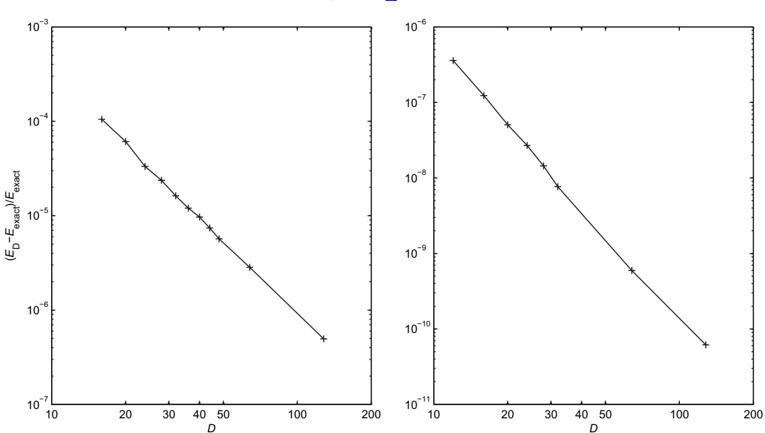
Verification
Claims the paper makes
The claims and statistics of this paper haven’t been checked yet.
Free: it reads the open-access text and checks the first 5 claims that cite a source we can check. Create a free account to check every claim.
Claims other papers make about this one
Each is checked against this paper’s own text: does it say what the citing paper says it does?
In the citing paper
“The long-range interactions of the Hamiltonian were approximated by an MPO [23] with a maximal absolute error smaller than 10 -8 .”
From Unifying time evolution and optimization with matrix product states (2016) · cites this paper as [23]
Self-check
Percentages, sums and reported differences re-computed from the paper’s own numbers.
The self-check needs the paper’s full text.
Citations
Cites
Density matrix formulation for quantum renormalization groups
White, S. R. (1992) · Physical Review Letters · doi:10.1103/physrevlett.69.2863 · Cited by 7,702
Fault-tolerant quantum computation by anyons
Kitaev, A. Y. (2003) · Annals of Physics · doi:10.1016/s0003-4916(02)00018-0 · Cited by 7,238
The density-matrix renormalization group
Schollwöck, U. (2005) · Reviews of Modern Physics · doi:10.1103/revmodphys.77.259 · Cited by 3,323
Efficient Classical Simulation of Slightly Entangled Quantum Computations
Vidal, G. (2003) · Physical Review Letters · doi:10.1103/physrevlett.91.147902 · Cited by 2,368
String-net condensation: A physical mechanism for topological phases
Levin, M. A., & Wen, X.-G. (2005) · Physical Review B · doi:10.1103/physrevb.71.045110 · Cited by 1,470
Real-Time Evolution Using the Density Matrix Renormalization Group
White, S. R., & Feiguin, A. E. (2004) · Physical Review Letters · doi:10.1103/physrevlett.93.076401 · Cited by 1,398
Time-dependent density-matrix renormalization-group using adaptive effective Hilbert spaces
Daley, A. J., Kollath, C., Schollwöck, U., & Vidal, G. (2004) · Journal of Statistical Mechanics: Theory and Experiment · doi:10.1088/1742-5468/2004/04/p04005 · Cited by 1,160
Matrix Product Density Operators: Simulation of Finite-Temperature and Dissipative Systems
Verstraete, F., García-Ripoll, J. J., & Cirac, J. I. (2004) · Physical Review Letters · doi:10.1103/physrevlett.93.207204 · Cited by 1,098
Self-citationZwolak, M., & Vidal, G. (2004) · Physical Review Letters · doi:10.1103/physrevlett.93.207205 · Cited by 657
Verstraete, F., Porras, D., & Cirac, J. I. (2004) · Physical Review Letters · doi:10.1103/physrevlett.93.227205 · Cited by 581
Self-citation
Cited by
Items 501–520 of 520
Ground- and excited-state energies extraction via Trotterization on IBM quantum computersPreprint
Espinoza-Ortiz, F., Lin, C., & Chien, C.-C. (2026) · arXiv (Cornell University) · doi:10.48550/arxiv.2606.18534
Yang, Q. (2026) · arXiv (Cornell University) · doi:10.48550/arxiv.2606.20522
Renormalization flows for 1D mixed states and a quantum Goursat lemmaPreprint
Le-Nestour, L., Pérez-García, D., & Ruiz-de-Alarcón, A. (2026) · arXiv (Cornell University) · doi:10.48550/arxiv.2607.08568
autotn: Automata-inspired construction of tensor-network operators from symbolic local rulesPreprint
Morais, A., Oregi, I., Pastor-López, I., & Osaba, E. (2026) · SSRN Electronic Journal · doi:10.2139/ssrn.7193119
autotn: Automata-inspired construction of tensor-network operators from symbolic local rulesPreprint
Morais, A., Oregi, I., Pastor-López, I., & Osaba, E. (2026) · SSRN Electronic Journal · doi:10.2139/ssrn.7193123
autotn: Automata-inspired construction of tensor-network operators from symbolic local rulesPreprint
Morais, A., Oregi, I., Pastor-López, I., & Osaba, E. (2026) · arXiv (Cornell University) · doi:10.48550/arxiv.2607.22232
Optimal nonlocality transfer matrix in quantum chains with translational symmetry breaking
Anonymous, Cheng, H.-G., Xu, Z., McCulloch, I. P., Yan, L., & Sun, Z. (2026) · Physical Review A · doi:10.1103/sllr-kbjx
Bourassa, B. (2019) · Knowledge UdeS (Institutional Deposit of the University of Sherbrooke)
Positive Tensor-Network Kähler Metrics on gCICY ThreefoldsPreprint
Wang, J. (2026) · arXiv (Cornell University) · doi:10.48550/arxiv.2608.16083
Wang, X., & Xiong, B. (2026) · arXiv (Cornell University) · doi:10.48550/arxiv.2609.21290
autotn: Automata-inspired construction of tensor-network operators from symbolic local rules
Morais, A., Oregi, I., Pastor-López, I., & Osaba, E. (2026) · SoftwareX · doi:10.1016/j.softx.2026.103050
Many-body physics of cavity embedded quantum matter
Bacciconi, Z. (2025) · SDL
An entanglement perspective on generalized symmetries, dualities and anomalies
Cuiper, B. V.-D. (2026) · Ghent University Academic Bibliography (Ghent University)
Lattice Symmetry Remnants in Spatial and Temporal Entanglement of Quantum Critical Spin ChainsPreprint
Yang, X.-H., & Huang, R. (2026) · arXiv (Cornell University) · doi:10.48550/arxiv.2610.31676
Universal dynamics of quantum phase transitions with fractional long-range interactionsPreprint
Grabarits, A., Carr, L. D., & del Campo, A. (2026) · arXiv (Cornell University) · doi:10.48550/arxiv.2611.05273
Bosgoed, D., Verstraete, F., & Lootens, L. (2026) · arXiv (Cornell University) · doi:10.48550/arxiv.2611.08293
Self-citationParameterized equivalence checking of quantum circuit generators via weighted automataPreprint
Chuklanov, P. (2026) · arXiv (Cornell University) · doi:10.48550/arxiv.2611.12049
Ran, S.-J., Peng, C., Li, W., & Su, G. (2015) · arXiv (Cornell University) · doi:10.48550/arxiv.1501.00661
Metadata
- Authors
- Pirvu, B., Murg, V, Cirac, J. I., & Verstraete, F.
- Affiliations
- University of Vienna (AT)
- Max Planck Institute of Quantum Optics (DE)
- Venue
- New Journal of Physics
- Publisher
- IOP Publishing
- Published
- 2010-02-26
- Volume
- 12
- Issue
- 2
- Pages
- 025012
- ISSN
- 1367-2630 (ISSN-L)
- OpenAlex
- W2014237348
- Semantic Scholar
- 7408cbc870e4006b3fa93fe46dbb767d730d10bb
- Cited by
- 374
- References
- 14
- Citations by year
- 2026: 23 · 2025: 39 · 2024: 31 · 2023: 22 · 2022: 26 · 2021: 32 · 2020: 37 · 2019: 25 · 2018: 23 · 2017: 25 · 2016: 16 · 2015: 21 · 2014: 12 · 2013: 12 · 2012: 16
- FWCI
- 7.03
- Type
- journal article
- Language
- en
- Open access
- gold
- doi.org
- Licence
- cc-by
- Locations
- New Journal of Physics (publishedVersion, cc-by)
- arXiv (Cornell University) (submittedVersion)
- Ghent University Academic Bibliography (Ghent University) (submittedVersion, other-oa)
- Phaidra (Universität Wien) (submittedVersion, cc-by-nc-nd)
- Max Planck Institute for Plasma Physics (submittedVersion)
- MPG.PuRe (Max Planck Society) (submittedVersion)
- arXiv (Cornell University)
- Funders
- Deutsche Forschungsgemeinschaft
- Austrian Science Fund (W 1210)
- Topics
- Physical Sciences › Physics and Astronomy › Atomic and Molecular Physics, and Optics › Quantum many-body systems
- Physical Sciences › Computer Science › Artificial Intelligence › Quantum Computing Algorithms and Architecture
- Physical Sciences › Physics and Astronomy › Atomic and Molecular Physics, and Optics › Quantum Mechanics and Applications
- Keywords
- matrix product operators, matrix product states, projected entangled pair states, time evolution, long-range interactions, quantum spin systems, quantum simulation algorithms
About these checks
Registry, retraction, Cites and statistics results are computed, not judged, with one exception: a printed reference that no index lists is read once by a model before it counts as a citation error. Claims are extracted by a model and kept only when their quote appears verbatim in the text; each cited source is then checked, with a model’s help, for whether it says what the claim relies on. Those verdicts can be wrong — read the claim’s quote and the cited source before relying on one.
Statistics and arithmetic are recomputed, not judged.
Confidence bands are shown only for fields calibrated on our annotated test set. None is calibrated yet, so no band is shown.
What counts as a claim ›How we measure confidence ›How we check this ›
Are you an author, or do you see a problem with this page? Request a review
Data sources
Bibliographic data: Semantic Scholar, OpenAlex, Crossref.
Contains information from the Semantic Scholar Academic Graph Datasets, made available under the ODC Attribution License (ODC-BY 1.0).
Semantic Scholar’s data is described in: Kinney, R., et al. (2023). The Semantic Scholar Open Data Platform. arXiv:2301.10140.
