

Universally optimal noisy quantum walks on complex networks
Open accessThe DOI matches its Crossref record; 80 of the 82 references it cites were found in a registry or an index.
Abstract
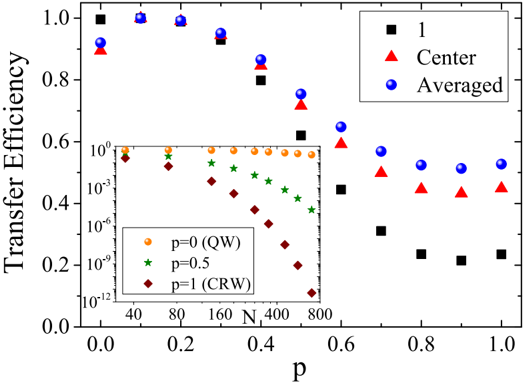
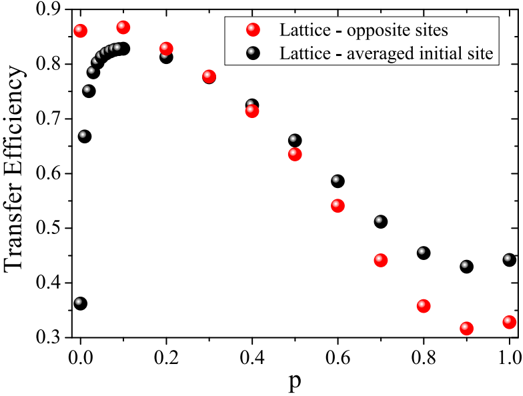
Transport properties play a crucial role in several fields of science, for example biology, chemistry, sociology, information science and physics. The behavior of many dynamical processes running over complex networks is known to be closely related to the geometry of the underlying topology, but this connection becomes even harder to understand when quantum effects come into play. Here, we exploit the Kossakowski–Lindblad formalism of quantum stochastic walks to investigate the capability of quickly and robustly transmitting energy (or information) between two distant points in very large complex structures, remarkably assisted by external noise and quantum features such as coherence. An optimal mixing of classical and quantum transport is, very surprisingly, quite universal for a large class of complex networks. This widespread behavior turns out to be also extremely robust with respect to geometry changes. These results might pave the way for designing optimal bio-inspired geometries of efficient transport nanostructures that can be used for solar energy and also quantum information and communication technologies.
Overview
The claims and statistics of this paper haven’t been checked yet.
Free: it reads the open-access text and checks the first 5 claims that cite a source we can check. Create a free account to check every claim.
Integrity signals
Registry
Cites
Statistics
Figures
Verification
Claims the paper makes
The claims and statistics of this paper haven’t been checked yet.
Free: it reads the open-access text and checks the first 5 claims that cite a source we can check. Create a free account to check every claim.
Claims other papers make about this one
Each is checked against this paper’s own text: does it say what the citing paper says it does?
The source backs part of the claim, not all of it — or backs it for a different population, condition or comparison.
In the citing paper
“Although the Lindblad model introduces decoherence only through direct classical transitions (T1-like processes), a similar behaviour would be obtained by considering a pure dephasing process (T2-like)—see (refs 27, 28, 29, 53).”
From Fast escape of a quantum walker from an integrated photonic maze (2016) · cites this paper as [28]
Experimental — accuracy not yet measuredThe cited source says what the claim attributes to it.
In the citing paper
“an analogous optimal mixing has been very recently demonstrated over a large family of complex networks for p≃0.1 (ref. 28) and experimentally observed in ref. 52”
From Fast escape of a quantum walker from an integrated photonic maze (2016) · cites this paper as [28]
Self-check
Percentages, sums and reported differences re-computed from the paper’s own numbers.
The self-check needs the paper’s full text.
Citations
Cites
Collective dynamics of ‘small-world’ networks
Watts, D. J., & Strogatz, S. H. (1998) · Nature · doi:10.1038/30918 · Cited by 43,060
Emergence of Scaling in Random Networks
Barabási, A.-L., & Albert, R. (1999) · Science · doi:10.1126/science.286.5439.509 · Cited by 36,135
Complex networks: structure and dynamics
BOCCALETTI, S., LATORA, V, MORENO, Y., CHAVEZ, M., & HWANG, D. (2006) · Physics Reports · doi:10.1016/j.physrep.2005.10.009 · Cited by 11,010
Quantum Mechanics Helps in Searching for a Needle in a Haystack
Grover, L. K. (1997) · Physical Review Letters · doi:10.1103/physrevlett.79.325 · Cited by 4,306
Evidence for wavelike energy transfer through quantum coherence in photosynthetic systems
Engel, G. S., Calhoun, T. R., Read, E. L., Ahn, T.-K., Mančal, T., Cheng, Y.-C., Blankenship, R. E., & Fleming, G. R. (2007) · Nature · doi:10.1038/nature05678 · Cited by 3,315
Small Worlds: The Dynamics of Networks between Order and Randomness
Watts, D. J. (1999) · Princeton University Press eBooks · doi:10.1515/9780691188331 · Cited by 2,105
Coherently wired light-harvesting in photosynthetic marine algae at ambient temperature
Collini, E., Wong, C. Y., Wilk, K. E., Curmi, P. M. G., Brumer, P., & Scholes, G. D. (2010) · Nature · doi:10.1038/nature08811 · Cited by 1,649
Aharonov, Y., Davidovich, L., & Zagury, N. (1993) · Physical Review A · doi:10.1103/physreva.48.1687 · Cited by 1,622
Quantum random walks: An introductory overview
Kempe, J. (2003) · Contemporary Physics · doi:10.1080/00107151031000110776 · Cited by 1,413
Quantum Communication through an Unmodulated Spin Chain
Bose, S. (2003) · Physical Review Letters · doi:10.1103/physrevlett.91.207901 · Cited by 1,407
Research works printed but not linked: 6
- Plenio M B and Huelga S F 2008 New J. Phys. 10 113019
- Santha M 2008 Quantum walk based search algorithms Theory and Applications of Models of Computation (Lecture Notes in Computer Science vol 4978) ed M Agrawal, D Z Du, Z H Duan and A S Li (Berlin: Springer) p 31
- Agliari E 2008 J. Phys. A: Math. Theor. 41 445301
- Sarovar M and Whaley K B 2013 New J. Phys. 15 013030
- Watts D J and Strogatz S H 1998 Nature 393 440 · DOI · Paper page
- Mülken O, Pernice V and Blumen A 2007 Phys. Rev. E 76 051125 · DOI · Paper page
Cited by
Quantum walk and its application domains: A systematic review
Kadian, K., Garhwal, S., & Kumar, A. (2021) · Computer Science Review · doi:10.1016/j.cosrev.2021.100419 · Cited by 204
Fast escape of a quantum walker from an integrated photonic maze
Caruso, F., Crespi, A., Ciriolo, A. G., Sciarrino, F., & Osellame, R. (2016) · Nature Communications · doi:10.1038/ncomms11682 · Cited by 105
“The transfer efficiency to the sink, calculated theoretically with the method reported in [27], is shown in Figure 4a for a maze with the layout presented in Fig.”
InfluentialSelf-citationObservation of Noise-Assisted Transport in an All-Optical Cavity-Based Network
Viciani, S., Lima, M., Bellini, M., & Caruso, F. (2015) · Physical Review Letters · doi:10.1103/physrevlett.115.083601 · Cited by 65
Self-citationDo photosynthetic complexes use quantum coherence to increase their efficiency? Probably not
Harush, E. Z., & Dubi, Y. (2021) · Science Advances · doi:10.1126/sciadv.abc4631 · Cited by 64
Complex quantum networks: a topical review
Nokkala, J., Piilo, J., & Bianconi, G. (2024) · Journal of Physics A Mathematical and Theoretical · doi:10.1088/1751-8121/ad41a6 · Cited by 74
Quantum Interference and Selectivity through Biological Ion Channels
Salari, V., Naeij, H. R., & Shafiee, A. (2017) · Scientific Reports · doi:10.1038/srep41625 · Cited by 47
New trends in quantum machine learning (a)
Buffoni, L., & Caruso, F. (2020) · Europhysics Letters (EPL) · doi:10.1209/0295-5075/132/60004 · Cited by 43
Self-citationQuantum reinforcement learning: the maze problem
Pozza, N. D., Buffoni, L., Martina, S., & Caruso, F. (2022) · Quantum Machine Intelligence · doi:10.1007/s42484-022-00068-y · Cited by 50
“[31] one of us has shown that one can design a sort of noise mask that leads to a transport behaviour as if one had modified the underlying topology.”
BackgroundMethodInfluentialSelf-citationEnvironment-assisted quantum transport through single-molecule junctions
Sowa, J. K., Mol, J. A., Briggs, G. A. D., & Gauger, E. M. (2017) · Physical Chemistry Chemical Physics · doi:10.1039/c7cp06237k · Cited by 30
Razzoli, L., Ghirardi, L., Siloi, I., Bordone, P., & Paris, M. G. A. (2019) · Physical Review A · doi:10.1103/physreva.99.062330 · Cited by 29
Pires, M. A., Molfetta, G. D., & Queirós, S. M. D. (2019) · Scientific Reports · doi:10.1038/s41598-019-55642-5 · Cited by 28
“P C C k k q k k t ( ) exp ( ) [1 (1 ) ] , with {1, 2, , }, (15) t t q t q [1, ] 1/(1 ) ≡ − = − − = .”
BackgroundMethodInfluential‘Momentum rejuvenation’ underlies the phenomenon of noise-assisted quantum energy flow
Li, Y., Caruso, F., Gauger, E., & Benjamin, S. C. (2015) · New Journal of Physics · doi:10.1088/1367-2630/17/1/013057 · Cited by 19
Self-citationFractional quantum mechanics on networks: Long-range dynamics and quantum transport
Riascos, A. P., & Mateos, J. L. (2015) · Physical Review E · doi:10.1103/physreve.92.052814 · Cited by 19
Davidson, S., Fruchtman, A., Pollock, F. A., & Gauger, E. M. (2020) · The Journal of Chemical Physics · doi:10.1063/5.0023702 · Cited by 19
Structure-Dynamics Relation in Physically-Plausible Multi-Chromophore Systems
Knee, G. C., Rowe, P., Smith, L. D., Troisi, A., & Datta, A. (2017) · The Journal of Physical Chemistry Letters · doi:10.1021/acs.jpclett.7b00829 · Cited by 18
Disorder and dephasing as control knobs for light transport in optical fiber cavity networks
Viciani, S., Gherardini, S., Lima, M., Bellini, M., & Caruso, F. (2016) · Scientific Reports · doi:10.1038/srep37791 · Cited by 18
Self-citationInterplay between Dephasing and Geometry and Directed Heat Flow in Exciton Transfer Complexes
Dubi, Y. (2015) · The Journal of Physical Chemistry C · doi:10.1021/acs.jpcc.5b08493 · Cited by 18
Simulating photosynthetic energy transport on a photonic network
Tang, H. L., Shang, X.-W., Shi, Z.-Y., He, T.-S., Feng, Z., Wang, T., Shi, R., Wang, H.-M., Tan, X., Xu, X.-Y., et al. (2024) · npj Quantum Information · doi:10.1038/s41534-024-00824-x · Cited by 21
“Theoretical quantum physicists have investigated the FMO structure [9, 10, 19, 20, 33] and proven that there exists certain optimal environmental noise levels to assist for an optimal energy transport efficiency.”
Quantum simulation of a quantum stochastic walk
Govia, L. C. G., Taketani, B. G., Schuhmacher, P. K., & Wilhelm, F. K. (2016) · Quantum Science and Technology · doi:10.1088/2058-9565/aa540b · Cited by 14
Quantum transport on generalized scale-free networks
Maciel, C. M., Mendes, C. F. O., Strunz, W. T., & Galiceanu, M. D. (2020) · Physical Review A · doi:10.1103/physreva.102.032219 · Cited by 14
Efficient learning of mixed-state tomography for photonic quantum walk
Wang, Q.-Q., Dong, S., Li, X.-W., Xu, X., Wang, C., Han, S., Yung, M., Han, Y., Li, C., & Guo, G. (2024) · Science Advances · doi:10.1126/sciadv.adl4871 · Cited by 16
Quantum state discrimination on reconfigurable noise-robust quantum networks
Pozza, N. D., & Caruso, F. (2020) · Physical Review Research · doi:10.1103/physrevresearch.2.043011 · Cited by 14
“The evolution of QSWs is defined by a GoriniKossakowski-Sudarshan-Lindblad master equation [38–40], dρ dt = −(1 − p)i[H, ρ] + p ∑ k ( LkρL † k − 1 2 {L†k Lk, ρ} ) , (1) where one assumes to work in units with h̄ = 1, H is the Hamiltonian, {Lk} are the Lindblad operators, and both are defined from the adjacency matrix…”
BackgroundInfluentialSelf-citationContinuous-time quantum walks in the presence of a quadratic perturbation
Candeloro, A., Razzoli, L., Cavazzoni, S., Bordone, P., & Paris, M. G. A. (2020) · Physical Review A · doi:10.1103/physreva.102.042214 · Cited by 9
Discrete dynamics and non-Markovianity
Luoma, K., & Piilo, J. (2016) · Journal of Physics B Atomic Molecular and Optical Physics · doi:10.1088/0953-4075/49/12/125501 · Cited by 11
Quantum transport on honeycomb networks
Batalha, G. M., Volta, A., Strunz, W. T., & Galiceanu, M. D. (2022) · Scientific Reports · doi:10.1038/s41598-022-10537-w · Cited by 10
From Goldilocks to twin peaks: multiple optimal regimes for quantum transport in disordered networks
Coates, A. R., Lovett, B. W., & Gauger, E. M. (2023) · Physical Chemistry Chemical Physics · doi:10.1039/d2cp04935j · Cited by 10
Noise assisted excitation energy transfer in a linear model of a selectivity filter backbone strand
Bassereh, H., Salari, V., & Shahbazi, F. (2015) · Journal of Physics Condensed Matter · doi:10.1088/0953-8984/27/27/275102 · Cited by 11
Principles underlying efficient exciton transport unveiled by information-geometric analysis
Davidson, S., Pollock, F. A., & Gauger, E. M. (2021) · Physical Review Research · doi:10.1103/physrevresearch.3.l032001 · Cited by 9
Quantum transport on modified multilayered spiderwebs
Maciel, C. M., Strunz, W. T., & Galiceanu, M. D. (2018) · Journal of Physics A Mathematical and Theoretical · doi:10.1088/1751-8121/aae8ab · Cited by 5
Noise as a resourcePreprint
Gherardini, S. (2018) · arXiv (Cornell University) · doi:10.48550/arxiv.1805.01800 · Cited by 4
“Only the additional and unavoidable presence of disorder and noise, which is usually assumed to be deleterious for the transport properties, seems to positively affect the transmission efficiency [46,47].”
BackgroundQuantum simulation of a discrete-time quantum stochastic walk
Schuhmacher, P. K., Govia, L. C. G., Taketani, B. G., & Wilhelm, F. K. (2021) · Europhysics Letters (EPL) · doi:10.1209/0295-5075/133/50003 · Cited by 5
“widely documented in literature [7, 17, 10, 18, 19, 20, 21, 22].”
Random Walk Quantum Clustering Algorithm Based on Space
Shufen, X., Dong, Y., & Ma, H. (2018) · International Journal of Theoretical Physics · doi:10.1007/s10773-018-3663-0 · Cited by 4
“In a random walk, the direction and length of every step are determined randomly [14–19], similar to the random walk of a person.”
BackgroundBuchleitner, A., Burghardt, I., Cheng, Y., Scholes, G. D., Schwarz, U. T., Weber‐Bargioni, A. F., & Wellens, T. (2014) · New Journal of Physics · doi:10.1088/1367-2630/16/10/105021 · Cited by 4
“[1] Caruso F 2014 Universally optimal noisy quantum walks on complex networks New J.”
BackgroundHow to suppress dark states in quantum networks and bio-engineered structures
Le, T. P., Donati, L., Severini, S., & Caruso, F. (2018) · Journal of Physics A Mathematical and Theoretical · doi:10.1088/1751-8121/aad3e6 · Cited by 5
Self-citationPhysics-inspired Generative AI models via real hardware-based noisy quantum diffusion
Parigi, M., Martina, S., Venturelli, F. A., & Caruso, F. (2026) · Quantum Machine Intelligence · doi:10.1007/s42484-026-00459-5 · Cited by 7
Self-citationQuantum Walks as a Tool to Design Robust Quantum Batteries: The Role of Topology and Chirality
Cavazzoni, S., Ragazzi, G., Bordone, P., & Paris, M. G. A. (2026) · Advanced Quantum Technologies · doi:10.1002/qute.202500897 · Cited by 6
“Finally, as a last decoherence model, we consider the so-called quantum stochastic walk (QSW) model [ 45–47 ] in which 𝑝 ∈ [ 0 , 1] quantifies the interplay between the standard Hamiltonian evolution ( 𝑝 = 0) and the irreversible dynamics ( 𝑝 = 1) and with 𝑃 𝑘𝑗 = ⟨ 𝑘 | | 𝑗 ⟩| 𝑘 ⟩⟨ 𝑗 |…”
Quantum transport on multilayer generalized scale-free networks
Galiceanu, M. D., & Strunz, W. T. (2024) · Physica Scripta · doi:10.1088/1402-4896/ad29cf · Cited by 3
Effects of Oscillatory Deformations on the Coherent and Incoherent Quantum Transport
Behzadi, N., & Ahansaz, B. (2017) · International Journal of Theoretical Physics · doi:10.1007/s10773-017-3507-3 · Cited by 3
Quantum Stochastic Walk models for quantum state discrimination
Pozza, N. D., & Caruso, F. (2019) · Physics Letters A · doi:10.1016/j.physleta.2019.126195 · Cited by 4
“1 and setup the optimization of the parameters in H , T using four QSW schemes: (a) Hi, j ≥ 0, T = H D−1 as in [24], (b) Hi, j ∈ {0, 1}, T = H D−1 as in [20], (c) Hi, j = − max{Ti, j, T j,i}, Hi,i = − ∑ j =i H j,i and T un–normalized as in [43] and (d) H , T independently optimized, with the optimization variables ind…”
BackgroundMethodSelf-citationHybrid Quantum-Classical Walks for Graph Representation Learning in Community Detection
Marin, A. J. S., Soto-Gomez, M., Valentini, G., Casiraghi, E., Cano, C., & Manzano, D. (2025) · IEEE International Conference on Quantum Artificial Intelligence (QAI) · doi:10.1109/qai63978.2025.00016 · Cited by 3
“This is consistent with previous findings [23], [31], [32].”
Perfect quantum excitation energy transport via single edge perturbation in a complete network
Bassereh, H., Salari, V., Shahbazi, F., & Ala-Nissilä, T. (2017) · The European Physical Journal B · doi:10.1140/epjb/e2017-80048-1 · Cited by 5
Bassereh, H., Salari, V., & Shahbazi, F. (2014) · arXiv (Cornell University) · doi:10.48550/arxiv.1408.6256 · Cited by 2
Decoherence and classicalization of continuous-time quantum walks on graphs
Bressanini, G., Benedetti, C., & Paris, M. G. A. (2022) · Quantum Information Processing · doi:10.1007/s11128-022-03647-x · Cited by 17
“It is described by the following master equation [34]”
BackgroundQuantum walk on a square lattice with identical particles
Camacho, G., Meinecke, J. D. A., & Wolters, J. (2025) · Physical Review A · doi:10.1103/physreva.111.052416 · Cited by 2
QWAK: Quantum walk analysis kit
Santos, J., Chagas, B., Chaves, R., & Buffoni, L. (2025) · Computer Physics Communications · doi:10.1016/j.cpc.2025.109676 · Cited by 1
Nonunitary enhanced transfer efficiency in quantum walk search on complex networks
Nzongani, U., Simonetto, A., & Molfetta, G. D. (2025) · Physical Review A · doi:10.1103/jhbs-27mm · Cited by 4
Feedback search algorithm for multi-particle quantum walks over a ring based on permutation groups
Jiang, Y.-Y., Zhang, W., Chu, P.-C., & Ma, H. (2022) · Acta Physica Sinica · doi:10.7498/aps.71.20211000 · Cited by 2
Optimal initialization of a quantum system for an efficient coherent energy transfer
Gong, Z., Tang, Z., Cao, J., & Wu, J. (2018) · Chinese Journal of Chemical Physics · doi:10.1063/1674-0068/31/cjcp1804068 · Cited by 1
Search Algorithm Based on Permutation Group by Quantum Walk on Hypergraphes
Jiang, Y.-Y., Chu, P.-C., Ma, Y., & Ma, H. (2022) · Chinese Journal of Electronics · doi:10.1049/cje.2021.00.125 · Cited by 1
Construction and Application to Complex Networks
Comellas, F. (2014)
Environment-Assisted Quantum Photo-Protection in Interacting Multi-Exciton Transfer ComplexesPreprint
Zerah-Harush, E., & Dubi, Y. (2019) · arXiv (Cornell University) · doi:10.48550/arxiv.1906.10231 · Cited by 2
GCRL: a graph neural network framework for network connectivity robustness learning
Zhang, Y., Chen, H., Chen, Q., Ding, J., & Li, X. (2024) · New Journal of Physics · doi:10.1088/1367-2630/ad6ead
“This field integrates methodologies and theories from multiple disciplines like computer science [3], applied mathematics [4], and physics [5–7], finding extensive applications in various real-world situations, including traffic and transportation networks [8], the Internet [9], electric power…”
Quantum Google Algorithm: Construction and Application to Complex NetworksPreprint
Paparo, G. D., Müller, M., Comellas, F., & Martin-Delgado, M. A. (2014) · arXiv (Cornell University) · doi:10.48550/arxiv.1409.3793
Quantum walks on a ring as a versatile single-parameter sensor
Zanoli, L., Ragazzi, G., Bordone, P., & Paris, M. G. A. (2026) · Frontiers in Quantum Science and Technology · doi:10.3389/frqst.2026.1894991
Metadata
- Authors
- Caruso, F.
- Affiliations
- Quantum Science and Technology in Arcetri (IT)
- Corresponding author
- Caruso, Filippo
- ORCID
- Caruso, Filippo
- Venue
- New Journal of Physics
- Publisher
- IOP Publishing
- Published
- 2014-05-28
- Volume
- 16
- Issue
- 5
- Pages
- 055015
- ISSN
- 1367-2630 (ISSN-L)
- OpenAlex
- W2010123297
- Semantic Scholar
- 8b8a0bc7af03208a2bee365c4a0e1c99d546e0c3
- Cited by
- 54
- References
- 80
- Citations by year
- 2026: 3 · 2025: 4 · 2024: 5 · 2023: 1 · 2022: 6 · 2021: 4 · 2020: 5 · 2019: 4 · 2018: 5 · 2017: 5 · 2016: 4 · 2015: 5 · 2014: 3
- FWCI
- 5.65
- Type
- journal article
- Language
- en
- Open access
- gold
- doi.org
- Licence
- cc-by
- iopscience.iop.org/info/page/text-and-data-mining (tdm)
- creativecommons.org/licenses/by/3.0/ (vor)
- Locations
- New Journal of Physics (publishedVersion, cc-by)
- arXiv (Cornell University) (submittedVersion)
- DOAJ (DOAJ: Directory of Open Access Journals) (submittedVersion)
- Florence Research (University of Florence) (submittedVersion, other-oa)
- arXiv (Cornell University)
- Funders
- Nvidia
- Ministero dell’Istruzione, dell’Università e della Ricerca (RBFR10M3SB)
- Topics
- Physical Sciences › Computer Science › Artificial Intelligence › Quantum Computing Algorithms and Architecture
- Physical Sciences › Physics and Astronomy › Atomic and Molecular Physics, and Optics › Quantum Mechanics and Applications
- Physical Sciences › Physics and Astronomy › Atomic and Molecular Physics, and Optics › Quantum Information and Cryptography
- Keywords
- complex networks, transport properties, energy transport, information transport, quantum coherence, network topology, solar energy
About these checks
Registry, retraction, Cites and statistics results are computed, not judged, with one exception: a printed reference that no index lists is read once by a model before it counts as a citation error. Claims are extracted by a model and kept only when their quote appears verbatim in the text; each cited source is then checked, with a model’s help, for whether it says what the claim relies on. Those verdicts can be wrong — read the claim’s quote and the cited source before relying on one.
Statistics and arithmetic are recomputed, not judged.
Confidence bands are shown only for fields calibrated on our annotated test set. None is calibrated yet, so no band is shown.
What counts as a claim ›How we measure confidence ›How we check this ›
Are you an author, or do you see a problem with this page? Request a review
Data sources
Bibliographic data: Semantic Scholar, OpenAlex, Crossref.
Contains information from the Semantic Scholar Academic Graph Datasets, made available under the ODC Attribution License (ODC-BY 1.0).
Semantic Scholar’s data is described in: Kinney, R., et al. (2023). The Semantic Scholar Open Data Platform. arXiv:2301.10140.
