

Estimation of meniscus reading uncertainty in volume calibration of conical volumetric instruments
Open accessThe DOI matches its Crossref record; 5 of the 5 references it cites were found in a registry or an index; none of the 12 sources its claims cite is checked for support yet.
Abstract
One of the major uncertainty sources during gravimetric volume calibration of laboratory glassware is the meniscus reading. To estimate this uncertainty, the internal diameter of the volumetric instrument at the calibration point must be known. Data for internal diameters are available from international standards for several volumetric instruments with cylindrical meniscus reading section. However, there are another kind of volumetric instruments with conical meniscus reading section, like Imhoff cones, whose internal diameter values are not available. This work aims to show how to overcome this problem through the measurement of the internal diameters with an optical comparator. The calculated correction due to the meniscus setting was also put in nomograms, which allow reading directly the value of the uncertainty contribution and illustrates the changes in the meniscus reading uncertainty contribution as the calibration point changes, unlike what happens with cylindrical laboratory volume instruments.
Overview
CoChat Summary
TL;DR
The paper addresses a practical gap in gravimetric volume calibration: how to estimate meniscus-reading uncertainty for conical volumetric instruments when internal diameters at each calibration point are not available. It measures internal diameters with an optical comparator, validates the method on standard glassware, and builds nomograms to read the meniscus-setting uncertainty directly.
Key findings
- The internal-diameter measurement uncertainty was treated as a Type B evaluation combining repeatability, resolution, and optical comparator standard contributions; the expanded uncertainty was reported as 0.004% to 0.045% relative to the average value.
- Validation against standardized instruments gave measured internal diameters of 4.783 mm for a Pyrex 10 mL single-volume pipette, 3.324 mm for an Assistant 5 mL single-volume pipette, and 13.743 mm for a Pyrex 100 mL volumetric flask, compared with the standard values in the table.
- The regression model relating conical container volume and internal diameter had coefficients of determination R² from 0.9794 to 0.9994, indicating good predictive performance.
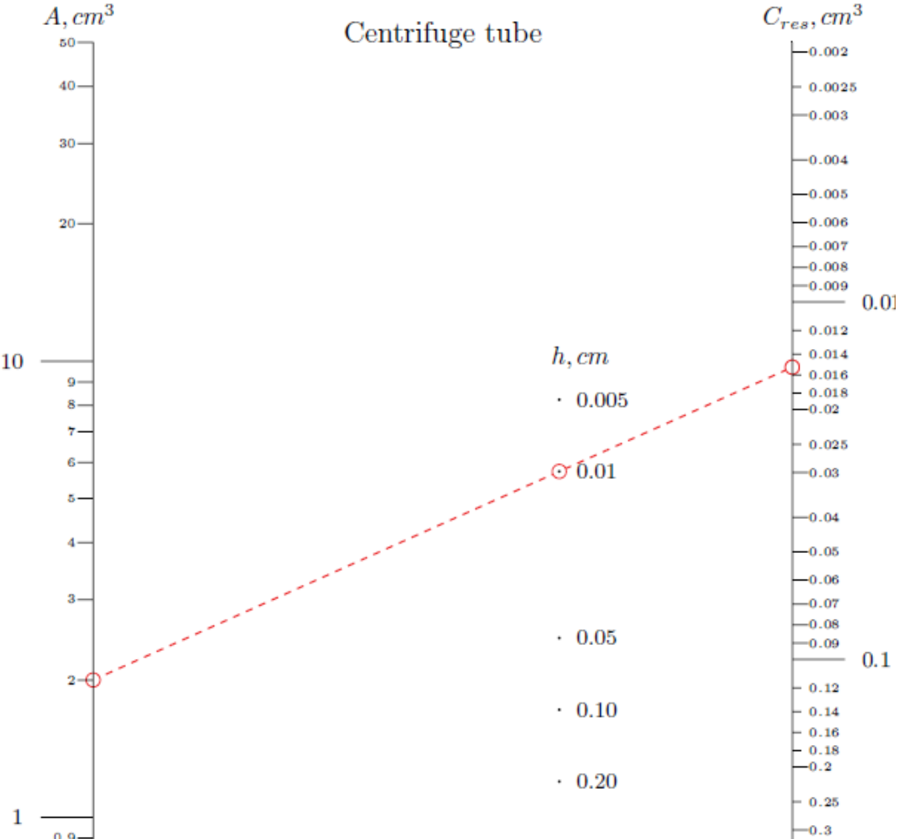
- An example nomogram for a centrifuge tube shows that at A = 2 cm³ and h = 0.01 cm, the meniscus-setting uncertainty contribution is Cres = 0.015 cm³.
Methods
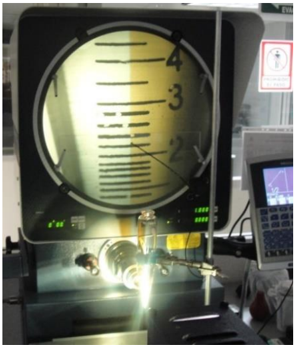
- The study used an optical comparator with a 20X lens and display resolution of 0.001 mm to measure internal diameters of volumetric laboratory glassware in an accredited laboratory following ISO/IEC 17025:2005 procedures.
- The measurement method was validated using standardized cylindrical volumetric instruments: single-volume pipettes and one-mark volumetric flasks from several commercial brands, compared against the relevant ISO standards.
- For conical volumetric instruments, the authors modeled volume vs. diameter with a power regression and used the resulting equations to construct parallel-scale nomograms for meniscus-setting uncertainty.
Limitations
- The paper states that for conical volumetric instruments, internal diameter data are not available for every graduation line, which is the core problem the work addresses.
- Only one nomogram is shown, and the paper says this was done to save space; this is an evident presentational limitation, not a reported methodological flaw.
- The paper provides validation data for only a small set of standardized instruments; broader generalization beyond the shown instruments is not stated in the paper.
Model-written summary. Check it against the paper before relying on it.
Integrity signals
Registry
Cites
Statistics
Figures


Verification
Claims the paper makes
0 Valid · 0 Not valid · 7 Not checked · 10 Own results and interpretations
A result the paper reports from its own data — it cites no other source for it, so there is none to check. The quote shows it is in the paper.
In the paper
“Moreover, the relationship between the volume contained in a conical volumetric measurement and the inner diameter, at a certain calibration point may be suitably modeled as:”
hedgedstates an association- Asserted: passes — The authors put it forward as true.
- Checkable: passes — It can be checked against evidence.
- Load-bearing: passes — The paper’s conclusions depend on it.
- Based: passes — The paper gives a reason why it holds.
A result the paper reports from its own data — it cites no other source for it, so there is none to check. The quote shows it is in the paper.
In the paper
“Values from 0.004 % to 0.045 % relative to the average value of the measurements were obtained.”
plain- Asserted: passes — The authors put it forward as true.
- Checkable: passes — It can be checked against evidence.
- Load-bearing: unclear — It is unclear whether the paper’s conclusions depend on it.
- Based: passes — The paper gives a reason why it holds.
A result the paper reports from its own data — it cites no other source for it, so there is none to check. The quote shows it is in the paper.
In the paper
“The nomogram allows to read directly on it the uncertainty contribution due to the meniscus setting”
- Also stated in: § O-J Purata-Sifuentes 1 , H-L González-Gómez 2 , J-A Echavarri-Rodríguez 2 and E Funes-Rodríguez 2 · plain
“which allow reading directly the value of the uncertainty contribution”
plain- Asserted: passes — The authors put it forward as true.
- Checkable: passes — It can be checked against evidence.
- Load-bearing: passes — The paper’s conclusions depend on it.
- Based: passes — The paper gives a reason why it holds.
- Also stated in: § O-J Purata-Sifuentes 1 , H-L González-Gómez 2 , J-A Echavarri-Rodríguez 2 and E Funes-Rodríguez 2 · plain
A result the paper reports from its own data — it cites no other source for it, so there is none to check. The quote shows it is in the paper.
In the paper
“where Cres value could be read: Cres = 0.015 cm 3 .”
hedgedstates a causeSingle case- Asserted: passes — The authors put it forward as true.
- Checkable: passes — It can be checked against evidence.
- Load-bearing: unclear — It is unclear whether the paper’s conclusions depend on it.
- Based: passes — The paper gives a reason why it holds.
None of the sources cited for this claim could be matched to a paper, so there is nothing to check it against.
In the paper
“One of the major uncertainty sources during gravimetric volume calibration of laboratory glassware is the meniscus reading.”
- Also stated in: § 1. Introduction · plain
“In the volume calibration of volumetric instruments by the gravimetric method, one of the influence quantities for the uncertainty budget is the correction due to the meniscus setting.”
What the sources say
- Not matchedcites [1] [1] ISO 4787:2010 (E) Laboratory glassware -Volumetric instruments -Methods for testing of capacity and for use (Geneva: ISO). -
Its entry has no title and year that we can search by.
- Not matchedcites [2] [2] EURAMET cg-19 2012 Guidelines on the determination of uncertainty in gravimetric volume calibration (Braunschweig: EURAMET). -
We searched by its title and found no matching paper.
plainstates a cause- Asserted: passes — The authors put it forward as true.
- Checkable: passes — It can be checked against evidence.
- Load-bearing: passes — The paper’s conclusions depend on it.
- Based: passes — The paper gives a reason why it holds.
- Also stated in: § 1. Introduction · plain
5 more claims
Create a free account to see all 17 claims and every source verdict.
- It may state two separate claims as one. 5
- Probably not a substantial claim. 3
- The quote only partly states this claim. 1
Claims other papers make about this one
Each is checked against this paper’s own text: does it say what the citing paper says it does?
The source backs part of the claim, not all of it — or backs it for a different population, condition or comparison.
In the citing paper
“A value of u position = 0.05 mm is easily achieved using simple optical aids [20], and the cross-section calculation is straightforward once the internal diameter has been measured or interpolated as described above.”
From Uncertainty Due to Meniscus Reading on Conical Graduated Volumetric Instruments (2021) · cites this paper as [20]
Experimental — accuracy not yet measuredThe source backs part of the claim, not all of it — or backs it for a different population, condition or comparison.
In the citing paper
“However, the CGVI do not meet the assumptions of either of the two cases addressed in [20] because the CGVI do not have a constant volume between graduation lines along the scale of the volumetric apparatus, nor are they one-mark instruments.”
From Uncertainty Due to Meniscus Reading on Conical Graduated Volumetric Instruments (2021) · cites this paper as [20]
Experimental — accuracy not yet measuredThe source backs part of the claim, not all of it — or backs it for a different population, condition or comparison.
In the citing paper
“The mathematical model for the gravimetric calibration method has been established and reported elsewhere [19], [20].”
From Uncertainty Due to Meniscus Reading on Conical Graduated Volumetric Instruments (2021) · cites this paper as [20]
Experimental — accuracy not yet measuredThe cited source says what the claim attributes to it.
In the citing paper
“For cylindrical volumetric instruments, how to address the un-certainty due to meniscus reading has been stated for both graduated scale or one-mark volumetric apparatus [20].”
From Uncertainty Due to Meniscus Reading on Conical Graduated Volumetric Instruments (2021) · cites this paper as [20]
The cited source says what the claim attributes to it.
In the citing paper
“However, the CGVI do not meet the assumptions of either of the two cases addressed in [20] because the CGVI do not have a constant volume between graduation lines along the scale of the volumetric apparatus, nor are they one-mark instruments.”
From Uncertainty Due to Meniscus Reading on Conical Graduated Volumetric Instruments (2021) · cites this paper as [20]
Citations
Cites
Quality Systems—Medical Devices—Particular Requirements for the Application of ISO 9001
(2004) · GMP/ISO Quality Audit Manual for Healthcare Manufacturers and Their Suppliers, (Volume 2 - Regulations, Standards, and Guidelines) · doi:10.3109/9780203026656-18 · Cited by 2,696
Laboratory glassware. One-mark volumetric flasks
(2015) · doi:10.3403/02014283u · Cited by 2
Laboratory glassware. Single-volume pipettes
(2008) · doi:10.3403/30163411 · Cited by 1
Research works printed but not linked: 2
- [2] EURAMET cg-19 2012 Guidelines on the determination of uncertainty in gravimetric volume calibration (Braunschweig: EURAMET). -
- [6] Doerfler R 2009 The UMAP J. 30 457-493.
Cited by
Uncertainty Due to Meniscus Reading on Conical Graduated Volumetric Instruments
Purata-Sifuentes, O.-J., Gonzalez-Gomez, H.-L., Echavarri-Rodriguez, J.-A., & Funes-Rodriguez, E. (2021) · IEEE Access · doi:10.1109/access.2021.3123961 · Cited by 3
“This paper is an extension of work initially presented in the XXII World Congress of the International Measurement Confederation (IMEKO 2018) and published [22].”
MethodSelf-citationIndirect Determination of the Internal Diameter of Glass Conical Volumetric Instruments
Purata Sifuentes, O. J. (2023) · Entreciencias: Diálogos en la Sociedad del Conocimiento · doi:10.22201/enesl.20078064e.2023.25.85557 · Cited by 1
Self-citationInternal diameter determination in conical glassware: A comparative analysis of measurement methods
Tornero-Navarro, M.-G., Mederos-Gutiérrez, G.-A., Valencia-Velázquez, E.-J., & Purata-Sifuentes, O.-J. (2024) · Measurement Sensors · doi:10.1016/j.measen.2024.101554
Self-citation
Metadata
- Authors
- Purata-Sifuentes, O.-J., González-Gómez, H.-L., Echavarri-Rodríguez, J.-A., & Funes-Rodríguez, E.
- Affiliations
- Universidad de Guanajuato (MX)
- Centro de Innovación Aplicada en Tecnologías Competitivas (MX)
- Venue
- Journal of Physics: Conference Series
- Publisher
- IOP Publishing
- Published
- 2018-08
- Volume
- 1065
- Pages
- 092021
- ISSN
- 1742-6588 (ISSN-L)
- 1742-6596
- OpenAlex
- W2901010891
- Semantic Scholar
- 776a40dbc09ce4b9e98c96c07aae697e731447a9
- Cited by
- 3
- References
- 5
- Citations by year
- 2024: 1 · 2023: 1 · 2021: 1
- FWCI
- 0.49
- Type
- conference paper
- Language
- en
- Open access
- diamond
- doi.org
- Licence
- cc-by
- iopscience.iop.org/info/page/text-and-data-mining (tdm)
- creativecommons.org/licenses/by/3.0/ (vor)
- Locations
- Journal of Physics Conference Series (publishedVersion, cc-by)
- Topics
- Physical Sciences › Physics and Astronomy › Instrumentation › Scientific Measurement and Uncertainty Evaluation
- Physical Sciences › Engineering › Mechanical Engineering › Advanced Measurement and Metrology Techniques
- Social Sciences › Education › Various Chemistry Research Topics
- Keywords
- volumetric glassware, internal diameter measurement, optical comparator, nomogram, measurement uncertainty
About these checks
Registry, retraction, Cites and statistics results are computed, not judged, with one exception: a printed reference that no index lists is read once by a model before it counts as a citation error. Claims are extracted by a model and kept only when their quote appears verbatim in the text; each cited source is then checked, with a model’s help, for whether it says what the claim relies on. Those verdicts can be wrong — read the claim’s quote and the cited source before relying on one.
A language model drew the claims from the paper on 2026-10-11, under version 3 of the claim definition (model deepseek-v4.1-flash, prompt extract-v3).
A second model labelled each claim on 2026-10-11 (model jev-1.13-20260917, definition revision gold-guideline-v0.2).
Statistics and arithmetic are recomputed, not judged.
Confidence bands are shown only for fields calibrated on our annotated test set. None is calibrated yet, so no band is shown.
What counts as a claim ›How we measure confidence ›How we check this ›
Are you an author, or do you see a problem with this page? Request a review
How to cite
Cite CoChat for the checks on this page, and the paper for its own findings.
- This page
- CoChat. (2026). Citation check: Estimation of meniscus reading uncertainty in volume calibration of conical volumetric instruments. https://app.cochat.ai/papers/10.1088/1742-6596/1065/9/092021
- The paper
- Purata-Sifuentes, O.-J., González-Gómez, H.-L., Echavarri-Rodríguez, J.-A., & Funes-Rodríguez, E. (2018). Estimation of meniscus reading uncertainty in volume calibration of conical volumetric instruments. Journal of Physics: Conference Series. https://doi.org/10.1088/1742-6596/1065/9/092021
Data sources
Bibliographic data: Semantic Scholar, OpenAlex, Crossref.
Contains information from the Semantic Scholar Academic Graph Datasets, made available under the ODC Attribution License (ODC-BY 1.0).
Semantic Scholar’s data is described in: Kinney, R., et al. (2023). The Semantic Scholar Open Data Platform. arXiv:2301.10140.
