

Analysis of aerodynamic characteristics of counter-rotating ducted UAV in hovering mode
Open accessThe DOI matches its Crossref record; 8 of the 8 references it cites were found in a registry or an index.
Abstract
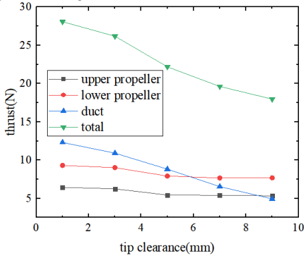
Abstract Ducted fan UAVs are a global research hotspot. This study designs a counter-rotating ducted propeller UAV and performs CFD numerical simulation with the sliding mesh technique to investigate its aerodynamic characteristics in hovering mode. The influences of tip clearance and propeller disk spacing are analyzed. Results show that the thrust of all components decreases with increasing tip clearance, with duct thrust exhibiting the most significant linear decline; propeller thrust first increases and then decreases, peaking at 40 mm spacing. A 40 mm spacing eliminates junction small vortices, achieving an optimal balance. Tip clearance has the most notable impact on hover thrust. The study recommends minimizing tip clearance with appropriate spacing to enhance aerodynamic efficiency and flow stability, providing theoretical support for related research.
Overview
CoChat Summary
TL;DR
This CFD study designs a counter-rotating ducted propeller UAV and analyzes its hovering aerodynamics, focusing on tip clearance and propeller disk spacing. It finds that minimizing tip clearance and using a 40 mm disk spacing best balance thrust and flow stability.
Key findings
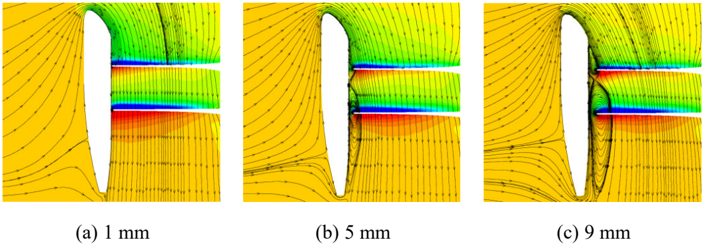
- Increasing tip clearance from 1 to 9 mm reduces thrust of all components; duct thrust shows the most significant approximately linear decline and dominates total thrust variation. Upper/lower propeller thrust decreases at an average rate of 8% for 1–5 mm clearance, then falls below 1% for 5–9 mm.
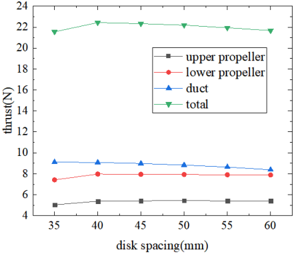
- Propeller thrust first increases and then decreases with disk spacing, peaking at 40 mm. For 40–60 mm spacing, duct thrust decreases approximately linearly at about 3%, dominating total thrust change; total thrust rises from 35 to 40 mm and decreases from 40 to 60 mm.
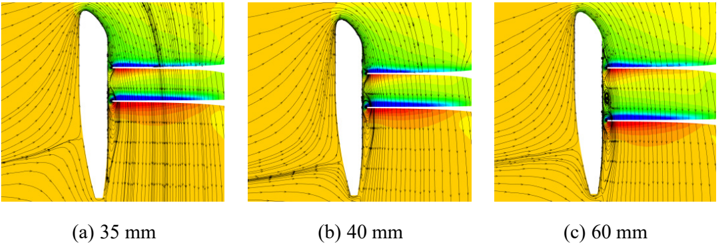
- At 40 mm disk spacing, small vortices at the tip-vortex junction are eliminated, achieving the optimal balance between flow-field stability and thrust performance. The lower propeller produces greater thrust than the upper propeller because it receives “secondary flow” accelerated by the upper propeller.
- The baseline design has a 5 mm tip clearance, 3500 rpm, 50 mm propeller disk spacing, and generates 2.2 kg thrust hovering at 0 km altitude. The study recommends minimizing tip clearance when conditions permit and matching it with an appropriate disk spacing.
Methods
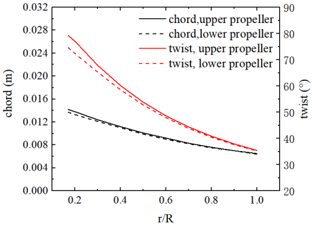
- The paper designs a counter-rotating ducted propeller UAV using Clark-Y blade airfoils, 4 blades each for upper/lower propellers, a design speed of 3500 rpm, 5 mm tip clearance, and 50 mm center distance between propeller disks.
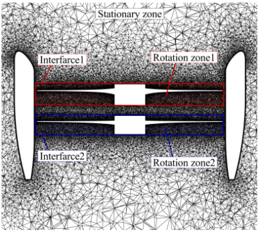
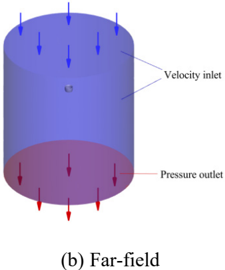
- CFD numerical simulation uses the sliding mesh technique, with the propeller-swept space as a rotating domain and the outer region as a stationary domain. The far-field is cylindrical with radius 20 times the propeller diameter and height 25 times the propeller diameter; total computational volume meshes are approximately 9.6 million. The Spalart-Allmaras turbulence model is selected.
- The study uses a single-factor variable method to analyze hovering mode at 0 km altitude, varying tip clearance from 1 to 9 mm and propeller disk spacing from 35 to 60 mm, with thrust curves, streamlines, and pressure coefficient contour maps.
Limitations
- The paper does not state explicit limitations.
- Evident from the text: the study is purely CFD-based with no experimental validation reported, uses a single-factor variable method that may not capture interactions between tip clearance and disk spacing, and analyzes only hovering mode at 0 km altitude for one specific counter-rotating ducted UAV geometry.
Model-written summary. Check it against the paper before relying on it.
Integrity signals
Registry
Cites
Statistics
Figures
Verification
Claims the paper makes
0 Valid · 0 Not valid · 0 Not checked · 40 Own results and interpretations
A result the paper states — it cites no source for it, so there is none to check. The quote shows it is in the paper.
In the paper
“When the tip clearance increases from 3 mm to 5 mm, the scale of the tip vortices changes most notably.”
plainstates a cause- Asserted: passes — The authors put it forward as true.
- Checkable: passes — It can be checked against evidence.
- Load-bearing: unclear — It is unclear whether the paper’s conclusions depend on it.
- Based: passes — The paper gives a reason why it holds.
- Rests on an assumption not shown here.
A result the paper states — it cites no source for it, so there is none to check. The quote shows it is in the paper.
In the paper
“With the increase in tip clearance, the propeller's inducing effect on the incoming flow at the duct inlet gradually weakens.”
plainstates a cause- Asserted: passes — The authors put it forward as true.
- Checkable: passes — It can be checked against evidence.
- Load-bearing: passes — The paper’s conclusions depend on it.
- Based: passes — The paper gives a reason why it holds.
- Rests on an assumption not shown here.
A result the paper reports from its own data — it cites no other source for it, so there is none to check. The quote shows it is in the paper.
In the paper
“Among them, the variation amplitudes of the thrust of the upper and lower propellers with changes in tip clearance are basically consistent.”
plain- Asserted: passes — The authors put it forward as true.
- Checkable: passes — It can be checked against evidence.
- Load-bearing: unclear — It is unclear whether the paper’s conclusions depend on it.
- Based: passes — The paper gives a reason why it holds.
- Rests on an assumption not shown here.
A result the paper reports from its own data — it cites no other source for it, so there is none to check. The quote shows it is in the paper.
In the paper
“Among all aerodynamic components, the impact of propeller disk spacing on duct thrust is the most significant.”
plainstates a cause- Asserted: passes — The authors put it forward as true.
- Checkable: passes — It can be checked against evidence.
- Load-bearing: passes — The paper’s conclusions depend on it.
- Based: passes — The paper gives a reason why it holds.
- Rests on an assumption not shown here.
A result the paper reports from its own data — it cites no other source for it, so there is none to check. The quote shows it is in the paper.
In the paper
“under the baseline condition of 50 mm propeller disk spacing, the tip vortices of the upper and lower propellers are very close in spatial position.”
plainstates an association- Asserted: passes — The authors put it forward as true.
- Checkable: passes — It can be checked against evidence.
- Load-bearing: passes — The paper’s conclusions depend on it.
- Based: passes — The paper gives a reason why it holds.
- Rests on an assumption not shown here.
19 more claims
Create a free account to see all 40 claims and every source verdict.
- It may state two separate claims as one. 14
- The quote only partly states this claim. 1
- Probably not a substantial claim. 1
Citations
Cites
Yılmaz, S., Erdem, D., & Kavsaoğlu, M. Ş. (2015) · Aerospace Science and Technology · doi:10.1016/j.ast.2015.06.005 · Cited by 74
An innovative variable shroud for micro wind turbines
Siavash, N. K., Najafi, G., Hashjin, T. T., et al. (2019) · Renewable Energy · doi:10.1016/j.renene.2019.06.098 · Cited by 48
A numerical study of noise characteristics originating from a shrouded subsonic automotive fan
Rynell, A., Chevalier, M., Åbom, M., et al. (2018) · Applied Acoustics · doi:10.1016/j.apacoust.2018.05.006 · Cited by 26 · cited 1×
“…simulation and wind tunnel experimental methods, and revealed the phenomenon and inherent mechanism of flow separation at the duct lip; Rynell [3] et al. adopted an improved detached eddy simulation (DES) method to explore the aerodynamic and acoustic characteristics of ducted fan systems at…”
Aerodynamic Analysis of the Ducted Fan for a VTOL UAV in Crosswinds
Ryu, M., 조이상, & Cho, J. (2016) · TRANSACTIONS OF THE JAPAN SOCIETY FOR AERONAUTICAL AND SPACE SCIENCES · doi:10.2322/tjsass.59.47 · Cited by 24
Numerical study on dynamic performance of a ducted fan moving in proximity to ground and ceiling
Luo, Y., He, Y., Ai, T., et al. (2024) · Physics of Fluids · doi:10.1063/5.0240144 · Cited by 12
Deng, S., & Ren, Z. (2017) · Proceedings of the Institution of Mechanical Engineers Part G Journal of Aerospace Engineering · doi:10.1177/0954410017731441 · Cited by 7
Impact analysis of design parameters and flow mechanism of ducted fan
Liu, Y., & Li, W. (2024) · Journal of Physics Conference Series · doi:10.1088/1742-6596/2820/1/012007 · Cited by 1
Computational Fluid Dynamics Simulation Of Propeller Fan
Pradeep Shetty*, T. P. W. (2016) · Zenodo (CERN European Organization for Nuclear Research) · doi:10.5281/zenodo.160899 · Cited by 1
Research works printed but not linked: 2
- [7] Zeng P N, Wei W, and Shi S G (2024) Simulation Study on Aerodynamic Characteristics of 350 kW Ducted-Fan. Journal of Engineering for Thermal Energy & Power / Reneng Dongli Gongcheng, 39(9).
- [9] Zhang X Z, Xiao H J, Liu X L, Xing K R, and Lu Xiang. (2025). Design and Realization of a Ducted Fan Water-air Amphibious UAV. Acta Armamentarii, 46(1).
Metadata
- Authors
- Wu, H., & Cai, H.
- Affiliations
- Nanjing University of Aeronautics and Astronautics (CN)
- Venue
- Journal of Physics: Conference Series
- Publisher
- IOP Publishing
- Published
- 2026-06-01
- Volume
- 3256
- Issue
- 1
- Pages
- 012057
- ISSN
- 1742-6588 (ISSN-L)
- 1742-6596
- OpenAlex
- W7164161309
- Cited by
- 0
- References
- 8
- FWCI
- 0.00
- Type
- conference paper
- Language
- en
- Open access
- diamond
- doi.org
- Licence
- cc-by
- creativecommons.org/licenses/by/4.0/ (vor)
- iopscience.iop.org/info/page/text-and-data-mining (tdm)
- Locations
- Journal of Physics Conference Series (publishedVersion, cc-by)
- Topics
- Physical Sciences › Engineering › Aerospace Engineering › Aerospace and Aviation Technology
- Physical Sciences › Engineering › Computational Mechanics › Computational Fluid Dynamics and Aerodynamics
- Physical Sciences › Engineering › Aerospace Engineering › Turbomachinery Performance and Optimization
- Keywords
- unmanned aerial vehicles, hovering flight, propeller thrust, tip clearance, aerodynamic efficiency, sliding mesh
About these checks
Registry, retraction, Cites and statistics results are computed, not judged, with one exception: a printed reference that no index lists is read once by a model before it counts as a citation error. Claims are extracted by a model and kept only when their quote appears verbatim in the text; each cited source is then checked, with a model’s help, for whether it says what the claim relies on. Those verdicts can be wrong — read the claim’s quote and the cited source before relying on one.
A language model drew the claims from the paper on 2026-10-10, under version 3 of the claim definition (model deepseek-v4.1-flash, prompt extract-v3).
A second model labelled each claim on 2026-10-10 (model jev-1.13-20260917, definition revision gold-guideline-v0.2).
Statistics and arithmetic are recomputed, not judged.
Confidence bands are shown only for fields calibrated on our annotated test set. None is calibrated yet, so no band is shown.
What counts as a claim ›How we measure confidence ›How we check this ›
Are you an author, or do you see a problem with this page? Request a review
How to cite
Cite CoChat for the checks on this page, and the paper for its own findings.
- This page
- CoChat. (2026). Citation check: Analysis of aerodynamic characteristics of counter-rotating ducted UAV in hovering mode. https://app.cochat.ai/papers/10.1088/1742-6596/3256/1/012057
- The paper
- Wu, H., & Cai, H. (2026). Analysis of aerodynamic characteristics of counter-rotating ducted UAV in hovering mode. Journal of Physics: Conference Series. https://doi.org/10.1088/1742-6596/3256/1/012057
Data sources
Bibliographic data: Semantic Scholar, OpenAlex, Crossref.
Contains information from the Semantic Scholar Academic Graph Datasets, made available under the ODC Attribution License (ODC-BY 1.0).
Semantic Scholar’s data is described in: Kinney, R., et al. (2023). The Semantic Scholar Open Data Platform. arXiv:2301.10140.
