

High Arctic plant phenology is determined by snowmelt patterns but duration of phenological periods is fixed: an example of periodicity
Open accessThe DOI matches its Crossref record; 54 of the 54 references it cites were found in a registry or an index.
Abstract
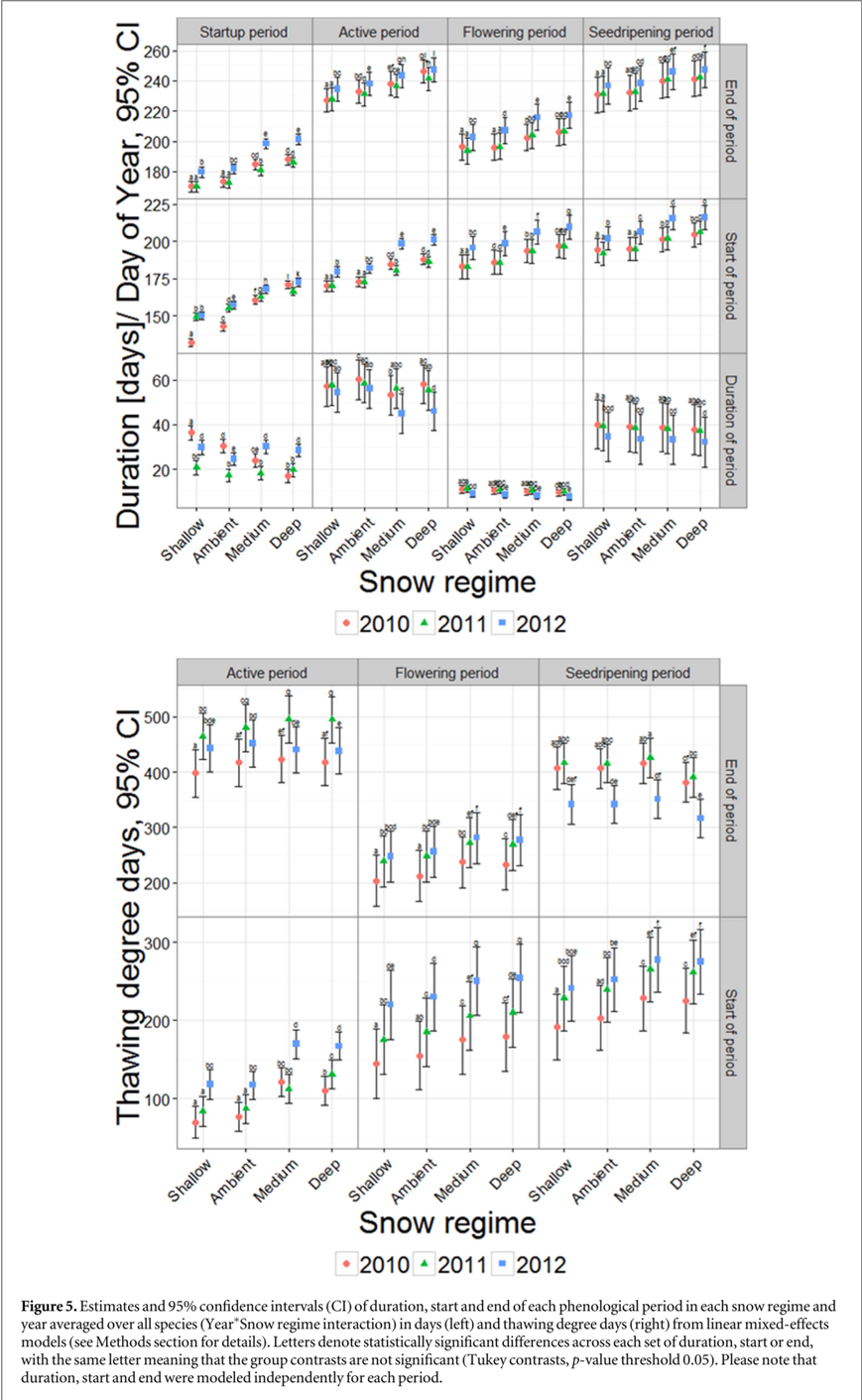
The duration of specific periods within a plant's life cycle are critical for plant growth and performance.In the High Arctic, the start of many of these phenological periods is determined by snowmelt date, which may change in a changing climate.It has been suggested that the end of these periods during late-season are triggered by external cues, such as day length, light quality or temperature, leading to the hypothesis that earlier or later snowmelt dates will lengthen or shorten the duration of these periods, respectively, and thereby affect plant performance.We tested whether snowmelt date controls phenology and phenological period duration in High Arctic Svalbard using a melt timing gradient from natural and experimentally altered snow depths.We investigated the response of early-and late-season phenophases from both vegetative and reproductive phenological periods of eight common species.We found that all phenophases follow snowmelt patterns, irrespective of timing of occurrence, vegetative or reproductive nature.Three of four phenological period durations based on these phenophases were fixed for most species, defining the studied species as periodic.Periodicity can thus be considered an evolutionary trait leading to disadvantages compared with aperiodic species and we conclude that the mesic and heath vegetation types in Svalbard are at risk of being outcompeted by invading, aperiodic species from milder biomes.
Overview
The claims and statistics of this paper haven’t been checked yet.
Free: it reads the open-access text and checks the first 5 claims that cite a source we can check. Create a free account to check every claim.
Integrity signals
Registry
Cites
Statistics
Figures





Verification
Claims the paper makes
The claims and statistics of this paper haven’t been checked yet.
Free: it reads the open-access text and checks the first 5 claims that cite a source we can check. Create a free account to check every claim.
Self-check
Percentages, sums and reported differences re-computed from the paper’s own numbers.
The self-check needs the paper’s full text.
Citations
Cites
R: A Language and Environment for Statistical Computing
R Core Team (2025) · doi:10.32614/r.manuals · Cited by 352,181
Fitting Linear Mixed-Effects Models Using lme4
Bates, D., Mächler, M., Bolker, B., & Walker, S. (2015) · Journal of Statistical Software · doi:10.18637/jss.v067.i01 · Cited by 86,835
Simultaneous Inference in General Parametric Models
Hothorn, T., Bretz, F., & Westfall, P. (2008) · Biometrical Journal · doi:10.1002/bimj.200810425 · Cited by 13,847
A globally coherent fingerprint of climate change impacts across natural systems
Parmesan, C., & Yohe, G. (2003) · Nature · doi:10.1038/nature01286 · Cited by 11,265 · cited 1×
“Recent climate change has led to considerable temporal shifts of both the start and end of the growing-season and has been accompanied by phenological responses across tundra and other ecosystems (Parmesan and Yohe 2003, Menzel et al 2006, Oberbauer et al 2013).”
BackgroundLeast-Squares Means: The R Package lsmeans
Lenth, R. V. (2016) · Journal of Statistical Software · doi:10.18637/jss.v069.i01 · Cited by 5,075
Increased plant growth in the northern high latitudes from 1981 to 1991
Myneni, R. B., Keeling, C. D., Tucker, C. J., Asrar, G., & Nemani, R. R. (1997) · Nature · doi:10.1038/386698a0 · Cited by 3,442
European phenological response to climate change matches the warming pattern
MENZEL, A., SPARKS, T. H., ESTRELLA, N., KOCH, E., AASA, A., AHAS, R., ALM‐KÜBLER, K., BISSOLLI, P., BRASLAVSKÁ, O., BRIEDE, A., et al. (2006) · Global Change Biology · doi:10.1111/j.1365-2486.2006.01193.x · Cited by 3,143
Continent-wide response of mountain vegetation to climate change
Gottfried, M., Pauli, H., Futschik, A., Akhalkatsi, M., Barančok, P., Benito Alonso, J. L., Coldea, G., Dick, J., Erschbamer, B., Fernández Calzado, M. R., et al. (2012) · Nature Climate Change · doi:10.1038/nclimate1329 · Cited by 1,262
Arft, A. M., Walker, M. D., Gurevitch, J., Alatalo, J. M., Bret-Harte, M. S., Dale, M., Diemer, M., Gugerli, F., Henry, G. H. R., Jones, M. H., et al. (1999) · Ecological Monographs · doi:10.1890/0012-9615(1999)069[0491:rotpte]2.0.co;2 · Cited by 791
Research works printed but not linked: 1
- Sørensen T J, 1941, Temperature Relations and Phenology of the Northeast Greenland Flowering Plants, 125
Cited by
Items 101–120 of 120
Inouye, D. W., & Wielgolaski, F. E. (2024) · Springer eBooks · doi:10.1007/978-3-031-75027-4_12
Henn, J. J., Bardsley, K., de Mesquita, C. P. B., Elmendorf, S. C., Emery, N. C., Farrer, E. C., Forrester, C. C., Smith, J. G., Spasojevic, M. J., Morse, J. F., et al. (2026) · Global Change Biology · doi:10.1111/gcb.71068
Arctic greening amplifies summer cyclone intensity over northern Eurasia
Qin, Y.-J., Yang, S., Kong, Y., & Lu, C. (2025) · Climate Dynamics · doi:10.1007/s00382-025-07994-0
Bangash, S. A. K. (2026) · IGI Global eBooks · doi:10.4018/979-8-2600-1207-9.ch012
Terrestrial Arthropod Responses to Arctic Cryosphere Degradation
Gillespie, M. A. K., & Høye, T. T. (2026) · Global Change Biology · doi:10.1111/gcb.71062
Self-citationEffects of Experimentally-Induced Climatic Changes on Plants, Pollinators, and Their Interactions
Rose‐Person, A. (2023) · eScholarship (California Digital Library)
Plant community responses to long-term experimental warming in a High Arctic tundra ecosystem
Rammell, N. (2024) · cIRcle (University of British Columbia) · doi:10.14288/1.0447415
Jørgensen, A., Semenchuk, P. R., Karlsen, S. R., Nilsen, L., Stien, A., & Cooper, E. (2026) · Arctic Science · doi:10.1139/as-2026-0007
Self-citationEcological Interactions in a Changing World
Sethi, M. L. (2021) · ResearchWorks at the University of Washington (University of Washington)
Sarma, P., & Devi, A. (2025) · Plant Ecology · doi:10.1007/s11258-025-01503-3
Hendricks, W. Q., & Mulder, C. P. H. (2025) · Botany · doi:10.1139/cjb-2025-0051
Hendricks, W. Q. (2024) · ScholarWorks - UA (University of Alaska System)
Käärmelahti, S. A. (2018) · UEF eRepo (University of Eastern Finland)
Shrubs Effects on Soil Temperatures, Snow Depth, and Vegetation Greenness in Arctic-alpine Tundra
Bäckman, A. (2024) · Epsilon Archive for Student Projects (Swedish University of Agricultural Sciences)
Sease, I. (2025) · CU Scholar (University of Colorado Boulder)
Global Change Impacts on Plant and Carbon Dynamics in Montane Meadows
Vought, O. K. (2025) · Deep Blue (University of Michigan) · doi:10.7302/28135
Ma, L., Gao, J., Zhang, C. H. I., Feng, J., Xue, J., & Zhang, Y. (2026) · Plant Cell & Environment · doi:10.1111/pce.70738
Seasonal transition in snow effects on vegetation growth across the Tibetan Plateau
Meng, Z., Wu, X., Huang, Y., Guo, R., Wang, X. H., Song, W., & Zhang, Z. (2026) · Frontiers in Plant Science · doi:10.3389/fpls.2026.1855382
The opposing effects of shortened days and cooling temperatures on tundra plant senescence
Bonner, C., Schon, C. E., Kiley, B. M. E., & MacDougall, A. H. (2026) · Botany · doi:10.1139/cjb-2026-0002
Weakened association between sequential phenological events corresponds to interphase extension
Zhang, Y., Gao, M., Zhang, Y., Peñuelas, J., Fu, Y. H., Wu, C., Xia, J., Hong, S., & Piao, S. L. (2026) · Nature Communications · doi:10.1038/s41467-026-79161-w
Metadata
- Authors
- Semenchuk, P. R., Gillespie, M. A. K., Rumpf, S. B., Baggesen, N., Elberling, B., & Cooper, E. J.
- Affiliations
- UiT The Arctic University of Norway (NO)
- Høgskulen i Sogn og Fjordane (NO)
- University of Vienna (AT)
- University of Copenhagen (DK)
- Corresponding author
- Semenchuk, Philipp R
- ORCID
- Venue
- Environmental Research Letters
- Publisher
- IOP Publishing
- Published
- 2016-11-29
- Volume
- 11
- Issue
- 12
- Pages
- 125006
- ISSN
- 1748-9326 (ISSN-L)
- OpenAlex
- W2558017913
- Semantic Scholar
- fe04024302c45ca5a0f73d1e2f309f9e28f9b8db
- Cited by
- 101
- References
- 54
- Citations by year
- 2026: 5 · 2025: 13 · 2024: 11 · 2023: 9 · 2022: 10 · 2021: 26 · 2020: 10 · 2019: 7 · 2018: 6 · 2017: 3 · 2016: 1
- FWCI
- 3.45
- Type
- journal article
- Language
- en
- Open access
- gold
- doi.org
- Licence
- cc-by
- iopscience.iop.org/info/page/text-and-data-mining (tdm)
- creativecommons.org/licenses/by/3.0/ (vor)
- Locations
- Environmental Research Letters (publishedVersion, cc-by)
- Research at the University of Copenhagen (University of Copenhagen) (publishedVersion, other-oa)
- Phaidra (Universität Wien) (submittedVersion, cc-by-nc-nd)
- DOAJ (DOAJ: Directory of Open Access Journals) (submittedVersion)
- edoc (University of Basel) (submittedVersion)
- NORA - Norwegian Open Research Archives (submittedVersion, cc-by)
- NORA - Norwegian Open Research Archives (submittedVersion, other-oa)
- Funders
- Norwegian Research Council (230970)
- Topics
- Physical Sciences › Earth and Planetary Sciences › Atmospheric Science › Climate change and permafrost
- Physical Sciences › Environmental Science › Nature and Landscape Conservation › Ecology and Vegetation Dynamics Studies
- Life Sciences › Agricultural and Biological Sciences › Plant Science › Botany and Plant Ecology Studies
- Keywords
- plant phenology, snowmelt timing, high Arctic, Svalbard, phenological stages, climate change, plant competition, heath vegetation
About these checks
Registry, retraction, Cites and statistics results are computed, not judged, with one exception: a printed reference that no index lists is read once by a model before it counts as a citation error. Claims are extracted by a model and kept only when their quote appears verbatim in the text; each cited source is then checked, with a model’s help, for whether it says what the claim relies on. Those verdicts can be wrong — read the claim’s quote and the cited source before relying on one.
Statistics and arithmetic are recomputed, not judged.
Confidence bands are shown only for fields calibrated on our annotated test set. None is calibrated yet, so no band is shown.
What counts as a claim ›How we measure confidence ›How we check this ›
Are you an author, or do you see a problem with this page? Request a review
Data sources
Bibliographic data: Semantic Scholar, OpenAlex, Crossref.
Contains information from the Semantic Scholar Academic Graph Datasets, made available under the ODC Attribution License (ODC-BY 1.0).
Semantic Scholar’s data is described in: Kinney, R., et al. (2023). The Semantic Scholar Open Data Platform. arXiv:2301.10140.
