

Greater stability of carbon capture in species-rich natural forests compared to species-poor plantations
Open accessThe DOI matches its Crossref record; 45 of the 48 references it cites were found in a registry or an index.
Abstract
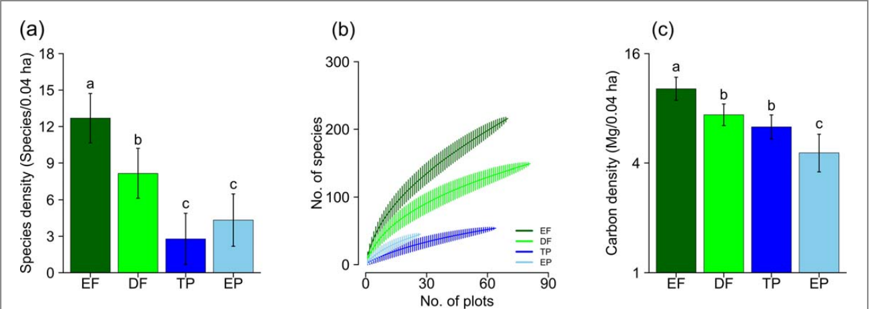
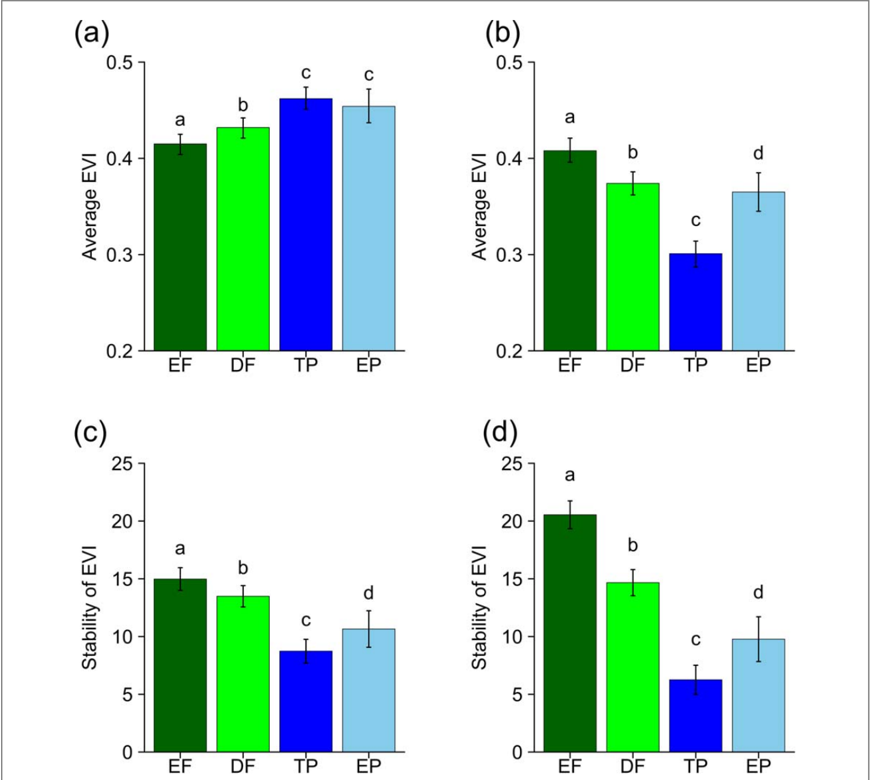
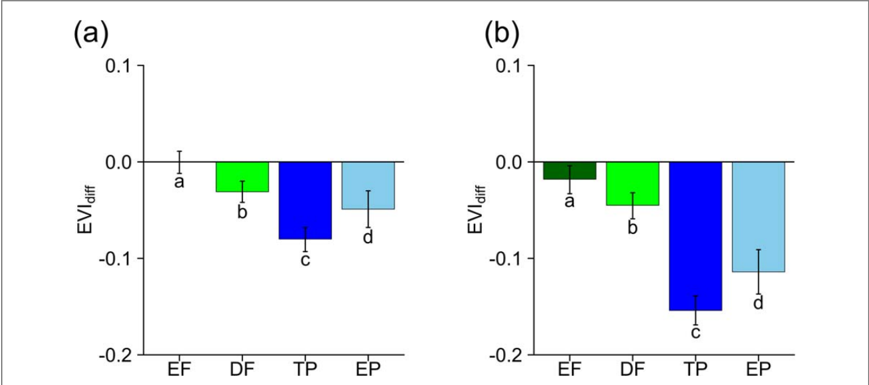
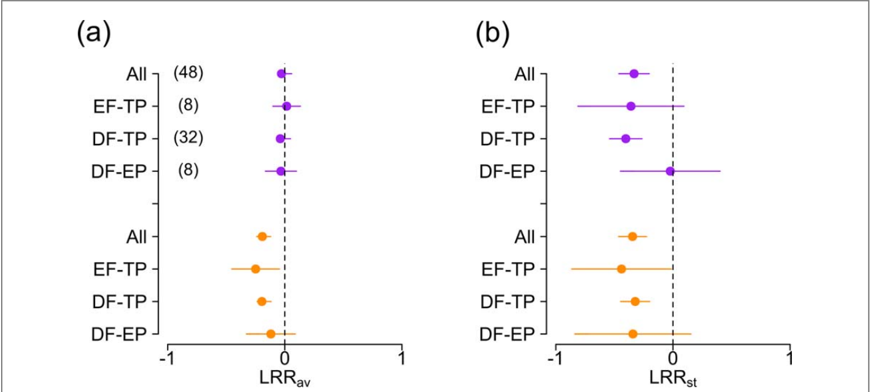
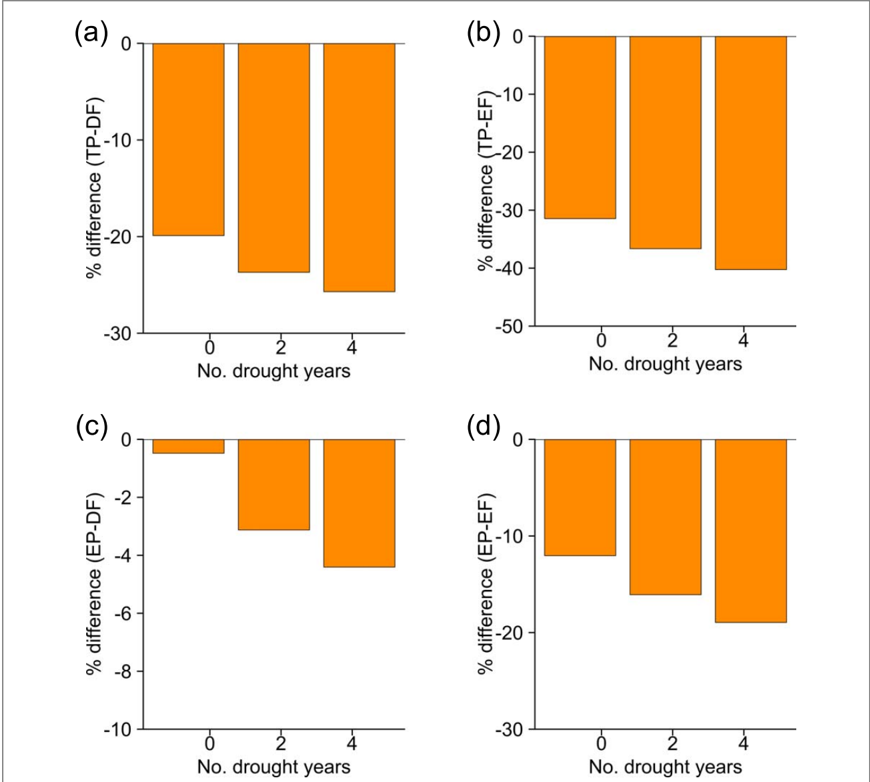
Tree plantations and forest restoration are leading strategies for enhancing terrestrial carbon (C) sequestration and mitigating climate change. While it is well established that species-rich natural forests offer superior C sequestering benefits relative to short-rotation commercial monoculture plantations, differences in rates of C capture and storage between longer-lived plantations (commercial or non-commercial) and natural forests remain unclear. Using a natural experiment in the Western Ghats of India, where late-20th century conservation laws prohibited timber extraction from monodominant plantations and natural forests within nature reserves, we assessed forests and plantations for aboveground C storage and the magnitude and temporal stability of rates of photosynthetic C capture (gross primary production). Specifically, we tested the hypothesis that species-rich forests show greater temporal stability of C capture, and are more resistant to drought, than monodominant plantations. Carbon stocks in monodominant teak (Tectona grandis) and Eucalyptus (Eucalyptus spp.) plantations were 30%–50% lower than in natural evergreen forests, but differed little from moist-deciduous forests. Plantations had 4%–9% higher average C capture rates (estimated using the Enhanced Vegetation Index–EVI) than natural forests during wet seasons, but up to 29% lower C capture during dry seasons across the 2000–18 period. In both seasons, the rate of C capture by plantations was less stable across years, and decreased more during drought years (i.e. lower resistance to drought), compared to forests. Thus, even as certain monodominant plantations could match natural forests for C capture and storage potential, plantations are unlikely to match the stability–and hence reliability–of C capture exhibited by forests, particularly in the face of increasing droughts and other climatic perturbations. Promoting natural forest regeneration and/or multi-species native tree plantations instead of plantation monocultures could therefore benefit climate change mitigation efforts, while offering valuable co-benefits for biodiversity conservation and other ecosystem services.
Overview
The claims and statistics of this paper haven’t been checked yet.
Free: it reads the open-access text and checks the first 5 claims that cite a source we can check. Create a free account to check every claim.
Integrity signals
Registry
Cites
Statistics
Figures





Verification
Claims the paper makes
The claims and statistics of this paper haven’t been checked yet.
Free: it reads the open-access text and checks the first 5 claims that cite a source we can check. Create a free account to check every claim.
Claims other papers make about this one
Each is checked against this paper’s own text: does it say what the citing paper says it does?
The source backs part of the claim, not all of it — or backs it for a different population, condition or comparison.
In the citing paper
“Multispecies plantations could provide more stable carbon capture in some tropical and temperate regions, and offer additional cobenefits for ecosystem services (25, 31, 62), which should be considered in future LCA when the challenges above can be tackled.”
From Climate-smart forestry through innovative wood products and commercial afforestation and reforestation on marginal land (2023) · cites this paper as [31]
Experimental — accuracy not yet measuredThe cited source says what the claim attributes to it.
In the citing paper
“GHG mitigation efficacy of AR depends on regional contexts, such as local climate conditions (18, 26), forest plantation management strategies (3, 19, 27–30), tree species (28, 31), and wood product types and their life cycle activities [e.g., manufacturing processes, use phase, substitution benefits, and end of life (EOL)] (18, 19, 29, 30).”
From Climate-smart forestry through innovative wood products and commercial afforestation and reforestation on marginal land (2023) · cites this paper as [31]
Self-check
Percentages, sums and reported differences re-computed from the paper’s own numbers.
The self-check needs the paper’s full text.
Citations
Cites
R: A Language and Environment for Statistical Computing
R Core Team (2025) · doi:10.32614/r.manuals · Cited by 352,181
Google Earth Engine: Planetary-scale geospatial analysis for everyone
Gorelick, N., Hancher, M., Dixon, M., Ilyushchenko, S., Thau, D., & Moore, R. (2017) · Remote Sensing of Environment · doi:10.1016/j.rse.2017.06.031 · Cited by 14,719
Overview of the radiometric and biophysical performance of the MODIS vegetation indices
Huete, A., Didan, K., Miura, T., Rodriguez, E. P., Gao, X., & Ferreira, L. G. (2002) · Remote Sensing of Environment · doi:10.1016/s0034-4257(02)00096-2 · Cited by 9,869
A large and persistent carbon sink in the world’s forests
Pan, Y., Birdsey, R. A., Fang, J., Houghton, R., Kauppi, P. E., Kurz, W. A., Phillips, O. L., Shvidenko, A., Lewis, S. L., Canadell, J. G., et al. (2011) · Science · doi:10.1126/science.1201609 · Cited by 8,458
EFFECTS OF BIODIVERSITY ON ECOSYSTEM FUNCTIONING: A CONSENSUS OF CURRENT KNOWLEDGE
Hooper, D. U., Chapin, F. S., Ewel, J. J., Hector, A., Inchausti, P., Lavorel, S., Lawton, J. H., Lodge, D. M., Loreau, M., Naeem, S., et al. (2005) · Ecological Monographs · doi:10.1890/04-0922 · Cited by 8,046
Self-citationBiodiversity loss and its impact on humanity
Cardinale, B. J., Duffy, J. E., Gonzalez, A., Hooper, D. U., Perrings, C., Venail, P., Narwani, A., Mace, G. M., Tilman, D., Wardle, D. A., et al. (2012) · Nature · doi:10.1038/nature11148 · Cited by 7,457
Self-citationChanges in the global value of ecosystem services
Costanza, R., de Groot, R., Sutton, P., van der Ploeg, S., Anderson, S. J., Kubiszewski, I., Farber, S., & Turner, R. K. (2014) · Global Environmental Change · doi:10.1016/j.gloenvcha.2014.04.002 · Cited by 6,322
Increasing drought under global warming in observations and models
Dai, A. (2013) · Nature Climate Change · doi:10.1038/nclimate1633 · Cited by 4,762
Griscom, B. W., Adams, J., Ellis, P. W., Houghton, R. A., Lomax, G., Miteva, D. A., Schlesinger, W. H., Shoch, D., Siikamäki, J. V., Smith, P., et al. (2017) · Proceedings of the National Academy of Sciences · doi:10.1073/pnas.1710465114 · Cited by 3,481
Biodiversity and ecosystem productivity in a fluctuating environment: The insurance hypothesis
Yachi, S., & Loreau, M. (1999) · Proceedings of the National Academy of Sciences · doi:10.1073/pnas.96.4.1463 · Cited by 3,211
Research works printed but not linked: 2
- Chandran M S 1997 On the ecological history of the Western Ghats Curr. Sci. 73 146-55
- Krishen P 2014 Jungle Trees of Central India: A Field Guide for Tree Spotters (India: Penguin)
Cited by
Getting the message right on nature‐based solutions to climate change
Seddon, N., Smith, A., Smith, P., Key, I., Chausson, A., Girardin, C., House, J., Srivastava, S., & Turner, B. (2021) · Global Change Biology · doi:10.1111/gcb.15513 · Cited by 1,073
“For example, natural forests and mixed species forest plantations have more stable carbon stores during climate extremes compared to species-poor plantations (Hutchison et al., 2018; Osuri et al., 2020), as do high diversity grassland plots com - pared to low diversity plots (Isbell et al., 2017).”
The biodiversity and ecosystem service contributions and trade-offs of forest restoration approaches
Hua, F., Bruijnzeel, L. A., Meli, P., Martin, P. A., Zhang, J., Nakagawa, S., Miao, X., Wang, W., McEvoy, C., Peña-Arancibia, J. L., et al. (2022) · Science · doi:10.1126/science.abl4649 · Cited by 831
Mapping the effectiveness of nature‐based solutions for climate change adaptation
Chausson, A., Turner, B., Seddon, D., Chabaneix, N., Girardin, C. A. J., Kapos, V., Key, I., Roe, D., Smith, A., Woroniecki, S., et al. (2020) · Global Change Biology · doi:10.1111/gcb.15310 · Cited by 707
“Speciespoor tree plantations, in contrast, have impoverished biodiversity and hold less resilient carbon stocks than natural/semi-natural forests (Osuri et al., 2020).”
BackgroundProtecting irrecoverable carbon in Earth’s ecosystems
Goldstein, A., Turner, W. R., Spawn, S. A., Anderson-Teixeira, K. J., Cook-Patton, S., Fargione, J., Gibbs, H. K., Griscom, B., Hewson, J. H., Howard, J. F., et al. (2020) · Nature Climate Change · doi:10.1038/s41558-020-0738-8 · Cited by 298
Self-citationGlobal recognition of the importance of nature-based solutions to the impacts of climate change
Seddon, N., Daniels, E., Davis, R., Chausson, A., Harris, R., Hou-Jones, X., Huq, S., Kapos, V., Mace, G. M., Rizvi, A. R., et al. (2020) · Global Sustainability · doi:10.1017/sus.2020.8 · Cited by 262
“, 2017), store more carbon (Maxwell et al., 2019; Osuri et al., 2020) and offer greater protection to people from climate change impacts (Martin & Watson, 2016; Watson et al.”
Interconnecting global threats: climate change, biodiversity loss, and infectious diseases
Pfenning-Butterworth, A., Buckley, L. B., Drake, J. M., Farner, J. E., Farrell, M. J., Gehman, A.-L. M., Mordecai, E. A., Stephens, P. R., Gittleman, J. L., & Davies, T. J. (2024) · The Lancet Planetary Health · doi:10.1016/s2542-5196(24)00021-4 · Cited by 185
“For instance, more diverse and speciesrich natural forests and grasslands have higher carbon sequestering potential (figure 2), 66 reflecting the general positive biodiversity–productivity relationship.”
Forests and Decarbonization – Roles of Natural and Planted Forests
Waring, B., Neumann, M., Prentice, I. C., Adams, M., Smith, P., & Siegert, M. (2020) · Frontiers in Forests and Global Change · doi:10.3389/ffgc.2020.00058 · Cited by 159
Rates and drivers of aboveground carbon accumulation in global monoculture plantation forests
Bukoski, J. J., Cook‐Patton, S. C., Melikov, C., Ban, H., Chen, J. L., Goldman, E. D., Harris, N. L., & Potts, M. D. (2022) · Nature Communications · doi:10.1038/s41467-022-31380-7 · Cited by 166
Self-citationBotanic garden solutions to the plant extinction crisis
Westwood, M., Cavender, N. D., Meyer, A., & Smith, P. P. (2020) · Plants People Planet · doi:10.1002/ppp3.10134 · Cited by 147
“Furthermore, it has been shown that forests with high biodiversity have higher productivity (Liang et al., 2016; Osuri et al., 2020).”
BackgroundIncreasing and widespread vulnerability of intact tropical rainforests to repeated droughts
Tao, S., Chave, J., Frison, P., Toan, T. L., Ciais, P., Fang, J., Wigneron, J., Santoro, M., Yang, H., Li, X., et al. (2022) · Proceedings of the National Academy of Sciences · doi:10.1073/pnas.2116626119 · Cited by 118
“, those not affected by direct anthropogenic deforestation) increasingly valuable (3).”
BackgroundKey, I., Smith, A. C., Turner, B., Chausson, A., Girardin, C. A. J., Macgillivray, M., & Seddon, N. (2022) · Frontiers in Environmental Science · doi:10.3389/fenvs.2022.905767 · Cited by 134
Wang, L., Wei, F., Tagesson, T., Fang, Z., & Svenning, J. (2025) · One Earth · doi:10.1016/j.oneear.2025.101195 · Cited by 126
Young mixed planted forests store more carbon than monocultures—a meta-analysis
Warner, E. A., Cook‐Patton, S. C., Lewis, O. T., Brown, N., Koricheva, J., Eisenhauer, N., Ferlian, O., Gravel, D., Hall, J. S., Jactel, H., et al. (2023) · Frontiers in Forests and Global Change · doi:10.3389/ffgc.2023.1226514 · Cited by 122
“Moreover, the benefits of diversification may become more apparent over the longer term and under future climate conditions, since mixed plantations may be more likely to maintain productivity even under perturbation (Osuri et al., 2020).”
Self-citationDefining biodiverse reforestation: Why it matters for climate change mitigation and biodiversity
Andres, S. E., Standish, R. J., Lieurance, P. E., Mills, C. H., Harper, R. J., Butler, D. W., Adams, V. M., Lehmann, C. E. R., Tetu, S. G., Cuneo, P., et al. (2022) · Plants People Planet · doi:10.1002/ppp3.10329 · Cited by 70
Global Natural and Planted Forests Mapping at Fine Spatial Resolution of 30 m
Xiao, Y., Wang, Q., & Zhang, H. K. (2024) · Journal of Remote Sensing · doi:10.34133/remotesensing.0204 · Cited by 62
Hailu, T. F., Assefa, E., & Zeleke, T. (2024) · Frontiers in Environmental Science · doi:10.3389/fenvs.2024.1454556 · Cited by 59
A taxonomy to map evidence on the co-benefits, challenges, and limits of carbon dioxide removal
Prütz, R., Fuss, S., Lück, S., Stephan, L., & Rogelj, J. (2024) · Communications Earth & Environment · doi:10.1038/s43247-024-01365-z · Cited by 54
“Bothaggregatedandhighlyspeci fi ccasesofbiodiversityimpactsof CDR were found 28,39,68,69 .”
Zhang, X., Su, J., Ji, Y., Zhao, J., & Gao, J. (2024) · Forest Ecology and Management · doi:10.1016/j.foreco.2024.121970 · Cited by 39
Zhang, B., Lan, K., Harris, T. B., Ashton, M. S., & Yao, Y. (2023) · Proceedings of the National Academy of Sciences · doi:10.1073/pnas.2221840120 · Cited by 36
Ni, Y., Xiao, W., Liu, J., Jian, Z., Li, M., Xu, J., Lei, L., Zhu, J., Li, Q., Zeng, L., et al. (2023) · Agricultural and Forest Meteorology · doi:10.1016/j.agrformet.2023.109422 · Cited by 31
Changes in soil carbon stocks under plantation systems and natural forests in Northeast India
Mishra, G., Sarkar, A., Giri, K., Nath, A. J., Lal, R., & Francaviglia, R. (2021) · Ecological Modelling · doi:10.1016/j.ecolmodel.2021.109500 · Cited by 33
Predicting effects of climate change on productivity and persistence of forest trees
Kramer, R. D., Ishii, H. T., Carter, K., Miyazaki, Y., Cavaleri, M. A., Araki, M. G., Azuma, W. A., Inoue, Y., & Hara, C. (2020) · Ecological Research · doi:10.1111/1440-1703.12127 · Cited by 36
Altamirano, A., Miranda, A., Aplin, P., Carrasco, J., Catalán, G., Cayuela, L., Fuentes‐Castillo, T., Hernández-Moreno, Á., Martinez‐Harms, M. J., Peluso, F., et al. (2020) · Environmental Research Letters · doi:10.1088/1748-9326/abca64 · Cited by 37
Vasiliev, D., & Greenwood, S. (2022) · Land Use Policy · doi:10.1016/j.landusepol.2022.106129 · Cited by 30
Babu, K. N., Mandyam, S., Jetty, S., Dar, A. A., Ayushi, K., Ayyappan, N., Sundarapandian, S., & Parthasarathy, N. (2023) · Environmental Monitoring and Assessment · doi:10.1007/s10661-023-10964-w · Cited by 27
“24 Mha planted for reforestation between 2015 and 2018, and should therefore be taken into account from a REDD+ perspective (Osuri et al., 2020), since over 40% of the forests are deteriorated and understocked REDD+ operations offer great potential in India (Sharma & Chaudhry, 2013).”
BackgroundBuffering Climate Change with Nature
Hessen, D. O., & Vandvik, V. (2022) · Weather Climate and Society · doi:10.1175/wcas-d-21-0059.1 · Cited by 31
“Also, the overall ecological structure of managed ecosystems}such as replacement of native with alien tree species and mixed stands with monocultures, along with a host of forest management strategies narrowly aimed at increasing tree stem growth rate}will be decisive for the climate change vulnerability of forests an…”
BackgroundQuantifying the Effect Size of Management Actions on Aboveground Carbon Stocks in Forest Plantations
Melikov, C., Bukoski, J. J., Cook‐Patton, S. C., Ban, H., Chen, J. L., & Potts, M. D. (2023) · Current Forestry Reports · doi:10.1007/s40725-023-00182-5 · Cited by 26
Self-citationOsuri, A. M., Mudappa, D., Kasinathan, S., & Raman, T. R. S. (2021) · Restoration Ecology · doi:10.1111/rec.13558 · Cited by 20
Self-citationChen, Y., Zhang, Y., Yu, S., Li, F., Liu, S., Zhou, L., & Fu, S. (2020) · Journal of Plant Ecology · doi:10.1093/jpe/rtaa087 · Cited by 16
Devaney, J. L., Pullen, J., Cook‐Patton, S. C., Burghardt, K. T., & Parker, J. D. (2020) · Ecology · doi:10.1002/ecy.3063 · Cited by 12
“…plantations, despite burgeoning evidence that tree diversity is critical for forest sustainability (Verheyen et al. 2016, Paquette et al. 2018, Osuri et al. 2019), especially as it relates to forest productivity (Liang et al. 2016, Fichtner et al. 2018, Huang et al. 2018, Jactel et al. 2018).”
BackgroundSelf-citationAn Analysis of the Impact of Forest Policy on Rural Areas of Chile
Cerda, R., Gallardo‐Cobos, R., & Sánchez‐Zamora, P. (2020) · Forests · doi:10.3390/f11101105 · Cited by 16
“This turns out to be a rare relationship at a global level and therefore little studied, probably because analyses usually include both forest surface and tree plantation area as one single element, without considering that both perform very different functions [21,104,105].”
BackgroundTew, E. R., Vanguelova, E., & Sutherland, W. J. (2021) · Forest Ecology and Management · doi:10.1016/j.foreco.2020.118906 · Cited by 13
Driving mechanisms of biomass mean annual increment in planted and natural forests in China
Tian, D., Yan, Y., Zhang, Z., & Jiang, L. (2024) · Forest Ecology and Management · doi:10.1016/j.foreco.2024.122191 · Cited by 11
Warner, E. A., Cook‐Patton, S. C., Lewis, O. T., Brown, N., Koricheva, J., Eisenhauer, N., Ferlian, O., Gravel, D., Hall, J. S., Jactel, H., et al. (2022) · bioRxiv (Cold Spring Harbor Laboratory) · doi:10.1101/2022.01.17.476441 · Cited by 10
“…yield and ease of management (Nabuurs et al., 2018), they may lack resilience to perturbation (Jactel et al., 2017, 2021), which could compromise their long-term carbon storage potential (Hutchison et al., 2018; Messier et al., 2021; Osuri et al., 2020), especially under future climate conditions.”
BackgroundInfluentialSelf-citationHow do nature-based solutions contribute to biodiversity in cities?
Li, M., Remme, R. P., van Bodegom, P. M., & van Oudenhoven, A. P. E. (2025) · Ecological Indicators · doi:10.1016/j.ecolind.2025.113523 · Cited by 12
Strauß, L., Baker, T. R., de Lima, R. F., Afionis, S., & Dallimer, M. (2021) · Environmental Science & Policy · doi:10.1016/j.envsci.2021.11.019 · Cited by 13
“Creating climate-resilient ecosystems goes hand in hand with biodiversity protection and, in addition, ensures carbon sequestration in the long term (Osuri et al., 2020).”
Nutrient utilization strategies and age-related changes in Larix principis-rupprechtii forests
Liu, T., Bo, F., Tan, Z., Hu, R., Ren, X., Wang, P., Guo, J., Zhang, Y., & Wang, Q. (2023) · Plant and Soil · doi:10.1007/s11104-023-06259-1 · Cited by 8
“…of the variable growth rates between natural and plantation forests (White et al. 2021), the soil composition (Liao et al. 2012; Cai et al. 2019; Osuri et al. 2020; Parhizkar et al. 2021), diversity of understory vegetation (Tripathi and Singh 2009; Gong and Tang 2016; Zhang et al. 2021a, b),…”
A comparison of approaches to quantify carbon for ecosystem service assessments through time
Schwantes, A. M., Firkowski, C. R., Rodriguez, P. S., Gonzalez, A., & Fortin, M. (2024) · FACETS · doi:10.1139/facets-2023-0053 · Cited by 8
An XGBoost-Based Machine Learning Approach to Simulate Carbon Metrics for Forest Harvest Planning
Subedi, B., Morneau, A., LeBel, L., Gautam, S., Cyr, G., Tremblay, R., & Carle, J.-F. (2025) · Sustainability · doi:10.3390/su17125454 · Cited by 10
Wang, L., Guo, W., Qin, Y., Wang, L., Niu, Z., & Svenning, J. (2021) · International Journal of Applied Earth Observation and Geoinformation · doi:10.1016/j.jag.2021.102583 · Cited by 12
Wang, J., & Shi, X. (2023) · Frontiers in Plant Science · doi:10.3389/fpls.2023.1135549 · Cited by 7
“Furthermore, carbon capture capacity in planted forests was less stable than in natural forests, particularly in the face of increasing global warming in the tropical zone (Figure 1) (Osuri et al., 2020).”
BackgroundBhat, Y., Kripa, M. K., & Dadhwal, V. K. (2023) · Journal of the Indian Society of Remote Sensing · doi:10.1007/s12524-023-01741-w · Cited by 7
Identifying Climate Adjacency for Enhancing Climate Action Using Systems Thinking and Modelling
Sharma, K., & Mathur, M. R. (2021) · Systems · doi:10.3390/systems9040083 · Cited by 7
Uphill Battle: Forest Rights and Restoration on Podu Landscapes in Keonjhar, Odisha
Valencia, L. M. (2021) · Journal of South Asian Development · doi:10.1177/09731741211057333 · Cited by 9
“Commercial tree plantations are linked with negative socio-economic impacts (Malkamäki et al., 2018) and often face mass grassroots resistance (Gerber, 2011) while also achieving lower rates of carbon capture (Osuri et al., 2020).”
BackgroundEnvironmental and social impacts of carbon sequestration
Enríquez‐de‐Salamanca, Á. (2024) · Integrated Environmental Assessment and Management · doi:10.1002/ieam.4925 · Cited by 7
Ecosystem Services from Agroforestry Systems in Australia
Nichols, J. D., Lee, S. M., Reid, R., & Grant, J. C. (2021) · Springer eBooks · doi:10.1007/978-3-030-80060-4_16 · Cited by 7
Kusbach, A., Šebesta, J., Meason, D. F., Mikita, T., Meyrat, A. M. C., Janata, P., Maděra, P., Hybler, V., & Smola, M. (2020) · Forest Ecology and Management · doi:10.1016/j.foreco.2020.118658 · Cited by 8
Can Nature-Based Solutions Deliver a Win-Win for Biodiversity and Climate Change Adaptation?Preprint
Key, I., Smith, A. C., Turner, B., Chausson, A. M., Girardin, C. A. J., MacGillivray, M. K., & Nathalie Seddon, A. (2021) · Preprints.org · doi:10.20944/preprints202110.0336.v1 · Cited by 5
Garre, S. S. G. (2024) · Sustainable development goals series · doi:10.1007/978-3-031-55821-4_8 · Cited by 4
Jeevan, K., Shilpa, G., Manjusha, K., Muthukumar, A., & Muthuchamy, M. (2024) · Land Degradation and Development · doi:10.1002/ldr.5400 · Cited by 7
Water Availability Controls the Biomass Increment of Melia dubia in South India
Röll, A., Ramesha, M. N., Link, R. M., Hertel, D., Schuldt, B., Patil, S. L., & Hölscher, D. (2021) · Forests · doi:10.3390/f12121675 · Cited by 8
Jaya, P., Rui, Y., Navya, M., & Sandeep, S. (2026) · PLoS ONE · doi:10.1371/journal.pone.0342399 · Cited by 5
Smith, W. J. S., Bekessy, S. A., Ward, M., & Wintle, B. A. (2024) · Conservation Science and Practice · doi:10.1111/csp2.13201 · Cited by 5
“…with relatively short rotation timber and wood-chip plantation forestry obscures the risks associated with longer term monoculture carbon plantations where the objective is carbon sequestration rather than timber production (Hutchison et al., 2018; Messier et al., 2022; Osuri et al., 2020).”
Nature-Based Climate Solutions Require Us to Answer the “Where” and the “Who”
Lamb, R., & Schmidt, J. (2021) · Journal of Science Policy & Governance · doi:10.38126/jspg180206 · Cited by 5
“…may still support www.sciencepolicyjournal.org JSPG, Vol. 18, Issue 2, June 2021 climate change mitigation and promote local livelihoods, they will not provide the same level of benefit to biodiversity as the intact and diverse forest ecosystems they often replace (e.g., Osuri et al. 2020).”
BackgroundEcosystem structure and function
Schowalter, T. D. (2022) · Elsevier eBooks · doi:10.1016/b978-0-323-85673-7.00004-6 · Cited by 4
Reconciling Conservation and Global Biodiversity Goals with Community Land Rights in Asia
(AIPP), A. I. P. P., Adat, B. R. W., Cambodian Indigenous Peoples Alliance, Federation of Community Forestry Users, N., Indigenous Media Network, Partnership, I. P., Partisipatif, J. K. P., Watch, L. C., Nepal Federation of Indigenous Nationalities, Network of Indigenous Peoples in Thailand, et al. (2022) · doi:10.53892/heuk4095 · Cited by 8
The Hidden Role of Forest Tree Species in Driving Soil Organic Carbon Dynamics
Razzaghi, S. (2026) · Forests · doi:10.3390/f17030319 · Cited by 3
Global change solutions must embrace biodiverse multifunctional planted forests
Ali, A. (2024) · Frontiers in Forests and Global Change · doi:10.3389/ffgc.2024.1346966 · Cited by 2
Forest species diversity and community composition in the northern Western Ghats, India
Tamhane, V. A., Kashikar, A. S., Gole, C., Bodkhe, B., Gulanikar, N., Hedda, G. V., Datkhile, P., Jaybhaye, R. G., Bhargava, S., & Sardesai, M. M. (2024) · Plant Ecology & Diversity · doi:10.1080/17550874.2024.2352372 · Cited by 1
“This region plays a vital role in regulating local climate and providing ecosystem services (Osuri et al. 2020, 2020).”
He, X., Guo, H., Lei, X., Gao, W., & Li, Y. (2025) · Forests · doi:10.3390/f16020227 · Cited by 2
Climate change and health in planetary perspectives: challenges for the health sector
Ha, M. (2025) · Environmental Analysis Health and Toxicology · doi:10.5620/eaht.2025s06 · Cited by 4
“Biodiversity-rich forests and grasslands have high carbon sequestration capacity, mitigating climate change [29].”
Balance™ methodology – converting carbon finance to biodiversity creation
Morrell, D., Dodds, F., & Cameron, J. (2023) · International Journal of Sustainable Energy · doi:10.1080/14786451.2023.2275809 · Cited by 3
“It is also important to widen forest species diversity due to the diversi fi cation of traits between species (Barsoum et al. 2016, Osuri et al. 2020).”
BackgroundTree Plantation: A Silver Bullet to Achieve Carbon Neutrality?
Kothandaraman, S., Dar, J. A., Bhat, N. A., Sundarapandian, S., & Khan, M. L. (2022) · Springer eBooks · doi:10.1007/978-981-19-5478-8_12 · Cited by 1
Ruiz-Blandon, B. A., Álvarez, E. H., Bertolini, V., & Martínez‐Trinidad, T. (2025) · Forests · doi:10.3390/f16101558 · Cited by 2
Wang, W., Wu, W., Zhang, W., Hu, D., Xu, W., Bai, J., & Wang, Y. (2026) · Remote Sensing · doi:10.3390/rs18030475 · Cited by 1
Liu, M., Wu, W., Zhao, D., Zhang, X., Wang, Y., Wang, K., Ren, X., & Cheng, J. (2026) · Journal of Forestry Research · doi:10.1007/s11676-026-02003-4 · Cited by 1
“…to natural ones; while plantations can achieve high initial carbon sequestration rates due to rapid growth, natural forests generally maintain higher carbon stocks and greater resilience to environmental stresses, including those along elevation gradients (Osuri et al. 2020; Li et al. 2024b).”
Insects as regulators of ecosystem processes
Schowalter, T. D. (2022) · Elsevier eBooks · doi:10.1016/b978-0-323-85673-7.00010-1 · Cited by 1
Wild animals enhance climate solutions across social-ecological systems
Goswami, V. R. (2023) · Trends in Ecology & Evolution · doi:10.1016/j.tree.2023.08.002 · Cited by 1
Otón, G., Capobianco, S., Girardello, M., Ceccherini, G., Piccardo, M., Pickering, M., Elia, A., Migliavacca, M., & Cescatti, A. (2023) · doi:10.1117/12.2680315 · Cited by 1
“Forest possess the ability to function as carbon storage and reduce the effects of disturbances and climate change 2, 3 .”
BackgroundGatti, L. V., Costa, P. M., Arieira, J., Blackham, G. V., Alencar, A. A. C., Macedo, M. N., Brown, F., Garavito, S., Suruí, G. W., da Silva, S. S., et al. (2023) · doi:10.55161/huye3394 · Cited by 7
Forest Management for Climate Protection
Meneguzzo, F., & Zabini, F. (2021) · Sustainable development goals series · doi:10.1007/978-3-030-66284-4_3
Forest carbon management in mangroves and monoculture plantations
Bukoski, J. J. (2021) · eScholarship (California Digital Library)
Anujan, K., Shabnam, A., Ali, I., Kumar, G. A., Sankaran, M., Krishnadas, M., & Naeem, S. (2022) · bioRxiv (Cold Spring Harbor Laboratory) · doi:10.1101/2022.03.08.483461
Self-citationSurendra, A., & Raman, T. R. S. (2022) · bioRxiv (Cold Spring Harbor Laboratory) · doi:10.1101/2022.10.22.513365
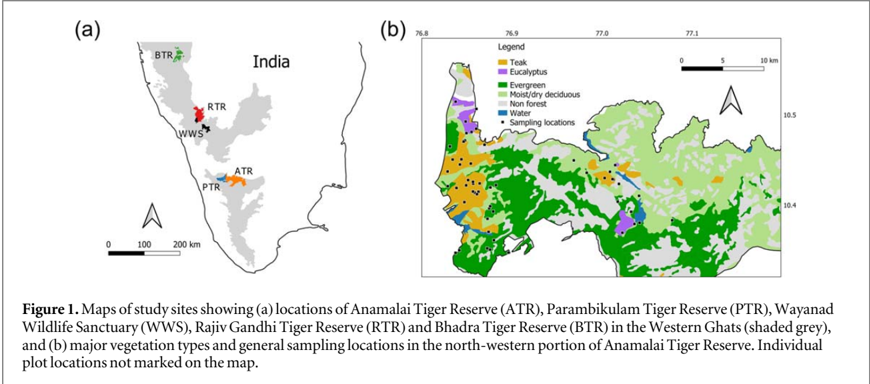
“These included 13 fragments (0.67 to 113 ha) embedded within tea and coffee plantations on the Valparai Plateau and six fragments (175 to 4310 ha) in the Anamalai Tiger Reserve that also abutted montane grasslands or deciduous forests (Osuri et al. 2020).”
BackgroundInfluentialSelf-citationRamesha, M. N. (2022) · eDiss (Georg-August-Universität Göttingen) · doi:10.53846/goediss-9556 · Cited by 1
Impactos Humanos nas Emissões de Carbono & Perdas nos Serviços Ecossistêmicos
Gatti, L. V., Costa, P. M., Arieira, J., Blackham, G. V., Alencar, A. A. C., Macedo, M. N., Brown, F., Garavito, S., Suruí, G. W., da Silva, S. S., et al. (2023) · doi:10.55161/urlb1949
Impactos Humanos en las Emisiones de Carbono y Pérdidas de los Servicios Ecosistémicos
Gatti, L. V., Costa, P. M., Arieira, J., Blackham, G. V., Alencar, A. A. C., Macedo, M. N., Brown, F., Garavito, S., Suruí, G. W., da Silva, S. S., et al. (2023) · doi:10.55161/aswz1496 · Cited by 1
Zanini, A. M. (2023) · Digital Library of Theses and Dissertations (Universidade de São Paulo) · doi:10.11606/t.11.2023.tde-07122023-101316
Vijayakrishnan, S., Raghunathan, G., Kumar, M. A., & Sinha, A. (2024) · bioRxiv (Cold Spring Harbor Laboratory) · doi:10.1101/2024.01.08.574633
Deswarman, D., Iswandi, U., & Nurhasanah, N. (2024) · Jurnal Teknologi Lingkungan Lahan Basah · doi:10.26418/jtllb.v12i2.74851
“…kondisi yang memungkinkan untuk perluasan kesempatan kerja (A4) dan peran serta masyarakat dalam mengelola hutan (A6), yang keduanya berkontribusi pada peningkatan kesejahteraan masyarakat (A1) yang terletak di luar diagram 4.4 ini (Osuri, Gopal, Raman, Defries, et al., 2020; Pandey et al., 2021).”
BackgroundInfluentialAre Planted Forests at a Higher Risk in Response to Drought than Natural Forests in Drylands?Preprint
Dong, X., Cui, Y. Z., Zhou, J., Li, X., Chen, N., Wang, G. G., & Zhao, C. (2024) · SSRN Electronic Journal · doi:10.2139/ssrn.4875059
Diversity under a Microscope: As Biodiversity Diminishes, Do Allergies and Asthma Increase?
Christensen, K. (2024) · Environmental Health Perspectives · doi:10.1289/ehp15798
Yuan, Z., Meng, S., Yu, T., Niu, X., & Pang, Y. (2025) · Ecological Engineering · doi:10.1016/j.ecoleng.2025.107814
Biodiversity co-benefits in carbon markets? Evidence from voluntary offset projects
Zhou, Z. Y., & Almond, D. V. (2025) · Review of Finance · doi:10.2139/ssrn.5678422 · Cited by 16
Traslación nutrimental e incremento medio anual en teca (Tectona grandis L.f.), en Tabasco, México
Obrador-Olán, J. J., Córdova-Sánchez, A., López, E. G., Castelán-Estrada, M., Palma-López, D. J., López, G. V., Pascual-Córdova, G., & López, J. G. (2026) · Colombia Forestal · doi:10.14483/2256201x.23641
Wang, X., Hua, L.-Q., & Zhou, G. (2026) · Remote Sensing · doi:10.3390/rs18040566 · Cited by 1
Sustainable practices to reduce carbon footprint and nurture biodiversity of academic campuses
Waghmare, U., Munje, A., Rao, P. V. D., & Prakash, O. (2026) · Discover Sustainability · doi:10.1007/s43621-026-02841-6
Thomson, R. F., Deshwal, A., Panwar, P., & Gosler, A. (2026) · Emu - Austral Ornithology · doi:10.1080/01584197.2026.2642985
Surendra, A., & Raman, T. R. S. (2026) · Ornithological Applications · doi:10.1093/ornithapp/duag040
Self-citationGertner, N., Vargas‐Gaete, R., Salas, C., Fuentes‐Ramírez, A., Elissetche, J. P., & Rubilar, R. A. (2026) · Forest Ecology and Management · doi:10.1016/j.foreco.2026.123828
Nyirenda, H., Chirwa, P. W., Assèdé, E. S. P., & Mtambo, D. (2026) · Environmental Research Communications · doi:10.1088/2515-7620/ae6b0d
“High tree diversity also promotes general resilience of a forest in cases of extreme disturbance such as drought (Osuri et al 2020). that Faidherbia albida , a popular agroforestry species in sub-Saharan Africa, dominated in C sequestration of about 70.8 Mg C ha − 1 even when Vitellaria paradoxa…”
InfluentialLi, J., Yu, P., Liu, H., Wei, X., Liu, B., Wan, Y., Li, Z., Zhang, Z., & Qi, J. (2026) · Agricultural and Forest Meteorology · doi:10.1016/j.agrformet.2026.111334
Wu, Q., Zhan, J., Zhang, H., Otho, A. R., Yang, Z., Cao, Y., & Wang, Q. (2026) · Geography and sustainability · doi:10.1016/j.geosus.2026.100565
Metadata
- Authors
- Osuri, A. M., Gopal, A., Raman, T. R. S., DeFries, R., Cook-Patton, S. C., & Naeem, S.
- Affiliations
- The Nature Conservancy (US)
- Nature Conservation Foundation (IN)
- Columbia University (US)
- Corresponding author
- Osuri, Anand M
- Venue
- Environmental Research Letters
- Publisher
- IOP Publishing
- Published
- 2020-02-18
- Volume
- 15
- Issue
- 3
- Pages
- 034011
- ISSN
- 1748-9326 (ISSN-L)
- OpenAlex
- W2993949137
- Cited by
- 93
- References
- 48
- Citations by year
- 2026: 13 · 2025: 8 · 2024: 17 · 2023: 15 · 2022: 15 · 2021: 14 · 2020: 11
- FWCI
- 7.16
- Type
- journal article
- Language
- en
- Open access
- gold
- doi.org
- Licence
- cc-by
- creativecommons.org/licenses/by/3.0/ (vor)
- iopscience.iop.org/info/page/text-and-data-mining (tdm)
- Locations
- Environmental Research Letters (publishedVersion, cc-by)
- DOAJ (DOAJ: Directory of Open Access Journals) (submittedVersion)
- Columbia Academic Commons (Columbia University)
- Funders
- Earth Institute, Columbia University
- Nature Conservancy
- Topics
- Life Sciences › Agricultural and Biological Sciences › Forestry › Forest ecology and management
- Physical Sciences › Environmental Science › Global and Planetary Change › Plant Water Relations and Carbon Dynamics
- Life Sciences › Agricultural and Biological Sciences › Forestry › Forest Management and Policy
- Keywords
- CO2 capture, carbon sequestration, natural forests, forest plantations, species richness, temporal stability, gross primary productivity, drought tolerance, aboveground carbon storage, teak plantations, eucalyptus plantations, evergreen forest, moist deciduous forest, Western Ghats, protected areas, climate change mitigation, forest restoration
About these checks
Registry, retraction, Cites and statistics results are computed, not judged, with one exception: a printed reference that no index lists is read once by a model before it counts as a citation error. Claims are extracted by a model and kept only when their quote appears verbatim in the text; each cited source is then checked, with a model’s help, for whether it says what the claim relies on. Those verdicts can be wrong — read the claim’s quote and the cited source before relying on one.
Statistics and arithmetic are recomputed, not judged.
Confidence bands are shown only for fields calibrated on our annotated test set. None is calibrated yet, so no band is shown.
What counts as a claim ›How we measure confidence ›How we check this ›
Are you an author, or do you see a problem with this page? Request a review
Data sources
Bibliographic data: Semantic Scholar, OpenAlex, Crossref.
Contains information from the Semantic Scholar Academic Graph Datasets, made available under the ODC Attribution License (ODC-BY 1.0).
Semantic Scholar’s data is described in: Kinney, R., et al. (2023). The Semantic Scholar Open Data Platform. arXiv:2301.10140.
