

Effect of α-Amylase and Glucoamylase Enzymes on Chemical Qualities of Vinegar from Banana Peel
Open accessThe DOI matches its Crossref record; 8 of the 8 references it cites were found in a registry or an index; none of the 5 sources its claims cite is checked for support yet.
Abstract
The study determined the effect of α-amylase and glucoamylase on chemical qualities of banana-peel vinegar. The best treatment was 0.10% α-amylase and 0.10% glucoamylase, with acetic acid of 4.05% and pH 3.52 on day 30.
Overview
CoChat Summary
## TL;DR
This paper tested whether adding α-amylase and glucoamylase affects the chemical quality of vinegar made from Nangka banana peel using simultaneous fermentation. The best treatment was 0.10% α-amylase plus 0.10% glucoamylase (A2B1), which gave 4.05% acetic acid and pH 3.52 on day 30.
## Key findings
- The experiment found significant treatment effects (P<0.05) on reducing sugar, alcohol, acetic acid, and pH.
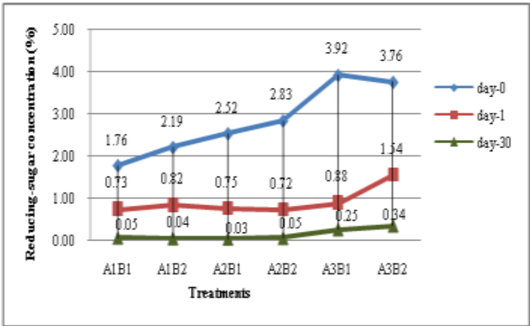
- On day 30, reducing sugar fell to 0.03–0.34%; the lowest value was 0.03% in A2B1 (0.10% α-amylase, 0.10% glucoamylase).
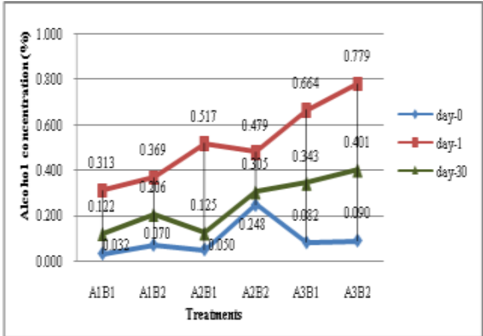
- Alcohol content decreased by day 30 to 0.122–0.401%; the paper reports 0.122% in A1B1 and 0.125% in A2B1 as the lowest values.
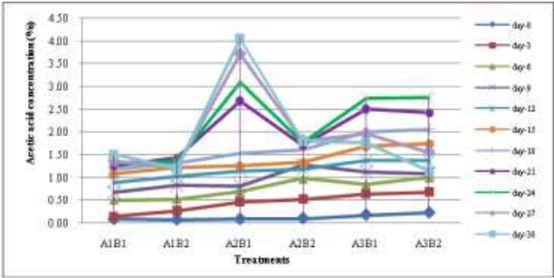
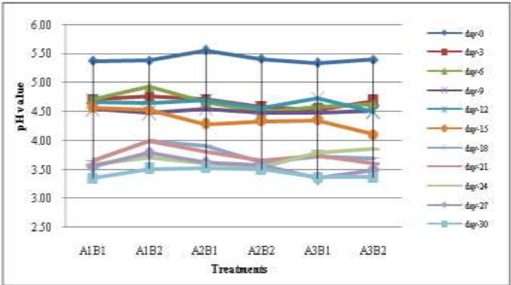
- The best acetic acid result was A2B1, with an average of 4.05% and pH 3.52 on day 30; the authors say this met Indonesian National Standard (SNI) No. 01-4371-1996 for vinegar.
## Methods
- Block Randomized Design with two factors and three replications: α-amylase at 0.05%, 0.1%, 0.15% and glucoamylase at 0.1%, 0.15%.
- Sample/material: Nangka banana peels; starter cultures of *Saccharomyces cerevisiae* and *Acetobacter aceti*; vinegar made by simultaneous fermentation after boiling, grinding, filtering, alcoholic fermentation, then acetic acid fermentation.
- Main analysis: ANOVA for two factors, followed by Duncan Multiple Range Test (DMRT) for significant differences; reducing sugar measured by DNS, alcohol by GC, acetic acid by alkalimetric titration, and pH by pH meter.
## Limitations
- The paper does not state explicit limitations.
- Evident from the text: the study reports only the treatments tested in this design, with three replications and one banana-peel variety, so the findings may be specific to these conditions.
Model-written summary. Check it against the paper before relying on it.
Integrity signals
Registry
Cites
Statistics
Figures
Verification
Claims the paper makes
0 Valid · 0 Not valid · 5 Not checked · 39 Own results and interpretations
A result the paper reports from its own data — it cites no other source for it, so there is none to check. The quote shows it is in the paper.
In the paper
“The point of pH on day-0 from all treatments had range values of 5.34-5.55(Figure 4).”
§ Effect of α-Amylase and Glucoamylase Enzymes on Chemical Qualities of Vinegar from Banana Peel > 3.4 pH value
plain- Asserted: passes — The authors put it forward as true.
- Checkable: passes — It can be checked against evidence.
- Load-bearing: unclear — It is unclear whether the paper’s conclusions depend on it.
- Based: passes — The paper gives a reason why it holds.
A result the paper states — it cites no source for it, so there is none to check. The quote shows it is in the paper.
In the paper
“On day-7, the treatments of A2B2, A3B1 and A3B2 decreased in acetic acid content to 1.80%, 1.97%, and 1.56 %, respectively.”
§ Effect of α-Amylase and Glucoamylase Enzymes on Chemical Qualities of Vinegar from Banana Peel > 3.3 Acetic acid concentration
plainstates a cause- Asserted: passes — The authors put it forward as true.
- Checkable: passes — It can be checked against evidence.
- Load-bearing: unclear — It is unclear whether the paper’s conclusions depend on it.
- Based: passes — The paper gives a reason why it holds.
A result the paper reports from its own data — it cites no other source for it, so there is none to check. The quote shows it is in the paper.
In the paper
“These data suggested that the reducing-sugar content was relatively high in A3B1 (3.92%) which was a combination between 0.15% of α-amylase and 0.10% of glucoamylase concentrations.”
§ Effect of α-Amylase and Glucoamylase Enzymes on Chemical Qualities of Vinegar from Banana Peel > 3.1 Reducing sugar concentration
hedgedstates an association- Asserted: passes — The authors put it forward as true.
- Checkable: passes — It can be checked against evidence.
- Load-bearing: unclear — It is unclear whether the paper’s conclusions depend on it.
- Based: passes — The paper gives a reason why it holds.
A result the paper reports from its own data — it cites no other source for it, so there is none to check. The quote shows it is in the paper.
In the paper
“Observation results on alcohol contents of treatments on day-0 showed the range values of 0.032-0.090%(Figure 2).”
§ Effect of α-Amylase and Glucoamylase Enzymes on Chemical Qualities of Vinegar from Banana Peel > 3.2 Alcohol concentration
plain- Asserted: passes — The authors put it forward as true.
- Checkable: passes — It can be checked against evidence.
- Load-bearing: unclear — It is unclear whether the paper’s conclusions depend on it.
- Based: passes — The paper gives a reason why it holds.
A result the paper reports from its own data — it cites no other source for it, so there is none to check. The quote shows it is in the paper.
In the paper
“Data suggested that the A2B1 treatment (0.10% αamylase, 0.10% glucoamylase) resulted in the lowest level of reducing-sugar (0.03%).”
§ Effect of α-Amylase and Glucoamylase Enzymes on Chemical Qualities of Vinegar from Banana Peel > 3.1 Reducing sugar concentration
hedgedstates a cause- Asserted: passes — The authors put it forward as true.
- Checkable: passes — It can be checked against evidence.
- Load-bearing: passes — The paper’s conclusions depend on it.
- Based: passes — The paper gives a reason why it holds.
26 more claims
Create a free account to see all 44 claims and to verify the 4 references still open.
- It may state two separate claims as one. 8
- Probably not a substantial claim. 7
Self-check
Percentages, sums and reported differences re-computed from the paper’s own numbers.
Each contradiction between two passages listed here was confirmed by an independent check.
Rated major: it would touch a result — a value a result rests on, reported and recomputed p-values on opposite sides of the significance level, two passages that conflict with no sign which is right, or a cited work retracted before this paper was published.
In the paper
§ Effect of α-Amylase and Glucoamylase Enzymes on Chemical Qualities of Vinegar from Banana Peel > Abstract
“An average value of reducing-sugar level on day-1 was 0.55% (g/ml) accompanied by alcohol content reduction of 0.386%.”
§ Effect of α-Amylase and Glucoamylase Enzymes on Chemical Qualities of Vinegar from Banana Peel > 3.1 Reducing sugar concentration
“On day-1, reduction of reducing-sugar level occurred with range values of all treatments were 0.72-1.54%.”
Citations
Cites
Bergey's Manual of Determinative Bacteriology
S., F. A., Buchanan, R. E. T., Gibbons, N. E., & Bergey (1975) · Taxon · doi:10.2307/1218353 · Cited by 11,333
Brock Biology of Microorganisms
Madigan (2000) · Cited by 1,166
The technology of food preservation
(1970) · Cited by 157
Ševčı́k, J., Hostinová, E., Solovicová, A., Gašperı́k, J., Dauter, Z., & Wilson, K. S. (2006) · FEBS Journal · doi:10.1111/j.1742-4658.2006.05230.x · Cited by 52
Optimization of Process Parameters for Vinegar Production Using Banana Fermentation
., P. S. (2013) · International Journal of Research in Engineering and Technology · doi:10.15623/ijret.2013.0209076 · Cited by 28
Fiedurek, J., Pielecki, J., & Skowronek, M. (2000) · Journal of Basic Microbiology · doi:10.1002/(sici)1521-4028(200005)40:2<83::aid-jobm83>3.0.co;2-6 · Cited by 5
Hydrothermal Conversion of Lignin and Its Model Compounds into Formic Acid and Acetic Acid
Zeng, X., Yao, G., Wang, Y., & Jin, F. (2014) · Green Chemistry and Sustainable Technology · doi:10.1007/978-3-642-54458-3_3 · Cited by 1
Research works printed but not linked: 8
- 2. Adams MR 1985 Microbiology of Fermented Food: Vinegar vol 1 (New York : Elsevier Applied Science Publisher Ltd)
- 3. Anhwange BA, Ugye TJ, Nyiaatagher TD 2009 Electronic Journal of Enviromental, Agriculture and Food Chemistry 8(6) 437-442
- 4. Mas A and Torija MJ 2014 The Scientific World Journal 1-6
- 5. Lewis MJ and Young TW 2002 Brewing Second Ed (Springer Sciences and Business LLC) 398
- 6. Mukhtar K, Asgher M, Afghan S, Hussain K and Zia-ul-Hussnain S 2010 Journal of Biomedicine and Biotechnology 1-5
- 8. Othaman MA, Sharifudin SA, Mansor A, Kahar AA and Long K 2014 Journal of Engineering Science and Technology 9(3) 293-302
- 11. Pratt CW and Cornely K 2013 Essential Biochemistry Third ed (Wiley) 626.
- 13. Akkarachaneeyakorn S, Suwakrai A, and Pewngam D 2018 Journal Science Technology 40(1) 1- 7
Metadata
- Authors
- Juniawati, Widaningrum, Usmiati, S., & Sandrasari, D. A.
- Affiliations
- Indonesian Agency for Agricultural Research and Development (ID)
- Venue
- IOP Conference Series: Earth and Environmental Science
- Publisher
- IOP Publishing
- Published
- 2019-09-01
- Volume
- 309
- Issue
- 1
- Pages
- 012047
- ISSN
- 1755-1315 (ISSN-L)
- 1755-1307
- OpenAlex
- W2979495581
- Cited by
- 0
- References
- 7
- FWCI
- 0.00
- Type
- conference paper
- Language
- en
- Open access
- diamond
- doi.org
- Licence
- cc-by
- creativecommons.org/licenses/by/3.0/ (vor)
- iopscience.iop.org/info/page/text-and-data-mining (tdm)
- Locations
- IOP Conference Series Earth and Environmental Science (publishedVersion, cc-by)
- Funders
- Badan Penelitian dan Pengembangan Pertanian
- Topics
- Life Sciences › Agricultural and Biological Sciences › Food Science › Fermentation and Sensory Analysis
- Life Sciences › Agricultural and Biological Sciences › Food Science › Food Nutrient Composition and Product Development
- Life Sciences › Biochemistry, Genetics and Molecular Biology › Biotechnology › Enzyme Production and Characterization
- Keywords
- alpha-amylase, glucoamylase, enzymatic hydrolysis, banana peel waste, acetic acid, reducing sugars, alcohol content, vinegar fermentation, food waste valorization, natural preservatives
About these checks
Registry, retraction, Cites and statistics results are computed, not judged, with one exception: a printed reference that no index lists is read once by a model before it counts as a citation error. Claims are extracted by a model and kept only when their quote appears verbatim in the text; each cited source is then checked, with a model’s help, for whether it says what the claim relies on. Those verdicts can be wrong — read the claim’s quote and the cited source before relying on one.
A language model drew the claims from the paper on 2026-10-10, under version 3 of the claim definition (model deepseek-v4.1-flash, prompt extract-v3).
A second model labelled each claim on 2026-10-10 (model jev-1.13-20260917, definition revision gold-guideline-v0.2).
Statistics and arithmetic are recomputed, not judged.
Confidence bands are shown only for fields calibrated on our annotated test set. None is calibrated yet, so no band is shown.
What counts as a claim ›How we measure confidence ›How we check this ›
Are you an author, or do you see a problem with this page? Request a review
How to cite
Cite CoChat for the checks on this page, and the paper for its own findings.
- This page
- CoChat. (2026). Citation check: Effect of α-Amylase and Glucoamylase Enzymes on Chemical Qualities of Vinegar from Banana Peel. https://app.cochat.ai/papers/10.1088/1755-1315/309/1/012047
- The paper
- Juniawati, Widaningrum, Usmiati, S., & Sandrasari, D. A. (2019). Effect of α-Amylase and Glucoamylase Enzymes on Chemical Qualities of Vinegar from Banana Peel. IOP Conference Series: Earth and Environmental Science. https://doi.org/10.1088/1755-1315/309/1/012047
Data sources
Bibliographic data: Semantic Scholar, OpenAlex, Crossref.
Contains information from the Semantic Scholar Academic Graph Datasets, made available under the ODC Attribution License (ODC-BY 1.0).
Semantic Scholar’s data is described in: Kinney, R., et al. (2023). The Semantic Scholar Open Data Platform. arXiv:2301.10140.
