

Adenosine Interaction with Adenosine Receptor A2a Promotes Gastric Cancer Metastasis by Enhancing PI3K-AKT-MTOR Signaling
Open accessThe DOI matches its Crossref record; 51 of the 51 references it cites were found in a registry or an index.
Abstract
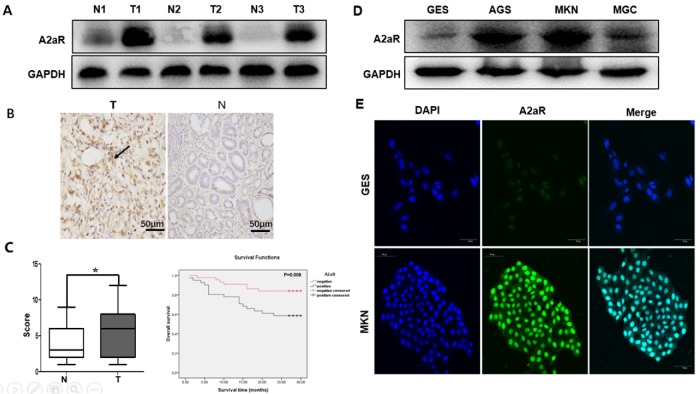
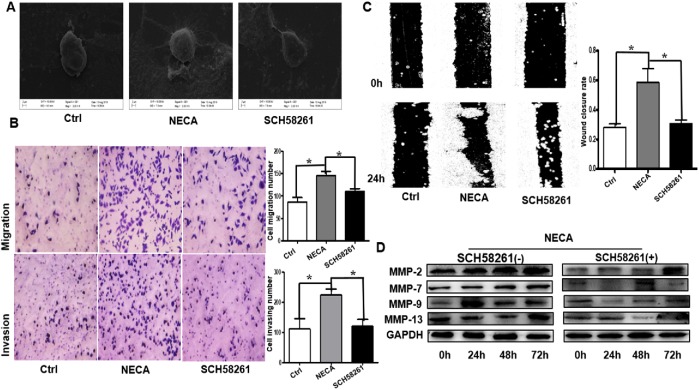
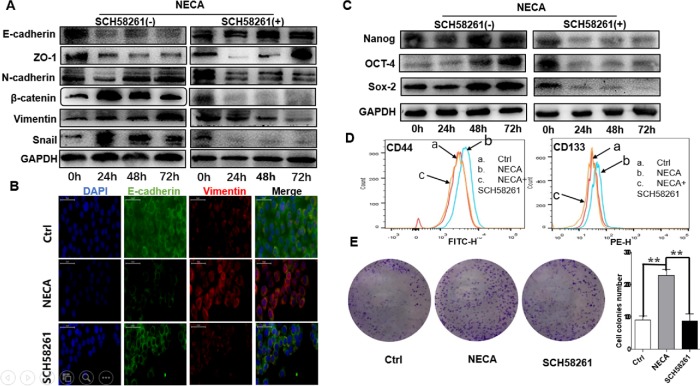
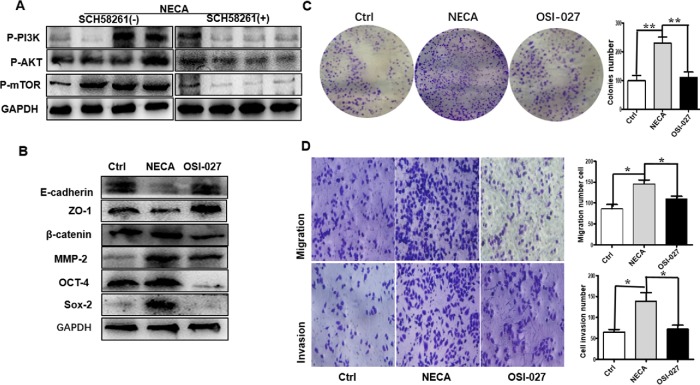
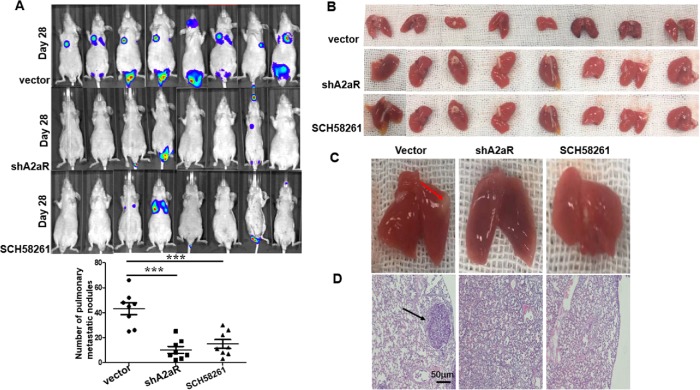
The accumulation of adenosine in the tumor microenvironment is associated with tumor progression in many cancers. However, whether adenosine is involved in gastric cancer (GC) metastasis and progression, and the underlying molecular mechanism, is largely unclear. In this study, we find that GC tissues and cell lines had higher A2aR levels than nontumor gastric tissues and cell lines. A2aR expression correlated positively with TNMstage, and associated with poor outcomes. Adenosine enhanced the expression of the stemness and epithelial-mesenchymal transition-associated genes by binding to A2aR. A2aR expression on GC cells promoted metastasis in vivo. The PI3K-AKT-mTOR signaling pathway was involved in adenosine-stimulated GC cell migration and invasion. Our results indicate that adenosine promotes GC cell invasion and metastasis by interacting with A2aR to enhance PI3K-AKT-mTOR pathway signaling.
Overview
The claims and statistics of this paper haven’t been checked yet.
Free: it reads the open-access text and checks the first 5 claims that cite a source we can check. Create a free account to check every claim.
Integrity signals
Registry
Cites
Statistics
Figures
Verification
Claims the paper makes
The claims and statistics of this paper haven’t been checked yet.
Free: it reads the open-access text and checks the first 5 claims that cite a source we can check. Create a free account to check every claim.
Claims other papers make about this one
Each is checked against this paper’s own text: does it say what the citing paper says it does?
The source backs part of the claim, not all of it — or backs it for a different population, condition or comparison.
In the citing paper
“While under normal conditions the Adenosinergic Pathway (AP) is fine-tuned and controlled, in cancer the signaling is altered, promoting malignant cell transformation. AP in cancer cells by increasing the secretion of cytokines and immune modulatory factors, including IL6, IL10, TGFβ, and VEGF, and activating survival/signaling pathways such as PI3K-Akt-mTOR, sustains immunosuppression and”
From Chronic Inflammation, Oxidative Stress and Metabolic Plasticity: Three Players Driving the Pro-Tumorigenic Microenvironment in Malignant Mesothelioma (2023) · cites this paper as [130]
Experimental — accuracy not yet measured
Self-check
Percentages, sums and reported differences re-computed from the paper’s own numbers.
The self-check needs the paper’s full text.
Citations
Cites
Cancer statistics in China, 2015
Chen, W., Zheng, R., Baade, P. D., Zhang, S., Zeng, H., Bray, F., Jemal, A., Yu, X. Q., & He, J. (2016) · CA: A Cancer Journal for Clinicians · doi:10.3322/caac.21338 · Cited by 17,038
Understanding the Warburg Effect: The Metabolic Requirements of Cell Proliferation
Vander Heiden, M. G., Cantley, L. C., & Thompson, C. B. (2009) · Science · doi:10.1126/science.1160809 · Cited by 16,197
Siegel, R., Ma, J., Zou, Z., & Jemal, A. (2014) · CA: A Cancer Journal for Clinicians · doi:10.3322/caac.21208 · Cited by 11,499
The Epithelial-Mesenchymal Transition Generates Cells with Properties of Stem Cells
Mani, S. A., Guo, W., Liao, M.-J., Eaton, E. N., Ayyanan, A., Zhou, A. Y., Brooks, M., Reinhard, F., Zhang, C. C., Shipitsin, M., et al. (2008) · Cell · doi:10.1016/j.cell.2008.03.027 · Cited by 8,672
Epithelial–mesenchymal transitions in tumour progression
Thiery, J. P. (2002) · Nature Reviews Cancer · doi:10.1038/nrc822 · Cited by 6,628
Signet-Ring Cell Carcinoma of the Colon: A Case Report and Review of the Literature
Park, P. Y., Goldin, T., Chang, J., Markman, M., & Kundranda, M. N. (2015) · Case Reports in Oncology · doi:10.1159/000441772 · Cited by 5,273
EMT, cancer stem cells and drug resistance: an emerging axis of evil in the war on cancer
Singh, A., & Settleman, J. (2010) · Oncogene · doi:10.1038/onc.2010.215 · Cited by 2,545
Defining the role of hypoxia-inducible factor 1 in cancer biology and therapeutics
Semenza, G. L. (2010) · Oncogene · doi:10.1038/onc.2009.441 · Cited by 1,712 · cited 1×
“The stabilization and activation of hypoxia-inducible factor (HIF) responses to hypoxic TME may facilitate tumor growth, angiogenesis, and metastasis (Semenza, 2010).”
BackgroundPI3K in cancer: divergent roles of isoforms, modes of activation and therapeutic targeting
Thorpe, L. M., Yuzugullu, H., & Zhao, J. J. (2015) · Nature Reviews Cancer · doi:10.1038/nrc3860 · Cited by 1,345
Adenosine receptors: therapeutic aspects for inflammatory and immune diseases
Haskó, G., Linden, J., Cronstein, B., & Pacher, P. (2008) · Nature Reviews Drug Discovery · doi:10.1038/nrd2638 · Cited by 1,217
Cited by
mTOR signaling pathway and mTOR inhibitors in cancer: progress and challenges
Zou, Z., Tao, T., Li, H., & Zhu, X. (2020) · Cell & Bioscience · doi:10.1186/s13578-020-00396-1 · Cited by 927
The adenosine pathway in immuno-oncology
Allard, B., Allard, D., Buisseret, L., & Stagg, J. (2020) · Nature Reviews Clinical Oncology · doi:10.1038/s41571-020-0382-2 · Cited by 586
Liu, X., Ding, Q., Zhang, H., Zhang, X., Chen, Q., & Weng, S. (2025) · Biochimica et Biophysica Acta (BBA) - Reviews on Cancer · doi:10.1016/j.bbcan.2025.189443 · Cited by 212
Purinergic Signaling in the Hallmarks of Cancer
Campos‐Contreras, A. D. R., Díaz‐Muñoz, M., & Vázquez‐Cuevas, F. G. (2020) · Cells · doi:10.3390/cells9071612 · Cited by 115
CD73's Potential as an Immunotherapy Target in Gastrointestinal Cancers
Harvey, J. B., Phan, L. H., Villarreal, O. E., & Bowser, J. L. (2020) · Frontiers in Immunology · doi:10.3389/fimmu.2020.00508 · Cited by 93
Metadata
- Authors
- Shi, L., Wu, Z., Miao, J., Du, S., Ai, S., Xu, E., Feng, M., Song, J., & Guan, W.
- Affiliations
- Affiliated Hospital of Xuzhou Medical College (CN)
- Xuzhou Medical College (CN)
- Nanjing Drum Tower Hospital (CN)
- Nanjing University (CN)
- Corresponding author
- Song, Jun
- Guan, Wenxian
- Venue
- Molecular Biology of the Cell
- Published
- 2019-09-01
- Volume
- 30
- Issue
- 19
- Pages
- 2527-2534
- ISSN
- 1059-1524 (ISSN-L)
- 1939-4586
- PMC
- PMC6743355
- OpenAlex
- W2963151784
- Cited by
- 79
- References
- 51
- Citations by year
- 2026: 10 · 2025: 7 · 2024: 13 · 2023: 18 · 2022: 10 · 2021: 11 · 2020: 10
- FWCI
- 5.15
- Type
- journal article
- Language
- en
- Open access
- green
- www.ncbi.nlm.nih.gov
- Licence
- cc-by-nc-sa
- Locations
- Molecular Biology of the Cell (publishedVersion)
- Europe PMC (PubMed Central) (publishedVersion, cc-by-nc-sa)
- PubMed Central (publishedVersion, cc-by-nc-sa)
- PubMed (publishedVersion)
- Funders
- Government of Jiangsu Province
- Natural Science Foundation of Jiangsu Province (BK201508, 2014-WSW-032)
- Topics
- Life Sciences › Biochemistry, Genetics and Molecular Biology › Physiology › Adenosine and Purinergic Signaling
- Life Sciences › Biochemistry, Genetics and Molecular Biology › Molecular Biology › RNA modifications and cancer
- Life Sciences › Biochemistry, Genetics and Molecular Biology › Molecular Biology › Biochemical and Molecular Research
- Keywords
- adenosine, adenosine A2A receptor, gastric cancer, metastasis, PI3K/AKT/mTOR pathway, tumor microenvironment, epithelial-mesenchymal transition, cancer stemness, cell migration, cell invasion, tumor progression
- MeSH terms
- Adenosine, Adult, Aged, Aged, 80 and over, Cell Movement, Female, Humans, Male, Middle Aged, Neoplasm Metastasis, Stomach Neoplasms, Signal Transduction, Gene Expression Regulation, Neoplastic, Receptors, Purinergic P1, Phosphatidylinositol 3-Kinases, Receptor, Adenosine A2A, Cell Line, Tumor, Cell Proliferation, Proto-Oncogene Proteins c-akt, TOR Serine-Threonine Kinases, Epithelial-Mesenchymal Transition, Tumor Microenvironment
About these checks
Registry, retraction, Cites and statistics results are computed, not judged, with one exception: a printed reference that no index lists is read once by a model before it counts as a citation error. Claims are extracted by a model and kept only when their quote appears verbatim in the text; each cited source is then checked, with a model’s help, for whether it says what the claim relies on. Those verdicts can be wrong — read the claim’s quote and the cited source before relying on one.
Statistics and arithmetic are recomputed, not judged.
Confidence bands are shown only for fields calibrated on our annotated test set. None is calibrated yet, so no band is shown.
What counts as a claim ›How we measure confidence ›How we check this ›
Are you an author, or do you see a problem with this page? Request a review
How to cite
Cite CoChat for the checks on this page, and the paper for its own findings.
- This page
- CoChat. (2026). Citation check: Adenosine Interaction with Adenosine Receptor A2a Promotes Gastric Cancer Metastasis by Enhancing PI3K-AKT-MTOR Signaling. https://app.cochat.ai/papers/10.1091/mbc.e19-03-0136
- The paper
- Shi, L., Wu, Z., Miao, J., Du, S., Ai, S., Xu, E., Feng, M., Song, J., & Guan, W. (2019). Adenosine Interaction with Adenosine Receptor A2a Promotes Gastric Cancer Metastasis by Enhancing PI3K-AKT-MTOR Signaling. Molecular Biology of the Cell. https://doi.org/10.1091/mbc.e19-03-0136
Data sources
Bibliographic data: Semantic Scholar, OpenAlex, Crossref.
Contains information from the Semantic Scholar Academic Graph Datasets, made available under the ODC Attribution License (ODC-BY 1.0).
Semantic Scholar’s data is described in: Kinney, R., et al. (2023). The Semantic Scholar Open Data Platform. arXiv:2301.10140.
