

A global perspective on evolving bioinformatics and data science training needs
Open accessPublished version of a preprint
The DOI matches its Crossref record; 25 of the 25 references it cites were found in a registry or an index.
Abstract
Bioinformatics is now intrinsic to life science research, but the past decade has witnessed a continuing deficiency in this essential expertise. Basic data stewardship is still taught relatively rarely in life science education programmes, creating a chasm between theory and practice, and fuelling demand for bioinformatics training across all educational levels and career roles. Concerned by this, surveys have been conducted in recent years to monitor bioinformatics and computational training needs worldwide. This article briefly reviews the principal findings of a number of these studies. We see that there is still a strong appetite for short courses to improve expertise and confidence in data analysis and interpretation; strikingly, however, the most urgent appeal is for bioinformatics to be woven into the fabric of life science degree programmes. Satisfying the relentless training needs of current and future generations of life scientists will require a concerted response from stakeholders across the globe, who need to deliver sustainable solutions capable of both transforming education curricula and cultivating a new cadre of trainer scientists.
Overview
The claims and statistics of this paper haven’t been checked yet.
Free: it reads the open-access text and checks the first 5 claims that cite a source we can check. Create a free account to check every claim.
Integrity signals
Registry
Cites
Statistics
Figures
Verification
Claims the paper makes
The claims and statistics of this paper haven’t been checked yet.
Free: it reads the open-access text and checks the first 5 claims that cite a source we can check. Create a free account to check every claim.
Claims other papers make about this one
Each is checked against this paper’s own text: does it say what the citing paper says it does?
The source backs part of the claim, not all of it — or backs it for a different population, condition or comparison.
In the citing paper
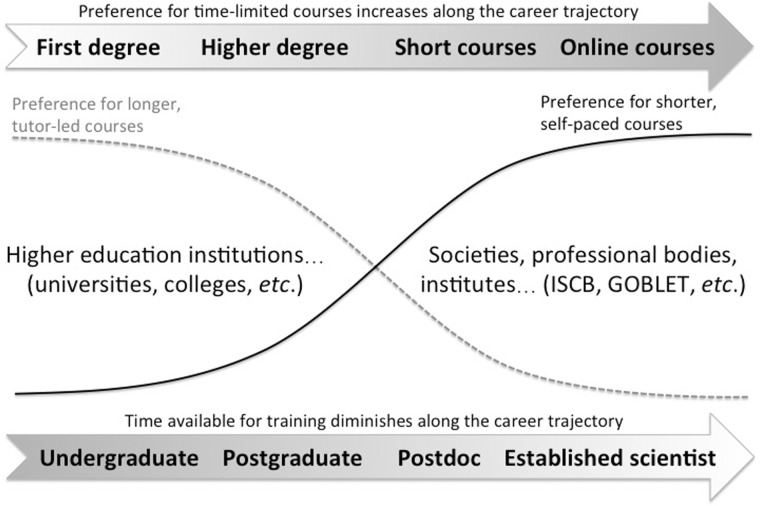
“Additionally, several independent surveys have indicated a strong preference for online training options, highlighting an important avenue to be addressed by instructors and program directors (Attwood et al., 2019).”
From Student‐led workshops: Filling skills gaps in computational research for life scientists (2021) · cites this paper as Attwood et al., 2019
Experimental — accuracy not yet measuredThe source backs part of the claim, not all of it — or backs it for a different population, condition or comparison.
In the citing paper
“Attwood et al. (2019) found that the time available for training is one of the most important factors for determining skills development and confidence level of participants.”
From Student‐led workshops: Filling skills gaps in computational research for life scientists (2021) · cites this paper as Attwood et al., 2019
Experimental — accuracy not yet measuredThe source backs part of the claim, not all of it — or backs it for a different population, condition or comparison.
In the citing paper
“and there is a strong preference for making these available online (Attwood et al., 2019).”
From Student‐led workshops: Filling skills gaps in computational research for life scientists (2021) · cites this paper as Attwood et al., 2019
Experimental — accuracy not yet measuredThe source backs part of the claim, not all of it — or backs it for a different population, condition or comparison.
In the citing paper
“Recent recommendations have highlighted the role of stand-alone workshops in meeting student, faculty, and professional training needs (Attwood et al., 2019; McGrath et al., 2019; Tractenberg et al., 2019).”
From Student‐led workshops: Filling skills gaps in computational research for life scientists (2021) · cites this paper as Attwood et al., 2019
Experimental — accuracy not yet measuredThe source backs part of the claim, not all of it — or backs it for a different population, condition or comparison.
In the citing paper
“Training modules offered as workshops are capable of increasing student participation compared to semester-long courses and improve the relevance of training experiences by directly addressing participant needs (Attwood et al., 2019).”
From Student‐led workshops: Filling skills gaps in computational research for life scientists (2021) · cites this paper as Attwood et al., 2019
Experimental — accuracy not yet measured
2 more claims about this paper
Create a free account to see every claim other papers make about this one.
Self-check
Percentages, sums and reported differences re-computed from the paper’s own numbers.
The self-check needs the paper’s full text.
Citations
Cites
Unmet needs for analyzing biological big data: A survey of 704 NSF principal investigators
Barone, L., Williams, J., & Micklos, D. (2017) · PLOS Computational Biology · doi:10.1371/journal.pcbi.1005755 · Cited by 156
Bioinformatics curriculum guidelines: Toward a definition of core competencies
Welch, L., Lewitter, F., Schwartz, R., Brooksbank, C., Radivojac, P., Gaeta, B., & Schneider, M. V. (2014) · PLoS Computational Biology · doi:10.1371/journal.pcbi.1003496 · Cited by 137 · cited 1×
“computational skills can help life and computational scientists to communicate and interact with one another more effectively, and improve critical thinking about research findings [1, 2].”
BackgroundSelf-citationComputational Thinking in Life Science Education
Rubinstein, A., & Chor, B. (2014) · PLoS Computational Biology · doi:10.1371/journal.pcbi.1003897 · Cited by 94
Best practices in bioinformatics training for life scientists
Via, A., Blicher, T. H., Bongcam‐Rudloff, E., Brazas, M. D., Brooksbank, C., Budd, A., Rivas, J. D. L., Dreyer, J., Fernandes, P., van Gelder, C. W. G., et al. (2013) · Briefings in Bioinformatics · doi:10.1093/bib/bbt043 · Cited by 68
Self-citationGOBLET: The Global Organisation for Bioinformatics Learning, Education and Training
Attwood, T. K., Bongcam‐Rudloff, E., Brazas, M. D., Corpas, M., Gaudet, P., Lewitter, F., Mulder, N., Palagi, P. M., Schneider, M. V., & van Gelder, C. W. G. (2015) · PLoS Computational Biology · doi:10.1371/journal.pcbi.1004143 · Cited by 67
Self-citationIntegrating bioinformatics into senior high school: design principles and implications
Machluf, Y., & Yarden, A. (2013) · Briefings in Bioinformatics · doi:10.1093/bib/bbt030 · Cited by 64
Bioinformatics training: a review of challenges, actions and support requirements
Schneider, M. V., Watson, J., Attwood, T. K., Rother, K. M., Budd, A., McDowall, J., Via, A., Fernandes, P., Nyrönen, T., Blicher, T. H., et al. (2010) · Briefings in Bioinformatics · doi:10.1093/bib/bbq021 · Cited by 60
Self-citationTan, T., Lim, S., Khan, A. M., & Ranganathan, S. (2009) · BMC Genomics · doi:10.1186/1471-2164-10-s3-s36 · Cited by 51 · cited 1×
“Submitted: 2 May 2017; Received (in revised form): 21 June 2017 computational skills can help life and computational scientists to communicate and interact with one another more effectively, and improve critical thinking about research findings [1, 2].”
Broader incorporation of bioinformatics in education: opportunities and challenges
Cummings, M. P., & Temple, G. G. (2010) · Briefings in Bioinformatics · doi:10.1093/bib/bbq058 · Cited by 50
Core services: Reward bioinformaticians
Chang, J. T. (2015) · Nature · doi:10.1038/520151a · Cited by 36
Research works printed but not linked: 1
- SEB/GOBLET Bioinformatics Workshop
Cited by
Strategic vision for improving human health at The Forefront of Genomics
Green, E. D., Gunter, C., Biesecker, L. G., Di Francesco, V., Easter, C. L., Feingold, E. A., Felsenfeld, A. L., Kaufman, D. J., Ostrander, E. A., Pavan, W. J., et al. (2020) · Nature · doi:10.1038/s41586-020-2817-4 · Cited by 324
Community-Driven Data Analysis Training for Biology
Batut, B., Hiltemann, S., Bagnacani, A., Baker, D., Bhardwaj, V., Blank, C., Bretaudeau, A., Brillet-Guéguen, L., Čech, M., Chilton, J., et al. (2018) · Cell Systems · doi:10.1016/j.cels.2018.05.012 · Cited by 211
Plant genome sequences: past, present, future
Kersey, P. J. (2019) · Current Opinion in Plant Biology · doi:10.1016/j.pbi.2018.11.001 · Cited by 173
Galaxy Training: A powerful framework for teaching!
Hiltemann, S., Rasche, H., Gladman, S. L., Hotz, H.-R., Larivière, D., Blankenberg, D. J., Jagtap, P. D., Wollmann, T., Bretaudeau, A., Goué, N., et al. (2023) · PLoS Computational Biology · doi:10.1371/journal.pcbi.1010752 · Cited by 128
SQMtools: automated processing and visual analysis of ’omics data with R and anvi’o
Puente‐Sánchez, F., García-García, N., & Tamames, J. (2020) · BMC Bioinformatics · doi:10.1186/s12859-020-03703-2 · Cited by 112
Metadata
- Authors
- Attwood, T. K., Blackford, S., Brazas, M. D., Davies, A., & Schneider, M. V.
- Affiliations
- University of Manchester (GB)
- Ontario Institute for Cancer Research (CA)
- Norwich Research Park (GB)
- Corresponding author
- Brazas, Michelle D
- Venue
- Briefings in Bioinformatics
- Publisher
- Oxford University Press (OUP)
- Published
- 2017-08-29
- Volume
- 20
- Issue
- 2
- Pages
- 398-404
- ISSN
- 1467-5463 (ISSN-L)
- 1477-4054
- PMC
- PMC6433731
- OpenAlex
- W2742478344
- Cited by
- 175
- References
- 23
- Citations by year
- 2026: 20 · 2025: 32 · 2024: 21 · 2023: 19 · 2022: 18 · 2021: 21 · 2020: 21 · 2019: 12 · 2018: 7 · 2017: 4
- FWCI
- 4.92
- Type
- journal article
- Language
- en
- Open access
- hybrid
- doi.org
- Licence
- Locations
- Briefings in Bioinformatics (publishedVersion, cc-by)
- bioRxiv (Cold Spring Harbor Laboratory) (acceptedVersion, cc-by)
- Europe PMC (PubMed Central) (publishedVersion, cc-by)
- PubMed Central (publishedVersion, cc-by)
- PubMed (publishedVersion)
- Research Explorer (The University of Manchester) (publishedVersion, cc-by)
- Minerva Access (University of Melbourne) (submittedVersion, cc-by)
- Research Explorer (The University of Manchester) (submittedVersion, other-oa)
- Funders
- GOBLET Foundation
- EMBL-ABR
- Biotechnology and Biological Sciences Research Council
- Medical Research Council and Natural Environment Research Council (BB/L005050/1)
- Topics
- Life Sciences › Biochemistry, Genetics and Molecular Biology › Molecular Biology › Genetics, Bioinformatics, and Biomedical Research
- Social Sciences › Decision Sciences › Information Systems and Management › Scientific Computing and Data Management
- Physical Sciences › Computer Science › Computer Science Applications › Teaching and Learning Programming
- Keywords
- bioinformatics education, data science education, training needs, life sciences education, data stewardship, curriculum integration, short courses, data analysis skills
- MeSH terms
- Data Science, Biological Science Disciplines, Humans, Surveys and Questionnaires, Computational Biology, Biomedical Research, Data Curation
About these checks
Registry, retraction, Cites and statistics results are computed, not judged, with one exception: a printed reference that no index lists is read once by a model before it counts as a citation error. Claims are extracted by a model and kept only when their quote appears verbatim in the text; each cited source is then checked, with a model’s help, for whether it says what the claim relies on. Those verdicts can be wrong — read the claim’s quote and the cited source before relying on one.
Statistics and arithmetic are recomputed, not judged.
Confidence bands are shown only for fields calibrated on our annotated test set. None is calibrated yet, so no band is shown.
What counts as a claim ›How we measure confidence ›How we check this ›
Are you an author, or do you see a problem with this page? Request a review
How to cite
Cite CoChat for the checks on this page, and the paper for its own findings.
- This page
- CoChat. (2026). Citation check: A global perspective on evolving bioinformatics and data science training needs. https://app.cochat.ai/papers/10.1093/bib/bbx100
- The paper
- Attwood, T. K., Blackford, S., Brazas, M. D., Davies, A., & Schneider, M. V. (2019). A global perspective on evolving bioinformatics and data science training needs. Briefings in Bioinformatics. https://doi.org/10.1093/bib/bbx100
Data sources
Bibliographic data: Semantic Scholar, OpenAlex, Crossref.
Contains information from the Semantic Scholar Academic Graph Datasets, made available under the ODC Attribution License (ODC-BY 1.0).
Semantic Scholar’s data is described in: Kinney, R., et al. (2023). The Semantic Scholar Open Data Platform. arXiv:2301.10140.
