

The DOI matches its Crossref record; 18 of the 18 references it cites were found in a registry or an index; none of the 11 sources its claims cite is checked for support yet.
PISA-SPARKY: an interactive SPARKY plugin to analyze oriented solid-state NMR spectra of helical membrane proteins
Open accessAbstract
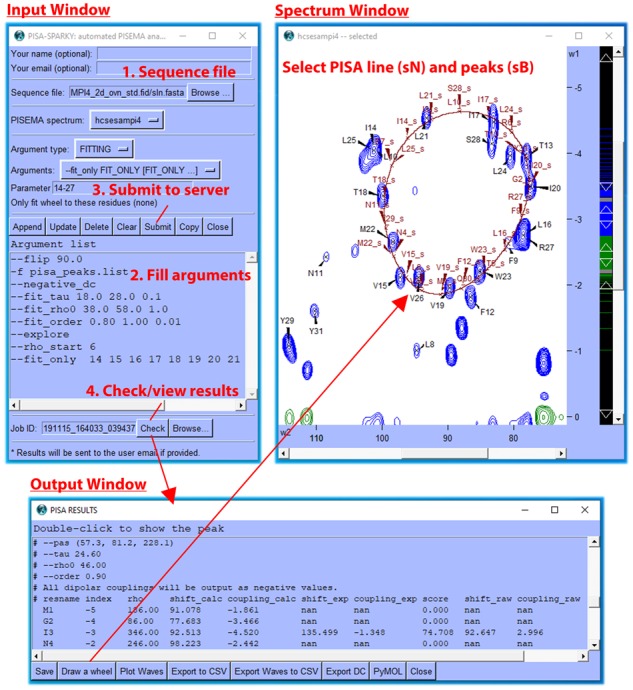
Motivation: Two-dimensional [15N-1H] separated local field solid-state nuclear magnetic resonance (NMR) experiments of membrane proteins aligned in lipid bilayers provide tilt and rotation angles for α-helical segments using Polar Index Slant Angle (PISA)-wheel models. No integrated software has been made available for data analysis and visualization. Results: We have developed the PISA-SPARKY plugin to seamlessly integrate PISA-wheel modeling into the NMRFAM-SPARKY platform. The plugin performs basic simulations, exhaustive fitting against experimental spectra, error analysis and dipolar and chemical shift wave plotting. The plugin also supports PyMOL integration and handling of parameters that describe variable alignment and dynamic scaling encountered with magnetically aligned media, ensuring optimal fitting and generation of restraints for structure calculation. Availability and implementation: PISA-SPARKY is freely available in the latest version of NMRFAM-SPARKY from the National Magnetic Resonance Facility at Madison (http://pine.nmrfam.wisc.edu/download_packages.html), the NMRbox Project (https://nmrbox.org) and to subscribers of the SBGrid (https://sbgrid.org). The pisa.py script is available and documented on GitHub (https://github.com/weberdak/pisa.py) along with a tutorial video and sample data. Supplementary information: Supplementary data are available at Bioinformatics online.
Overview
CoChat Summary
TL;DR
PISA-SPARKY is an interactive NMRFAM-SPARKY plugin that integrates PISA-wheel modeling for analyzing oriented solid-state NMR spectra of helical membrane proteins. It provides simulation, exhaustive fitting, error analysis, wave plotting, PyMOL integration, and export of dipolar coupling restraints for structure calculation.
Key findings
- The plugin fills a gap because PISA models have been used in OS-ssNMR for almost two decades but no software was available for widespread quantitative data analysis.
- PISA-SPARKY performs basic simulations, exhaustive fitting against experimental spectra, error analysis, and dipolar and chemical shift wave plotting.
- It supports PyMOL integration and handles parameters describing variable alignment and dynamic scaling in magnetically aligned media, enabling optimal fitting and generation of restraints for structure calculation.
- PISA-SPARKY is freely available in the latest NMRFAM-SPARKY, via NMRbox and SBGrid, and the pisa.py script is available on GitHub with a tutorial video and sample data.
Methods
- The plugin was written in Python 2.7 using the Tkinter GUI module and is loaded in NMRFAM-SPARKY with the two-letter code “PS”; results are returned to SPARKYHOME/PISA/Job ID and read with the Check button.
- Fitting is executed by the pisa.py script, written in Python 3.7 using Numpy and the concurrent library to parallelize fitting routines over multiple cores; it can also be used as a standalone tool.
- The webserver consists of an AMD 48-core Opteron 2.6 GHz, 128 GB RAM, running 64-bit Linux CentOS and a Python 3 virtual environment; the plugin is demonstrated using an hcSE-SAMPI4 spectrum of sarcolipin reconstituted into an unflipped bicelle.
Limitations
- The paper states no limitations.
- Evident from the text: the Results section demonstrates the plugin only with an hcSE-SAMPI4 spectrum of sarcolipin reconstituted into an unflipped bicelle; no broader benchmarking or quantitative accuracy metrics are reported.
- Evident from the text: computation-intensive jobs are submitted to the PISA-SPARKY webserver, so remote server availability is part of the described workflow, although pisa.py may be used standalone locally.
Model-written summary. Check it against the paper before relying on it.
Integrity signals
Registry
Cites
Statistics
Figures
Verification
Claims the paper makes
0 Valid · 0 Not valid · 7 Not checked · 5 Own results and interpretations
In the paper
“The plugin is demonstrated in the Supplementary Data using an hcSE-SAMPI4 spectrum of sarcolipin reconstituted into an unflipped bicelle (Wang et al., 2019).”
§ PISA-SPARKY: an interactive SPARKY plugin to analyze oriented solid-state NMR spectra of helical membrane proteins > 3 Results
What the sources say
- Not checked yetcites Wang et al., 2019 source
boostedSingle case- Asserted: passes — The authors put it forward as true.
- Checkable: passes — It can be checked against evidence.
- Load-bearing: unclear — It is unclear whether the paper’s conclusions depend on it.
- Based: passes — The paper gives a reason why it holds.
None of the sources cited for this claim have been checked yet.
In the paper
“We have developed the PISA-SPARKY plugin to seamlessly integrate PISA-wheel modeling into the NMRFAM-SPARKY platform.”
- Also stated in: § 1 Introduction · plain
“We have, therefore, built the PISA-SPARKY plugin into NMRFAM-SPARKY (Lee et al., 2015) as part of our development of an integrative platform for biomolecular NMR research (Lee et al., 2016).”
§ PISA-SPARKY: an interactive SPARKY plugin to analyze oriented solid-state NMR spectra of helical membrane proteins > Abstract > Results
What the sources say
- Not checked yetcites Lee et al., 2015 source
- Not checked yetcites Lee et al., 2016 doi:10.1007/s10858-016-0029-x
plainstates a cause- Asserted: passes — The authors put it forward as true.
- Checkable: passes — It can be checked against evidence.
- Load-bearing: passes — The paper’s conclusions depend on it.
- Based: passes — The paper gives a reason why it holds.
- Rests on an assumption not shown here.
- Also stated in: § 1 Introduction · plain
None of the sources cited for this claim have been checked yet.
In the paper
“Two-dimensional [15N-1H] separated local field (SLF) experiments (Hester et al., 1976) of uniformly 15N-labeled samples, such as PISEMA (Wu et al., 1994) and SAMPI4 (Nevzorov and Opella, 2007), provide residue-specific orientational restraints by correlating amide 15N chemical shifts and 15N-1H dipolar couplings.”
§ PISA-SPARKY: an interactive SPARKY plugin to analyze oriented solid-state NMR spectra of helical membrane proteins > 1 Introduction
What the sources say
- Not checked yetcites Hester et al., 1976 doi:10.1103/physrevlett.36.1081
- Not matchedcites Wu et al., 1994
Couldn’t be matched to a paper in Crossref, so it can’t be checked.
- Not checked yetcites Nevzorov and Opella, 2007 doi:10.1016/j.jmr.2006.09.006
plainstates an association- Asserted: passes — The authors put it forward as true.
- Checkable: passes — It can be checked against evidence.
- Load-bearing: passes — The paper’s conclusions depend on it.
- Based: passes — The paper gives a reason why it holds.
In the paper
“Oriented sample solid-state nuclear magnetic resonance (OS-ssNMR) spectroscopy enables the acquisition of highly resolved spectra of membrane proteins aligned in lipid bilayers (Opella and Marassi, 2004).”
§ PISA-SPARKY: an interactive SPARKY plugin to analyze oriented solid-state NMR spectra of helical membrane proteins > 1 Introduction
What the sources say
- Not checked yetcites Opella and Marassi, 2004 source
plainstates a cause- Asserted: passes — The authors put it forward as true.
- Checkable: passes — It can be checked against evidence.
- Load-bearing: passes — The paper’s conclusions depend on it.
- Based: passes — The paper gives a reason why it holds.
10 references still to check
A free account verifies the references that are still open.
- It may state two separate claims as one. 5
- Probably not a substantial claim. 4
Claims other papers make about this one
Each is checked against this paper’s own text: does it say what the citing paper says it does?
In the citing paper
“Using the PISA-SPARKY routine [48], we analyzed the experimental wheel-like patterns in the SLF spectra using an ideal helical model and obtained a global tilt and azimuthal (rotational) angles of each α-helical TM domain with an accuracy of 1 and 4 degrees, respectively (Fig.2A).[47, 48, 63].”
From Pathological mutations in the phospholamban cytoplasmic region affect its topology and dynamics modulating the extent of SERCA inhibition (2024) · cites this paper as [48]
Citations
Cites
NMRFAM-SPARKY: enhanced software for biomolecular NMR spectroscopy
Lee, W., Tonelli, M., & Markley, J. L. (2015) · Bioinformatics · doi:10.1093/bioinformatics/btu830 · Cited by 2,045
Self-citationHigh-Resolution Heteronuclear Dipolar Solid-State NMR Spectroscopy
Wu, C. H., Ramamoorthy, A., & Opella, S. J. (1994) · Journal of Magnetic Resonance, Series A · doi:10.1006/jmra.1994.1169 · Cited by 434
Structure Determination of Membrane Proteins by NMR Spectroscopy
Opella, S. J., & Marassi, F. M. (2004) · Chemical Reviews · doi:10.1021/cr0304121 · Cited by 425
Reconstitution of Membrane Proteins into Lipid-Rich Bilayered Mixed Micelles for NMR Studies
Sanders, C. R., & Landis, G. C. (1995) · Biochemistry · doi:10.1021/bi00012a022 · Cited by 387
The Magic of Bicelles Lights Up Membrane Protein Structure
Dürr, U. H. N., Gildenberg, M., & Ramamoorthy, A. (2012) · Chemical Reviews · doi:10.1021/cr300061w · Cited by 362
A solid-state NMR Index of helical membrane protein structure and topology
Marassi, F. M., & Opella, S. J. (2000) · Journal of Magnetic Resonance · doi:10.1006/jmre.2000.2035 · Cited by 310
Structure determination of membrane proteins by NMR spectroscopy
Opella, S. J., Nevzorov, A. A., Mesleh, M. F., & Marassi, F. M. (2002) · Biochemistry and Cell Biology · doi:10.1139/o02-154 · Cited by 122
Dynamic Helix Interactions in Transmembrane Signaling
Matthews, E. E., Zoonens, M., & Engelman, D. M. (2006) · Cell · doi:10.1016/j.cell.2006.10.016 · Cited by 121
Nanodiscs versus Macrodiscs for NMR of Membrane Proteins
Park, S. H., Berkamp, S., Cook, G. A., Chan, M. K., Viadiu, H., & Opella, S. J. (2011) · Biochemistry · doi:10.1021/bi201289c · Cited by 113
PONDEROSA-C/S: client–server based software package for automated protein 3D structure determination
Lee, W., Stark, J. L., & Markley, J. L. (2014) · Journal of Biomolecular NMR · doi:10.1007/s10858-014-9855-x · Cited by 57
Self-citation
Cited by
POKY: a software suite for multidimensional NMR and 3D structure calculation of biomolecules
Lee, W., Rahimi, M., Lee, Y., & Chiu, A. (2021) · Bioinformatics · doi:10.1093/bioinformatics/btab180 · Cited by 272
Self-citationWeber, D. K., Reddy, U. V., Wang, S., Larsen, E. K., Gopinath, T., Gustavsson, M. B., Cornea, R. L., Thomas, D. D., De Simone, A., & Veglia, G. (2021) · eLife · doi:10.7554/elife.66226 · Cited by 51
Self-citationWang, S., Gopinath, T., Larsen, E. K., Weber, D. K., Walker, C., Uddigiri, V. R., Mote, K. R., Sahoo, S. K., Periasamy, M., & Veglia, G. (2021) · Science Advances · doi:10.1126/sciadv.abi7154 · Cited by 26
Self-citationA kink in DWORF helical structure controls the activation of the sarcoplasmic reticulum Ca2+-ATPase
Reddy, U. V., Weber, D. K., Wang, S., Larsen, E. K., Gopinath, T., De Simone, A., Robia, S., & Veglia, G. (2022) · Structure · doi:10.1016/j.str.2021.11.003 · Cited by 21
Self-citationManthey, I., Tonelli, M., Clos, L. J., Rahimi, M., Markley, J. L., & Lee, W. (2022) · Journal of Structural Biology X · doi:10.1016/j.yjsbx.2022.100073 · Cited by 19
Self-citation
Metadata
- Authors
- Weber, D. K., Wang, S., Markley, J. L., Veglia, G., & Lee, W.
- Affiliations
- University of Minnesota (US)
- University of Wisconsin–Madison (US)
- Corresponding author
- Veglia, Gianluigi
- Lee, Woonghee
- Venue
- Bioinformatics
- Publisher
- Oxford University Press (OUP)
- Published
- 2020-01-13
- Volume
- 36
- Issue
- 9
- Pages
- 2915-2916
- ISSN
- 1367-4803 (ISSN-L)
- 1367-4811
- PMC
- PMC7203746
- OpenAlex
- W3000133472
- Cited by
- 11
- References
- 18
- Citations by year
- 2026: 1 · 2025: 2 · 2024: 1 · 2022: 2 · 2021: 5
- FWCI
- 0.64
- Type
- journal article
- Language
- en
- Open access
- hybrid
- doi.org
- Licence
- Locations
- Bioinformatics (publishedVersion, cc-by-nc)
- PubMed (publishedVersion)
- PubMed Central (publishedVersion, cc-by-nc)
- Funders
- National Science Foundation (DBI 1902076)
- National Institutes of Health (R01 GM 64742, HL 144130, P41 GM 103399)
- American Heart Association (19POST34420009)
- University of Minnesota Supercomputing Institute
- Topics
- Physical Sciences › Chemistry › Spectroscopy › Advanced NMR Techniques and Applications
- Life Sciences › Biochemistry, Genetics and Molecular Biology › Molecular Biology › Protein Structure and Dynamics
- Life Sciences › Biochemistry, Genetics and Molecular Biology › Molecular Biology › Lipid Membrane Structure and Behavior
- Keywords
- helical membrane proteins, spectral fitting
- MeSH terms
- Lipid Bilayers, Magnetic Resonance Imaging, Membrane Proteins, Magnetic Resonance Spectroscopy, Software, Nuclear Magnetic Resonance, Biomolecular
About these checks
Registry, retraction, Cites and statistics results are computed, not judged, with one exception: a printed reference that no index lists is read once by a model before it counts as a citation error. Claims are extracted by a model and kept only when their quote appears verbatim in the text; each cited source is then checked, with a model’s help, for whether it says what the claim relies on. Those verdicts can be wrong — read the claim’s quote and the cited source before relying on one.
A language model drew the claims from the paper on 2026-11-18, under version 3 of the claim definition (model deepseek-v4.1-flash, prompt extract-v3).
A second model labelled each claim on 2026-11-18 (model jev-1.13-20260917, definition revision gold-guideline-v0.2).
Statistics and arithmetic are recomputed, not judged.
Confidence bands are shown only for fields calibrated on our annotated test set. None is calibrated yet, so no band is shown.
What counts as a claim ›How we measure confidence ›How we check this ›
Are you an author, or do you see a problem with this page? Request a review
How to cite
Cite CoChat for the checks on this page, and the paper for its own findings.
- This page
- CoChat. (2026). Citation check: PISA-SPARKY: an interactive SPARKY plugin to analyze oriented solid-state NMR spectra of helical membrane proteins. https://app.cochat.ai/papers/10.1093/bioinformatics/btaa019
- The paper
- Weber, D. K., Wang, S., Markley, J. L., Veglia, G., & Lee, W. (2020). PISA-SPARKY: an interactive SPARKY plugin to analyze oriented solid-state NMR spectra of helical membrane proteins. Bioinformatics. https://doi.org/10.1093/bioinformatics/btaa019
Data sources
Bibliographic data: Semantic Scholar, OpenAlex, Crossref.
Contains information from the Semantic Scholar Academic Graph Datasets, made available under the ODC Attribution License (ODC-BY 1.0).
Semantic Scholar’s data is described in: Kinney, R., et al. (2023). The Semantic Scholar Open Data Platform. arXiv:2301.10140.
