

The DOI matches its Crossref record; 2 of the 2 references it cites were found in a registry or an index.
Efficient protein structure archiving using ProteStAr
Open accessPublished version of a preprint
Abstract
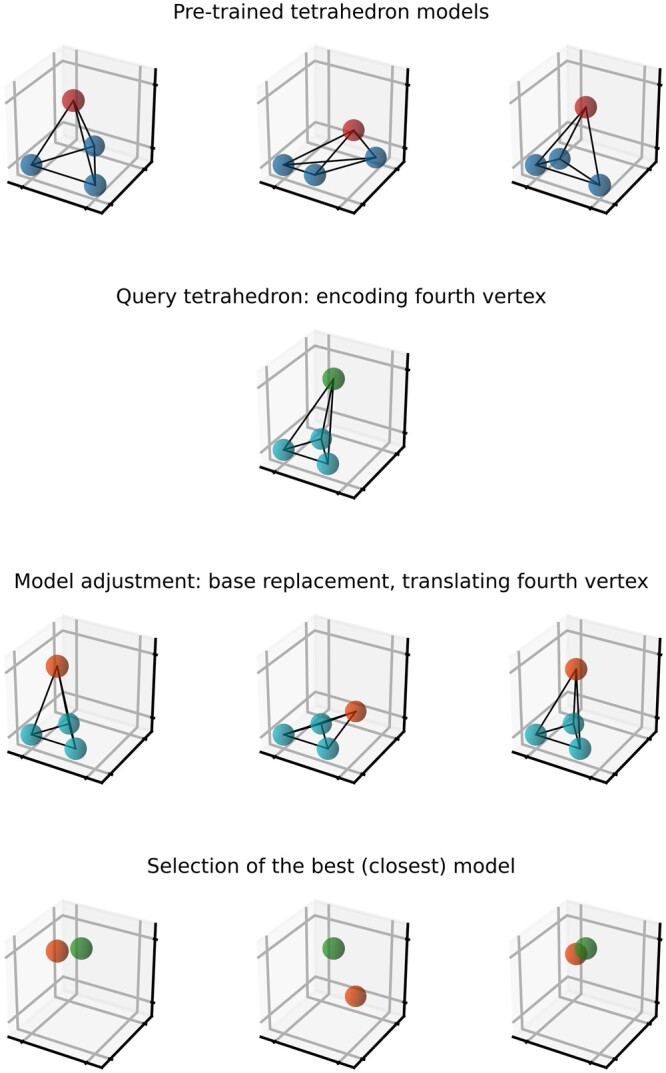
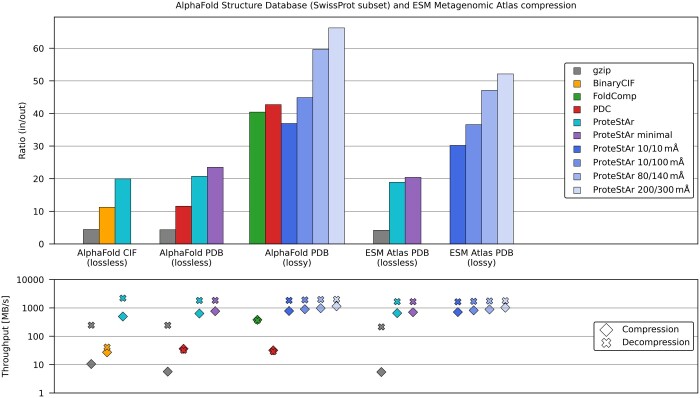
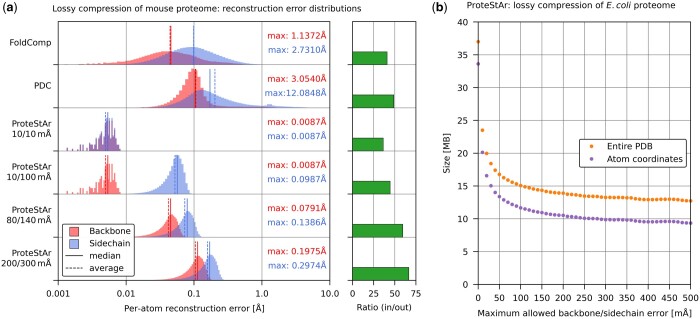
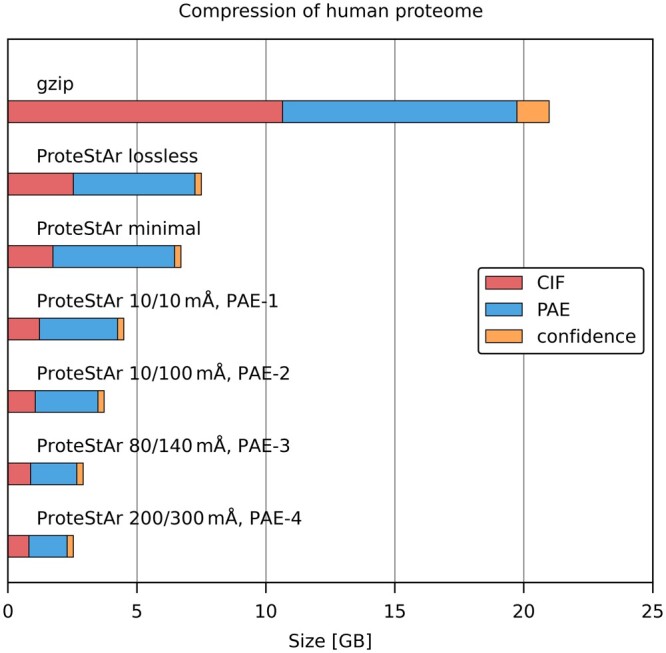
Motivation: The introduction of Deep Minds’ Alpha Fold 2 enabled the prediction of protein structures at an unprecedented scale. AlphaFold Protein Structure Database and ESM Metagenomic Atlas contain hundreds of millions of structures stored in CIF and/or PDB formats. When compressed with a general-purpose utility like gzip, this translates to tens of terabytes of data, which hinders the effective use of predicted structures in large-scale analyses. Results: Here, we present ProteStAr, a compressor dedicated to CIF/PDB, as well as supplementary PAE files. Its main contribution is a novel approach to predicting atom coordinates on the basis of the previously analyzed atoms. This allows efficient encoding of the coordinates, the largest component of the protein structure files. The compression is lossless by default, though the lossy mode with a controlled maximum error of coordinates reconstruction is also present. Compared to the competing packages, i.e. BinaryCIF, Foldcomp, PDC, our approach offers a superior compression ratio at established reconstruction accuracy. By the efficient use of threads at both compression and decompression stages, the algorithm takes advantage of the multicore architecture of current central processing units and operates with speeds of about 1 GB/s. The presence of Python and C++ API further increases the usability of the presented method. Availability and implementation: The source code of ProteStAr is available at https://github.com/refresh-bio/protestar.
Overview
The claims and statistics of this paper haven’t been checked yet.
Run the check — free, no account needed. It reads the open-access text and checks the sources it cites.
Integrity signals
Registry
Cites
Statistics
Figures
Verification
Claims the paper makes
The claims and statistics of this paper haven’t been checked yet.
Run the check — free, no account needed. It reads the open-access text and checks the sources it cites.
Self-check
Percentages, sums and reported differences re-computed from the paper’s own numbers.
The self-check needs the paper’s full text.
Citations
Cites
Highly accurate protein structure prediction with AlphaFold
Jumper, J., Evans, R., Pritzel, A., Green, T., Figurnov, M., Ronneberger, O., Tunyasuvunakool, K., Bates, R., Žídek, A., Potapenko, A., et al. (2021) · Nature · doi:10.1038/s41586-021-03819-2 · Cited by 43,764
Evolutionary-scale prediction of atomic level protein structure with a language model
Lin, Z., Akin, H., Rao, R., Hie, B., Zhu, Z., Lu, W., Smetanin, N., Verkuil, R., Kabeli, O., Shmueli, Y., et al. (2022) · doi:10.1101/2022.07.20.500902 · Cited by 5,990
Research works printed but not linked: 12
- Alakuijala, JPEG XL next-generation image compression architecture and coding tools, 10.1117/12.2529237 · DOI
- Berman, 2000, The protein data bank, Nucleic Acids Res, 28, 235, 10.1093/nar/28.1.235 · DOI · Paper page
- Bradley, 2017, MMTF—an efficient file format for the transmission, visualization, and analysis of macromolecular structures, PLoS Comput Biol, 13, e1005575, 10.1371/journal.pcbi.1005575 · DOI
- Forgy, 1965, Cluster analysis of multivariate data: efficiency versus interpretability of classifications, Biometrics, 21, 768
- Kim, 2023, Foldcomp: a library and format for compressing and indexing large protein structure sets, Bioinformatics, 39, btad153, 10.1093/bioinformatics/btad153 · DOI · Paper page
- Rotkiewicz, 2008, Fast procedure for reconstruction of full atom protein models from reduced representations, J Comput Chem, 29, 1460, 10.1002/jcc.20906 · DOI
- Salomon, 2010, Handbook of Data Compression, 10.1007/978-1-84882-903-9 · DOI
- Sehnal, 2020, BinaryCIF and CIFTools-Lightweight, efficient and extensible macromolecular data management, PLoS Comput Biol, 16, e1008247, 10.1371/journal.pcbi.1008247 · DOI
- Staniscia, 2023, Image-centric compression of protein structures improves space savings, BMC Bioinformatics, 24, 437, 10.1186/s12859-023-05570-z · DOI
- Varadi, 2021, AlphaFold protein structure database: massively expanding the structural coverage of protein-sequence space with high-accuracy models, Nucleic Acids Res, 50, D439, 10.1093/nar/gkab1061 · DOI · Paper page
- Westbrook, 2022, PDBx/mmCIF ecosystem: foundational semantic tools for structural biology, J Mol Biol, 434, 167599, 10.1016/j.jmb.2022.167599 · DOI
- Zhang, 2023, PDC: a highly compact file format to store protein 3D coordinates, Database, 2023, baad018, 10.1093/database/baad018 · DOI
Metadata
- Authors
- Deorowicz, S., & Gudyś, A.
- Affiliations
- Silesian University of Technology (PL)
- Corresponding author
- Deorowicz, Sebastian
- Gudyś, Adam
- Venue
- Bioinformatics
- Publisher
- Oxford University Press (OUP)
- Published
- 2024-07-01
- Volume
- 40
- Issue
- 7
- ISSN
- 1367-4803 (ISSN-L)
- 1367-4811
- PMC
- PMC11239224
- OpenAlex
- W4400517741
- Cited by
- 4
- References
- 2
- Citations by year
- 2026: 2 · 2025: 1 · 2024: 1
- FWCI
- 0.59
- Type
- journal article
- Language
- en
- Open access
- gold
- doi.org
- Licence
- Locations
- Bioinformatics (publishedVersion, cc-by)
- bioRxiv (Cold Spring Harbor Laboratory) (acceptedVersion, cc-by)
- PubMed Central (publishedVersion, cc-by)
- PubMed (publishedVersion)
- Funders
- National Science Centre (DEC-2022/45/B/ST6/03032)
- Silesian University of Technology (02/080/RGJ23/0032, 02/080/RGJ23/0034)
- Topics
- Physical Sciences › Mathematics › Theoretical Computer Science › Algorithms and Data Compression
- Life Sciences › Biochemistry, Genetics and Molecular Biology › Molecular Biology › Protein Structure and Dynamics
- Life Sciences › Biochemistry, Genetics and Molecular Biology › Structural Biology › Enzyme Structure and Function
- Keywords
- coordinate prediction, lossless compression, lossy compression, AlphaFold
- MeSH terms
- Algorithms, Protein Conformation, Proteins, Software, Computational Biology, Databases, Protein, Data Compression
About these checks
Registry, retraction, Cites and statistics results are computed, not judged, with one exception: a printed reference that no index lists is read once by a model before it counts as a citation error. Claims are extracted by a model and kept only when their quote appears verbatim in the text; each cited source is then checked, with a model’s help, for whether it says what the claim relies on. Those verdicts can be wrong — read the claim’s quote and the cited source before relying on one.
Statistics and arithmetic are recomputed, not judged.
Confidence bands are shown only for fields calibrated on our annotated test set. None is calibrated yet, so no band is shown.
What counts as a claim ›How we measure confidence ›How we check this ›
Are you an author, or do you see a problem with this page? Request a review
