

The DOI matches its Crossref record; 3 of the 3 references it cites were found in a registry or an index.
scDock: streamlining drug discovery targeting cell–cell communication via scRNA-seq analysis and molecular docking
Open accessPublished version of a preprint
Abstract
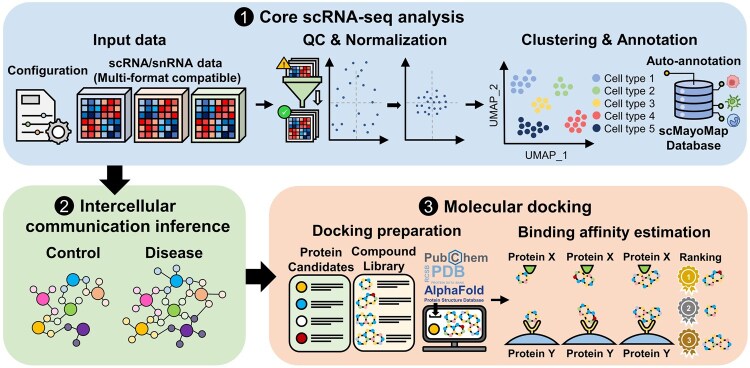
Summary: Identifying drugs that target intercellular communication networks represents a promising therapeutic strategy, yet linking single-cell RNA sequencing (scRNA-seq) analysis to structure-based drug screening remains technically challenging and requires substantial bioinformatics expertise. We present scDock, an integrated and user-friendly pipeline that seamlessly connects scRNA-seq data processing, cell–cell communication inference, and molecular docking-based drug discovery. Through a single configuration file, users can execute the complete workflow, from raw scRNA-seq data to ranked drug candidates, without programming skills. scDock automates the identification of disease-relevant ligand–receptor interactions from scRNA-seq data and performs structure-based virtual screening against these communication targets using Protein Data Bank (PDB) or AlphaFold-predicted protein structures. The pipeline generates comprehensive outputs at each stage, enabling users to explore intercellular signaling alterations and discover therapeutic compounds targeting specific cell–cell communications. scDock addresses a critical gap by providing an accessible end-to-end solution for communication-targeted drug discovery from single-cell data. Availability and implementation: scDock is freely available at https://doi.org/10.6084/m9.figshare.31370368 and https://github.com/Andrewneteye4343/scDock. It is implemented in R, Python, shell scripts, and supports Linux systems, including Ubuntu and Debian.
Overview
The claims and statistics of this paper haven’t been checked yet.
Run the check — free, no account needed. It reads the open-access text and checks the sources it cites.
Integrity signals
Registry
Cites
Statistics
Figures
Verification
Claims the paper makes
The claims and statistics of this paper haven’t been checked yet.
Run the check — free, no account needed. It reads the open-access text and checks the sources it cites.
Self-check
Percentages, sums and reported differences re-computed from the paper’s own numbers.
The self-check needs the paper’s full text.
Citations
Cites
Highly accurate protein structure prediction with AlphaFold
Jumper, J., Evans, R., Pritzel, A., Green, T., Figurnov, M., Ronneberger, O., Tunyasuvunakool, K., Bates, R., Žídek, A., Potapenko, A., et al. (2021) · Nature · doi:10.1038/s41586-021-03819-2 · Cited by 43,764
CellChat for systematic analysis of cell–cell communication from single-cell transcriptomics
Jin, S., Plikus, M. V., & Nie, Q. (2025) · Nature Protocols · doi:10.1038/s41596-024-01045-4 · Cited by 1,448
Lu, H., Zhou, Q., He, J., Jiang, Z., Peng, C., Tong, R., & Shi, J. (2020) · Signal Transduction and Targeted Therapy · doi:10.1038/s41392-020-00315-3 · Cited by 891
Research works printed but not linked: 18
- Aibar, 2017, SCENIC: single-cell regulatory network inference and clustering, Nat Methods, 14, 1083, 10.1038/nmeth.4463 · DOI · Paper page
- Becht, 2018, Dimensionality reduction for visualizing single-cell data using UMAP, Nat Biotechnol, 37, 38, 10.1038/nbt.4314 · DOI · Paper page
- Bergen, 2020, Generalizing RNA velocity to transient cell states through dynamical modeling, Nat Biotechnol, 38, 1408, 10.1038/s41587-020-0591-3 · DOI · Paper page
- Berman, 2000, The protein data bank, Nucleic Acids Res, 28, 235, 10.1093/nar/28.1.235 · DOI · Paper page
- Butler, 2018, Integrating single-cell transcriptomic data across different conditions, technologies, and species, Nat Biotechnol, 36, 411, 10.1038/nbt.4096 · DOI · Paper page
- Cao, 2017, Comprehensive single-cell transcriptional profiling of a multicellular organism, Science, 357, 661, 10.1126/science.aam8940 · DOI · Paper page
- Hao, 2024, Dictionary learning for integrative, multimodal and scalable single-cell analysis, Nat Biotechnol, 42, 293, 10.1038/s41587-023-01767-y · DOI · Paper page
- Hie, 2019, Efficient integration of heterogeneous single-cell transcriptomes using Scanorama, Nat Biotechnol, 37, 685, 10.1038/s41587-019-0113-3 · DOI
- Kim, 2025, PubChem 2025 update, Nucleic Acids Res, 53, D1516, 10.1093/nar/gkae1059 · DOI
- Korsunsky, 2019, Fast, sensitive and accurate integration of single-cell data with Harmony, Nat Methods, 16, 1289, 10.1038/s41592-019-0619-0 · DOI · Paper page
- Liu, 2023, Single-cell transcriptomics reveals a mechanosensitive injury signaling pathway in early diabetic nephropathy, Genome Med, 15, 2, 10.1186/s13073-022-01145-4 · DOI
- Liu, 2025, BindingDB in 2024: a FAIR knowledgebase of protein-small molecule binding data, Nucleic Acids Res, 53, D1633, 10.1093/nar/gkae1075 · DOI
- Morris, 2009, AutoDock4 and AutoDockTools4: automated docking with selective receptor flexibility, J Comput Chem, 30, 2785, 10.1002/jcc.21256 · DOI
- O’Boyle, 2011, Open Babel: an open chemical toolbox, J Cheminform, 3, 33, 10.1186/1758-2946-3-33 · DOI
- Stuart, 2019, Comprehensive integration of Single-Cell data, Cell, 177, 1888, 10.1016/j.cell.2019.05.031 · DOI · Paper page
- Trott, 2010, AutoDock Vina: improving the speed and accuracy of docking with a new scoring function, efficient optimization, and multithreading, J Comput Chem, 31, 455, 10.1002/jcc.21334 · DOI · Paper page
- Yang, 2023, Single-cell Mayo Map (scMayoMap): an easy-to-use tool for cell type annotation in single-cell RNA-sequencing data analysis, BMC Biol, 21, 223, 10.1186/s12915-023-01728-6 · DOI
- Zhuang, 2022, findPC: an R package to automatically select the number of principal components in single-cell analysis, Bioinformatics, 38, 2949, 10.1093/bioinformatics/btac235 · DOI
Metadata
- Authors
- Huang, C.-H., Oyang, Y.-J., Huang, H.-C., & Juan, H.-F.
- Affiliations
- Graduate Institute of Biomedical Electronics and Bioinformatics, National Taiwan University , Taipei 106,
- National Taiwan University (TW)
- National Yang Ming Chiao Tung University (TW)
- Corresponding author
- Huang, Hsuan-Cheng
- Juan, Hsueh-Fen
- Venue
- Bioinformatics
- Publisher
- Oxford University Press (OUP)
- Published
- 2026-02-28
- Volume
- 42
- Issue
- 3
- ISSN
- 1367-4803 (ISSN-L)
- 1367-4811
- PMC
- PMC12996892
- OpenAlex
- W7133224016
- Cited by
- 1
- References
- 3
- Citations by year
- 2026: 1
- FWCI
- 3.63
- Type
- journal article
- Language
- en
- Open access
- gold
- doi.org
- Licence
- Locations
- Bioinformatics (publishedVersion, cc-by)
- bioRxiv (Cold Spring Harbor Laboratory) (acceptedVersion)
- PubMed Central (publishedVersion, cc-by)
- PubMed (publishedVersion)
- Funders
- National Science and Technology Council (NSTC 112-2221-E-A49-061-MY3, NSTC 114-2221-E-A49-144-MY3)
- Topics
- Life Sciences › Pharmacology, Toxicology and Pharmaceutics › Drug Discovery › Computational Drug Discovery Methods
- Life Sciences › Biochemistry, Genetics and Molecular Biology › Molecular Biology › Single-cell and spatial transcriptomics
- Life Sciences › Biochemistry, Genetics and Molecular Biology › Molecular Biology › Bioinformatics and Genomic Networks
- Keywords
- intercellular communication, drug discovery, ligand-receptor interactions, structure-based virtual screening, molecular docking, single-cell RNA sequencing, AlphaFold protein structure, drug target prioritization, bioinformatics pipeline
- MeSH terms
- RNA-Seq, Single-Cell Gene Expression Analysis, Cell Communication, Humans, Ligands, Software, Sequence Analysis, RNA, Computational Biology, Drug Discovery, Single-Cell Analysis, Molecular Docking Simulation
About these checks
Registry, retraction, Cites and statistics results are computed, not judged, with one exception: a printed reference that no index lists is read once by a model before it counts as a citation error. Claims are extracted by a model and kept only when their quote appears verbatim in the text; each cited source is then checked, with a model’s help, for whether it says what the claim relies on. Those verdicts can be wrong — read the claim’s quote and the cited source before relying on one.
Statistics and arithmetic are recomputed, not judged.
Confidence bands are shown only for fields calibrated on our annotated test set. None is calibrated yet, so no band is shown.
What counts as a claim ›How we measure confidence ›How we check this ›
Are you an author, or do you see a problem with this page? Request a review
