

A defect of sphingolipid metabolism modifies the properties of normal appearing white matter in multiple sclerosis
Open accessThe DOI matches its Crossref record; 45 of the 46 references it cites were found in a registry or an index.
Abstract
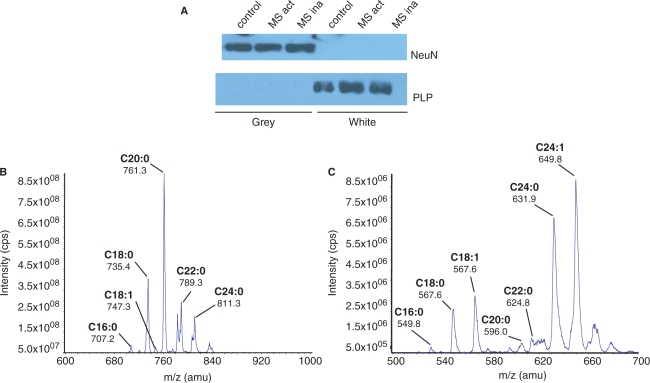
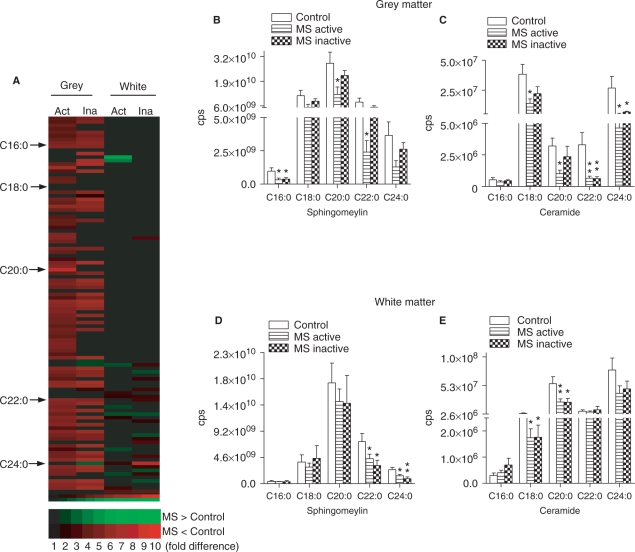
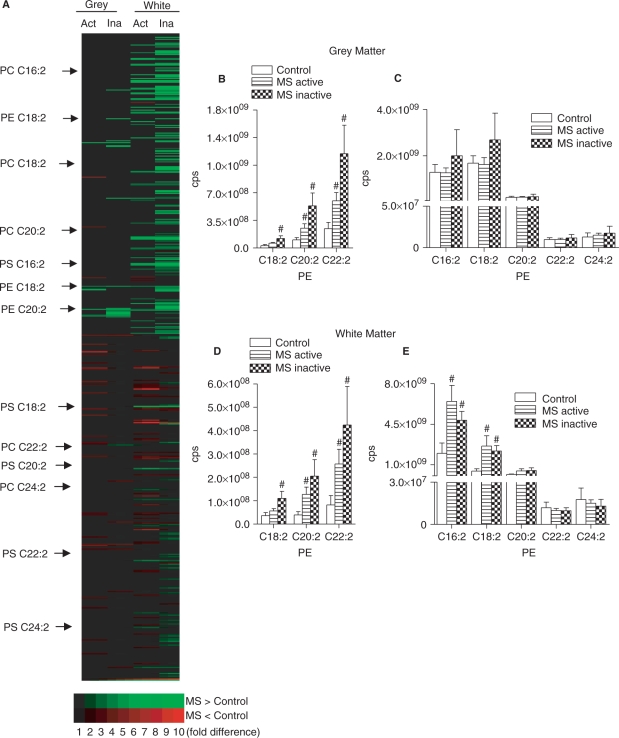
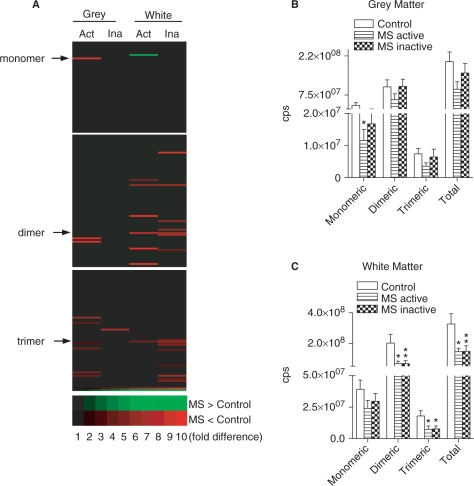
Maintaining the appropriate complement and content of lipids in cellular membranes is critical for normal neural function. Accumulating evidence suggests that even subtle perturbations in the lipid content of neurons and myelin can disrupt their function and may contribute to myelin and axonal degradation. In this study, we determined the composition and quantified the content of lipids and sterols in normal appearing white matter (NAWM) and normal appearing grey matter (NAGM) from control and multiple sclerosis brain tissues by electrospray ionization tandem mass spectrometry. Our results suggest that in active-multiple sclerosis, there is a shift in the lipid composition of NAWM and NAGM to a higher phospholipid and lower sphingolipid content. We found that this disturbance in lipid composition was reduced in NAGM but not in NAWM of inactive-multiple sclerosis. The pattern of disturbance in lipid composition suggests a metabolic defect that causes sphingolipids to be shuttled to phospholipid production. Modelling the biophysical consequence of this change in lipid composition of NAWM indicated an increase in the repulsive force between opposing bilayers that could explain decompaction and disruption of myelin structure.
Overview
The claims and statistics of this paper haven’t been checked yet.
Free: it reads the open-access text and checks the first 5 claims that cite a source we can check. Create a free account to check every claim.
Integrity signals
Registry
Cites
Statistics
Figures
Verification
Claims the paper makes
The claims and statistics of this paper haven’t been checked yet.
Free: it reads the open-access text and checks the first 5 claims that cite a source we can check. Create a free account to check every claim.
Claims other papers make about this one
Each is checked against this paper’s own text: does it say what the citing paper says it does?
The cited source says what the claim attributes to it.
In the citing paper
“Its composition can vary between tissue types (González de San Román et al., 2018), species (Gopalakrishnan et al., 2013) and in pathologies (Wheeler et al., 2008)”
From Can MRI measure myelin? Systematic review, qualitative assessment, and meta-analysis of studies validating microstructural imaging with myelin histology (2021) · cites this paper as Wheeler et al., 2008
Self-check
Percentages, sums and reported differences re-computed from the paper’s own numbers.
The self-check needs the paper’s full text.
Citations
Cites
Derjaguin, B. V. (1941) · Cited by 5,490
The Immune Modulator FTY720 Targets Sphingosine 1-Phosphate Receptors
Brinkmann, V., Davis, M. D., Heise, C. E., Albert, R., Cottens, S., Hof, R., Bruns, C., Prieschl, E., Baumruker, T., Hiestand, P., et al. (2002) · Journal of Biological Chemistry · doi:10.1074/jbc.c200176200 · Cited by 1,504 · cited 2×
“This orally available S1P-receptor modulator has shown striking efficacy in experimental allergic encephalomyelitis models of multiple sclerosis (Brinkmann et al., 2002; Fujino et al., 2003; Webb et al., 2004 Kataoka et al., 2005; Balatoni et al., 2007) and recent results from phase II trials with…”
BackgroundTheory of the Stability of Lyophobic Colloids.
Verwey, E. J. W. (1947) · The Journal of Physical and Colloid Chemistry · doi:10.1021/j150453a001 · Cited by 1,367
Oral Fingolimod (FTY720) for Relapsing Multiple Sclerosis
Kappos, L., Antel, J., Comi, G., Montalban, X., O'Connor, P., Polman, C. H., Haas, T., Korn, A. A., Karlsson, G., & Radue, E. W. (2006) · New England Journal of Medicine · doi:10.1056/nejmoa052643 · Cited by 1,054 · cited 2×
“, 2007) and recent results from phase II trials with RRMS patients are promising (Kappos et al., 2006).”
BackgroundResultIdentification of autoantibodies associated with myelin damage in multiple sclerosis
Genain, C. P., Cannella, B., Hauser, S. L., & Raine, C. S. (1999) · Nature Medicine · doi:10.1038/5532 · Cited by 892 · cited 1×
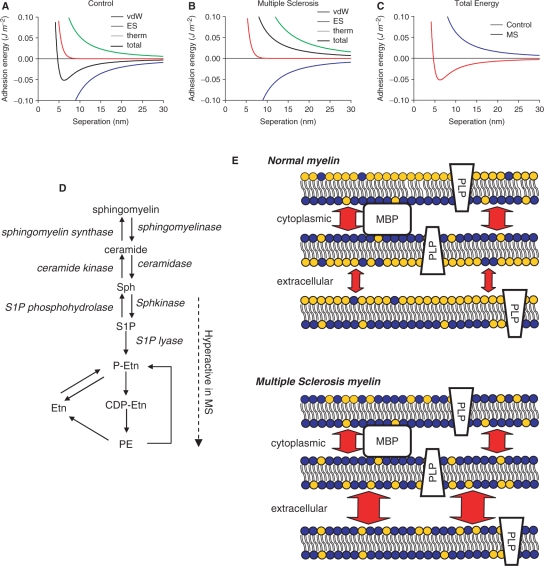
“Thus, a change in repulsive energy is more likely to disrupt adhesion at the intraperiod line, consistent with reports that this interface is more often disrupted in demyelinating disease (Bornstein and Raines, 1976; Genain et al., 1999).”
ResultPhysical properties of the fluid lipid-bilayer component of cell membranes: a perspective
Bloom, M., Evans, E., & Mouritsen, O. G. (1991) · Quarterly Reviews of Biophysics · doi:10.1017/s0033583500003735 · Cited by 872 · cited 1×
“6C) (Servuss et al., 1976; Evans and Parsegian, 1986; Bloom et al., 1991).”
Sphingosine kinases, sphingosine 1-phosphate, apoptosis and diseases
Hait, N. C., Oskeritzian, C. A., Paugh, S. W., Milstien, S., & Spiegel, S. (2006) · Biochimica et Biophysica Acta (BBA) - Biomembranes · doi:10.1016/j.bbamem.2006.08.007 · Cited by 478 · cited 1×
“S1P is a potent endogenous lipid mediator involved in cell survival, proliferation and cell–cell interactions (see Hait et al., 2006 for a review).”
BackgroundFoster, C. A., Howard, L. M., Schweitzer, A., Persohn, E., Hiestand, P. C., Balatoni, B., Reuschel, R., Beerli, C., Schwartz, M., & Billich, A. (2007) · The Journal of Pharmacology and Experimental Therapeutics · doi:10.1124/jpet.107.127183 · Cited by 322 · cited 1×
“These results are consistent with evidence that the bioactive metabolite FTY720-P widely distributes to the CNS white matter, supporting the likelihood for functional interaction with glial cells bearing S1P receptors in the brain and spinal cord (Foster et al., 2007).”
ResultVerwey, E. J. W., & Overbeek, J. T. G. (1948) · Elsevier eBooks · Cited by 293
Amelioration of Experimental Autoimmune Encephalomyelitis in Lewis Rats by FTY720 Treatment
Fujino, M., Funeshima, N., Kitazawa, Y., Kimura, H., Amemiya, H., Suzuki, S., & Li, X.-K. (2003) · The Journal of Pharmacology and Experimental Therapeutics · doi:10.1124/jpet.102.045658 · Cited by 280 · cited 2×
“…S1P-receptor modulator has shown striking efficacy in experimental allergic encephalomyelitis models of multiple sclerosis (Brinkmann et al., 2002; Fujino et al., 2003; Webb et al., 2004 Kataoka et al., 2005; Balatoni et al., 2007) and recent results from phase II trials with RRMS patients are…”
Background
Cited by
Mechanism of Action of Oral Fingolimod (FTY720) in Multiple Sclerosis
Chun, J., & Hartung, H.-P. (2010) · Clinical Neuropharmacology · doi:10.1097/wnf.0b013e3181cbf825 · Cited by 796
“Sphingosine 1-phosphate receptors have been implicated in disease progression on the basis of studies in animal models of MS,(47,48) and data from a human study suggest that there is a disturbance in sphingolipid metabolism in MS patients.(49) There are 5 known S1P receptor subtypes, S1P1Y5, and these are expressed on…”
BackgroundChoi, J. W., Gardell, S. E., Herr, D. R., Rivera, R., Lee, C.-W., Noguchi, K., Teo, S. T., Yung, Y. C., Lu, M., Kennedy, G., et al. (2011) · Proceedings of the National Academy of Sciences · doi:10.1073/pnas.1014154108 · Cited by 581
Adibhatla, R. M., & Hatcher, J. F. (2010) · Antioxidants & Redox Signaling · doi:10.1089/ars.2009.2668 · Cited by 480
Groves, A., Kihara, Y., & Chun, J. (2013) · Journal of the Neurological Sciences · doi:10.1016/j.jns.2013.02.011 · Cited by 314
“white matter [65] but an increased level of S1P in their cerebrospinal fluid [66].”
Redox Control of Microglial Function: Molecular Mechanisms and Functional Significance
Rojo, A. I., McBean, G., Cindric, M., Egea, J., López, M. G., Rada, P., Zarkovic, N., & Cuadrado, A. (2014) · Antioxidants & Redox Signaling · doi:10.1089/ars.2013.5745 · Cited by 309
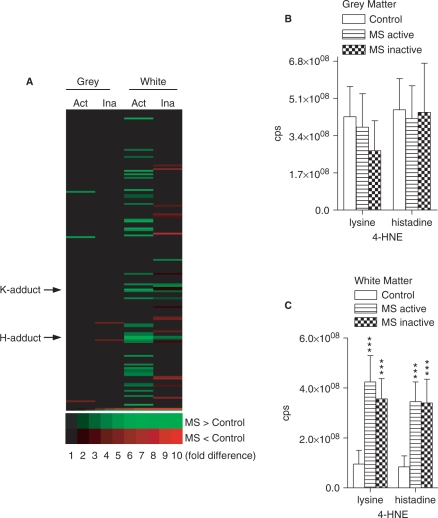
“Even though free HNE was not detected in MS, a large accumulation of both lysine and histidine HNE adducts was observed, implying a role of HNE in protein modifications (336).”
Metadata
- Authors
- Wheeler, D., Bandaru, V. V. R., Calabresi, P. A., Nath, A., & Haughey, N. J.
- Affiliations
- Johns Hopkins University (US)
- Corresponding author
- Haughey, Norman J.
- Venue
- Brain
- Publisher
- Oxford University Press (OUP)
- Published
- 2008-09-04
- Volume
- 131
- Issue
- 11
- Pages
- 3092-3102
- ISSN
- 0006-8950 (ISSN-L)
- 1460-2156
- PMC
- PMC2577809
- OpenAlex
- W2060437747
- Semantic Scholar
- f4513ecd3047b9a0b6bfc9c95ff089d6bdcb5427
- Cited by
- 171
- References
- 46
- Citations by year
- 2026: 4 · 2025: 9 · 2024: 12 · 2023: 10 · 2022: 7 · 2021: 10 · 2020: 16 · 2019: 12 · 2018: 8 · 2017: 11 · 2016: 8 · 2015: 9 · 2014: 12 · 2013: 9 · 2012: 8
- FWCI
- 6.17
- Type
- journal article
- Language
- en
- Open access
- bronze
- doi.org
- Locations
- Brain (publishedVersion)
- PubMed Central (publishedVersion, cc-by-nc)
- PubMed (publishedVersion)
- Funders
- Multiple Sclerosis Society
- National Institutes of Health
- National Institute on Alcohol Abuse and Alcoholism (R01AA017408, AA017408)
- National Institute on Aging (R21AG034849, AG023471, R01AG023471)
- National Institute of Mental Health (MH077542, R21MH072534, R01MH077542, P30MH075673)
- Topics
- Health Sciences › Medicine › Clinical Neurology › Multiple Sclerosis Research Studies
- Life Sciences › Biochemistry, Genetics and Molecular Biology › Molecular Biology › Sphingolipid Metabolism and Signaling
- Life Sciences › Biochemistry, Genetics and Molecular Biology › Molecular Biology › Lipid Membrane Structure and Behavior
- Keywords
- multiple sclerosis, normal-appearing white matter, normal-appearing gray matter, sphingolipid metabolism, lipid composition, phospholipids, myelin, membrane sterols, myelin degradation, axonal degeneration
- MeSH terms
- Adult, Aldehydes, Biophysics, Brain, Cholesterol, Female, Humans, Male, Membrane Lipids, Middle Aged, Models, Biological, Multiple Sclerosis, Myelin Sheath, Phospholipids, Sphingolipids, Lipid Peroxidation, Spectrometry, Mass, Electrospray Ionization, Young Adult
About these checks
Registry, retraction, Cites and statistics results are computed, not judged, with one exception: a printed reference that no index lists is read once by a model before it counts as a citation error. Claims are extracted by a model and kept only when their quote appears verbatim in the text; each cited source is then checked, with a model’s help, for whether it says what the claim relies on. Those verdicts can be wrong — read the claim’s quote and the cited source before relying on one.
Statistics and arithmetic are recomputed, not judged.
Confidence bands are shown only for fields calibrated on our annotated test set. None is calibrated yet, so no band is shown.
What counts as a claim ›How we measure confidence ›How we check this ›
Are you an author, or do you see a problem with this page? Request a review
Data sources
Bibliographic data: Semantic Scholar, OpenAlex, Crossref.
Contains information from the Semantic Scholar Academic Graph Datasets, made available under the ODC Attribution License (ODC-BY 1.0).
Semantic Scholar’s data is described in: Kinney, R., et al. (2023). The Semantic Scholar Open Data Platform. arXiv:2301.10140.
