

The DOI matches its Crossref record; 32 of the 32 references it cites were found in a registry or an index.
The prognosis of functional limb weakness: a 14-year case-control study
Open accessAbstract
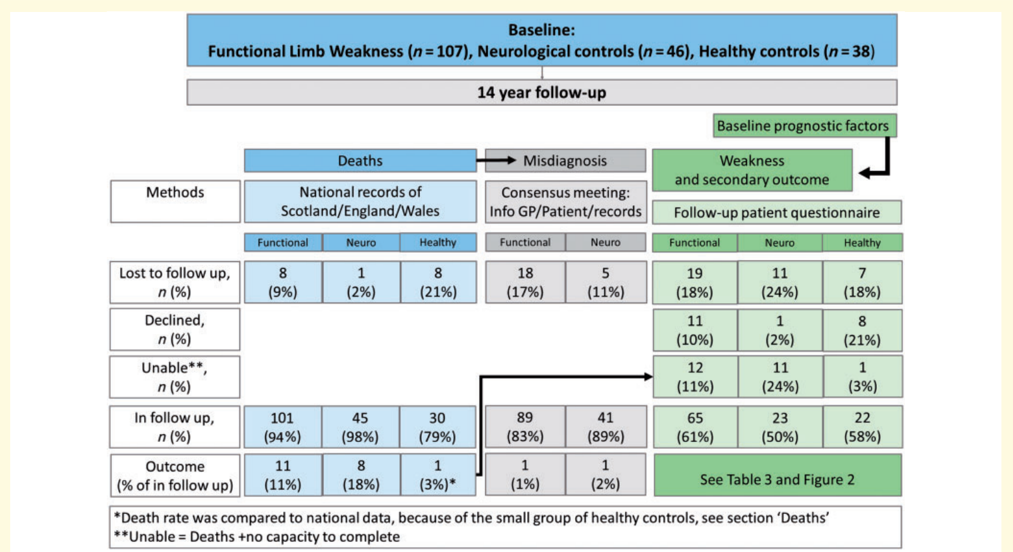
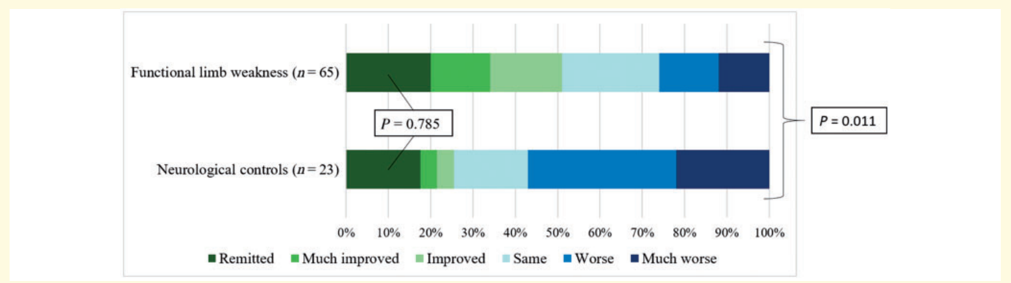
Reliable data on the prognosis of functional motor disorder are scarce, as existing studies of the prognosis of functional motor disorder are nearly all retrospective, small and uncontrolled. In this study we used a prospectively recruited, controlled cohort design to assess misdiagnosis, mortality and symptomatic and health outcome in patients with functional limb weakness compared to neurological disease and healthy control subjects. We also carried out an exploratory analysis for baseline factors predicting outcome. One hundred and seven patients with functional limb weakness, 46 neurological and 38 healthy control subjects from our previously studied prospective cohort were traced for follow-up after an average of 14 years. Misdiagnosis was determined in a consensus meeting using information from records, patients and their GPs. Numbers and causes of death were collected via death certificates. Outcome of limb weakness, physical and psychiatric symptoms, disability/quality of life and illness perception were recorded with self-rated questionnaires. Outcome measures were compared within and between groups. Seventy-six patients (71%) with functional limb weakness, 31 (67%) neurological and 23 (61%) healthy controls were included in follow-up. Misdiagnosis was found in one patient in the functional limb weakness group (1%) and in one neurological control (2%). Eleven patients with functional limb weakness, eight neurological control subjects and one healthy control subject had died. Weakness had completely remitted in 20% of patients in the functional limb weakness group and in 18% of the neurological controls (P = 0.785) and improved in a larger proportion of functional limb weakness patients (P = 0.011). Outcomes were comparable between patient groups, and worse than the healthy control group. No baseline factors were independent predictors of outcome, although somatization disorder, general health, pain and total symptoms at baseline were univariably correlated to outcome. This study is the largest and longest follow-up study of functional limb weakness. Misdiagnosis in functional limb weakness is rare after long-term follow-up. The disorder is associated with a higher mortality rate than expected, and symptoms are persistent and disabling. It appears difficult to predict outcome based on common baseline variables. These data should help inform clinicians to provide a more realistic outlook of the outcome and emphasize the importance of active and targeted therapy.
Overview
The claims and statistics of this paper haven’t been checked yet.
Run the check — free, no account needed. It reads the open-access text and checks the sources it cites.
Integrity signals
Registry
Cites
Statistics
Figures
Verification
Claims the paper makes
The claims and statistics of this paper haven’t been checked yet.
Run the check — free, no account needed. It reads the open-access text and checks the sources it cites.
Claims other papers make about this one
Each is checked against this paper’s own text: does it say what the citing paper says it does?
The source backs part of the claim, not all of it — or backs it for a different population, condition or comparison.
In the citing paper
“In a 14-year prospective case–control study of 89 patients with functional limb weakness published in 2019, the only person who had a diagnosis at follow-up which in hindsight may have been a better explanation for their symptoms had been diagnosed with MS. This patient had comorbid FND and MS [18].”
From Functional neurological disorder and multiple sclerosis: a systematic review of misdiagnosis and clinical overlap (2022) · cites this paper as [18]
Experimental — accuracy not yet measuredThe cited source says what the claim attributes to it.
In the citing paper
“This patient had comorbid FND and MS [18].”
From Functional neurological disorder and multiple sclerosis: a systematic review of misdiagnosis and clinical overlap (2022) · cites this paper as [18]
The cited source says what the claim attributes to it.
In the citing paper
“Clinical practice suggests that FND diagnoses do generally remain stable [7, 17, 18]”
From Functional neurological disorder and multiple sclerosis: a systematic review of misdiagnosis and clinical overlap (2022) · cites this paper as [18]
Self-check
Percentages, sums and reported differences re-computed from the paper’s own numbers.
The self-check needs the paper’s full text.
Citations
Cites
Handbook of Clinical Neurology
Drake, M. J. (2015) · Handbook of clinical neurology · Cited by 592
The prognosis of functional (psychogenic) motor symptoms: a systematic review
Gelauff, J., Stone, J., Edwards, M., & Carson, A. (2014) · Journal of Neurology, Neurosurgery & Psychiatry · doi:10.1136/jnnp-2013-305321 · Cited by 368 · cited 4×
“As duration of symptoms has been found to be a negative prognostic factor (Gelauff et al., 2014), prognosis may be better in patients presenting to primary care or emergency settings.”
BackgroundMethodInfluentialSelf-citationSystematic review of misdiagnosis of conversion symptoms and “hysteria”
Stone, J., Smyth, R., Carson, A., Lewis, S., Prescott, R., Warlow, C., & Sharpe, M. (2005) · BMJ · doi:10.1136/bmj.38628.466898.55 · Cited by 358 · cited 1×
“Rates of diagnostic revision have been 4% since 1970 (Stone et al., 2005).”
BackgroundSelf-citationStone, J., Carson, A., Duncan, R., Coleman, R., Roberts, R., Warlow, C., Hibberd, C., Murray, G., Cull, R., Pelosi, A., et al. (2009) · Brain · doi:10.1093/brain/awp220 · Cited by 356 · cited 4×
“Not all diagnostic revision represents a ‘misdiagnosis’ and we categorized patients according to the classification of Stone et al. (2009).”
BackgroundMethodInfluentialSelf-citationSlater revisited: 6 year follow up study of patients with medically unexplained motor symptoms
Crimlisk, H. L., Bhatia, K., Cope, H., David, A., Marsden, C. D., & Ron, M. A. (1998) · BMJ · doi:10.1136/bmj.316.7131.582 · Cited by 328 · cited 5×
“The two studies that have investigated this have found no correlation between somatoform disorders and outcome (Crimlisk et al., 1998; Ibrahim et al., 2009).”
BackgroundInfluentialPsychogenic movement disorders: frequency, clinical profile, and characteristics.
Factor, S. A., Podskalny, G. D., & Molho, E. (1995) · Journal of Neurology Neurosurgery & Psychiatry · doi:10.1136/jnnp.59.4.406 · Cited by 313 · cited 1×
“Factors that have most consistently correlated with positive outcome in the literature included an early diagnosis and short duration of symptoms at baseline (Knutsson and Mårtensson, 1985; Couprie et al., 1995; Factor et al., 1995; Mace and Trimble, 1996; Crimlisk et al., 1998; Feinstein et al., 2001; Thomas et al.,…”
BackgroundDiagnostic and pathophysiological aspects of psychogenic tremors
Deuschl, G., Köster, B., Lücking, C. H., & Scheidt, C. E. (1998) · Movement Disorders · doi:10.1002/mds.870130216 · Cited by 283 · cited 2×
“functional motor symptoms the limited available data do not provide a meaningful answer (Crimlisk et al., 1998; Deuschl et al., 1998; Feinstein et al., 2001; Stone et al., 2003).”
BackgroundThe symptom of functional weakness: a controlled study of 107 patients
Stone, J., Warlow, C. P., & Sharpe, M. (2010) · Brain · doi:10.1093/brain/awq068 · Cited by 273 · cited 2×
“Most of these factors were based on standardized questionnaires (Stone et al., 2010).”
BackgroundSelf-citationCarson, A. J., Stone, J., Hibberd, C., Murray, G. D., Duncan, R., Coleman, R. J., Warlow, C., ROBERTS, R. C., Pelosi, A. J., Cavanagh, J., et al. (2011) · Journal of Neurology Neurosurgery & Psychiatry · doi:10.1136/jnnp.2010.220640 · Cited by 273 · cited 2×
“Our own large epidemiological study of patients presenting to neurologists with symptoms lacking a pathophysiological explanation, a wider phenotype than functional motor symptoms (Carson et al., 2011), found a much lower frequency of that diagnostic revision and highlighted that actual diagnostic error was rare (4 ou…”
BackgroundResultSelf-citationPsychiatric outcome in patients with a psychogenic movement disorder: a prospective study.
Feinstein, A., Stergiopoulos, V., Fine, J., & Lang, A. E. (2001) · PubMed · Cited by 195
The 12 year prognosis of unilateral functional weakness and sensory disturbance
Stone, J. (2003) · Journal of Neurology Neurosurgery & Psychiatry · doi:10.1136/jnnp.74.5.591 · Cited by 151 · cited 2×
“functional motor symptoms the limited available data do not provide a meaningful answer (Crimlisk et al., 1998; Deuschl et al., 1998; Feinstein et al., 2001; Stone et al., 2003).”
BackgroundSelf-citationTen-Year Prognosis of Conversion Disorder
Mace, C. J., & Trimble, M. (1996) · The British Journal of Psychiatry · doi:10.1192/bjp.169.3.282 · Cited by 134
Long-term prognosis of patients with psychogenic movement disorders
Thomas, M., Vuong, K. D., & Jankovic, J. J. (2006) · Parkinsonism & Related Disorders · doi:10.1016/j.parkreldis.2006.03.005 · Cited by 126 · cited 1×
“Factors that have most consistently correlated with positive outcome in the literature included an early diagnosis and short duration of symptoms at baseline (Knutsson and Mårtensson, 1985; Couprie et al., 1995; Factor et al., 1995; Mace and Trimble, 1996; Crimlisk et al., 1998; Feinstein et al., 2001; Thomas et al.,…”
BackgroundPrognosis of functional neurologic disorders
Gelauff, J., & Stone, J. (2016) · Handbook of clinical neurology · doi:10.1016/b978-0-12-801772-2.00043-6 · Cited by 121 · cited 1×
“It is also the longest follow-up study ever for any functional neurological disorder (Gelauff and Stone, 2016).”
BackgroundSelf-citationStone, J., Carson, A., Duncan, R., Roberts, R., Coleman, R., Warlow, C., Murray, G., Pelosi, A., Cavanagh, J., Matthews, K., et al. (2012) · Journal of Neurology · doi:10.1007/s00415-011-6111-0 · Cited by 110
Self-citationFunctional weakness: Clues to mechanism from the nature of onset
Stone, J., Warlow, C., & Sharpe, M. (2012) · Journal of Neurology, Neurosurgery & Psychiatry · doi:10.1136/jnnp-2011-300125 · Cited by 106
Self-citationFunctional neurological disorders in Parkinson disease
Wissel, B. D., Dwivedi, A. K., Merola, A., Chin, D., Jacob, C., Duker, A. P., Vaughan, J. E., Lovera, L., LaFaver, K., Levy, A., et al. (2018) · Journal of Neurology, Neurosurgery & Psychiatry · doi:10.1136/jnnp-2017-317378 · Cited by 106 · cited 1×
“This is in line with observations that functional neurological disorders often occur in the context of recognized neurological disease (Stone et al., 2012a; Pareés et al., 2013; Wissel et al., 2018).”
BackgroundOutcome in conversion disorder: a follow up study.
Couprie, W., Wijdicks, E. F. M., Hg, R., & van Gijn, J. (1995) · Journal of Neurology Neurosurgery & Psychiatry · doi:10.1136/jnnp.58.6.750 · Cited by 106 · cited 1×
“Factors that have most consistently correlated with positive outcome in the literature included an early diagnosis and short duration of symptoms at baseline (Knutsson and Mårtensson, 1985; Couprie et al., 1995; Factor et al., 1995; Mace and Trimble, 1996; Crimlisk et al., 1998; Feinstein et al., 2001; Thomas et al.,…”
BackgroundPrognosis of Hysterical Symptoms
Carter, A. B. (1949) · BMJ · doi:10.1136/bmj.1.4615.1076 · Cited by 95 · cited 1×
“Other smaller studies of outcome of patients with functional weakness, with 10–30 patients over 0.5–6 years, found a large range of outcomes with 10–56% being the same or worse weakness at follow-up (Carter, 1949; Brown and Pisetsky, 1954; Knutsson and Mårtensson, 1985; Binzer and Kullgren, 1998).”
BackgroundInfluentialMotor Conversion Disorder: A Prospective 2- to 5-Year Follow-Up Study
Binzer, M., & Kullgren, G. (1998) · Psychosomatics · doi:10.1016/s0033-3182(98)71284-8 · Cited by 90 · cited 2×
“Other studies of patients with functional motor disorders have found a low frequency of being in work ranging from 11% to 57% (Binzer and Kullgren, 1998; Crimlisk et al., 1998).”
BackgroundThe prognosis of fixed dystonia: A follow-up study
Ibrahim, N. M., Martino, D., van de Warrenburg, B. P. C., Quinn, N. P., Bhatia, K. P., Brown, R. J., Trimble, M., & Schrag, A. E. (2009) · Parkinsonism & Related Disorders · doi:10.1016/j.parkreldis.2009.02.010 · Cited by 86 · cited 2×
“The two studies that have investigated this have found no correlation between somatoform disorders and outcome (Crimlisk et al., 1998; Ibrahim et al., 2009).”
BackgroundPsychogenic Tremor: Long-Term Outcome
Jankovic, J. J., Vuong, K. D., & Thomas, M. (2006) · CNS Spectrums · doi:10.1017/s1092852900013535 · Cited by 82 · cited 1×
“Factors that have most consistently correlated with positive outcome in the literature included an early diagnosis and short duration of symptoms at baseline (Knutsson and Mårtensson, 1985; Couprie et al., 1995; Factor et al., 1995; Mace and Trimble, 1996; Crimlisk et al., 1998; Feinstein et al., 2001; Thomas et al.,…”
BackgroundFunctional (psychogenic) symptoms in Parkinson's disease
Pareés, I., Saifee, T. A., Kojović, M., Kassavetis, P., Rubio‐Agusti, I., Sadnicka, A., Bhatia, K. P., & Edwards, M. J. (2013) · Movement Disorders · doi:10.1002/mds.25544 · Cited by 69 · cited 1×
“This is in line with observations that functional neurological disorders often occur in the context of recognized neurological disease (Stone et al., 2012a; Pareés et al., 2013; Wissel et al., 2018).”
BackgroundPsychogenic tremor: Long term prognosis in patients with electrophysiologically‐confirmed disease
McKeon, A. B., Ahlskog, J. E., Bower, J. H., Josephs, K. A., & Matsumoto, J. Y. (2008) · Movement Disorders · doi:10.1002/mds.22301 · Cited by 64 · cited 1×
“Factors that have most consistently correlated with positive outcome in the literature included an early diagnosis and short duration of symptoms at baseline (Knutsson and Mårtensson, 1985; Couprie et al., 1995; Factor et al., 1995; Mace and Trimble, 1996; Crimlisk et al., 1998; Feinstein et al., 2001; Thomas et al.,…”
BackgroundIsokinetic measurements of muscle strength in hysterical paresis
KNUTSSON, E., & Mårtensson, A. (1985) · Electroencephalography and Clinical Neurophysiology · doi:10.1016/0013-4694(85)91027-2 · Cited by 57 · cited 2×
“…have most consistently correlated with positive outcome in the literature included an early diagnosis and short duration of symptoms at baseline (Knutsson and Mårtensson, 1985; Couprie et al., 1995; Factor et al., 1995; Mace and Trimble, 1996; Crimlisk et al., 1998; Feinstein et al., 2001;…”
BackgroundInfluentialMortality in a cohort of patients with psychogenic non-epileptic seizures
Duncan, R., Oto, M., & Wainman-Lefley, J. (2012) · Journal of Neurology Neurosurgery & Psychiatry · doi:10.1136/jnnp-2012-302900 · Cited by 46
Psychogenic axial myoclonus: Clinical features and long-term outcome
Erro, R., Edwards, M. J., Bhatia, K. P., Esposito, M., Farmer, S. F., & Cordivari, C. (2014) · Parkinsonism & Related Disorders · doi:10.1016/j.parkreldis.2014.02.026 · Cited by 41 · cited 1×
“Factors that have most consistently correlated with positive outcome in the literature included an early diagnosis and short duration of symptoms at baseline (Knutsson and Mårtensson, 1985; Couprie et al., 1995; Factor et al., 1995; Mace and Trimble, 1996; Crimlisk et al., 1998; Feinstein et al., 2001; Thomas et al.,…”
BackgroundLudwig, L., Whitehead, K., Sharpe, M., Reuber, M., & Stone, J. (2015) · Journal of Psychosomatic Research · doi:10.1016/j.jpsychores.2015.05.010 · Cited by 36 · cited 1×
“Four studies have been published on the baseline data (Stone et al., 2010, 2012b; Ludwig et al., 2015; Whitehead et al., 2015).”
BackgroundSelf-citationDuncan, R., Graham, C. D., & Oto, M. (2014) · Epilepsy & Behavior · doi:10.1016/j.yebeh.2014.06.011 · Cited by 34 · cited 1×
“Duncan et al. (2014) found a death rate of 0.58% per year in a group of patients with psychogenic non-epileptic attacks (n = 260).”
BackgroundInfluentialWhitehead, K., Stone, J., Norman, P. E., Sharpe, M., & Reuber, M. (2014) · Epilepsy & Behavior · doi:10.1016/j.yebeh.2014.10.031 · Cited by 32 · cited 1×
“Four studies have been published on the baseline data (Stone et al., 2010, 2012b; Ludwig et al., 2015; Whitehead et al., 2015).”
BackgroundSelf-citationMunhoz, R. P., Zavala, J. A., Becker, N., & Teive, H. A. G. (2010) · Clinical Neurology and Neurosurgery · doi:10.1016/j.clineuro.2010.10.004 · Cited by 26
SOCIOPSYCHOLOGIC FACTORS IN HYSTERICAL PARAPLEGIA
Brown, W. L., & Pisetsky, J. E. (1954) · The Journal of Nervous and Mental Disease · doi:10.1097/00005053-195404000-00001 · Cited by 10 · cited 1×
“5–6 years, found a large range of outcomes with 10–56% being the same or worse weakness at follow-up (Carter, 1949; Brown and Pisetsky, 1954; Knutsson and Mårtensson, 1985; Binzer and Kullgren, 1998).”
Background
Cited by
Sorted by citations
Diagnosis and management of functional neurological disorder
Aybek, S., & Perez, D. L. (2022) · BMJ · doi:10.1136/bmj.o64 · Cited by 302
“117 118 Recently, efforts have been made to integrate additional clinical features in the process of diagnosis, such as, for example, abrupt onset, fluctuations of the motor symptom, comorbid pain, and fatigue.”
BackgroundFunctional cognitive disorders: a systematic review
McWhirter, L., Ritchie, C., Stone, J., & Carson, A. (2020) · The Lancet Psychiatry · doi:10.1016/s2215-0366(19)30405-5 · Cited by 240
Self-citationNeuroimaging in functional neurological disorder: State of the field and research agenda
Perez, D. L., Nicholson, T. R., Asadi-Pooya, A. A., Bègue, I., Butler, M., Carson, A. J., David, A. S., Deeley, Q., Diez, I., Edwards, M. J., et al. (2021) · NeuroImage: Clinical · doi:10.1016/j.nicl.2021.102623 · Cited by 216
“2nd most common outpatient neurologic diagnosis, with many patients remaining chronically symptomatic and incurring high healthcare costs (Gelauff et al., 2019; Stephen et al., 2021; Stone et al., 2010a).”
BackgroundSelf-citationDecade of progress in motor functional neurological disorder: Continuing the momentum
Perez, D. L., Edwards, M. J., Nielsen, G., Kozlowska, K., Hallett, M., & LaFrance, Jr. (2021) · Journal of Neurology, Neurosurgery & Psychiatry · doi:10.1136/jnnp-2020-323953 · Cited by 149
“16 17”
Perez, D. L., Aybek, S., Popkirov, S., Kozlowska, K., Stephen, C. D., Anderson, J., Shura, R. D., Ducharme, S., Carson, A. J., Hallett, M., et al. (2020) · Journal of Neuropsychiatry · doi:10.1176/appi.neuropsych.19120357 · Cited by 134
Self-citation
Metadata
- Authors
- Gelauff, J. M., Carson, A., Ludwig, L., Tijssen, M. A. J., & Stone, J.
- Affiliations
- University Medical Center Groningen (NL)
- University of Edinburgh (GB)
- Corresponding author
- Gelauff, Jeannette M
- Venue
- Brain
- Publisher
- Oxford University Press (OUP)
- Published
- 2019-06-05
- Volume
- 142
- Issue
- 7
- Pages
- 2137-2148
- ISSN
- 0006-8950 (ISSN-L)
- 1460-2156
- OpenAlex
- W2948558558
- Cited by
- 102
- References
- 32
- Citations by year
- 2026: 13 · 2025: 11 · 2024: 14 · 2023: 17 · 2022: 18 · 2021: 7 · 2020: 17 · 2019: 5
- FWCI
- 9.36
- Type
- journal article
- Language
- en
- Open access
- hybrid
- doi.org
- Licence
- Locations
- Brain (publishedVersion, cc-by-nc)
- PubMed (publishedVersion)
- University of Groningen research database (University of Groningen / Centre for Information Technology) (publishedVersion, other-oa)
- Edinburgh Research Explorer (University of Edinburgh) (submittedVersion, cc-by-nc)
- University of Groningen research database (University of Groningen / Centre for Information Technology) (submittedVersion, other-oa)
- Funders
- NHS Research Scotland Career Fellowship
- Topics
- Health Sciences › Medicine › Psychiatry and Mental health › Psychosomatic Disorders and Their Treatments
- Health Sciences › Medicine › Psychiatry and Mental health › Fibromyalgia and Chronic Fatigue Syndrome Research
- Health Sciences › Health Professions › Physical Therapy, Sports Therapy and Rehabilitation › Musculoskeletal pain and rehabilitation
- Keywords
- prognosis, misdiagnosis, mortality, disability, quality of life, illness perception, somatization disorder, long-term follow-up, prognostic factors
- MeSH terms
- Cause of Death, Diagnostic Errors, Disability Evaluation, Female, Follow-Up Studies, Humans, Male, Middle Aged, Nervous System Diseases, Prognosis, Prospective Studies, Quality of Life, Remission Induction, Time Factors, Case-Control Studies, Muscle Weakness
About these checks
Registry, retraction, Cites and statistics results are computed, not judged, with one exception: a printed reference that no index lists is read once by a model before it counts as a citation error. Claims are extracted by a model and kept only when their quote appears verbatim in the text; each cited source is then checked, with a model’s help, for whether it says what the claim relies on. Those verdicts can be wrong — read the claim’s quote and the cited source before relying on one.
Statistics and arithmetic are recomputed, not judged.
Confidence bands are shown only for fields calibrated on our annotated test set. None is calibrated yet, so no band is shown.
What counts as a claim ›How we measure confidence ›How we check this ›
Are you an author, or do you see a problem with this page? Request a review
