

The molecular phenotype of human cardiac myosin associated with hypertrophic obstructive cardiomyopathy
Open accessThe DOI matches its Crossref record; 39 of the 40 references it cites were found in a registry or an index, and 1 are not checked yet.
Abstract
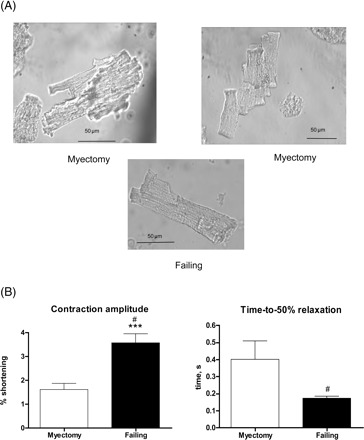
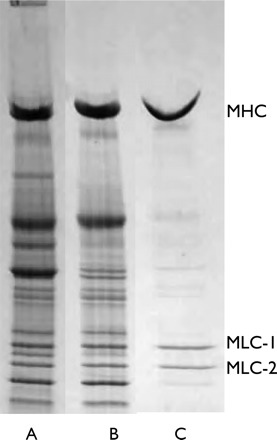
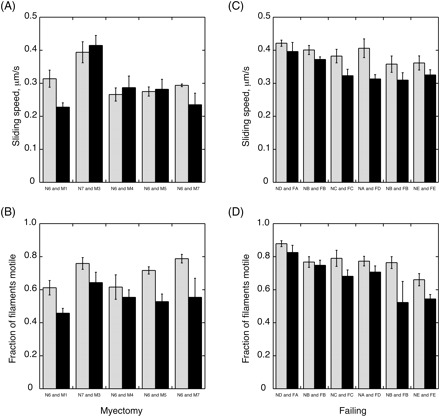
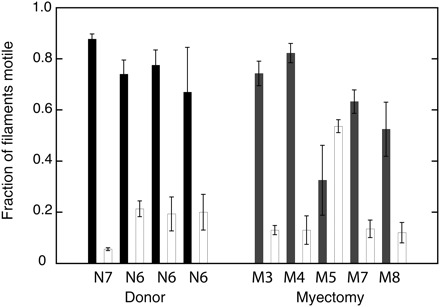
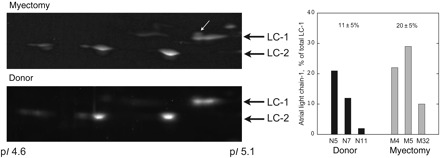
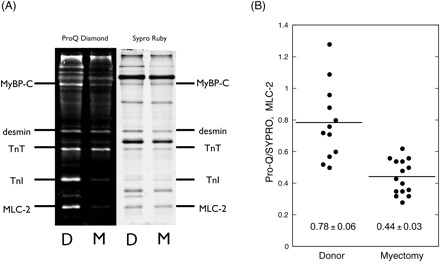
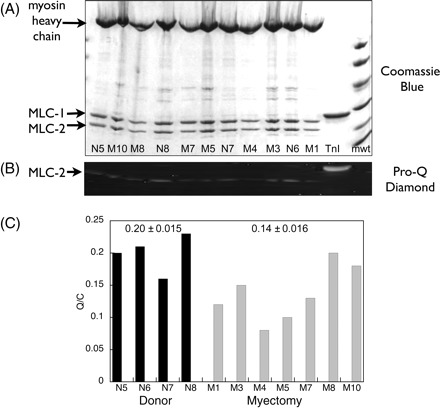
AIM: The aim of the study was to compare the functional and structural properties of the motor protein, myosin, and isolated myocyte contractility in heart muscle excised from hypertrophic cardiomyopathy patients by surgical myectomy with explanted failing heart and non-failing donor heart muscle. METHODS: Myosin was isolated and studied using an in vitro motility assay. The distribution of myosin light chain-1 isoforms was measured by two-dimensional electrophoresis. Myosin light chain-2 phosphorylation was measured by sodium dodecyl sulphate-polyacrylamide gel electrophoresis using Pro-Q Diamond phosphoprotein stain. RESULTS: The fraction of actin filaments moving when powered by myectomy myosin was 21% less than with donor myosin (P = 0.006), whereas the sliding speed was not different (0.310 +/- 0.034 for myectomy myosin vs. 0.305 +/- 0.019 microm/s for donor myosin in six paired experiments). Failing heart myosin showed 18% reduced motility. One myectomy myosin sample produced a consistently higher sliding speed than donor heart myosin and was identified with a disease-causing heavy chain mutation (V606M). In myectomy myosin, the level of atrial light chain-1 relative to ventricular light chain-1 was 20 +/- 5% compared with 11 +/- 5% in donor heart myosin and the level of myosin light chain-2 phosphorylation was decreased by 30-45%. Isolated cardiomyocytes showed reduced contraction amplitude (1.61 +/- 0.25 vs. 3.58 +/- 0.40%) and reduced relaxation rates compared with donor myocytes (TT(50%) = 0.32 +/- 0.09 vs. 0.17 +/- 0.02 s). CONCLUSION: Contractility in myectomy samples resembles the hypocontractile phenotype found in end-stage failing heart muscle irrespective of the primary stimulus, and this phenotype is not a direct effect of the hypertrophy-inducing mutation. The presence of a myosin heavy chain mutation causing hypertrophic cardiomyopathy can be predicted from a simple functional assay.
Overview
The claims and statistics of this paper haven’t been checked yet.
Free: it reads the open-access text and checks the first 5 claims that cite a source we can check. Create a free account to check every claim.
Integrity signals
Registry
Cites
Statistics
Figures
Verification
Claims the paper makes
The claims and statistics of this paper haven’t been checked yet.
Free: it reads the open-access text and checks the first 5 claims that cite a source we can check. Create a free account to check every claim.
Claims other papers make about this one
Each is checked against this paper’s own text: does it say what the citing paper says it does?
In the citing paper
“Marston and coworkers found twice as much MLC-1a, on average, in a small cohort of HCM tissues (n = 3) compared to donor tissues, using two-dimensional electrophoresis (2DE) and sypro ruby staining (37).”
From Distinct hypertrophic cardiomyopathy genotypes result in convergent sarcomeric proteoform profiles revealed by top-down proteomics (2020) · cites this paper as [37]
Self-check
Percentages, sums and reported differences re-computed from the paper’s own numbers.
The self-check needs the paper’s full text.
Citations
Cites
Richard, P., Charron, P., Carrier, L., Ledeuil, C., Cheav, T., Pichereau, C., Benaiche, A., Isnard, R., Dubourg, O., Burban, M., et al. (2003) · Circulation · doi:10.1161/01.cir.0000066323.15244.54 · Cited by 1,279
Oxidative stress and redox signalling in cardiac hypertrophy and heart failure
Seddon, M., Looi, Y. H., & Shah, A. M. (2007) · Heart · doi:10.1136/hrt.2005.068270 · Cited by 479
Elliott, P. M., Gimeno, J. R., Tomé, M. T., Shah, J., Ward, D., Thaman, R., Mogensen, J., & McKenna, W. J. (2006) · European Heart Journal · doi:10.1093/eurheartj/ehl041 · Cited by 427 · cited 1×
“LVOTO is associated with an increased risk of sudden death and therefore justifies intervention.(14) The surgical septal myectomy operation removes 3–7 g of myocardium from the interventricular septum in the region of the obstruction(15,16) and the excised muscle is a unique source of human heart muscle with hypertrop…”
BackgroundSelf-citationMyosin binding protein C mutations and compound heterozygosity in hypertrophic cardiomyopathy
Van Driest, S. L., Vasile, V. C., Ommen, S. R., Will, M. L., Tajik, A. J., Gersh, B. J., & Ackerman, M. J. (2004) · Journal of the American College of Cardiology · doi:10.1016/j.jacc.2004.07.045 · Cited by 424
[33] Assays for actin sliding movement over myosin-coated surfaces
Kron, S. J., Toyoshima, Y. Y., Uyeda, T. Q. P., & Spudich, J. A. (1991) · Methods in Enzymology · doi:10.1016/0076-6879(91)96035-p · Cited by 402 · cited 1×
“38 mm/s at 308C was somewhat lower than previous measurements with human heart myosin,(8,24) however we made measurements in 50 mmol/L KCl and used silica-coated glass rather than the more usual nitrocelluose surface.(25,26) We found a pattern of abnormality in all the myectomy myosin samples; the fraction of filament…”
MethodMorrow, A. G., Reitz, B. A., Epstein, S. E., Henry, W. L., Conkle, D. M., Itscoitz, S. B., & Redwood, D. R. (1975) · Circulation · doi:10.1161/01.cir.52.1.88 · Cited by 395
Global quantitative phosphoprotein analysis using Multiplexed Proteomics technology
Steinberg, T. H., Agnew, B. J., Gee, K. R., Leung, W., Goodman, T., Schulenberg, B., Hendrickson, J., Beechem, J. M., Haugland, R. P., & Patton, W. F. (2003) · PROTEOMICS · doi:10.1002/pmic.200300434 · Cited by 380 · cited 1×
“One-dimensional SDS–PAGE gels were used to analyse the levels of phosphorylation using the Pro-Q Diamond stain developed by Molecular Probes (Invitrogen).(20) Myofibrils or myosin (10–20 mg) was separated on 10 12 cm gels (8–18% Polyacrylamide gradient, 1% SDS: Exelgel, GE Biosciences).”
MethodVANDERVELDEN, J., PAPP, Z., ZAREMBA, R., BOONTJE, N., DEJONG, J., OWEN, V, BURTON, P., GOLDMANN, P., JAQUET, K., & STIENEN, G. (2003) · Cardiovascular Research · doi:10.1016/s0008-6363(02)00606-5 · Cited by 301
Davies, C. H., Davia, K., Bennett, J. G., Pepper, J. R., Poole-Wilson, P. A., & Harding, S. E. (1995) · Circulation · doi:10.1161/01.cir.92.9.2540 · Cited by 208 · cited 1×
“Myocytes were isolated from fresh myectomy or transplant tissue and analysed as described previously.(21) Detailed protocols are provided in the Supplementary material.”
MethodSelf-citationVan Driest, S. L., Jaeger, M. A., Ommen, S. R., Will, M. L., Gersh, B. J., Tajik, A. J., & Ackerman, M. J. (2004) · Journal of the American College of Cardiology · doi:10.1016/j.jacc.2004.04.039 · Cited by 194
Cited by
Lyon, A. R., MacLeod, K. T., Zhang, Y., Garcia, E., Kanda, G. K., Lab, M. J., Korchev, Y. E., Harding, S. E., & Gorelik, J. (2009) · Proceedings of the National Academy of Sciences · doi:10.1073/pnas.0809777106 · Cited by 369
“We have recently demonstrated that these share the slow contraction and relaxation kinetics that characterize end-stage failing human heart (31).”
BackgroundSelf-citationMarston, S., Copeland, O., Jacques, A., Livesey, K., Tsang, V., McKenna, W. J., Jalilzadeh, S., Carballo, S., Redwood, C., & Watkins, H. (2009) · Circulation Research · doi:10.1161/circresaha.109.202440 · Cited by 238
Self-citationFunctions of myosin light chain-2 (MYL2) in cardiac muscle and disease
Sheikh, F., Lyon, R. C., & Chen, J. (2015) · Gene · doi:10.1016/j.gene.2015.06.027 · Cited by 172
“…has also been reported in human patients carrying a rare form of familial hypertrophic cardiomyopathy (FHC) that impacts cardiac papillary muscle and adjacent ventricular muscle, based on specific MLC2v and MLCK mutations (Szczesna et al., 2001; Davis et al., 2001; Jacques et al., 2008).”
BackgroundMyosin light chains: Teaching old dogs new tricks
Heissler, S. M., & Sellers, J. R. (2014) · BioArchitecture · doi:10.1080/19490992.2015.1054092 · Cited by 140
“RLC phosphorylation is reduced in hypertrophic hearts.(116,117) Interestingly, overexpression of the skeletal muscle MLCK gene in mouse cardiac tissue attenuates the isopreternol-induced hypertrophy.”
BackgroundHow Do Mutations in Contractile Proteins Cause the Primary Familial Cardiomyopathies?
Marston, S. B. (2011) · Journal of Cardiovascular Translational Research · doi:10.1007/s12265-011-9266-2 · Cited by 127
Self-citationMyosin binding protein C phosphorylation in normal, hypertrophic and failing human heart muscle
Jacques, A. M., Copeland, O., Messer, A. E., Gallon, C. E., King, K., McKenna, W. J., Tsang, V. T., & Marston, S. B. (2008) · Journal of Molecular and Cellular Cardiology · doi:10.1016/j.yjmcc.2008.05.020 · Cited by 109
“6 myectomy samples were identified with MYBPC3 mutations, one with MYH7 mutation and two were unknown (see Table in the “Supplementary material” section) [23,24].”
Self-citationTucholski, T., Cai, W., Gregorich, Z. R., Bayne, E. F., Mitchell, S. D., McIlwain, S. J., de Lange, W. J., Wrobbel, M., Karp, H., Hite, Z., et al. (2020) · Proceedings of the National Academy of Sciences · doi:10.1073/pnas.2006764117 · Cited by 107
“We next investigated the levels of MLC-1 isoforms in the donor and HCM tissues, since partial replacement of MLC-1v with the atrial isoform of myosin light chain 1 (MLC-1a) has been previously observed in hypertrophic myocardium (37).”
BackgroundResultSelf-citationModelling sarcomeric cardiomyopathies in the dish: from human heart samples to iPSC cardiomyocytes
Eschenhagen, T., Mummery, C., & Knollmann, B. C. (2015) · Cardiovascular Research · doi:10.1093/cvr/cvv017 · Cited by 97
“For example, homozygous V606M mutations were associated with increased actin sliding motility.(40) Similarly, homozygous”
BackgroundToepfer, C. N., Caorsi, V., Kampourakis, T., Sikkel, M. B., West, T. G., Leung, M. C., Al‐Saud, S. A., MacLeod, K. T., Lyon, A. R., Marston, S. B., et al. (2013) · Journal of Biological Chemistry · doi:10.1074/jbc.m113.455444 · Cited by 83
“Previously reported RLC phosphorylation in disease phenotypes canbecompletely abolishedandsignificantly reduced (12, 19, 20, 54, 55).”
BackgroundSelf-citationCardiomyopathies and Related Changes in Contractility of Human Heart Muscle
Vikhorev, P. G., & Vikhoreva, N. N. (2018) · International Journal of Molecular Sciences · doi:10.3390/ijms19082234 · Cited by 93
Greenberg, M. J., Kaźmierczak, K., Szczesna‐Cordary, D., & Moore, J. R. (2010) · Proceedings of the National Academy of Sciences · doi:10.1073/pnas.1009619107 · Cited by 75
“Recent studies have shown that hypertrophic human hearts show reductions in the levels of RLC phosphorylation (32).”
BackgroundHoskins, A. C., Jacques, A., Bardswell, S. C., McKenna, W. J., Tsang, V., dos Remedios, C. G., Ehler, E., Adams, K., Jalilzadeh, S., Avkiran, M., et al. (2010) · Journal of Molecular and Cellular Cardiology · doi:10.1016/j.yjmcc.2010.06.006 · Cited by 73
“3 and 5) that a similar contractile phenotype is seen in myocytes from six unrelated HCM patients (with different mutations in MYBPC3 or MYH7, or neither of these), measured under identical conditions, suggests that the contractile deficiency is a common consequence of HCM, secondary to the initial abnormalities produ…”
BackgroundMethodInfluentialSelf-citationMesser, A. E., Bayliss, C. R., El-Mezgueldi, M., Redwood, C. S., Ward, D. G., Leung, M.-C., Papadaki, M., dos Remedios, C., & Marston, S. B. (2016) · Archives of Biochemistry and Biophysics · doi:10.1016/j.abb.2016.03.027 · Cited by 60
Self-citationMüller, M., Mazur, A. J., Behrmann, E., Diensthuber, R. P., Radke, M. B., Qu, Z., Littwitz, C., Raunser, S., Schoenenberger, C., Manstein, D. J., et al. (2012) · Cellular and Molecular Life Sciences · doi:10.1007/s00018-012-1030-5 · Cited by 67
Messer, A. E., Gallon, C. E., McKenna, W. J., Dos Remedios, C. G., & Marston, S. B. (2009) · PROTEOMICS – Clinical Applications · doi:10.1002/prca.200900071 · Cited by 61
“These results are in accord with preliminary measurements on hcTnI using Pro-Q Diamond [8, 45] and reflect a generalised decrease in phosphorylation levels that includes TnT, myosin binding protein-C and myosin light chain-2 [46, 47], presumably associated with increased phosphatase activity [4].”
ResultSelf-citationMesser, A. E., & Marston, S. B. (2014) · Frontiers in Physiology · doi:10.3389/fphys.2014.00315 · Cited by 64
“…TnI phosphorylation level and Frontiers in Physiology | Striated Muscle Physiology August 2014 | Volume 5 | Article 315 | 6 this was found to be due to uncoupling of the relationship between Ca2+-sensitivity and TnI phosphorylation (Gallon et al., 2007; Jacques et al., 2008; Bayliss et al., 2012b).”
BackgroundSelf-citationFamilial hypertrophic cardiomyopathy: Functional effects of myosin mutation R723G in cardiomyocytes
Kraft, T., Witjas‐Paalberends, E. R., Boontje, N. M., Tripathi, S., Brandis, A., Montag, J., Hodgkinson, J. L., Francino, A., Navarro‐López, F., Brenner, B., et al. (2013) · Journal of Molecular and Cellular Cardiology · doi:10.1016/j.yjmcc.2013.01.001 · Cited by 61
“Data on functional effects of FHC-related β-MyHC-mutations in human ventricular cardiomyocytes are, however, scarce [7–10].”
Small molecule-mediated refolding and activation of myosin motor function
Radke, M. B., Taft, M. H., Stapel, B., Hilfiker-Kleiner, D., Preller, M., & Manstein, D. J. (2014) · eLife · doi:10.7554/elife.01603 · Cited by 53
“DOI: 10.7554/eLife.01603 14 of 19 Research article and Jacques et al. (2008) and further purified by gel filtration.”
BackgroundInfluentialDyer, E., Jacques, A. M., Hoskins, A. C., Ward, D. G., Gallon, C. E., Messer, A. E., Kaski, J. P., Burch, M., Kentish, J. C., & Marston, S. B. (2009) · Circulation Heart Failure · doi:10.1161/circheartfailure.108.818237 · Cited by 51
Self-citationSamant, S. A., Courson, D. S., Sundaresan, N. R., Pillai, V. B., Tan, M., Zhao, Y., Shroff, S. G., Rock, R. S., & Gupta, M. P. (2010) · Journal of Biological Chemistry · doi:10.1074/jbc.m110.163865 · Cited by 46
RetractedSamant, S. A., Pillai, V. B., Sundaresan, N. R., Shroff, S. G., & Gupta, M. P. (2015) · Journal of Biological Chemistry · doi:10.1074/jbc.m115.653048 · Cited by 40
“All reagents were prepared in AB buffer (25 mM imidazole, pH 7.5, 25 mM KCl, 1 mM EGTA, 4 mM MgCl2, and 10 mM DTT).”
InfluentialLuo, X., Chae, M., Krishnakumar, R., Danko, C. G., & Kraus, W. L. (2014) · BMC Genomics · doi:10.1186/1471-2164-15-155 · Cited by 38
“For example: (1) motor protein and myosinrelated muscle functions are directly related to the electrophysiology of heart muscle [42], (2) fibroblast proliferation and endothelial-to-mesenchymal transition contribute to cardiac fibrosis [7,43]; and (3) mitochondrial function and lipid oxidation are closely related to n…”
BackgroundThe Molecular Mechanisms of Mutations in Actin and Myosin that Cause Inherited Myopathy
Marston, S. B. (2018) · International Journal of Molecular Sciences · doi:10.3390/ijms19072020 · Cited by 38
“A significant number of HCM patients have a septal myectomy operation to relieve outflow tract obstruction and this can yield a few grams of mutant tissue [45,46]; finally, explanted hearts from DCM patients with identified causative mutations undergoing heart transplant provides a rare source of tissue for investigat…”
BackgroundSelf-citationBayliss, C. R., Jacques, A. M., Leung, M.-C., Ward, D. G., Redwood, C. S., Gallon, C. E., Copeland, O., McKenna, W. J., dos Remedios, C., Marston, S. B., et al. (2013) · Cardiovascular Research · doi:10.1093/cvr/cvs322 · Cited by 34
“tion in individual reconstituted thick and thin filaments, using a quantitative in vitro motility assay (IVMA).(8,12,24,25) Applying these techniques to contractile proteins from HOCM heart muscle, we found”
Self-citationJacques, A. M., Hoskins, A. C., Kentish, J. C., & Marston, S. B. (2008) · Journal of Muscle Research and Cell Motility · doi:10.1007/s10974-009-9174-0 · Cited by 34
“The results indicate a more severe disruption of ventricular myocyte contractile parameters at the cellular level in myectomies, including M15, compared to that seen even in end-stage heart failure ( Jacques et al. 2008a, b).”
BackgroundResultInfluentialSelf-citationGetting the skinny on thick filament regulation in cardiac muscle biology and disease
Sheikh, F., Lyon, R. C., & Chen, J. (2013) · Trends in Cardiovascular Medicine · doi:10.1016/j.tcm.2013.07.004 · Cited by 32
Pilagov, M., Heling, L. W. H. J., Walklate, J., Geeves, M. A., & Kad, N. M. (2022) · The Journal of General Physiology · doi:10.1085/jgp.202213087 · Cited by 27
“Therefore, we purified MyBP-C using a series of washes with 10 mM EDTA, 5 mM DTT, and 150 mMNa2HPO4, adjusted to pH 5.0, and then concentrated the sample using a 55% ammonium sulfate cut (Jacques et al., 2008).”
InfluentialCopeland, O., Nowak, K. J., Laing, N. G., Ravenscroft, G., Messer, A. E., Bayliss, C. R., & Marston, S. B. (2010) · Journal of Muscle Research and Cell Motility · doi:10.1007/s10974-010-9224-7 · Cited by 26
“(Palmer 2005) and expression of the atrial isoform of myosin light chain-1 increases from near zero to as much as 27% of total myosin light chain-1 (Jacques et al. 2008a; Morano et al. 1997).”
BackgroundResultInfluentialSelf-citationLatham, S. L., Weiß, N., Schwanke, K., Thiel, C., Croucher, D. R., Zweigerdt, R., Manstein, D. J., & Taft, M. H. (2020) · Cell Reports · doi:10.1016/j.celrep.2020.108090 · Cited by 20
Heart Research Advances Using Database Search Engines, Human Protein Atlas and the Sydney Heart Bank
Li, A. S., Estigoy, C., Raftery, M. J., Cameron, D., Odeberg, J., Pontén, F., Lal, S., & dos Remedios, C. G. (2013) · Heart Lung and Circulation · doi:10.1016/j.hlc.2013.06.006 · Cited by 22
“They include myosin, actin, cardiac myosin binding protein C, titin, and the relaxing proteins–troponins and tropomyosin [11–22].”
BackgroundBayne, E. F., Rossler, K. J., Gregorich, Z. R., Aballo, T. J., Roberts, D. S., Chapman, E. A., Guo, W., Palecek, S. P., Ralphe, J. C., Kamp, T. J., et al. (2023) · Journal of Molecular and Cellular Cardiology · doi:10.1016/j.yjmcc.2023.06.003 · Cited by 16
Leung, M. C., Hitchen, P. G., Ward, D. G., Messer, A. E., & Marston, S. B. (2012) · Journal of Biological Chemistry · doi:10.1074/jbc.m112.410316 · Cited by 17
Self-citationChristopher, B. A., Pizarro, G. O., Nicholson, B., Yuen, S. L., Hoit, B. D., & Ogut, O. (2009) · Journal of Muscle Research and Cell Motility · doi:10.1007/s10974-009-9180-2 · Cited by 12
“agreement with published data (Jacques et al. 2008).”
ResultCurrent techniques for the study of troponin I phosphorylation in human heart
Gallon, C. E. (2008) · Journal of Muscle Research and Cell Motility · doi:10.1007/s10974-009-9170-4 · Cited by 9
“Recently, we have observed reduced cTnI phosphorylation in tissue from the interventricular septum of patients undergoing the septal myectomy operation for alleviation of left ventricular out-flow tract obstruction in hypertrophic obstructive cardiomyopathy (HOCM) (Gallon et al. 2008; Jacques et al. 2008a, b). However…”
BackgroundMethodSelf-citationMechanical Forces Matter in Health and Disease: From Cancer to Tissue Engineering
Vogel, V., & Sheetz, M. P. (2010) · Wiley eBooks · doi:10.1002/9783527628155.nanotech057 · Cited by 9
Greve, J. N., Schwäbe, F. V., Taft, M. H., & Manstein, D. J. (2024) · Cytoskeleton · doi:10.1002/cm.21852 · Cited by 7
Copeland, O., Messer, A., Jabbour, A., Poggesi, C., Prasad, S., & Marston, S. (2020) · Frontiers in Physiology · doi:10.3389/fphys.2020.00241 · Cited by 3
Self-citationPertici, I., Taft, M. H., Greve, J. N., Fedorov, R., Caremani, M., & Manstein, D. J. (2021) · The Journal of Physiology · doi:10.1113/jp281563 · Cited by 3
“Porcine cardiac myosin-2 was purified as described previously (Jacques et al. 2008; Pant et al. 2009).”
MethodFeng, Q., Zhang, G., Ma, L., & Ni, Y. (2011) · The Heart Surgery Forum · doi:10.1532/hsf98.20111069 · Cited by 1
Liu, Y., Chen, C., Duan, X., Ma, W., Wang, M., Tu, M., & Chen, Y. (2015) · PubMed Central · Cited by 1
Cellular Basis for Heart Failure
Margulies, K. B., & Houser, S. R. (2010) · Elsevier eBooks · doi:10.1016/b978-1-4160-5895-3.10003-8 · Cited by 1
Mildly reduced SRF protein is good for the older heart
Azhar, G., Zhang, X., Zuo, C., Wang, S. C., Wei, J. Y., & Reynolds, D. W. (2010) · Cited by 1
Evidence for a role of adverse sarcomere signaling in atrial fibrillation induction
McCauley, M. D., & Solaro, R. J. (2026) · Journal of Molecular and Cellular Cardiology Plus · doi:10.1016/j.jmccpl.2026.100866
“While MLC1-v is restricted to adult ventricles, MLC1-a expression may be beneficial in failing heats [75,86].”
Metadata
- Authors
- Jacques, A. M., Briceno, N., Messer, A. E., Gallon, C. E., Jalilzadeh, S., Garcia, E., Kikonda-Kanda, G., Goddard, J., Harding, S. E., Watkins, H., Esteban, M. T., Tsang, V. T., McKenna, W. J., & Marston, S. B.
- Affiliations
- Imperial College London (GB)
- John Radcliffe Hospital (GB)
- University College London (GB)
- Corresponding author
- Marston, Steven B.
- ORCID
- Venue
- Cardiovascular Research
- Publisher
- Oxford University Press (OUP)
- Published
- 2008-04-14
- Volume
- 79
- Issue
- 3
- Pages
- 481-491
- ISSN
- 0008-6363 (ISSN-L)
- 1755-3245
- PMC
- PMC2492731
- OpenAlex
- W2074688769
- Cited by
- 43
- References
- 40
- Citations by year
- 2026: 1 · 2024: 1 · 2023: 1 · 2022: 1 · 2021: 1 · 2020: 3 · 2018: 2 · 2016: 1 · 2015: 4 · 2014: 4 · 2013: 4 · 2012: 3
- FWCI
- 4.14
- Type
- journal article
- Language
- en
- Open access
- hybrid
- doi.org
- Licence
- other-oa
- Locations
- Cardiovascular Research (publishedVersion, other-oa)
- Europe PMC (PubMed Central) (publishedVersion, cc-by-nc)
- PubMed Central (publishedVersion, cc-by-nc)
- PubMed (publishedVersion)
- St George's Online Research Archive (St George's University of London) (acceptedVersion)
- UCL Discovery (University College London) (submittedVersion)
- Funders
- National Institute for Health and Care Research
- British Heart Foundation (RG/07/012/24110)
- Topics
- Health Sciences › Medicine › Cardiology and Cardiovascular Medicine › Cardiomyopathy and Myosin Studies
- Health Sciences › Medicine › Cardiology and Cardiovascular Medicine › Cardiac electrophysiology and arrhythmias
- Life Sciences › Biochemistry, Genetics and Molecular Biology › Molecular Biology › Muscle Physiology and Disorders
- Keywords
- hypertrophic obstructive cardiomyopathy, cardiac myosin, myosin light chain 2 phosphorylation, cardiomyocyte contractility, myectomy, heart failure, myosin motility, molecular phenotypes
- MeSH terms
- Adult, Cardiomyopathy, Hypertrophic, Genotype, Heart Failure, Humans, Actin Cytoskeleton, Middle Aged, Muscle Contraction, Mutation, Phenotype, Phosphorylation, Myosin Light Chains, Myosin Heavy Chains, Cardiac Myosins, Myocytes, Cardiac, Young Adult
About these checks
Registry, retraction, Cites and statistics results are computed, not judged, with one exception: a printed reference that no index lists is read once by a model before it counts as a citation error. Claims are extracted by a model and kept only when their quote appears verbatim in the text; each cited source is then checked, with a model’s help, for whether it says what the claim relies on. Those verdicts can be wrong — read the claim’s quote and the cited source before relying on one.
Statistics and arithmetic are recomputed, not judged.
Confidence bands are shown only for fields calibrated on our annotated test set. None is calibrated yet, so no band is shown.
What counts as a claim ›How we measure confidence ›How we check this ›
Are you an author, or do you see a problem with this page? Request a review
Data sources
Bibliographic data: Semantic Scholar, OpenAlex, Crossref.
Contains information from the Semantic Scholar Academic Graph Datasets, made available under the ODC Attribution License (ODC-BY 1.0).
Semantic Scholar’s data is described in: Kinney, R., et al. (2023). The Semantic Scholar Open Data Platform. arXiv:2301.10140.
