

Artificial intelligence with multi-functional machine learning platform development for better healthcare and precision medicine
Open accessThe DOI matches its Crossref record; 257 of the 259 references it cites were found in a registry or an index.
Abstract
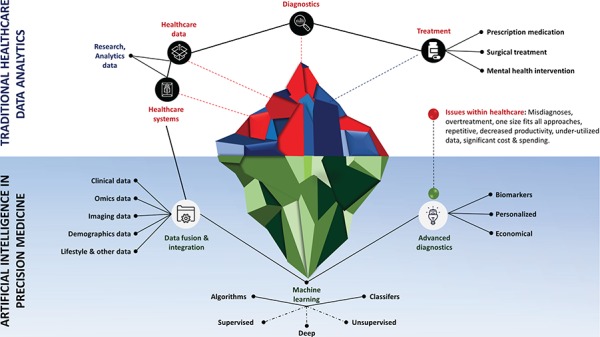
Precision medicine is one of the recent and powerful developments in medical care, which has the potential to improve the traditional symptom-driven practice of medicine, allowing earlier interventions using advanced diagnostics and tailoring better and economically personalized treatments. Identifying the best pathway to personalized and population medicine involves the ability to analyze comprehensive patient information together with broader aspects to monitor and distinguish between sick and relatively healthy people, which will lead to a better understanding of biological indicators that can signal shifts in health. While the complexities of disease at the individual level have made it difficult to utilize healthcare information in clinical decision-making, some of the existing constraints have been greatly minimized by technological advancements. To implement effective precision medicine with enhanced ability to positively impact patient outcomes and provide real-time decision support, it is important to harness the power of electronic health records by integrating disparate data sources and discovering patient-specific patterns of disease progression. Useful analytic tools, technologies, databases, and approaches are required to augment networking and interoperability of clinical, laboratory and public health systems, as well as addressing ethical and social issues related to the privacy and protection of healthcare data with effective balance. Developing multifunctional machine learning platforms for clinical data extraction, aggregation, management and analysis can support clinicians by efficiently stratifying subjects to understand specific scenarios and optimize decision-making. Implementation of artificial intelligence in healthcare is a compelling vision that has the potential in leading to the significant improvements for achieving the goals of providing real-time, better personalized and population medicine at lower costs. In this study, we focused on analyzing and discussing various published artificial intelligence and machine learning solutions, approaches and perspectives, aiming to advance academic solutions in paving the way for a new data-centric era of discovery in healthcare.
Overview
The claims and statistics of this paper haven’t been checked yet.
Free: it reads the open-access text and checks the first 5 claims that cite a source we can check. Create a free account to check every claim.
Integrity signals
Registry
Cites
Statistics
Figures
Verification
Claims the paper makes
The claims and statistics of this paper haven’t been checked yet.
Free: it reads the open-access text and checks the first 5 claims that cite a source we can check. Create a free account to check every claim.
Claims other papers make about this one
Each is checked against this paper’s own text: does it say what the citing paper says it does?
The source backs part of the claim, not all of it — or backs it for a different population, condition or comparison.
In the citing paper
“This integration enhances the ability of clinicians to detect early signs of complications, offering the potential for more precise and personalized interventions (87).”
From Generative artificial intelligence in predictive analysis of diabetes and its complications: a narrative review (2025) · cites this paper as [87]
Experimental — accuracy not yet measuredIn the citing paper
“There is growing concern that breaches of confidentiality may lead to an erosion of public confidence in the healthcare system”
From SHIFTing artificial intelligence to be responsible in healthcare: a systematic review (2022) · cites this paper as Ahmed et al., 2020
Self-check
Percentages, sums and reported differences re-computed from the paper’s own numbers.
The self-check needs the paper’s full text.
Citations
Cites
LeCun, Y., Bengio, Y., & Hinton, G. (2015) · Nature · doi:10.1038/nature14539 · Cited by 84,126
A tutorial on hidden Markov models and selected applications in speech recognition
Rabiner, L. R. (1989) · Proceedings of the IEEE · doi:10.1109/5.18626 · Cited by 22,743
Quinlan, J. R. (1986) · Machine Learning · doi:10.1007/bf00116251 · Cited by 21,439
Goldberg, D. E., & Shakespeare, W. (2002) · Cited by 16,088
Dermatologist-level classification of skin cancer with deep neural networks
Esteva, A., Kuprel, B., Novoa, R. A., Ko, J., Swetter, S. M., Blau, H. M., & Thrun, S. (2017) · Nature · doi:10.1038/nature21056 · Cited by 14,362
High-performance medicine: the convergence of human and artificial intelligence
Topol, E. J. (2019) · Nature Medicine · doi:10.1038/s41591-018-0300-7 · Cited by 10,450
PLS-regression: a basic tool of chemometrics
Wold, S., Sjöström, M., & Eriksson, L. (2001) · Chemometrics and Intelligent Laboratory Systems · doi:10.1016/s0169-7439(01)00155-1 · Cited by 10,084 · cited 1×
“It has been successful in detecting microcalcifications in mammograms of breast cancer (218,219), developing a non-invasive technique for cervical cancer detection (220), analyzing microarray data from cancer cell lines (221), investigating relationships between soil trace elements and cervical cancer mortality (222),…”
BackgroundGulshan, V., Peng, L., Coram, M., Stumpe, M. C., Wu, D., Narayanaswamy, A., Venugopalan, S., Widner, K., Madams, T., Cuadros, J., et al. (2016) · JAMA · doi:10.1001/jama.2016.17216 · Cited by 7,697
Hearst, M. A., Dumais, S. T., Osuna, E., Platt, J., & Scholkopf, B. (1998) · IEEE Intelligent Systems and their Applications · doi:10.1109/5254.708428 · Cited by 7,243
The random subspace method for constructing decision forests
Ho, T. K. (1998) · IEEE Transactions on Pattern Analysis and Machine Intelligence · doi:10.1109/34.709601 · Cited by 6,842
Research works printed but not linked: 8
- Ahmed, 2019, Lecture Notes in Networks and Systems 69 Springer Nature
- Raghupathi, 2014, Big data analytics in healthcare: promise and potential, Health Inform. Sci. Syst., 2, 3, 10.1186/2047-2501-2-3 · DOI · Paper page
- Somashekhar, 2018, Watson for oncology and breast cancer treatment recommendations: agreement with an expert multidisciplinary tumor board, Ann. Oncol., 29
- Mesko, 2017, The role of artificial intelligence in precision medicine, Expert Rev. Precis. Med. Drug Dev., 2, 239, 10.1080/23808993.2017.1380516 · DOI · Paper page
- Mesko, 2019, Artificial intelligence is the stethoscope of the 21st century, The Medical Futurist
- Kaura, 2018, Big data and machine learning based secure healthcare framework, Procedia Comput. Sci., 132, 1049, 10.1016/j.procs.2018.05.020 · DOI · Paper page
- Boser, 1992, 5th Annual ACM Workshop on COLT, 144
- Langley, 1992, An analysis of Bayesian classifiers. Proceedings of the Tenth National Conference on, Artif. Intell., 223
Cited by
Items 701–800 of 1,000
Forecasting China’s Nuclear Power Generation to 2030: An ARIMA Model-Based Trend Analysis
Luo, Y., Shao, Y., Zhang, B., Liu, P., Liu, S., Yuan, Z., & Sang, S. (2025) · Engineering Frontiers · doi:10.71411/ef.2025.v1i1.939 · Cited by 3
Key Factors in Patient Satisfaction: A Random Forest Strategy
Silva-Aravena, F., Morales, J., Sáez, P., Baltierra, S., & Cornide-Reyes, H. (2026) · Lecture notes in computer science · doi:10.1007/978-3-032-12801-0_19 · Cited by 3
Huang, X., Goh, H. H., He, T., Zhang, D.-D., Dai, W., Kurniawan, T. A., Goh, K. C., Wong, H. Y., Islam, M. T., & Liang, X. (2026) · Journal of Chinese Integrative Medicine · doi:10.1016/j.joim.2026.02.004 · Cited by 3
Integrating Physiological Signals With Technology-Driven Stroke Rehabilitation: A Systematic Review
Khalaf, K. A., Hamsa, S., Kizhakkethil, M. A., Wasti, S. A., & Jelinek, H. F. (2026) · IEEE Access · doi:10.1109/access.2026.3672190 · Cited by 3
Risk Stratification for Postoperative Mortality in Cardiac Surgery: “Quo Vadis”?
Iacobescu, R.-A., Lunguleac, T., Antoniu, S. A., Burduloi, V. M., Bulimar, V., & Tinică, G. (2026) · Medicina · doi:10.3390/medicina62030606 · Cited by 3
A scoping review on remote patient monitoring technologies
Venkatesan, V., Osoro, I., & Rajanandh, M. G. (2026) · Discover Artificial Intelligence · doi:10.1007/s44163-026-01177-4 · Cited by 3
Role of artificial intelligence augmented interventions in Rehabilitation: A scoping review
Sadiq, S., Asim, H. M., Kousar, A., & Akram, R. (2026) · Journal of Bodywork and Movement Therapies · doi:10.1016/j.jbmt.2026.04.011 · Cited by 3
Lin, Y.-E., Yang, S., Huang, C.-J., Tsai, Y., Cheng, H., Lee, W.-C., & Wang, S. (2026) · npj Digital Medicine · doi:10.1038/s41746-026-02690-7 · Cited by 3
Artificial intelligence in respiratory medicine: From diagnosis to treatment and future directions
Chen, Z., Tang, Z., Ewing, R. M., Belkhatir, Z., & Wang, Y. (2026) · Chinese Medical Journal - Pulmonary and Critical Care Medicine · doi:10.1016/j.pccm.2026.05.005 · Cited by 3
Athukorala, D., Ahmed, K. E. U., & Nowrozy, R. (2026) · Healthcare · doi:10.3390/healthcare14131975 · Cited by 3
PREDICTION OF PNEUMONIA USING BIG DATA, DEEP LEARNING AND MACHINE LEARNING TECHNIQUES
(2022) · International Research Journal of Modernization in Engineering Technology and Science · doi:10.56726/irjmets29620 · Cited by 3
Breast Image Reconstruction and Cancer Detection Using Microwave Imaging
Patel, H. N., Ghodgaonkar, D. K., & Suri, J. S. (2022) · Institute of Physics eBooks · doi:10.1088/978-0-7503-2592-9 · Cited by 3
Capes, N., Patel, H., Sarhan, I., Ashwood, N., Dekker, A., & Shehata, R. (2023) · International Journal of Intelligence Science · doi:10.4236/ijis.2023.133005 · Cited by 3
Breast Cancer Classification based on Artificial Intelligence: State of the Art
Shaban, W. M. (2023) · Nile Journal of Communication and Computer Science/Nile Journal of Communication and Computer Science · doi:10.21608/njccs.2023.189145.1008 · Cited by 3
Begum S., S. D., Dey, S., Chakraborty, D., Hembrom, T., Hazra, S., & Barman, D. (2024) · Journal of Electrical Systems · doi:10.52783/jes.1424 · Cited by 3
Momoh, H., Ibrahim, H. A., Abdulmalik, M. O., & Bello, A. I. (2024) · Journal of applied science and environmental management · doi:10.4314/jasem.v28i4.8 · Cited by 3
Shaping Tomorrow's Minds: The Future of Education in an AI (Artificial Intelligence)-Augmented World
Chaudhry, M., & Goswami, N. (2024) · Advances in educational technologies and instructional design book series · doi:10.4018/979-8-3693-2440-0.ch022 · Cited by 3
Sharma, A. K., & Singh, V. K. (2024) · IEEE International Conference for Convergence in Technology (I2CT) · doi:10.1109/i2ct61223.2024.10543393 · Cited by 3
Mental Health Disorder Prediction Using Recurrent Neural Network Algorithm
Mariappan, U., Balakrishnan, D., Merline, G., Sandhia, M., Reddy, D. S., & Teja, S. G. (2024) · Asia Pacific Conference on Innovation in Technology (APCIT) · doi:10.1109/apcit62007.2024.10673508 · Cited by 3
A brief on artificial intelligence in medicine
Ounasser, N., Rhanoui, M., Mikram, M., & Asri, B. E. (2024) · International Journal of Advances in Applied Sciences · doi:10.11591/ijaas.v13.i4.pp1055-1064 · Cited by 3
Early stage detection of osteoarthritis of the joints (hip and knee) using machine learning
Hemanth, K. S., Tigulla, D., Lakshmi, V., & Buhari, S. M. (2024) · Elsevier eBooks · doi:10.1016/b978-0-443-32892-3.00003-8 · Cited by 3
Chaotic quasi-opposition marine predator algorithm for automatic data clustering
Ouertani, M. W., Manita, G., Chhabra, A., & Korbaa, O. (2025) · Cluster Computing · doi:10.1007/s10586-024-04721-y · Cited by 3
The Impact of Optimization Techniques on Cancer Classification with Gene Expression Data
P, S. S. A., Jonnalagadda, I., Vardhan, V., S, V. C., & Sahay, A. (2024) · International Conference on Advances in Computing and Communications (ICACC) · doi:10.1109/icacc63692.2024.10845662 · Cited by 3
Smart Remote Physical Therapy: Deep Learning-Based Patient Monitoring
Thirumangai, S., Thilagan, P., & Anitha, N. (2024) · IEEE International Conference on Green Industrial Electronics and Sustainable Technologies (GIEST) · doi:10.1109/giest62955.2024.10959779 · Cited by 3
Moneke, K. C., & Jacqueline, O. N. (2023) · World Journal of Advanced Research and Reviews · doi:10.30574/wjarr.2023.18.1.0735 · Cited by 3
Brauner, P., Offermann, J., & Ziefle, M. (2026) · Frontiers in Digital Health · doi:10.3389/fdgth.2025.1715810 · Cited by 3
Bernal, Y. A., Blanco, A., Oróstica, K., Delgado, I., & Armisén, R. (2026) · Biomedicines · doi:10.3390/biomedicines14030665 · Cited by 3
Predicting Diabetic Retinopathy Using Machine Learning
Zhang, N. (2022) · Journal of Student Research · doi:10.47611/jsrhs.v11i4.3179 · Cited by 3
Using Machine Learning Models for The Prediction of Coronary Arteries Disease
Bilal, M., Aslam, N., Naeem, A., & Abid, M. K. (2023) · VFAST Transactions on Software Engineering · doi:10.21015/vtse.v11i2.1487 · Cited by 3
Sivamanikanta, M., & Ravinder, N. (2024) · International Journal of Advanced Computer Science and Applications · doi:10.14569/ijacsa.2024.0150124 · Cited by 3
Artificial Intelligence and Machine Learning in Healthcare
Sarkar, N., & Goel, S. (2024) · Advances in bioinformatics and biomedical engineering book series · doi:10.4018/979-8-3693-1922-2.ch002 · Cited by 3
Yang, C., Xu, J., Wang, S., Wang, Y., Zhang, Y., & Piao, C. (2024) · Oncology Letters · doi:10.3892/ol.2024.14518 · Cited by 3
Radončić, A. (2024) · Lecture notes in networks and systems · doi:10.1007/978-3-031-66271-3_59 · Cited by 3
Transforming healthcare: The powerful integration of artificial intelligence and machine learning
Barhate, A., Barole, A., Jikar, N., Thakare, T., Tale, A., Verma, P., & Gote, A. C. (2024) · AIP conference proceedings · doi:10.1063/5.0240472 · Cited by 3
Yisa, M. I. (2024) · World Journal of Advanced Research and Reviews · doi:10.30574/wjarr.2024.24.3.4041 · Cited by 3
Utilising Machine Learning Algorithms to Address Computational Challenges in Big Data Analytics
Islam, M. M., Sharma, A. K., & Khilji, N. (2025) · International Journal of Computational and Experimental Science and Engineering · doi:10.22399/ijcesen.3165 · Cited by 3
Enhancing Early Autism Prediction Using Machine Learning Techniques
Tandon, A., Mazumdar, B. D., Pal, M. K., Gupta, P. K., & Sahu, N. K. (2025) · International Conference on Computing for Sustainable Global Development · doi:10.23919/indiacom66777.2025.11115668 · Cited by 3
Hemalatha, K. P. J., David Samuel Azariya., S., Pushpalatha., R., Kamali., R., Vaishnavi Dali., A., & Soms, N. (2025) · International Conference on Expert Clouds and Applications (ICOECA) · doi:10.1109/icoeca66273.2025.00044 · Cited by 3
Rare disease patients’ needs: an up-to-date analysis and future directions
Kamusheva, M., & Milushewa, P. (2021) · Pharmacia · doi:10.3897/pharmacia.68.e73240 · Cited by 3
Empathic Smart Conversational Agent for Enhanced Recovery from Abdominal Surgery at Home
Díaz, F. D., Pedrosa, I., Quirós, P., & Díaz, P. Á. (2022) · Communications in computer and information science · doi:10.1007/978-3-031-19679-9_51 · Cited by 3
DGH-GO: dissecting the genetic heterogeneity of complex diseases using gene ontology
Asif, M., Martiniano, H., Lamúrias, A., Kausar, S., & Couto, F. M. (2023) · BMC Bioinformatics · doi:10.1186/s12859-023-05290-4 · Cited by 3
Qiao, S., Khushf, G., Li, X., Zhang, J., & Olatosi, B. (2023) · BMJ Open · doi:10.1136/bmjopen-2022-070870 · Cited by 3
Women's Care With Generalized Metabolism Analysis Report Based on Age Using Deep Learning
Sahu, M., Ramteke, M. A., Sahu, A. P., Chourasia, H., & Ponnusamy, S. (2023) · Advances in computational intelligence and robotics book series · doi:10.4018/979-8-3693-2679-4.ch017 · Cited by 3
Pogrebnoi, D., Funkner, A. A., & Kovalchuk, S. V. (2024) · Journal of Computational Science · doi:10.1016/j.jocs.2024.102393 · Cited by 3
Gomes, M. A. S., Kovaleski, J. L., Pagani, R., da Silva, V. L., & Borges, H. B. (2024) · Technology Analysis and Strategic Management · doi:10.1080/09537325.2024.2410349 · Cited by 3
Aguilar, C., Regensburger, A. P., Knieling, F., Wagner, A. L., Siebenlist, G., Woelfle, J., Koehler, H., Hoerning, A., & Jüngert, J. (2021) · Ultraschall in der Medizin - European Journal of Ultrasound · doi:10.1055/a-1471-3039 · Cited by 3
Ge, X., Wang, Y., Xie, L. H., Shang, Y., Zhai, Y., Huang, Z., Huang, J., Ye, C., Ma, A., Li, W., et al. (2022) · medRxiv · doi:10.1101/2022.10.07.22280541 · Cited by 3
Azimzade, Y., Haugen, M. H., Tekpli, X., Steen, C. B., Fleischer, T., Kilburn, D. F., Ma, H., Egeland, E. V., Mills, G. B., Engebraaten, O., et al. (2023) · bioRxiv (Cold Spring Harbor Laboratory) · doi:10.1101/2023.09.07.556655 · Cited by 3
Xu, Y. (2024) · cIRcle (University of British Columbia) · doi:10.14288/1.0444099 · Cited by 3
Ethical issues using artificial intelligence in healthcare
Lemonnier, N. (2021) · Jyväskylä University Digital Archive (University of Jyväskylä) · Cited by 3
Integration of biotechnology and information technology for healthcare innovation
Akinola, S. (2023) · ROMANIAN BIOTECHNOLOGICAL LETTERS · doi:10.25083/rbl/28.1/3860.3871 · Cited by 2
Integrating IoT and AI in Healthcare: A Novel MS-GNN Framework for Disease Diagnosis
Alfurhood, B. S. (2024) · Information systems engineering and management · doi:10.1007/978-3-031-65022-2_3 · Cited by 2
Han, H., Lee, C.-S., Naseem, M. T., Bhatti, M. A., Sarhan, N. M., Awwad, E. M., & Ghadi, Y. Y. (2024) · Polish Journal of Environmental Studies · doi:10.15244/pjoes/187607 · Cited by 2
Digital Twin Using Clinical Personal Knowledge Graphs: Toward Precision Medicine
Lee, J. X., & Song, Y.-T. (2025) · International Conference on Ubiquitous Information Management and Communication (IMCOM) · doi:10.1109/imcom64595.2025.10857482 · Cited by 2
Mahfouz, A. H. A. S., Mathe, A. I. M., Ali, A. O. I., Ahmed, A. O. M., & Gasmalla, A. M. M. (2025) · International Journal of Science and Research Archive · doi:10.30574/ijsra.2025.14.2.0495 · Cited by 2
AI in Healthcare Safeguarding Patient Privacy and Confidentiality
Sindiramutty, S. R., Jhanjhi, N. Z., & Khan, N. A. (2025) · Advances in information security, privacy, and ethics book series · doi:10.4018/979-8-3693-6135-1.ch015 · Cited by 2
Sharma, A. K., Pesarlanka, D. B., Lankadasu, N. V. Y., & Sharma, S. (2025) · Advances in medical technologies and clinical practice book series · doi:10.4018/979-8-3693-7550-1.ch008 · Cited by 2
Pareek, P., Kumari, N., & Yadav, P. (2025) · International Journal of Research -GRANTHAALAYAH · doi:10.29121/granthaalayah.v13.i1.2025.6123 · Cited by 2
Technology, Artificial Intelligence, and the Era of Information in Healthcare and Allied Sciences
Choudhury, S. R., Singh, K., Koner, S., & Ghosh, J. (2025) · IGI Global eBooks · doi:10.4018/979-8-3693-9755-8.ch016 · Cited by 2
Syalum, C. L., Widjaja, M. A. S., & Chandra, Y. U. (2025) · International Conference on Computer Sciences, Engineering, and Technology Innovation (ICoCSETI) · doi:10.1109/icocseti63724.2025.11019062 · Cited by 2
Listening to Users: Privacy and Security in Mobile Health Apps
Hassan, M., Bashir, M. N., & Brooks, I. S. (2025) · Lecture notes in computer science · doi:10.1007/978-3-031-93064-5_4 · Cited by 2
Singh, K., Sudershan, A., Kumar, S., Shastri, S., & Mansotra, V. (2025) · International Journal of Pattern Recognition and Artificial Intelligence · doi:10.1142/s0218001425570150 · Cited by 2
A Low-Power Analog Hardware Sigmoid-based Neural Network for Biomedical Applications
Alimisis, V., Dimas, C., Papathanasiou, A., & Sotiriadis, P. P. (2025) · IEEE International Symposium on Circuits and Systems proceedings · doi:10.1109/iscas56072.2025.11043171 · Cited by 2
Kim, S. C., Lee, J., & Nam, S. (2025) · Frontiers in Rehabilitation Sciences · doi:10.3389/fresc.2025.1620335 · Cited by 2
AI in Diagnostics and the Law: Regulating Machine-Learning Tools in Clinical Decision-Making
Akomolafe, O. O., Okoli, A. O., Sagay, I., & Oparah, S. (2025) · Journal of Frontiers in Multidisciplinary Research · doi:10.54660/.ijfmr.2021.2.2.135-147 · Cited by 2
Qasrawi, R., Ajab, A., Ismail, L. C., Dhaheri, A. S. A., AlBlooshi, S., Ghoush, R. A., Polo, S. V., Amro, M., Thwib, S., Issa, G., et al. (2025) · Frontiers in Nutrition · doi:10.3389/fnut.2025.1574063 · Cited by 2
Assessment of AI models in healthcare: performance metrics and applications across critical diseases
Goel, A., Singhal, A., & Kumar, S. (2025) · International Journal of Systems Assurance Engineering and Management · doi:10.1007/s13198-025-02968-1 · Cited by 2
Al-Dekah, A. M. (2025) · Naunyn-Schmiedeberg s Archives of Pharmacology · doi:10.1007/s00210-025-04732-5 · Cited by 2
AI-based blockchain for smart healthcare system
Rawat, A., Verma, R., & Dhanda, N. (2025) · Elsevier eBooks · doi:10.1016/b978-0-443-36434-1.00022-7 · Cited by 2
Kıvrak, M., Nalkıran, H. S., Kesen, O., & Nalkıran, İ. (2025) · Biology · doi:10.3390/biology14111539 · Cited by 2
Bhattacharya, M., Chatterjee, S., Das, A., Lee, S., & Chakraborty, C. (2025) · Vaccine · doi:10.1016/j.vaccine.2025.128051 · Cited by 2
Balaji, T., Krishna, G. V., Kumar, P. R., Sameera, M. S., Avani, V. S., & Sowjanya, G. N. (2025) · International Journal of Innovative Technology and Interdisciplinary Sciences · doi:10.15157/ijitis.2025.8.4.937-969 · Cited by 2
Guo, K., Yon, M. J. Y., Yang, Y., McGrath, C. P. J., & Lam, P. P. Y. (2026) · Journal of Evidence Based Dental Practice · doi:10.1016/j.jebdp.2025.102225 · Cited by 2
Innovations in Biosensing Technologies for Cancer Diagnosis and Theranostics
Purohit, A., Singh, A. P., Tomar, S., Nema, P., Kashaw, S. K., & Soni, V. (2026) · Mini-Reviews in Medicinal Chemistry · doi:10.2174/0113895575411891251201081213 · Cited by 2
Fabijan, A., Kolejwa, M., Zawadzka-Fabijan, A., Fabijan, R., Kosińska, R., Nowosławska, E., Socha‐Banasiak, A., Lwow, N., Tkaczyk, M., Zakrzewski, K., et al. (2026) · Journal of Clinical Medicine · doi:10.3390/jcm15031150 · Cited by 2
Mehta, A., & Sarika (2025) · IEEE Pune Section International Conference (PuneCon) · doi:10.1109/punecon67554.2025.11379769 · Cited by 2
Cloud-Based AI Development Tools: Making Machine Learning is Accessible to Everyone
Agarwal, G., Katiyar, V. K., & Tiwari, A. (2026) · Lecture notes in networks and systems · doi:10.1007/978-981-95-3309-1_2 · Cited by 2
Zhang, X., Ling, H., Zhang, X., & Zhang, A. (2026) · JMIR Medical Informatics · doi:10.2196/85255 · Cited by 2
Basant, N., Reid, T.-E. R., Singh, R., & Singh, R. (2026) · Journal of environmental chemical engineering · doi:10.1016/j.jece.2026.123240 · Cited by 2
Momo, E. N., & Sakib, M. N. (2026) · Future Business Journal · doi:10.1186/s43093-026-00869-8 · Cited by 2
Syifa, R. S. A., Akram, M., & Hutabarat, Z. (2026) · Narra X · doi:10.52225/narrax.v4i2.275 · Cited by 2
Multi‐omics–driven precision medicine
Li, H., Zhao, Z., Zhang, Y., Ma, Y., Hu, G., Zeng, M., Yang, Z., Zhao, Z., Zhou, X., Hu, W., et al. (2026) · iMeta · doi:10.1002/imt2.70165 · Cited by 2
Karmakar, P., Hossain, M. S., Islam, R., & Hasan, M. (2025) · International Journal of Computer Applications · doi:10.5120/ijca2025924667 · Cited by 2
Roy, P. C., & Mishra, S. K. (2024) · International Conference on Advancement in Computation & Computer Technologies (InCACCT) · doi:10.1109/incacct61598.2024.10551097 · Cited by 2
Personalized risk reduction of hiv plans with artificial intelligence: a narrative review
Ezeanya, C. U., Ukaigwe, J. A., Nwoyibe, O. I., & Obeagu, E. I. (2024) · KIU Journal of Health Sciences · doi:10.59568/kjhs-2024-4-1-01 · Cited by 2
Mental Health Assessment Using EEG Sensor and Machine Learning
Singh, M., Vyas, C., & Mazumdaar, B. D. (2024) · Lecture notes in networks and systems · doi:10.1007/978-981-97-3817-5_13 · Cited by 2
Lab-on-a-chip: A Stepping Stone for Personalized Healthcare Management
Kuru, C. İ., & Ulucan‐Karnak, F. (2024) · Royal Society of Chemistry eBooks · doi:10.1039/9781837673476-00221 · Cited by 2
Kamino: A Scalable Architecture to Support Medical AI Research Using Large Real World Data
Lin, F., Young, P., He, H., Huang, J., Gagne, R. R. J., Rice, D., Price, N. D., Byron, W., Hu, Y., Felker, D., et al. (2024) · IEEE International Conference on Healthcare Informatics (ICHI) · doi:10.1109/ichi61247.2024.00072 · Cited by 2
Improving medical education through the integration of artificial intelligence
Kashani, M., & Beigzadeh, A. (2024) · Research and Development in Medical Education · doi:10.34172/rdme.33293 · Cited by 2
BCDM: A Novel AI-Based Model for Detection of Breast Cancer
Shaban, W. M., Moustafa, H. E.-D., & El-Seddek, M. (2025) · Lecture notes in networks and systems · doi:10.1007/978-3-031-82377-0_38 · Cited by 2
Riyaz (2024) · IEEE Conference on Engineering Informatics (ICEI) · doi:10.1109/icei64305.2024.10912362 · Cited by 2
Chen, H. (2025) · BENTHAM SCIENCE PUBLISHERS eBooks · doi:10.2174/9789815305517125010003 · Cited by 2
Al-Hashimy, H. N. H., Jinfang, Y., Hussein, W. N., & Hussain, H. N. (2023) · Umsida Repository (Universitas Muhammadiyah Sidoarjo) · doi:10.5281/zenodo.10154214 · Cited by 2
Carbone, G. C. D. A., de Vasconcelos, E. B., Rodrigues, F. M., Lima, A. M., Pereira, G. K. [., Batista, A. B. D. S., Souza, P. S. D., & Carlétti, F. R. (2024) · LA Referencia (Red Federada de Repositorios Institucionales de Publicaciones Científicas) · doi:10.18378/rebes.v14i3.10833 · Cited by 2
Abdul Nazar, N. (2025) · Journal of Informatics Education and Research · Cited by 2
Patel, P., & Biradar, V. (2024) · International Journal of Innovative Research in Technology and Science · Cited by 2
CIMI: Classify and Itemize Medical Image System for PFT Big Data Based on Deep Learning
Kim, T. M., Lee, S.-J., Lee, H. Y., Chang, D. J., Yoon, C. I., Choi, I., & Yoon, K. (2020) · Applied Sciences · doi:10.3390/app10238575 · Cited by 2
Analysis of Histopathological Images Using Machine Learning Techniques
Singh, R. R., Kumar, S., Vijh, S., & Roy, N. R. (2021) · Communications in computer and information science · doi:10.1007/978-981-16-1480-4_20 · Cited by 2
Pruinelli, L., Zhou, J., Stai, B., Schold, J. D., Pruett, T. L., Ma, S., & Simon, G. (2021) · Journal of the American Medical Informatics Association · doi:10.1093/jamia/ocab087 · Cited by 2
Sleep Stage Recognition from EEG Using a Distributed Multi-Channel Decision-Making System
Cheng, Y.-H., Lech, M., & Wilkinson, R. H. (2021) · International Conference on Signal Processing and Communication Systems · doi:10.1109/icspcs53099.2021.9660265 · Cited by 2
Metadata
- Authors
- Ahmed, Z., Mohamed, K., Zeeshan, S., & Dong, X.
- Affiliations
- Rutgers, The State University of New Jersey (US)
- UConn Health (US)
- The Jackson Laboratory for Genomic Medicine (US)
- Corresponding author
- Ahmed, Zeeshan
- Venue
- Database
- Publisher
- Oxford University Press (OUP)
- Published
- 2020-01-01
- Volume
- 2020
- ISSN
- 1758-0463 (ISSN-L)
- PMC
- PMC7078068
- OpenAlex
- W3011742849
- Cited by
- 1,035
- References
- 259
- Citations by year
- 2026: 149 · 2025: 295 · 2024: 264 · 2023: 135 · 2022: 92 · 2021: 84 · 2020: 16
- FWCI
- 24.06
- Type
- journal article
- Language
- en
- Open access
- gold
- doi.org
- Licence
- Locations
- Database (publishedVersion, cc-by)
- PubMed Central (publishedVersion, cc-by)
- PubMed (publishedVersion)
- Rutgers University Community Repository (Rutgers University) (submittedVersion)
- The Mouseion at the JAXlibrary (Jackson Laboratory) (submittedVersion)
- Topics
- Health Sciences › Medicine › Health Informatics › Artificial Intelligence in Healthcare and Education
- Physical Sciences › Computer Science › Artificial Intelligence › Machine Learning in Healthcare
- Health Sciences › Health Professions › Health Information Management › Artificial Intelligence in Healthcare
- Keywords
- artificial intelligence in healthcare, precision medicine, machine learning platform, electronic health records, clinical decision support, data interoperability, healthcare data privacy, clinical information extraction, disease progression patterns, personalized medicine
- MeSH terms
- Machine Learning, Artificial Intelligence, Delivery of Health Care, Humans, Data Mining, Precision Medicine, Data Curation
About these checks
Registry, retraction, Cites and statistics results are computed, not judged, with one exception: a printed reference that no index lists is read once by a model before it counts as a citation error. Claims are extracted by a model and kept only when their quote appears verbatim in the text; each cited source is then checked, with a model’s help, for whether it says what the claim relies on. Those verdicts can be wrong — read the claim’s quote and the cited source before relying on one.
Statistics and arithmetic are recomputed, not judged.
Confidence bands are shown only for fields calibrated on our annotated test set. None is calibrated yet, so no band is shown.
What counts as a claim ›How we measure confidence ›How we check this ›
Are you an author, or do you see a problem with this page? Request a review
Data sources
Bibliographic data: Semantic Scholar, OpenAlex, Crossref.
Contains information from the Semantic Scholar Academic Graph Datasets, made available under the ODC Attribution License (ODC-BY 1.0).
Semantic Scholar’s data is described in: Kinney, R., et al. (2023). The Semantic Scholar Open Data Platform. arXiv:2301.10140.
