

Clinical features modifying the cardiovascular benefits of GLP-1 receptor agonists: a systematic review and meta-analysis
Open accessThe DOI matches its Crossref record; 37 of the 37 references it cites were found in a registry or an index.
Abstract
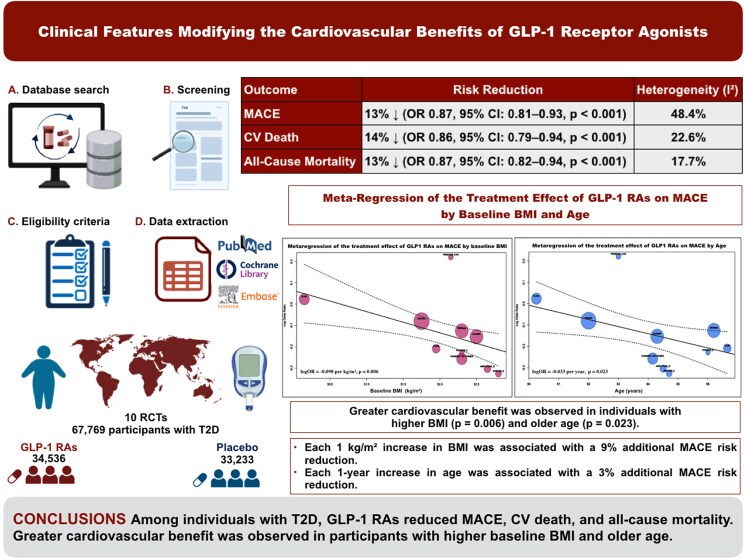
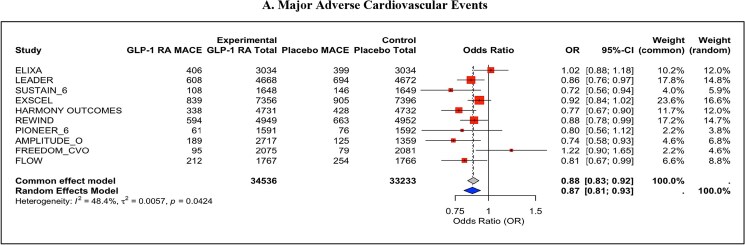
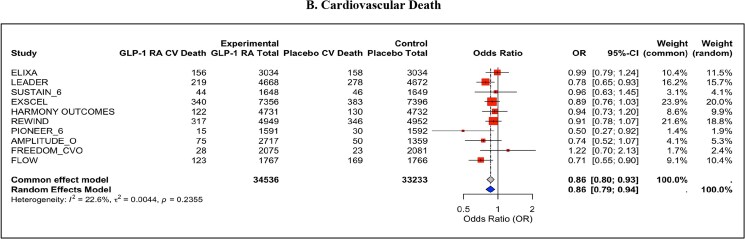
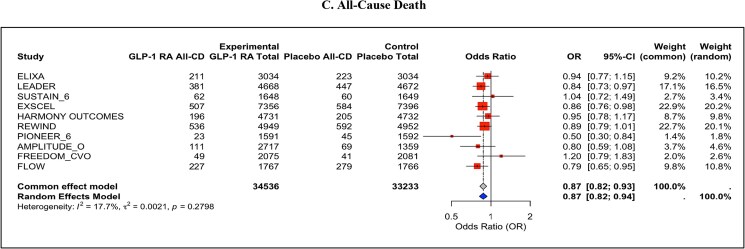
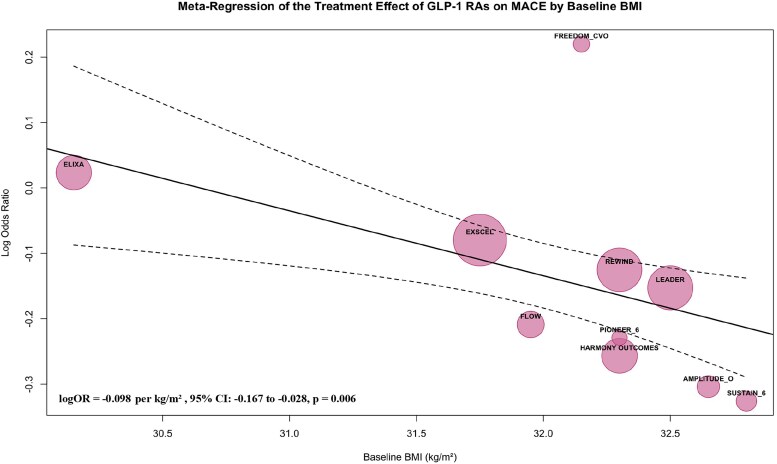
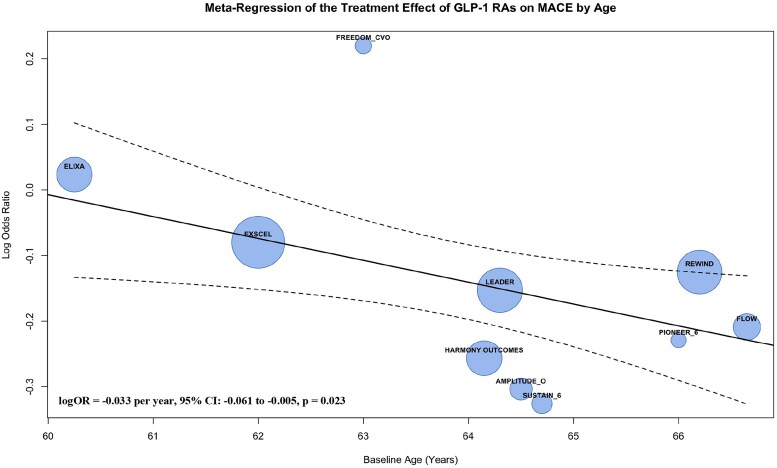
Glucagon-like peptide-1 receptor agonists (GLP-1 RAs) reduce major adverse cardiovascular events (MACE) in patients with type 2 diabetes (T2D), but heterogeneity exists across cardiovascular outcome trials (CVOTs). A comprehensive search of PubMed, EMBASE, and Cochrane Library was conducted through November 2024. Eligible CVOTs compared GLP-1 RAs with placebo in T2D patients. The primary outcome was MACE, defined as a composite of cardiovascular death, non-fatal myocardial infarction, and non-fatal stroke. Pooled odds ratios (ORs) with 95% confidence intervals (CIs) were calculated using a random-effects model. Heterogeneity was assessed using I², τ², and R². Meta-regression analyses evaluated the influence of baseline covariates on cardiovascular benefits of GLP-1 RAs, contingent upon the detection of moderate to substantial heterogeneity (I² ≥ 30%). Sensitivity analyses and GRADE assessments were also performed. Ten trials (67 769 patients; 34 536 receiving GLP-1 RAs) were analyzed. GLP-1 RAs significantly reduced MACE compared with placebo (OR = 0.87, 95% CI: 0.81–0.93, P < 0.001, I² = 48.4%). Cardiovascular death (OR = 0.86, 95% CI: 0.79–0.94, P < 0.001, I² = 22.6%) and all-cause mortality (OR = 0.87, 95% CI: 0.82–0.94, P < 0.001, I² = 17.7%) were also reduced. Meta-regression revealed a greater cardiovascular benefit in patients with higher baseline body mass index (BMI; logOR = −0.098 per kg/m², P = 0.006, R² = 99.98%) and older age (logOR = −0.033 per year, P = 0.023, R² = 75.47%). Sensitivity analyses confirmed the robustness of these findings, with consistent effect sizes and no single trial unduly influencing the results. The certainty of evidence was rated as high for all outcomes based on GRADE criteria. GLP-1 RAs significantly reduce MACE, cardiovascular death, and all-cause mortality in T2D patients. Higher baseline BMI and older age were associated with greater cardiovascular benefit.
Overview
The claims and statistics of this paper haven’t been checked yet.
Free: it reads the open-access text and checks the first 5 claims that cite a source we can check. Create a free account to check every claim.
Integrity signals
Registry
Cites
Statistics
Figures
Verification
Claims the paper makes
The claims and statistics of this paper haven’t been checked yet.
Free: it reads the open-access text and checks the first 5 claims that cite a source we can check. Create a free account to check every claim.
Claims other papers make about this one
Each is checked against this paper’s own text: does it say what the citing paper says it does?
The source backs part of the claim, not all of it — or backs it for a different population, condition or comparison.
In the citing paper
“These data indicate that GLP-1 RAs function primarily as direct vascular and systemic disease-modifying agents, operating through anti-inflammatory pathways and endothelial stabilization, rather than solely through adiposity reduction [85,87].”
From Adherence and Persistence with GLP-1-Based Therapies: International Real-World Evidence and the Role of Nutritional and Lifestyle Support—A Narrative Review (2026) · cites this paper as [87]
Experimental — accuracy not yet measured
Self-check
Percentages, sums and reported differences re-computed from the paper’s own numbers.
The self-check needs the paper’s full text.
Citations
Cites
The PRISMA 2020 statement: An updated guideline for reporting systematic reviews
Page, M. J., McKenzie, J. E., Bossuyt, P. M., Boutron, I., Hoffmann, T. C., Mulrow, C. D., Shamseer, L., Tetzlaff, J. M., Akl, E. A., Brennan, S. E., et al. (2021) · BMJ · doi:10.1136/bmj.n71 · Cited by 108,283
Measuring inconsistency in meta-analyses
Higgins, J. P. T., Thompson, S. G., Deeks, J. J., & Altman, D. G. (2003) · BMJ · doi:10.1136/bmj.327.7414.557 · Cited by 63,139 · cited 1×
“21 To further explore sources of heterogeneity, we performed meta-regression analyses to evaluate the moderating effects of baseline body mass index (BMI) and age on the treatment effects.”
The Cochrane Collaboration's tool for assessing risk of bias in randomised trials
Higgins, J. P. T., Altman, D. G., Gotzsche, P. C., Juni, P., Moher, D., Oxman, A. D., Savovic, J., Schulz, K. F., Weeks, L., Sterne, J. A. C., et al. (2011) · BMJ · doi:10.1136/bmj.d5928 · Cited by 33,817
GRADE: an emerging consensus on rating quality of evidence and strength of recommendations
Guyatt, G. H., Oxman, A. D., Vist, G. E., Kunz, R., Falck-Ytter, Y., Alonso-Coello, P., & Schünemann, H. J. (2008) · BMJ · doi:10.1136/bmj.39489.470347.ad · Cited by 23,305
Liraglutide and Cardiovascular Outcomes in Type 2 Diabetes
Marso, S. P., Daniels, G. H., Brown-Frandsen, K., Kristensen, P., Mann, J. F. E., Nauck, M. A., Nissen, S. E., Pocock, S., Poulter, N. R., Ravn, L. S., et al. (2016) · New England Journal of Medicine · doi:10.1056/nejmoa1603827 · Cited by 7,629
Semaglutide and Cardiovascular Outcomes in Patients with Type 2 Diabetes
Marso, S. P., Bain, S. C., Consoli, A., Eliaschewitz, F. G., Jódar, E., Leiter, L. A., Lingvay, I., Rosenstock, J., Seufert, J., Warren, M. L., et al. (2016) · New England Journal of Medicine · doi:10.1056/nejmoa1607141 · Cited by 6,900
Gerstein, H. C., Colhoun, H. M., Dagenais, G. R., Diaz, R., Lakshmanan, M., Pais, P., Probstfield, J., Riesmeyer, J. S., Riddle, M. C., Rydén, L., et al. (2019) · The Lancet · doi:10.1016/s0140-6736(19)31149-3 · Cited by 3,163
Lixisenatide in Patients with Type 2 Diabetes and Acute Coronary Syndrome
Pfeffer, M. A., Claggett, B., Diaz, R., Dickstein, K., Gerstein, H. C., Køber, L. V., Lawson, F. C., Ping, L., Wei, X., Lewis, E. F., et al. (2015) · New England Journal of Medicine · doi:10.1056/nejmoa1509225 · Cited by 2,409
Effects of once-weekly exenatide on cardiovascular outcomes in type 2 diabetes
Holman, R. R., Bethel, M. A., Mentz, R. J., Thompson, V. P., Lokhnygina, Y., Buse, J. B., Chan, J. C., Choi, J., Gustavson, S. M., Iqbal, N., et al. (2017) · New England Journal of Medicine · doi:10.1056/nejmoa1612917 · Cited by 2,162
Effects of Semaglutide on Chronic Kidney Disease in Patients with Type 2 Diabetes.
Perkovic, V., Tuttle, K. R., Rossing, P., Mahaffey, K. W., Mann, J. F. E., Bakris, G., Baeres, F. M. M., Idorn, T., Bosch-Traberg, H., Lausvig, N. L., et al. (2024) · New England Journal of Medicine · doi:10.1056/nejmoa2403347 · Cited by 2,099
Research works printed but not linked: 1
- International Diabetes Federation. IDF Diabetes Atlas. 11th ed. Brussels, Belgium: International Diabetes Federation; 2025.
Cited by
Kansakar, U., Jankauskas, S. S., Pande, S., Mone, P., Varzideh, F., & Santulli, G. (2026) · International Journal of Molecular Sciences · doi:10.3390/ijms27031409 · Cited by 22
Kowalska, M. K., El‐Mallul, A., Hudecka, W., Lubojańska, J. E., Lubojański, P. J., Orłowska, S. M., & Bednarczyk, Ł. (2026) · International Journal of Molecular Sciences · doi:10.3390/ijms27041886 · Cited by 10
Marzano, F., Paolillo, S., Gargiulo, P., Cotticelli, C., Santo, M. D., Nardi, E., Abbellito, G. M., Liccardi, L., Filardi, F. P., Bruzzese, D., et al. (2026) · Cardiovascular Diabetology · doi:10.1186/s12933-026-03215-y · Cited by 4
“Previous meta-analyses mainly assessed GLP-1 receptor agonists as a class and restricted analyses to patients with T2DM [6, 19, 20].”
Dziewierz, A., & Siudak, Z. (2026) · Nutrients · doi:10.3390/nu18111761 · Cited by 3
“These data indicate that GLP-1 RAs function primarily as direct vascular and systemic disease-modifying agents, operating through anti-inflammatory pathways and endothelial stabilization, rather than solely through adiposity reduction [85,87].”
Kim, C., Bu, F., Blacketer, C., Ostropolets, A., Duarte‐Salles, T., Viernes, B., Falconer, T., Pistillo, A., Li, J., Yin, C., et al. (2026) · Nature Communications · doi:10.1038/s41467-026-71307-0 · Cited by 4
Diabetic macular edema and GLP-1 receptor agonist use: a systematic review and meta-analysis
Al-Burak, S. A., Voznyy, V., Elganga, M., Zajner, C., Juncal, V., Sheidow, T., & Malvankar‐Mehta, M. S. (2026) · Canadian Journal of Ophthalmology · doi:10.1016/j.jcjo.2026.05.004 · Cited by 2
Roy, E., Parent, M.-C., & Ducharme, A. (2026) · Drugs in Context · doi:10.7573/dic.2025-12-4 · Cited by 2
Dhali, A., Maity, R., Khan, F., Biswas, J., & Faisal, A. R. (2026) · BMC Gastroenterology · doi:10.1186/s12876-026-05125-5 · Cited by 2
“The cardiovascular benefits of GLP-1 RAs are well established, with meta-analyses demonstrating a 13% reduction in major adverse cardiovascular events and a 13% reduction in all-cause mortality in patients with type 2 diabetes [6, 24].”
Farley, B., Radetich, E., D’Alessandro, J. S., & Bulaj, G. W. (2025) · Healthcare · doi:10.3390/healthcare13243220 · Cited by 2
“Given their broad effectiveness and popularity, there is an interest in using GLP1RAs for prevention of diabetes and cardiovascular conditions [42–44].”
Targeting GLP1 receptor for reducing global cardiovascular risk
Curcio, A., Meringolo, F., Marincolo, C., Polimeni, A., & Costanzo, S. (2026) · Journal of Translational Medicine · doi:10.1186/s12967-026-07736-8 · Cited by 2
“In the SURPASS-2 trial, tirzepatide demonstrated superior reductions in HbA1c and body weight compared with semaglutide in patients with T2DM, highlighting the metabolic potency of combined incretin signaling [23, 32].”
Chen, Q., Chen, T., Lin, W., & Chen, X. (2026) · Diabetes Metabolic Syndrome and Obesity · doi:10.2147/dmso.s585436 · Cited by 3
Abusnana, S., Sabbour, H. M., Afandi, B. O., Farghaly, M., Farooqi, M. H., Hafidh, K., Hassanein, M. M., Jabbar, A., Shehab, A., Kalimat, R., et al. (2026) · Vascular Health and Risk Management · doi:10.2147/vhrm.s579970 · Cited by 1
Kamel, K. S., Chan, D., & Hovelroud, R. (2026) · Internal Medicine Journal · doi:10.1111/imj.70522 · Cited by 1
Ghaffari, S., Mirzohreh, S., Roshanravan, N., & Tarighat, F. (2025) · Journal of Cardiovascular and Thoracic Research · doi:10.34172/jcvtr.025.33793 · Cited by 1
Ghosal, S., & Ghosal, A. (2025) · Diabetes Therapy · doi:10.1007/s13300-025-01817-5 · Cited by 1
“Prior meta-analyses have pooled data within drug classes but rarely integrated cross-class comparisons or net benefit analyses accounting for both efficacy and harms [15, 16].”
Cardiovascular outcomes of glucagon-like peptide-1 receptor agonists: A systematic review
Bihelek, N., Burke, S., & Barry, A. R. (2026) · American Journal of Health-System Pharmacy · doi:10.1093/ajhp/zxag121
Parekh, R. S., Inban, P., Thai, A., Agrawal, A., Kudaiarov, D., & Tariq, H. (2026) · Disease-a-Month · doi:10.1016/j.disamonth.2026.102150
Yıldırım, B. O., Sarkım, İ. F., Yalman, G., Arslantas, B., Celik, C. B., & Yıldırım, Ş. (2026) · BMC Cardiovascular Disorders · doi:10.1186/s12872-026-06387-3
“It has been suggested that GLP-1RAs provide cardiovascular protection through their effects on body weight, blood pressure, and inflammatory mediators [28].”
Insulin signaling and impairments in executive functions in preclinical models: A narrative approach
Pisa, E., & Macrì, S. (2026) · Elsevier eBooks · doi:10.1016/b978-0-443-30263-3.00025-7
Pucek, W. F., Hoffmann, K., Bryl, W., Kus, K., & Paczkowska, A. (2026) · Frontiers in Endocrinology · doi:10.3389/fendo.2026.1906959
Emerging therapies and evolving paradigms in cardiovascular pharmacotherapy
Rocca, B. (2026) · European Heart Journal - Cardiovascular Pharmacotherapy · doi:10.1093/ehjcvp/pvag053
“6 Using a target-trial emulation approach, Malik et al . investigated semaglutide in patients with type 2 diabetes mellitus (DM), obesity, and rheumatoid arthritis, a population with a particularly high cardiovascular risk profile, but without established atherosclerotic disease or symptomatic…”
de Toledo, J. O., Ferreira, C. D. C., da Silva, C. P., de David, F., de Castro, L. C., Vilarino, M. T., Zani, M. D., Ferreira, M. S., Teles, T. K. B., & Nogueira, A. D. S. (2026) · Revista fisio&terapia. · doi:10.69849/6tp4j418
Gisal, M., Koźlak, J., Sokół, M., Wróblewska, K., Leszczyński, F., & Stopyra, L. (2026) · Journal of Pre-Clinical and Clinical Research · doi:10.26444/jpccr/235860
“N In addition, between-trial variability may partly reflect differences in age, body mass index, kidney function, baseline cardiovascular risk, treatment discontinuation, and duration of follow-up [31].”
Yokote, K., Yamauchi, T., Shingaki, T., Chin, R., Oura, T., 長井友紀子, Shimomura, I., & Kadowaki, T. (2026) · The Lancet Diabetes & Endocrinology · doi:10.1016/s2213-8587(26)00232-9 · Cited by 2
Metadata
- Authors
- Kalayci, A., Januzzi, J. L., Mitsunami, M., Tanboga, I. H., Karabay, C. Y., & Gibson, C. M.
- Affiliations
- Cardiovascular Division, Brigham and Women's Hospital, Harvard Medical School , 75 Francis Street, Boston, MA 02115 ,
- Harvard University (US)
- Department of Cardiology, Hisar Intercontinental Hospital, Nişantaşı University , Yamanevler, Site Yolu Cd No:7, 34768 Umraniye, Istanbul ,
- Department of Cardiology, Dr. Siyami Ersek Training and Research Hospital, University of Health Sciences , Selimiye, Tibbiye Cd No:25, 34668 Uskudar, Istanbul ,
- Beth Israel Deaconess Medical Center (US)
- Corresponding author
- Gibson, Charles Michael
- Venue
- European Heart Journal - Cardiovascular Pharmacotherapy
- Publisher
- Oxford University Press (OUP)
- Published
- 2025-08-31
- Volume
- 11
- Issue
- 6
- Pages
- 552-561
- ISSN
- 2055-6837 (ISSN-L)
- 2055-6845
- PMC
- PMC12450594
- OpenAlex
- W4413882572
- Cited by
- 18
- References
- 36
- Citations by year
- 2026: 16 · 2025: 2
- FWCI
- 2.45
- Type
- journal article
- Language
- en
- Open access
- hybrid
- doi.org
- Licence
- Locations
- European Heart Journal - Cardiovascular Pharmacotherapy (publishedVersion, cc-by)
- Europe PMC (PubMed Central) (publishedVersion, cc-by)
- PubMed (publishedVersion)
- PubMed Central (publishedVersion, cc-by)
- Funders
- National Heart, Lung, and Blood Institute (T32HL094301)
- Topics
- Health Sciences › Medicine › Endocrinology, Diabetes and Metabolism › Diabetes Treatment and Management
- Health Sciences › Medicine › Endocrinology, Diabetes and Metabolism › Diabetes, Cardiovascular Risks, and Lipoproteins
- Health Sciences › Medicine › Cardiology and Cardiovascular Medicine › Heart Failure Treatment and Management
- Keywords
- GLP-1 receptor agonists, type 2 diabetes, major adverse cardiovascular events, cardiovascular outcome trials, cardiovascular mortality, body mass index, age, baseline covariates, cardiovascular risk factors, weight loss, myocardial infarction, stroke, all-cause mortality, sex differences, alcohol consumption, physical activity
- MeSH terms
- Glucagon-Like Peptide-1 Receptor Agonists, Aged, Cardiovascular Diseases, Diabetes Mellitus, Type 2, Female, Humans, Hypoglycemic Agents, Male, Middle Aged, Risk Factors, Randomized Controlled Trials as Topic, Treatment Outcome, Risk Assessment, Incretins
About these checks
Registry, retraction, Cites and statistics results are computed, not judged, with one exception: a printed reference that no index lists is read once by a model before it counts as a citation error. Claims are extracted by a model and kept only when their quote appears verbatim in the text; each cited source is then checked, with a model’s help, for whether it says what the claim relies on. Those verdicts can be wrong — read the claim’s quote and the cited source before relying on one.
Statistics and arithmetic are recomputed, not judged.
Confidence bands are shown only for fields calibrated on our annotated test set. None is calibrated yet, so no band is shown.
What counts as a claim ›How we measure confidence ›How we check this ›
Are you an author, or do you see a problem with this page? Request a review
Data sources
Bibliographic data: Semantic Scholar, OpenAlex, Crossref.
Contains information from the Semantic Scholar Academic Graph Datasets, made available under the ODC Attribution License (ODC-BY 1.0).
Semantic Scholar’s data is described in: Kinney, R., et al. (2023). The Semantic Scholar Open Data Platform. arXiv:2301.10140.
