

Gonadotropins for pubertal induction in males with hypogonadotropic hypogonadism: systematic review and meta-analysis
Open accessThe DOI matches its Crossref record; 88 of the 88 references it cites were found in a registry or an index; none of the 111 sources its claims cite is checked for support yet.
Abstract
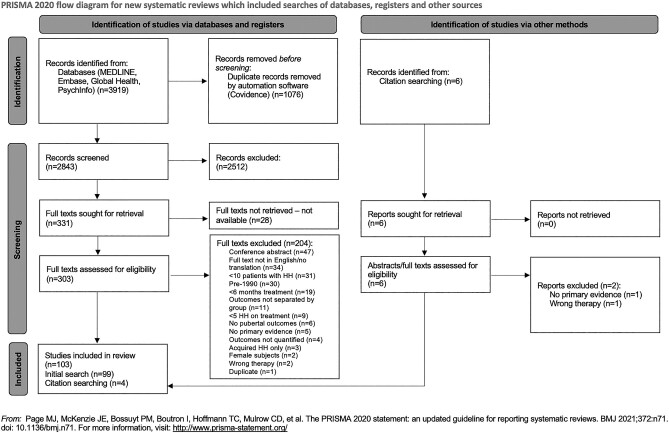
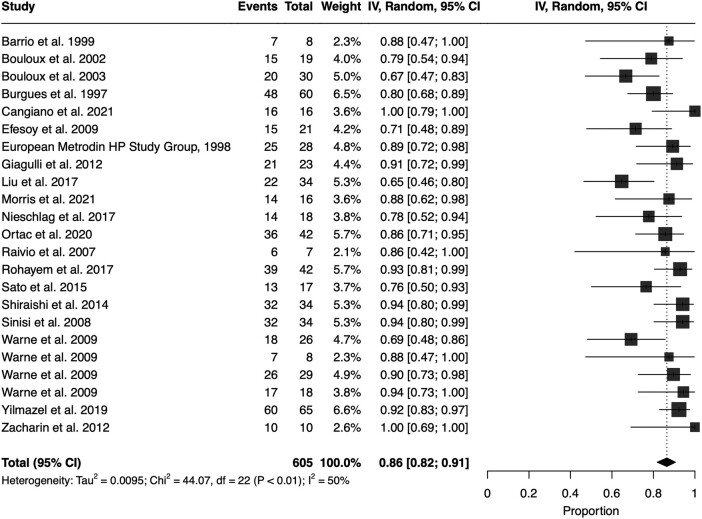
Objective: Hypogonadotropic hypogonadism is characterized by inadequate secretion of pituitary gonadotropins, leading to absent, partial, or arrested puberty. In males, classical treatment with testosterone promotes virilization but not testicular growth or spermatogenesis. To quantify treatment practices and efficacy, we systematically reviewed all studies investigating gonadotropins for the achievement of pubertal outcomes in males with hypogonadotropic hypogonadism. Design: Systematic review and meta-analysis. Methods: A systematic review of Medline, Embase, Global Health, and PsycINFO databases in December 2022. Risk of Bias 2.0/Risk Of Bias In Non-randomized Studies of Interventions/National Heart, Lung, and Blood Institute tools for quality appraisal. Protocol registered on PROSPERO (CRD42022381713). Results: After screening 3925 abstracts, 103 studies were identified including 5328 patients from 21 countries. The average age of participants was <25 years in 45.6% (n = 47) of studies. Studies utilized human chorionic gonadotropin (hCG) (n = 93, 90.3% of studies), human menopausal gonadotropin (n = 42, 40.8%), follicle-stimulating hormone (FSH) (n = 37, 35.9%), and gonadotropin-releasing hormone (28.2% n = 29). The median reported duration of treatment/follow-up was 18 months (interquartile range 10.5-24 months). Gonadotropins induced significant increases in testicular volume, penile size, and testosterone in over 98% of analyses. Spermatogenesis rates were higher with hCG + FSH (86%, 95% confidence interval [CI] 82%-91%) as compared with hCG alone (40%, 95% CI 25%-56%). However, study heterogeneity and treatment variability were high. Conclusions: This systematic review provides convincing evidence of the efficacy of gonadotropins for pubertal induction. However, there remains substantial heterogeneity in treatment choice, dose, duration, and outcomes assessed. Formal guidelines and randomized studies are needed.
Overview
CoChat Summary
TL;DR
This systematic review and meta-analysis of 103 studies including 5328 patients found that gonadotropins for pubertal induction in males with hypogonadotropic hypogonadism significantly increased testicular volume, penile size, and testosterone in over 98% of analyses. Spermatogenesis rates were highest with hCG + FSH (86%, 95% CI 82%–91%) versus hCG alone (40%, 95% CI 25%–56%), but heterogeneity and study bias were high.
Key findings
- Across 103 studies (5328 patients, 21 countries), hCG was used in 90.3% (n = 93), hMG in 40.8% (n = 42), FSH in 35.9% (n = 37), and GnRH in 28.2% (n = 29); median treatment/follow-up duration was 18 months (IQR 10.5–24).
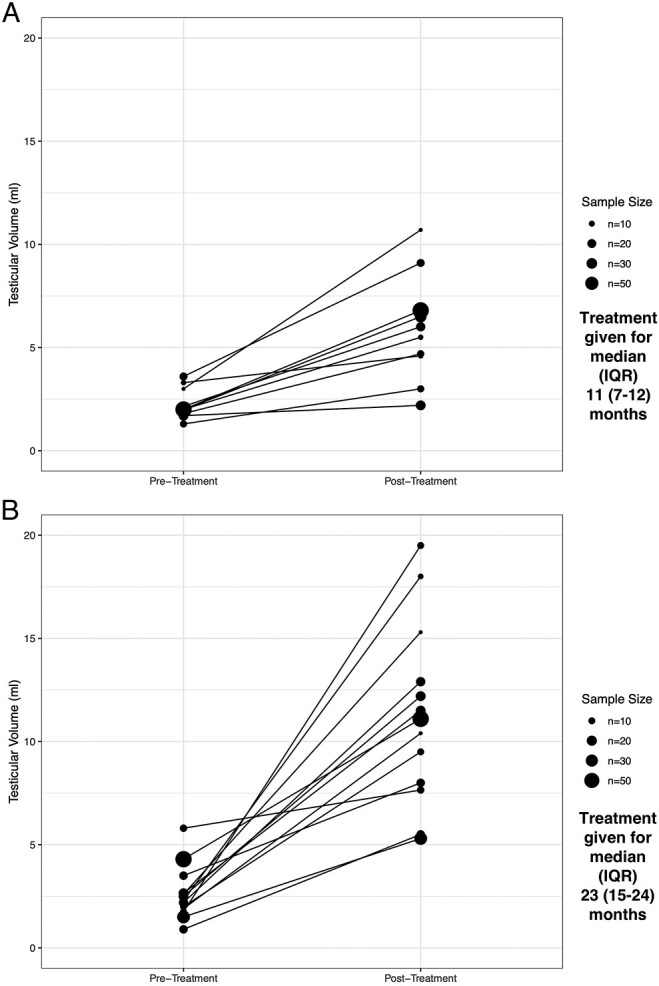
- Gonadotropins induced significant increases in testicular volume in 98.1% (51/52) of analyses, penile length in 100% (20/20) of analyses, and testosterone in 98% (49/50) of analyses; median testosterone rose from 0.4 ng/mL pre-treatment to 4.7 ng/mL post-treatment.
- Pooled spermatogenesis proportions were 86% (95% CI 82%–91%) for hCG + FSH, 76% (95% CI 68%–84%) for hCG + hMG, 76% (95% CI 65%–86%) for GnRH, and 40% (95% CI 25%–56%) for hCG alone.
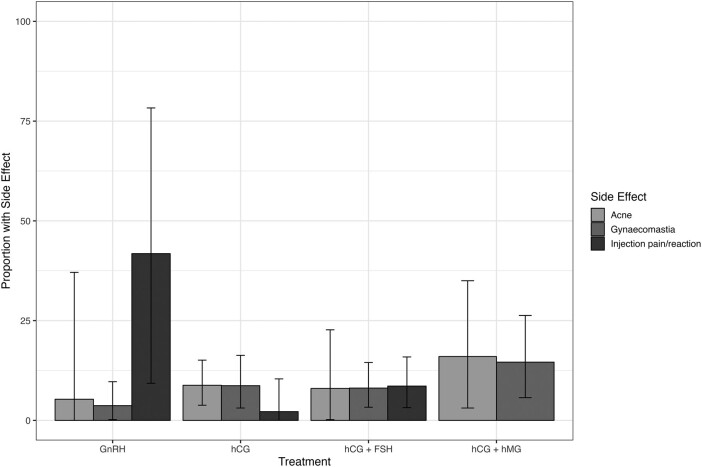
- Pooled adverse effects included gynaecomastia 9% (95% CI 3%–16%) with hCG, injection site reaction/pain 9% (95% CI 3%–16%) with hCG + FSH, and injection site reaction/pain 42% (95% CI 9%–78%) with GnRH.
Methods
- Systematic review and meta-analysis; searched Medline, Embase, Global Health, and PsycINFO from inception to December 2022; protocol registered on PROSPERO (CRD42022381713).
- After screening 3925 abstracts, 103 studies met inclusion criteria (76 pre–post observational, 19 comparative non-randomized, 6 RCTs, 2 other); quality appraisal used ROBINS-I, Risk of Bias 2.0, and NHLBI tools, excluding critical/high risk or NHLBI score <7 from data synthesis.
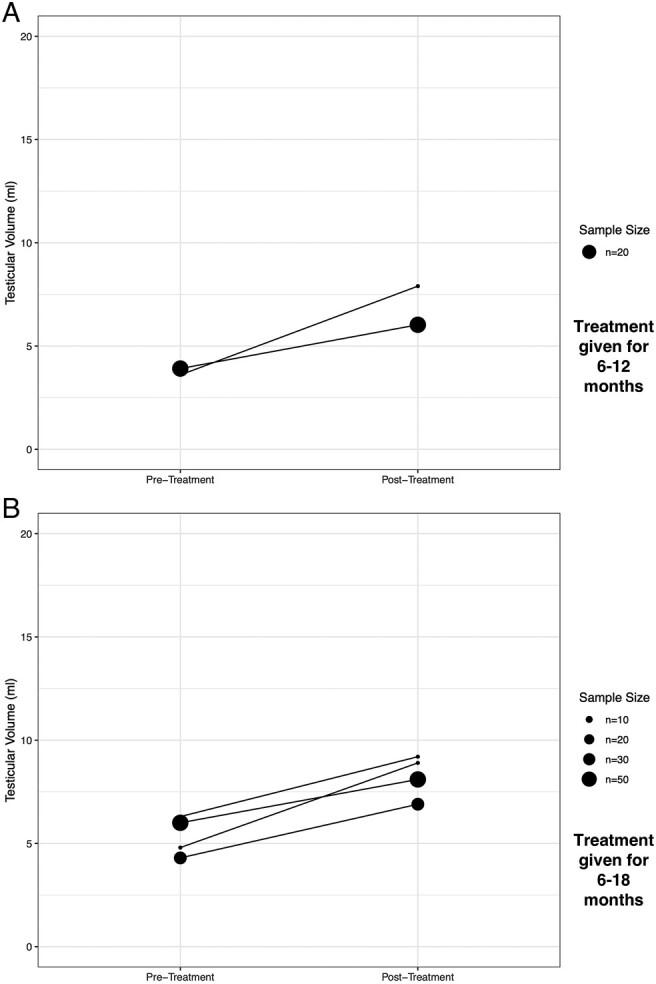
- Random-effects proportional meta-analyses were performed for spermatogenesis and adverse effects; pre–post testicular volume, penile length, and biochemical outcomes were not meta-analyzed due to bias risk, and were summarized by proportion of analyses reporting significant change and modified Albatross plots.
Limitations
- The paper states that meta-analyses of observational data are highly liable to bias and confounding, with variability in cohorts, dosing, treatment duration, and statistical heterogeneity; publication bias is present, participant data may have been duplicated, and FSH/hMG misclassification may have occurred.
- The paper also states that pubertal status was reported variably and influenced by pre-treatment and HH itself; prior testosterone treatment and inclusion of mixed IHH/CHH and acquired HH cohorts may reduce specificity; adverse effect data may have been collected inconsistently; time to maximal outcomes could not be synthesized; and only English-language studies were included.
- Evident from the text: heterogeneity was high for several outcomes (e.g., I² = 83% for hCG spermatogenesis; I² = 90% for acne with hCG + FSH), and few studies directly compared key treatment options, with most evidence coming from pre–post observational designs.
Model-written summary. Check it against the paper before relying on it.
Integrity signals
Registry
Cites
Statistics
Figures
Verification
Claims the paper makes
0 Valid · 0 Not valid · 31 Not checked · 69 Own results and interpretations
A result the paper reports from its own data — it cites no other source for it, so there is none to check. The quote shows it is in the paper.
In the paper
“The median of the average age was 25.3 years (interquartile range [IQR] 21.4-30.6 years)”
§ Gonadotropins for pubertal induction in males with hypogonadotropic hypogonadism: systematic review and meta-analysis > Results
plain- Asserted: passes — The authors put it forward as true.
- Checkable: passes — It can be checked against evidence.
- Load-bearing: unclear — It is unclear whether the paper’s conclusions depend on it.
- Based: passes — The paper gives a reason why it holds.
A result the paper reports from its own data — it cites no other source for it, so there is none to check. The quote shows it is in the paper.
In the paper
“Of these, 98.1% (n = 51) found that administration of gonadotropins caused a significant increase in size of the testicles.”
§ Gonadotropins for pubertal induction in males with hypogonadotropic hypogonadism: systematic review and meta-analysis > Results > Clinical outcomes in all cohorts
plainstates a causen = 51 ·- Asserted: passes — The authors put it forward as true.
- Checkable: passes — It can be checked against evidence.
- Load-bearing: passes — The paper’s conclusions depend on it.
- Based: passes — The paper gives a reason why it holds.
A result the paper reports from its own data — it cites no other source for it, so there is none to check. The quote shows it is in the paper.
In the paper
“Fifty studies (48.5%) had cohorts exclusively with IHH or CHH, with no patients with acquired/pituitary causes (Table S1), and the remainder were mixed cohorts.”
§ Gonadotropins for pubertal induction in males with hypogonadotropic hypogonadism: systematic review and meta-analysis > Results > Summary of treatment, cohorts, and pubertal status across all studies
plain- Asserted: passes — The authors put it forward as true.
- Checkable: passes — It can be checked against evidence.
- Load-bearing: unclear — It is unclear whether the paper’s conclusions depend on it.
- Based: passes — The paper gives a reason why it holds.
A result the paper states — it cites no source for it, so there is none to check. The quote shows it is in the paper.
In the paper
“Five randomized trials and 18 non-randomized comparative studies of different gonadotropins passed quality screening.”
§ Gonadotropins for pubertal induction in males with hypogonadotropic hypogonadism: systematic review and meta-analysis > Results > Direct comparison of gonadotropin regimes
plain- Asserted: passes — The authors put it forward as true.
- Checkable: passes — It can be checked against evidence.
- Load-bearing: passes — The paper’s conclusions depend on it.
- Based: passes — The paper gives a reason why it holds.
A result the paper reports from its own data — it cites no other source for it, so there is none to check. The quote shows it is in the paper.
In the paper
“For GnRH, the pooled proportion was 76% (95% CI 65%-86%).”
§ Gonadotropins for pubertal induction in males with hypogonadotropic hypogonadism: systematic review and meta-analysis > Results > Clinical outcomes in all cohorts
plain- Asserted: passes — The authors put it forward as true.
- Checkable: passes — It can be checked against evidence.
- Load-bearing: passes — The paper’s conclusions depend on it.
- Based: passes — The paper gives a reason why it holds.
44 more claims
Create a free account to see all 100 claims and to verify the 110 references still open.
- Probably not a substantial claim. 24
- It may state two separate claims as one. 33
Self-check
Percentages, sums and reported differences re-computed from the paper’s own numbers.
Each contradiction between two passages listed here was confirmed by an independent check.
Rated minor: it would not touch a result — a value no result rests on, a p-value that stays on the same side of the significance level, or a conflict that is clerical, resolved elsewhere in the paper, or outside its own findings.
In the paper
§ Gonadotropins for pubertal induction in males with hypogonadotropic hypogonadism: systematic review and meta-analysis > Results > Quality appraisal
“Overall, 44.0% of non-randomized or randomized comparative studies appraised using RoB 2.0 or ROBINS-I had serious (randomized) or high (non-randomized) risk of bias in at least one domain (Table S3).”
§ Gonadotropins for pubertal induction in males with hypogonadotropic hypogonadism: systematic review and meta-analysis > Results > Quality appraisal
“Overall ratings showed that, of six RCTs, one study had a high risk of bias, four studies had some concerns, and one study had a low risk of bias. Of non-randomized studies of interventions (comparative) studies, nine studies had a moderate risk of bias, nine had a serious risk of bias, and one study had a critical risk of bias.”
Citations
Cites
The PRISMA 2020 statement: An updated guideline for reporting systematic reviews
Page, M. J., McKenzie, J. E., Bossuyt, P. M., Boutron, I., Hoffmann, T. C., Mulrow, C. D., Shamseer, L., Tetzlaff, J. M., Akl, E. A., Brennan, S. E., et al. (2021) · BMJ · doi:10.1136/bmj.n71 · Cited by 108,283
RoB 2: a revised tool for assessing risk of bias in randomised trials
Sterne, J. A. C., Savović, J., Page, M. J., Elbers, R. G., Blencowe, N. S., Boutron, I., Cates, C. J., Cheng, H.-Y., Corbett, M. S., Eldridge, S. M., et al. (2019) · BMJ · doi:10.1136/bmj.l4898 · Cited by 34,787
ROBINS-I: a tool for assessing risk of bias in non-randomised studies of interventions
Sterne, J. A., Hernán, M. A., Reeves, B. C., Savović, J., Berkman, N. D., Viswanathan, M., Henry, D., Altman, D. G., Ansari, M. T., Boutron, I., et al. (2016) · BMJ · doi:10.1136/bmj.i4919 · Cited by 20,329
Barker, T. H., Migliavaca, C. B., Stein, C., Colpani, V., Falavigna, M., Aromataris, E., & Munn, Z. (2021) · BMC Medical Research Methodology · doi:10.1186/s12874-021-01381-z · Cited by 738
Pre-post effect sizes should be avoided in meta-analyses
Cuijpers, P., Weitz, E., Cristea, I. A., & Twisk, J. (2017) · Epidemiology and Psychiatric Sciences · doi:10.1017/s2045796016000809 · Cited by 432
Challenges in meta-analyses with observational studies
Metelli, S., & Chaimani, A. (2020) · Evidence Based Mental Health · doi:10.1136/ebmental-2019-300129 · Cited by 290
Buchter, D., Behre, H., Kliesch, S., & Nieschlag, E. (1998) · European Journal of Endocrinology · doi:10.1530/eje.0.1390298 · Cited by 269
CORTES, D., MÜLLER, J., & SKAKKEBÆK, N. E. (1987) · International Journal of Andrology · doi:10.1111/j.1365-2605.1987.tb00358.x · Cited by 263
Predictors of Outcome of Long-Term GnRH Therapy in Men with Idiopathic Hypogonadotropic Hypogonadism
Pitteloud, N., Hayes, F. J., Dwyer, A., Boepple, P. A., Lee, H., & Crowley, W. F. (2002) · The Journal of Clinical Endocrinology & Metabolism · doi:10.1210/jc.2002-020518 · Cited by 243
Dodé, C., & Hardelin, J.-P. (2009) · European Journal of Human Genetics · doi:10.1038/ejhg.2008.206 · Cited by 221
Cited by
Esteves, S. C., Viana, M. C., Achermann, A. P. P., & Santi, D. (2025) · Andrology · doi:10.1111/andr.70003 · Cited by 29
Kallmann syndrome: Diagnostics and management
Yadav, R. K., Qi, B., Wen, J., Gang, X., & Banerjee, S. (2024) · Clinica Chimica Acta · doi:10.1016/j.cca.2024.119994 · Cited by 28
Current landscape of fertility induction in males with congenital hypogonadotropic hypogonadism
Dwyer, A. A., McDonald, I. R., & Quinton, R. (2024) · Annals of the New York Academy of Sciences · doi:10.1111/nyas.15214 · Cited by 27
Khera, M., Torres, L. O., Grober, E. D., Morgentaler, A., Miner, M. M., Jones, T. H., Mills, J. N., & Salonia, A. (2025) · Sexual Medicine Reviews · doi:10.1093/sxmrev/qeaf036 · Cited by 26
Delayed Puberty and Management of Treatment
Abacı, A., & Besci, Ö. (2024) · Journal of Clinical Research in Pediatric Endocrinology · doi:10.4274/jcrpe.galenos.2024.2024-2-7 · Cited by 19
Metadata
- Authors
- Alexander, E. C., Faruqi, D., Farquhar, R., Unadkat, A., Ng Yin, K., Hoskyns, R., Varughese, R., & Howard, S. R.
- Affiliations
- Queen Mary University of London (GB)
- King's College London (GB)
- Centre for Endocrinology, William Harvey Research Institute, Barts and the London School of Medicine and Dentistry, Queen Mary University of London , London EC1M 6BQ , United Kingdom
- Great Ormond Street Hospital (GB)
- Corresponding author
- Howard, Sasha R
- Venue
- European Journal of Endocrinology
- Publisher
- Oxford University Press (OUP)
- Published
- 2023-12-21
- Volume
- 190
- Issue
- 1
- Pages
- S1-S11
- ISSN
- 0804-4643 (ISSN-L)
- 1479-683X
- PMC
- PMC10773669
- OpenAlex
- W4390046499
- Semantic Scholar
- 020e176155829da455f2b76529ac3395847f6dc1
- Cited by
- 51
- References
- 88
- Citations by year
- 2026: 20 · 2025: 21 · 2024: 10
- FWCI
- 1.45
- Type
- journal article
- Language
- en
- Open access
- hybrid
- doi.org
- Licence
- Locations
- European Journal of Endocrinology (publishedVersion, cc-by)
- PubMed Central (publishedVersion, cc-by)
- PubMed (publishedVersion)
- Queen Mary Research Online (Queen Mary University of London) (submittedVersion, cc-by)
- Funders
- NIHR Academic Clinical Fellowship (ACF-2021-19-002)
- NIHR
- NHS
- UK Department of Health and Social Care
- Wellcome Trust (222049/Z/20/Z)
- Barts Charity (MGU0552)
- Topics
- Health Sciences › Medicine › Reproductive Medicine › Hypothalamic control of reproductive hormones
- Health Sciences › Medicine › Endocrinology, Diabetes and Metabolism › Hormonal and reproductive studies
- Health Sciences › Medicine › Endocrinology, Diabetes and Metabolism › Growth Hormone and Insulin-like Growth Factors
- Keywords
- hypogonadotropic hypogonadism, puberty induction, gonadotropins, human chorionic gonadotropin, human menopausal gonadotropin, follicle-stimulating hormone, gonadotropin-releasing hormone, testicular volume, spermatogenesis, testosterone, male puberty, treatment effect heterogeneity, treatment guidelines, masculinization
- MeSH terms
- Follicle Stimulating Hormone, Gonadotropins, Chorionic Gonadotropin, Humans, Hypogonadism, Klinefelter Syndrome, Gonadotropin-Releasing Hormone, Male, Spermatogenesis, Testis, Testosterone, Young Adult
About these checks
Registry, retraction, Cites and statistics results are computed, not judged, with one exception: a printed reference that no index lists is read once by a model before it counts as a citation error. Claims are extracted by a model and kept only when their quote appears verbatim in the text; each cited source is then checked, with a model’s help, for whether it says what the claim relies on. Those verdicts can be wrong — read the claim’s quote and the cited source before relying on one.
A language model drew the claims from the paper on 2026-11-27, under version 3 of the claim definition (model deepseek-v4.1-flash, prompt extract-v3).
A second model labelled each claim on 2026-11-27 (model jev-1.13-20260917, definition revision gold-guideline-v0.2).
Statistics and arithmetic are recomputed, not judged.
Confidence bands are shown only for fields calibrated on our annotated test set. None is calibrated yet, so no band is shown.
What counts as a claim ›How we measure confidence ›How we check this ›
Are you an author, or do you see a problem with this page? Request a review
Data sources
Bibliographic data: Semantic Scholar, OpenAlex, Crossref.
Contains information from the Semantic Scholar Academic Graph Datasets, made available under the ODC Attribution License (ODC-BY 1.0).
Semantic Scholar’s data is described in: Kinney, R., et al. (2023). The Semantic Scholar Open Data Platform. arXiv:2301.10140.
