

The DOI matches its Crossref record; 30 of the 31 references it cites were found in a registry or an index.
Novel genetic markers improve measures of atrial fibrillation risk prediction
Open accessAbstract
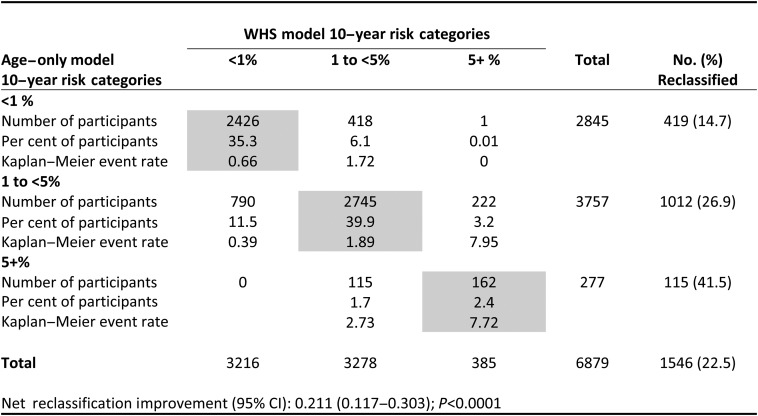
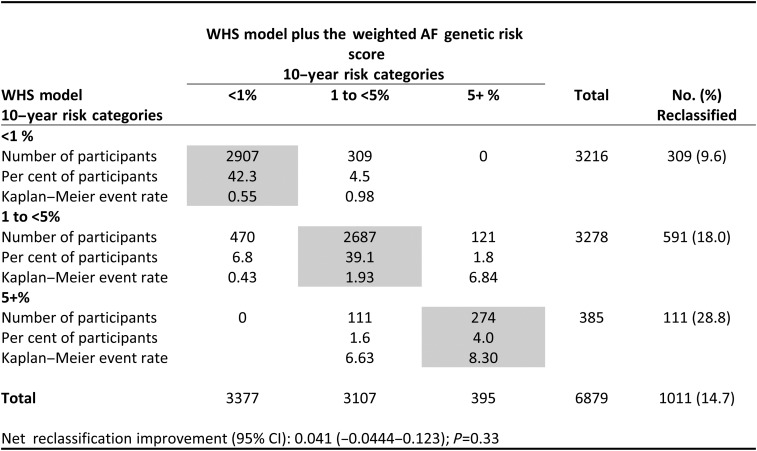
AIMS: Atrial fibrillation (AF) is associated with adverse outcome. Whether recently discovered genetic risk markers improve AF risk prediction is unknown. METHODS AND RESULTS: We derived and validated a novel AF risk prediction model from 32 possible predictors in the Women's Health Study (WHS), a cohort of 20 822 women without cardiovascular disease (CVD) at baseline followed prospectively for incident AF (median: 14.5 years). We then created a genetic risk score (GRS) comprised of 12 risk alleles in nine loci and assessed model performance in the validation cohort with and without the GRS. The newly derived WHS AF risk algorithm included terms for age, weight, height, systolic blood pressure, alcohol use, and smoking (current and past). In the validation cohort, this model was well calibrated with good discrimination [C-index (95% CI) = 0.718 (0.684-0.753)] and improved all reclassification indices when compared with age alone. The addition of the genetic score to the WHS AF risk algorithm model improved the C-index [0.741 (0.709-0.774); P = 0.001], the category-less net reclassification [0.490 (0.301-0.670); P < 0.0001], and the integrated discrimination improvement [0.00526 (0.0033-0.0076); P < 0.0001]. However, there was no improvement in net reclassification into 10-year risk categories of <1, 1-5, and 5+% [0.041 (-0.044-0.12); P = 0.33]. CONCLUSION: Among women without CVD, a simple risk prediction model utilizing readily available risk markers identified women at higher risk for AF. The addition of genetic information resulted in modest improvements in predictive accuracy that did not translate into improved reclassification into discrete AF risk categories.
Overview
The claims and statistics of this paper haven’t been checked yet.
Run the check — free, no account needed. It reads the open-access text and checks the sources it cites.
Integrity signals
Registry
Cites
Statistics
Figures
Verification
Claims the paper makes
The claims and statistics of this paper haven’t been checked yet.
Run the check — free, no account needed. It reads the open-access text and checks the sources it cites.
Claims other papers make about this one
Each is checked against this paper’s own text: does it say what the citing paper says it does?
In the citing paper
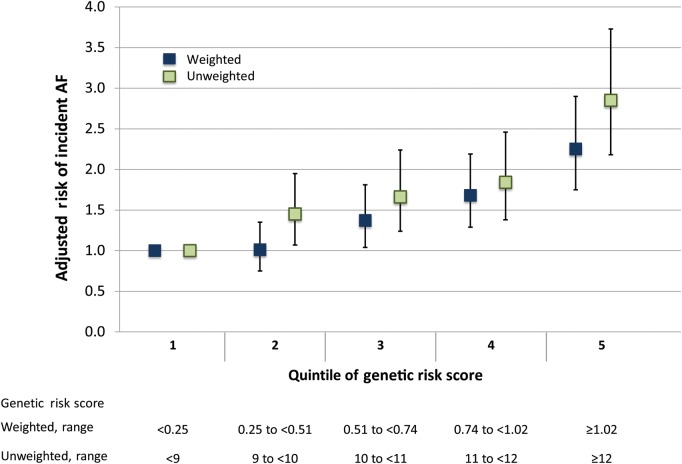
“In the WGHS analysis, those in the top quintile of AF-GRS had a greater than two-fold increased risk for incident AF in a model that adjusted for non-genetic factors.”
From Twelve-single nucleotide polymorphism genetic risk score identifies individuals at increased risk for future atrial fibrillation and stroke (2014) · cites this paper as [35]
Self-check
Percentages, sums and reported differences re-computed from the paper’s own numbers.
The self-check needs the paper’s full text.
Citations
Cites
Regression Modeling Strategies
Harrell, F. E. (2001) · Springer series in statistics · doi:10.1007/978-1-4757-3462-1 · Cited by 9,270
Harrell (2015) · Springer Series in Statistics · doi:10.1007/978-3-319-19425-7 · Cited by 6,878
Benjamin, E. J. (1994) · JAMA · doi:10.1001/jama.1994.03510350050036 · Cited by 2,613
Miyasaka, Y., Barnes, M. E., Gersh, B. J., Cha, S. S., Bailey, K. R., Abhayaratna, W. P., Seward, J. B., & Tsang, T. S. M. (2006) · Circulation · doi:10.1161/circulationaha.105.595140 · Cited by 2,564
Extensions of net reclassification improvement calculations to measure usefulness of new biomarkers
Pencina, M. J., D’Agostino, R. B., & Steyerberg, E. W. (2010) · Statistics in Medicine · doi:10.1002/sim.4085 · Cited by 2,483
Plasma Natriuretic Peptide Levels and the Risk of Cardiovascular Events and Death
Wang, T. J., Larson, M. G., Levy, D. A., Benjamin, E. J., Leip, E. P., Omland, T., Wolf, P. A., & Vasan, R. S. (2004) · New England Journal of Medicine · doi:10.1056/nejmoa031994 · Cited by 1,521
Incidence of and risk factors for atrial fibrillation in older adults
Psaty, B. M., Manolio, T. A., Kuller, L. H., Kronmal, R. A., Cushman, M., Fried, L. P., White, R., Furberg, C. D., & Rautaharju, P. M. (1997) · Circulation · doi:10.1161/01.cir.96.7.2455 · Cited by 1,462
Schnabel, R. B., SULLIVAN, L. M., Levy, D. A., Pencina, M. J., Massaro, J. M., D’Agostino, R. B., Newton‐Cheh, C., Yamamoto, J. F., Magnani, J. W., Tadros, T. M., et al. (2009) · The Lancet · doi:10.1016/s0140-6736(09)60443-8 · Cited by 1,038
Variants conferring risk of atrial fibrillation on chromosome 4q25
Gudbjartsson, D. F., Arnar, D. O., Helgadottir, A., Gretarsdottir, S., Holm, H., Sigurdsson, A., Jonasdottir, A., Baker, A., Thorleifsson, G., Kristjansson, K., et al. (2007) · Nature · doi:10.1038/nature06007 · Cited by 955
Impact of Atrial Fibrillation on Mortality, Stroke, and Medical Costs
Wolf, P. A., Mitchell, J. B., Baker, C. S., Kannel, W. B., & D’Agostino, R. B. (1998) · Archives of Internal Medicine · doi:10.1001/archinte.158.3.229 · Cited by 683
Cited by
Sorted by citations
Items 101–140 of 140
Investigating the Genetic Architecture of the PR Interval Using Clinical Phenotypes
Mosley, J. D., Shoemaker, M. B., Wells, Q. S., Darbar, D., Shaffer, C. M., Edwards, T. L., Bastarache, L. A., McCarty, C. A., Thompson, W. K., Chute, C. G., et al. (2017) · Circulation Cardiovascular Genetics · doi:10.1161/circgenetics.116.001482 · Cited by 9
Cruz, D., Pinto, R., Freitas-Silva, M., Nunes, J. P. L., & Medeiros, R. (2019) · Pharmacogenomics · doi:10.2217/pgs-2019-0054 · Cited by 9
Kawakami, M., Karashima, S., Morita, K., Tada, H., Okada, H., Aono, D., Kometani, M., Nomura, A., Demura, M., Furukawa, K., et al. (2021) · Circulation Reports · doi:10.1253/circrep.cr-21-0151 · Cited by 10
Genetic Discoveries in Atrial Fibrillation and Implications for Clinical Practice
Mahida, S., & Leeds General Infirmary, G. G. S. (2014) · Arrhythmia & Electrophysiology Review · doi:10.15420/aer.2014.3.2.69 · Cited by 8
Noseworthy, P. A., Attia, Z. I., Carter, R. E., Yao, X., & Friedman, P. A. (2020) · The Lancet · doi:10.1016/s0140-6736(20)31064-3 · Cited by 7
Yang, H., Zeng, M., Fan, T., Chen, H., Fang, X., Li, Z. A., Wang, X., Hunter, D. J., Ding, C., & Zhu, Z. (2025) · Journal of Orthopaedic Translation · doi:10.1016/j.jot.2025.02.004 · Cited by 8
Poh, M. Q. W., Tham, C. H., Chee, J. D. M. S., Saffari, S. E., Tan, K. W. K., Tan, L. W., Ng, E. Y., Yeo, C. P. X., Seet, C. Y. H., Xie, J. P., et al. (2022) · Cerebrovascular Diseases Extra · doi:10.1159/000528516 · Cited by 6
Genotype influence in responses to therapy for atrial fibrillation
Huang, H. D., & Darbar, D. (2016) · Expert Review of Cardiovascular Therapy · doi:10.1080/14779072.2016.1210510 · Cited by 6
Saracyn, M., Kisiel, B. M., Bachta, A., Franaszczyk, M., Brodowska-Kania, D. A., Żmudzki, W., Szymański, K., Sokalski, A., Klatko, W., Stopiński, M., et al. (2018) · Scientific Reports · doi:10.1038/s41598-018-27382-5 · Cited by 6
Prognosis in Familial Atrial Fibrillation
Fauchier, L., Bisson, A., & Clémenty, N. (2016) · Journal of the American Heart Association · doi:10.1161/jaha.116.004905 · Cited by 6
Abdul-Kadir, N. A., Safri, N. M., & Othman, M. A. (2015) · Jurnal Teknologi · doi:10.11113/jt.v74.4673 · Cited by 5
Szirák, K., Soltész, B., Hajas, O., Urbancsek, R., Nagy-Baló, E., Penyige, A., Csanádi, Z., & Nagy, B. (2019) · Journal of Biotechnology · doi:10.1016/j.jbiotec.2019.04.022 · Cited by 6
Changing the Paradigm to Understand and Manage Atrial Fibrillation
Dan, G. (2013) · Springer eBooks · doi:10.1007/978-1-4471-5475-4_6 · Cited by 7
Genomic risk scores in atrial fibrillation: predicting the unpredictable?: Figure 1
Lubitz, S. A., & Husser, D. (2013) · European Heart Journal · doi:10.1093/eurheartj/eht106 · Cited by 5
2018 Korean Guidelines for Catheter Ablation of Atrial Fibrillation: Part I
Park, H., Jeong, D. S., Yu, H. T., Pak, H., Uhm, J., Kim, J. Y., Kim, J., Lee, J., Kim, K. H., Roh, S., et al. (2018) · International Journal of Arrhythmia · doi:10.18501/arrhythmia.2018.011 · Cited by 4
Kanegae, H., Fujishiro, K., Fukatani, K., Ito, T., & Kario, K. (2024) · Journal of Clinical Hypertension · doi:10.1111/jch.14848 · Cited by 4
Ferrán, A., Alegret, J. M., Subirana, I., Aragonès, G., Lluís-Ganella, C., Romero‐Menor, C., Planas, F., Joven, J., & Elosúa, R. (2014) · Revista Española de Cardiología · doi:10.1016/j.recesp.2013.12.021 · Cited by 4
Zhang, F., Hu, Y., Wang, J., Zhang, Q., Yang, X., Du, Z., Chen, Y., Lü, Z., & Yu, R. (2025) · Canadian Journal of Cardiology · doi:10.1016/j.cjca.2025.09.034 · Cited by 4
Calkins, H. G., Hindricks, G., Cappato, R., Kim, Y., Saad, E., Aguinaga, L., Akar, J. G., Badhwar, V., Brugada, J., Camm, A. J., et al. (2017) · Journal of Arrhythmia · doi:10.1016/j.joa.2017.05.001 · Cited by 2
Healthy lifestyle and prevention of atrial fibrillation: Weighty matters
Aeschbacher, S., & Conen, D. (2018) · European Journal of Preventive Cardiology · doi:10.1177/2047487318791005 · Cited by 3
Self-citationRisk Analysis of Atrial Fibrillation Based on ECG Phenotypes: The RAF-ECP Study Protocol
Wang, A., He, J., Feng, X., Luo, J., Chen, W., Wei, Y., & Yang, C. (2024) · Phenomics · doi:10.1007/s43657-023-00151-9 · Cited by 2
The mC2HEST Score for Incident Atrial Fibrillation
Li, Y., Li, Q., Wang, L., Zhang, T., Gao, H., Pastori, D., Liang, Z., Lip, G. Y. H., & Wang, Y. (2025) · JACC Advances · doi:10.1016/j.jacadv.2024.101521 · Cited by 4
Arafa, A., Kato, Y., Sakata, S., Ninomiya, T., Khairan, P., Kawachi, H., Nakao, Y. M., Matsumoto, C., Mizuno, A., & Kokubo, Y. (2025) · Circulation Journal · doi:10.1253/circj.cj-24-0939 · Cited by 2
Atrial Fibrillation and Cancer
Grewal, U. S., Byer, S. H., Mahajan, S., Sheth, A. R., Beedupalli, K., Fradley, M. G., Yang, E. H., Russo, A. M., Asnani, A. H., & Dominic, P. S. (2025) · JACC. Clinical electrophysiology · doi:10.1016/j.jacep.2025.09.044 · Cited by 1
DSP ASIC module Design for natural frequency of ECG signal
Abdul-Kadir, N. A., Safri, N. M., & Othman, M. A. (2015) · IEEE International Circuits and Systems Symposium (ICSyS) · doi:10.1109/circuitsandsystems.2015.7394067 · Cited by 1
Frequency of Atrial Fibrillation and its Complication
Haadi, A., Ishfaq, S., Nazir, M., Bukhari, S. M. S. A., Ishraf-Ul-Islam, M., & Munir, Z. (2021) · Pakistan Journal of Medical and Health Sciences · doi:10.53350/pjmhs2115112989 · Cited by 1
Questions, Behavior, and Responsibility in Precision Medicine
Hall, J. L. (2017) · Circulation · doi:10.1161/circulationaha.116.025307 · Cited by 1
Electrophysiological abnormalities in subjects with lone atrial fibrillation – Too little, too late?
Nair, G. M., Nery, P. B., Redpath, C. J., Sadek, M. M., & Birnie, D. H. (2016) · Indian Pacing and Electrophysiology Journal · doi:10.1016/j.ipej.2016.11.012
OBSOLETE: Genetic Atrial Fibrillation
Darbar, D. (2017) · Elsevier eBooks · doi:10.1016/b978-0-12-801238-3.99761-7
Inherited Conduction Disease and Atrial Fibrillation
Martin, C., & Lambiase, P. D. (2018) · Springer eBooks · doi:10.1007/978-3-319-66114-8_15
Poorthuis, M. H. F. (2021) · doi:10.33540/79
Atrial Fibrillation Genomics: Discovery and Translation
Yoo, D. H., Bodmer, R., Ocorr, K. A., Larson, C. J., Colas, A. R., & Muse, E. D. (2021) · Current Cardiology Reports · doi:10.1007/s11886-021-01597-x · Cited by 1
Prevention of Atrial Fibrillation
Kornej, J., & Benjamin, E. J. (2020) · Contemporary cardiology · doi:10.1007/978-3-030-56279-3_23
Rahm, A., Katus, H. A., & Thomas, D. (2018) · Cardiac and vascular biology · doi:10.1007/978-3-319-77812-9_12
Chia, R. N., Mehta, A. B., Huang, H. D., & Darbar, D. (2017) · Elsevier eBooks · doi:10.1016/b978-0-12-809657-4.99761-8
Wang, S., Xie, Z., Wang, F., & Zhang, W. (2024) · Frontiers in Cardiovascular Medicine · doi:10.3389/fcvm.2024.1429431
Arias, F. G., Tilves-Bellas, C., Cordero, A., Rincon, L. M., Cardeso-Paredes, B., Muñoz‐Esparza, C., Jiménez‐Candil, J., Sánchez, P. L., Rey-Rañal, E. M., Pascual-Figal, D. A., et al. (2025) · Heart Rhythm · doi:10.1016/j.hrthm.2025.12.011
Liang, W. ‐., Wu, Y., Xue, R., Wu, Z., Wu, D., He, J., Dong, Y., Lip, G. Y. H., Zhu, W., & Liu, C. (2021) · Figshare · doi:10.6084/m9.figshare.14053470
Frederiksen, T. C., Nadarajah, R., Christiansen, M. K., Wu, J., Gale, C. P., Benjamin, E. J., Olsen, A. B., Andersen, M. K., Hansen, T. C. B., Grarup, N., et al. (2026) · Open Heart · doi:10.1136/openhrt-2026-004078
Zhang, F., Hu, Y., 陈良川, Zheng, P., Xu, Y., Yuan, C., Du, Z., Xie, Y., Lu, Z., Wang, X., et al. (2026) · Journal of the American Heart Association · doi:10.1161/jaha.126.049774
Metadata
- Authors
- Everett, B. M., Cook, N. R., Conen, D., Chasman, D. I., Ridker, P. M., & Albert, C. M.
- Affiliations
- Brigham and Women's Hospital (US)
- University Hospital of Basel (CH)
- Corresponding author
- Everett, Brendan M.
- ORCID
- Venue
- European Heart Journal
- Publisher
- Oxford University Press (OUP)
- Published
- 2013-02-26
- Volume
- 34
- Issue
- 29
- Pages
- 2243-2251
- ISSN
- 0195-668X (ISSN-L)
- 1522-9645
- PMC
- PMC3730133
- OpenAlex
- W2115751016
- Cited by
- 141
- References
- 31
- Citations by year
- 2026: 3 · 2025: 7 · 2024: 5 · 2023: 3 · 2022: 8 · 2021: 16 · 2020: 11 · 2019: 5 · 2018: 13 · 2017: 15 · 2016: 26 · 2015: 12 · 2014: 12 · 2013: 4
- FWCI
- 12.23
- Type
- journal article
- Language
- en
- Open access
- hybrid
- doi.org
- Licence
- cc-by-nc
- Locations
- European Heart Journal (publishedVersion, cc-by-nc)
- Europe PMC (PubMed Central) (publishedVersion, cc-by-nc)
- PubMed Central (publishedVersion, cc-by-nc)
- PubMed (publishedVersion)
- reroDoc Digital Library (submittedVersion)
- Digital Access to Scholarship at Harvard (DASH) (Harvard University) (submittedVersion, cc-by)
- HighWire Press Open Archive (submittedVersion)
- Funders
- Donald W. Reynolds Foundation (CA-047988)
- American Heart Association (0835304N)
- Amgen (HL-043851, HL-080467, CA-047988)
- Schweizerischer Nationalfonds zur Förderung der Wissenschaftlichen Forschung (133681)
- National Institutes of Health (5r01hl043851-10)
- National Heart, Lung, and Blood Institute (R01HL080467, HL043851, HL-093613, HL099355, R01HL116690, R21HL093613, RC1HL099355, HL080467)
- National Cancer Institute (HL-080467, HL-099355, HL-043851, CA 047988, R01CA047988)
- Topics
- Health Sciences › Medicine › Cardiology and Cardiovascular Medicine › Atrial Fibrillation Management and Outcomes
- Life Sciences › Biochemistry, Genetics and Molecular Biology › Genetics › Genetic Associations and Epidemiology
- Health Sciences › Medicine › Cardiology and Cardiovascular Medicine › Cardiac electrophysiology and arrhythmias
- Keywords
- atrial fibrillation, polygenic risk score, risk prediction model, genetic risk markers, Women's Health Study, risk reclassification, integrated discrimination improvement
- MeSH terms
- Age Factors, Alcohol Drinking, Algorithms, Atrial Fibrillation, Body Height, Body Weight, Female, Genetic Markers, Humans, Middle Aged, Prospective Studies, Risk Factors, Smoking, Risk Assessment, Polymorphism, Single Nucleotide
About these checks
Registry, retraction, Cites and statistics results are computed, not judged, with one exception: a printed reference that no index lists is read once by a model before it counts as a citation error. Claims are extracted by a model and kept only when their quote appears verbatim in the text; each cited source is then checked, with a model’s help, for whether it says what the claim relies on. Those verdicts can be wrong — read the claim’s quote and the cited source before relying on one.
Statistics and arithmetic are recomputed, not judged.
Confidence bands are shown only for fields calibrated on our annotated test set. None is calibrated yet, so no band is shown.
What counts as a claim ›How we measure confidence ›How we check this ›
Are you an author, or do you see a problem with this page? Request a review
