

N-acetyl galactosamine-conjugated antisense drug to APOC3 mRNA, triglycerides and atherogenic lipoprotein levels
Open accessThe DOI matches its Crossref record; 28 of the 28 references it cites were found in a registry or an index.
Abstract
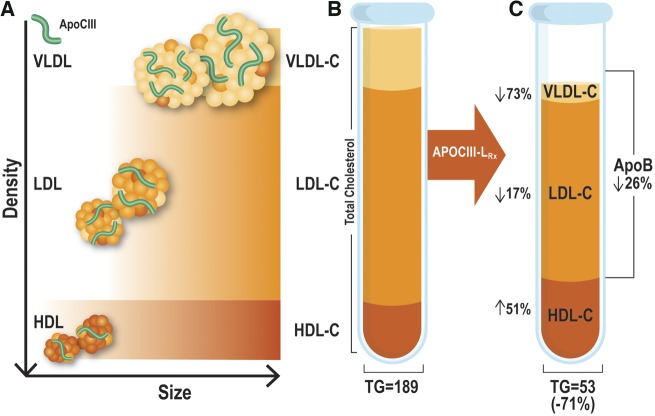
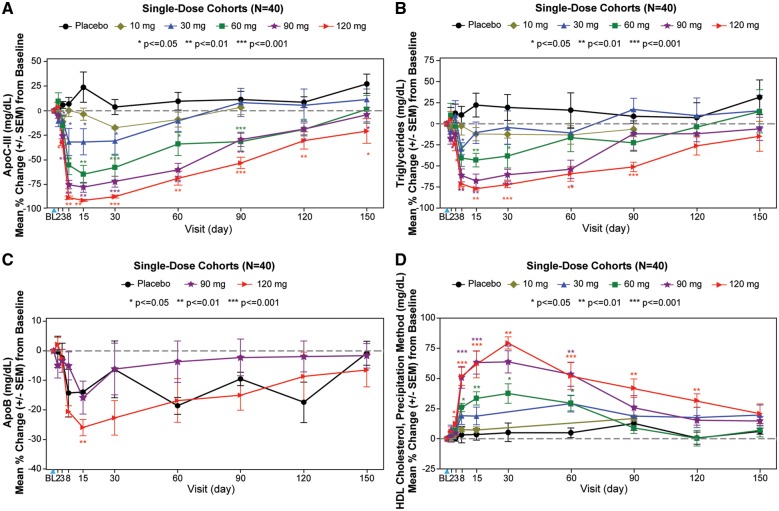
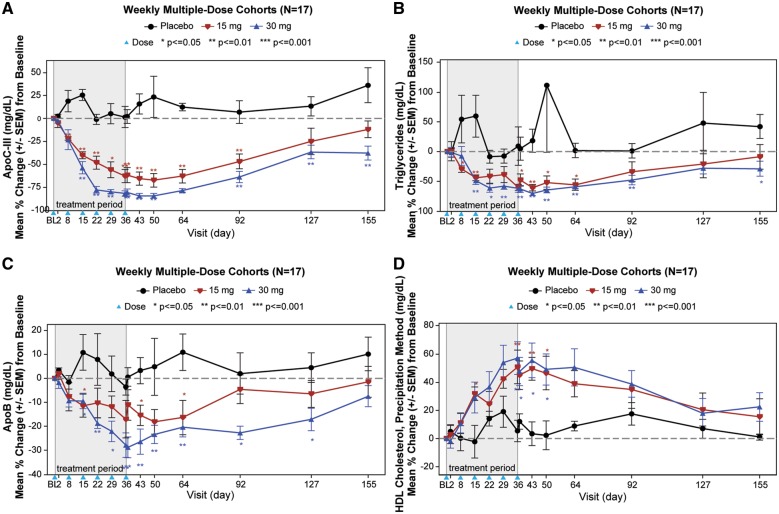
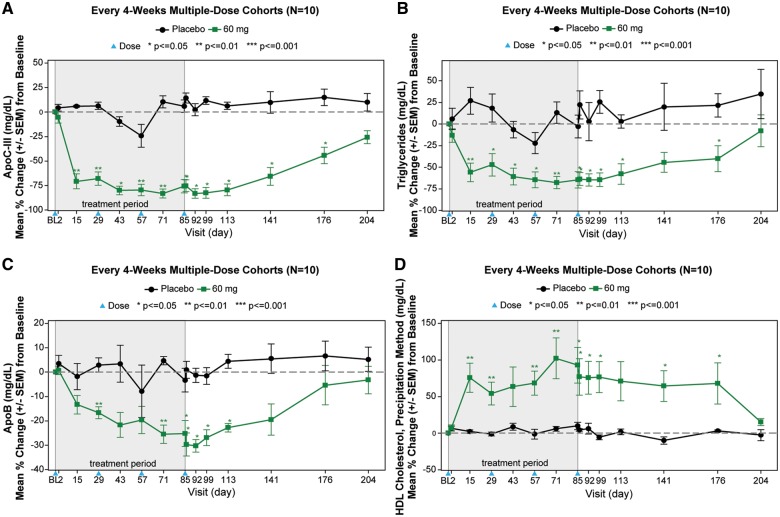
Aims: Elevated apolipoprotein C-III (apoC-III) levels are associated with hypertriglyceridaemia and coronary heart disease. AKCEA-APOCIII-LRx is an N-acetyl galactosamine-conjugated antisense oligonucleotide targeted to the liver that selectively inhibits apoC-III protein synthesis. Methods and results: The safety, tolerability, and efficacy of AKCEA-APOCIII-LRx was assessed in a double-blind, placebo-controlled, dose-escalation Phase 1/2a study in healthy volunteers (ages 18–65) with triglyceride levels ≥90 or ≥200 mg/dL. Single-dose cohorts were treated with 10, 30, 60, 90, and 120 mg subcutaneously (sc) and multiple-dose cohorts were treated with 15 and 30 mg weekly sc for 6 weeks or 60 mg every 4 weeks sc for 3 months. In the single-dose cohorts treated with 10, 30, 60, 90, or 120 mg of AKCEA-APOCIII-LRx, median reductions of 0, −42%, −73%, −81%, and −92% in apoC-III, and −12%, −7%, −42%, −73%, and −77% in triglycerides were observed 14 days after dosing. In multiple-dose cohorts of 15 and 30 mg weekly and 60 mg every 4 weeks, median reductions of −66%, −84%, and −89% in apoC-III, and −59%, −73%, and −66% in triglycerides were observed 1 week after the last dose. Significant reductions in total cholesterol, apolipoprotein B, non-high-density lipoprotein cholesterol (HDL-C), very low-density lipoprotein cholesterol, and increases in HDL-C were also observed. AKCEA-APOCIII-LRx was well tolerated with one injection site reaction of mild erythema, and no flu-like reactions, platelet count reductions, liver, or renal safety signals. Conclusion: Treatment of hypertriglyceridaemic subjects with AKCEA-APOCIII-LRx results in a broad improvement in the atherogenic lipid profile with a favourable safety and tolerability profile. ClinicalTrials.gov Identifier: NCT02900027.
Overview
The claims and statistics of this paper haven’t been checked yet.
Free: it reads the open-access text and checks the first 5 claims that cite a source we can check. Create a free account to check every claim.
Integrity signals
Registry
Cites
Statistics
Figures
Verification
Claims the paper makes
The claims and statistics of this paper haven’t been checked yet.
Free: it reads the open-access text and checks the first 5 claims that cite a source we can check. Create a free account to check every claim.
Claims other papers make about this one
Each is checked against this paper’s own text: does it say what the citing paper says it does?
The source backs part of the claim, not all of it — or backs it for a different population, condition or comparison.
In the citing paper
“In a phase 1/2a trial enrolling 40 healthy volunteers, olezarsen reduced ApoC-III by up to − 92% and triglycerides by − 77%, whilst only 1 participant (2.5%) suffered from an injection site reaction [206]”
From Established and Emerging Lipid-Lowering Drugs for Primary and Secondary Cardiovascular Prevention (2023) · cites this paper as [206]
Experimental — accuracy not yet measuredThe source backs part of the claim, not all of it — or backs it for a different population, condition or comparison.
In the citing paper
“Olezarsen is an investigational GalNAc 3 -conjugated antisense oligonucleotide that reduces apolipoprotein C-III production by binding to APOC3 mRNA and inducing its degradation through ribonuclease H1-mediated cleavage of the sense strand. 26,28,29”
From Olezarsen, Acute Pancreatitis, and Familial Chylomicronemia Syndrome (2024) · cites this paper as [28]
Experimental — accuracy not yet measuredThe source backs part of the claim, not all of it — or backs it for a different population, condition or comparison.
In the citing paper
“The data on the reduction in apolipoprotein C-III levels that were obtained in the Balance trial are consistent with those of studies in which healthy participants or patients with coronary artery disease with normal LPL activity had reductions of 74.0 to 85.5% with olezarsen doses between 50 and 60 mg every 4 weeks. 28,29”
From Olezarsen, Acute Pancreatitis, and Familial Chylomicronemia Syndrome (2024) · cites this paper as [28]
Experimental — accuracy not yet measuredThe cited source says what the claim attributes to it.
In the citing paper
“Olezarsen reduces the plasma triglyceride level by reducing hepatic synthesis of apolipoprotein C-III.”
From Olezarsen, Acute Pancreatitis, and Familial Chylomicronemia Syndrome (2024) · cites this paper as [28]
In the citing paper
“An antisense oligonucleotide targeting apolipoprotein C3, for example, has shown reductions in triglycerides up to 77% and in ApoB up to 30% in healthy volunteers without major safety concerns, 22 although the reductions in ApoB seen in patients with hypertriglyceridemia have been of lower magnitude.23”
From Effect of Vupanorsen on Non–High-Density Lipoprotein Cholesterol Levels in Statin-Treated Patients With Elevated Cholesterol: TRANSLATE-TIMI 70 (2022) · cites this paper as [22]
Self-check
Percentages, sums and reported differences re-computed from the paper’s own numbers.
The self-check needs the paper’s full text.
Citations
Cites
Cardiovascular Risk Reduction with Icosapent Ethyl for Hypertriglyceridemia
Bhatt, D. L., Steg, P. G., Miller, M., Brinton, E. A., Jacobson, T. A., Ketchum, S. B., Doyle, R. T., Juliano, R. A., Jiao, L., Granowitz, C., et al. (2019) · New England Journal of Medicine · doi:10.1056/nejmoa1812792 · Cited by 3,317 · cited 1×
“Pure preparations of omega-3 fatty acids containing only eicosapentaenoic acid tend to be LDL-C neutral.(22,23) In contrast, inhibiting APOC3 mRNA in this study was associated not only with a more potent triglyceride reduction compared with fish oils/omega-3 fatty acids, but also had a significant reduction in all apo…”
Result2016 ESC/EAS Guidelines for the Management of Dyslipidaemias
Catapano, A. L., Graham, I., De Backer, G., Wiklund, O., Chapman, M. J., Drexel, H., Hoes, A. W., Jennings, C. S., Landmesser, U., Pedersen, T. R., et al. (2016) · European Heart Journal · doi:10.1093/eurheartj/ehw272 · Cited by 3,162
2016 ESC/EAS Guidelines for the Management of Dyslipidaemias
Catapano, A. L., Graham, I., De Backer, G., Wiklund, O., Chapman, M. J., Drexel, H., Hoes, A. W., Jennings, C. S., Landmesser, U., Pedersen, T. R., et al. (2016) · Atherosclerosis · doi:10.1016/j.atherosclerosis.2016.08.018 · Cited by 1,582
Triglycerides and cardiovascular disease
Nordestgaard, B. G., & Varbo, A. (2014) · The Lancet · doi:10.1016/s0140-6736(14)61177-6 · Cited by 1,419 · cited 1×
“Such elevations of triglycerides are accompanied by elevations of remnant cholesterol that promote atherogenesis and cardiovascular events.(2,3) A smaller subset of patients with hypertriglyceridaemia have fasting chylomicronemia and triglyceride levels >10 mmol/L(4) and are categorized as having familial chylomicrone…”
BackgroundRemnant Cholesterol as a Causal Risk Factor for Ischemic Heart Disease
Varbo, A., Benn, M., Tybjærg-Hansen, A., Jørgensen, A. B., Frikke-Schmidt, R., & Nordestgaard, B. G. (2013) · Journal of the American College of Cardiology · doi:10.1016/j.jacc.2012.08.1026 · Cited by 1,115
Loss-of-Function Mutations in APOC3 and Risk of Ischemic Vascular Disease
Jørgensen, A. B., Frikke-Schmidt, R., Nordestgaard, B. G., & Tybjærg-Hansen, A. (2014) · New England Journal of Medicine · doi:10.1056/nejmoa1308027 · Cited by 919 · cited 1×
“The evidence for APOC3 as a target for cardiovascular disease (CVD) risk reduction was suggested by genome-wide significance studies showing that individuals with loss of function mutations exhibited reduced plasma triglyceride levels, reduced coronary heart disease, and increased longevity.(19,20) In aggregate, these…”
BackgroundCrooke, S. T., Witztum, J. L., Bennett, C. F., & Baker, B. F. (2018) · Cell Metabolism · doi:10.1016/j.cmet.2018.03.004 · Cited by 841
Self-citationViney, N. J., van Capelleveen, J. C., Geary, R. S., Xia, S., Tami, J. A., Yu, R. Z., Marcovina, S. M., Hughes, S. G., Graham, M. J., Crooke, R. M., et al. (2016) · The Lancet · doi:10.1016/s0140-6736(16)31009-1 · Cited by 754
Self-citationPollin, T. I., Damcott, C. M., Shen, H., Ott, S. H., Shelton, J., Horenstein, R. B., Post, W., McLenithan, J. C., Bielak, L. F., Peyser, P. A., et al. (2008) · Science · doi:10.1126/science.1161524 · Cited by 688 · cited 1×
“The evidence for APOC3 as a target for cardiovascular disease (CVD) risk reduction was suggested by genome-wide significance studies showing that individuals with loss of function mutations exhibited reduced plasma triglyceride levels, reduced coronary heart disease, and increased longevity.(19,20) In aggregate, these…”
BackgroundVolanesorsen and Triglyceride Levels in Familial Chylomicronemia Syndrome
Witztum, J. L., Gaudet, D., Freedman, S. D., Alexander, V. J., Digenio, A., Williams, K. R., Yang, Q., Hughes, S. G., Geary, R. S., Arca, M., et al. (2019) · New England Journal of Medicine · doi:10.1056/nejmoa1715944 · Cited by 669 · cited 1×
“However, the incidence of thrombocytopenia in FCS subjects was higher in those treated with volanesorsen compared with those on placebo.(26) In the current relatively small, short-term study using AKCEA-APOCIII-LRx in patients without FCS, no significant declines in platelet count were noted.”
ResultSelf-citationHegele, R. A., Ginsberg, H. N., Chapman, M. J., Nordestgaard, B. G., Kuivenhoven, J. A., Averna, M., Borén, J., Bruckert, E., Catapano, A. L., Descamps, O. S., et al. (2014) · The Lancet Diabetes & Endocrinology · doi:10.1016/s2213-8587(13)70191-8 · Cited by 635
Cardiovascular and Metabolic Effects of ANGPTL3 Antisense Oligonucleotides
Graham, M. J., Lee, R. G., Brandt, T. A., Tai, L.-J., Fu, W., Peralta, R., Yu, R., Hurh, E., Paz, E., McEvoy, B. W., et al. (2017) · New England Journal of Medicine · doi:10.1056/nejmoa1701329 · Cited by 573
Self-citationAntisense Inhibition of Apolipoprotein C-III in Patients with Hypertriglyceridemia
Gaudet, D., Alexander, V. J., Baker, B. F., Brisson, D., Tremblay, K., Singleton, W., Geary, R. S., Hughes, S. G., Viney, N. J., Graham, M. J., et al. (2015) · New England Journal of Medicine · doi:10.1056/nejmoa1400283 · Cited by 528 · cited 2×
“The efficacy of AKCEA-APOCIII-LRx in the current study is in line with prior studies with volanesorsen, showing reductions in apoC-III protein levels by 70–80% and reductions in triglycerides by 60–70% with the highest doses.(9,13) Furthermore, both agents significantly reduced VLDL-C and non-HDL-C and increased HDL-C.”
BackgroundResultSelf-citationTargeting APOC3 in the familial chylomicronemia syndrome
Gaudet, D., Brisson, D., Tremblay, K., Alexander, V. J., Singleton, W., Hughes, S. G., Geary, R. S., Baker, B. F., Graham, M. J., Crooke, R. M., et al. (2014) · New England Journal of Medicine · doi:10.1056/nejmoa1400284 · Cited by 491
Self-citationGraham, M. J., Lee, R. G., Bell, T. A., Fu, W., Mullick, A. E., Alexander, V. J., Singleton, W., Viney, N., Geary, R., Su, J., et al. (2013) · Circulation Research · doi:10.1161/circresaha.111.300367 · Cited by 377 · cited 1×
“Volanesorsen, a second-generation antisense oligonucleotide (ASO) targets hepatic APOC3 mRNA to inhibit apoC-III protein production, resulting in substantial reductions in plasma triglyceride levels.(9,13,14) Furthermore, new targeting approaches of ASOs, using triantennary N-acetyl galactosamine (GalNAc3) modified AS…”
BackgroundSelf-citationApoC-III inhibits clearance of triglyceride-rich lipoproteins through LDL family receptors
Gordts, P. L. S. M., Nock, R., Son, N.-H., Ramms, B., Lew, I., Gonzales, J. C., Thacker, B. E., Basu, D., Lee, R. G., Mullick, A. E., et al. (2016) · Journal of Clinical Investigation · doi:10.1172/jci86610 · Cited by 274
Self-citationSchwartz, G. G., Abt, M., Bao, W., DeMicco, D., Kallend, D., Miller, M., Mundl, H., & Olsson, A. G. (2015) · Journal of the American College of Cardiology · doi:10.1016/j.jacc.2015.03.544 · Cited by 272 · cited 1×
“Such elevations of triglycerides are accompanied by elevations of remnant cholesterol that promote atherogenesis and cardiovascular events.(2,3) A smaller subset of patients with hypertriglyceridaemia have fasting chylomicronemia and triglyceride levels >10 mmol/L(4) and are categorized as having familial chylomicrone…”
BackgroundApolipoprotein C-III: from pathophysiology to pharmacology
Norata, G. D., Tsimikas, S., Pirillo, A., & Catapano, A. L. (2015) · Trends in Pharmacological Sciences · doi:10.1016/j.tips.2015.07.001 · Cited by 182 · cited 1×
“A key regulator of plasma triglyceride-rich lipoprotein (TRL) metabolism is apolipoprotein C-III (apoC-III), a 79 amino acid glycoprotein synthesized principally in the liver and to a lesser extent in the intestine.(6) Apolipoprotein C-III circulates on very low-density lipoprotein (VLDL), LDL, Lp(a), and HDL particle…”
BackgroundSelf-citationClinical and biochemical features of different molecular etiologies of familial chylomicronemia
Hegele, R. A., Berberich, A. J., Ban, M. R., Wang, J., Digenio, A., Alexander, V. J., D'Erasmo, L., Arca, M., Jones, A., Bruckert, E., et al. (2018) · Journal of Clinical Lipidology · doi:10.1016/j.jacl.2018.03.093 · Cited by 165 · cited 1×
“A smaller subset of patients with hypertriglyceridaemia have fasting chylomicronemia and triglyceride levels >10 mmol/L(4) and are categorized as having familial chylomicronemia syndrome (FCS).(5) * Corresponding author.”
BackgroundSelf-citationWyler von Ballmoos, M. C., Haring, B., & Sacks, F. M. (2015) · Journal of Clinical Lipidology · doi:10.1016/j.jacl.2015.05.002 · Cited by 134
Crooke, S. T., Baker, B. F., Xia, S., Yu, R. Z., Viney, N. J., Wang, Y., Tsimikas, S., & Geary, R. S. (2019) · Nucleic Acid Therapeutics · doi:10.1089/nat.2018.0753 · Cited by 127
Self-citationJensen, M. K., Aroner, S. A., Mukamal, K. J., Furtado, J. D., Post, W. S., Tsai, M. Y., Tjønneland, A., Polak, J. F., Rimm, E. B., Overvad, K., et al. (2018) · Circulation · doi:10.1161/circulationaha.117.031276 · Cited by 105
Yang, X., Lee, S.-R., Choi, Y.-S., Alexander, V. J., Digenio, A., Yang, Q., Miller, Y. I., Witztum, J. L., & Tsimikas, S. (2016) · Journal of Lipid Research · doi:10.1194/jlr.m066399 · Cited by 103 · cited 1×
“Apolipoprotein C-III circulates on very low-density lipoprotein (VLDL), LDL, Lp(a), and HDL particles and can be present in multiple copies per particle.(7,8) Apolipoprotein C-III plays a key role in determining serum triglyceride levels by two main mechanisms, by inhibiting LPL activity as well as by directly inhibit…”
BackgroundSelf-citationDisposition and Pharmacology of a GalNAc3-conjugated ASO Targeting Human Lipoprotein (a) in Mice
Yu, R. Z., Graham, M. J., Post, N., Riney, S., Zanardi, T., Hall, S., Burkey, J., Shemesh, C. S., Prakash, T. P., Seth, P. P., et al. (2016) · Molecular Therapy - Nucleic Acids · doi:10.1038/mtna.2016.26 · Cited by 96
Self-citationThe ACCORD (Action to Control Cardiovascular Risk in Diabetes) Lipid Trial
Ginsberg, H. N. (2011) · Diabetes Care · doi:10.2337/dc11-s203 · Cited by 82
Yu, R. Z., Gunawan, R., Post, N., Zanardi, T., Hall, S., Burkey, J., Kim, T.-W., Graham, M. J., Prakash, T. P., Seth, P. P., et al. (2016) · Nucleic Acid Therapeutics · doi:10.1089/nat.2016.0623 · Cited by 75
Self-citationBallantyne, C. M., Braeckman, R. A., Bays, H. E., Kastelein, J. J., Otvos, J. D., Stirtan, W. G., Doyle, R. T., Soni, P. N., & Juliano, R. A. (2015) · Journal of Clinical Lipidology · doi:10.1016/j.jacl.2014.11.009 · Cited by 46 · cited 1×
“Pure preparations of omega-3 fatty acids containing only eicosapentaenoic acid tend to be LDL-C neutral.(22,23) In contrast, inhibiting APOC3 mRNA in this study was associated not only with a more potent triglyceride reduction compared with fish oils/omega-3 fatty acids, but also had a significant reduction in all apo…”
ResultGaudet, D., Baass, A., Tremblay, K., Brisson, D., Laflamme, N., Paquette, M., Dufour, R., & Bergeron, J. (2017) · Journal of Clinical Lipidology · doi:10.1016/j.jacl.2017.04.043 · Cited by 19 · cited 1×
“An observational study in FCS has suggested that these patients have greater than expected spontaneous fluctuations in platelet count.(25) However, the incidence of thrombocytopenia in FCS subjects was higher in those treated with volanesorsen compared with those on placebo.”
Result
Cited by
Antisense technology: an overview and prospectus
Crooke, S. T., Baker, B. F., Crooke, R. M., & Liang, X.-H. (2021) · Nature Reviews Drug Discovery · doi:10.1038/s41573-021-00162-z · Cited by 775
Duan, Y., Gong, K., Xu, S., Zhang, F., Meng, X., & Han, J. (2022) · Signal Transduction and Targeted Therapy · doi:10.1038/s41392-022-01125-5 · Cited by 538
A Modern Approach to Dyslipidemia
Berberich, A. J., & Hegele, R. A. (2022) · Endocrine Reviews · doi:10.1210/endrev/bnab037 · Cited by 469
Epigenetic regulation in cardiovascular disease: mechanisms and advances in clinical trials
Shi, Y., Zhang, H., Huang, S., Yin, L., Wang, F., Luo, P., & Huang, H. (2022) · Signal Transduction and Targeted Therapy · doi:10.1038/s41392-022-01055-2 · Cited by 362
Antisense technology: A review
Crooke, S. T., Liang, X.-H., Baker, B. F., & Crooke, R. M. (2021) · Journal of Biological Chemistry · doi:10.1016/j.jbc.2021.100416 · Cited by 326
Metadata
- Authors
- Alexander, V. J., Xia, S., Hurh, E., Hughes, S. G., O’Dea, L., Geary, R. S., Witztum, J. L., & Tsimikas, S.
- Affiliations
- Ionis Pharmaceuticals (United States) (US)
- Akcea Therapeutics, 22 Boston Wharf Road, 9th Floor, Boston, MA, USA
- University of California San Diego (US)
- Corresponding author
- Tsimikas, Sotirios
- ORCID
- Venue
- European Heart Journal
- Publisher
- Oxford University Press (OUP)
- Published
- 2019-04-24
- Volume
- 40
- Issue
- 33
- Pages
- 2785-2796
- ISSN
- 0195-668X (ISSN-L)
- 1522-9645
- PMC
- PMC6736334
- OpenAlex
- W2941139188
- Semantic Scholar
- 9bb65451774fb180f55ce50e6b6fa554c38c8147
- Cited by
- 231
- References
- 28
- Citations by year
- 2026: 15 · 2025: 26 · 2024: 37 · 2023: 30 · 2022: 37 · 2021: 44 · 2020: 35 · 2019: 7
- FWCI
- 22.21
- Type
- journal article
- Language
- en
- Open access
- hybrid
- doi.org
- Licence
- Locations
- European Heart Journal (publishedVersion, cc-by-nc)
- PubMed Central (publishedVersion, cc-by-nc)
- PubMed (publishedVersion)
- eScholarship (California Digital Library) (submittedVersion, cc-by-nc)
- Funders
- Ionis Pharmaceuticals
- Topics
- Health Sciences › Medicine › Cardiology and Cardiovascular Medicine › Lipid metabolism and disorders
- Health Sciences › Medicine › Cardiology and Cardiovascular Medicine › Lipoproteins and Cardiovascular Health
- Life Sciences › Biochemistry, Genetics and Molecular Biology › Molecular Biology › RNA Interference and Gene Delivery
- Keywords
- apolipoprotein C-III, antisense oligonucleotides, hypertriglyceridemia, triglycerides, atherogenic lipoproteins, lipid profile, safety and tolerability, dose escalation, HDL cholesterol
- MeSH terms
- Adolescent, Adult, Aged, Apolipoproteins B, Cholesterol, Double-Blind Method, Drug Administration Schedule, Female, Humans, Male, Middle Aged, Oligonucleotides, RNA, Messenger, Hypertriglyceridemia, Treatment Outcome, Atherosclerosis, Apolipoprotein C-III, Young Adult
About these checks
Registry, retraction, Cites and statistics results are computed, not judged, with one exception: a printed reference that no index lists is read once by a model before it counts as a citation error. Claims are extracted by a model and kept only when their quote appears verbatim in the text; each cited source is then checked, with a model’s help, for whether it says what the claim relies on. Those verdicts can be wrong — read the claim’s quote and the cited source before relying on one.
Statistics and arithmetic are recomputed, not judged.
Confidence bands are shown only for fields calibrated on our annotated test set. None is calibrated yet, so no band is shown.
What counts as a claim ›How we measure confidence ›How we check this ›
Are you an author, or do you see a problem with this page? Request a review
Data sources
Bibliographic data: Semantic Scholar, OpenAlex, Crossref.
Contains information from the Semantic Scholar Academic Graph Datasets, made available under the ODC Attribution License (ODC-BY 1.0).
Semantic Scholar’s data is described in: Kinney, R., et al. (2023). The Semantic Scholar Open Data Platform. arXiv:2301.10140.
