

Multimodal deep learning methods enhance genomic prediction of wheat breeding
Open accessThe DOI matches its Crossref record; 39 of the 39 references it cites were found in a registry or an index; 4 of the 16 sources its claims cite were checked for support.
Abstract
While several statistical machine learning methods have been developed and studied for assessing the genomic prediction (GP) accuracy of unobserved phenotypes in plant breeding research, few methods have linked genomics and phenomics (imaging). Deep learning (DL) neural networks have been developed to increase the GP accuracy of unobserved phenotypes while simultaneously accounting for the complexity of genotype–environment interaction (GE); however, unlike conventional GP models, DL has not been investigated for when genomics is linked with phenomics. In this study we used 2 wheat data sets (DS1 and DS2) to compare a novel DL method with conventional GP models. Models fitted for DS1 were GBLUP, gradient boosting machine (GBM), support vector regression (SVR) and the DL method. Results indicated that for 1 year, DL provided better GP accuracy than results obtained by the other models. However, GP accuracy obtained for other years indicated that the GBLUP model was slightly superior to the DL. DS2 is comprised only of genomic data from wheat lines tested for 3 years, 2 environments (drought and irrigated) and 2–4 traits. DS2 results showed that when predicting the irrigated environment with the drought environment, DL had higher accuracy than the GBLUP model in all analyzed traits and years. When predicting drought environment with information on the irrigated environment, the DL model and GBLUP model had similar accuracy. The DL method used in this study is novel and presents a strong degree of generalization as several modules can potentially be incorporated and concatenated to produce an output for a multi-input data structure.
Overview
CoChat Summary
TL;DR
This study compares a novel multimodal deep learning (MMDL) method with conventional genomic prediction models (GBLUP, GBM, SVR) in two wheat datasets, using genomic, year, and NDVI image data for DS1 and genomic-only data for DS2. MMDL improved accuracy in some scenarios, especially predicting irrigated from drought environments and some leave-one-year-out predictions, but GBLUP was often slightly superior under 5-fold cross-validation.
Key findings
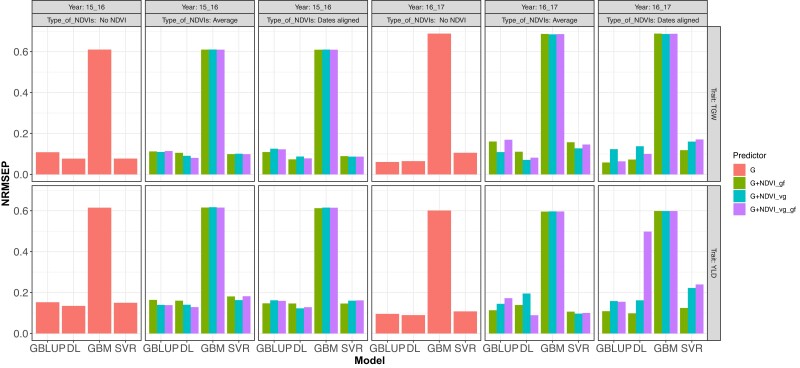
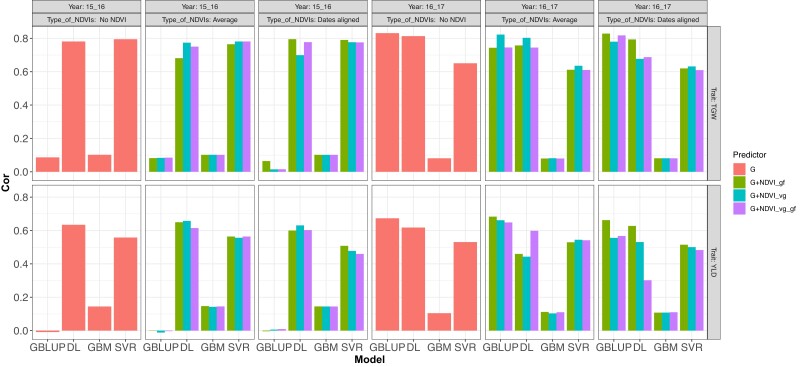
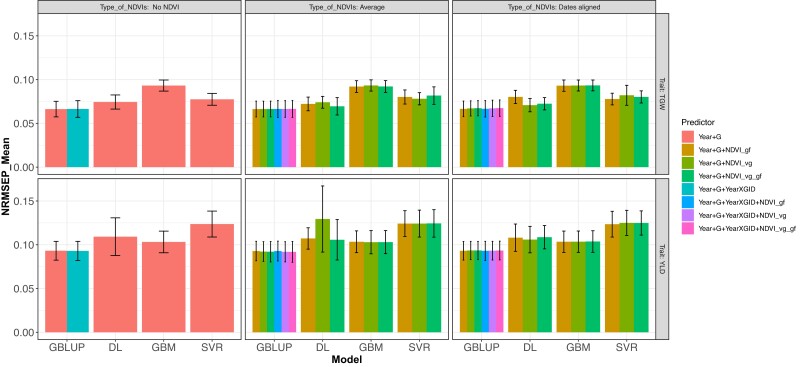
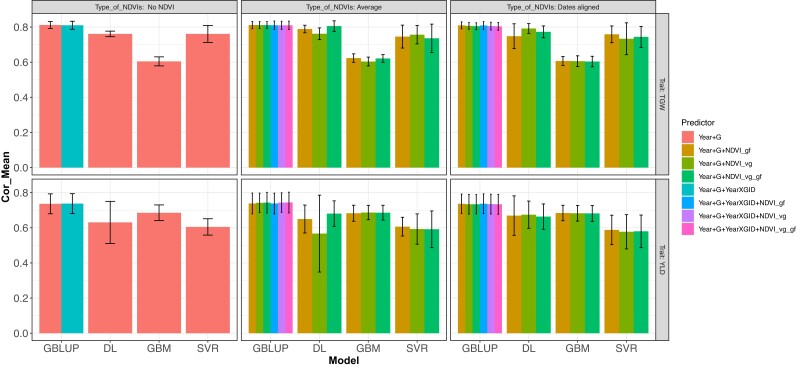
- In DS1 (350 wheat lines, 2 years, traits YLD and TGW), DL provided better GP accuracy than the other models for one year, but for other years GBLUP was slightly superior to DL. Under 5FCV, GBLUP was slightly superior to DL when genomic and various NDVI measurements were included; for example, GBLUP-TGW with Year + G had Cor = 0.8116 (SD 0.0195) versus MMDL-TGW Cor = 0.7608 (SD 0.0158), and GBLUP-YLD had Cor = 0.7364 (SD 0.0567) versus MMDL-YLD Cor = 0.6305 (SD 0.1198).
- Under leave-one-year-out (LOO) in DS1, the authors report that DL outperformed the other models for both YLD and TGW, for NDVI average and NDVI dates aligned, and for both metrics (NRMSEP and Cor Mean).
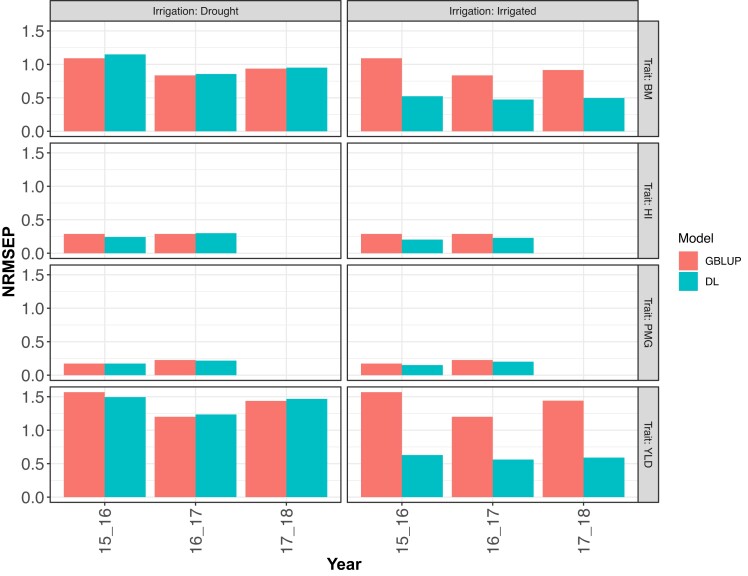
- In DS2 (genomic-only, 3 years, drought and irrigated environments, traits BM, HI, PMG, YLD), when predicting the irrigated environment with the drought environment, DL had higher accuracy than GBLUP in all analyzed traits and years, with the most considerable differences in YLD and BM. When predicting drought with irrigated information, DL and GBLUP had similar accuracy except in the first year (2015–2016), where a more significant difference was obtained.
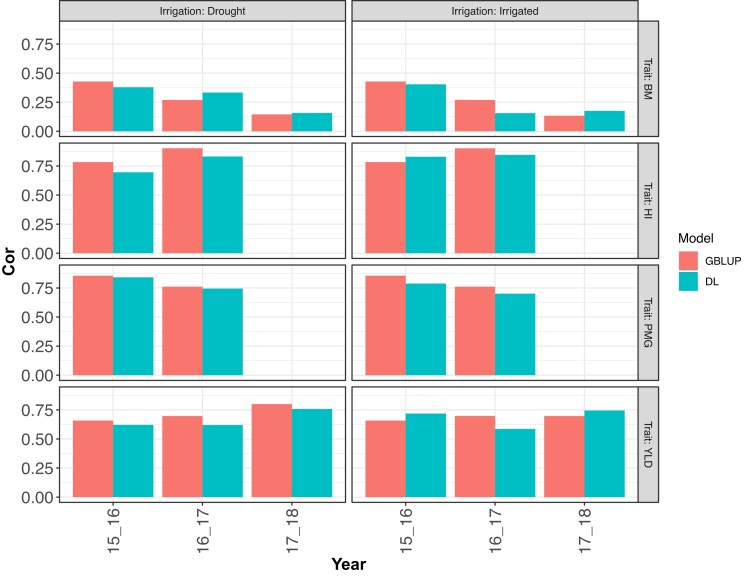
- The correlation metric in DS2 was more ambiguous: for PMG, GBLUP was better than DL in all cases but with marginal differences when predicting drought; for YLD, DL was less accurate than GBLUP when predicting drought, but in 2 of 3 years the difference was small, while DL was better in 2 of 3 years when predicting irrigated.
Methods
- DS1: 350 wheat cultivars/accessions from CIMMYT evaluated over 2 years (2015–2016 and 2016–2017) for grain yield (YLD) and thousand grains weight (TGW) under fully irrigated conditions; alpha lattice design with 2 replicates and 6 incomplete blocks of size 5. Genotyping used the 35 K Axiom Wheat Breeders array, leaving 10,560 SNPs after QC. Aerial multispectral UAV imagery provided NDVI measured 4 times during vegetative and 2 times during grain filling, used as average or dates-aligned covariates. Models compared were GBLUP, MMDL, GBM, and SVR, assessed by 5-fold cross-validation (5FCV) and leave-one-year-out (LOO) using NRMSEP and correlation between observed and predicted values.
- DS2: synthetic hexaploid wheat lines evaluated over 3 consecutive years (2015–2016, 2016–2017, 2017–2018), with 145–155 lines per year in drought and irrigated environments and 2 or 4 traits (BM, HI, PMG, YLD). Genomic-only data with 10,064 SNPs after QC; GBLUP and DL were compared by predicting one entire environment from the other (LOO).
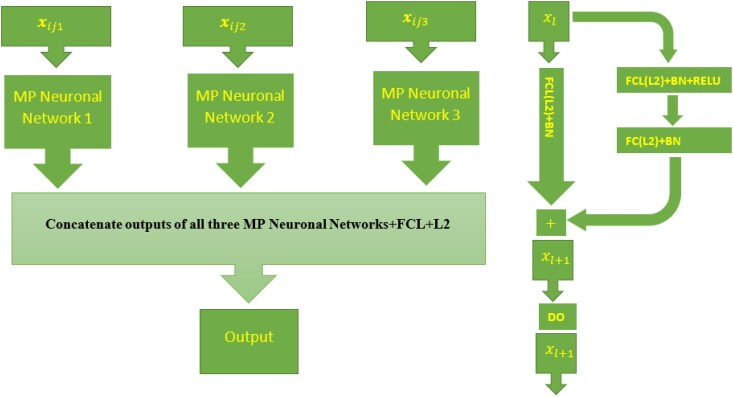
- Analysis: GBLUP was fitted with the BGLR R package; MMDL used three modalities (year, genomic, NDVI) with separate neural networks whose outputs were concatenated, implemented in TensorFlow with batch size 32, 128 epochs, Adam optimizer, early stopping, dropout, and L2 regularization. Hyperparameters were tuned with Bayesian optimization (`bayes_opt`) over 150 iterations, requiring an average of 8 hours to train a model.
Limitations
- Stated by the authors: validation on additional data is needed; larger datasets with denser NDVI data should be used; different neural network types beyond the multilayer perceptron and other late fusion strategies (e.g., uncertainty-based weighting or additional layers after combining sub-model outputs) need to be explored.
- Evident from the text: DS2 lacks image/phenomics data, so the multimodal DL reduces to standard DL for that dataset; MMDL was only used under 5FCV in DS1, not under LOO; results were mixed, with GBLUP often slightly superior under 5FCV; and the study uses only two wheat datasets with small-to-medium sample sizes, while training each DL model took about 8 hours.
Model-written summary. Check it against the paper before relying on it.
Integrity signals
Registry
Cites
Statistics
Figures
Verification
Claims the paper makes
4 Valid · 1 Not valid · 12 Not checked · 71 Own results and interpretations
Every source the paper cites for this claim was checked and supports it.
In the paper
“Jarquín et al. (2014) found that the prediction accuracy of models, including the GE term (reaction norm model), was substantially higher (17–34%) than that of models based only on major effects.”
§ Multimodal deep learning methods enhance genomic prediction of wheat breeding > Introduction
What the sources say
- Supportedcites Jarquín et al. (2014) matched to “A reaction norm model for genomic selection using high-dimensional genomic and environmental data” (2014) source
The Abstract (p.1) states verbatim that 'Interaction terms accounted for a sizable proportion (16 %) of the within-environment yield variance, and the prediction accuracy of models including interaction terms was substantially higher (17–34 %) than that of models based on main effects only,' and the model is explicitly described there as a random reaction norm with marker and EC gradients. The Introduction corroborates the magnitude: relative to a model with only main effects of markers, environments and ECs, adding interactions raised predictive correlation by roughly 35 % (0.175 to 0.236) in CV1 and 17 % (0.439 to 0.514) in CV2. The citing sentence's 'major effects' is simply the source's 'main effects'; population (139 wheat lines, 340 year×location combinations, northern France) and design are as reported. (LLM, conf=0.93)
plainstates a cause- Asserted: passes — The authors put it forward as true.
- Checkable: passes — It can be checked against evidence.
- Load-bearing: unclear — It is unclear whether the paper’s conclusions depend on it.
- Based: passes — The paper gives a reason why it holds.
- Supported
Every source the paper cites for this claim was checked and supports it.
In the paper
“Using wheat data, Cuevas et al. (2016) found that models with the GE term were up to 60–68% better in terms of GP accuracy (association between the true genotypic values and the genomic genotypic values) than the corresponding single-environment models.”
§ Multimodal deep learning methods enhance genomic prediction of wheat breeding > Introduction
What the sources say
- Supportedcites Cuevas et al. (2016) matched to “Genomic Prediction of Genotype × Environment Interaction Kernel Regression Models” (2016) source
In the Wheat Data section our copy states that when the pairwise correlation between environments is positive, the GE models' accuracy exceeded their single-environment counterparts, 'reaching prediction accuracies for Site 3 (for pair 2-3) of 60 and 68% for RKHS EB-G×E vs. RKHS EB single environment and for RKHS KA-G×E vs. RKHS KA single environment, respectively'; Table 1 corroborates the 60 and 68 percentage-change entries for Environment 3 in the 2-3 combination. The claim's 'up to' correctly frames these as maxima rather than a general gain, since the same passage records no improvement (and even declines) for zero/negatively correlated environments such as 1-2, 1-3, 1-4 and the four-environment combination. (LLM, conf=0.85)
plainstates a cause- Asserted: passes — The authors put it forward as true.
- Checkable: passes — It can be checked against evidence.
- Load-bearing: unclear — It is unclear whether the paper’s conclusions depend on it.
- Based: passes — The paper gives a reason why it holds.
- Supported
A result the paper reports from its own data — it cites no other source for it, so there is none to check. The quote shows it is in the paper.
In the paper
“When predicting the irrigated environment with the drought environment, DL had higher accuracy (less NRMSEP) than the GBLUP model in all analyzed traits and all years.”
§ Multimodal deep learning methods enhance genomic prediction of wheat breeding > Result > Results DS2
plainstates an association- Asserted: passes — The authors put it forward as true.
- Checkable: passes — It can be checked against evidence.
- Load-bearing: passes — The paper’s conclusions depend on it.
- Based: passes — The paper gives a reason why it holds.
A result the paper reports from its own data — it cites no other source for it, so there is none to check. The quote shows it is in the paper.
In the paper
“Furthermore, Fig. 5 shows similar GP accuracy based on Cor Mean for the 8 models with a slight increase in GP accuracy when adding image to the genomic prediction.”
§ Multimodal deep learning methods enhance genomic prediction of wheat breeding > Result > DS1
plainstates a cause- Asserted: passes — The authors put it forward as true.
- Checkable: passes — It can be checked against evidence.
- Load-bearing: unclear — It is unclear whether the paper’s conclusions depend on it.
- Based: passes — The paper gives a reason why it holds.
A result the paper reports from its own data — it cites no other source for it, so there is none to check. The quote shows it is in the paper.
In the paper
“the GE model did not improve GP accuracy”
§ Multimodal deep learning methods enhance genomic prediction of wheat breeding > Result > DS1
plain- Asserted: passes — The authors put it forward as true.
- Checkable: passes — It can be checked against evidence.
- Load-bearing: unclear — It is unclear whether the paper’s conclusions depend on it.
- Based: passes — The paper gives a reason why it holds.
40 more claims
Create a free account to see all 88 claims and to verify the 12 references still open.
- Probably not a substantial claim. 20
- It may state two separate claims as one. 26
Claims other papers make about this one
Each is checked against this paper’s own text: does it say what the citing paper says it does?
The source backs part of the claim, not all of it — or backs it for a different population, condition or comparison.
In the citing paper
“The MMDL model demonstrated superior performance in predicting traits like yield (YLD), thousand-grain weight (TGW), and NDVI averages and dates compared to the baseline models.”
From A review of multimodal deep learning methods for genomic-enabled prediction in plant breeding (2024) · cites this paper as Montesinos-López et al. (2023)
Experimental — accuracy not yet measuredIn the citing paper
“For instance, when predicting TGW using genomic and year data, GBLUP achieved an nRMSE of 0.0663 ± 0.0089, slightly better than MMDL's 0.0744 ± 0.0081 (Supplementary Table 6).”
From A review of multimodal deep learning methods for genomic-enabled prediction in plant breeding (2024) · cites this paper as Montesinos-López et al. (2023)
In the citing paper
“Montesinos-López et al. (2023) applied a MMDL framework to analyze 2 wheat datasets incorporating genomic data, Normalized Difference Vegetation Index (NDVI), and years as modalities.”
From A review of multimodal deep learning methods for genomic-enabled prediction in plant breeding (2024) · cites this paper as Montesinos-López et al. (2023)
In the citing paper
“However, integrating NDVI data showed mixed results in PCC improvement in the multimodal approach.”
From A review of multimodal deep learning methods for genomic-enabled prediction in plant breeding (2024) · cites this paper as Montesinos-López et al. (2023)
Self-check
Percentages, sums and reported differences re-computed from the paper’s own numbers.
Each contradiction between two passages listed here was confirmed by an independent check.
Rated major: it would touch a result — a value a result rests on, reported and recomputed p-values on opposite sides of the significance level, two passages that conflict with no sign which is right, or a cited work retracted before this paper was published.
In the paper
§ Multimodal deep learning methods enhance genomic prediction of wheat breeding > Discussion > Conclusions
“Results show that the novel DL approach presented in this study was accurate for predicting 1 year based on the other one (LOO) and outperformed the other models for both YLD and TGW traits, NDVI average and NDVI dates aligned, and at both metrics used to assess the GP accuracy (NRMSPE and Cor Mean).”
§ Multimodal deep learning methods enhance genomic prediction of wheat breeding > Result > DS1
“| 2016–2017 | G | 0.0607 | 0.831 | — |”
Rated minor: it would not touch a result — a value no result rests on, a p-value that stays on the same side of the significance level, or a conflict that is clerical, resolved elsewhere in the paper, or outside its own findings.
In the paper
“the model with predictor year + G + NDVIs_gf and NDVIs with dates aligned, have an average value of patience hyperparameter (Pat) at least 10 units larger than the rest of the models (rows 2 and 4–8 from Table 9).”
§ Multimodal deep learning methods enhance genomic prediction of wheat breeding > Result > DS1
Reported 10 · recomputed 0.8
Rated minor: it would not touch a result — a value no result rests on, a p-value that stays on the same side of the significance level, or a conflict that is clerical, resolved elsewhere in the paper, or outside its own findings.
In the paper
§ Multimodal deep learning methods enhance genomic prediction of wheat breeding > Materials and methods > Phenotypic data
“An alpha lattice design was used with 2 replicates and 6 incomplete blocks of size 5.”
§ Multimodal deep learning methods enhance genomic prediction of wheat breeding > Materials and methods > Phenotypic data
“The data set is a panel of 350 wheat cultivars and wheat accessions from a wheat gene bank”
Citations
Cites
Deep Residual Learning for Image Recognition
He, K., Zhang, X., Ren, S., & Sun, J. (2016) · 2016 IEEE Conference on Computer Vision and Pattern Recognition (CVPR) · doi:10.1109/cvpr.2016.90 · Cited by 235,474
Greedy function approximation: A gradient boosting machine
Friedman, J. H. (2001) · The Annals of Statistics · doi:10.1214/aos/1013203451 · Cited by 30,731
The Elements of Statistical Learning
Hastie, T., Tibshirani, R., & Friedman, J. (2009) · Springer Series in Statistics · doi:10.1007/978-0-387-84858-7 · Cited by 25,970
A tutorial on support vector regression
Smola, A. J., & Schölkopf, B. (2004) · Statistics and Computing · doi:10.1023/b:stco.0000035301.49549.88 · Cited by 13,387
Efficient Methods to Compute Genomic Predictions
VanRaden, P. M. (2008) · Journal of Dairy Science · doi:10.3168/jds.2007-0980 · Cited by 6,050
Multimodal Machine Learning: A Survey and Taxonomy
Baltrusaitis, T., Ahuja, C., & Morency, L.-P. (2019) · IEEE Transactions on Pattern Analysis and Machine Intelligence · doi:10.1109/tpami.2018.2798607 · Cited by 5,018
Support Vector Regression Machines
Drucker, H., Burges, C. J. C., Kaufman, L., Smola, A. J., & Vapnik, V. N. (1996) · Cited by 4,658
Genome-Wide Regression and Prediction with the BGLR Statistical Package
Pérez, P., & de los Campos, G. (2014) · Genetics · doi:10.1534/genetics.114.164442 · Cited by 1,594
Self-citationDeep multimodal learning: a survey on recent advances and trends
Ramachandram, D., & Taylor, G. W. (2017) · IEEE Signal Processing Magazine · doi:10.1109/msp.2017.2738401 · Cited by 1,139
Multimodal deep learning for biomedical data fusion: a review
Stahlschmidt, S. R., Ulfenborg, B., & Synnergren, J. (2022) · Briefings in Bioinformatics · doi:10.1093/bib/bbab569 · Cited by 766
Research works printed but not linked: 1
- Ouyang W, Chu X, Wang X. Multi-source deep learning for human pose estimation. In Proceedings of the IEEE Conference on Computer Vision and Pattern Recognition (pp. 2329– 2336) 2014.
Cited by
Artificial intelligence in plant breeding
Farooq, M. A., Gao, S., Hassan, M. A., Huang, Z., Rasheed, A., Hearne, S., Prasanna, B., Li, X., & Li, H. (2024) · Trends in Genetics · doi:10.1016/j.tig.2024.07.001 · Cited by 288
Self-citationCrossa, J. L., Martini, J. W. R., Vitale, P., Pérez‐Rodríguez, P., Costa‐Neto, G., Fritsche‐Neto, R., Runcie, D. E., Cuevas, J., Toledo, F. H. R. B., Li, H., et al. (2025) · Trends in Plant Science · doi:10.1016/j.tplants.2024.12.009 · Cited by 134
Self-citationBig data and artificial intelligence‐aided crop breeding: Progress and prospects
Zhu, W., Li, W., Zhang, H., & Li, L. (2024) · Journal of Integrative Plant Biology · doi:10.1111/jipb.13791 · Cited by 93
A review of multimodal deep learning methods for genomic-enabled prediction in plant breeding
Montesinos-López, O. A., Chavira-Flores, M., Kiasmiantini, Crespo-Herrera, L., Saint Piere, C., Li, H., Fritsche-Neto, R., Al-Nowibet, K., Montesinos-López, A., & Crossa, J. (2024) · GENETICS · doi:10.1093/genetics/iyae161 · Cited by 47
Self-citationLopez-Cruz, M. A., Aguate, F. M., Washburn, J. D., de León, N., Kaeppler, S. M., Lima, D. C., Tan, R., Thompson, A., Bretonne, L. W. D. L., & Campos, G. D. L. (2023) · Nature Communications · doi:10.1038/s41467-023-42687-4 · Cited by 55
Deep learning methods improve genomic prediction of wheat breeding
Montesinos‐López, A., Crespo‐Herrera, L., Dreisigacker, S., Gerard, G., Vitale, P., Pierre, C. S., Govindan, V., Tadesse, Z., Flores, M. C., Pérez‐Rodríguez, P., et al. (2024) · Frontiers in Plant Science · doi:10.3389/fpls.2024.1324090 · Cited by 52
Self-citationApplications of Artificial Intelligence in Wheat Breeding for Sustainable Food Security
Mushtaq, M. A., Ahmed, H. G. M., & Zeng, Y. (2024) · Sustainability · doi:10.3390/su16135688 · Cited by 48
King, J., Dreisigacker, S., Reynolds, M. P., Bandyopadhyay, A., Braun, H., Crespo‐Herrera, L., Crossa, J. L., Govindan, V., Huerta‐Espino, J., Ibba, M. I., et al. (2024) · Global Change Biology · doi:10.1111/gcb.17440 · Cited by 47
Self-citationoptRF: Optimising random forest stability by determining the optimal number of trees
Lange, T. M., Gültaş, M., Schmitt, A. O., & Heinrich, F. (2025) · BMC Bioinformatics · doi:10.1186/s12859-025-06097-1 · Cited by 44
Montesinos‐López, A., Montesinos-López, O. A., Ramos-Pulido, S., Mosqueda-González, B. A., Guerrero-Arroyo, E. A., Crossa, J. L., & Ortiz, R. O. (2025) · Frontiers in Genetics · doi:10.3389/fgene.2025.1568705 · Cited by 32
Self-citationGenomics‐based plant disease resistance prediction using machine learning
Upadhyaya, S. R., Danilevicz, M. F., Dolatabadian, A., Neik, T. X., Zhang, F., Al-Mamun, H. A., Bennamoun, M., Batley, J., & Edwards, D. (2024) · Plant Pathology · doi:10.1111/ppa.13988 · Cited by 40
Genetic and Genomic Pathways to Improved Wheat (Triticum aestivum L.) Yields: A Review
Chachar, Z., Fan, L., Chachar, S., Ahmed, N., Narejo, M.-U.-N., Ahmed, N., Lai, R., & Yongwen, Q. (2024) · Agronomy · doi:10.3390/agronomy14061201 · Cited by 31
Kick, D. R., & Washburn, J. D. (2023) · in silico Plants · doi:10.1093/insilicoplants/diad015 · Cited by 25
Zou, Q., Tai, S., Yuan, Q., Nie, Y., Gou, H., Wang, L., Li, C., Jing, Y., Dong, F., Yue, Z., et al. (2024) · Computers and Electronics in Agriculture · doi:10.1016/j.compag.2024.109833 · Cited by 19
Jacob, M. S., Xu, A., Qian, K., Qi, Z.-X., Li, X., & Zhang, B. (2025) · Journal of Fungi · doi:10.3390/jof11110758 · Cited by 27
Plant Phenotypic Plasticity: From Molecular Mechanisms to Breeding and Climate Change Adaptation
Schneider, R., Bäurle, I., Nikoloski, Z., & Lenhard, M. (2026) · Annual Review of Plant Biology · doi:10.1146/annurev-arplant-063025-111942 · Cited by 26
Lozada, D. N., Sandhu, K. S., & Bhatta, M. (2023) · BMC Genomic Data · doi:10.1186/s12863-023-01179-6 · Cited by 13
Yu, W., Wang, X., Wang, H., Wang, W., Cheng, H., Mei, D., Jiang, L., Hu, Q., & Liu, J. (2025) · Horticulture Research · doi:10.1093/hr/uhaf115 · Cited by 12
ResDeepGS: A deep learning-based method for crop phenotype prediction
Yan, C., Li, J., Feng, Q., Luo, J., & Luo, H. (2025) · Methods · doi:10.1016/j.ymeth.2025.07.013 · Cited by 4
Genomic language model-based genomic prediction in plant breeding
Alagarasan, G., Li, H., Xu, Y., Crossa, J. L., & Varshney, R. K. (2026) · Trends in Plant Science · doi:10.1016/j.tplants.2026.04.012 · Cited by 6
Self-citationA review of AI-driven phenomics, genomics, and predictive breeding in wheat
Tanin, M. J., Saini, D. K., Alagappan, P., & Kaur, J. P. (2026) · Discover Plants. · doi:10.1007/s44372-026-00696-9 · Cited by 9
Liang, X., Yu, S. Y., Ju, Y., Wang, Y., & Yin, D. (2026) · Agronomy · doi:10.3390/agronomy16101019 · Cited by 4
ResDeepGS: A Deep Learning-Based Method for Crop Phenotype Prediction
Yan, C., Li, J., Feng, Q., Luo, J., & Luo, H. (2024) · Lecture notes in computer science · doi:10.1007/978-981-97-5131-0_40 · Cited by 5
Normalized cumulative gain as an alternative evaluation measure for genomic selection models
Heinrich, F., Lange, T. M., Ramzan, F., Gültaş, M., & Schmitt, A. O. (2025) · Genetics Selection Evolution · doi:10.1186/s12711-025-01022-9 · Cited by 6
Harnessing genomics approaches for heat stress resilience in wheat: from discovery to deployment
Chitikineni, A., Jan, F., Saini, D. K., Rathore, M., Bennett, D., Chen, Z., Harper, R., Xin, L., Varshney, R. K., & Mir, R. R. (2026) · Journal of Experimental Botany · doi:10.1093/jxb/erag226 · Cited by 4
Dong, Q., Cheng, Y.-T., Li, Y., Tong, Y., Liu, D., Yu, J., Zhao, N., Liu, B., Ding, X., & Xu, C. (2025) · Agronomy · doi:10.3390/agronomy15051181 · Cited by 1
A Short Survey on Multimodal Deep Learning Models in Healthcare
Datsi, T., Ali, B. A. B., Srifi, M., Hachimi, M., & Khayya, E. K. (2025) · Lecture notes in networks and systems · doi:10.1007/978-3-031-95326-2_20 · Cited by 1
Zafar, M. M., Firdous, H., Siddiqua, A., Naveed, A., Razzaq, A., Munawar, S., Ijaz, A., Anwar, Z., Erċışlı, S., Jiang, X., et al. (2026) · Plant Biotechnology Journal · doi:10.1111/pbi.70749 · Cited by 6
Kick, D. R., & Washburn, J. D. (2023) · Research Square · doi:10.21203/rs.3.rs-2757632/v1 · Cited by 1
Li, Z., Li, X., Liu, S., Wilson, I., Zhu, Q., Stiller, W. N., & Conaty, W. C. (2026) · bioRxiv (Cold Spring Harbor Laboratory) · doi:10.64898/2026.05.03.722538 · Cited by 2
Kick, D. R., & Washburn, J. D. (2023) · bioRxiv (Cold Spring Harbor Laboratory) · doi:10.1101/2023.03.30.532932
Zhang, L., & Li, X. (2024) · International Conference on Artificial Intelligence and Automation Control (AIAC) · doi:10.1109/aiac63745.2024.10899714
A Gated Convolutional Neural Network-Based Method for Crop Phenotype Prediction
Xu, J., Sheng, Y., & Peng, W. (2025) · Chinese Control Conference (CCC) · doi:10.23919/ccc64809.2025.11179354
Integration of Machine Learning in Plant Breeding
Yahyaoui, A., & Melki, M. N. E. (2025) · Wiley eBooks · doi:10.1002/9781394192595.ch15
Osatohanmwen, B. E., Júnior, I. C. V., Sharifi, A. R., & Beissinger, T. M. (2026) · Plant Methods · doi:10.1186/s13007-026-01545-2
The next frontier for genomic prediction is computational
McIntyre, L. M. (2026) · G3 Genes Genomes Genetics · doi:10.1093/g3journal/jkaf290
Boyles, R. E., Ballén‐Taborda, C., Conti, M. A., Sapkota, S., Boatwright, J. L., Kresovich, S., & Brenton, Z. W. (2026) · Crop Science · doi:10.1002/csc2.70249
Integrative Phenomics: Bridging Genomics and Stress Resilience in Crops
Gahtyari, N. C., Sharma, D., Kumar, A., Kumar, M., Ghasal, P., Pal, R. S., Hedau, N. K., & Kant, L. (2026) · Springer eBooks · doi:10.1007/978-981-95-7680-7_3
Advancing Breeding Strategies for Late Blight Resistance in Potatoes
Sahito, Z. A., Mangal, V., Nkurikiyimfura, O., Abouelgalagel, I. M., Singh, S. K., Sood, S., Zhao, Z., Bai, J., & ZheChao, P. (2026) · American Journal of Potato Research · doi:10.1007/s12230-026-10056-8
Crossa, J. L., Sun, J., Montesinos‐López, A., Pérez‐Rodríguez, P., Vitale, P., Pérez‐Elizalde, S., Howard, R., & López, O. A. M. (2026) · The Plant Genome · doi:10.1002/tpg2.70278 · Cited by 1
Self-citationAdewale, S. A., Babar, M. A., Jarquín, D., Khan, N., Harrison, S. A., DeWitt, N., Boyles, R. E., Liu, S., Melson, E. E., Hathcoat, D., et al. (2026) · The Plant Genome · doi:10.1002/tpg2.70307
Metadata
- Authors
- Montesinos-López, A., Rivera, C., Pinto, F., Piñera, F., Gonzalez, D., Reynolds, M., Pérez-Rodríguez, P., Li, H., Montesinos-López, O. A., & Crossa, J.
- Affiliations
- Departamento de Matemáticas, Centro Universitario de Ciencias Exactas e Ingenierías (CUCEI), Universidad de Guadalajara , 44430, Guadalajara, Jalisco , Mexico
- Centro Internacional de Mejoramiento de Maíz Y Trigo (MX)
- International Maize and Wheat Improvement Center (CIMMYT) , Carretera México- Veracruz Km. 45, El Batán, CP 56237, Texcoco, Edo. de México , Mexico
- Colegio de Postgraduados , Montecillos, Edo. de México, CP 56230 , Mexico
- Chinese Academy of Agricultural Sciences (CN)
- Universidad de Colima (MX)
- Corresponding author
- Montesinos-López, Osval A
- Venue
- G3: Genes, Genomes, Genetics
- Publisher
- Oxford University Press (OUP)
- Published
- 2023-02-27
- Volume
- 13
- Issue
- 5
- ISSN
- 2160-1836 (ISSN-L)
- PMC
- PMC10151399
- OpenAlex
- W4323067038
- Semantic Scholar
- 055957f4a1ea1dd98bdd89ead5a4d57956bd61de
- Cited by
- 41
- References
- 38
- Citations by year
- 2026: 14 · 2025: 11 · 2024: 11 · 2023: 5
- FWCI
- 6.80
- Type
- journal article
- Language
- en
- Open access
- gold
- doi.org
- Licence
- Locations
- G3 Genes Genomes Genetics (publishedVersion, cc-by)
- PubMed Central (publishedVersion, cc-by)
- PubMed (publishedVersion)
- DOAJ (DOAJ: Directory of Open Access Journals) (submittedVersion, cc-by-sa)
- Funders
- Bill & Melinda Gates Foundation (INV-003439)
- BMGF/FCDO
- Accelerating Genetic Gains in Maize and Wheat for Improved Livelihoods
- USAID
- AGG
- CIMMYT CRP
- Foundation for Research Levy on Agricultural Products
- Agricultural Agreement Research Fund
- Research Council of Norway (301835, 320090)
- International Wheat Yield Partnership
- Heat and Drought Wheat Improvement Consortium
- Foundation for Food and Agriculture Research (DFs-19-0000000013)
- Topics
- Life Sciences › Biochemistry, Genetics and Molecular Biology › Genetics › Genetic and phenotypic traits in livestock
- Life Sciences › Agricultural and Biological Sciences › Plant Science › Wheat and Barley Genetics and Pathology
- Life Sciences › Agricultural and Biological Sciences › Plant Science › Genetics and Plant Breeding
- Keywords
- genomic prediction, wheat breeding, deep learning, multimodal data, phenomics, gene-environment interaction, GBLUP, gradient boosting, support vector regression, drought tolerance, multi-input neural network
- MeSH terms
- Plant Breeding, Deep Learning, Genotype, Models, Genetic, Phenotype, Triticum, Genomics
About these checks
Registry, retraction, Cites and statistics results are computed, not judged, with one exception: a printed reference that no index lists is read once by a model before it counts as a citation error. Claims are extracted by a model and kept only when their quote appears verbatim in the text; each cited source is then checked, with a model’s help, for whether it says what the claim relies on. Those verdicts can be wrong — read the claim’s quote and the cited source before relying on one.
A language model drew the claims from the paper on 2026-10-05, under version 3 of the claim definition (model deepseek-v4.1-flash, prompt extract-v3).
A second model labelled each claim on 2026-10-05 (model jev-1.13-20260917, definition revision gold-guideline-v0.2).
Cited sources are checked with a language model’s help (qwen3.8-omni-flash).
Statistics and arithmetic are recomputed, not judged.
Confidence bands are shown only for fields calibrated on our annotated test set. None is calibrated yet, so no band is shown.
What counts as a claim ›How we measure confidence ›How we check this ›
Are you an author, or do you see a problem with this page? Request a review
Data sources
Bibliographic data: Semantic Scholar, OpenAlex, Crossref.
Contains information from the Semantic Scholar Academic Graph Datasets, made available under the ODC Attribution License (ODC-BY 1.0).
Semantic Scholar’s data is described in: Kinney, R., et al. (2023). The Semantic Scholar Open Data Platform. arXiv:2301.10140.
