

Does Living in a Higher Proportion Minority Facility Improve Quality of Life for Racial/Ethnic Minority Residents in Nursing Homes?
Open accessThe DOI matches its Crossref record; 34 of the 34 references it cites were found in a registry or an index.
Abstract
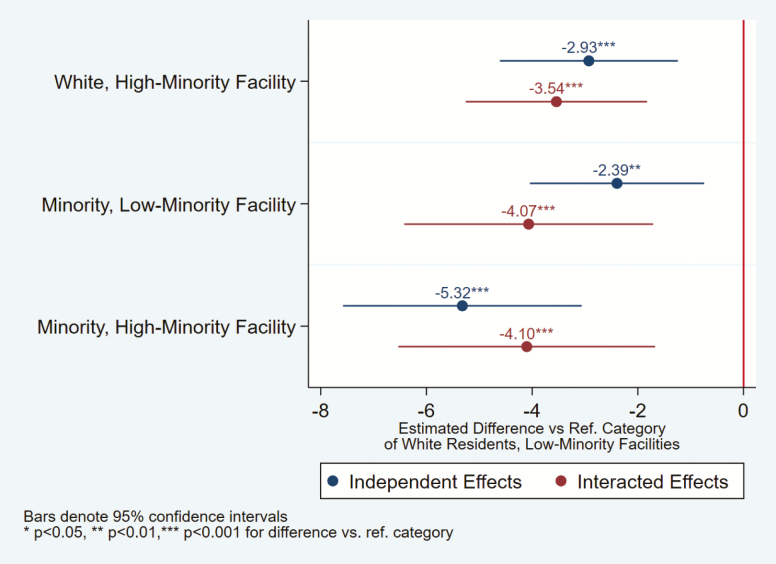
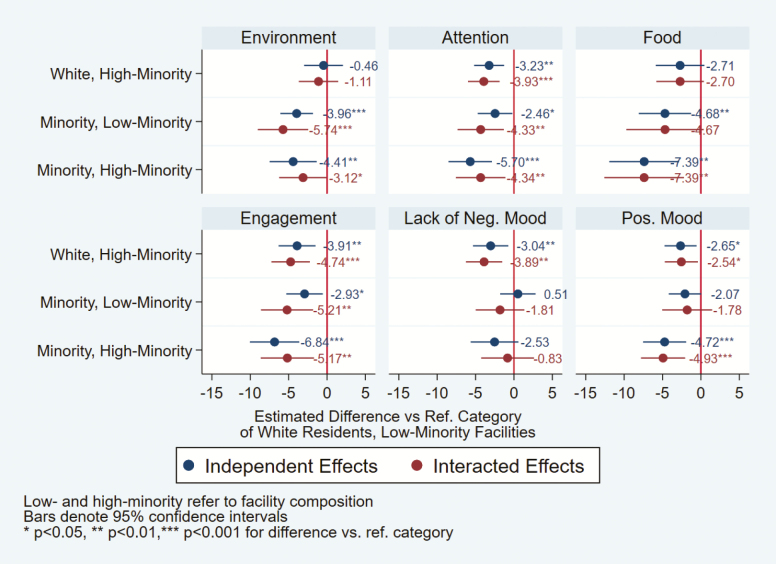
BACKGROUND AND OBJECTIVES: The proportion of racial/ethnic minority older adults in nursing homes (NHs) has increased dramatically and will surpass the proportion of white adults by 2030.Yet, little is known about minority groups' experiences related to the quality of life (QOL). QOL is a person-centered measure, capturing multiple aspects of well-being. NH quality has been commonly measured using clinical care indicators, but there is growing recognition for the need to include QOL. This study examines the role of individual race/ethnicity, facility racial/ethnic composition, and the interaction of both for NH resident QOL. RESEARCH DESIGN AND METHODS: We used a unique state-level data set that includes self-reported QOL surveys with a random sample of long-stay Minnesota NH residents, using a multidimensional measure of QOL. These surveys were linked to resident clinical data from the Minimum Dataset 3.0 and facility-level characteristics. Minnesota is one of the two states in the nation that collects validated QOL measures, linked to data on resident and detailed facility characteristics. We used mixed-effects models, with random intercepts to model summary QOL score and individual domains. RESULTS: We identified significant racial disparities in NH resident QOL. Minority residents report significantly lower QOL scores than white residents, and NHs with higher proportion minority residents have significantly lower QOL scores. Minority residents have significantly lower adjusted QOL than white residents, whether they are in low- or high-minority facilities, indicating a remaining gap in individual care needs. DISCUSSION AND IMPLICATIONS: The findings highlight system-level racial disparities in NH residents QOL, with residents who live in high-proportion minority NHs facing the greatest threats to their QOL. Efforts need to focus on reducing racial/ethnic disparities in QOL, including potential public reporting (similar to quality of care) and resources and attention to provision of culturally sensitive care in NHs to address residents' unique needs.
Overview
The claims and statistics of this paper haven’t been checked yet.
Free: it reads the open-access text and checks the first 5 claims that cite a source we can check. Create a free account to check every claim.
Integrity signals
Registry
Cites
Statistics
Figures
Verification
Claims the paper makes
The claims and statistics of this paper haven’t been checked yet.
Free: it reads the open-access text and checks the first 5 claims that cite a source we can check. Create a free account to check every claim.
Claims other papers make about this one
Each is checked against this paper’s own text: does it say what the citing paper says it does?
The source backs part of the claim, not all of it — or backs it for a different population, condition or comparison.
In the citing paper
“Largely due to their segregation into lower quality facilities, Black nursing home residents as compared with their white counterparts report lower quality of life (Shippee et al., 2020), are more often physically restrained (Cassie and Cassie, 2013), and receive pain treatment less often (Mack et al., 2018).”
From Algorithmic harms and digital ageism in the use of surveillance technologies in nursing homes (2022) · cites this paper as Shippee et al., 2020
Experimental — accuracy not yet measured
Self-check
Percentages, sums and reported differences re-computed from the paper’s own numbers.
The self-check needs the paper’s full text.
Citations
Cites
Driven to tiers: socioeconomic and racial disparities in the quality of nursing home care
MOR, V., ZINN, J., ANGELELLI, J., TENO, J. M., & MILLER, S. C. (2004) · The Milbank Quarterly · doi:10.1111/j.0887-378x.2004.00309.x · Cited by 488 · cited 1×
“These findings on QOL align with past studies on quality of care which have argued that the NH industry is effectively operated in a two-tiered system where some NHs have fewer resources and thus deliver subpar care (27,28).”
ResultRace/Ethnicity and Socioeconomic Status: Measurement and Methodological Issues
Williams, D. R. (1996) · International Journal of Health Services · doi:10.2190/u9qt-7b7y-hq15-jt14 · Cited by 366 · cited 1×
“Being in a facility with more people with similar backgrounds can lead to stronger social relationships, more shared experiences that stem from interacting with the health care system (31), and the NH being more willing to accommodate the needs of a minority group if there are more of them in the facility.”
BackgroundThe Minimum Data Set 3.0 Cognitive Function Scale
Thomas, K. S., Dosa, D., Wysocki, A., & Mor, V. (2017) · Medical Care · doi:10.1097/mlr.0000000000000334 · Cited by 344 · cited 1×
“Cognitive status was determined by responses to the Brief Interview for Mental Status, or if the resident is unable to respond, the nurse-assessed Cognitive Performance Scale (34).”
MethodKane, R. A. (2003) · The Gerontologist · doi:10.1093/geront/43.suppl_2.28 · Cited by 271
Feng, Z., Fennell, M. L., Tyler, D. A., Clark, M., & Mor, V. (2011) · Health Affairs · doi:10.1377/hlthaff.2011.0126 · Cited by 188
Resident- and Facility-Level Predictors of Quality of Life in Long-Term Care
Shippee, T. P., Henning‐Smith, C., Kane, R. L., & Lewis, T. (2013) · The Gerontologist · doi:10.1093/geront/gnt148 · Cited by 159
Improving the Quality of Long‐Term Care with Better Information
Mor, V. (2005) · Milbank Quarterly · doi:10.1111/j.1468-0009.2005.00405.x · Cited by 151
Zubritsky, C. D., Abbott, K. H., Hirschman, K. B., Bowles, K. H., Foust, J. B., & Naylor, M. D. (2012) · The Gerontologist · doi:10.1093/geront/gns093 · Cited by 122
Review: Disparities in Long-Term Care: Building Equity Into Market-Based Reforms
Konetzka, R. T., & Werner, R. M. (2009) · Medical Care Research and Review · doi:10.1177/1077558709331813 · Cited by 107 · cited 1×
“NHs account for 17% of Medicaid spending (2) but remain more racially segregated than other health care settings (3).”
BackgroundPrevalence and Treatment of Diagnosed Depression among Elderly Nursing Home Residents in Ohio
Levin, C. A., Wei, W., Akıncıgil, A., Lucas, J. A., Bilder, S. M., & Crystal, S. (2007) · Journal of the American Medical Directors Association · doi:10.1016/j.jamda.2007.07.010 · Cited by 95 · cited 1×
“Other studies identified racial disparities in use of antipsychotic medications (12), diagnosis and treatment of depression (13), and differences in rates of pressure sores (12–14).”
Background
Research works printed but not linked: 6
- Eiken S, Sredl K, Gold L, Kasten J, Burwell B, Saucier P. Medicaid Expenditures for Long-Term Care Services and Supports in FFY 2012. Ann Arbor, MI: Truven Health Analytics; 2014.
- Shippee TP. Examining Racial Differences in Nursing Home Residents’ Quality of Life. St. Paul, MN: Minnesota Department of Human Services; 2016.
- Konetzka RT, Gray ZS The role of socioeconomic status in nursing home quality ratings. Seniors Hous Care J. 2017; 25(1): 3– 14.
- Vital Research. Implementation of the 2010 Consumer Satisfaction and Quality of Life Survey in Minnesota Nursing Homes and Satisfaction Survey of Family Members of Residents in Minnesota Nursing Homes: Final Report. Los Angeles, CA: Vital Research; 2010.
- Minnesota Department of Human Services. Minnesota Nursing Home Report Card Technical User Guide. St. Paul, MN: Minnesota Department of Human Services; 2017.
- Harrington C, Wiener JM, Ross L, Musumeci M. Key Issues in Long-Term Services and Supports Quality. San Francisco, CA: Kaiser Family Foundation; 2017.
Cited by
COVID-19 Pandemic: Exacerbating Racial/Ethnic Disparities in Long-Term Services and Supports
Shippee, T. P., Akosionu, O., Ng, W., Woodhouse, M., Duan, Y., Thao, M. S., & Bowblis, J. R. (2020) · Journal of Aging & Social Policy · doi:10.1080/08959420.2020.1772004 · Cited by 96
Addressing systemic racism in nursing homes: a time for action
Sloane, P. D., Yearby, R., Konetzka, R. T., Li, Y., Espinoza, R., & Zimmerman, S. (2021) · Journal of the American Medical Directors Association · doi:10.1016/j.jamda.2021.02.023 · Cited by 76
Evidence for Action: Addressing Systemic Racism Across Long-Term Services and Supports
Shippee, T. P., Fabius, C. D., Fashaw‐Walters, S. A., Bowblis, J. R., Nkimbeng, M. J., Bucy, T., Duan, Y., Ng, W., Akosionu, O., & Travers, J. L. (2021) · Journal of the American Medical Directors Association · doi:10.1016/j.jamda.2021.12.018 · Cited by 72
Algorithmic harms and digital ageism in the use of surveillance technologies in nursing homes
Berridge, C., & Grigorovich, A. (2022) · Frontiers in Sociology · doi:10.3389/fsoc.2022.957246 · Cited by 47
Musa, M. K., Akdur, G., Brand, S. L., Killett, A., Spilsbury, K., Peryer, G., Burton, J. K., Gordon, A. L., Hanratty, B., Towers, A., et al. (2022) · BMC Geriatrics · doi:10.1186/s12877-021-02705-w · Cited by 40
Metadata
- Authors
- Shippee, T. P., Ng, W., & Bowblis, J. R.
- Affiliations
- University of Minnesota (US)
- Miami University (US)
- Corresponding author
- Shippee, Tetyana P
- Venue
- Innovation in Aging
- Publisher
- Oxford University Press (OUP)
- Published
- 2020
- Volume
- 4
- Issue
- 3
- Pages
- igaa014-igaa014
- ISSN
- 2399-5300 (ISSN-L)
- PMC
- PMC7272785
- OpenAlex
- W3033527519
- Cited by
- 56
- References
- 34
- Citations by year
- 2026: 8 · 2025: 8 · 2024: 14 · 2023: 10 · 2022: 10 · 2021: 3 · 2020: 2
- FWCI
- 6.52
- Type
- journal article
- Language
- en
- Open access
- gold
- doi.org
- Licence
- Locations
- Innovation in Aging (publishedVersion, cc-by-nc-nd)
- PubMed Central (publishedVersion, cc-by-nc-nd)
- PubMed (publishedVersion)
- Funders
- National Institute of Minority Health Disparities (5R01MD010729)
- Topics
- Health Sciences › Medicine › Geriatrics and Gerontology › Geriatric Care and Nursing Homes
- Health Sciences › Medicine › Public Health, Environmental and Occupational Health › Aging, Health, and Disability
- Social Sciences › Health › Health disparities and outcomes
- Keywords
- nursing homes, quality of life, racial disparities, older adults, culturally sensitive care, long-term care quality
About these checks
Registry, retraction, Cites and statistics results are computed, not judged, with one exception: a printed reference that no index lists is read once by a model before it counts as a citation error. Claims are extracted by a model and kept only when their quote appears verbatim in the text; each cited source is then checked, with a model’s help, for whether it says what the claim relies on. Those verdicts can be wrong — read the claim’s quote and the cited source before relying on one.
Statistics and arithmetic are recomputed, not judged.
Confidence bands are shown only for fields calibrated on our annotated test set. None is calibrated yet, so no band is shown.
What counts as a claim ›How we measure confidence ›How we check this ›
Are you an author, or do you see a problem with this page? Request a review
Data sources
Bibliographic data: Semantic Scholar, OpenAlex, Crossref.
Contains information from the Semantic Scholar Academic Graph Datasets, made available under the ODC Attribution License (ODC-BY 1.0).
Semantic Scholar’s data is described in: Kinney, R., et al. (2023). The Semantic Scholar Open Data Platform. arXiv:2301.10140.
