

A comparison of hierarchical cluster analysis and league table rankings as methods for analysis and presentation of district health system performance data in Uganda
Open accessThe DOI matches its Crossref record; 40 of the 40 references it cites were found in a registry or an index.
Abstract
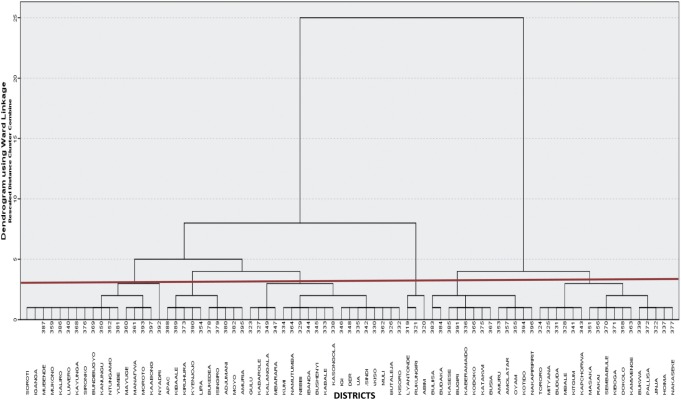
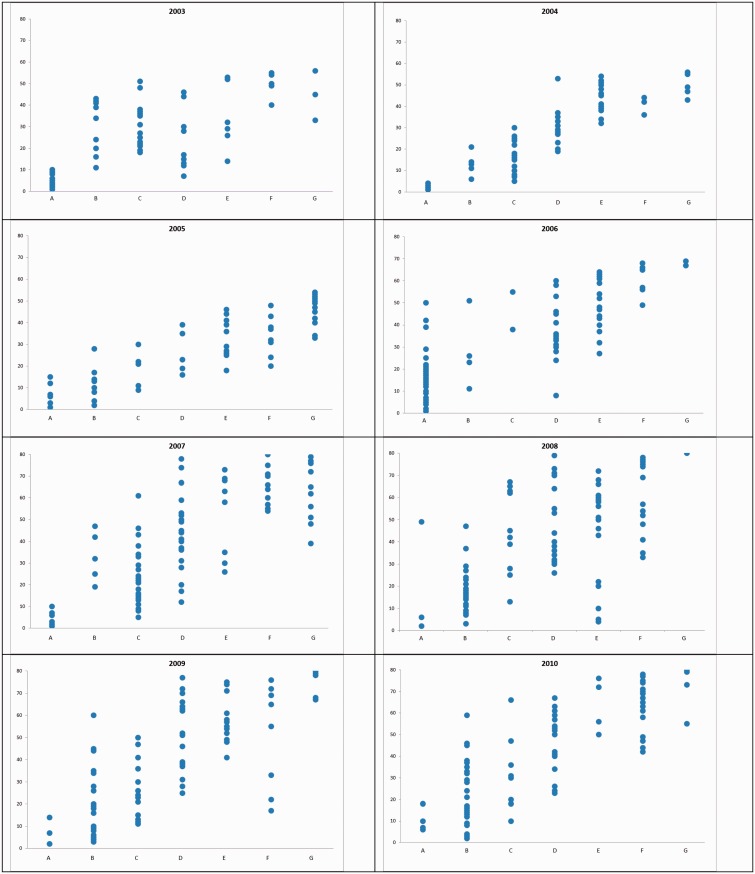
In 2003, the Uganda Ministry of Health introduced the district league table for district health system performance assessment. The league table presents district performance against a number of input, process and output indicators and a composite index to rank districts. This study explores the use of hierarchical cluster analysis for analysing and presenting district health systems performance data and compares this approach with the use of the league table in Uganda. Ministry of Health and district plans and reports, and published documents were used to provide information on the development and utilization of the Uganda district league table. Quantitative data were accessed from the Ministry of Health databases. Statistical analysis using SPSS version 20 and hierarchical cluster analysis, utilizing Wards' method was used. The hierarchical cluster analysis was conducted on the basis of seven clusters determined for each year from 2003 to 2010, ranging from a cluster of good through moderate-to-poor performers. The characteristics and membership of clusters varied from year to year and were determined by the identity and magnitude of performance of the individual variables. Criticisms of the league table include: perceived unfairness, as it did not take into consideration district peculiarities; and being oversummarized and not adequately informative. Clustering organizes the many data points into clusters of similar entities according to an agreed set of indicators and can provide the beginning point for identifying factors behind the observed performance of districts. Although league table ranking emphasize summation and external control, clustering has the potential to encourage a formative, learning approach. More research is required to shed more light on factors behind observed performance of the different clusters. Other countries especially low-income countries that share many similarities with Uganda can learn from these experiences.
Overview
The claims and statistics of this paper haven’t been checked yet.
Free: it reads the open-access text and checks the first 5 claims that cite a source we can check. Create a free account to check every claim.
Integrity signals
Registry
Cites
Statistics
Figures
Verification
Claims the paper makes
The claims and statistics of this paper haven’t been checked yet.
Free: it reads the open-access text and checks the first 5 claims that cite a source we can check. Create a free account to check every claim.
Claims other papers make about this one
Each is checked against this paper’s own text: does it say what the citing paper says it does?
The cited source says what the claim attributes to it.
In the citing paper
“the MoH produces a ‘district league table’ [5] using an HMIS database which is based on a unified reporting system for public and NFP sectors [6, 7].”
From Beyond pilotitis: taking digital health interventions to the national level in China and Uganda (2017) · cites this paper as [5]
Self-check
Percentages, sums and reported differences re-computed from the paper’s own numbers.
The self-check needs the paper’s full text.
Citations
Cites
Finding Groups in Data: An Introduction to Cluster Analysis
Kaufman, L., & Rousseeuw, P. J. (1990) · Wiley Series in Probability and Statistics · doi:10.1002/9780470316801 · Cited by 7,344
A Survey of Clustering Data Mining Techniques
Berkhin, P. (2006) · Grouping Multidimensional Data · doi:10.1007/3-540-28349-8_2 · Cited by 2,804 · cited 5×
“It was determined that less than seven clusters grouped together too many districts, whereas more than seven clusters were considered unwieldy for decision making (Romesburg 2004; Berkhin 2006).”
BackgroundMethodInfluentialSystematic determination of genetic network architecture
Tavazoie, S., Hughes, J. D., Campbell, M. J., Cho, R. J., & Church, G. M. (1999) · Nature Genetics · doi:10.1038/10343 · Cited by 2,507 · cited 1×
“In health it has been used extensively in biomedicine, in genetics, asthma and cancer studies and in psychology (Tavazoie et al. 1999; Beckstead 2002; Dyrskjot et al. 2003; Haldar et al. 2008; Andreopoulos et al. 2009).”
MethodCluster analysis and clinical asthma phenotypes
Haldar, P., Pavord, I. D., Shaw, D. E., Berry, M. A., Thomas, M., Brightling, C. E., Wardlaw, A. J., & Green, R. H. (2008) · American Journal of Respiratory and Critical Care Medicine · doi:10.1164/rccm.200711-1754oc · Cited by 1,987 · cited 2×
“In health it has been used extensively in biomedicine, in genetics, asthma and cancer studies and in psychology (Tavazoie et al. 1999; Beckstead 2002; Dyrskjot et al. 2003; Haldar et al. 2008; Andreopoulos et al. 2009).”
MethodCluster analysis for researchers
(1987) · Environmental Software · doi:10.1016/0266-9838(87)90010-4 · Cited by 1,850
Health systems performance assessment: debates, methods and empiricism.
Murray, C. J. L., & EVANS, D. B. (2003) · Cited by 855
Identifying distinct classes of bladder carcinoma using microarrays
Dyrskjøt, L., Thykjaer, T., Kruhøffer, M., Jensen, J. L., Marcussen, N., Hamilton-Dutoit, S., Wolf, H., & Ørntoft, T. F. (2003) · Nature Genetics · doi:10.1038/ng1061 · Cited by 501 · cited 2×
“In health it has been used extensively in biomedicine, in genetics, asthma and cancer studies and in psychology (Tavazoie et al. 1999; Beckstead 2002; Dyrskjot et al. 2003; Haldar et al. 2008; Andreopoulos et al. 2009).”
MethodPerformance Measurement for Health System Improvement: Experiences, Challenges and Prospects
(2010) · Cambridge University Press eBooks · doi:10.1017/cbo9780511711800 · Cited by 426
Assessing health system performance in developing countries: A review of the literature
Kruk, M. E., & Freedman, L. P. (2008) · Health Policy · doi:10.1016/j.healthpol.2007.09.003 · Cited by 332 · cited 2×
“Yet the marked difference in contexts between HICs and L/MICs means that it is not always possible and/or desirable to copy HSPA approaches and frameworks from one context to the other (Kruk and Freedman 2008; Smith et al. 2009; Tashobya et al. 2014).”
BackgroundGrouping Multidimensional Data
(2006) · Springer eBooks · doi:10.1007/3-540-28349-8 · Cited by 323
Research works printed but not linked: 6
- Foro GP 2013 Evaluation de la Performance des Districts Sanitaires An Burkina faso: Analyse Situationnelle et Perspectives. Masters in Public Health, Health Policy and Management, Thesis, Institute of Tropical Medicine, Antwerp.
- Komakech I 2005 The curse of league tables: how Uganda missed the point. Health Policy and Development 3: 164– 9.
- Ministry of Health. 2008a Aide Memoire: The 7th National Health Assembly and 15th Health Sector Joint Review Mission. Kampala: Ministry of Health and Development Partners.
- Ministry of Health. 2008c Mid-Term Review of the Health Sector Strategic Plan II. Kampala: Ministry of Health, Uganda.
- Ministry of Health. 2011 Independent review health sector programme of Work 2010. Final Report. Accra, Ministry of Health Ghana.
- Ministry of Health. 2012 Aide Memoire: The 18th Government of Uganda and Development Partners Health Sector Joint Review Mission. Kampala: Ministry of Health and Development Partners.
Cited by
Hogan, D. R., Stevens, G. A., Hosseinpoor, A. R., & Boerma, T. (2018) · The Lancet Global Health · doi:10.1016/s2214-109x(17)30472-2 · Cited by 444
Beyond pilotitis: taking digital health interventions to the national level in China and Uganda
Huang, F., Blaschke, S., & Lucas, H. (2017) · Globalization and Health · doi:10.1186/s12992-017-0275-z · Cited by 182
“District Health Teams are held responsible for the overall performance of services in their district, to the extent that the MoH produces a ‘district league table’ [5] using an HMIS database which is based on a unified reporting system for public and NFP sectors [6, 7].”
MethodMaina, I., Wanjala, P., Soti, D., Kipruto, H., Droti, B., & Boerma, T. (2017) · Bulletin of the World Health Organization · doi:10.2471/blt.17.194399 · Cited by 119
Zakumumpa, H., Tumwine, C., Kiconco, M., & Spicer, N. (2021) · BMC Health Services Research · doi:10.1186/s12913-021-06607-w · Cited by 45
“Uganda has a decentralized health system whereby subnational units known as districts retain overall responsibility for social service provision [11, 12].”
BackgroundHenriksson, D. K., Ayebare, F., Waiswa, P., Peterson, S., Tumushabe, E. K., & Fredriksson, M. (2017) · BMC Health Services Research · doi:10.1186/s12913-017-2059-9 · Cited by 40
“Although the Ministry of Health in Uganda recognizes the best performing districts annually through the league table [58], it is also important to systematize recognition for good performance at the district level in order to motivate staff.”
BackgroundPromoting transparency and accountability with district league tables in Sierra Leone and Malawi
Sæbø, J. I., Moyo, C., & Nielsen, P. (2018) · Health Policy and Technology · doi:10.1016/j.hlpt.2018.01.003 · Cited by 24
Jiao, J., Jia, X., Liu, P., Zhang, Q., Liu, F., Cun-de, M., Xi, P., & Liang, Z. (2018) · Comptes Rendus Biologies · doi:10.1016/j.crvi.2017.10.004 · Cited by 23
KirungaTashobya, C., Ssengooba, F., Nabyonga‐Orem, J., Bataringaya, J. E., Macq, J., Marchal, B., Musila, T., & Criel, B. (2018) · BMC Health Services Research · doi:10.1186/s12913-018-3126-6 · Cited by 20
“The ‘top performers’ were recognized in public fora and the ‘bottom performers’ advised to improve [18].”
BackgroundMethodSelf-citationQuality Indicators for Older Persons’ Transitions in Care: A Systematic Review and Delphi Process
Tate, K., Lee, S., Rowe, B. H., Cummings, G. E., Holroyd-Leduc, J. M., Reid, R. C., El‐Bialy, R., Bakal, J. A., Estabrooks, C. A., Anderson, C. L., et al. (2021) · Canadian Journal on Aging / La Revue canadienne du vieillissement · doi:10.1017/s0714980820000446 · Cited by 19
Post-operative opioid pain management patterns for patients who receive hip surgery
Cook, C. E., Rhon, D. I., Lewis, B. D., & George, S. Z. (2017) · Substance Abuse Treatment Prevention and Policy · doi:10.1186/s13011-017-0094-5 · Cited by 17
“Cluster analysis—also called segmentation or taxonomy analysis—is an explorative approach that identifies grouping structures within data [14].”
BackgroundTransitioning health workers from PEPFAR contracts to the Uganda government payroll
Zakumumpa, H., Rujumba, J., Amde, W. K., Damian, R. S., Maniple, E., & Ssengooba, F. (2021) · Health Policy and Planning · doi:10.1093/heapol/czab077 · Cited by 16
“In Uganda, decentralization was a part of governance reforms that date as far back as 1992 (Awortwi, 2010; Tashobya et al., 2016).”
BackgroundMethodSelf-citationYan, W., & Zhang, Y. (2018) · Higher Education · doi:10.1007/s10734-018-0339-x · Cited by 17
“Lastly, a demarcation of clusters was made, given the understanding of the context, at the point where it works the best with neither too few clusters with too many members in each nor too many clusters to be difficult for decision making (Romesburg 2004; Berkhin 2006; Tashobya et al. 2015).”
BackgroundTeng, J. (2024) · Systems Science & Control Engineering · doi:10.1080/21642583.2024.2305411 · Cited by 9
“It can be of two types: agglomerative and divisive (Tashobya et al., 2016).”
QALY league table of Iran: a practical method for better resource allocation
Hashempour, R., Raei, B., Lari, M. S., Gallehzan, N. A., & Akbarisari, A. (2021) · Cost Effectiveness and Resource Allocation · doi:10.1186/s12962-020-00256-2 · Cited by 9
Niza, I. L., da Luz, I. M., de Souza, M. P., & Broday, E. E. (2024) · Architectural Engineering and Design Management · doi:10.1080/17452007.2024.2371157 · Cited by 2
“In the dendrogram, the clusters were established using a vertical line (Tashobya et al., 2016), indicating that they were formed at point A and point B, visually representing the interactions, similar to the study by Xulong, Li, and Tongjin (2022) on interactions between genetic factors in the risk…”
Atwiine, J., Atukunda, G., Tumwesigye, W., & Asasira, J. (2021) · Open Access Journal of Biogeneric Science and Research · doi:10.46718/jbgsr.2021.08.000189 · Cited by 1
Iddrisu, Z., & Thill, J. (2024) · Growth and Change · doi:10.1111/grow.70007 · Cited by 1
Erdurak, Y. (2025) · Çukurova Üniversitesi Sosyal Bilimler Enstitüsü Dergisi · doi:10.35379/cusosbil.1696675 · Cited by 1
Zakumumpa, H., Ssegujja, E., Kyomuhendo, M., Maritim, B., Musila, T., & Ssengooba, F. (2026) · PLoS ONE · doi:10.1371/journal.pone.0341328 · Cited by 1
“Uganda runs a decentralized health service delivery system [28], where the mandate for social services provision has been devolved to sub-national units known as districts.”
Self-citationZakumumpa, H., Rujumba, J., Amde, W. K., Damian, R. S., & Ssengooba, F. (2021) · Research Square · doi:10.21203/rs.3.rs-301407/v1
“Health sector decentralization was formally provided for under the 1995 national constitution and further operationalized in the Local Government Act of 1997 (Tashobya et al. 2016).”
BackgroundMethodSelf-citationHuman Resources Factors and Management of Health Products and Technologies
Meme, S. M., Kawila, C., & Njoroge, K. M. (2026) · International Journal of Professional Practice · doi:10.71274/ijpp.v14i2.675
Metadata
- Authors
- Tashobya, C. K., Dubourg, D., Ssengooba, F., Speybroeck, N., Macq, J., & Criel, B.
- Affiliations
- Ministry of Health (UG)
- Instituut voor Tropische Geneeskunde (BE)
- Makerere University (UG)
- UCLouvain (BE)
- Corresponding author
- Tashobya, Christine K
- Venue
- Health Policy and Planning
- Publisher
- Oxford University Press (OUP)
- Published
- 2015-05-28
- Volume
- 31
- Issue
- 2
- Pages
- 217-228
- ISSN
- 0268-1080 (ISSN-L)
- 1460-2237
- PMC
- PMC4748130
- OpenAlex
- W2261717200
- Cited by
- 22
- References
- 40
- Citations by year
- 2026: 2 · 2025: 1 · 2024: 3 · 2022: 1 · 2021: 6 · 2018: 4 · 2017: 5
- FWCI
- 5.78
- Type
- journal article
- Language
- en
- Open access
- hybrid
- doi.org
- Licence
- cc-by-nc
- Locations
- Health Policy and Planning (publishedVersion, cc-by-nc)
- PubMed Central (publishedVersion, cc-by-nc)
- PubMed (publishedVersion)
- HighWire Press Open Archive (publishedVersion)
- Digital Access to Libraries (submittedVersion)
- Topics
- Health Sciences › Medicine › Public Health, Environmental and Occupational Health › Healthcare Quality and Management
- Health Sciences › Medicine › Public Health, Environmental and Occupational Health › Healthcare Systems and Practices
- Health Sciences › Medicine › Public Health, Environmental and Occupational Health › Healthcare Systems and Reforms
- Keywords
- hierarchical clustering, health performance indicators, composite index, Uganda, low-income countries
- MeSH terms
- Decision Making, Delivery of Health Care, Government Programs, Humans, Uganda, Models, Statistical, Cluster Analysis
About these checks
Registry, retraction, Cites and statistics results are computed, not judged, with one exception: a printed reference that no index lists is read once by a model before it counts as a citation error. Claims are extracted by a model and kept only when their quote appears verbatim in the text; each cited source is then checked, with a model’s help, for whether it says what the claim relies on. Those verdicts can be wrong — read the claim’s quote and the cited source before relying on one.
Statistics and arithmetic are recomputed, not judged.
Confidence bands are shown only for fields calibrated on our annotated test set. None is calibrated yet, so no band is shown.
What counts as a claim ›How we measure confidence ›How we check this ›
Are you an author, or do you see a problem with this page? Request a review
Data sources
Bibliographic data: Semantic Scholar, OpenAlex, Crossref.
Contains information from the Semantic Scholar Academic Graph Datasets, made available under the ODC Attribution License (ODC-BY 1.0).
Semantic Scholar’s data is described in: Kinney, R., et al. (2023). The Semantic Scholar Open Data Platform. arXiv:2301.10140.
