

Real-life insights on menstrual cycles and ovulation using big data
Open accessThe DOI matches its Crossref record; 29 of the 33 references it cites were found in a registry or an index; 2 of the 29 sources its claims cite were checked for support.
Abstract
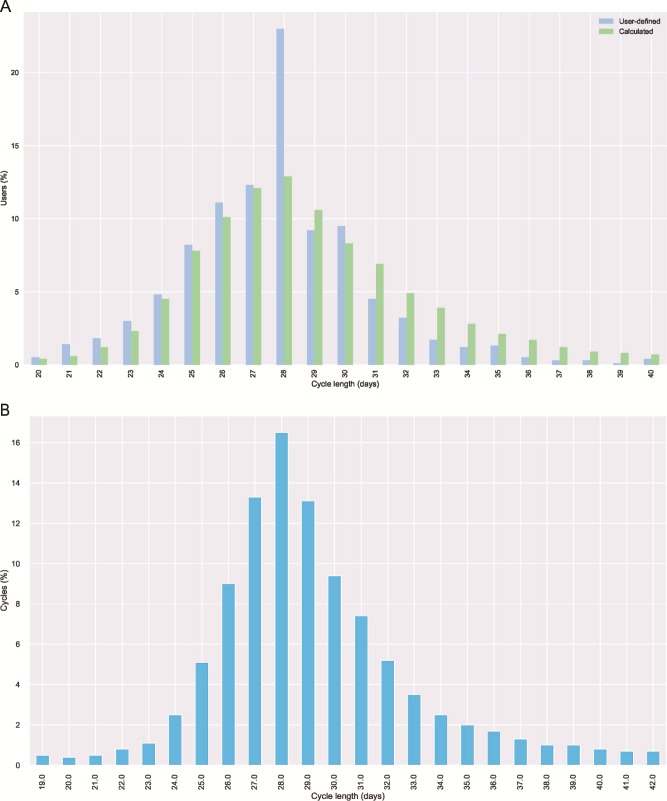
STUDY QUESTION: What variations underlie the menstrual cycle length and ovulation day of women trying to conceive? SUMMARY ANSWER: Big data from a connected ovulation test revealed the extent of variation in menstrual cycle length and ovulation day in women trying to conceive. WHAT IS KNOWN ALREADY: Timing intercourse to coincide with the fertile period of a woman maximises the chances of conception. The day of ovulation varies on an inter- and intra-individual level. STUDY DESIGN, SIZE, DURATION: A total of 32 595 women who had purchased a connected ovulation test system contributed 75 981 cycles for analysis. Day of ovulation was determined from the fertility test results. The connected home ovulation test system enables users to identify their fertile phase. The app benefits users by enabling them to understand their personal fertility information. During each menstrual cycle, users input their perceived cycle length into an accessory application, and data on hormone levels from the tests are uploaded to the application and stored in an anonymised cloud database. This study compared users’ perceived cycle characteristics with actual cycle characteristics. The perceived and actual cycle length information was analysed to provide population ranges. PARTICIPANTS/MATERIALS, SETTING, METHODS: This study analysed data from the at-home use of a commercially available connected home ovulation test by women across the USA and UK. MAIN RESULTS AND THE ROLE OF CHANCE: Overall, 25.3% of users selected a 28-day cycle as their perceived cycle length; however, only 12.4% of users actually had a 28-day cycle. Most women (87%) had actual menstrual cycle lengths between 23 and 35 days, with a normal distribution centred on day 28, and over half of the users (52%) had cycles that varied by 5 days or more. There was a 10-day spread of observed ovulation days for a 28-day cycle, with the most common day of ovulation being Day 15. Similar variation was observed for all cycle lengths examined. For users who conducted a test on every day requested by the app, a luteinising hormone (LH) surge was detected in 97.9% of cycles. LIMITATIONS, REASONS FOR CAUTION: Data were from a self-selected population of women who were prepared to purchase a commercially available product to aid conception and so may not fully represent the wider population. No corresponding demographic data were collected with the cycle information. WIDER IMPLICATIONS OF THE FINDINGS: Using big data has provided more personalised insights into women’s fertility; this could enable women trying to conceive to better time intercourse, increasing the likelihood of conception. STUDY FUNDING/COMPETING INTERESTS: The study was funded by SPD Development Company Ltd (Bedford, UK), a fully owned subsidiary of SPD Swiss Precision Diagnostics GmbH (Geneva, Switzerland). I.S., B.G. and S.J. are employees of the SPD Development Company Ltd.
Overview
CoChat Summary
TL;DR
This study used anonymized big data from a connected home ovulation test to describe real-life menstrual cycle length and ovulation-day variation among women trying to conceive. It found that perceived cycle length often differs from actual cycle length and that ovulation day varies widely even within the same cycle length.
Key findings
- Among 32,595 users contributing 75,981 cycles, 25.3% selected a 28-day cycle as their perceived cycle length, but only 12.4% actually had a 28-day cycle; in cycle-level results, 28 days was selected in 23.3% of cycles overall and 31.1% on first use.
- Most women (87%) had actual cycle lengths between 23 and 35 days, and over half (52%) had cycles that varied by 5 days or more.
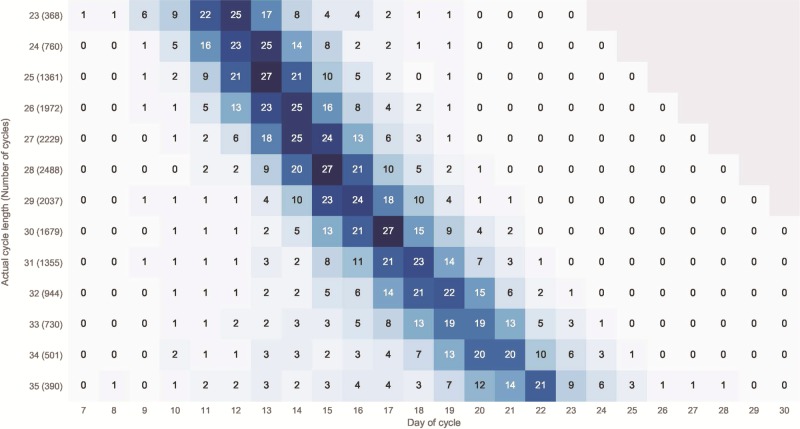
- For 28-day cycles, there was a 10-day spread of observed ovulation days, with the most common ovulation day being Day 15 (27%), followed by Day 16 (21%) and Day 14 (20%); similar variation was seen for all cycle lengths examined.
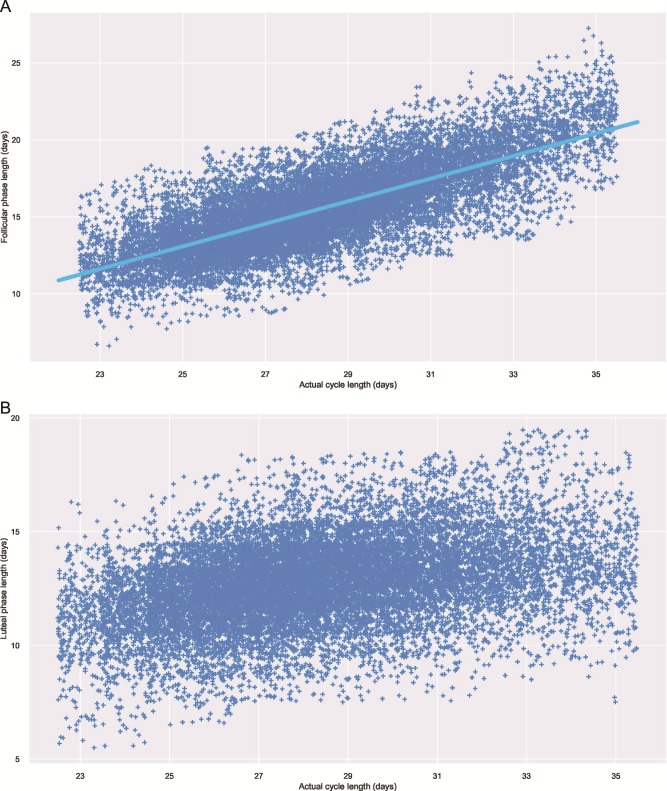
- For users who tested every day requested by the app, an LH surge was detected in 97.9% of cycles; follicular phase length correlated strongly with actual cycle length (Pearson’s r = 0.77, P < 0.001), while luteal phase length correlated weakly (r = 0.37, P < 0.001), with mean luteal length estimated at 12.77 ± 1.86 days.
Methods
- Retrospective analysis of anonymized cloud database data from users of the Clearblue® Connected Ovulation Test System in the USA and UK, including 354,687 ovulation test results and 75,982 cycles inputted by 32,595 users.
- Perceived cycle length entered by users was compared with actual cycle length calculated from inputted menstrual bleeding data; unfinished cycles were excluded, and cycles with actual length longer or shorter than 1.5 times the user cycle length were excluded from comparative analyses.
- Analyses included an ex-Gaussian fit for intra-individual cycle variation, a subgroup of users with exactly 4 completed cycles (n = 1,143), grouping of LH-surge cycles by actual cycle length to estimate ovulation probability per cycle day, Pearson correlations, and robust regression using Huber’s M-estimator.
Limitations
- The paper states that data came from a self-selected population of women prepared to purchase a commercial product to aid conception, so they may not fully represent the wider population; no corresponding demographic data were collected.
- The paper states that causes of extreme observations cannot be determined, such as whether a very long cycle was genuine, due to early pregnancy loss, or due to user input/testing behavior, so cycle characterization focused on robust data for 23–35 day cycles.
- The paper notes that ovulation day was assigned as the day following the LH surge, with reported imprecision of ±1 day for this assay; the study was funded by SPD Development Company Ltd, and the authors are employees of that company.
Model-written summary. Check it against the paper before relying on it.
Integrity signals
Registry
Cites
Statistics
Figures
Verification
Claims the paper makes
2 Valid · 0 Not valid · 14 Not checked · 44 Own results and interpretations
The sources with a verdict support this claim; the rest weren’t checked yet, have no full text we could read, or their verdicts aren’t rated yet.
In the paper
“Apps to track fertility are increasingly being used among women who are seeking to conceive, and many purport to predict ovulation based on cycle length characteristics alone, which can have extremely low predictive accuracy (Moglia et al. 2016; Setton et al. 2016; Johnson et al. 2018).”
§ Real-life insights on menstrual cycles and ovulation using big data > Introduction
What the sources say
- Not checked — no full text of the sourcecites Moglia et al. 2016 matched to “Evaluation of smartphone menstrual cycle tracking applications using an adapted APPLICATIONS scoring system” (2016) source
- Not checked — no full text of the sourcecites Setton et al. 2016 matched to “The accuracy of web sites and cellular phone applications in predicting the fertile window” (2016) source
- Supportedcites Johnson et al. 2018 matched to “Can apps and calendar methods predict ovulation with accuracy?” (2018) source
The Introduction says most fertility-app predictions use menstrual dates and cycle length or assume a 28-day cycle. The Results report that 55 apps predicted ovulation from cycle-related inputs, while the Abstract reports prediction accuracy of no better than 21% for the apps. (LLM, conf=0.93)
plain- Asserted: passes — The authors put it forward as true.
- Checkable: passes — It can be checked against evidence.
- Load-bearing: passes — The paper’s conclusions depend on it.
- Based: passes — The paper gives a reason why it holds.
The cited sources support only part of this claim — read each source’s verdict below.
In the paper
“A 10-day spread of observed ovulation days was observed for all cycle lengths examined; this also agrees with the findings of Johnson et al. (2018).”
§ Real-life insights on menstrual cycles and ovulation using big data > Discussion
What the sources say
- Partly supportedcites Johnson et al. 2018 matched to “Can apps and calendar methods predict ovulation with accuracy?” (2018) sourceExperimental — accuracy not yet measured
The Results report ovulation probabilities across days 11–20 for 28-day cycles and a similarly broad spread for shorter and longer cycles. They do not establish a 10-day spread for every cycle length examined; Table 1 shows that the spreads vary by cycle length. The claim’s 'all cycle lengths' qualifier is therefore too specific. (LLM, conf=0.86)
plain- Asserted: passes — The authors put it forward as true.
- Checkable: passes — It can be checked against evidence.
- Load-bearing: unclear — It is unclear whether the paper’s conclusions depend on it.
- Based: passes — The paper gives a reason why it holds.
- Partly supported
A result the paper reports from its own data — it cites no other source for it, so there is none to check. The quote shows it is in the paper.
In the paper
“Strong correlation was seen between the follicular phase and the actual cycle length for cycle lengths of 23 to 35 days (Pearson’s r = 0.77, P < 0.001)”
§ Real-life insights on menstrual cycles and ovulation using big data > Results > Ovulation day and cycle length
boostedstates an association- Asserted: passes — The authors put it forward as true.
- Checkable: passes — It can be checked against evidence.
- Load-bearing: passes — The paper’s conclusions depend on it.
- Based: passes — The paper gives a reason why it holds.
A result the paper reports from its own data — it cites no other source for it, so there is none to check. The quote shows it is in the paper.
In the paper
“Over half of the users (52.3%) had cycle lengths that varied by 5 or more days.”
§ Real-life insights on menstrual cycles and ovulation using big data > Results > Intra-individual variability of cycles
plain- Asserted: passes — The authors put it forward as true.
- Checkable: passes — It can be checked against evidence.
- Load-bearing: passes — The paper’s conclusions depend on it.
- Based: passes — The paper gives a reason why it holds.
A result the paper reports from its own data — it cites no other source for it, so there is none to check. The quote shows it is in the paper.
In the paper
“The absolute difference in min–max cycle length increases with the number of cycles a user has completed, which is a function of having more data available but may also indicate population differences based on how quickly the woman conceives.”
§ Real-life insights on menstrual cycles and ovulation using big data > Results > Intra-individual variability of cycles
hedgedstates a cause- Asserted: passes — The authors put it forward as true.
- Checkable: passes — It can be checked against evidence.
- Load-bearing: unclear — It is unclear whether the paper’s conclusions depend on it.
- Based: passes — The paper gives a reason why it holds.
29 more claims
Create a free account to see all 60 claims and every source verdict.
- It may state two separate claims as one. 20
- Probably not a substantial claim. 9
Self-check
Percentages, sums and reported differences re-computed from the paper’s own numbers.
Each contradiction between two passages listed here was confirmed by an independent check.
Rated major: it would touch a result — a value a result rests on, reported and recomputed p-values on opposite sides of the significance level, two passages that conflict with no sign which is right, or a cited work retracted before this paper was published.
In the paper
§ Real-life insights on menstrual cycles and ovulation using big data > Abstract > MAIN RESULTS AND THE ROLE OF CHANCE
“Overall, 25.3% of users selected a 28-day cycle as their perceived cycle length; however, only 12.4% of users actually had a 28-day cycle.”
§ Real-life insights on menstrual cycles and ovulation using big data > Discussion
“23.3% (31.1% on first use) of users recording their cycle as 28 days, whereas only 12.4% of the individuals had an actual cycle length of 28 days.”
Citations
Cites
Robust estimation of a location parameter
Huber, P. J. (1964) · The Annals of Mathematical Statistics · doi:10.1214/aoms/1177703732 · Cited by 7,228
Huber, P. J. (1981) · Wiley Series in Probability and Statistics · doi:10.1002/0471725250 · Cited by 7,066
The Diagnosis of Polycystic Ovary Syndrome during Adolescence
Witchel, S. F., Oberfield, S., Rosenfield, R. L., Codner, E., Bonny, A., Ibáñez, L., Pena, A., Horikawa, R., Gomez-Lobo, V., Joel, D., et al. (2015) · Hormone Research in Paediatrics · doi:10.1159/000375530 · Cited by 3,113
Mascarenhas, M. N., Flaxman, S. R., Boerma, T., Vanderpoel, S., & Stevens, G. A. (2012) · PLoS Medicine · doi:10.1371/journal.pmed.1001356 · Cited by 2,312 · cited 1×
“5 million couples worldwide experience infertility (Mascarenhas et al. 2012; Fertility Fairness, 2019), and failure to”
BackgroundWhy do people postpone parenthood? Reasons and social policy incentives
Mills, M., Rindfuss, R. R., McDonald, P., te Velde, E., & on behalf of the ESHRE Reproduction and Society Task Force (2011) · Human Reproduction Update · doi:10.1093/humupd/dmr026 · Cited by 1,082 · cited 1×
“…childbearing, often until their late 30s or early 40s, for reasons such as furthering education, career, financial security or fulfilment of personal goals, thereby risking involuntary childlessness, infertility or a smaller family size than desired (Mills et al. 2011; Bellieni 2016; Sobotka 2017).”
BackgroundVARIATION OF THE HUMAN MENSTRUAL CYCLE THROUGH REPRODUCTIVE LIFE
TRELOAR, A. E., BOYNTON, R. E., BEHN, B. G., & BROWN, B. W. (1968) · Obstetrical & Gynecological Survey · doi:10.1097/00006254-196801000-00019 · Cited by 1,018
(1977) · PubMed · Cited by 488
Wilcox, A. J. (2000) · BMJ · doi:10.1136/bmj.321.7271.1259 · Cited by 452
The length and variability of the human menstrual cycle
Chiazze, L. (1968) · JAMA: The Journal of the American Medical Association · doi:10.1001/jama.1968.03140060001001 · Cited by 374
(1967) · PubMed · Cited by 257
Cited by
The Impact of Menstrual Cycle Phase on Athletes’ Performance: A Narrative Review
Carmichael, M. A., Thomson, R. L., Moran, L. J., & Wycherley, T. P. (2021) · International Journal of Environmental Research and Public Health · doi:10.3390/ijerph18041667 · Cited by 362
“The approximate timing of each MC phase is presented in Figure 1; however, the timing of ovulation, and therefore the various MC phases, can be highly variable [9].”
Period tracker applications: What menstrual cycle information are they giving women?
Worsfold, L., Marriott, L., Johnson, S., & Harper, J. C. (2021) · Women s Health · doi:10.1177/17455065211049905 · Cited by 107
Self-citationOptimizing natural fertility: a committee opinion
Penzias, A., Azziz, R., Bendikson, K., Falcone, T., Hansen, K., Hill, M., Jindal, S., Kalra, S., Mersereau, J., Reindollar, R., et al. (2022) · Fertility and Sterility · doi:10.1016/j.fertnstert.2021.10.007 · Cited by 69
Elliott-Sale, K. J., Altini, M., Doyle-Baker, P., Ferrer, E., Flood, T. R., Harris, R., Impellizzeri, F. M., de Jonge, X. J., Kryger, K. O., Lewin, G., et al. (2025) · Sports Medicine · doi:10.1007/s40279-025-02189-3 · Cited by 64
“…Most menstrual cycles are 28 days, with ovulation occurring on day 14 It is estimated that this ‘textbook cycle’ represents as few as 10% of all ‘real world’ cycles [30]; cycle length has a healthy range of up to 14 days, such that women can have both short (21 days) and long cycles (35 days).”
Schantz, J. S., Fernandez, C. S. P., & Jukic, A. M. Z. (2021) · Current Epidemiology Reports · doi:10.1007/s40471-020-00260-3 · Cited by 61
Antero, J., Golovkine, S., Niffoi, L., Meignié, A., Chassard, T., Larochelambert, Q. D., Duclos, M., Maître, C., Maciejewski, H., Diry, A., et al. (2023) · Frontiers in Physiology · doi:10.3389/fphys.2023.1110526 · Cited by 55
Dupuit, M., Meignié, A., Chassard, T., Blanquet, L., LeHeran, J., Delaunay, T., Bernardeau, E., Toussaint, J., Duclos, M., & Antero, J. (2023) · International Journal of Sports Physiology and Performance · doi:10.1123/ijspp.2022-0287 · Cited by 41
A predictive model for next cycle start date that accounts for adherence in menstrual self-tracking
Li, K., Urteaga, I., Shea, A. A., Vitzthum, V. J., Wiggins, C. H., & Elhadad, N. (2021) · Journal of the American Medical Informatics Association · doi:10.1093/jamia/ocab182 · Cited by 52
Jones, B. P., L’Heveder, A., Bishop, C., Kasaven, L. S., Saso, S., Davies, S. R., Chakraverty, R., Brown, J. C., & Pollock, N. (2024) · Frontiers in Sports and Active Living · doi:10.3389/fspor.2024.1296189 · Cited by 48
Grace, B., Shawe, J., Johnson, S., Usman, N. O., & Stephenson, J. (2022) · Human Reproduction · doi:10.1093/humrep/deac036 · Cited by 32
“There is a lack of understanding regarding fertility, even in men and women seeking to conceive (Soumpasis et al., 2020).”
BackgroundSelf-citationJames, J. J., Leach, O. K., Young, A. M., Newman, A. N., Mpongo, K., Quirante, J., Wardell, D., Ahmadi, M., & Gifford, J. R. (2022) · Journal of Applied Physiology · doi:10.1152/japplphysiol.00416.2022 · Cited by 31
Langan‐Evans, C., Hearris, M. A., McQuilliam, S. J., Burke, L. M., Stellingwerff, T., Elliott-Sale, K. J., & Morton, J. P. (2023) · International Journal of Sports Science & Coaching · doi:10.1177/17479541231163088 · Cited by 26
“Menstrual cycle length within and between individuals was highly variable (across the 2 – 72 day range: i.e. some cycle lengths varied by 2 days and are considered largely regular , whilst other cycle lengths varied by up to 72 days and are considered highly irregular ) and in this regard, only 33% of the variability…”
ResultEndoTime: non-categorical timing estimates for luteal endometrium
Lipecki, J., Mitchell, A. E., Muter, J., Lucas, E. S., Makwana, K., Fishwick, K. J., Odendaal, J., Hawkes, A., Vrljicak, P., Brosens, J. J., et al. (2022) · Human Reproduction · doi:10.1093/humrep/deac006 · Cited by 21
“While the average length of menstrual cycle is 28 days, there is considerable intra- and inter-individual variation (Soumpasis et al., 2020).”
A molecular staging model for accurately dating the endometrial biopsy
Teh, W. T., Chung, J., Holdsworth‐Carson, S. J., Donoghue, J. F., Healey, M., Rees, H. C., Bittinger, S. E., Obers, V., Sloggett, C., Kendarsari, R. I., et al. (2023) · Nature Communications · doi:10.1038/s41467-023-41979-z · Cited by 23
“In a study of over 30,000 women, only 12.4%hada 28-daycycle 11 .”
InfluentialDigital health technologies to transform women’s health innovation and inclusive research
Grace, B., Wise, L. A., Nieroda, M., Egbunike, J., & Usman, N. O. (2025) · BMJ · doi:10.1136/bmj-2025-085682 · Cited by 26
Self-citationAlzueta, E., Gombert, M., Javitz, H. S., Yüksel, D., Perez-Amparan, E., Camacho, L., Kiss, O., de Zambotti, M., Sattari, N. S., Pena, A., et al. (2024) · Journal of Biological Rhythms · doi:10.1177/07487304241265018 · Cited by 21
“However, recent work, including a study integrating more than 75,000 cycles, showed that the day of ovulation (estimated based on luteinizing hormone [LH] urine tests results) is tightly linked to the cycle duration (Soumpasis et al., 2020).”
Adnan, T., Coull, B. A., Jukic, A. M. Z., & Mahalingaiah, S. (2021) · Current Opinion in Endocrinology Diabetes and Obesity · doi:10.1097/med.0000000000000682 · Cited by 22
Wegrzynowicz, A. K., Eyvazzadeh, A. D., & Beckley, A. (2024) · Seminars in Reproductive Medicine · doi:10.1055/s-0044-1791190 · Cited by 23
“48 For instance, a woman with a 30-day cycle may assume ovulation occurs on day 14, and have inter-course on days 10 to 15 accordingly.”
Écochard, R., Leiva, R. A., Bouchard, T. P., Boehringer, H., Iwaz, J., & Plotton, I. (2022) · Steroids · doi:10.1016/j.steroids.2022.108964 · Cited by 16
Timed intercourse for couples trying to conceive
Gibbons, T., Reavey, J. J., Georgiou, E. X., & Becker, C. M. (2023) · Cochrane Database of Systematic Reviews · doi:10.1002/14651858.cd011345.pub3 · Cited by 20
Carlin, H., Dupuit, M., Storme, F., Chassard, T., Meignié, A., Sachet, I., Brunet, E., Toussaint, J., & Antero, J. (2024) · Frontiers in Sports and Active Living · doi:10.3389/fspor.2024.1307436 · Cited by 15
“For cyclists in the MC group, we estimated the ovulation day for each cycle period using a linear regression model based on each cyclist cycle length through the follow up duration, showing a high accordance with the real ovulation date in previsous studies (20).”
MethodUsing Hormone Data and Age to Pinpoint Cycle Day within the Menstrual Cycle
Hills, E., Woodland, M. B., & Divaraniya, A. A. (2023) · Medicina · doi:10.3390/medicina59071348 · Cited by 17
“Many at-home fertility monitoring and testing kits focus on identifying the fertile window and confirming ovulation [25,26], but the full ability of these tools to map the hormone cycle with more granularity has been largely unexplored.”
BackgroundKoşar, Ş. N., Güzel, Y., Köse, M. G., İŞLER, A. K., & Hazır, T. (2022) · Annals of Human Biology · doi:10.1080/03014460.2022.2088857 · Cited by 12
“Also, hormonal fluctuations and the responses to these fluctuations are highly individual (Yeung et al. 2013; Soumpasis et al. 2020).”
BackgroundAhn, S. H., Lee, I., Cho, S., Kim, H. I., Baek, H. W., Lee, J. H., Park, Y. J., Kim, H., Yun, B. H., Seo, S. K., et al. (2021) · Frontiers in Endocrinology · doi:10.3389/fendo.2021.650883 · Cited by 11
“A study using data from the anonymous information stored in the cloud database from users of the Clearblue® Connected Ovulation Test System (SPD Swiss Precision Diagnostics, GmbH, Geneva, Switzerland) showed that ovulation days could vary widely, even if the cycle length can be predicted with this system (33).”
MethodLafitte, A., Dupuit, M., Chassard, T., Barlier, K., Badier, N., Duclos, M., Toussaint, J., & Antero, J. (2024) · BMJ Open Sport & Exercise Medicine · doi:10.1136/bmjsem-2024-002078 · Cited by 13
“38 As described previously, FP and LP were divided into early, mid and late sub-phases.”
Grace, B., Shawe, J., & Stephenson, J. (2023) · Sexual & Reproductive Healthcare · doi:10.1016/j.srhc.2023.100826 · Cited by 13
“…and school education, other sources of fertility and reproductive health information such as books, magazines, television programmes, menstrual cycle tracking apps, friends and family have been reported as sources of fertility information [16 – 19], with varying levels of usage and trust.”
BackgroundSelf-citationLarochelambert, Q. D., Hamri, I., Chassard, T., Meignié, A., Storme, F., Dupuit, M., Diry, A., Toussaint, J., Louis, P., Coulmy, N., et al. (2024) · BMJ Open Sport & Exercise Medicine · doi:10.1136/bmjsem-2023-001810 · Cited by 12
“After each training session, the rated perceived exertion (RPE), 27 28”
BackgroundMizrachi, Y., Weissman, A., Rozen, G., Rogers, P. A. W., Stern, C. J., & Polyakov, A. (2022) · Reproductive BioMedicine Online · doi:10.1016/j.rbmo.2022.03.021 · Cited by 11
Becoming One with Kuddi: Touching Data through an Intimate Data Physicalisation
Ívansdóttir, G. M., Park, J. Y., Ståhl, A., & Balaam, M. (2025) · CHI Conference on Human Factors in Computing Systems · doi:10.1145/3706598.3713221 · Cited by 9
Helfrich‐Förster, C., Domenie, E. D., Mitesser, O., Hovestadt, T., Ferlin, A., Wehr, T. A., Costa, R., & Montagnese, S. (2025) · Science Advances · doi:10.1126/sciadv.adw4096 · Cited by 12
“We and others have shown that the period of the menstrual cycle shortens with age ( 21 , 41 , 42 ), while Roenneberg and colleagues ( 43 ) were the first to demonstrate that the circadian chro-notype shifts to later phases during puberty and then becomes progressively earlier with increasing age, a…”
Satwik, R., Majumdar, A., Gupta, S. M., Tiwari, N., Majumdar, G., & Kochhar, M. (2021) · European Journal of Obstetrics & Gynecology and Reproductive Biology · doi:10.1016/j.ejogrb.2021.06.005 · Cited by 9
Hamidovic, A., Davis, J. M., Wardle, M. C., Naveed, A., & Soumare, F. (2023) · Biology · doi:10.3390/biology12060785 · Cited by 10
“The duration and ovulation timings vary both within and between women [15,16], and the underlying hormonal shifts, reflecting different menstrual cycle subphases, are unknown at the time of clinic visits.”
BackgroundPereira, T. J., Bouakkar, J., Johnston, H., Pakosh, M. T., Drake, J. D., & Edgell, H. (2023) · Clinical Autonomic Research · doi:10.1007/s10286-023-00996-0 · Cited by 9
“This duration of pill regimen mimics the average menstrual cycle length of naturally cycling women, with a median or average cycle of roughly 28 days [4–6].”
Carr, G., & Fleddermann, M. (2025) · Scandinavian Journal of Medicine and Science in Sports · doi:10.1111/sms.70093 · Cited by 11
“The typical ovulatory cycle has a variability between 21 and 35 days [17, 18], and is comprised of three distinct phases: the follicular phase (FP), the ovulatory phase, and the luteal phase (LP) [19, 20].”
AACC Guidance Document on the Use of Point-of-Care Testing in Fertility and Reproduction
Nichols, J. H., Ali, M., Anetor, J. I., Chen, L. S., Chen, Y., Collins, S. P., Das, S., Devaraj, S., Fu, L., Karon, B. S., et al. (2022) · The Journal of Applied Laboratory Medicine · doi:10.1093/jalm/jfac042 · Cited by 6
“More recent large-scale studies further confirmed the wide variations in the cycle length and date of ovulation at the population level (10, 11).”
BackgroundMethodLuo, C. W., Su, Y.-F., Ren, Y., Zhang, Q., Li, R., Zhang, Q., Li, C., Hao, Y., Zhang, A., Zhang, H., et al. (2025) · Reproductive BioMedicine Online · doi:10.1016/j.rbmo.2025.104795 · Cited by 9
Are there sex differences in the variability of fasting metabolism?
Bradshaw, L., Buniam, J., Betts, J. A., & Gonzalez, J. T. (2024) · Journal of Applied Physiology · doi:10.1152/japplphysiol.00053.2024 · Cited by 5
Wearable intelligence: can we transform fertility tracking through digital innovation?
Ali, Z. E., Ammar, O. F., Liperis, G., Sharma, K., Hall, J., Grace, B., & Fraire-Zamora, J. J. (2025) · Human Reproduction · doi:10.1093/humrep/deaf148 · Cited by 4
Self-citationBadier, N., Dupuit, M., Dormion, G., Chassard, T., Barlier, K., Lafitte, A., Delrieu, L., Toussaint, J., & Antero, J. (2025) · Applied Sciences · doi:10.3390/app15031357 · Cited by 5
“…day of the remaining athletes was predicted, based on a linear regression relying on data of more than 30,000 women with ovulation confirmed [17,18]: Follicular cycle length ( days ) = − 5.2835 + 0.7344 ∗ Actual cycle length ( days ) Athletes reported the beginning and the end of the…”
InfluentialBaber, F., Chassard, T., Badier, N., Lafitte, A., Dupuit, M., Saulière, G., Debaud, E., Toussaint, J., & Antero, J. (2025) · Chronobiology International · doi:10.1080/07420528.2025.2594720 · Cited by 4
“Using menstrual cycle length and regularity for the remaining athletes, the most likely ovulation day was estimated through a linear regression model derived from data on more than 30 000 women with confirmed ovulation (Soumpasis et al. 2020).”
Plasma proteomic signature of the human menstrual cycle
Riishede, I., Rode, L., Lundegaard, P. R., Rand, S. A., Dyrskjøt, L., Larsen, O. H., Ekelund, C. K., Pinborg, A. B., Stender, S., & Ghouse, J. (2026) · Nature Medicine · doi:10.1038/s41591-026-04326-5 · Cited by 6
“First, despite that several previous publications have documented the validity of self-reported menstrual cycle characteristics 24,25 , some degree of misclassification is expected, such as recall error and cycle-to-cycle variability 26,27 .”
Malliou-Becher, M.-N., Herrmann, P. M., Freis, A., Freundl-Schütt, T., Wallwiener, L.-M., Baur, S., Fehring, R. J., Gnoth, C., Mallios, A., Strowitzki, T., et al. (2026) · Human Reproduction · doi:10.1093/humrep/deag057 · Cited by 5
Access to Ovulation Tests and Strategic Timing of Intercourse in a Low Fertility Context
Tan, P. L., & Lim‐Soh, J. (2023) · Population Research and Policy Review · doi:10.1007/s11113-023-09769-z · Cited by 3
“The probability of positive test results peaked at around 3% during the middle of the cycle around day 15, consistent with existing clinical research (Soumpasis et al., 2020).”
BackgroundResultLedesma, B. R., Arbeláez, M. C. S., Grewal, M. R., Marquez, K., Palmerola, K. L., Ghomeshi, A., & Ramasamy, R. (2023) · Cureus · doi:10.7759/cureus.43972 · Cited by 4
“Through this method of family planning, known as fertility-focused timed intercourse, conception is likely to occur more quickly [5].”
MethodImproving Menstrual Cycle Prediction Accuracy using Advanced Machine Learning Model Methods
Odirichukwu, J. C., Njoku, O. A., Odirichukwu, S. P. C., Ndigwe, C., Nwachukwu, D. C., U, N. J., Okorie, I. C., Dimoji, C., Odii, J. N., N., J. C., et al. (2023) · Journal of IoT and Machine Learning. · doi:10.48001/joitml.2023.121-7 · Cited by 1
Valente, J. S., Moreira, O. C., da Costa, B. D. D., & de Oliveira, C. E. P. (2024) · Cuadernos de Educación y Desarrollo · doi:10.55905/cuadv16n5-045 · Cited by 2
Storme, F., Chassard, T., Dupuit, M., Larochelambert, Q. D., Brunet, E., Sachet, I., Toussaint, J., & Antero, J. (2025) · Scandinavian Journal of Medicine and Science in Sports · doi:10.1111/sms.70045 · Cited by 1
Silva, R. L. F. D., da Silva, R. M., & Costa, A. D. S. (2021) · Praxia - Revista on-line de Educação Física da UEG · doi:10.31668/praxia.v3i0.12103 · Cited by 1
Neary, S. L. (2022) · Springer Publishing Company eBooks · doi:10.1891/9780826182432.0012
Kinderwunsch und Familienplanung
Amrani, M. (2023) · Springer eBooks · doi:10.1007/978-3-662-65371-5_13
Hosseinzadeh, P., Peck, J. D., Burks, H. R., Souter, I. C., Xing, A., Craig, L. B., Diamond, M. P., & Hansen, K. R. (2023) · F&S Reports · doi:10.1016/j.xfre.2023.08.003
Shukla, M., Singh, A., & Neelabh (2023) · Springer eBooks · doi:10.1007/978-3-031-08956-5_244-1
FASES DO CICLO MENSTRUAL E SUA INFLUÊNCIA NO DESEMPENHO DE ATLETAS UNIVERSITÁRIAS DE FUTSAL
Balzan, T. E., Morales, M. D. S. B., Müller, C. B., et al. (2024) · Corpoconsciência · doi:10.51283/rc.28.e17123
Point of Care Tests in Healthcare: Traditional Review
BİLMEZ, F., İşbilir, H., & Topkaya, S. N. (2024) · Journal of Literature Pharmacy Sciences · doi:10.5336/pharmsci.2023-99468
Jadhav, M. A., Poojari, S. D., Bhosale, S. R., & Patil, H. (2025) · International Journal of Advanced Research in Science Communication and Technology · doi:10.48175/ijarsct-23530
No, submitting junk data to period tracking apps won’t protect reproductive privacy
Siek, K. A., Hayes, A., & Ibrahim, Z. (2022) · The Conversation · doi:10.64628/aai.4ve33smff · Cited by 3
Decoding menstrual health across the lifespan: a scoping review of digital health tools in research
Johnson, S. C., O’Day, J. J., Kraus, E., Delp, S. L., & Hicks, J. L. (2026) · npj Women s Health · doi:10.1038/s44294-026-00146-7 · Cited by 8
“43,45 .”
InfluentialSelf-citationChen, T., & Chien, L. (2025) · Journal of Nursing Research · doi:10.1097/jnr.0000000000000705
“…which corresponds with data from the United Kingdom (cycle length of 23 – 35 days and ovulation signs on Days 10 – 15 associated with shorter TTP; Soumpasis et al., 2020) and an international study (shorter TTP associated with a cycle length of 25 – 30 days and ovulation signs on Day 12.4 ± 2.4…”
InfluentialDaily Laryngeal Kinematics and Acoustics Throughout the Menstrual Cycle: A Longitudinal Case Study
Kervin, S. R., Sun, C., Warner, G., Schwartz, R., & Johnson, A. M. (2025) · Journal of Voice · doi:10.1016/j.jvoice.2025.09.040
Exploring the role of menstrual perceptions on health, well-being, and daily functioning
Dhonnabháin, B. N., & Wallace, H. (2025) · Women s Health · doi:10.1177/17455057251399893 · Cited by 3
Platen, P. (2025) · Springer eBooks · doi:10.1007/978-3-662-69524-1_11
How well do women understand their menstrual cycles? Insights from 383,085 UK based women
Ali, Z. E., Wainwright, E., Murugesu, S., Moraru, S., Lawrie, L., Getreu, N., & O’Neill, H. C. (2026) · Reproductive Health · doi:10.1186/s12978-026-02275-3
“In a study of 32,595 UK-and US-based women, 25.3% selected a 28-day cycle as their perceived cycle length, however, only 12.4% of users actually had a 28-day cycle [8].”
InfluentialHistory and Use of Fertility Awareness-Based Methods
Urrutia, R. P. (2026) · Reproductive medicine for clinicians · doi:10.1007/978-3-032-07322-8_6
Is ‘period syncing’ real? 2 reproductive health experts explain
Ford, E. A., & Copp, T. (2026) · doi:10.64628/aa.f6mrkv6jd
Greenwalt, C. E., Ansdell, P., Thomas, K., McNulty, K. L., Howatson, G., Mutuwa, A. G., Munro, O. M., & Hicks, K. M. (2026) · European Journal of Applied Physiology · doi:10.1007/s00421-026-06211-y
“…follicular and luteal phases are equal in length, despite the follicular phase accounting for most of the biological variability in cycle length (Cole et al. 2009; Johnson et al. 2018 ) which might decrease predictive accuracy as cycle length increases (Sohda et al. 2017 ; Soumpasis et al. 2020 ).”
InfluentialGombert, M., Taitz, A., Kiss, O., & Baker, F. C. (2026) · Science Advances · doi:10.1126/sciadv.aeb1175
“This finding supports previous studies that used other ovulation detection proxies such as at-home LH kits or thresholds of temperature increases ( 21 , 22 ) and showed that there is a shortening of the follicular phase over the years, resulting in shorter menstrual cycles overall ( 21 ).”
InfluentialWearables and women’s healthtech: advancing measurement, monitoring and action via digital medicine
Grace, B., & Wise, L. A. (2026) · Nature Reviews Disease Primers · doi:10.1038/s41572-026-00710-0 · Cited by 2
“Women with endometriosis wait an average of 7–10 years for a confirmed diagnosis 9 .”
InfluentialSelf-citationMenstrual cycle and athletic performance: a systematic review and meta-analysis
SILVA, A. B. D. A., de Assis, G. G., Ribeiro, T. D., Peralta, M., Marques, A., Trybulski, R., Grzywacz, T., Sawicki, P., & Gonçalves, C. (2026) · Human Movement · doi:10.5114/hm/216984 · Cited by 1
“However, the timing of ovulation, and therefore the various MC phases, can be highly variable among women [10].”
Evolutionary and physiological arguments for the existence of a circalunar clock in humans
Helfrich-Förster, C., & Wehr, T. A. (2026) · BMC Ecology and Evolution · doi:10.1186/s12862-026-02550-8 · Cited by 1
“We and others have shown that the period of the menstrual cycle shortens with age and again hormonal changes appear to be responsible for this [9, 10, 118, 119].”
Hossmann, S., FRIEDMAN, M., Lizoain, A., Caduff, M., Braunack-Mayer, V., Burlando, L., Lal, R., Cengiz, E., Braune, K., Tan, S., et al. (2026) · Diabetes Care · doi:10.2337/dc26-0692 · Cited by 3
Goldenstein, S. J., Bechke, E. E., Shultz, S. J., McDowell, C., & Wideman, L. (2026) · Physiological Reports · doi:10.14814/phy2.71026
“Ovulation testing days were based on the self-reported length of the previous menstrual cycle (Table 1) and days were selected as the highest probability of ovulation occurring within that menstrual cycle based on previous research (Soumpasis et al., 2020).”
InfluentialThe Menstrual Cycle and Training
Toigo, M. (2026) · Springer eBooks · doi:10.1007/978-3-662-74087-3_7
Validity of self-reported menstrual cycle length
Bates‐Fraser, L. C., Wong, M., Gaudet, M. M., Chiang, K. E., Deubler, E. L., Teras, L. R., & Patel, A. V. (2026) · Annals of Epidemiology · doi:10.1016/j.annepidem.2026.110259
Exploring engagement patterns in a reproductive health app using the Technology Acceptance Model
Kazakoff, A., & Doyle–Baker, P. K. (2026) · Frontiers in Reproductive Health · doi:10.3389/frph.2026.1904798
“As highlighted by Elliott-Sale et al. (43), such assumptions are challenged by issues of validity, reliability, and causality, and the commonly cited 28-day cycle applies to as few as 10% of menstrual cycles (44).”
Der Menstruationszyklus und Training
Toigo, M. (2026) · Springer eBooks · doi:10.1007/978-3-662-73816-0_7
Clarke, A., & Carmichael, M. A. (2026) · Springer eBooks · doi:10.1007/978-981-95-8357-7_18
Metadata
- Authors
- Soumpasis, I., Grace, B., & Johnson, S.
- Affiliations
- Clinical Research Department, SPD Swiss Precision Diagnostics Development Company Limited, Bedford, MK44 3UP, UK
- Corresponding author
- Johnson, S
- Venue
- Human Reproduction Open
- Publisher
- Oxford University Press (OUP)
- Published
- 2020
- Volume
- 2020
- Issue
- 2
- Pages
- hoaa011-hoaa011
- ISSN
- 2399-3529 (ISSN-L)
- PMC
- PMC7164578
- OpenAlex
- W3016770067
- Semantic Scholar
- bef6f563392b893676cb0f07833bbb94bd43a67e
- Cited by
- 76
- References
- 33
- Citations by year
- 2026: 18 · 2025: 15 · 2024: 10 · 2023: 15 · 2022: 9 · 2021: 9
- FWCI
- 7.28
- Type
- journal article
- Language
- en
- Open access
- gold
- doi.org
- Licence
- Locations
- Human Reproduction Open (publishedVersion, cc-by-nc)
- PubMed Central (publishedVersion, cc-by-nc)
- PubMed (publishedVersion)
- UCL Discovery (University College London) (submittedVersion)
- Funders
- SPD Development Company Ltd
- Topics
- Health Sciences › Medicine › Reproductive Medicine › Reproductive Health and Technologies
- Health Sciences › Medicine › Public Health, Environmental and Occupational Health › Reproductive Health and Contraception
- Health Sciences › Medicine › Reproductive Medicine › Ovarian function and disorders
- Keywords
- menstrual cycle length, luteinizing hormone surge, fertility awareness, fertility tracking apps, conception timing, IoT devices, luteal phase, follicular phase
About these checks
Registry, retraction, Cites and statistics results are computed, not judged, with one exception: a printed reference that no index lists is read once by a model before it counts as a citation error. Claims are extracted by a model and kept only when their quote appears verbatim in the text; each cited source is then checked, with a model’s help, for whether it says what the claim relies on. Those verdicts can be wrong — read the claim’s quote and the cited source before relying on one.
The claim verdicts this report counts are experimental: their accuracy is not yet measured.
A language model drew the claims from the paper on 2026-10-10, under version 3 of the claim definition (model deepseek-v4.1-flash, prompt extract-v3).
A second model labelled each claim on 2026-10-10 (model jev-1.13-20260917, definition revision gold-guideline-v0.2).
Cited sources are checked with a language model’s help (gpt-6-sol).
Statistics and arithmetic are recomputed, not judged.
Confidence bands are shown only for fields calibrated on our annotated test set. None is calibrated yet, so no band is shown.
What counts as a claim ›How we measure confidence ›How we check this ›
Are you an author, or do you see a problem with this page? Request a review
Data sources
Bibliographic data: Semantic Scholar, OpenAlex, Crossref.
Contains information from the Semantic Scholar Academic Graph Datasets, made available under the ODC Attribution License (ODC-BY 1.0).
Semantic Scholar’s data is described in: Kinney, R., et al. (2023). The Semantic Scholar Open Data Platform. arXiv:2301.10140.
