

The DOI matches its Crossref record; 69 of the 69 references it cites were found in a registry or an index.
Prevalence of infertility and help seeking among 15 000 women and men
Open accessAbstract
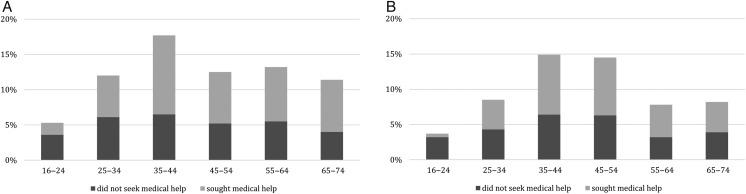
STUDY QUESTION: What is the prevalence of infertility and of help seeking among women and men in Britain? SUMMARY ANSWER: One in eight women and one in ten men aged 16-74 years had experienced infertility, defined by unsuccessfully attempting pregnancy for a year or longer, and little more than half of these people sought medical or professional help. WHAT IS KNOWN ALREADY: Estimates of infertility and help seeking in Britain vary widely and are not easily comparable because of different definitions and study populations. STUDY DESIGN, SIZE, DURATION: A cross-sectional population survey was conducted between 2010 and 2012 with a sample of 15 162 women and men aged 16-74 years. PARTICIPANTS/MATERIALS, SETTING, METHODS: Participants completed the Natsal-3 questionnaire, using computer-assisted personal interviewing (CAPI) and computer-assisted self-interview (CASI). MAIN RESULTS AND THE ROLE OF CHANCE: The reported prevalence of infertility was 12.5% (CI 95% 11.7-13.3) among women and 10.1% (CI 95% 9.2-11.1) among men. Increased prevalence was associated with later cohabitation with a partner, higher socio-economic status and, for those who had a child, becoming parents at older ages. The reported prevalence of help seeking was 57.3% (CI 95% 53.6-61.0) among women and 53.2% (CI 95% 48.1-58.1) among men. Help seekers were more likely to be better educated and in higher status occupations and, among those who had a child, to have become parents later in life. LIMITATIONS, REASONS FOR CAUTION: These data are cross-sectional so it is not possible to establish temporality or infer causality. Self-reported data may be subject to recall bias. WIDER IMPLICATIONS OF THE FINDINGS: The study provides estimates of infertility and help seeking in Britain and the results indicate that the prevalence of infertility is higher among those delaying parenthood. Those with higher educational qualifications and occupational status are more likely to consult with medical professionals for fertility problems than others and these inequalities in help seeking should be considered by clinical practice and public health. STUDY FUNDING/COMPETING INTERESTS: Funding was provided by grants from the Medical Research Council and the Wellcome Trust, with support from the Economic and Social Research Council and the Department of Health. AMJ is a Governor of the Wellcome Trust. Other authors have no competing interests.
Overview
The claims and statistics of this paper haven’t been checked yet.
Run the check — free, no account needed. It reads the open-access text and checks the sources it cites.
Integrity signals
Registry
Cites
Statistics
Figures
Verification
Claims the paper makes
The claims and statistics of this paper haven’t been checked yet.
Run the check — free, no account needed. It reads the open-access text and checks the sources it cites.
Claims other papers make about this one
Each is checked against this paper’s own text: does it say what the citing paper says it does?
The source backs part of the claim, not all of it — or backs it for a different population, condition or comparison.
In the citing paper
“Also, the propensity to seek medical attention among women with pelvic pain and infertility is higher among women from higher compared with lower socio-economic status groups. 29”
From Risk of cardiovascular outcomes among women with endometriosis in the United Kingdom: a retrospective matched cohort study (2021) · cites this paper as [29]
Experimental — accuracy not yet measuredThe check wasn’t confident either way, so it gives no verdict — never disputed.
In the citing paper
“Socio-economic status may be a proxy marker for lifestyle risk factors associated with endometriosis in the UK.”
From Risk of cardiovascular outcomes among women with endometriosis in the United Kingdom: a retrospective matched cohort study (2021) · cites this paper as [29]
Experimental — accuracy not yet measuredThe check wasn’t confident either way, so it gives no verdict — never disputed.
In the citing paper
“Third, in previous observational studies that used surgically confirmed endometriosis as the case definition, the inclusion of non-surgically confirmed endometriosis cases in sensitivity analyses, 29 or in stratified analyses, 23 did not lead to changes in the observed effect estimates.”
From Risk of cardiovascular outcomes among women with endometriosis in the United Kingdom: a retrospective matched cohort study (2021) · cites this paper as [29]
Experimental — accuracy not yet measured
Self-check
Percentages, sums and reported differences re-computed from the paper’s own numbers.
The self-check needs the paper’s full text.
Citations
Cites
The Patient Health Questionnaire-2: Validity of a Two-Item Depression Screener
Kroenke, K., Spitzer, R. L., & Williams, J. B. W. (2003) · Medical Care · doi:10.1097/01.mlr.0000093487.78664.3c · Cited by 6,359 · cited 1×
“Participants were also asked questions that comprise the validated Patient Health Questionnaire-2 (PHQ-2) (Kroenke et al. , 2003), a composite measure of depression experi-encedinthe2weekspriortointerviewandquestionsonsatisfactionwithsex life and relationship in the past year.”
Boivin, J., Bunting, L., Collins, J. A., & Nygren, K. G. (2007) · Human Reproduction · doi:10.1093/humrep/dem046 · Cited by 2,437
Mascarenhas, M., Flaxman, S. R., Boerma, T., Vanderpoel, S., & Stevens, G. A. (2012) · PLoS Medicine · doi:10.1371/journal.pmed.1001356 · Cited by 2,357 · cited 1×
“Infertility is experienced by an estimated 48.5 million couples world-wide (Mascarenhas et al. , 2012) and around 1 in 7 couples in the UK (National Institute for Health and Clinical Excellence, 2013).”
InfluentialZegers-Hochschild, F., Adamson, G. D., de Mouzon, J., Ishihara, O., Mansour, R. T., Nygren, K. G., Sullivan, E. A., & Vanderpoel, S. (2009) · Fertility and Sterility · doi:10.1016/j.fertnstert.2009.09.009 · Cited by 1,895 · cited 1×
“Infertility is defined by the International Committee for Monitoring Assisted Reproductive Technology (ICMART) and WHO as the ‘failure to achieve a pregnancy after 12 months or more of regular unprotected sexual intercourse’ (Zegers-Hochschild et al. , 2009).”
Loren, A. W., Mangu, P. B., Beck, L. N., Brennan, L. V., Magdalinski, A. J., Partridge, A. H., Quinn, G. P., Wallace, W. H., & Oktay, K. (2013) · Journal of Clinical Oncology · doi:10.1200/jco.2013.49.2678 · Cited by 1,615
Population study of causes, treatment, and outcome of infertility.
Hull, M. G., Glazener, C. M., Kelly, N. J., Conway, D. I., Foster, P. A., Hinton, R. A., Coulson, C., Lambert, P. A., Watt, E. M., & Desai, K. M. (1985) · BMJ · doi:10.1136/bmj.291.6510.1693 · Cited by 1,141 · cited 1×
“Hull et al. (1985) Prevalence of infertility and help seeking estimated it to be around one in six while NICE cites estimates of one in seven (National Institute for Health and Clinical Excellence, 2013).”
Why do people postpone parenthood? Reasons and social policy incentives
Mills, M., Rindfuss, R. R., McDonald, P., te Velde, E., & on behalf of the ESHRE Reproduction and Society Task Force (2011) · Human Reproduction Update · doi:10.1093/humupd/dmr026 · Cited by 1,082 · cited 2×
“A marked trend for delaying the timing of first birth has been seen in developed and, more recently, developing countries (Gyimah, 2003; Mathews and Hamilton, 2009; Rosero-Bixby et al. , 2009; Mills et al. , 2011).”
Psychological impact of infertility
Cousineau, T. M., & Domar, A. D. (2007) · Best Practice & Research Clinical Obstetrics & Gynaecology · doi:10.1016/j.bpobgyn.2006.12.003 · Cited by 997 · cited 1×
“Infertility is associated with psychological distress (Cousineau and Domar, 2007; Greil et al., 2011) and patientsfindtheprocessofundergoinginfertilitytreatmentanditsuncer-tainoutcomestressful(Sbaragli etal.”
Standard occupational classification
Surveys (1990) · HMSO eBooks · Cited by 963
Demographic and medical consequences of the postponement of parenthood
Schmidt, L., Sobotka, T., Bentzen, J. G., Nyboe Andersen, A., & on behalf of the ESHRE Reproduction and Society Task Force (2012) · Human Reproduction Update · doi:10.1093/humupd/dmr040 · Cited by 656 · cited 1×
“A large body of literature describes the trend among women in developed countries to delay having children (Schmidt et al. , 2012) and it is proposedthatthischangingfertilitytempoisbecomingaglobalphenom-enon (Rosero-Bixby et al. , 2009; Sobotka, 2010).”
Cited by
Sorted by citations
Sun, H. J., Gong, T., Jiang, Y., Zhang, S., Zhao, Y., & Wu, Q. (2019) · Aging · doi:10.18632/aging.102497 · Cited by 697
“Another cross-sectional population survey showed that the ageadjusted odds of experiencing infertility were significantly higher among females who first gave birth at age 35 or older compared with those who did so before the age of 25 [9].”
BackgroundResultBarratt, C. L. R., Björndahl, L., De Jonge, C. J., Lamb, D. J., Osorio Martini, F., McLachlan, R., Oates, R. D., van der Poel, S., St John, B., Sigman, M., et al. (2017) · Human Reproduction Update · doi:10.1093/humupd/dmx021 · Cited by 505
“Current studies of male infertility often employ cross-sectional population study designs (e.g. Datta et al., 2016 above), or are observational studies of those men who present to infertility clinics.”
BackgroundFarquhar, C. M., Bhattacharya, S., Repping, S., Mastenbroek, S., Kamath, M. S., Marjoribanks, J., & Boivin, J. (2019) · Nature Reviews Disease Primers · doi:10.1038/s41572-018-0058-8 · Cited by 202
Liang, Y., Huang, J., Zhao, Q., Mo, H., Su, Z., Feng, S., Li, S., & Ruan, X. (2024) · Human Reproduction · doi:10.1093/humrep/deae292 · Cited by 204
Genetic abnormalities leading to qualitative defects of sperm morphology or function
Ray, P. F., Toure, A., Metzler‐Guillemain, C., Mitchell, M. J., Arnoult, C., & Coutton, C. (2017) · Clinical Genetics · doi:10.1111/cge.12905 · Cited by 179
Metadata
- Authors
- Datta, J., Palmer, M. J., Tanton, C., Gibson, L. J., Jones, K. G., Macdowall, W., Glasier, A., Sonnenberg, P., Field, N., Mercer, C. H., Johnson, A. M., & Wellings, K.
- Affiliations
- London School of Hygiene & Tropical Medicine (GB)
- Mortimer Market Centre (GB)
- Corresponding author
- Datta, J.
- ORCID
- Venue
- Human Reproduction
- Publisher
- Oxford University Press (OUP)
- Published
- 2016-06-30
- Volume
- 31
- Issue
- 9
- Pages
- 2108-2118
- ISSN
- 0268-1161 (ISSN-L)
- 1460-2350
- PMC
- PMC4991655
- OpenAlex
- W2464514360
- Cited by
- 471
- References
- 69
- Citations by year
- 2026: 28 · 2025: 41 · 2024: 52 · 2023: 62 · 2022: 76 · 2021: 66 · 2020: 70 · 2019: 39 · 2018: 18 · 2017: 16 · 2016: 2
- FWCI
- 33.25
- Type
- journal article
- Language
- en
- Open access
- hybrid
- doi.org
- Licence
- cc-by
- Locations
- Human Reproduction (publishedVersion, cc-by)
- Europe PMC (PubMed Central) (publishedVersion, cc-by)
- PubMed Central (publishedVersion, cc-by)
- PubMed (publishedVersion)
- LSHTM Research Online (London School of Hygiene and Tropical Medicine) (acceptedVersion)
- UCL Discovery (University College London) (submittedVersion)
- HighWire Press Open Archive (submittedVersion)
- Edinburgh Research Explorer (University of Edinburgh) (submittedVersion, cc-by)
- Funders
- Medical Research Council and the Wellcome Trust
- Economic and Social Research Council and Department of Health
- National Institute for Health Research Methods Fellowship
- Topics
- Health Sciences › Medicine › Reproductive Medicine › Reproductive Health and Technologies
- Health Sciences › Medicine › Public Health, Environmental and Occupational Health › Reproductive Health and Contraception
- Social Sciences › Gender Studies › Demographic Trends and Gender Preferences
- Keywords
- infertility prevalence, help-seeking, fertility problems, delayed parenthood, socioeconomic disparities, educational attainment, occupational status, cohabitation, age at first birth, Natsal-3, Great Britain, recall bias
- MeSH terms
- Adolescent, Adult, Aged, Cross-Sectional Studies, Female, United Kingdom, Humans, Infertility, Female, Infertility, Male, Male, Middle Aged, Patient Acceptance of Health Care, Surveys and Questionnaires, Prevalence, Young Adult
About these checks
Registry, retraction, Cites and statistics results are computed, not judged, with one exception: a printed reference that no index lists is read once by a model before it counts as a citation error. Claims are extracted by a model and kept only when their quote appears verbatim in the text; each cited source is then checked, with a model’s help, for whether it says what the claim relies on. Those verdicts can be wrong — read the claim’s quote and the cited source before relying on one.
Statistics and arithmetic are recomputed, not judged.
Confidence bands are shown only for fields calibrated on our annotated test set. None is calibrated yet, so no band is shown.
What counts as a claim ›How we measure confidence ›How we check this ›
Are you an author, or do you see a problem with this page? Request a review
