

Antimicrobial use in hospitalized patients: a multicentre point prevalence survey across seven hospitals in Ghana
Open accessThe DOI matches its Crossref record; 24 of the 24 references it cites were found in a registry or an index; none of the 57 sources its claims cite is checked for support yet.
Abstract
Background: Antimicrobial resistance (AMR) is a public health crisis of global proportions. Data is required to understand the local drivers of antimicrobial resistance and support decision-making processes including implementation of appropriate antimicrobial stewardship strategies. Objectives: To measure antimicrobial usage in hospitals in Ghana. Methods: Using the Global Point Prevalence instruments and processes, we conducted point prevalence surveys across AMR surveillance sentinel hospitals in Ghana, between September and December 2019. Hospital records of all inpatients on admission at 0800 hours on a specific day were reviewed for antimicrobial use at the time of the survey. Data on antibiotic use, including indication for use and quality of prescribing were recorded. Results: Overall prevalence of antibiotic use across the sentinel sites was 54.9% (n = 1591/2897), ranging between 48.4% (n = 266/550) and 67.2% (n = 82/122). The highest prevalence of antibiotic use 89.3% (n = 25/28) was observed in adult ICUs. The average number of antibiotics prescribed per patient was 1.7 (n = 1562/2620), with the majority (66%, n = 728/2620) administered via the parenteral route. The five most-commonly used antibiotics were metronidazole (20.6%, n = 541/2620), cefuroxime (12.9%, n = 338/2620), ceftriaxone (11.8%, n = 310/2620), amoxicillin/clavulanic acid (8.8%, n = 231/2620) and ciprofloxacin (7.8%, n = 204/2620). The majority (52.2%; n = 1367/2620) of antibiotics were prescribed to treat an infection, whilst surgical prophylaxis accounted for 26.1% (n = 684/2620). Conclusions: We observed a high use of antibiotics including metronidazole and cephalosporins at the participating hospitals. Most antibiotics were empirically prescribed, with low use of microbiological cultures. High usage of third-generation cephalosporins especially for community-acquired infections offers an opportunity for antibiotic stewardship interventions.
Overview
CoChat Summary
TL;DR
In a 2019 multicentre point prevalence survey across seven Ghanaian hospitals, about half of inpatients were receiving antimicrobials, most commonly metronidazole and cephalosporins, and most treatment prescriptions were empirical. High prophylactic use and poor documentation of prescribing rationale and stop/review dates identify key antimicrobial stewardship targets.
Key findings
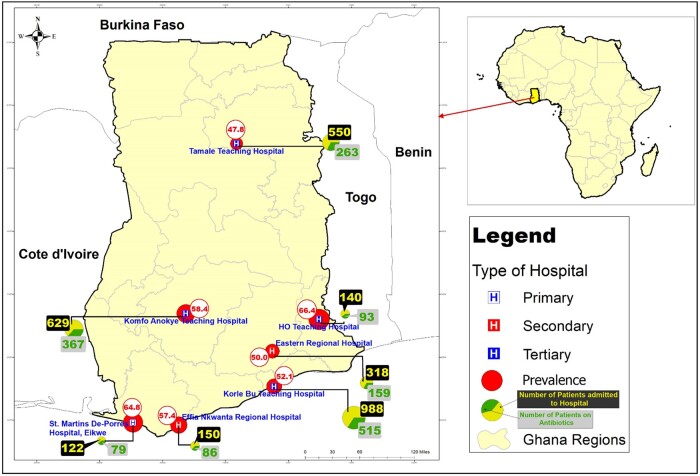
- Among 2897 inpatients, 1591 (54.9%) received anti-infective agents and 1562 (53.9%) received at least one systemic antibiotic; site prevalence ranged from 47.8% (Tamale Teaching Hospital) to 66.4% (Ho Teaching Hospital) in the results, and was highest in adult ICU at 89.3% (25/28).
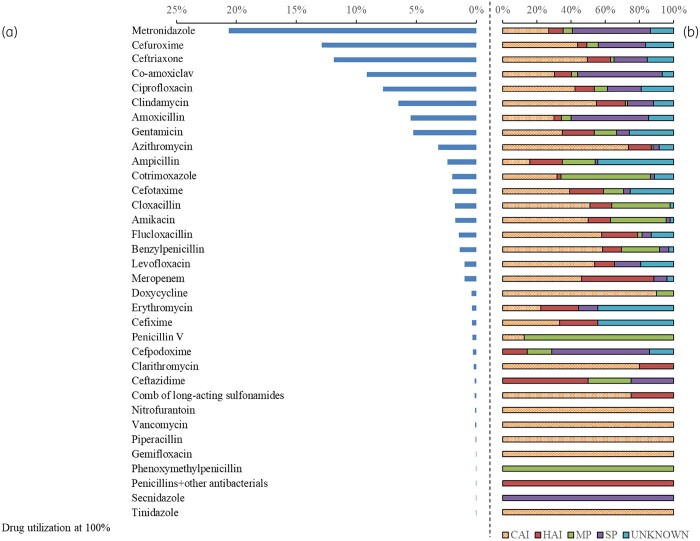
- The average number of antibiotics per treated patient was 1.7 (2620/1562), and 66% (1728/2620) were given parenterally. The five most common antibiotics were metronidazole 20.6% (541/2620), cefuroxime 12.9% (338/2620), ceftriaxone 11.8% (310/2620), amoxicillin/clavulanic acid 8.8% (231/2620), and ciprofloxacin 7.8% (204/2620).
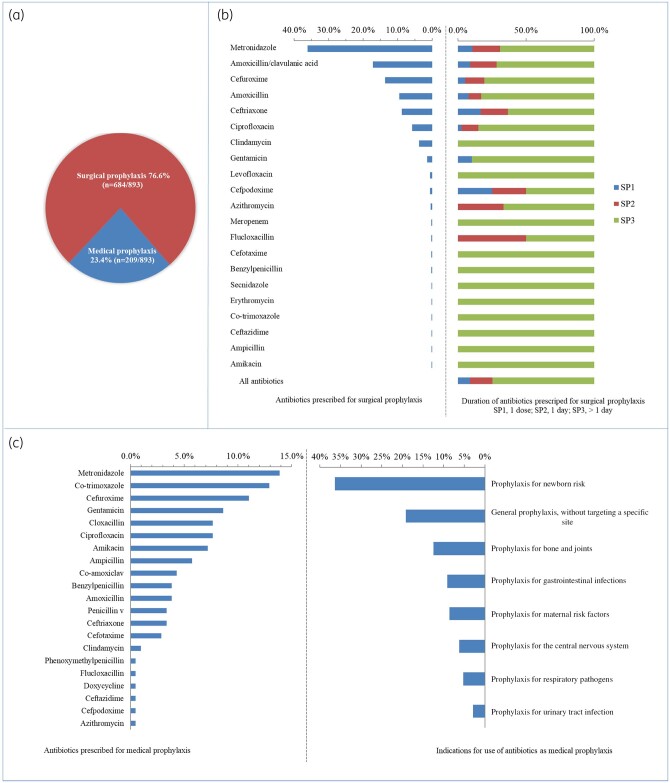
- Indications were treatment of infection for 52.2% (1367/2620), prophylaxis for 34.1% (893), and no documented indication for 13.7% (360); surgical prophylaxis accounted for 26.1% (684/2620), and 74.7% (511/684) of surgical prophylaxis was given for more than 1 day.
- Quality indicators: approximately 96% (1314/1367) of treatment prescriptions were empirical; 53 guided treatments targeted at least one MDR organism; 48.2% (1262) had a documented reason and 46.7% (1226) had a documented stop/review date.
Methods
- Multicentre observational point prevalence survey using Global PPS instruments and processes across seven Ghana AMR surveillance sentinel hospitals (four tertiary, two secondary, one primary), September–December 2019.
- All inpatients on a ward at 0800 on the survey day, admitted for more than 24 h, were eligible; day-care patients and stays under 24 h were excluded. Records were reviewed within 12 h for current systemic antimicrobial use; all wards in a hospital were surveyed once, with data collection not exceeding 4 days per hospital. A total of 2897 patients in 55 wards were included.
- Data were entered on the Global PPS platform, exported to Excel, and analysed in SPSS version 21. Categorical data were reported as frequency and percentage; continuous data as mean/median. Prevalence of antibiotic use was defined as patients receiving at least one antibiotic divided by total patients on admission; drug utilization 100% (DU100%) was also used.
Limitations
- The paper states that the data may not be representative for most of Ghana; private healthcare facilities were not surveyed, primary hospitals were underrepresented, overall rates are averages, institutional factors were not controlled for, and poor record-keeping may have led to underestimation of antimicrobial use.
- The text makes evident some internal inconsistencies between the abstract and results, including prevalence figures (54.9% vs 53.9%), parenteral administration counts (n = 728 vs n = 1728), and site prevalence ranges (48.4–67.2% vs 47.8–66.4%), which limit precision.
Model-written summary. Check it against the paper before relying on it.
Integrity signals
Registry
Cites
Statistics
Figures
Verification
Claims the paper makes
0 Valid · 0 Not valid · 28 Not checked · 78 Own results and interpretations
A result the paper reports from its own data — it cites no other source for it, so there is none to check. The quote shows it is in the paper.
In the paper
“High usage of third-generation cephalosporins especially for community-acquired infections offers an opportunity for antibiotic stewardship interventions.”
§ Antimicrobial use in hospitalized patients: a multicentre point prevalence survey across seven hospitals in Ghana > Abstract > Conclusions
plain- Asserted: passes — The authors put it forward as true.
- Checkable: passes — It can be checked against evidence.
- Load-bearing: passes — The paper’s conclusions depend on it.
- Based: passes — The paper gives a reason why it holds.
A result the paper reports from its own data — it cites no other source for it, so there is none to check. The quote shows it is in the paper.
In the paper
“The average number of antibiotics prescribed per patient was 1.7 (n = 1562/2620), with the majority (66%, n = 728/2620) administered via the parenteral route.”
- Also stated in: § Prevalence of antibiotic use · plain
“The average number of antibiotics per patient was 1 : 1.7 (n = 2620 antibiotics/1562 patients).”
§ Antimicrobial use in hospitalized patients: a multicentre point prevalence survey across seven hospitals in Ghana > Abstract > Results
plainn = 1,562- Asserted: passes — The authors put it forward as true.
- Checkable: passes — It can be checked against evidence.
- Load-bearing: unclear — It is unclear whether the paper’s conclusions depend on it.
- Based: passes — The paper gives a reason why it holds.
- Also stated in: § Prevalence of antibiotic use · plain
A result the paper reports from its own data — it cites no other source for it, so there is none to check. The quote shows it is in the paper.
In the paper
“The highest prevalence of antibiotic use 89.3% (n = 25/28) was observed in adult ICUs.”
- Also stated in: § Prevalence of antibiotic use · plain
“In addition, the use of antibiotics varied by speciality (from 45.8% in paediatric intensive care to 89.3% in adult intensive care).”
§ Antimicrobial use in hospitalized patients: a multicentre point prevalence survey across seven hospitals in Ghana > Abstract > Results
plainn = 25- Asserted: passes — The authors put it forward as true.
- Checkable: passes — It can be checked against evidence.
- Load-bearing: unclear — It is unclear whether the paper’s conclusions depend on it.
- Based: passes — The paper gives a reason why it holds.
- Also stated in: § Prevalence of antibiotic use · plain
A result the paper reports from its own data — it cites no other source for it, so there is none to check. The quote shows it is in the paper.
In the paper
“The majority (52.2%; n = 1367/2620) of antibiotics were prescribed to treat an infection, whilst surgical prophylaxis accounted for 26.1% (n = 684/2620).”
- Also stated in: § Drug utilization at 100% (DU100%) · plain
“The majority of antibiotic prescriptions were used for treatment of infections (52.2%, n = 1367/2620), prophylaxis accounted for 34.1% (n = 893), and 13.7% (n = 360) of the prescribed antibiotics had no documented indications.”
§ Antimicrobial use in hospitalized patients: a multicentre point prevalence survey across seven hospitals in Ghana > Abstract > Results
plainn = 1,367- Asserted: passes — The authors put it forward as true.
- Checkable: passes — It can be checked against evidence.
- Load-bearing: unclear — It is unclear whether the paper’s conclusions depend on it.
- Based: passes — The paper gives a reason why it holds.
- Also stated in: § Drug utilization at 100% (DU100%) · plain
A result the paper reports from its own data — it cites no other source for it, so there is none to check. The quote shows it is in the paper.
In the paper
“The five most-commonly used antibiotics were metronidazole (20.6%, n = 541/2620), cefuroxime (12.9%, n = 338/2620), ceftriaxone (11.8%, n = 310/2620), amoxicillin/clavulanic acid (8.8%, n = 231/2620) and ciprofloxacin (7.8%, n = 204/2620).”
- Also stated in: § Drug utilization at 100% (DU100%) · plain
“The five most commonly prescribed antibiotics were metronidazole (n = 20.6%, n = 541/2620), cefuroxime (12.9%, n = 338/2620), ceftriaxone (11.8%, n = 310/2620), amoxicillin/clavulanic acid (8.8%, n = 231/2620), and ciprofloxacin (7.8%, n = 204/2620).”
§ Antimicrobial use in hospitalized patients: a multicentre point prevalence survey across seven hospitals in Ghana > Abstract > Results
plainn = 541- Asserted: passes — The authors put it forward as true.
- Checkable: passes — It can be checked against evidence.
- Load-bearing: unclear — It is unclear whether the paper’s conclusions depend on it.
- Based: passes — The paper gives a reason why it holds.
- Also stated in: § Drug utilization at 100% (DU100%) · plain
44 more claims
Create a free account to see all 106 claims and to verify the 40 references still open.
- It may state two separate claims as one. 32
- Probably not a substantial claim. 42
Self-check
Percentages, sums and reported differences re-computed from the paper’s own numbers.
Each contradiction between two passages listed here was confirmed by an independent check.
Rated major: it would touch a result — a value a result rests on, reported and recomputed p-values on opposite sides of the significance level, two passages that conflict with no sign which is right, or a cited work retracted before this paper was published.
In the paper
§ Antimicrobial use in hospitalized patients: a multicentre point prevalence survey across seven hospitals in Ghana > Results > Overview of quality of antibiotic prescriptions
“About 5.2% (n = 137) of the antibiotic prescriptions were based on biomarkers”
§ Antimicrobial use in hospitalized patients: a multicentre point prevalence survey across seven hospitals in Ghana > Results > Overview of quality of antibiotic prescriptions
“| Total (n = 2897) | 2875 | 2620 (91.1) | 7 (0.5) | 6 (0.4) | 156 (11.4) | 169 (12.4)”
Rated minor: it would not touch a result — a value no result rests on, a p-value that stays on the same side of the significance level, or a conflict that is clerical, resolved elsewhere in the paper, or outside its own findings.
In the paper
§ Antimicrobial use in hospitalized patients: a multicentre point prevalence survey across seven hospitals in Ghana > Results > Antibiotic prescription by type of infection
“| Surgical | 684 | (26.1) | MTZ | 247 | (36.1) | AMC | 113 | (16.5) | CXM | 93 | (13.6) | AMX | 65 | (9.5) | CTO | 60 | (8.8) |”
§ Antimicrobial use in hospitalized patients: a multicentre point prevalence survey across seven hospitals in Ghana > Results > Antibiotic prescription by type of infection
“| Prophylaxis | 893 | (34.1) | MTZ | 276 | (30.9) | AMC | 121 | (13.5) | CXM | 116 | (13.0) | AMX | 73 | (8.2) | CTO | 57 | (6.4) |”
Rated minor: it would not touch a result — a value no result rests on, a p-value that stays on the same side of the significance level, or a conflict that is clerical, resolved elsewhere in the paper, or outside its own findings.
In the paper
“The average number of antibiotics prescribed per patient was 1.7 (n = 1562/2620)”
§ Antimicrobial use in hospitalized patients: a multicentre point prevalence survey across seven hospitals in Ghana > Abstract > Results
Reported 1.7 · recomputed 0.596183
Rated minor: it would not touch a result — a value no result rests on, a p-value that stays on the same side of the significance level, or a conflict that is clerical, resolved elsewhere in the paper, or outside its own findings.
In the paper
“the majority (66%, n = 728/2620) administered via the parenteral route”
§ Antimicrobial use in hospitalized patients: a multicentre point prevalence survey across seven hospitals in Ghana > Abstract > Results
Reported 66 · recomputed 27.78626
Rated minor: it would not touch a result — a value no result rests on, a p-value that stays on the same side of the significance level, or a conflict that is clerical, resolved elsewhere in the paper, or outside its own findings.
In the paper
§ Antimicrobial use in hospitalized patients: a multicentre point prevalence survey across seven hospitals in Ghana > Abstract > Results
“Overall prevalence of antibiotic use across the sentinel sites was 54.9% (n = 1591/2897)”
§ Antimicrobial use in hospitalized patients: a multicentre point prevalence survey across seven hospitals in Ghana > Results > Prevalence of antibiotic use
“Overall, 1562/2897 (53.9%) patients on admission received at least one antibiotic for systemic use on the day of the survey.”
4 more findings
Create a free account to see every finding of this check.
Citations
Cites
Antimicrobial resistance : global report on surveillance: 2014
de la Salud, O. M. (2014) · Virtual Defense Library (Ministerio de Defensa) · Cited by 4,511
Versporten, A., Zarb, P., Caniaux, I., Gros, M.-F., Drapier, N., Miller, M., Jarlier, V., Nathwani, D., Goossens, H., Koraqi, A., et al. (2018) · The Lancet Global Health · doi:10.1016/s2214-109x(18)30186-4 · Cited by 671
Hsia, Y., Lee, B. R., Versporten, A., Yang, Y., Bielicki, J., Jackson, C., Newland, J., Goossens, H., Magrini, N., Sharland, M., et al. (2019) · The Lancet Global Health · doi:10.1016/s2214-109x(19)30071-3 · Cited by 350
(2019) · JAC-Antimicrobial Resistance · doi:10.1093/jacamr/dlz072 · Cited by 218
Clinical bacteriology in low-resource settings: today's solutions
Ombelet, S., Ronat, J.-B., Walsh, T., Yansouni, C. P., Cox, J., Vlieghe, E., Martiny, D., Semret, M., Vandenberg, O., Jacobs, J., et al. (2018) · The Lancet Infectious Diseases · doi:10.1016/s1473-3099(18)30093-8 · Cited by 203
Resistance to antimicrobial drugs in Ghana
Donkor, E., & Newman, M. (2011) · Infection and Drug Resistance · doi:10.2147/idr.s21769 · Cited by 164
Self-citationSartelli, M., C. Hardcastle, T., Catena, F., Chichom-Mefire, A., Coccolini, F., Dhingra, S., Haque, M., Hodonou, A., Iskandar, K., Labricciosa, F. M., et al. (2020) · Antibiotics · doi:10.3390/antibiotics9080497 · Cited by 149
Obeng-Nkrumah, N., Twum-Danso, K., Krogfelt, K. A., & Newman, M. J. (2013) · The American Society of Tropical Medicine and Hygiene · doi:10.4269/ajtmh.12-0642 · Cited by 127
Self-citationSituational analysis of antibiotic use and resistance in Ghana: policy and regulation
Yevutsey, S. K., Buabeng, K. O., Aikins, M., Anto, B. P., Biritwum, R. B., Frimodt-Møller, N., & Gyansa-Lutterodt, M. (2017) · BMC Public Health · doi:10.1186/s12889-017-4910-7 · Cited by 126
Antibiotic use in a tertiary healthcare facility in Ghana: a point prevalence survey
Labi, A.-K., Obeng-Nkrumah, N., Nartey, E. T., Bjerrum, S., Adu-Aryee, N. A., Ofori-Adjei, Y. A., Yawson, A. E., & Newman, M. J. (2018) · Antimicrobial Resistance & Infection Control · doi:10.1186/s13756-018-0299-z · Cited by 97
Self-citation
Research works printed but not linked: 3
- O’Neill J. Tackling Drug-Resistant Infections Globally. 2014. https://amr-review.org/Publications.html.
- WHO Collaborating Centre for Drug Statistics Methodology. Guidelines for ATC Classification and DDD Assignment 2013. Sixteenth Edition. Oslo, 2012.
- WHO. Antimicrobial Stewardship Programmes in Health-Care Facilities in Low- and Middle-Income Countries: A WHO Practical Toolkit. 2019. https://apps.who.int/iris/handle/10665/329404. PMC8210188 34222945
Cited by
Godman, B., Egwuenu, A. J., Wesangula, E., Schellack, N., Kalungia, A. C., Tiroyakgosi, C., Kgatlwane, J., Mwita, J. C., Okwen, P., Niba, L. L., et al. (2022) · Expert Opinion on Drug Safety · doi:10.1080/14740338.2022.2106368 · Cited by 162
Saleem, Z., Godman, B., Cook, A., Khan, M. A., Campbell, S., Seaton, R. A., Siachalinga, L., Haseeb, A., Amir, A., Kurdi, A. B., et al. (2022) · Antibiotics · doi:10.3390/antibiotics11121824 · Cited by 103
Ajayi, A. O., Odeyemi, A. T., Akinjogunla, O. J., Adeyeye, A. B., & Ayo-Ajayi, I. (2024) · Infection Ecology & Epidemiology · doi:10.1080/20008686.2024.2312953 · Cited by 87
Saleem, Z., Sheikh, S., Godman, B., Haseeb, A., Afzal, S., Qamar, M. U., Imam, M. T., Abuhussain, S. S. A., & Sharland, M. (2025) · JAC-Antimicrobial Resistance · doi:10.1093/jacamr/dlaf031 · Cited by 73
Abubakar, U., & Salman, M. (2023) · Journal of Racial and Ethnic Health Disparities · doi:10.1007/s40615-023-01610-9 · Cited by 50
Metadata
- Authors
- Labi, A.-K., Obeng-Nkrumah, N., Dayie, N. T. K. D., Egyir, B., Sampane-Donkor, E., Newman, M. J., & Opintan, J. A.
- Affiliations
- University of Ghana (GH)
- Department of Medical Laboratory Sciences, School of Biomedical and Allied Health Sciences, College of Health Sciences, University of Ghana, Accra, Ghana
- Department of Medical Microbiology, University of Ghana Medical School, College of Health Sciences, University of Ghana, Accra, Ghana
- ORCID
- Venue
- JAC-Antimicrobial Resistance
- Publisher
- Oxford University Press (OUP)
- Published
- 2021-07-12
- Volume
- 3
- Issue
- 3
- Pages
- dlab087-dlab087
- ISSN
- 2632-1823 (ISSN-L)
- PMC
- PMC8275021
- OpenAlex
- W3182264350
- Semantic Scholar
- 62ae6d0c74e90974a50095a0bda00e52684700b7
- Cited by
- 41
- References
- 24
- Citations by year
- 2026: 6 · 2025: 5 · 2024: 12 · 2023: 6 · 2022: 12
- FWCI
- 2.27
- Type
- journal article
- Language
- en
- Open access
- gold
- doi.org
- Licence
- Locations
- JAC-Antimicrobial Resistance (publishedVersion, cc-by)
- PubMed Central (publishedVersion, cc-by)
- PubMed (publishedVersion)
- Funders
- UK government through the Fleming Fund
- Topics
- Health Sciences › Medicine › Infectious Diseases › Antibiotic Use and Resistance
- Health Sciences › Medicine › Microbiology (medical) › Antibiotic Resistance in Bacteria
- Health Sciences › Medicine › Surgery › Surgical site infection prevention
- Keywords
- antimicrobial use, hospitalized patients, antimicrobial resistance, point prevalence survey, antimicrobial stewardship, antibiotic prescribing quality, perioperative antibiotic prophylaxis, third-generation cephalosporins, metronidazole, empirical prescribing, microbial cultivation, intensive care unit, community-acquired infections, parenteral antibiotics, sentinel hospitals, antimicrobial resistance surveillance
About these checks
Registry, retraction, Cites and statistics results are computed, not judged, with one exception: a printed reference that no index lists is read once by a model before it counts as a citation error. Claims are extracted by a model and kept only when their quote appears verbatim in the text; each cited source is then checked, with a model’s help, for whether it says what the claim relies on. Those verdicts can be wrong — read the claim’s quote and the cited source before relying on one.
A language model drew the claims from the paper on 2026-11-23, under version 3 of the claim definition (model deepseek-v4.1-flash, prompt extract-v3).
A second model labelled each claim on 2026-11-23 (model jev-1.13-20260917, definition revision gold-guideline-v0.2).
Statistics and arithmetic are recomputed, not judged.
Confidence bands are shown only for fields calibrated on our annotated test set. None is calibrated yet, so no band is shown.
What counts as a claim ›How we measure confidence ›How we check this ›
Are you an author, or do you see a problem with this page? Request a review
Data sources
Bibliographic data: Semantic Scholar, OpenAlex, Crossref.
Contains information from the Semantic Scholar Academic Graph Datasets, made available under the ODC Attribution License (ODC-BY 1.0).
Semantic Scholar’s data is described in: Kinney, R., et al. (2023). The Semantic Scholar Open Data Platform. arXiv:2301.10140.
