

The MetaCyc database of metabolic pathways and enzymes and the BioCyc collection of pathway/genome databases
Open accessThe DOI matches its Crossref record; 50 of the 51 references it cites were found in a registry or an index.
Abstract
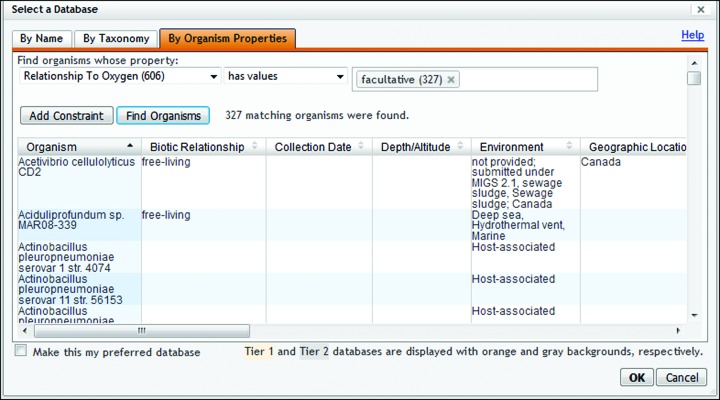
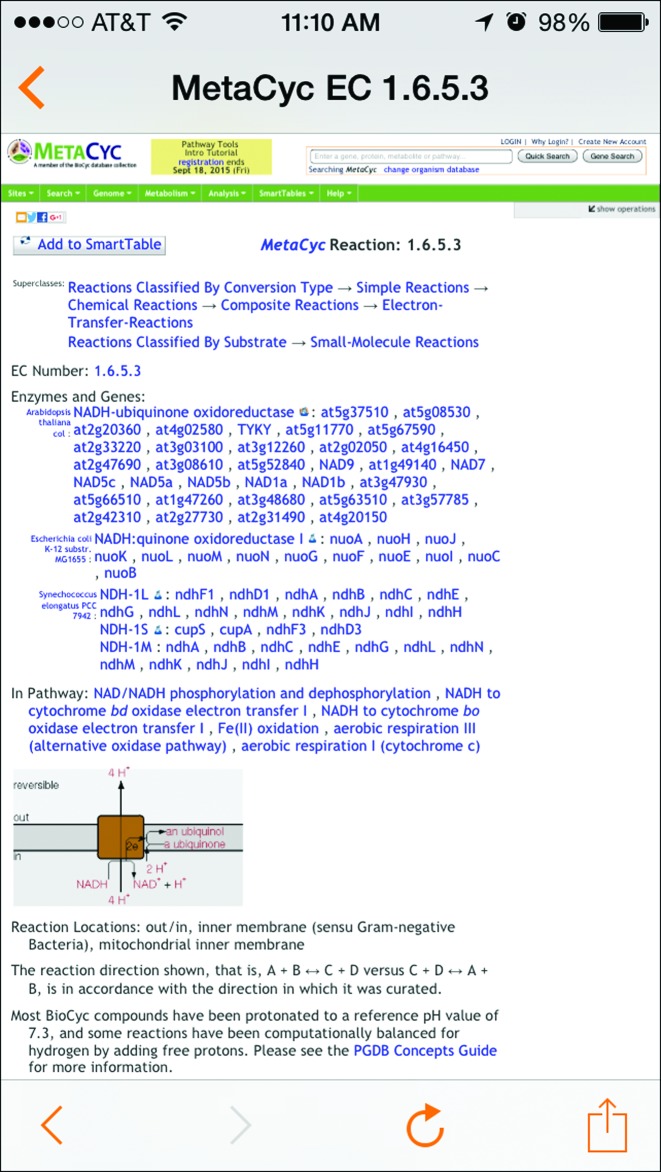
The MetaCyc database (MetaCyc.org) is a freely accessible comprehensive database describing metabolic pathways and enzymes from all domains of life. The majority of MetaCyc pathways are small-molecule metabolic pathways that have been experimentally determined. MetaCyc contains more than 2400 pathways derived from >46,000 publications, and is the largest curated collection of metabolic pathways. BioCyc (BioCyc.org) is a collection of 5700 organism-specific Pathway/Genome Databases (PGDBs), each containing the full genome and predicted metabolic network of one organism, including metabolites, enzymes, reactions, metabolic pathways, predicted operons, transport systems, and pathway-hole fillers. The BioCyc website offers a variety of tools for querying and analyzing PGDBs, including Omics Viewers and tools for comparative analysis. This article provides an update of new developments in MetaCyc and BioCyc during the last two years, including addition of Gibbs free energy values for compounds and reactions; redesign of the primary gene/protein page; addition of a tool for creating diagrams containing multiple linked pathways; several new search capabilities, including searching for genes based on sequence patterns, searching for databases based on an organism's phenotypes, and a cross-organism search; and a metabolite identifier translation service.
Overview
The claims and statistics of this paper haven’t been checked yet.
Free: it reads the open-access text and checks the first 5 claims that cite a source we can check. Create a free account to check every claim.
Integrity signals
Registry
Cites
Statistics
Figures
Verification
Claims the paper makes
The claims and statistics of this paper haven’t been checked yet.
Free: it reads the open-access text and checks the first 5 claims that cite a source we can check. Create a free account to check every claim.
Self-check
Percentages, sums and reported differences re-computed from the paper’s own numbers.
The self-check needs the paper’s full text.
Citations
Cites
Gene Ontology: tool for the unification of biology
Ashburner, M., Ball, C. A., Blake, J. A., Botstein, D., Butler, H., Cherry, J. M., Davis, A. P., Dolinski, K., Dwight, S. S., Eppig, J. T., et al. (2000) · Nature Genetics · doi:10.1038/75556 · Cited by 43,206
Database resources of the National Center for Biotechnology Information: update
Wheeler, D. L. (2004) · Nucleic Acids Research · doi:10.1093/nar/gkh073 · Cited by 10,641
Complete genome sequence of Pseudomonas aeruginosa PAO1, an opportunistic pathogen
Stover, C. K., Pham, X. Q., Erwin, A. L., Mizoguchi, S. D., Warrener, P., Hickey, M. J., Brinkman, F. S. L., Hufnagle, W. O., Kowalik, D. J., Lagrou, M., et al. (2000) · Nature · doi:10.1038/35023079 · Cited by 4,573
Data, information, knowledge and principle: back to metabolism in KEGG
Kanehisa, M., Goto, S., Sato, Y., Kawashima, M., Furumichi, M., & Tanabe, M. (2014) · Nucleic Acids Research · doi:10.1093/nar/gkt1076 · Cited by 3,092
COBRApy: COnstraints-Based Reconstruction and Analysis for Python
Ebrahim, A., Lerman, J. A., Palsson, B. O., & Hyduke, D. R. (2013) · BMC Systems Biology · doi:10.1186/1752-0509-7-74 · Cited by 1,378 · cited 1×
“A similar technique has also been implemented by the COBRA (COnstraints-Based Reconstruction and Analysis) group (16).”
MethodCaspi, R., Altman, T., Billington, R., Dreher, K., Foerster, H., Fulcher, C. A., Holland, T. A., Keseler, I. M., Kothari, A., Kubo, A., et al. (2014) · Nucleic Acids Research · doi:10.1093/nar/gkt1103 · Cited by 1,204
Self-citationSCIP: solving constraint integer programs
Achterberg, T. (2009) · Mathematical Programming Computation · doi:10.1007/s12532-008-0001-1 · Cited by 1,167
The minimum information about a genome sequence (MIGS) specification
Field, D., Garrity, G., Gray, T., Morrison, N., Selengut, J., Sterk, P., Tatusova, T., Thomson, N., Allen, M. J., Angiuoli, S. V., et al. (2008) · Nature Biotechnology · doi:10.1038/nbt1360 · Cited by 1,141
Bairoch, A. (2000) · Nucleic Acids Research · doi:10.1093/nar/28.1.304 · Cited by 1,129
Varma, A., & Palsson, B. O. (1994) · Applied and Environmental Microbiology · doi:10.1128/aem.60.10.3724-3731.1994 · Cited by 1,051
Cited by
Szklarczyk, D., Gable, A. L., Lyon, D., Junge, A., Wyder, S., Huerta-Cepas, J., Simonovic, M., Doncheva, N. T., Morris, J. H., Bork, P., et al. (2019) · Nucleic Acids Research · doi:10.1093/nar/gky1131 · Cited by 17,749
“The database channel is based on manually curated interaction records assembled by expert curators, at KEGG (41), Reactome (50), BioCyc (51) and Gene Ontology (52), as well as legacy datasets from PID and BioCarta.”
MethodPICRUSt2 for prediction of metagenome functions
Douglas, G. M., Maffei, V. J., Zaneveld, J. R., Yurgel, S. N., Brown, J. R., Taylor, C. M., Huttenhower, C., & Langille, M. G. I. (2020) · Nature Biotechnology · doi:10.1038/s41587-020-0548-6 · Cited by 6,709
The Reactome pathway Knowledgebase
Fabregat, A., Sidiropoulos, K., Garapati, P., Gillespie, M., Hausmann, K., Haw, R., Jassal, B., Jupe, S., Korninger, F., McKay, S., et al. (2016) · Nucleic Acids Research · doi:10.1093/nar/gkv1351 · Cited by 5,605
Gut microbiome modulates response to anti-PD-1 immunotherapy in melanoma patients
Gopalakrishnan, V., Spencer, C. N., Nezi, L., Reuben, A., Andrews, M. C., Karpinets, T. V., Prieto, P. A., Vicente, D., Hoffman, K., Wei, S. C., et al. (2018) · Science · doi:10.1126/science.aan4236 · Cited by 4,812
STRING v9.1: protein-protein interaction networks, with increased coverage and integration
Franceschini, A., Szklarczyk, D., Frankild, S., Kuhn, M., Simonovic, M., Roth, A., Lin, J., Minguez, P., Bork, P., von Mering, C., et al. (2012) · Nucleic Acids Research · doi:10.1093/nar/gks1094 · Cited by 4,398
Metadata
- Authors
- Caspi, R., Billington, R., Ferrer, L., Foerster, H., Fulcher, C. A., Keseler, I. M., Kothari, A., Krummenacker, M., Latendresse, M., Mueller, L. A., Ong, Q., Paley, S., Subhraveti, P., Weaver, D. S., & Karp, P. D.
- Affiliations
- SRI International (US)
- Consejo Nacional de Investigaciones Científicas y Técnicas (AR)
- Boyce Thompson Institute (US)
- Corresponding author
- Karp, Peter D.
- ORCID
- Venue
- Nucleic Acids Research
- Publisher
- Oxford University Press (OUP)
- Published
- 2015-11-02
- Volume
- 44
- Issue
- D1
- Pages
- D471-D480
- ISSN
- 0305-1048 (ISSN-L)
- 1362-4962
- PMC
- PMC4702838
- OpenAlex
- W2128601422
- Cited by
- 3,395
- References
- 51
- Citations by year
- 2026: 61 · 2025: 111 · 2024: 170 · 2023: 160 · 2022: 172 · 2021: 204 · 2020: 235 · 2019: 248 · 2018: 292 · 2017: 314 · 2016: 251 · 2015: 248
- FWCI
- 160.60
- Type
- journal article
- Language
- en
- Open access
- gold
- doi.org
- Locations
- Nucleic Acids Research (publishedVersion, cc-by)
- Europe PMC (PubMed Central) (publishedVersion, cc-by)
- PubMed Central (publishedVersion, cc-by)
- PubMed (publishedVersion)
- Americanae (AECID Library) (submittedVersion, cc-by-nc-sa)
- HighWire Press Open Archive (submittedVersion)
- LA Referencia (Red Federada de Repositorios Institucionales de Publicaciones Científicas) (submittedVersion, cc-by-nc-sa)
- Greater South Information System
- Funders
- National Institutes of Health
- National Institute of General Medical Sciences (GM080746, GM077678, GM75742, R01GM080746, U24GM077678, R01GM075742)
- Topics
- Life Sciences › Biochemistry, Genetics and Molecular Biology › Molecular Biology › Bioinformatics and Genomic Networks
- Life Sciences › Biochemistry, Genetics and Molecular Biology › Molecular Biology › Microbial Metabolic Engineering and Bioproduction
- Life Sciences › Biochemistry, Genetics and Molecular Biology › Molecular Biology › Genomics and Phylogenetic Studies
- Keywords
- MetaCyc, BioCyc, metabolic pathways, metabolic enzymes, pathway/genome databases, genome-scale metabolic networks, Gibbs free energy, pathway diagrams, comparative genomics, metabolite identifiers, database curation
- MeSH terms
- Electron Transport, Enzymes, Software, Genome, Internet, Databases, Genetic, Metabolic Networks and Pathways, Databases, Chemical
About these checks
Registry, retraction, Cites and statistics results are computed, not judged, with one exception: a printed reference that no index lists is read once by a model before it counts as a citation error. Claims are extracted by a model and kept only when their quote appears verbatim in the text; each cited source is then checked, with a model’s help, for whether it says what the claim relies on. Those verdicts can be wrong — read the claim’s quote and the cited source before relying on one.
Statistics and arithmetic are recomputed, not judged.
Confidence bands are shown only for fields calibrated on our annotated test set. None is calibrated yet, so no band is shown.
What counts as a claim ›How we measure confidence ›How we check this ›
Are you an author, or do you see a problem with this page? Request a review
Data sources
Bibliographic data: Semantic Scholar, OpenAlex, Crossref.
Contains information from the Semantic Scholar Academic Graph Datasets, made available under the ODC Attribution License (ODC-BY 1.0).
Semantic Scholar’s data is described in: Kinney, R., et al. (2023). The Semantic Scholar Open Data Platform. arXiv:2301.10140.
