

4D spinless topological insulator in a periodic electric circuit
Open accessThe DOI matches its Crossref record; 62 of the 62 references it cites were found in a registry or an index.
Abstract
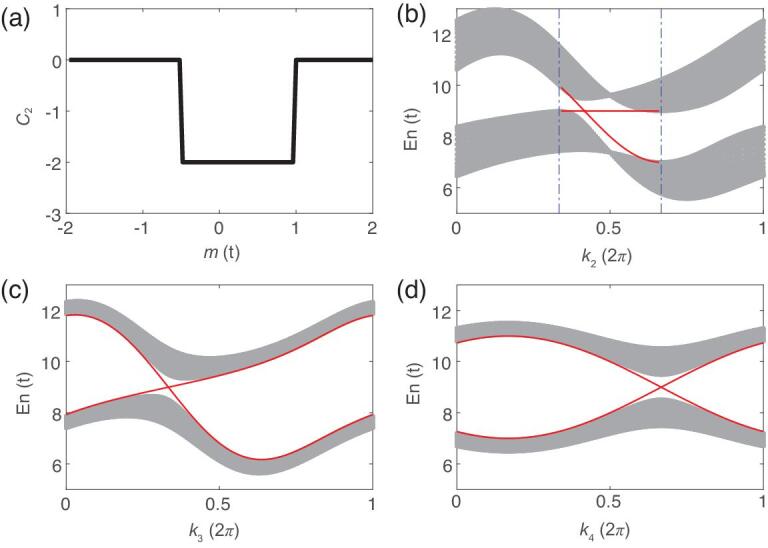
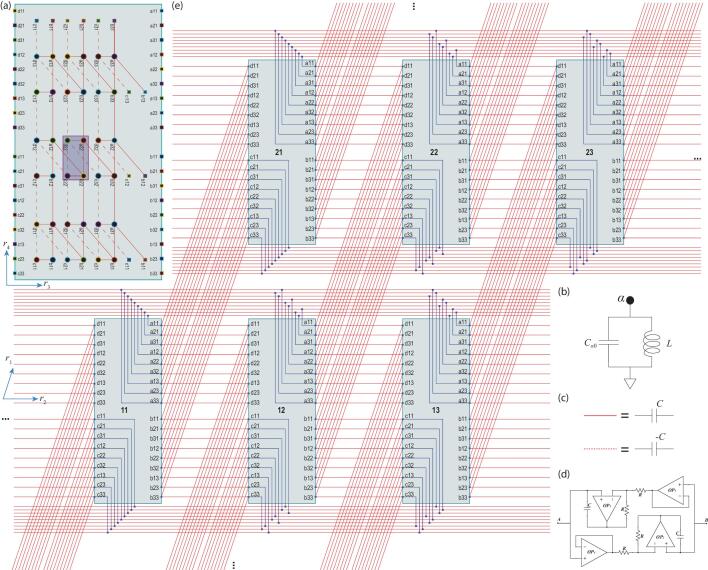
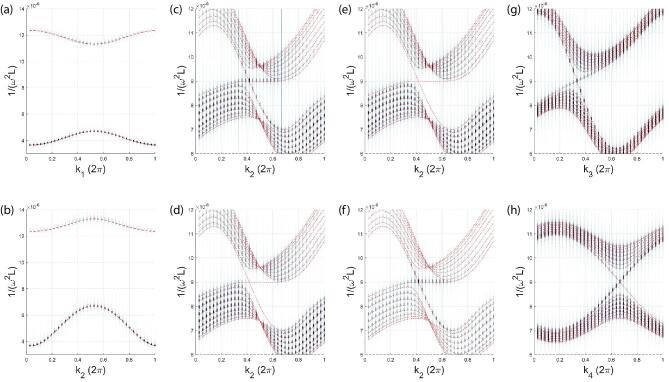
According to the mathematical classification of topological band structures, there exist a number of fascinating topological states in dimensions larger than three with exotic boundary phenomena and interesting topological responses. While these topological states are not accessible in condensed matter systems, recent works have shown that synthetic systems, such as photonic crystals or electric circuits, can realize higher-dimensional band structures. Here, we argue that, because of its symmetry properties, the 4D spinless topological insulator is particularly well suited for implementation in these synthetic systems. We explicitly construct a 2D electric circuit lattice, whose resonance frequency spectrum simulates the 4D spinless topological insulator. We perform detailed numerical calculations of the circuit lattice and show that the resonance frequency spectrum exhibits pairs of 3D Weyl boundary states, a hallmark of the nontrivial topology. These pairs of 3D Weyl states with the same chirality are protected by classical time-reversal symmetry that squares to +1, which is inherent in the proposed circuit lattice. We also discuss how the simulated 4D topological band structure can be observed in experiments.
Overview
The claims and statistics of this paper haven’t been checked yet.
Free: it reads the open-access text and checks the first 5 claims that cite a source we can check. Create a free account to check every claim.
Integrity signals
Registry
Cites
Statistics
Figures
Verification
Claims the paper makes
The claims and statistics of this paper haven’t been checked yet.
Free: it reads the open-access text and checks the first 5 claims that cite a source we can check. Create a free account to check every claim.
Claims other papers make about this one
Each is checked against this paper’s own text: does it say what the citing paper says it does?
The cited source says what the claim attributes to it.
In the citing paper
“Based on the similarity between circuit Laplacian and lattice Hamiltonian 34 -50 , electric circuits can be used as an extremely fl exible platform to ful fi ll the mapped 2D lattice.”
From Observation of interaction-induced phenomena of relativistic quantum mechanics (2021) · cites this paper as [43]
Self-check
Percentages, sums and reported differences re-computed from the paper’s own numbers.
The self-check needs the paper’s full text.
Citations
Cites
Colloquium : Topological insulators
Hasan, M. Z., & Kane, C. L. (2010) · Reviews of Modern Physics · doi:10.1103/revmodphys.82.3045 · Cited by 19,930 · cited 1×
“in condensed matter physics [1–6], recent research has branched out to the study of topological bands in synthetic lattices, such as, photonic crystals [7–10], ultracold atomic gases [11–16], and electric circuit networks [17–34].”
BackgroundTopological insulators and superconductors
Qi, X.-L., & Zhang, S.-C. (2011) · Reviews of Modern Physics · doi:10.1103/revmodphys.83.1057 · Cited by 14,394 · cited 1×
“in condensed matter physics [1–6], recent research has branched out to the study of topological bands in synthetic lattices, such as, photonic crystals [7–10], ultracold atomic gases [11–16], and electric circuit networks [17–34].”
BackgroundWeyl and Dirac semimetals in three-dimensional solids
Armitage, N. P., Mele, E. J., & Vishwanath, A. (2018) · Reviews of Modern Physics · doi:10.1103/revmodphys.90.015001 · Cited by 4,528 · cited 1×
“in condensed matter physics [1–6], recent research has branched out to the study of topological bands in synthetic lattices, such as, photonic crystals [7–10], ultracold atomic gases [11–16], and electric circuit networks [17–34].”
BackgroundOzawa, T., Price, H. M., Amo, A., Goldman, N., Hafezi, M., Lu, L., Rechtsman, M. C., Schuster, D., Simon, J., Zilberberg, O., et al. (2019) · Reviews of Modern Physics · doi:10.1103/revmodphys.91.015006 · Cited by 3,722
Lu, L., Joannopoulos, J. D., & Soljačić, M. (2014) · Nature Photonics · doi:10.1038/nphoton.2014.248 · Cited by 3,655
Photonic Floquet topological insulators
Rechtsman, M. C., Zeuner, J. M., Plotnik, Y., Lumer, Y., Podolsky, D., Dreisow, F., Nolte, S., Segev, M., & Szameit, A. (2013) · Nature · doi:10.1038/nature12066 · Cited by 3,332 · cited 1×
“in condensed matter physics [1–6], recent research has branched out to the study of topological bands in synthetic lattices, such as, photonic crystals [7–10], ultracold atomic gases [11–16], and electric circuit networks [17–34].”
BackgroundTopological field theory of time-reversal invariant insulators
Qi, X.-L., Hughes, T. L., & Zhang, S.-C. (2008) · Physical Review B · doi:10.1103/physrevb.78.195424 · Cited by 3,329 · cited 1×
“The celebrated 10-fold classification of topological materials [35–39] predicts a number of interesting higher-dimensional topological states, including four-dimensional (4D) topological insulators [36,40], 4D topological superconductors and a 4D generalization of the integer quantumHall effect [41].”
BackgroundClassification of topological insulators and superconductors in three spatial dimensions
Schnyder, A. P., Ryu, S., Furusaki, A., & Ludwig, A. W. W. (2008) · Physical Review B · doi:10.1103/physrevb.78.195125 · Cited by 3,322 · cited 1×
“The celebrated 10-fold classification of topological materials [35–39] predicts a number of interesting higher-dimensional topological states, including four-dimensional (4D) topological insulators [36,40], 4D topological superconductors and a 4D generalization of the integer quantumHall effect [41].”
BackgroundSelf-citationClassification of topological quantum matter with symmetries
Chiu, C.-K., Teo, J. C. Y., Schnyder, A. P., & Ryu, S. (2016) · Reviews of Modern Physics · doi:10.1103/revmodphys.88.035005 · Cited by 2,736
Self-citationSolitons with fermion number ½
Jackiw, R., & Rebbi, C. (1976) · Physical Review D · doi:10.1103/physrevd.13.3398 · Cited by 2,243 · cited 1×
“alization of the 4D spinless topological insulator could allow to simulate chiral lattice gauge theory of high-energy physics [51–53].”
Background
Research works printed but not linked: 1
- Price HM. Four-dimensional topological lattices without gauge fields. 2018, arXiv:180605263.
Cited by
Items 101–120 of 120
Simulation of the non-Hermitian Kitaev chain by electrical circuits
徐, J. 佳. X., Geng, H., Wahab, A., Yang, X., Xie, Y., & Chen, Y. (2025) · Chinese Physics B · doi:10.1088/1674-1056/adbedb · Cited by 2
Takagi Topological Insulator on the Honeycomb Lattice
Liu, Q., Wang, K., Dai, J.-X., & Zhao, Y. X. (2022) · Frontiers in Physics · doi:10.3389/fphy.2022.915764 · Cited by 2
Self-citationPhotonic Kramers-like degeneracy and spin-orbital Hall effects of light
Yang, L., 张鹏鸣, Qi, Y., & Feng, L. (2026) · Annals of Physics · doi:10.1016/j.aop.2026.170557 · Cited by 1
Observation of exceptional points and realization of high sensitivity sensing in electric circuits
Cai, J., Wang, X., Zhang, X., 乐, T. 陶. Y., & 王, J. 纪. W. (2025) · Chinese Physics B · doi:10.1088/1674-1056/adec5e · Cited by 1
Unified Theory of Quantum Crystalline SymmetriesPreprint
Zhao, Y. X., & Shao, L. B. (2020) · arXiv (Cornell University) · doi:10.48550/arxiv.2009.07483 · Cited by 1
Self-citationProjective crystal symmetry and topological phasesPreprint
Zhang, C., Yang, S. A., & Zhao, Y. X. (2025) · arXiv (Cornell University) · doi:10.48550/arxiv.2509.19735 · Cited by 1
Self-citationExotic topological phases induced by periodic driving
Ming-Jian, G., Yu-peng, M., & Jun-Hong, A. (2026) · Zhongguo kexue. Wulixue Lixue Tianwenxue · doi:10.1360/sspma-2025-0564
Symmetry-enforced topological phonons in solids
Zheng, B., Jiao, Y., & Wang, R. (2026) · Materials Today Quantum · doi:10.1016/j.mtquan.2026.100063
Third Chern Topology in Hexeract Circuits
Wang, Z., Huangyang, W., Wang, X., Ma, P., & Zhou, X. (2026) · Annalen der Physik · doi:10.1002/andp.70274
Subharmonic oscillations in the Floquet circuit with the frequency-synthesis dimension
Lv, B., Xia, S., Tian, Y., Liu, T., Mu, H., Shen, Z., Wang, S., Zhu, Z., Tao, H., Meng, F., et al. (2025) · Reviews in Physics · doi:10.1016/j.revip.2025.100105
Exact solutions of Kondo problems in higher-order fermions
Song, P., Ma, H., Wang, R., & Wang, B. (2022) · Physical review. B./Physical review. B · doi:10.1103/physrevb.105.024416
Experimental realization of non-Abelian gauge field in circuit systemPreprint
Yu, R., Song, Z., Wu, T., & Wu, W. (2020) · Research Square · doi:10.21203/rs.3.rs-85833/v1
Self-citationReport on scipost_202305_00013v1
(2023) · SciPost Physics · doi:10.21468/scipost.report.7606
Report on scipost_202305_00013v1
(2023) · SciPost Physics · doi:10.21468/scipost.report.7539
Techniques for quantum simulation with ultracold gases, paraxial optics and electric circuits
Oliver, C. (2023) · University of Birmingham Institutional Research Archive (University of Birmingham)
Supporting information 1 of Takagi Topological Insulator on the Honeycomb Lattice
Liu, Q., Wang, K., Dai, J.-X., & Zhao, Y. X. (2022) · doi:10.3389/fphy.2022.915764.s001
Self-citationTunable second Chern numbers in four-dimensional topological insulators with long-range hopping
Liu, Z., Liu, X., Chen, R., & 周, B. 斌. Z. (2026) · Chinese Physics B · doi:10.1088/1674-1056/aeb2b9
Chern character and Fermi point
Horie, K. (2026) · Journal of Mathematical Physics · doi:10.1063/5.0303032
Topological bound states in the continuum with controllable multiplicityPreprint
Lou, Y.-P., & Jia, W. (2026) · arXiv (Cornell University) · doi:10.48550/arxiv.2606.08510
Effects of off-diagonal disorder on a four-dimensional topological insulator
Liu, X., Yi, X.-X., Liu, Z., Chen, R., & Zhou, B. (2026) · Journal of Physics Condensed Matter · doi:10.1088/1361-648x/ae8e19
Metadata
- Authors
- Yu, R., Zhao, Y. X., & Schnyder, A. P.
- Affiliations
- Wuhan University (CN)
- Collaborative Innovation Center of Advanced Microstructures (CN)
- Max Planck Institute for Solid State Research (DE)
- Corresponding author
- Yu, Rui
- Zhao, Y X
- Venue
- National Science Review
- Publisher
- Oxford University Press (OUP)
- Published
- 2020-04-15
- Volume
- 7
- Issue
- 8
- Pages
- 1288-1295
- ISSN
- 2053-714X (ISSN-L)
- 2095-5138
- PMC
- PMC8289168
- OpenAlex
- W3016566822
- Cited by
- 106
- References
- 62
- Citations by year
- 2026: 7 · 2025: 19 · 2024: 12 · 2023: 19 · 2022: 17 · 2021: 19 · 2020: 13
- FWCI
- 6.91
- Type
- journal article
- Language
- en
- Open access
- gold
- doi.org
- Licence
- Locations
- National Science Review (publishedVersion, cc-by)
- PubMed Central (publishedVersion, cc-by)
- PubMed (publishedVersion)
- arXiv (Cornell University) (submittedVersion)
- arXiv (Cornell University)
- Funders
- National Key Research and Development Program of China (2017YFA0303402, 2017YFA0304700)
- National Natural Science Foundation of China (11874048, 11674077)
- Glaucoma Research Foundation (HKU 173057/17P)
- Topics
- Physical Sciences › Physics and Astronomy › Condensed Matter Physics › Topological Materials and Phenomena
- Physical Sciences › Physics and Astronomy › Condensed Matter Physics › Advanced Condensed Matter Physics
- Physical Sciences › Physics and Astronomy › Atomic and Molecular Physics, and Optics › Quantum Mechanics and Non-Hermitian Physics
- Keywords
- time-reversal symmetry, higher-dimensional topology, photonic crystals
About these checks
Registry, retraction, Cites and statistics results are computed, not judged, with one exception: a printed reference that no index lists is read once by a model before it counts as a citation error. Claims are extracted by a model and kept only when their quote appears verbatim in the text; each cited source is then checked, with a model’s help, for whether it says what the claim relies on. Those verdicts can be wrong — read the claim’s quote and the cited source before relying on one.
Statistics and arithmetic are recomputed, not judged.
Confidence bands are shown only for fields calibrated on our annotated test set. None is calibrated yet, so no band is shown.
What counts as a claim ›How we measure confidence ›How we check this ›
Are you an author, or do you see a problem with this page? Request a review
Data sources
Bibliographic data: Semantic Scholar, OpenAlex, Crossref.
Contains information from the Semantic Scholar Academic Graph Datasets, made available under the ODC Attribution License (ODC-BY 1.0).
Semantic Scholar’s data is described in: Kinney, R., et al. (2023). The Semantic Scholar Open Data Platform. arXiv:2301.10140.
